
CHARACTERISATION OF COLLOIDS Kausar Ahmad http staff iium



- Slides: 30
CHARACTERISATION OF COLLOIDS Kausar Ahmad http: //staff. iium. edu. my/akausar@iium. edu. my Physical Pharmacy 2 1
OBJECTIVES OF CHARACTERISATION To determine stability To formulate emulsions or suspensions with higher stability Take precautions Physical Pharmacy 2 2
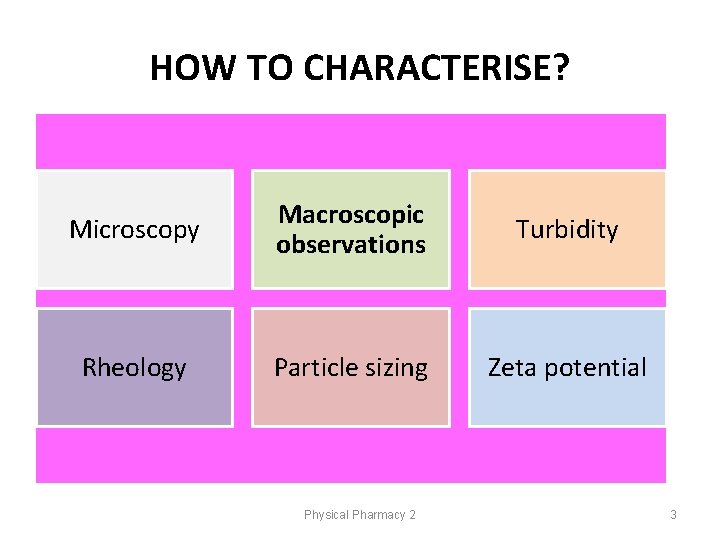
HOW TO CHARACTERISE? Microscopy Macroscopic observations Turbidity Rheology Particle sizing Zeta potential Physical Pharmacy 2 3
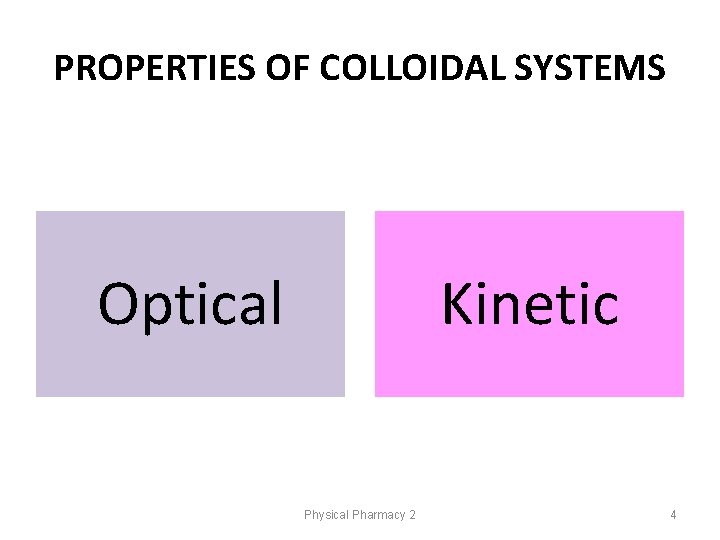
PROPERTIES OF COLLOIDAL SYSTEMS Optical Kinetic Physical Pharmacy 2 4
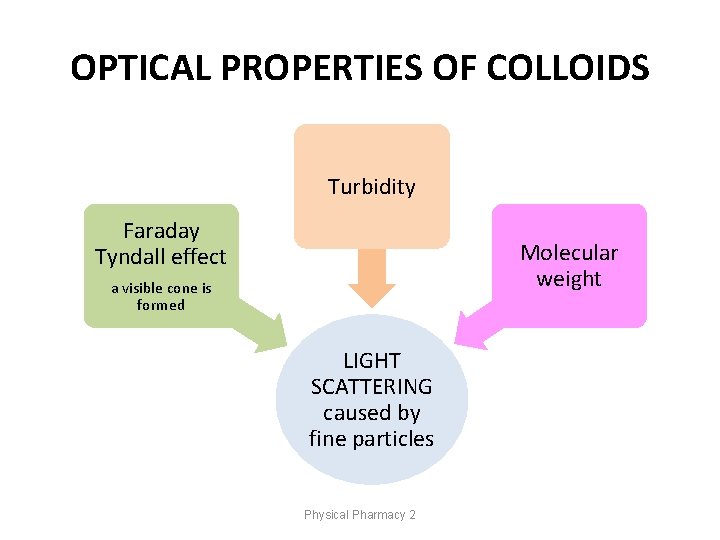
OPTICAL PROPERTIES OF COLLOIDS Turbidity Faraday Tyndall effect Molecular weight a visible cone is formed LIGHT SCATTERING caused by fine particles Physical Pharmacy 2
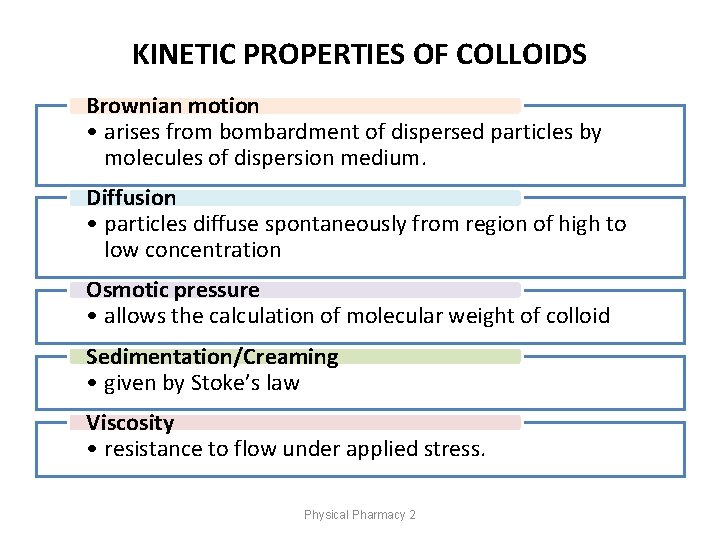
KINETIC PROPERTIES OF COLLOIDS Brownian motion • arises from bombardment of dispersed particles by molecules of dispersion medium. Diffusion • particles diffuse spontaneously from region of high to low concentration Osmotic pressure • allows the calculation of molecular weight of colloid Sedimentation/Creaming • given by Stoke’s law Viscosity • resistance to flow under applied stress. Physical Pharmacy 2
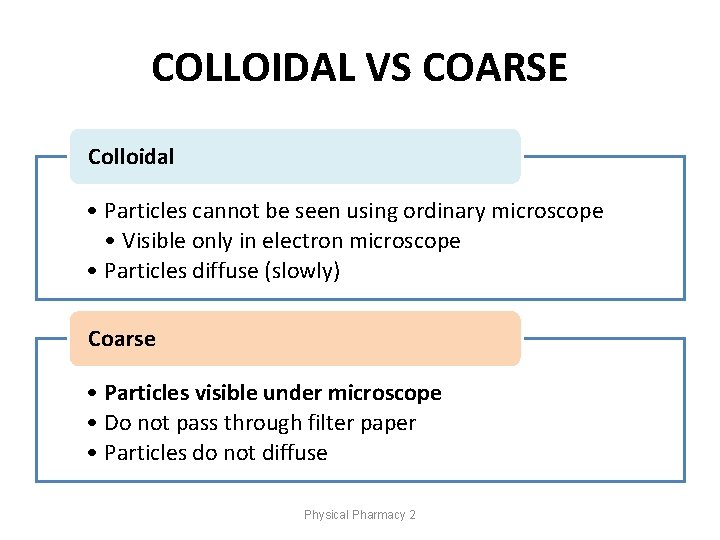
COLLOIDAL VS COARSE Colloidal • Particles cannot be seen using ordinary microscope • Visible only in electron microscope • Particles diffuse (slowly) Coarse • Particles visible under microscope • Do not pass through filter paper • Particles do not diffuse Physical Pharmacy 2
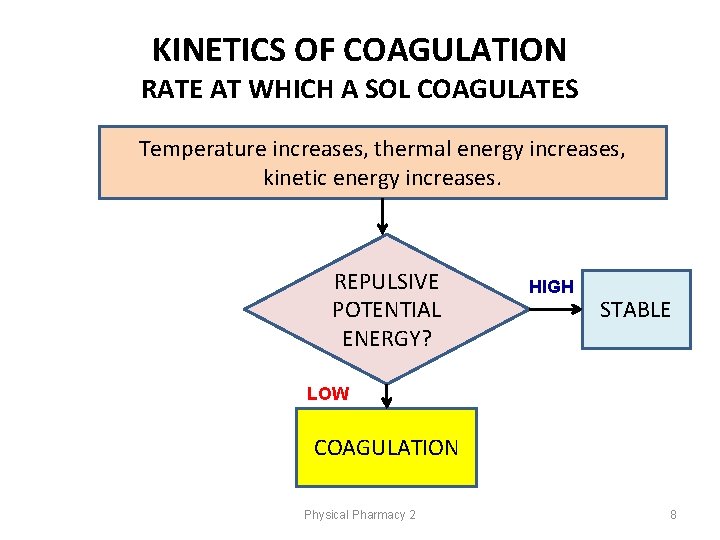
KINETICS OF COAGULATION RATE AT WHICH A SOL COAGULATES Temperature increases, thermal energy increases, kinetic energy increases. REPULSIVE POTENTIAL ENERGY? HIGH STABLE LOW COAGULATION Physical Pharmacy 2 8
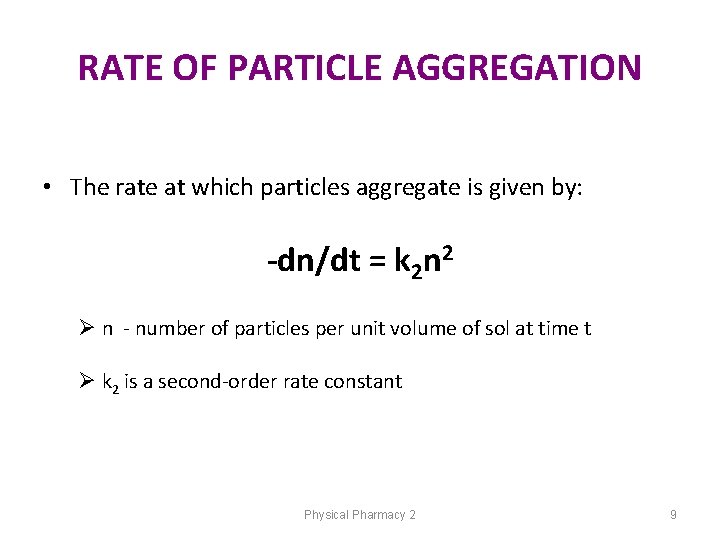
RATE OF PARTICLE AGGREGATION • The rate at which particles aggregate is given by: -dn/dt = k 2 n 2 Ø n - number of particles per unit volume of sol at time t Ø k 2 is a second-order rate constant Physical Pharmacy 2 9
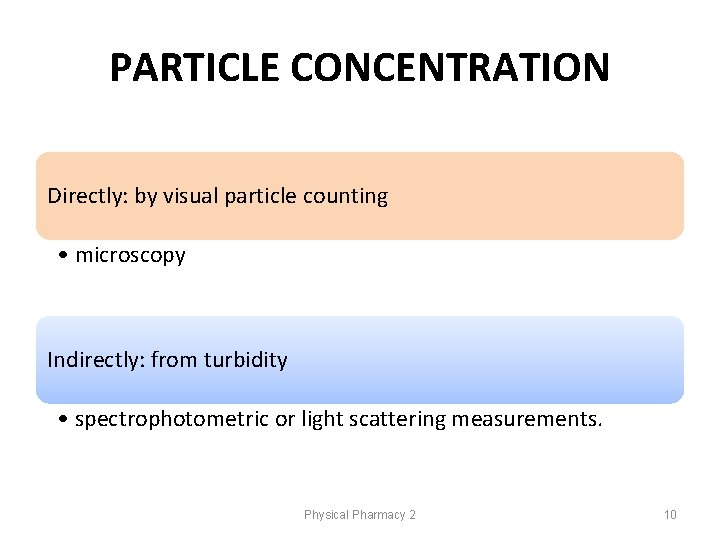
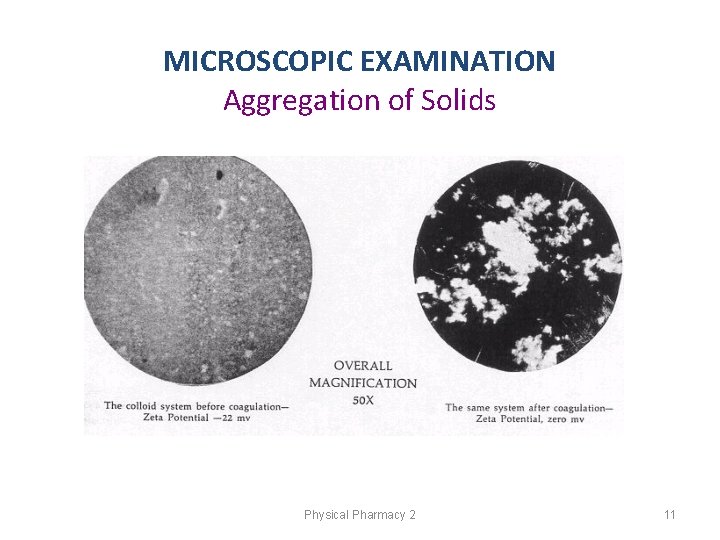
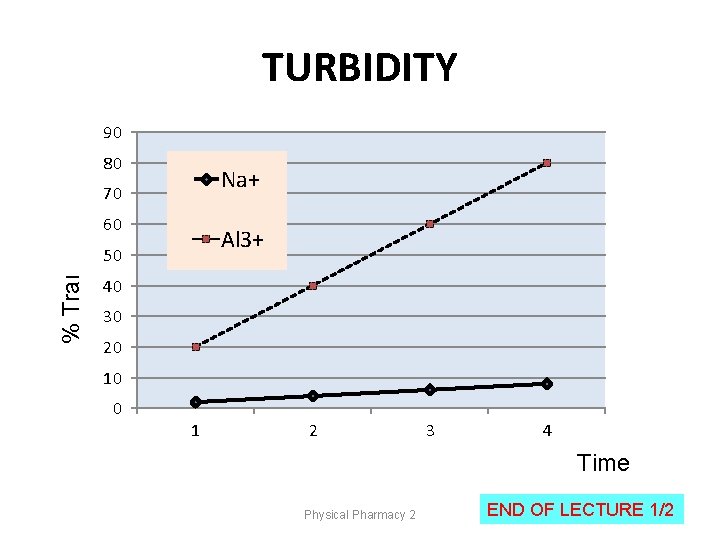
PARTICLE CONCENTRATION Directly: by visual particle counting • microscopy Indirectly: from turbidity • spectrophotometric or light scattering measurements. Physical Pharmacy 2 10
MICROSCOPIC EXAMINATION Aggregation of Solids Physical Pharmacy 2 11
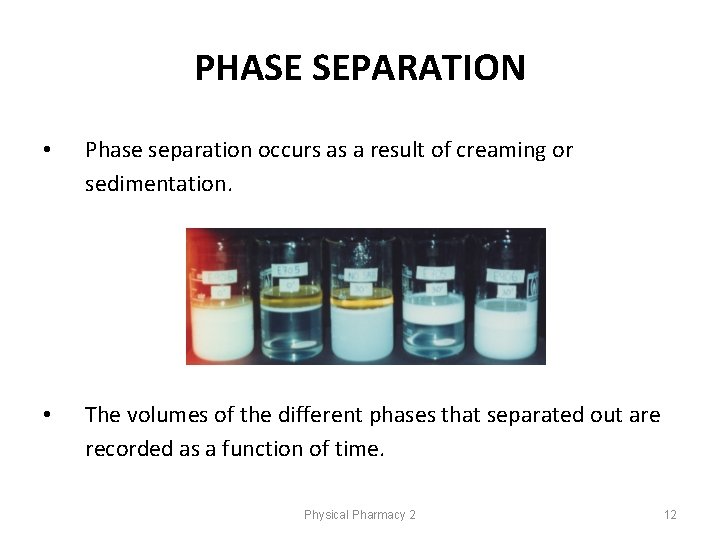
PHASE SEPARATION • Phase separation occurs as a result of creaming or sedimentation. • The volumes of the different phases that separated out are recorded as a function of time. Physical Pharmacy 2 12
Phase separation of emulsions in 100 ml measuring cylinder. Oil emulsions with different emulsifiers at 10% concentration; emulsified at 6000 rpm for 30 min. at 30 C. Physical Pharmacy 2 13
TURBIDITY % Transmittance 90 80 Na+ 70 60 Al 3+ 50 40 30 20 10 0 1 2 3 4 Time Physical Pharmacy 2 END OF LECTURE 1/2 14
PARTICLE SIZE ANALYSIS Common method to determine overall stability of colloid The particle size distribution (PSD) of a colloid can be determined using: • Microscope • Coulter counter • Instrument based on laser diffraction technique • Instrument based on photon correlation spectroscopy For monitoring stability the PSD is taken as a function of time Physical Pharmacy 2 15
PARTICLE SIZE DISTRIBUTION Effect of Span® 20/Tween® 20 concentration on size and polydispersity of oil droplet Physical Pharmacy 2 16
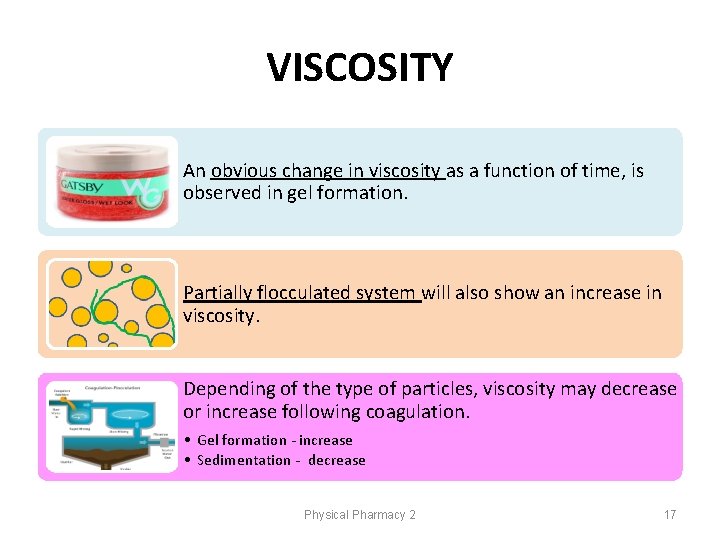
VISCOSITY An obvious change in viscosity as a function of time, is observed in gel formation. Partially flocculated system will also show an increase in viscosity. Depending of the type of particles, viscosity may decrease or increase following coagulation. • Gel formation - increase • Sedimentation - decrease Physical Pharmacy 2 17
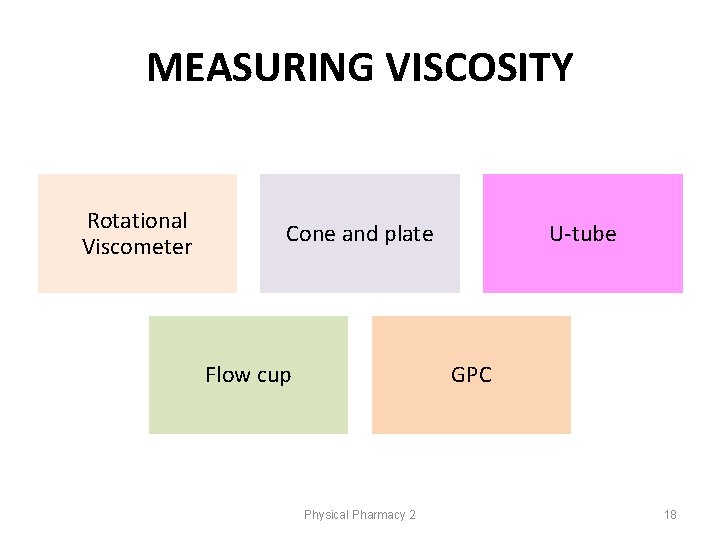
MEASURING VISCOSITY Rotational Viscometer Cone and plate Flow cup U-tube GPC Physical Pharmacy 2 18
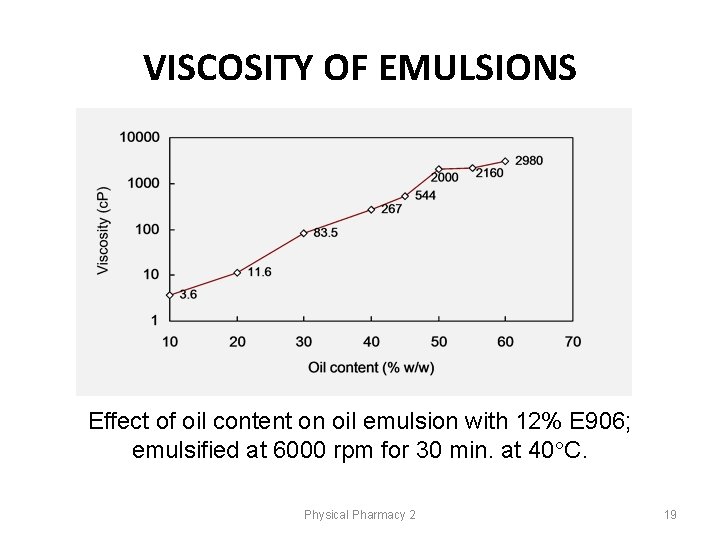
VISCOSITY OF EMULSIONS Effect of oil content on oil emulsion with 12% E 906; emulsified at 6000 rpm for 30 min. at 40 C. Physical Pharmacy 2 19
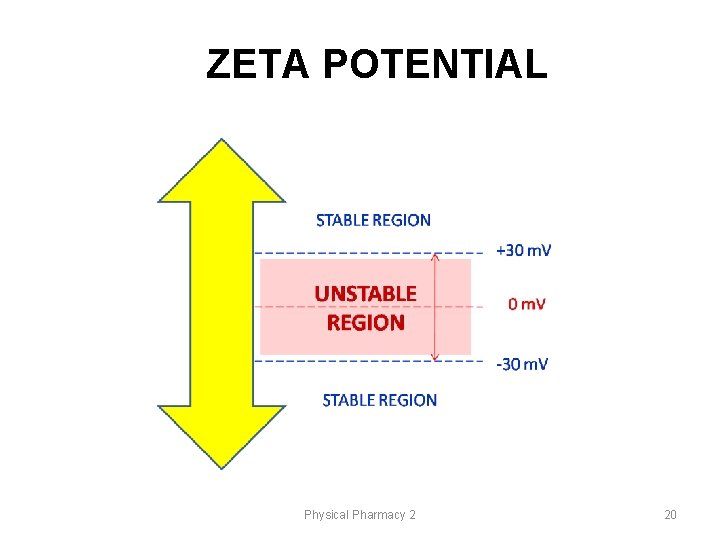
ZETA POTENTIAL Physical Pharmacy 2 20
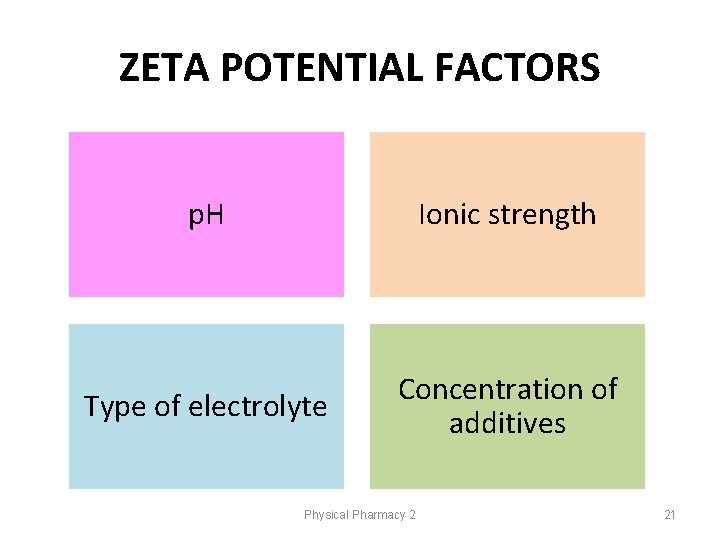
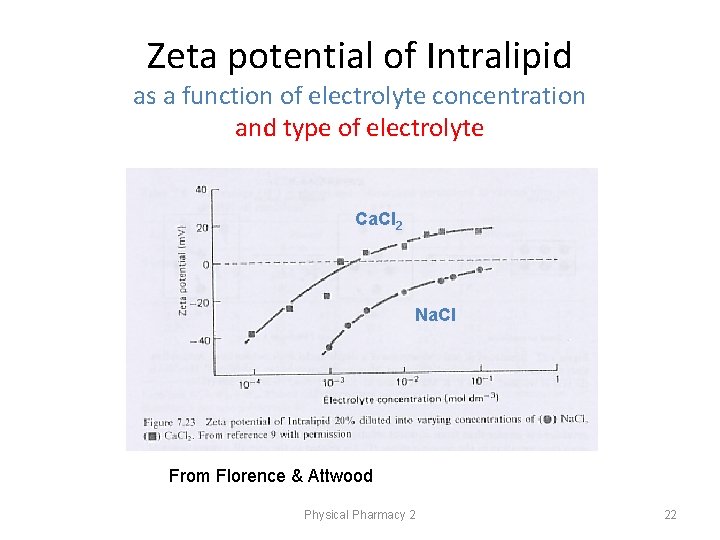
ZETA POTENTIAL FACTORS p. H Ionic strength Type of electrolyte Concentration of additives Physical Pharmacy 2 21
Zeta potential of Intralipid as a function of electrolyte concentration and type of electrolyte Ca. Cl 2 Na. Cl From Florence & Attwood Physical Pharmacy 2 22
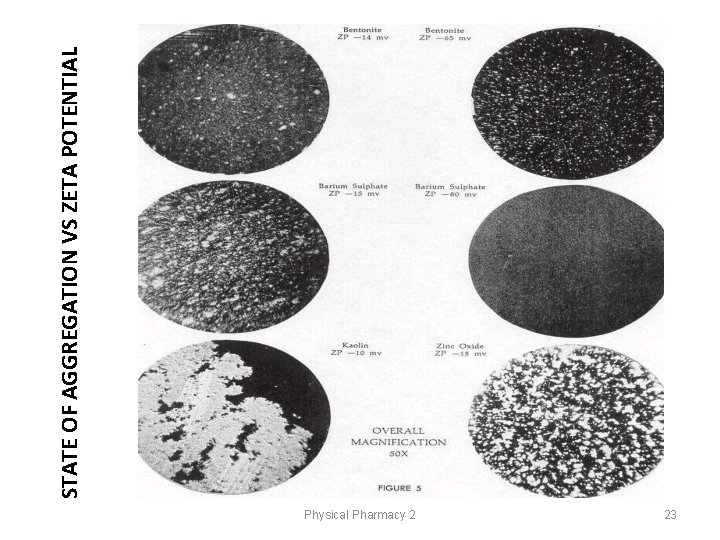
Physical Pharmacy 2 23 STATE OF AGGREGATION VS ZETA POTENTIAL
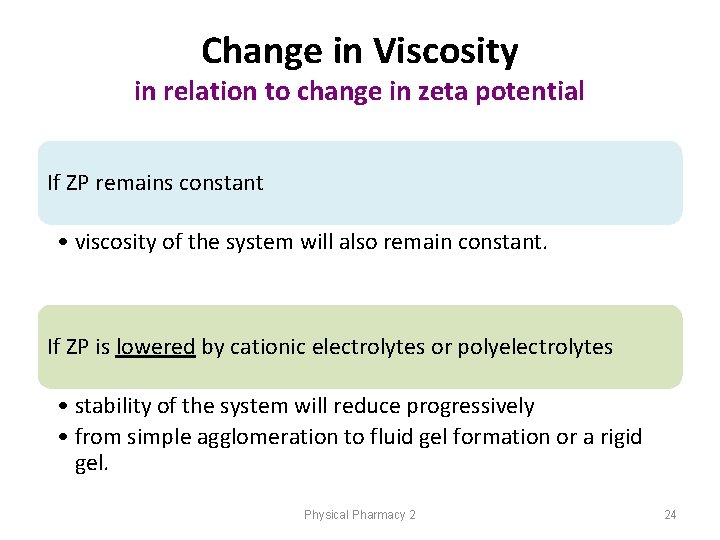
Change in Viscosity in relation to change in zeta potential If ZP remains constant • viscosity of the system will also remain constant. If ZP is lowered by cationic electrolytes or polyelectrolytes • stability of the system will reduce progressively • from simple agglomeration to fluid gel formation or a rigid gel. Physical Pharmacy 2 24
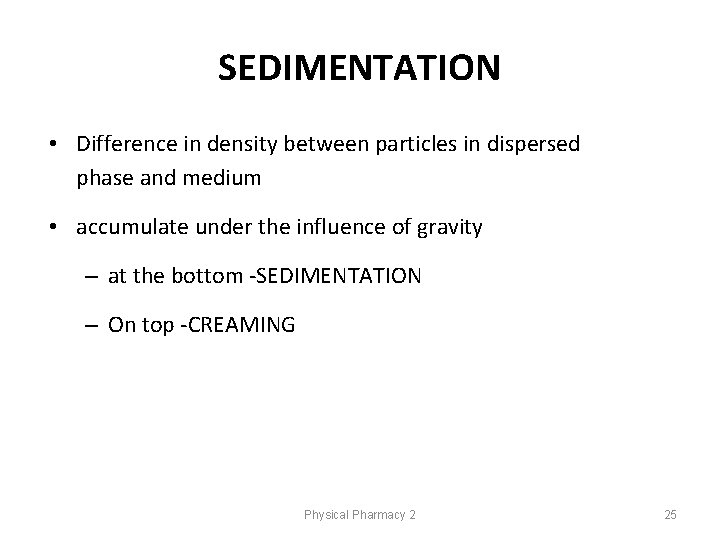
SEDIMENTATION • Difference in density between particles in dispersed phase and medium • accumulate under the influence of gravity – at the bottom -SEDIMENTATION – On top -CREAMING Physical Pharmacy 2 25
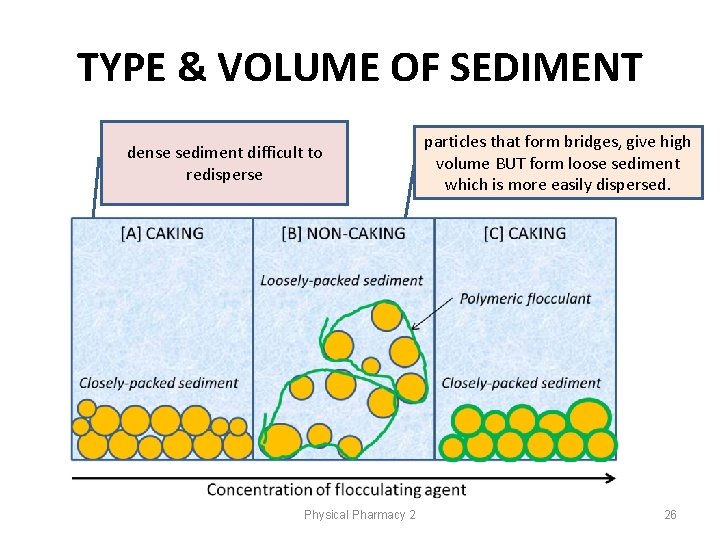
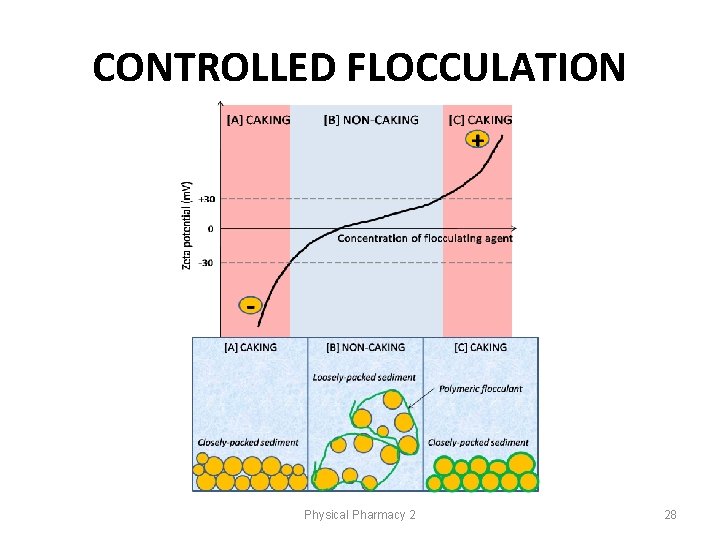
TYPE & VOLUME OF SEDIMENT dense sediment difficult to redisperse Physical Pharmacy 2 particles that form bridges, give high volume BUT form loose sediment which is more easily dispersed. 26
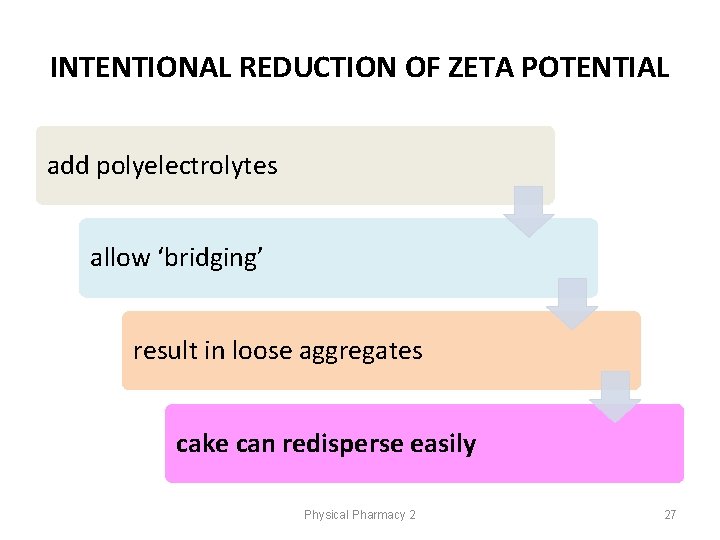
INTENTIONAL REDUCTION OF ZETA POTENTIAL add polyelectrolytes allow ‘bridging’ result in loose aggregates cake can redisperse easily Physical Pharmacy 2 27
CONTROLLED FLOCCULATION Physical Pharmacy 2 28
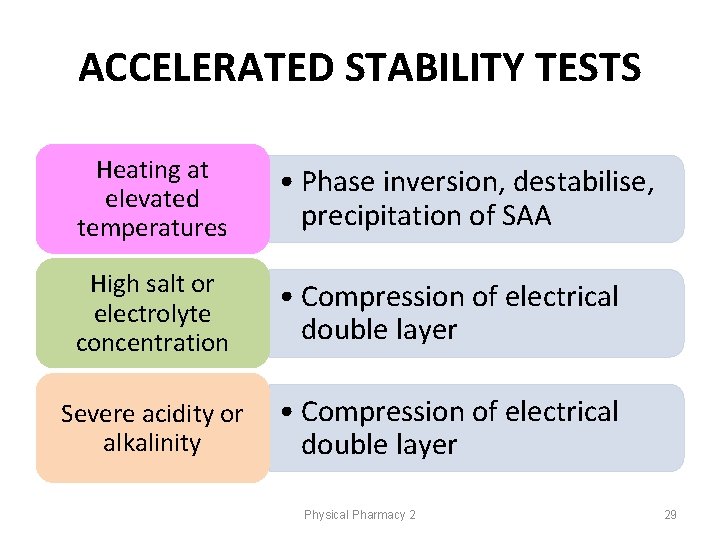
ACCELERATED STABILITY TESTS Heating at elevated temperatures • Phase inversion, destabilise, precipitation of SAA High salt or electrolyte concentration • Compression of electrical double layer Severe acidity or alkalinity • Compression of electrical double layer Physical Pharmacy 2 29
REFERENCES RJ Hunter, Foundations of Colloid Science Volume 2 Chapter 16, Clarendon Press Oxford (1989) Lab data The aggregation pix from internet but I have lost the link. I acknowledge the contribution of authors. Thank you. Physical Pharmacy 2 30