
CHARACTER TYPES ELA Unit 1 Foundations OBJECTIVES To

CHARACTER TYPES ELA Unit 1 Foundations

OBJECTIVES: To identify literary characters as major, minor, dynamic, round, or flat To identify the point of view used by a narrator To mark text and analyze reading passages for character and point of view
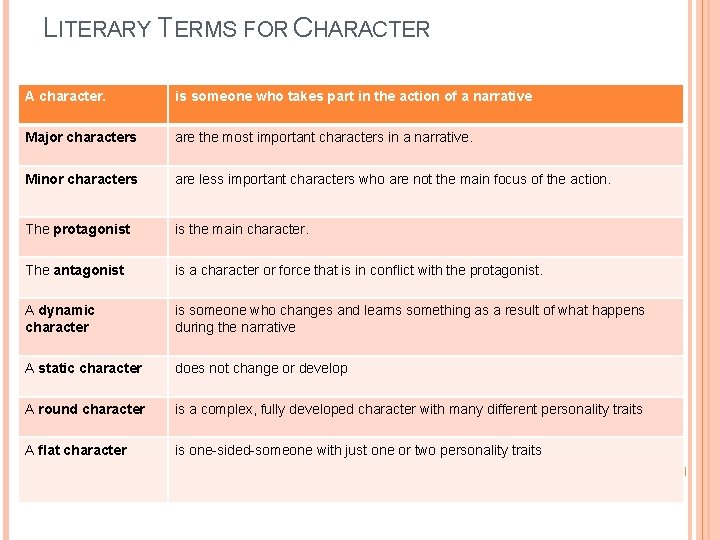
LITERARY TERMS FOR CHARACTER A character. is someone who takes part in the action of a narrative Major characters are the most important characters in a narrative. Minor characters are less important characters who are not the main focus of the action. The protagonist is the main character. The antagonist is a character or force that is in conflict with the protagonist. A dynamic character is someone who changes and learns something as a result of what happens during the narrative A static character does not change or develop A round character is a complex, fully developed character with many different personality traits A flat character is one-sided-someone with just one or two personality traits

PROTAGONIS T VS ANTAGONIST CHARACTERS

PROTAGONIST/ANTAGONIST It is easiest to think of the protagonist and antagonist characters as the "good guy" and the "bad guy" respectively.

HERO AND VILLAIN In order to understand protagonist and antagonist, you can think of the protagonist as the hero and the antagonist as the villain.

HOW TO REMEMBER Pro Ant The prefix pro means good, or positive. prefix ant means bad, or negative.

PROTAGONIST Central character of story Can be male or female Written as being "good" most of the time, but in some instances can be "bad. " Story usually told from protagonists point of view.

ANOTHER EXAMPLE? Think of other characters that are PROTAGONIST characters.

ANTAGONIST Causes or leads the conflict against the protagonist Not always human, but can be a group or force as well. Mirrors protagonist Whatever the protagonist does that is good, the antagonist will work to undo. Usually the antagonist attempts to disguise him/her/itself.

EXAMPLE Consider the story The Three Little Pigs. In the original story, the three pigs are the protagonists and the wolf is the antagonist. A new book titled The Real Story of The Three Little Pigs is written in the wolf's point of view and he becomes the protagonist and the pigs are the antagonists.

ANOTHER EXAMPLE? Think of other characters that are ANTAGONISTS characters.

PROTAGONIST/ANTAGONIST Completely different and in most cases, complete opposites Can Just both be very complex because the protagonist is the central character in the story does not mean that he/she/it is any more complex than the antagonist.

HOW TO IDENTIFY Think about which character is central to the story. (protagonist) Think about which character (or what force) is acting against that central character (antagonist). Usually you can consider which character is good and which is bad. In most instances, the good character is the protagonist and the bad, or opposing character, is the antagonist.

SO…HOW ARE THESE 2 CHARACTER TYPES DIFFERENT? Summarize (in your own words) the DEFINING CHARACTERISTIC of each character type.

STATIC VS DYNAMIC CHARACTERS

DYNAMIC CHARACTER In a story, a DYNAMIC CHARACTER is someone who changes in an important and significant way. This internal change happens as a result of events in the plot. Ebenezer Scrooge, from Charles Dickens's A Christmas Carol, is a classic example. When we first meet him, he is mean, bitter, and greedy. Through his experiences with the three ghosts, he becomes generous, kind, & beloved.

ANOTHER EXAMPLE? Think of other examples of DYNAMIC characters.

STATIC CHARACTER character is someone whose personality does NOT change significantly throughout the events in the story's plot. Internally, this character is basically the same as he/she was at the story’s beginning. Disney, as usual, is a great source for an example. Cinderella remains friendly, honorable, and positive despite being orphaned, abused, and taken advantage of by her wicked stepmother and stepsisters. A static

ANOTHER EXAMPLE? Think of other characters that are STATIC characters.

SO…HOW ARE THESE 2 CHARACTER TYPES DIFFERENT? Summarize (in your own words) the DEFINING CHARACTERISTIC of each character type.

FLAT VS. ROUND CHARACTERS

FLAT CHARACTERS A character whose distinguishing moral qualities or personal traits are summed up in one or two traits. They are not complicated or deep characters. For example, Scar, from The Lion King, is very much a FLAT character. He is JUST PLAIN EVIL & MEAN! There is never any point during the movie where he could logically be described any other way. He’s not complicated at all; he’s easy to predict.

ANOTHER EXAMPLE? Think of another example of a FLAT character.

ROUND CHARACTERS A character whose distinguishing moral qualities or personal traits are complex and many-sided. These characters are complicated and can have both good and bad qualities. For example, Woody from Toy Story, is definitely a ROUND character. He’s an honest, loyal friend a concerned leader. However, he is not perfect. There are times where his flaws show through; he makes the wrong decisions, gets jealous, and is even selfish at times. He’s a complicated guy!

ANOTHER EXAMPLE? Think of another example of a ROUND character.

SO…HOW ARE THESE 2 CHARACTER TYPES DIFFERENT? Summarize (in your own words) the DEFINING CHARACTERISTIC of each character type.

TASK: Look at the picture Read the caption below the picture Answer the question embedding… 1. What literary terms from your notes could you use to describe what you know about The Strange Case of Dr. Jekyll and Mr. Hyde? Good to Know! A Strange Case of Dr. Jekyll and Mr. Hyde a book, by Robert Louis Stevenson, features a main character, Dr. Jekyll, who keeps changing into another personality-the violent Mr. Hyde. Written in 1886, it was an instant success, and has been adapted many times for the stage and screen. A “Jekyll and Hyde” has come to mean a person with wildly changeable behaviors.
- Slides: 28