
Character Revealing Human Nature Characters can be kind
Character Revealing Human Nature
Characters can be kind sneaky happy funny greedy sad impatient serious mean angry
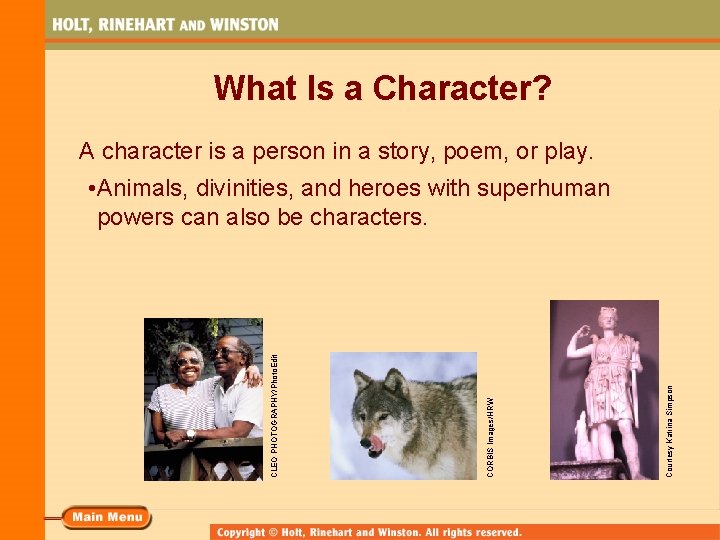
What Is a Character? A character is a person in a story, poem, or play. Courtesy Katrina Simpson CORBIS Images/HRW CLEO PHOTOGRAPHY/Photo. Edit • Animals, divinities, and heroes with superhuman powers can also be characters.
How Writers Reveal Character • Writers reveal a character’s personality through characterization. • Characterization may be direct or indirect.

Direct Characterization When writers use direct characterization, they tell readers directly what a character is like. Betsy was sharp-tongued. She had an opinion about everything and wasn’t afraid to speak her mind. She’d give advice to anyone and everyone whether they asked for it or not.
Indirect Characterization When writers use indirect characterization, readers have to use their own judgement to decide what a character is like, based on the evidence the writer gives us. It wasn’t a surprise when Betsy interrupted again. “That’s no way to catch the thief, ” she said rolling her eyes. “We can’t just wait until he robs another museum. We’ve got to be prepared. We’ve got to be there first. We need a piece of art he can’t resist. We need a trap!”

Understanding a Character When writers use indirect characterization, readers must decide what the character is like based on • the character’s speech • the character’s appearance • the character’s private thoughts • the responses of other characters • the character’s actions

Speech Pay attention to • the way the character speaks—tone of voice, dialect, volume • the words the character uses—slang, contractions, long, difficult words “Stop messing with the camera and take the picture already, why doncha. I don’t want to stand out here in the heat all day. I’ve got things to do, ” Aunt Ida hollered.
Appearance Pay attention to • the way the character looks • the kinds of clothes the character wears Jack checked his reflection in the window. His red hair was cut short with a bit of a spike in the front, and his pale skin was cleanshaven. His gray pinstriped trousers had wrinkled a bit during the train ride, but the creases in his pant legs were still sharp. As the train pulled into the station, he stood up, adjusted his tie, and re-tucked his starched blue shirt. Then, he draped his suit jacket over his arm, picked up his briefcase, and waited for a break in the stream of people exiting the train.
Private Thoughts Pay attention to • what the character thinks and feels about the events and other characters “Why did I ever agree to this? ” Gerald asked himself as he loaded his camping gear into the van. He could list a dozen other things that he needed to get done this weekend. “Gerald, ” Kevin said as he walked up beside him, “Glad you could make it, man. I know you’ve been busy with the new job and all. . . ” “Hey, no problem. I always have time for my friends, ” Gerald replied with a forced smile.
Response of Other Characters Pay attention to • what other characters think about the character • what other characters say about the character • how other characters act toward the character “Did you hear that Candace made the team? ” Ray asked. “Yeah, ” replied Bonnie, “I’m so happy for her. She was determined to make the cut this year—she and I practiced every weekend, and she worked really hard to improve her serve and backhand. She even beat me a few times. ”
Actions Pay attention to • what the character does • how the character does it (willingly, grudgingly, joyfully) Nina hummed to herself as she chopped up vegetables—celery, carrots, bell peppers—for the soup. She cheerfully carried the cutting board over to the stove and tilted it so all the vegetables slid into the stock pot. Then she turned, held the cutting board above her head with one hand, and shimmied over to the sink.
What Have You Learned? Determine whether each of the following statements is true or false. 1. Characters in stories, poems, and plays are always people. a. true b. false 2. When trying to determine what a character is like based on speech, you should pay attention to tone of voice. a. true b. false 3. When writers use direct characterization, they allow readers to interpret what a character is like. a. true b. false
The End
- Slides: 14