
Character Dr Jekyll Mr Hyde Knowledge Organiser Plot
- Slides: 1
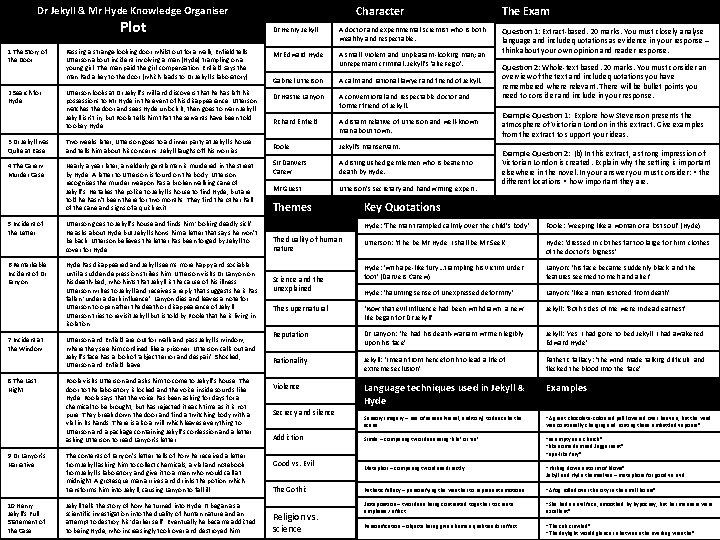
Character Dr Jekyll & Mr Hyde Knowledge Organiser Plot 1 The Story of the Door 2 Search for Hyde 3 Dr Jekyll was Quite at Ease 4 The Carew Murder Case 5 Incident of the Letter 6 Remarkable Incident of Dr Lanyon 7 Incident at the Window 8 The Last Night 9 Dr Lanyon’s Narrative 10 Henry Jekyll’s Full Statement of the Case Passing a strange-looking door whilst out for a walk, Enfield tells Utterson about incident involving a man (Hyde) trampling on a young girl. The man paid the girl compensation. Enfield says the man had a key to the door (which leads to Dr Jekyll’s laboratory) Utterson looks at Dr Jekyll’s will and discovers that he has left his possessions to Mr Hyde in the event of his disappearance. Utterson watches the door and sees Hyde unlock it, then goes to warn Jekyll isn’t in, but Poole tells him that the servants have been told to obey Hyde. Two weeks later, Utterson goes to a dinner party at Jekyll’s house and tells him about his concerns. Jekyll laughs off his worries. Nearly a year later, an elderly gentleman is murdered in the street by Hyde. A letter to Utterson is found on the body. Utterson recognises the murder weapon has a broken walking cane of Jekyll’s. He takes the police to Jekyll’s house to find Hyde, but are told he hasn’t been there for two months. They find the other half of the cane and signs of a quick exit. Utterson goes to Jekyll’s house and finds him ‘looking deadly sick’. He asks about Hyde but Jekyll shows him a letter that says he won’t be back. Utterson believes the letter has been forged by Jekyll to cover for Hyde has disappeared and Jekyll seems more happy and sociable until a sudden depression strikes him. Utterson visits Dr Lanyon on his death-bed, who hints that Jekyll is the cause of his illness. Utterson writes to Jekyll and receives a reply that suggests he is has fallen ‘under a dark influence’. Lanyon dies and leaves a note for Utterson to open after the death or disappearance of Jekyll. Utterson tries to revisit Jekyll but is told by Poole that he is living in isolation. Utterson and Enfield are out for walk and pass Jekyll’s window, where they see him confined like a prisoner. Utterson calls out and Jekyll’s face has a look of ‘abject terror and despair’. Shocked, Utterson and Enfield leave. Poole visits Utterson and asks him to come to Jekyll’s house. The door to the laboratory is locked and the voice inside sounds like Hyde. Poole says that the voice has been asking for days for a chemical to be brought, but has rejected it each time as it is not pure. They break down the door and find a twitching body with a vial in its hands. There is also a will which leaves everything to Utterson and a package containing Jekyll’s confession and a letter asking Utterson to read Lanyon’s letter. The contents of Lanyon’s letter tells of how he received a letter from Jekyll asking him to collect chemicals, a vial and notebook from Jekyll’s laboratory and give it to a man who would call at midnight. A grotesque man arrives and drinks the potion which transforms him into Jekyll, causing Lanyon to fall ill. Jekyll tells the story of how he turned into Hyde. It began as a scientific investigation into the duality of human nature and an attempt to destroy his ‘darker self’. Eventually he became addicted to being Hyde, who increasingly took over and destroyed him. Dr Henry Jekyll A doctor and experimental scientist who is both wealthy and respectable. Mr Edward Hyde A small, violent and unpleasant-looking man; an unrepentant criminal. Jekyll’s ‘alter-ego’. Gabriel Utterson A calm and rational lawyer and friend of Jekyll. Dr Hastie Lanyon A conventional and respectable doctor and former friend of Jekyll. Richard Enfield A distant relative of Utterson and well-known man about town. Poole Jekyll’s manservant. Sir Danvers Carew A distinguished gentlemen who is beaten to death by Hyde. Mr Guest Utterson’s secretary and handwriting expert. Themes The Exam Question 1: Extract-based. 20 marks. You must closely analyse language and include quotations as evidence in your response – think about your own opinion and reader response. Question 2: Whole-text based. 20 marks. You must consider an overview of the text and include quotations you have remembered where relevant. There will be bullet points you need to consider and include in your response. Example Question 1: Explore how Stevenson presents the atmosphere of Victorian London in this extract. Give examples from the extract to support your ideas. Example Question 2: (b) In this extract, a strong impression of Victorian London is created. Explain why the setting is important elsewhere in the novel. In your answer you must consider: • the different locations • how important they are. Key Quotations Hyde: ‘The man trampled calmly over the child’s body’ Poole: ‘weeping like a woman or a lost soul’ (Hyde) Utterson: ‘If he be Mr Hyde, I shall be Mr Seek’ Hyde: ‘dressed in clothes far too large for him, clothes of the doctor’s bigness’ Hyde: ‘with ape-like fury…trampling his victim under foot’ (Danvers Carew) Lanyon: ‘his face became suddenly black, and the features seemed to melt and alter’ Hyde: ‘haunting sense of unexpressed deformity’ Lanyon: ‘like a man restored from death’ The supernatural ‘Now that evil influence had been withdrawn, a new life began for Dr Jekyll’ Jekyll: ‘Both sides of me were in dead earnest’ Reputation Dr Lanyon: ‘he had his death-warrant written legibly upon his face’ Jekyll: ‘Yes, I had gone to bed Jekyll, I had awakened Edward Hyde’ Rationality Jekyll: ‘I mean from henceforth to lead a life of extreme seclusion’ Pathetic fallacy: ‘the wind made talking difficult, and flecked the blood into the face’ Violence Language techniques used in Jekyll & Hyde Examples Sensory imagery – use of senses (visual, auditory) to describe the scene “A great chocolate-coloured pall lowered over heaven, but the wind was continually charging and routing these embattled vapours” Simile – comparing two ideas using ‘like’ or ‘as’ “as empty as a church” “like some damned Juggernaut” “ape-like fury” Metaphor – comparing two ideas directly “Hailing down a storm of blows” Jekyll and Hyde themselves – metaphors for good vs. evil Pathetic fallacy – personifying the weather to represent emotions “A fog rolled over the city in the small hours” Juxtaposition – two ideas being contrasted together to create emphasis / effect “She had an evil face, smoothed by hypocrisy; but her manners were excellent” Personification – objects being given human qualities for effect “The cab crawled” “The daylight would glance in between the swirling wreaths” The duality of human nature Science and the unexplained Secrecy and silence Addiction Good vs. Evil The Gothic Religion vs. science