
Character Development The Goals of Character Design In

- Slides: 18
Character Development
The Goals of Character Design • In many genres, games structure gameplay around characters • Characters should be distinctive and credible • Good character design aims to create characters that are: o Compelling and believable o Easy for the player to identify with and care about o Competently constructed – well drawn or well described
The Relationship Between Player and Avatar • Varies considerably from game to game • Factors that influence the relationship include: o Whether the player designed the avatar himself, o If the player can see and hear the avatar, o How the player controls the avatar’s movements
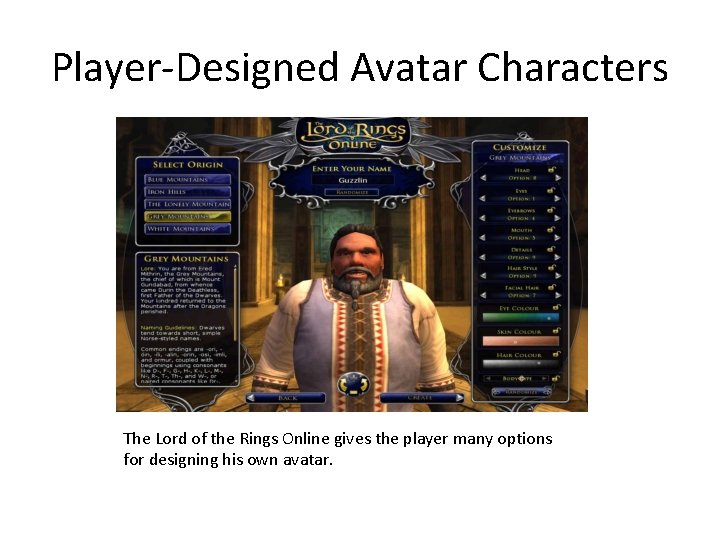
Player-Designed Avatar Characters • Some games give players considerable freedom to design an avatar to their own specifications • The player chooses the avatar’s physical attributes and other details that can directly affect the way the avatar performs • The player creates the avatar’s personality
Player-Designed Avatar Characters The Lord of the Rings Online gives the player many options for designing his own avatar.
Specific and Nonspecific Avatars • Nonspecific avatars o The avatar acts as an empty shell for the player to inhabit, so appearance and personality are left unspecified o Very limiting to the designer o Are completely controlled by the player, so they seem like visitors to the world • Specific avatars o Games with strong storylines use detailed characters with their own history and personality
The Effects of Different Control Mechanisms • Direct control o The player steers their avatar through the game world o The player sees the avatar as an extension of himself o The avatar is treated like a puppet or tool of the player
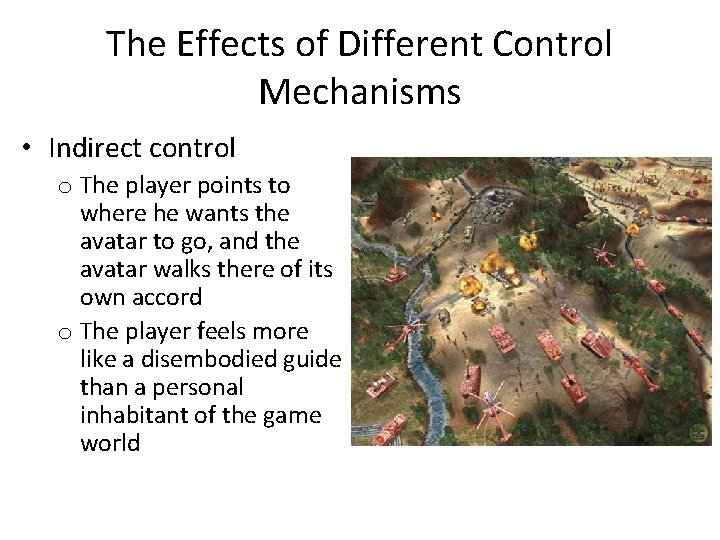
The Effects of Different Control Mechanisms • Indirect control o The player points to where he wants the avatar to go, and the avatar walks there of its own accord o The player feels more like a disembodied guide than a personal inhabitant of the game world
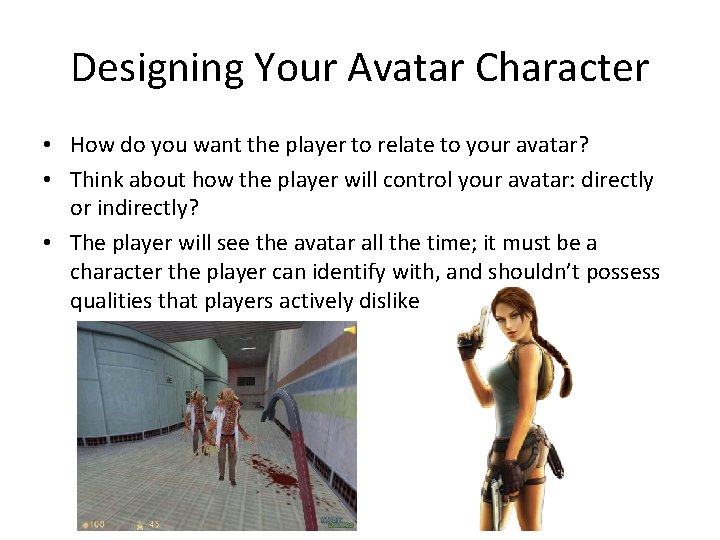
Designing Your Avatar Character • How do you want the player to relate to your avatar? • Think about how the player will control your avatar: directly or indirectly? • The player will see the avatar all the time; it must be a character the player can identify with, and shouldn’t possess qualities that players actively dislike
Designing Your Avatar Character • Select the characteristics that will achieve your goals for the player-avatar relationship o The more we know about the avatar, the more it becomes differentiated from us o With indirect control, the avatar is distinctly someone else, with a mind of their own o With direct control, the avatar is to some degree an extension of the player
Visual Appearances • Art-driven character design o Think about a character’s visual appearance first o Works well for simple characters who don’t change much during the course of the game • Story-driven character design o Works well for designing characters with complex personalities, and o Characters whose behaviour or appearance change during the course of the game
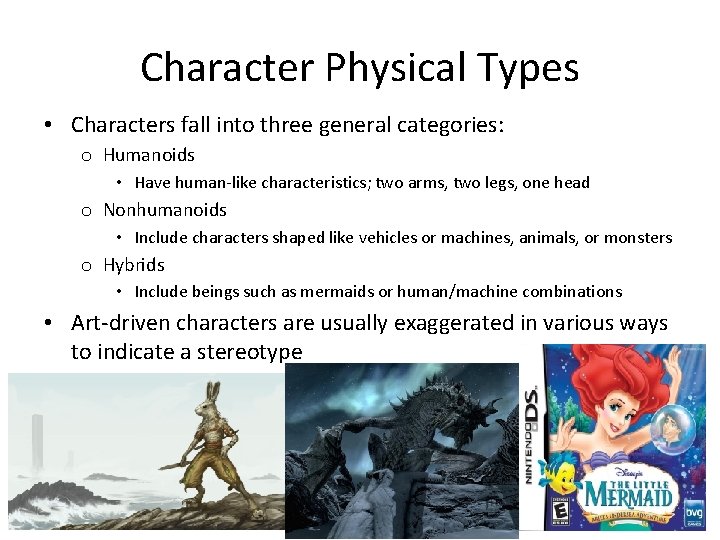
Character Physical Types • Characters fall into three general categories: o Humanoids • Have human-like characteristics; two arms, two legs, one head o Nonhumanoids • Include characters shaped like vehicles or machines, animals, or monsters o Hybrids • Include beings such as mermaids or human/machine combinations • Art-driven characters are usually exaggerated in various ways to indicate a stereotype
Character Physical Types • Four of the most common stereotypes are: o Cool characters • Never get too upset about anything • Often drawn as insouciant when standing still, but their game actions are usually fast and focused o Tough characters • Exemplify physical aggression – they are frequently drawn with exaggerated height and bulk • Animations are usually big and abrupt, fast moving, and aggressive
Character Physical Types • Four of the most common stereotypes are: o Cute characters • Have a general demeanor of cheerfulness, they usually look innocent and detached • Animations usually allow them to achieve things that they physically could not accomplish in the real world o Goofy characters • Are seldom upset by anything for long, have slightly odd proportions and funny looking walks and other movements
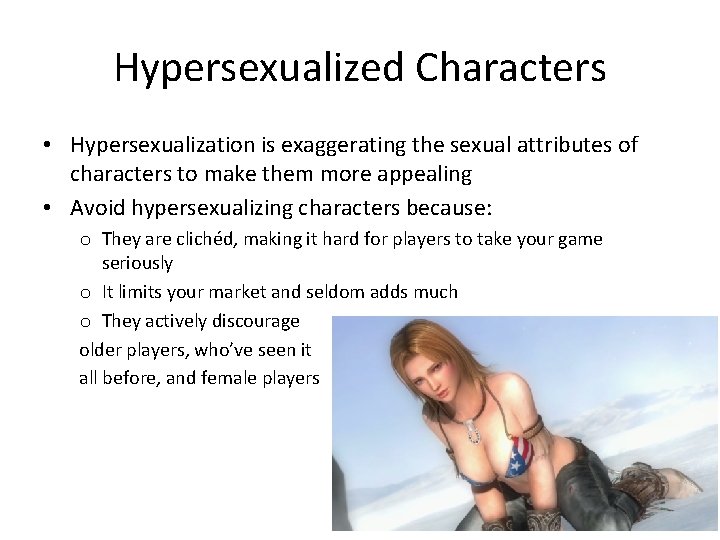
Hypersexualized Characters • Hypersexualization is exaggerating the sexual attributes of characters to make them more appealing • Avoid hypersexualizing characters because: o They are clichéd, making it hard for players to take your game seriously o It limits your market and seldom adds much o They actively discourage older players, who’ve seen it all before, and female players
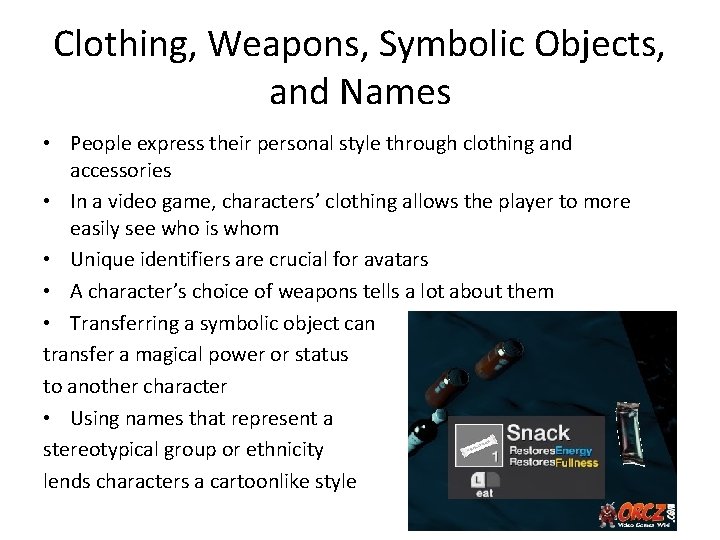
Clothing, Weapons, Symbolic Objects, and Names • People express their personal style through clothing and accessories • In a video game, characters’ clothing allows the player to more easily see who is whom • Unique identifiers are crucial for avatars • A character’s choice of weapons tells a lot about them • Transferring a symbolic object can transfer a magical power or status to another character • Using names that represent a stereotypical group or ethnicity lends characters a cartoonlike style
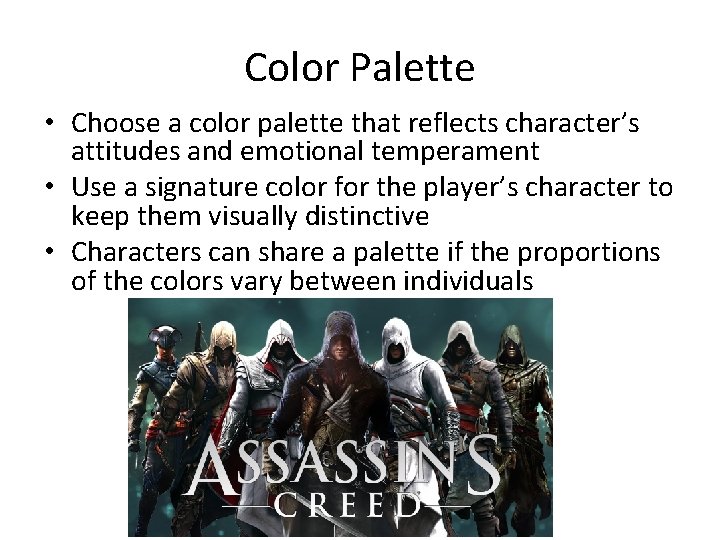
Color Palette • Choose a color palette that reflects character’s attitudes and emotional temperament • Use a signature color for the player’s character to keep them visually distinctive • Characters can share a palette if the proportions of the colors vary between individuals
Sidekicks • Allow you to give the player additional moves and other actions that would not be believable in a single character • Extend the emotional range of the game by showing the player a character with a different personality from the hero • They can give information that the player wouldn’t necessarily get any other way