
Character Development Creative Thinking and Writing Elements of

- Slides: 23
Character Development: Creative Thinking and Writing
Elements of fiction n. Plot n. Setting n. Character n. Point of View n. Theme
The plot “The series of events in the story, chronological or not, which serve to move the story from its beginning through its climax or turning point and to a resolution of its conflicts” (Schaefer 2010).
Elements of a plot n Foreshadowing: used as a way to create tension and rising conflict and to move the story closer to its eventual outcome. It gives hints about what may eventually occur or be decided. n Stream of Consciousness: The author provides the protagonist’s thoughts through interior monologues throughout the course of the story. These thoughts do not have to be sequential or linear, and they allow the reader to experience both externalaction and internal thoughts and feelings about the action in the story
SETTING PRACTICE Can you determine the setting: His wide-brimmed. Stetson pulled down to cast his face in a shadow, the sheriff rode slowly down the dusty main street. Sunlight sparkled on his silver spurs and on the handle of his rarely used revolver which hung causally by his right side. Stretching his long frame, he dismounted outside the saloon. The town clock began to chime twelve times in the distance. He took a long calming breath and pushed through the saloon doors.
OVERVIEW of character development … Characters are the most important component of any narrative. Without them, there would be no story. Character development is an important skill to master because characters are important parts of any creative writing from books and short stories, from biographies and autobiographies, to poetry.
Character development You should consider many factors when introducing a character to readers. All of the kinds of details mentioned below are necessary to fully develop a character because each of them reveals a different part of the characters appearance or personality and gives background about that characters traits. .
Character development n n n Physical Details about the character: Is he/she short, tall, thin, old, etc? Physical environment surrounding the character: Is he/she on a desert island, in an urban community, living in the mountains, etc? The other characters surrounding the character: What kinds of people does the character associate with?
Character development n The things that the character does: Does he/she go to school, fly an airplane, eat pizza every night for dinner, etc? n The things that the character says or thinks: These things reveal the character is feelings and opinions about things.
Characterization n Direct: author describes a character’s appearance, personality, or feelings. (A) Physical appearance and personality (B) Speech, behavior, and actions n Indirect: t he author will leave clues and expect you to draw conclusions about what the person or animal is like. (A)Thoughts and feelings (B)Interactions with other characters
Direct Characterization n Direct: author describes a character’s appearance, personality, or feelings. (A) Physical appearance and personality (B) Speech, behavior, and actions n Indirect: the author will leave clues and expect you to draw conclusions about what the person or animal is like. (A)Thoughts and feelings (B)Interactions with other characters
Types of characters n n n Protagonist: The central character on whom the story focuses and with whom we identify. A story could have more than one protagonist. Antagonists: The characters aligned against the central character. They can be internal or external. Flat characters: Extra characters whose purpose is to highlight what the protagonist is experiencing.
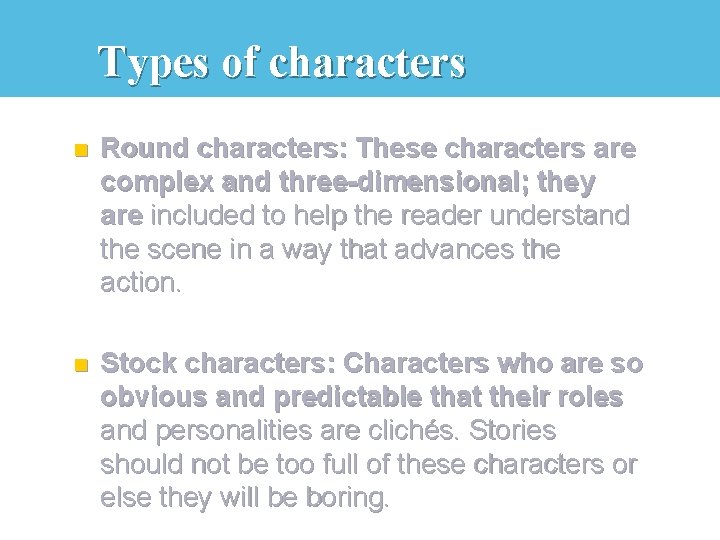
Types of characters n Round characters: These characters are complex and three-dimensional; they are included to help the reader understand the scene in a way that advances the action. n Stock characters: Characters who are so obvious and predictable that their roles and personalities are clichés. Stories should not be too full of these characters or else they will be boring.
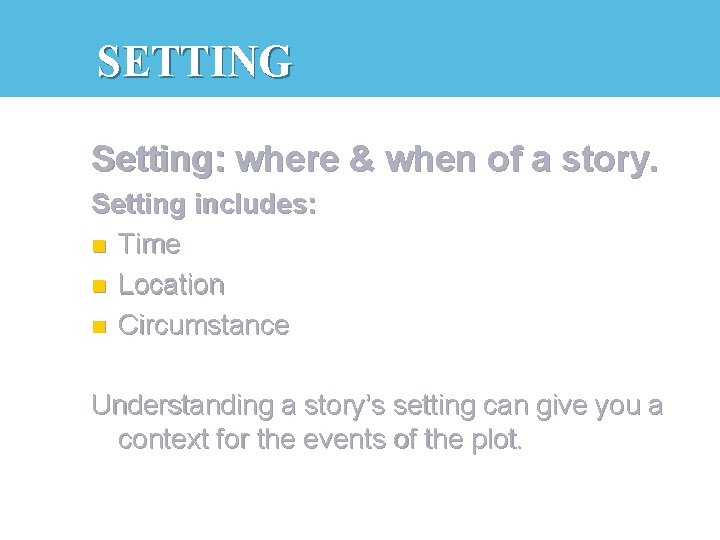
SETTING Setting: where & when of a story. Setting includes: n Time n Location n Circumstance Understanding a story’s setting can give you a context for the events of the plot.
SETTING PRACTICE Time (High Noon) n Location (the Wild West) n Circumstance (Sheriff entering a saloon) n PREDICT: What is going to happen?
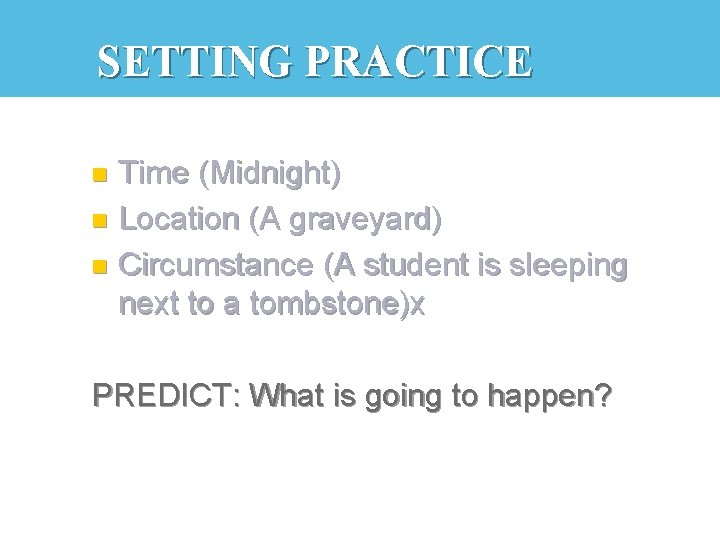
SETTING PRACTICE Time (Midnight) n Location (A graveyard) n Circumstance (A student is sleeping next to a tombstone)x n PREDICT: What is going to happen?
Events Most stories follow the same basic sequence of events, and as the character moves through these events he/she grows and develops.
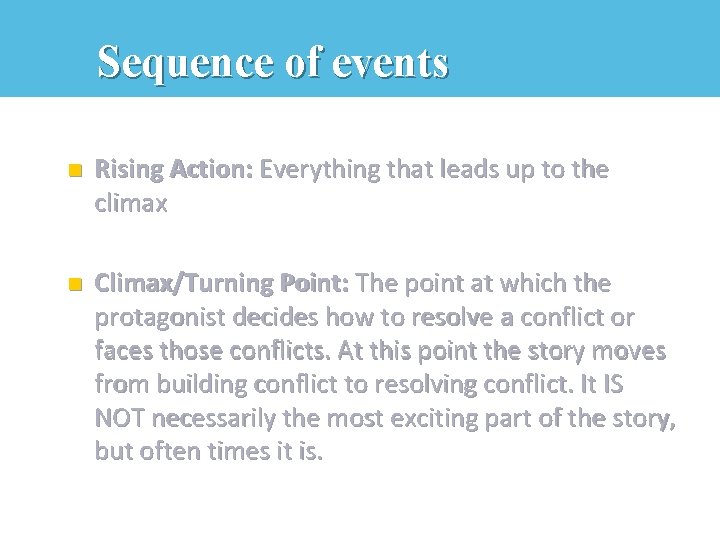
Sequence of events n Rising Action: Everything that leads up to the climax n Climax/Turning Point: The point at which the protagonist decides how to resolve a conflict or faces those conflicts. At this point the story moves from building conflict to resolving conflict. It IS NOT necessarily the most exciting part of the story, but often times it is.
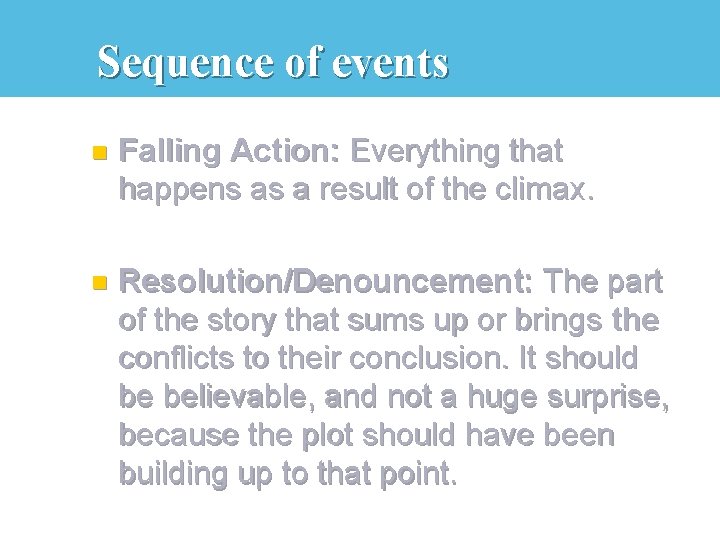
Sequence of events n Falling Action: Everything that happens as a result of the climax. n Resolution/Denouncement: The part of the story that sums up or brings the conflicts to their conclusion. It should be believable, and not a huge surprise, because the plot should have been building up to that point.
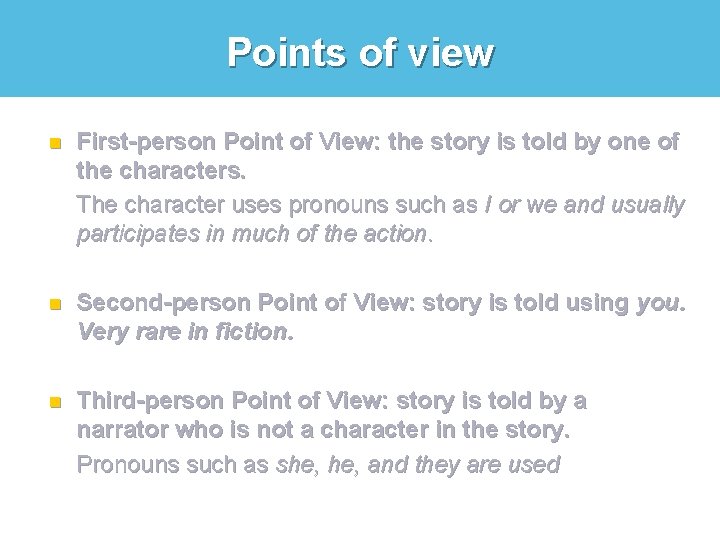
Points of view n First-person Point of View: the story is told by one of the characters. The character uses pronouns such as I or we and usually participates in much of the action. n Second-person Point of View: story is told using you. Very rare in fiction. n Third-person Point of View: story is told by a narrator who is not a character in the story. Pronouns such as she, and they are used
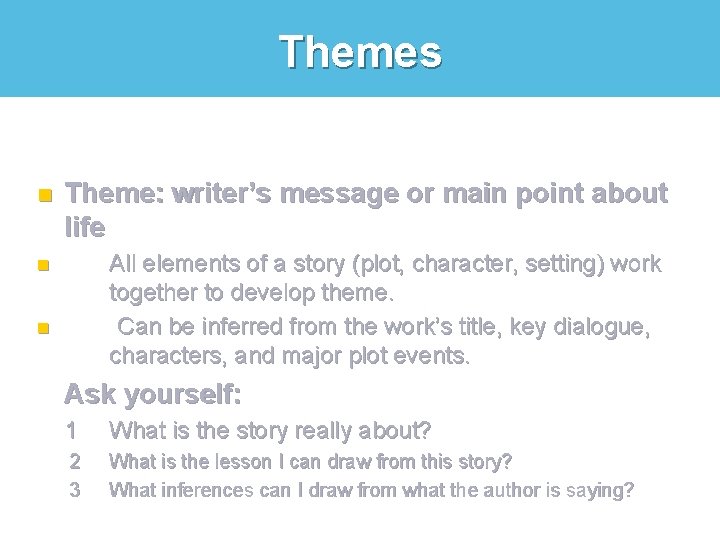
Themes n Theme: writer’s message or main point about life All elements of a story (plot, character, setting) work together to develop theme. Can be inferred from the work’s title, key dialogue, characters, and major plot events. n n Ask yourself: 1 What is the story really about? 2 3 What is the lesson I can draw from this story? What inferences can I draw from what the author is saying?
Summarization Have a Protagonist and an Antagonist n Use proper settings and plot lines n Utilize proper grammar and language skills n Demonstrate your knowledge of characters, use of setting, and plot n Be able to back up your character choice if requested n
CRITIQUE THIS SHORT FILM Look at the elements that make up this film. 1. Setting 2. Plot 3. Characters 4. Conflict 5. Theme