
Character Development By Naomi Rawlings Who is your

Character Development By Naomi Rawlings
Who is your main character? What traits does he/she have? Male or female? Height, weight, hair color Background Current job Anything that will show up on a police scanner when an officer runs your driver’s license Special skills that may need to be used later in the story (these skills will usually correspond to the characters’ heroic qualities)
What is Character Development? How your character changes over the course of the story. Character development is NOT a list of things your character does… However, your characters actions and reactions CAN reveal the internal changes taking place. These changes give your characters a sense of depth and make them true-tolife.
Changes Marlin Undergoes in Finding Nemo Starts the story afraid to leave the reef and distrustful of everyone Leaves the reef but is very scared Tentatively makes a friend (Dori) Saves Dori from the sharks (grows a little bold) Saves Dori from the jellyfish (grows bolder) Trust the turtles to take him to Sydney (learns to rely on others) Trusts a bird to not eat him and bring him up to the tower where Nemo is (becomes better at relying on others)
How Do Other Characters Change in Familiar Stories? How does Nemo change? How do Elizabeth and Darcy change in Pride and Prejudice? How does Elsa change in Frozen? Other Examples?
Notes about Character Changes Other characters besides your protagonist can change throughout the story. If antagonists change, it’s usually change for the worst (but sometimes they can change for the better or have a change-of-heart). If your main character doesn’t change at all, then you need to work harder at developing him/her and making the character more realistic.
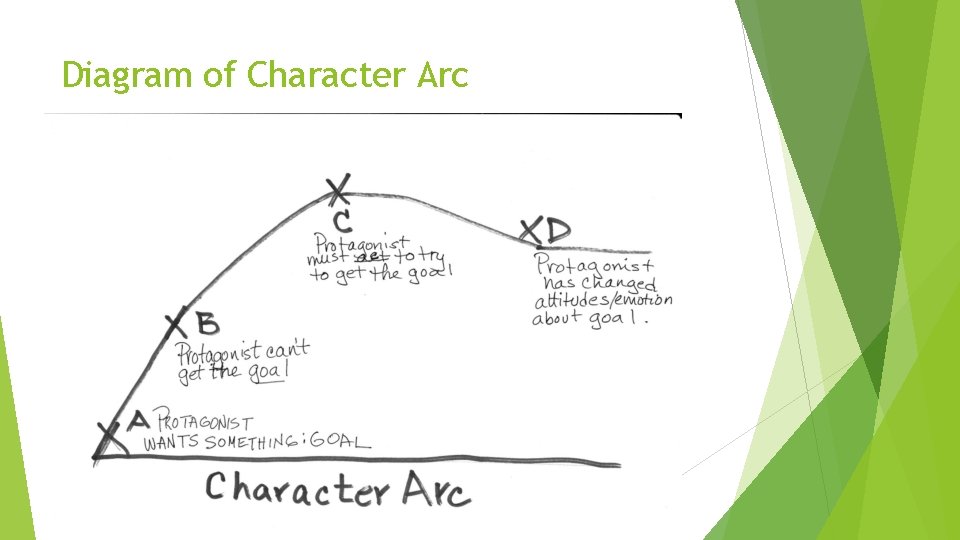
Diagram of Character Arc
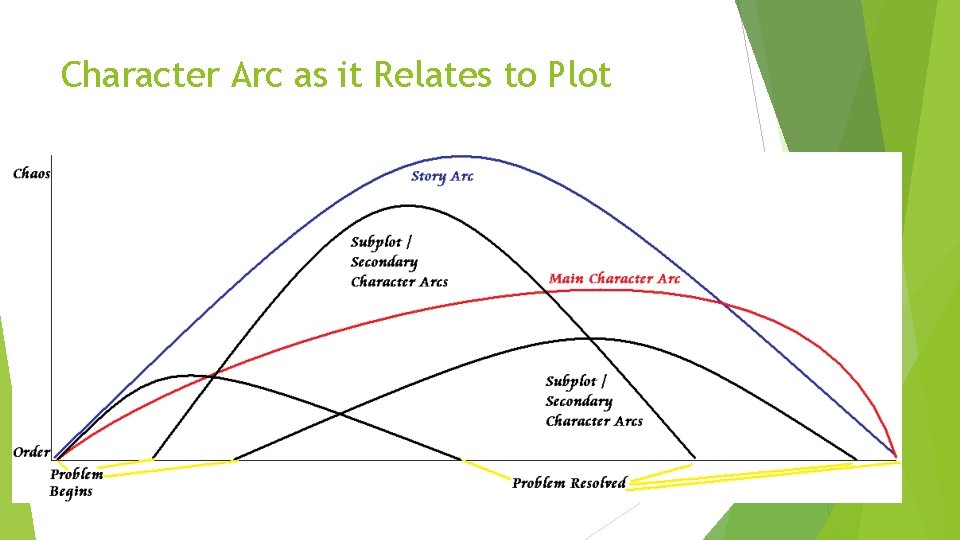
Character Arc as it Relates to Plot

Making Your Character Stand Out Heroic Qualities and Internal Conflict
Heroic Qualities Your main character needs to possess qualities that humanity looks up to and admires. Marlin from Finding Nemo is dedicated—he’s willing to cross an ocean and stop at nothing to save his son. Katniss Everdeen from The Hunger Games is sacrificial—she’s willing to take her sister’s place in the Hunger Games. Your character might also need a special skill to help them through the story. Katniss starts The Hunger Games as a skilled archer. Giving your characters heroic qualities will make readers care about what happens to them. Giving your characters heroic qualities will make readers care whether they succeed in achieving their story goal.
Internal Conflict Internal conflict can be summed up as the inner turmoil that’s going on inside the character’s head and heart. Books are always much better at conveying internal conflict than movies because books can describe characters’ thoughts and feelings, while movies and plays can only hint at them.
Two Simple Methods for Giving Characters Internal Conflict Have your character face inner demons and triggering situations. Give your character two mutually-exclusive goals. How can your character want two different things, even though he’ll never be able to have both of them? List 4 different steps that your character can take to achieve each of those goals, even though she knows she’ll never be able to have both of them.
Examples of Inner Conflict Marlin in Finding Nemo is afraid to leave the reef because he lost his wife and other children to a predatory fish (Inner Demon). He wants to stay safe himself, but he wants to save Nemo (Mutually Exclusive Goals). Katniss is loyal and wants to save the people she cares about (Prim, Peeta, even Rue), but she also wants to survive The Hunger Games and return home (Mutually Exclusive Goals). One of the biggest questions in The Hunger Games is how she can return home alive without killing Peeta.
Internal Conflict can Correspond with the Genre You’re Writing Romance novels often pit the protagonist’s story goal against the protagonists growing romantic feelings for another character. Thrillers often pit the protagonists desire to stay alive against his desire to kill the bad guys and save others. (I love him, but if I move across the country to be with him, then I’ll have to give up the dream job I’ve spent the last 10 years working for. ) (I willingly walk into a terrorists’ den knowing I have little hope of surviving but at least I tried to stop the nuclear bomb. ) Always, always have your character face his/her biggest fears!
Characters and Dialogue can reveal a lot about your characters Setting “Well now, reckon ya’ might find what yer looking for down yonder. ” “Go down the road for about seven miles, then turn left across from the old white church. ” “Continue down this road for 7. 3 miles, then turn left onto Reed Street. ” Character’s Social Status and Background “Ma, come quick! You have to see this!” “Mother, there’s something in the stable that you might find of interest. ”
Characters and Dialogue Relationships What do they call their parents? Mother and father Ma and pa Mom and dad? What do they call their siblings and friends? Katherine Elizabeth Katherine Kat Sunshine
Dialogue, Emotions, and Thoughts When used alongside beats and descriptive phrases, the dialogue can also reveal characters emotions. “No…” she whispered past the sudden lump that had formed in her throat. “No, I don’t wish to see him. Please tell him I’m not home. ” “No!” the force of his voice echoed around the room, and a muscle pulsed at the side of his jaw. “I refuse to see him. Tell him if he returns, I’ll call the police. ” Dialogue can also revealing thoughts of non POV characters. Think of a police detective interviewing a suspect.
Quick Dialogue Tips Dialogue needs to be natural—sound like every day conversation Dialogue needs to advance the plot—it needs to have a point and fit into your story structure Don’t use dialogue as an information dump. Don’t have the main character go to Sunday dinner at moms and then have nothing happen that relates to the story. Less is usually more. Keep the words meaningful and to the point so that your readers don’t get overwhelmed with the dialogue.
Conclusion Giving fake people real thoughts and emotions isn’t easy. There are lots of facets that go into developing a well-rounded character that readers will remember after they finish the book. Remember to give your character both heroic qualities and internal conflict in order to make the protagonist stand out to the reader.
- Slides: 19