
Chapters 8 9 Differentiation Positioning Product Market Analysis

- Slides: 15
Chapters 8 & 9 Differentiation, Positioning & Product Market Analysis
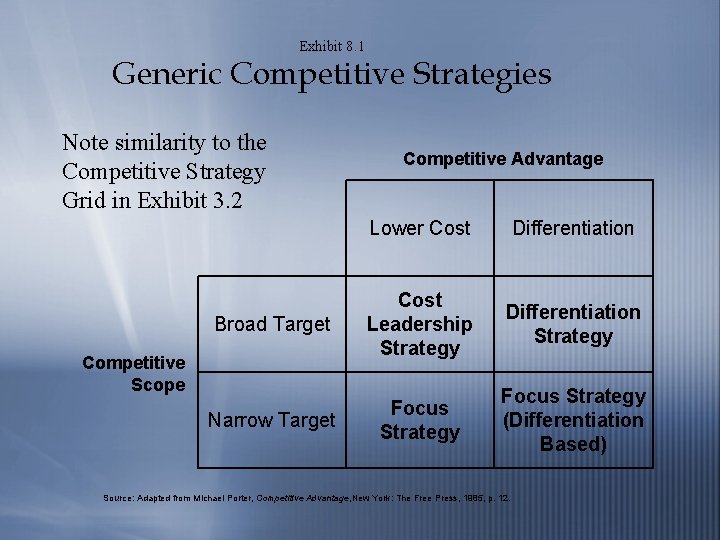
Exhibit 8. 1 Generic Competitive Strategies Note similarity to the Competitive Strategy Grid in Exhibit 3. 2 Competitive Advantage Lower Cost Differentiation Broad Target Cost Leadership Strategy Differentiation Strategy Narrow Target Focus Strategy (Differentiation Based) Competitive Scope Source: Adapted from Michael Porter, Competitive Advantage, New York: The Free Press, 1985, p. 12.
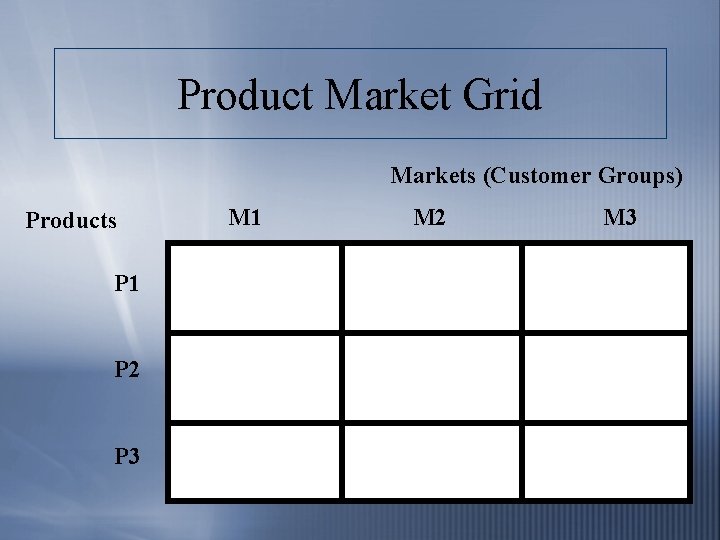
Product Market Grid Markets (Customer Groups) Products P 1 P 2 P 3 M 1 M 2 M 3
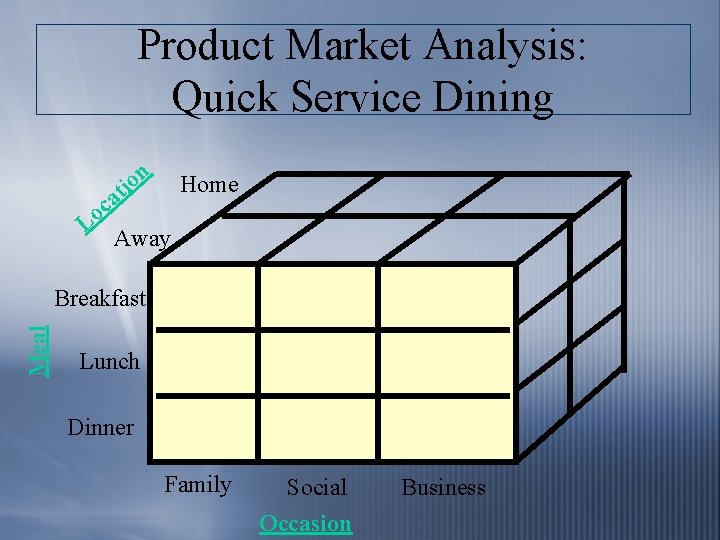
Product Market Analysis: Quick Service Dining n Home it o a c Lo Away Meal Breakfast Lunch Dinner Family Social Occasion Business
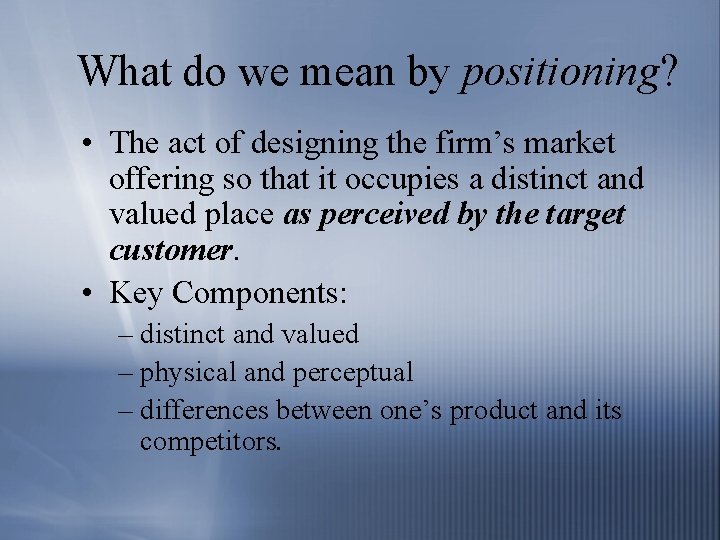
What do we mean by positioning? • The act of designing the firm’s market offering so that it occupies a distinct and valued place as perceived by the target customer. • Key Components: – distinct and valued – physical and perceptual – differences between one’s product and its competitors.
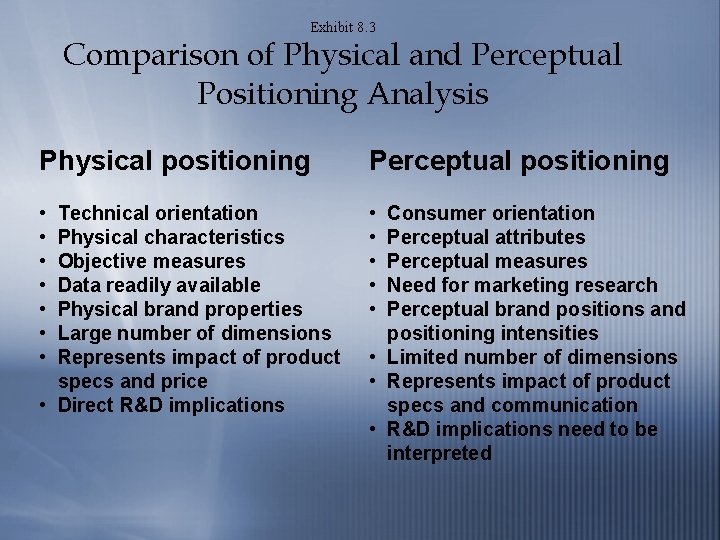
Exhibit 8. 3 Comparison of Physical and Perceptual Positioning Analysis Physical positioning Perceptual positioning • • • Technical orientation Physical characteristics Objective measures Data readily available Physical brand properties Large number of dimensions Represents impact of product specs and price • Direct R&D implications Consumer orientation Perceptual attributes Perceptual measures Need for marketing research Perceptual brand positions and positioning intensities • Limited number of dimensions • Represents impact of product specs and communication • R&D implications need to be interpreted
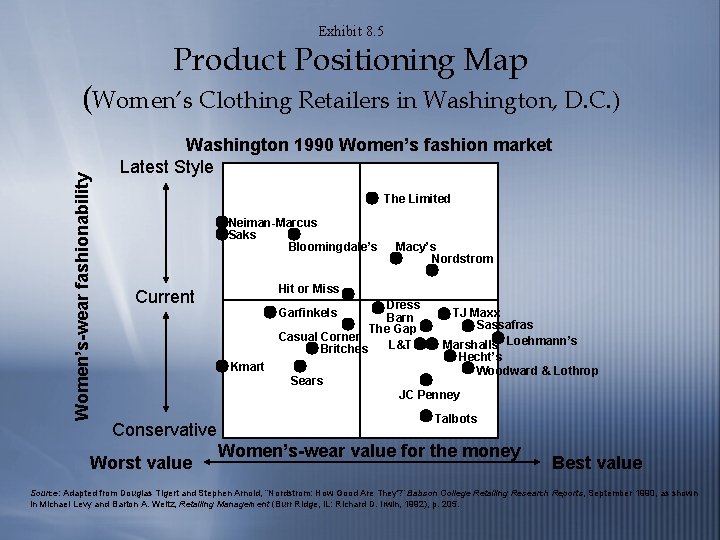
Exhibit 8. 5 Product Positioning Map Women’s-wear fashionability (Women’s Clothing Retailers in Washington, D. C. ) Washington 1990 Women’s fashion market Latest Style The Limited Neiman-Marcus Saks Bloomingdale’s Macy’s Nordstrom Hit or Miss Current Dress Barn The Gap Casual Corner L&T Britches Garfinkels Kmart Sears TJ Maxx Sassafras Marshalls Loehmann’s Hecht’s Woodward & Lothrop JC Penney Conservative Worst value Talbots Women’s-wear value for the money Best value Source: Adapted from Douglas Tigert and Stephen Arnold, “Nordstrom: How Good Are They? ” Babson College Retailing Research Reports, September 1990, as shown in Michael Levy and Barton A. Weitz, Retailing Management (Burr Ridge, IL: Richard D. Irwin, 1992), p. 205.
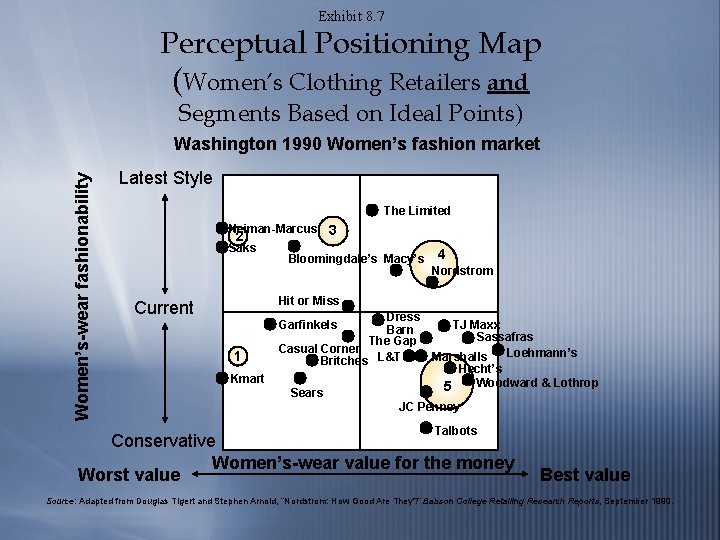
Exhibit 8. 7 Perceptual Positioning Map (Women’s Clothing Retailers and Segments Based on Ideal Points) Women’s-wear fashionability Washington 1990 Women’s fashion market Latest Style The Limited Neiman-Marcus 3 2 Saks Bloomingdale’s Macy’s 4 Nordstrom Hit or Miss Current Dress TJ Maxx Barn Sassafras The Gap Casual Corner Loehmann’s Marshalls Britches L&T Hecht’s Woodward & Lothrop 5 Sears JC Penney Garfinkels 1 Kmart Talbots Conservative Women’s-wear value for the money Worst value Best value Source: Adapted from Douglas Tigert and Stephen Arnold, “Nordstrom: How Good Are They? ” Babson College Retailing Research Reports, September 1990.
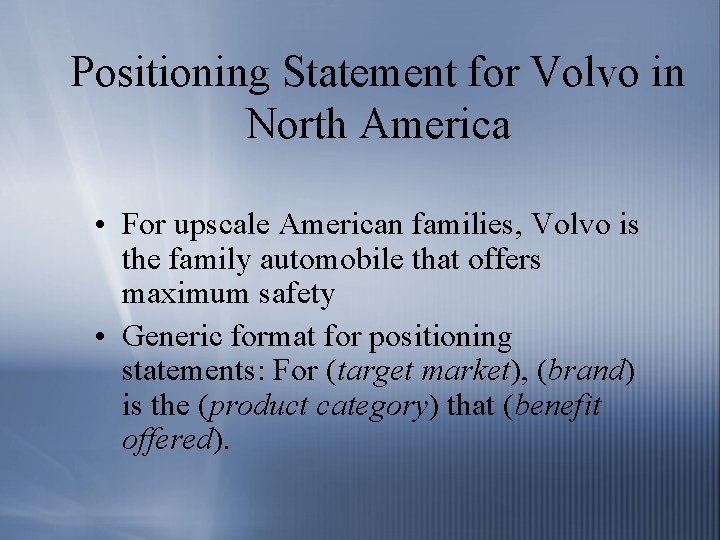
Positioning Statement for Volvo in North America • For upscale American families, Volvo is the family automobile that offers maximum safety • Generic format for positioning statements: For (target market), (brand) is the (product category) that (benefit offered).
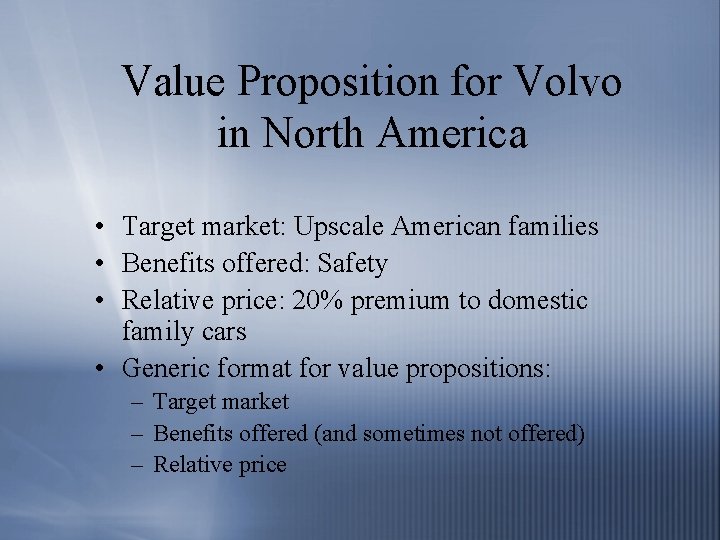
Value Proposition for Volvo in North America • Target market: Upscale American families • Benefits offered: Safety • Relative price: 20% premium to domestic family cars • Generic format for value propositions: – Target market – Benefits offered (and sometimes not offered) – Relative price
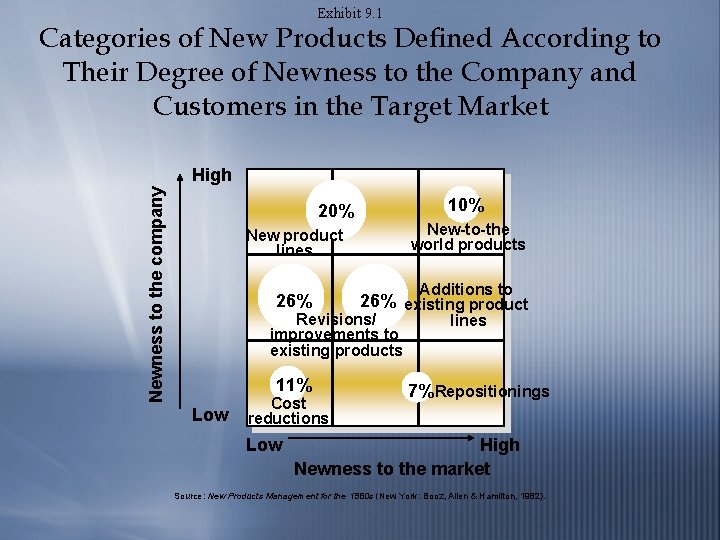
Exhibit 9. 1 Categories of New Products Defined According to Their Degree of Newness to the Company and Customers in the Target Market Newness to the company High 10% 20% New-to-the world products New product lines 26% Revisions/ improvements to existing products 11% Low Cost reductions Low Additions to 26% existing product lines 7% Repositionings High Newness to the market Source: New Products Management for the 1980 s (New York: Booz, Allen & Hamilton, 1982).
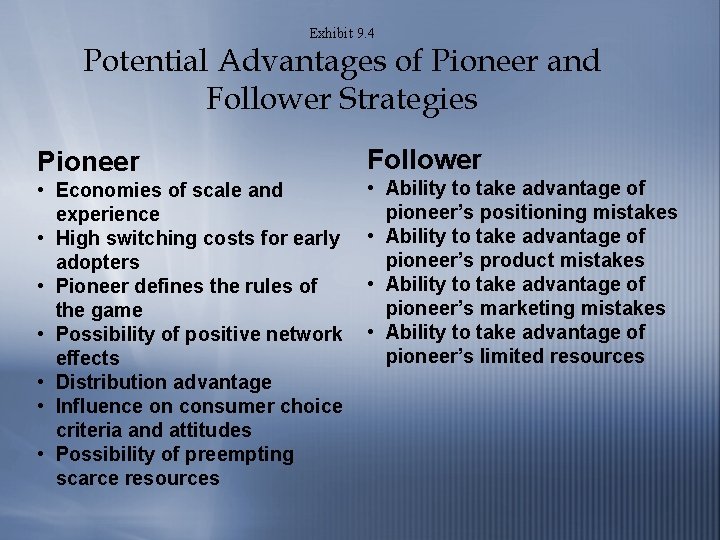
Exhibit 9. 4 Potential Advantages of Pioneer and Follower Strategies Pioneer • Economies of scale and experience • High switching costs for early adopters • Pioneer defines the rules of the game • Possibility of positive network effects • Distribution advantage • Influence on consumer choice criteria and attitudes • Possibility of preempting scarce resources Follower • Ability to take advantage of pioneer’s positioning mistakes • Ability to take advantage of pioneer’s product mistakes • Ability to take advantage of pioneer’s marketing mistakes • Ability to take advantage of pioneer’s limited resources
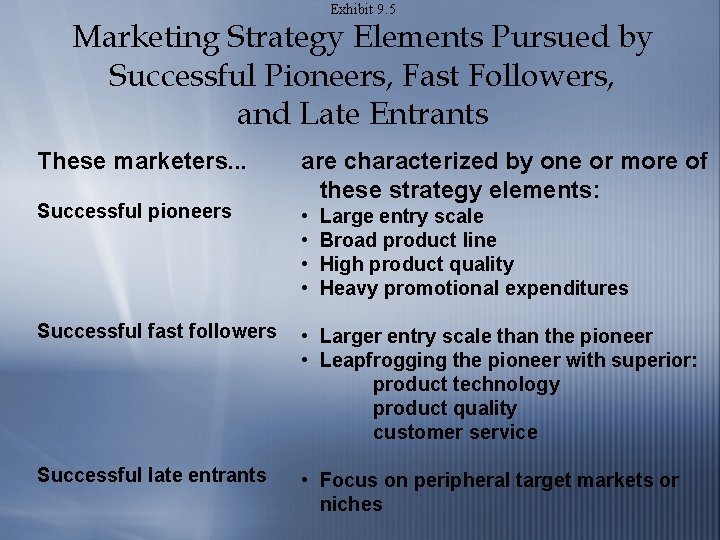
Exhibit 9. 5 Marketing Strategy Elements Pursued by Successful Pioneers, Fast Followers, and Late Entrants These marketers. . . Successful pioneers are characterized by one or more of these strategy elements: • • Large entry scale Broad product line High product quality Heavy promotional expenditures Successful fast followers • Larger entry scale than the pioneer • Leapfrogging the pioneer with superior: product technology product quality customer service Successful late entrants • Focus on peripheral target markets or niches
Advice for Would-Be Pioneers • First mover advantage is often trumped by followers who are better. – Best beats first. Concentrate on being best. – Best and first is the ideal. • Being a pioneer without the basis for sustainable competitive advantage is a trap!
New Product Development Key success criteria include: – Product fit with market need – Product fit with capabilities – Product or cost superiority – Cross-functional team approach – Clear vision of future market based on customer feedback – Continuous, quality-based process