
Chapters 4 5 Behavioral Testing Perry C Hanavan
Chapters 4 & 5 Behavioral Testing Perry C. Hanavan, Au. D. Audiologist
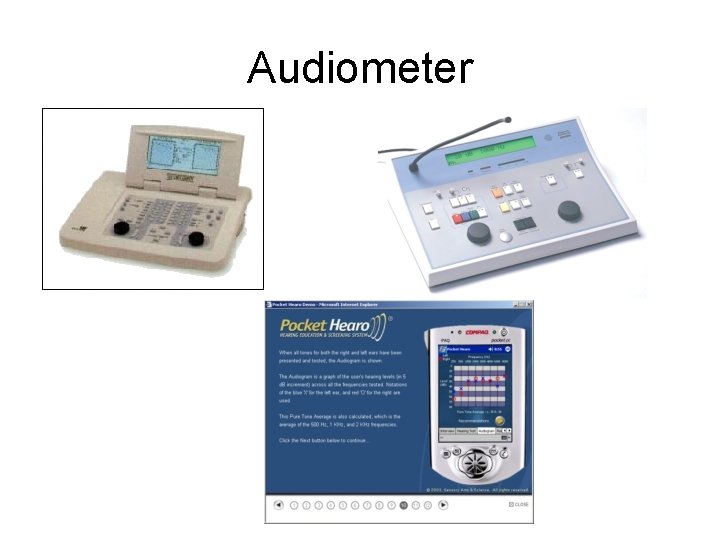
Audiometer
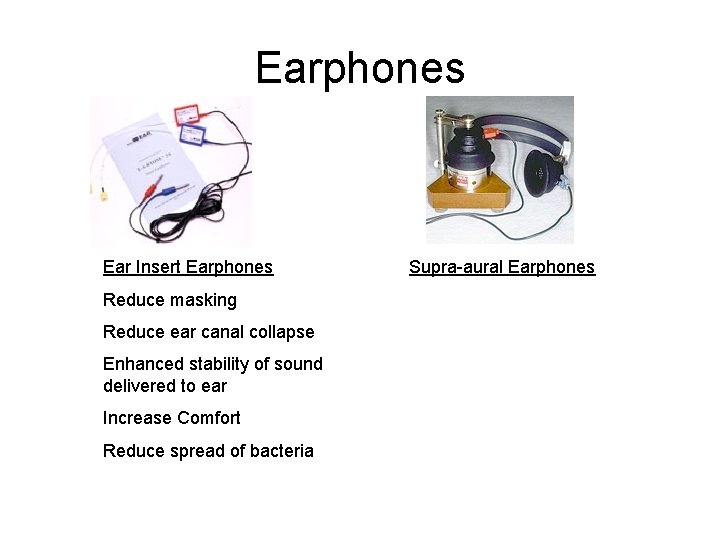
Earphones Ear Insert Earphones Reduce masking Reduce ear canal collapse Enhanced stability of sound delivered to ear Increase Comfort Reduce spread of bacteria Supra-aural Earphones
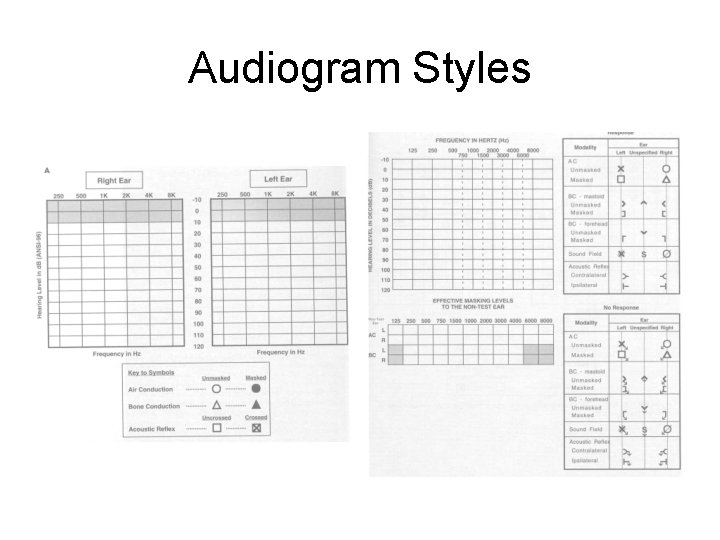
Audiogram Styles
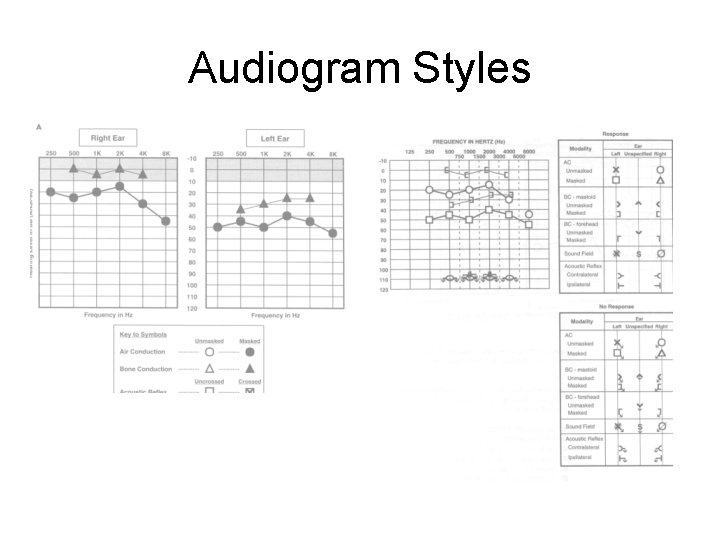
Audiogram Styles
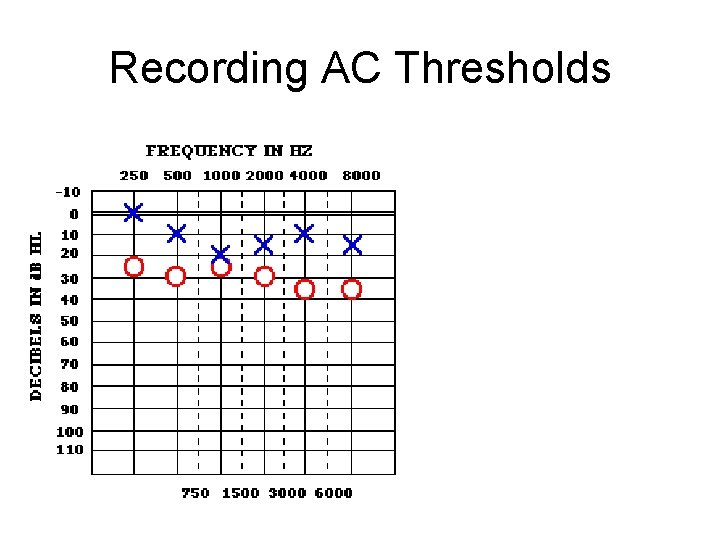
Recording AC Thresholds
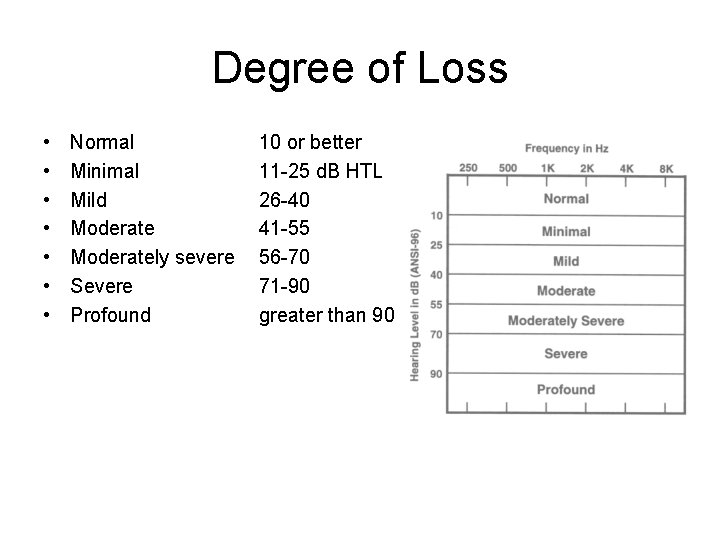
Degree of Loss • • Normal Minimal Mild Moderately severe Severe Profound 10 or better 11 -25 d. B HTL 26 -40 41 -55 56 -70 71 -90 greater than 90
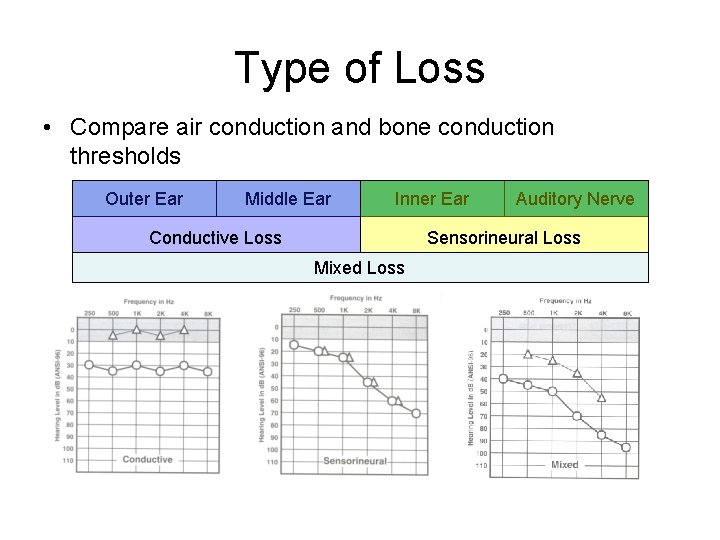
Type of Loss • Compare air conduction and bone conduction thresholds Outer Ear Middle Ear Inner Ear Conductive Loss Auditory Nerve Sensorineural Loss Mixed Loss
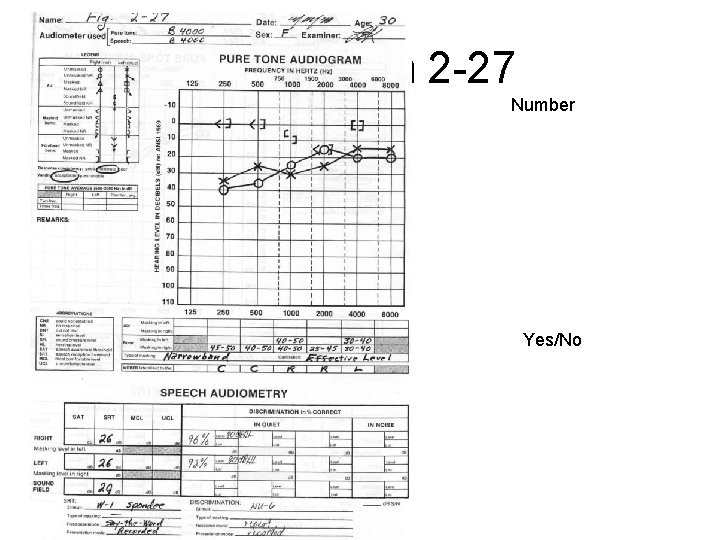
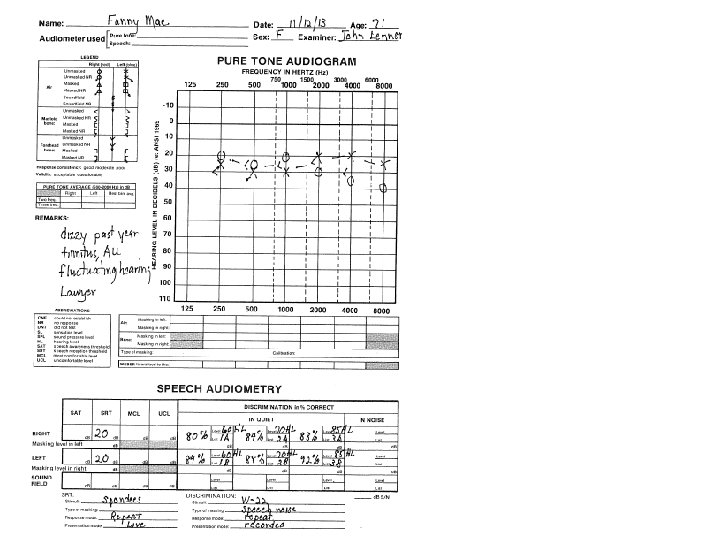
Audiogram 2 -27 Number Yes/No
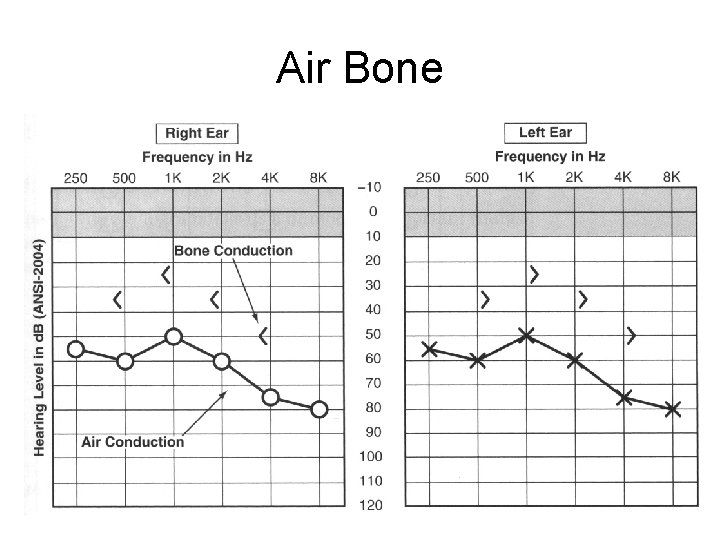
Air Bone
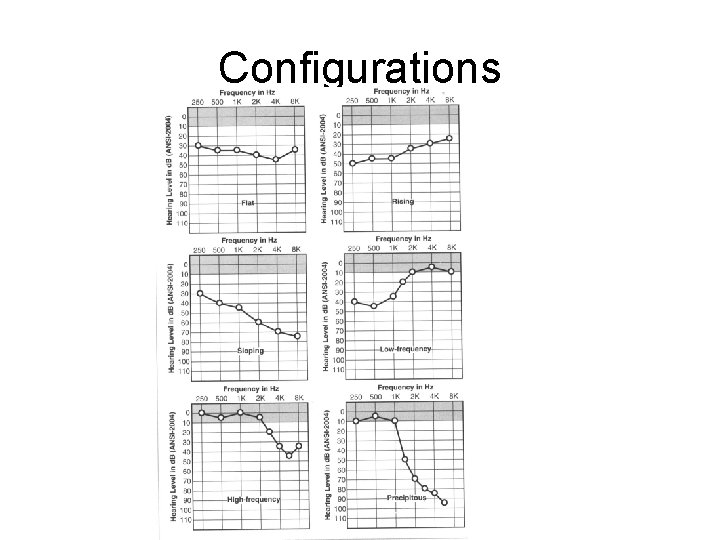
Configurations
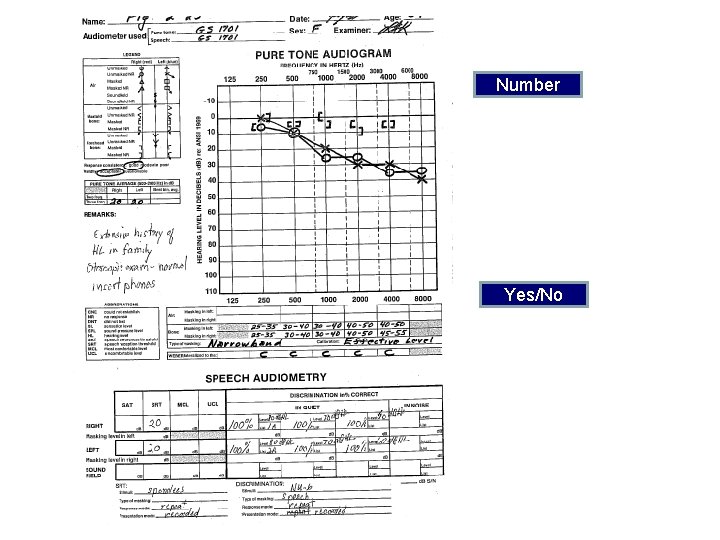
Number Yes/No
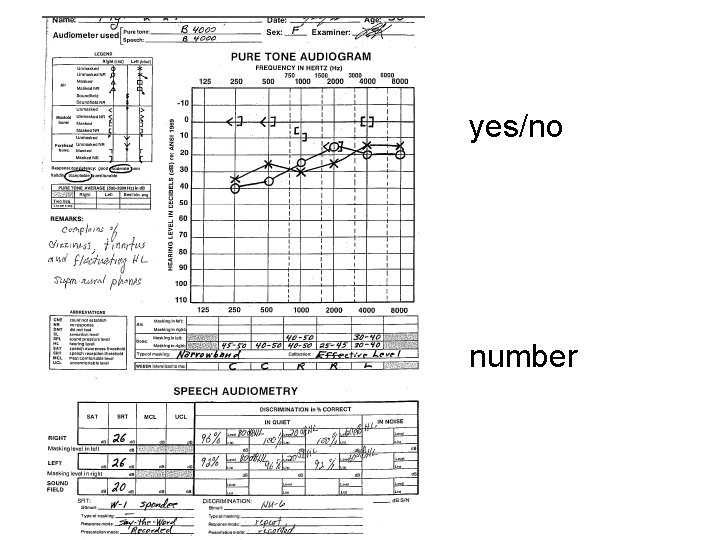
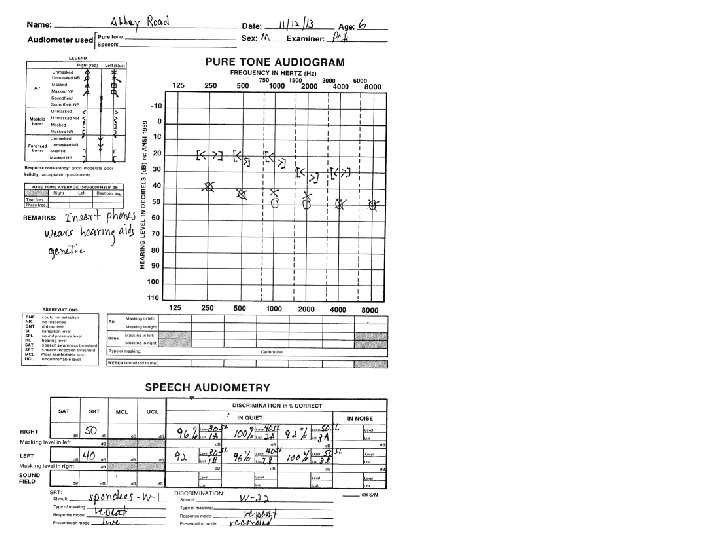
yes/no number
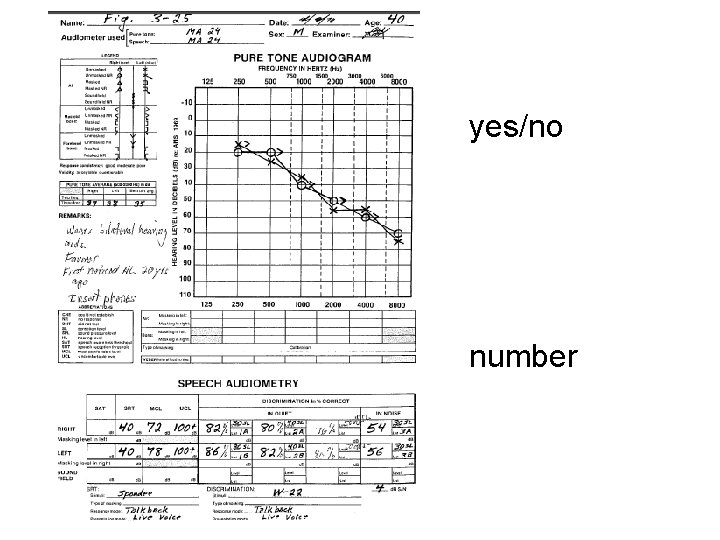
yes/no number
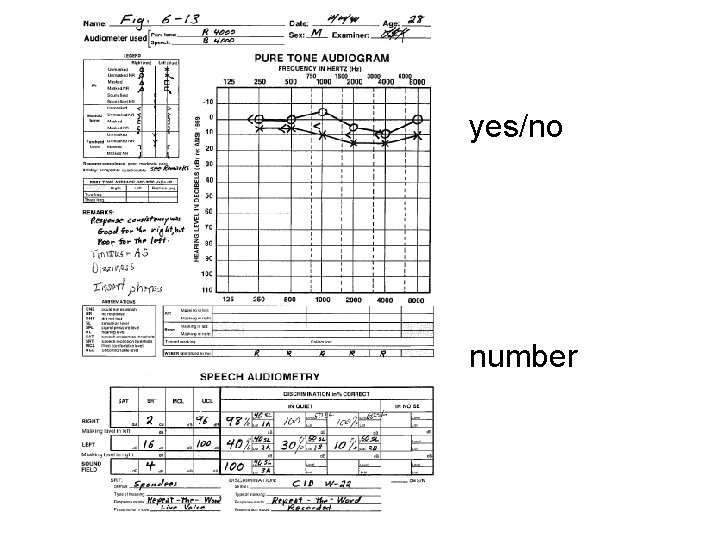
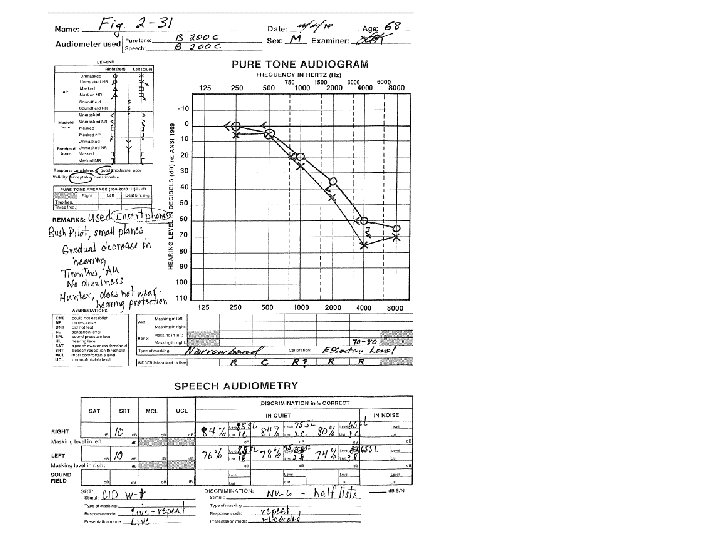
yes/no number
CROSS CHECK • SRT should be within +/- 10 d. B of PTA
Masking • Crossover – Results when sound presented to one ear through earphones crosses to the head via bone conduction and is perceived by the opposite ear
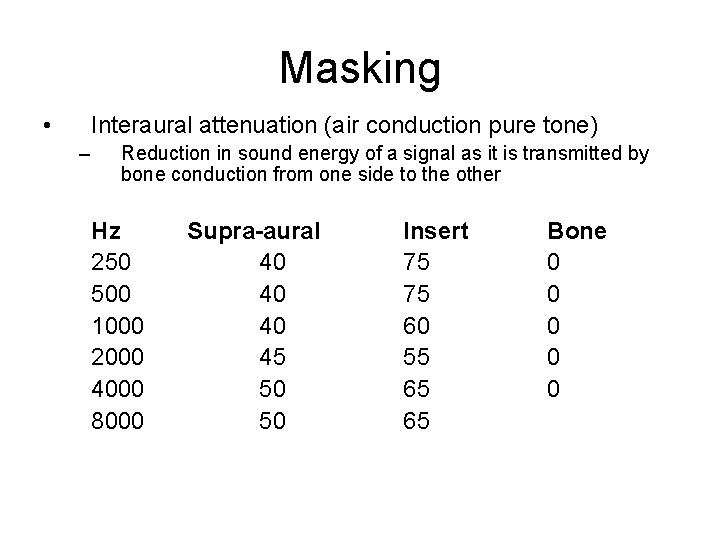
Masking • Interaural attenuation (air conduction pure tone) – Reduction in sound energy of a signal as it is transmitted by bone conduction from one side to the other Hz 250 500 1000 2000 4000 8000 Supra-aural 40 40 40 45 50 50 Insert 75 75 60 55 65 65 Bone 0 0 0
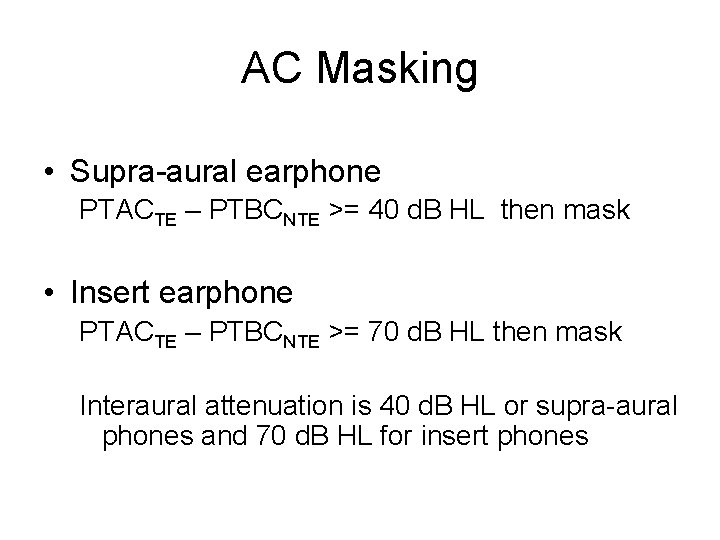
AC Masking • Supra-aural earphone PTACTE – PTBCNTE >= 40 d. B HL then mask • Insert earphone PTACTE – PTBCNTE >= 70 d. B HL then mask Interaural attenuation is 40 d. B HL or supra-aural phones and 70 d. B HL for insert phones
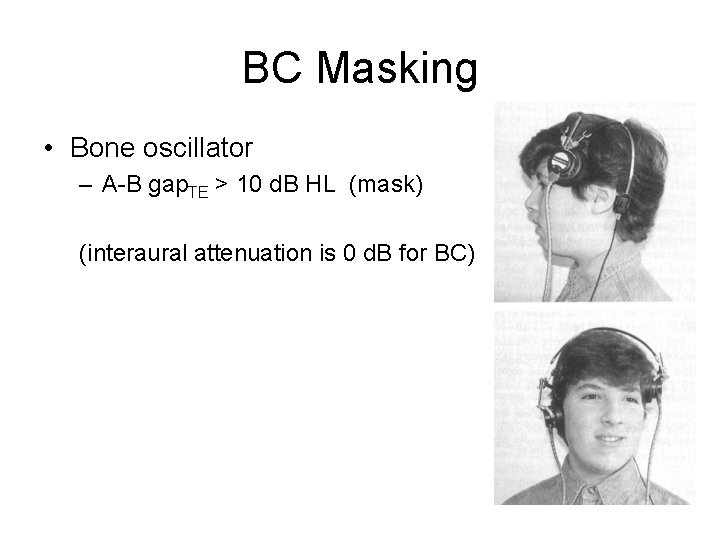
BC Masking • Bone oscillator – A-B gap. TE > 10 d. B HL (mask) (interaural attenuation is 0 d. B for BC)
Speech Masking Supra-aural phones: • Speech Test Level. TE – best BCNTE => 40 d. B Insert Phones • Speech Test Level. TE – best BCNTE => 70 d. B ( Evaluate any speech test such as SRT and/or SRA and compare to the best BC of the non-test or opposite ear)
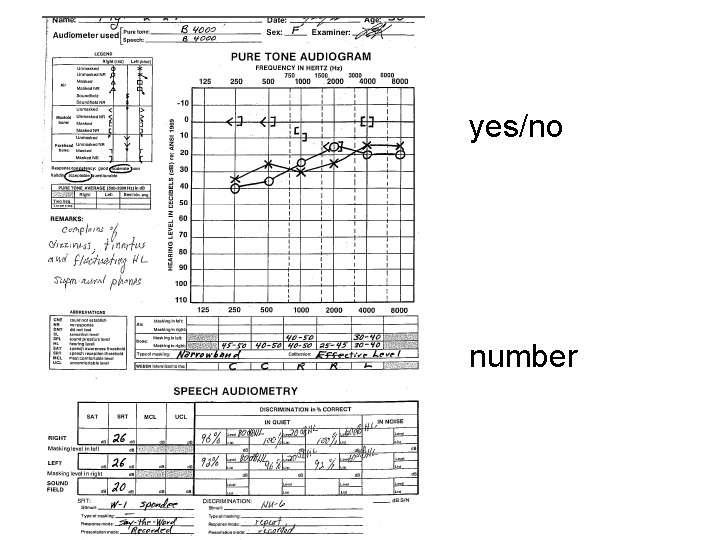
yes/no number
Speech Audiometry • Purpose – Attempt to measure the ability to understand everyday conversational communication
Uses of Speech Audiometry • Measure of speech threshold • Cross-check pure tone results • Measure of supra-threshold speech recognition ability • Differential diagnosis • Measure of auditory processing ability • Estimation of communication function
SPEECH TESTING • SRT (speech recognition threshold) – Measure of speech threshold – Typically use spondees • SRA (speech recognition ability) – Measure of clarity – Supra threshold – Typically use monosyllabic or sentence material
Speech Threshold • Lowest level at which speech can be recognized or detected – SRT (could be any kind of speech material) – ST (spondee threshold) – SAT (speech awareness threshold) – SDT (speech detection threshold)
Spondee Threshold • ST – the lowest level in decibels spondees can be recognize correctly – Measure of threshold sensitivity for recognizing speech – Provides estimation of hearing sensitivity in the primary speech frequencies – Comparable estimation of PTA (useful for cross-check) • Spondee – bisyllabic word enunciated with equal stress on both syllables • Trochees (not used for assessing SRT) – bisyllabic word with unequal stress on both syllables
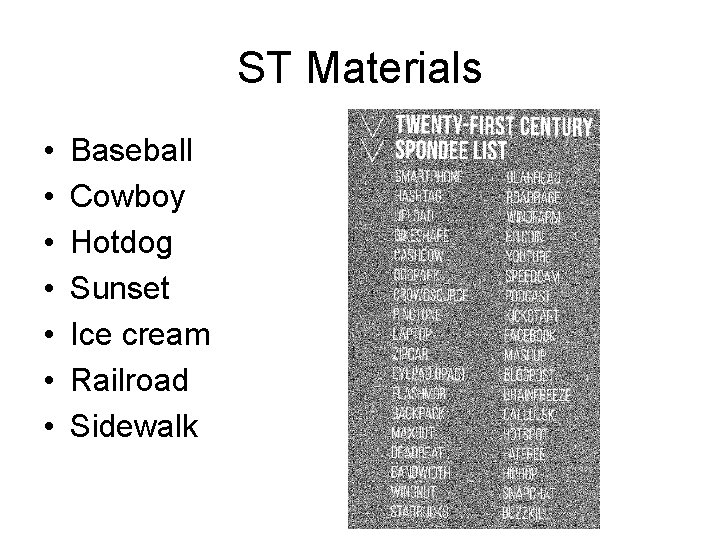
ST Materials • • Baseball Cowboy Hotdog Sunset Ice cream Railroad Sidewalk
SRT • Speech Recognition Threshold – Lowest level in decibels at which speech can be recognized correctly with at lease 50% criterion – Sentences, spondees, etc. – Typically use spondees unless otherwise indicated
SAT/SDT • Speech awareness or detection level – Lowest level in decibels at which speech is detected – Used when patient unable to respond to spondees (infants, developmental delays, etc. ) – Approximately 10 d. B better threshold than SRT threshold • Audiometers calibrated to speech recognition level than detection levels
Supra-threshold Speech Recognition Ability • Ability to correctly recognize speech at supra-threshold levels (reported in percentage of words correct at intensity level of presentation) – 100% at 80 d. B HL – 96% at 40 d. B SL • Measured scores are generally predictable from degree, configuration and type of loss from pure tone results
Speech Recognition Ability Materials • • • Discourse Sentences Words syllables Phonemes Nonsense words Synthetic sentences Speech in noise Filtered speech
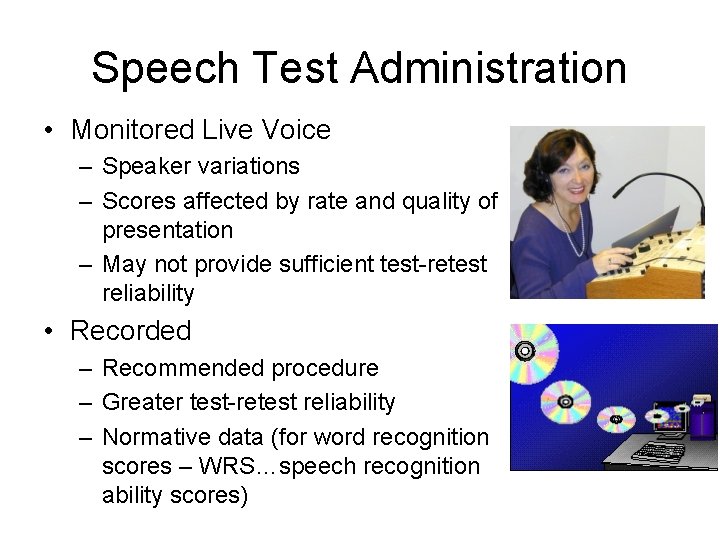
Speech Test Administration • Monitored Live Voice – Speaker variations – Scores affected by rate and quality of presentation – May not provide sufficient test-retest reliability • Recorded – Recommended procedure – Greater test-retest reliability – Normative data (for word recognition scores – WRS…speech recognition ability scores)
Open Vs. Closed Set • Closed Set – Limited set of response possibilities – Useful for young children with limited vocabulary, patients with poor articulation, developmental delays – Scores may be 10% better compared to open set scores • Open Set – More challenging as response possibilities are somewhat unlimited
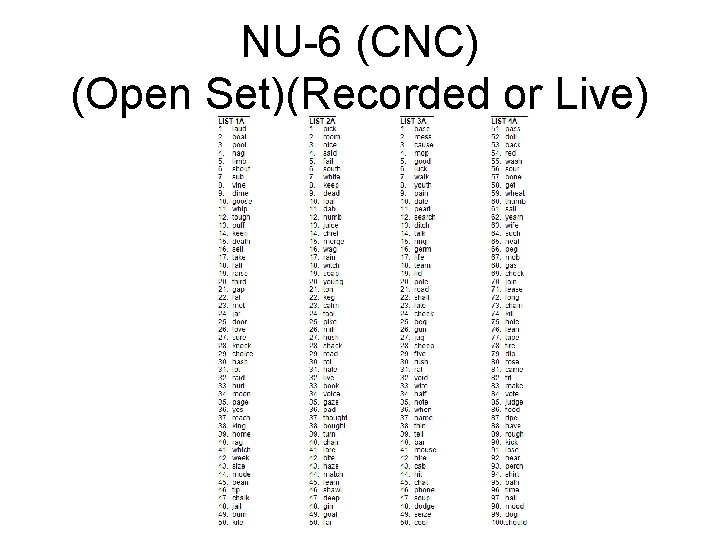
NU-6 (CNC) (Open Set)(Recorded or Live)

CID W-22 (PB Word Lists) (Open Set)(Recorded or Live)
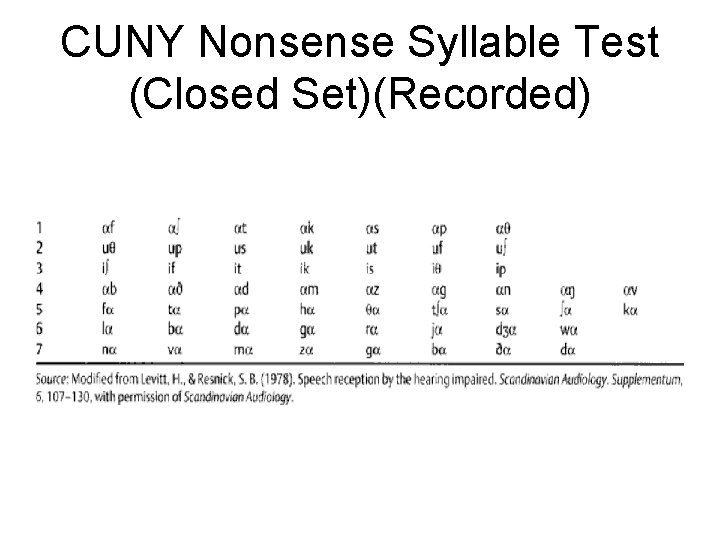
CUNY Nonsense Syllable Test (Closed Set)(Recorded)
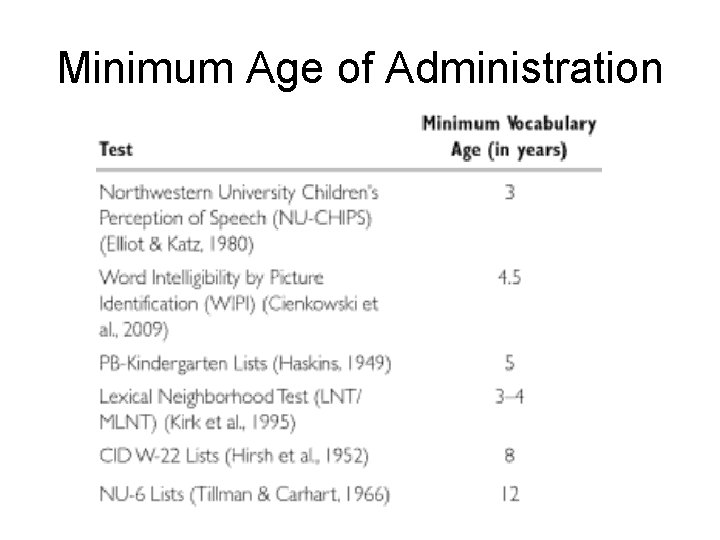
Minimum Age of Administration
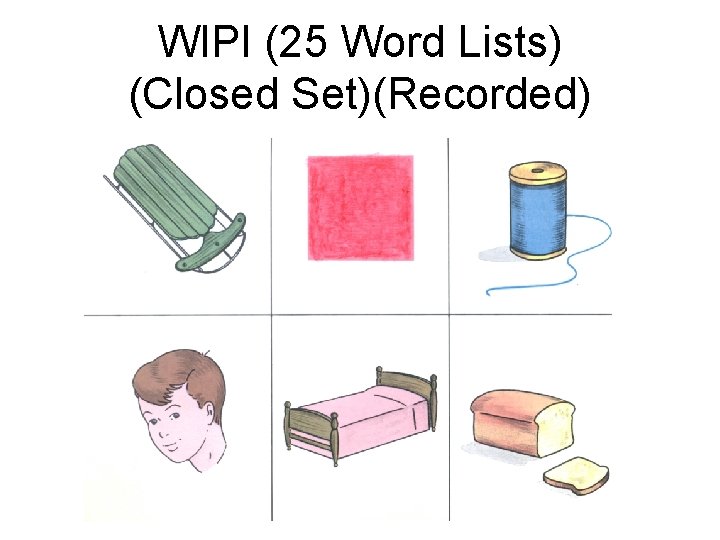
WIPI (25 Word Lists) (Closed Set)(Recorded)
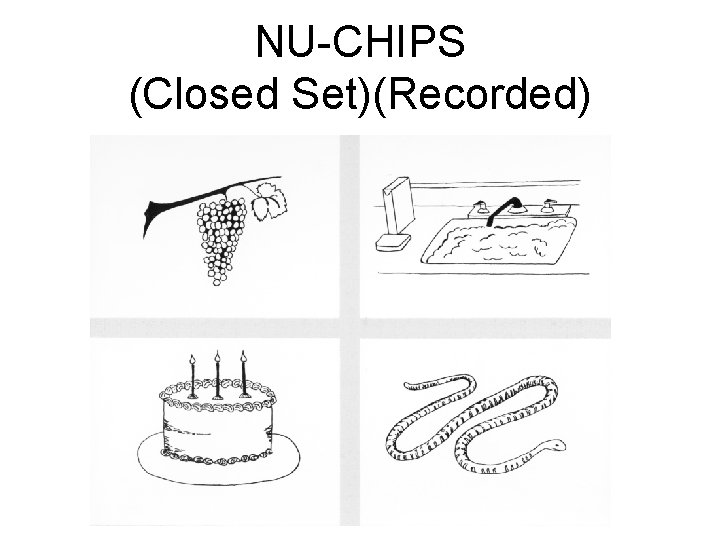
NU-CHIPS (Closed Set)(Recorded)
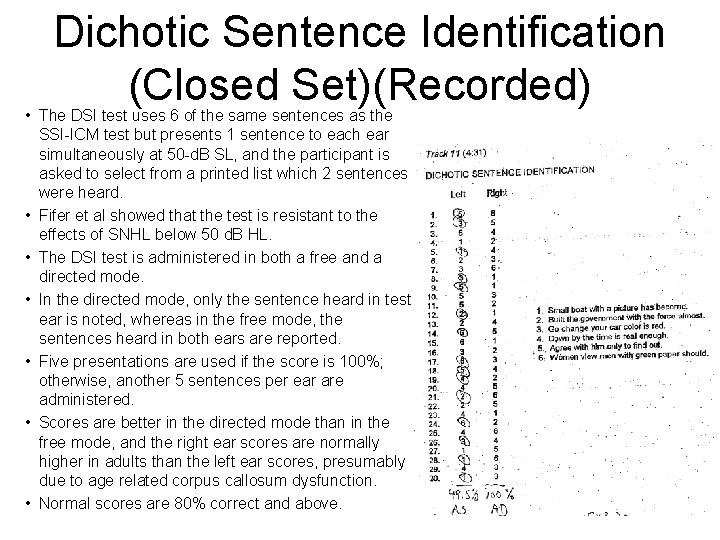
Dichotic Sentence Identification (Closed Set)(Recorded) • The DSI test uses 6 of the same sentences as the SSI-ICM test but presents 1 sentence to each ear simultaneously at 50 -d. B SL, and the participant is asked to select from a printed list which 2 sentences were heard. • Fifer et al showed that the test is resistant to the effects of SNHL below 50 d. B HL. • The DSI test is administered in both a free and a directed mode. • In the directed mode, only the sentence heard in test ear is noted, whereas in the free mode, the sentences heard in both ears are reported. • Five presentations are used if the score is 100%; otherwise, another 5 sentences per ear are administered. • Scores are better in the directed mode than in the free mode, and the right ear scores are normally higher in adults than the left ear scores, presumably due to age related corpus callosum dysfunction. • Normal scores are 80% correct and above.
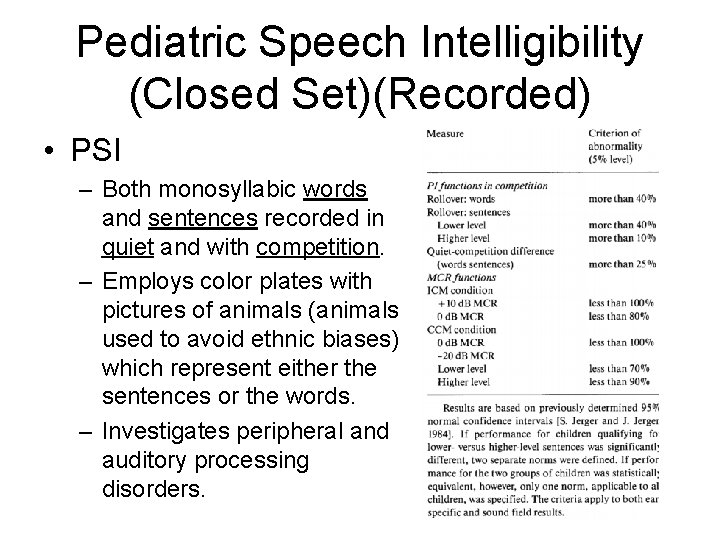
Pediatric Speech Intelligibility (Closed Set)(Recorded) • PSI – Both monosyllabic words and sentences recorded in quiet and with competition. – Employs color plates with pictures of animals (animals used to avoid ethnic biases) which represent either the sentences or the words. – Investigates peripheral and auditory processing disorders.
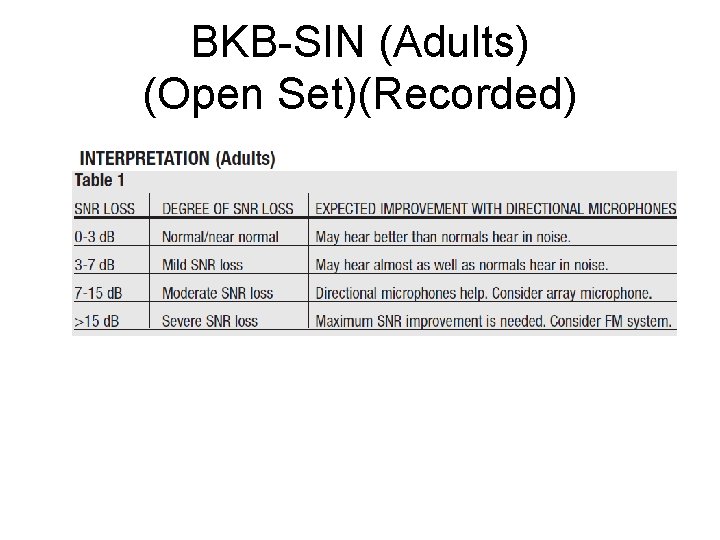
BKB-SIN (Adults) (Open Set)(Recorded)
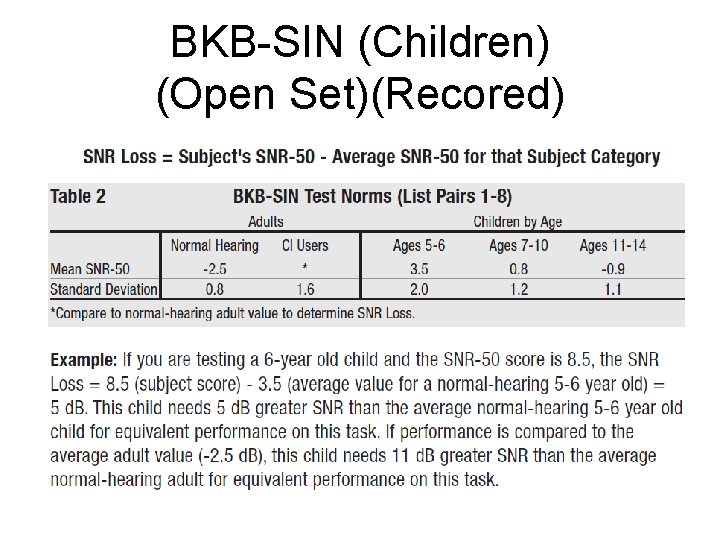
BKB-SIN (Children) (Open Set)(Recored)
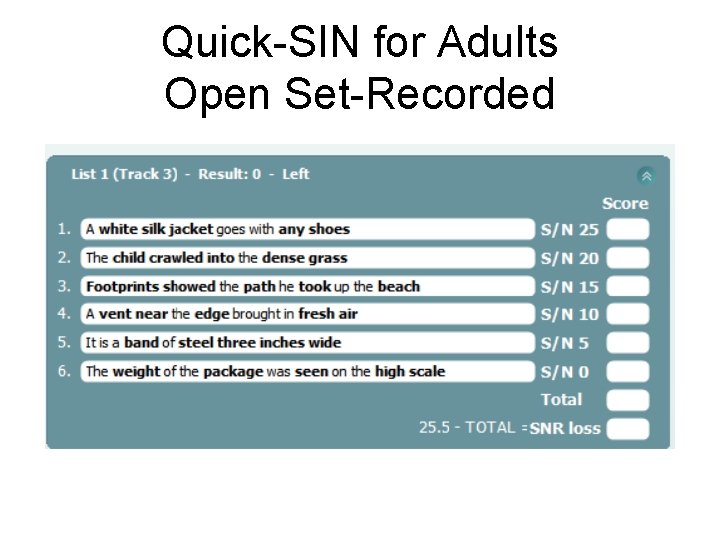
Quick-SIN for Adults Open Set-Recorded
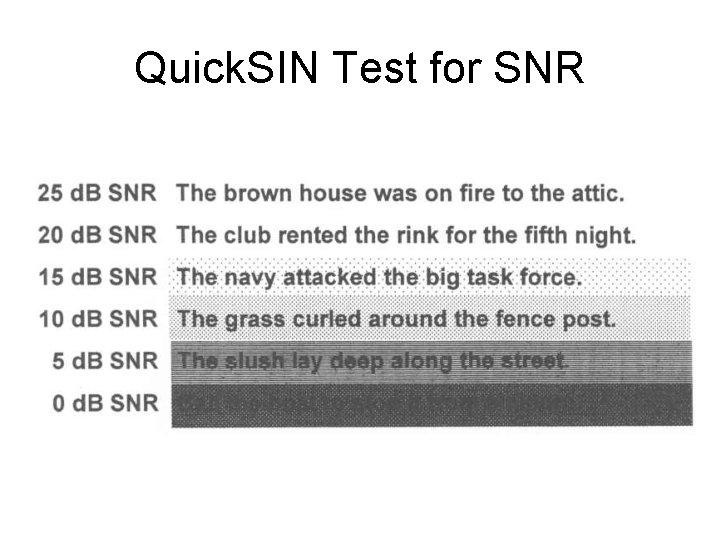
Quick. SIN Test for SNR
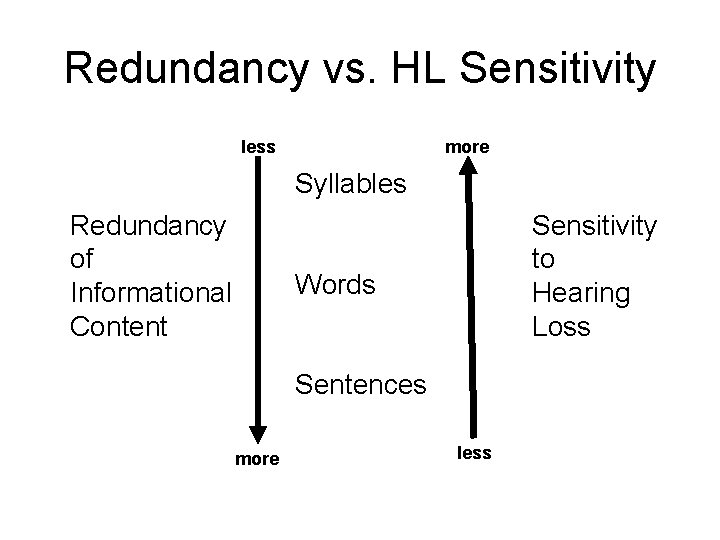
Redundancy vs. HL Sensitivity less more Syllables Redundancy of Informational Content Sensitivity to Hearing Loss Words Sentences more less
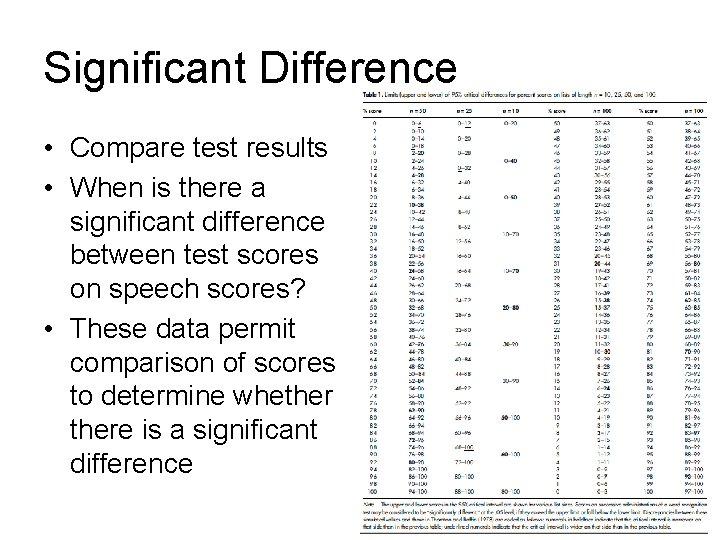
Significant Difference • Compare test results • When is there a significant difference between test scores on speech scores? • These data permit comparison of scores to determine whethere is a significant difference
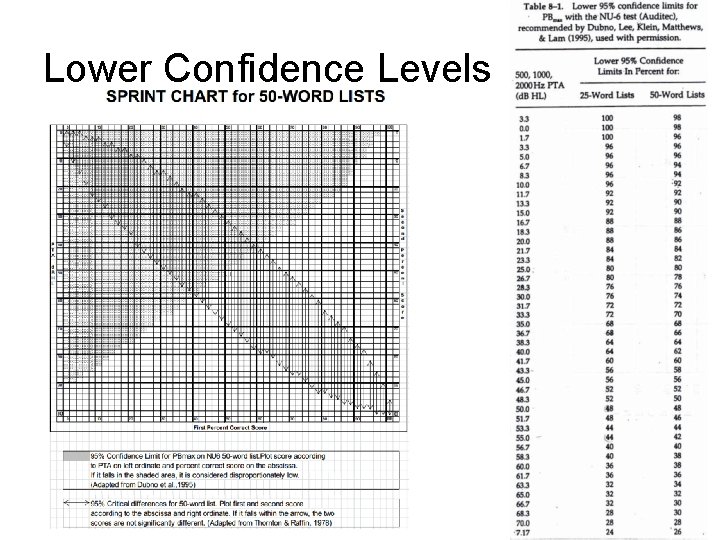
Lower Confidence Levels
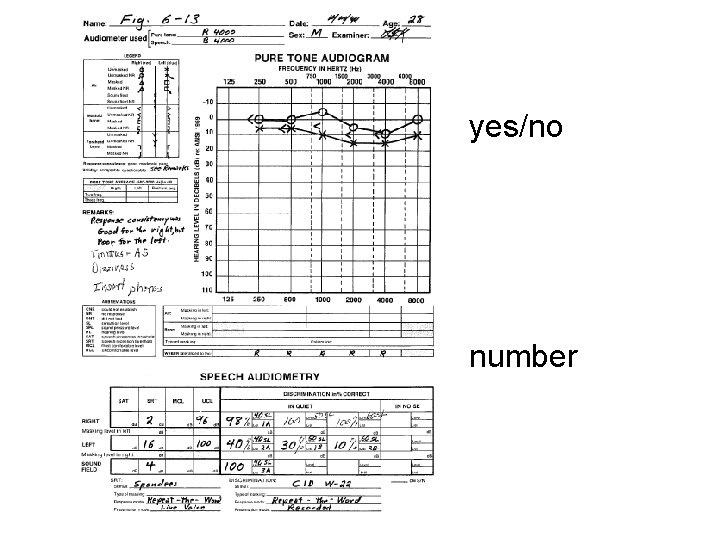
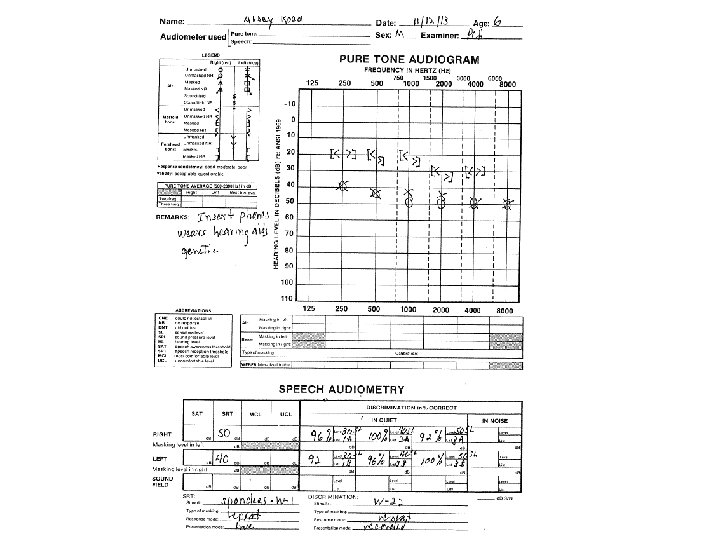
yes/no number
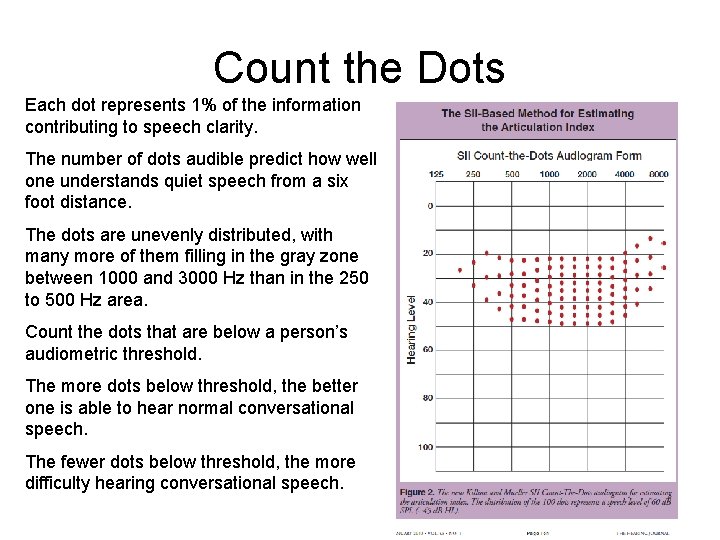
Count the Dots Each dot represents 1% of the information contributing to speech clarity. The number of dots audible predict how well one understands quiet speech from a six foot distance. The dots are unevenly distributed, with many more of them filling in the gray zone between 1000 and 3000 Hz than in the 250 to 500 Hz area. Count the dots that are below a person’s audiometric threshold. The more dots below threshold, the better one is able to hear normal conversational speech. The fewer dots below threshold, the more difficulty hearing conversational speech.
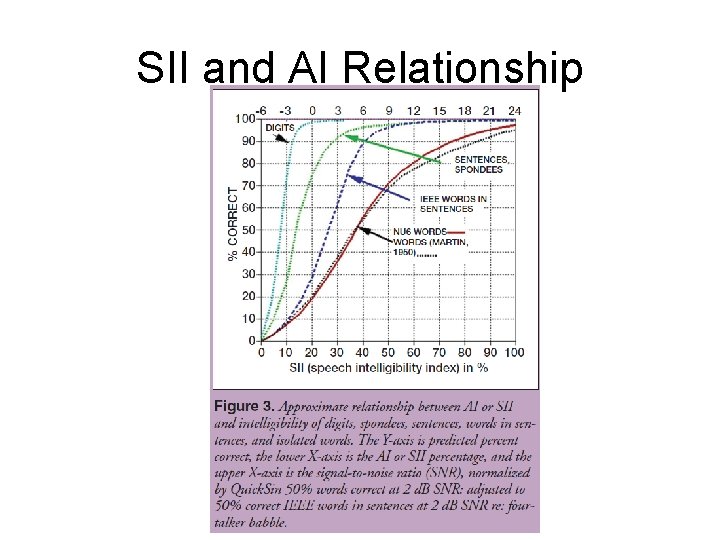
SII and AI Relationship
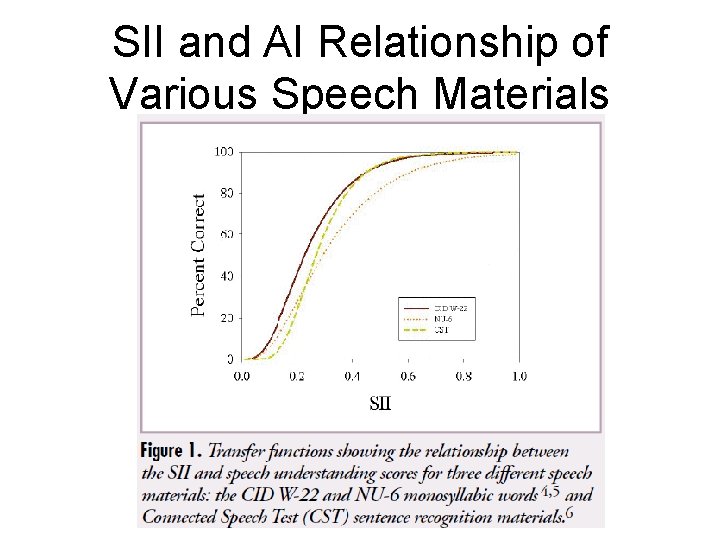
SII and AI Relationship of Various Speech Materials
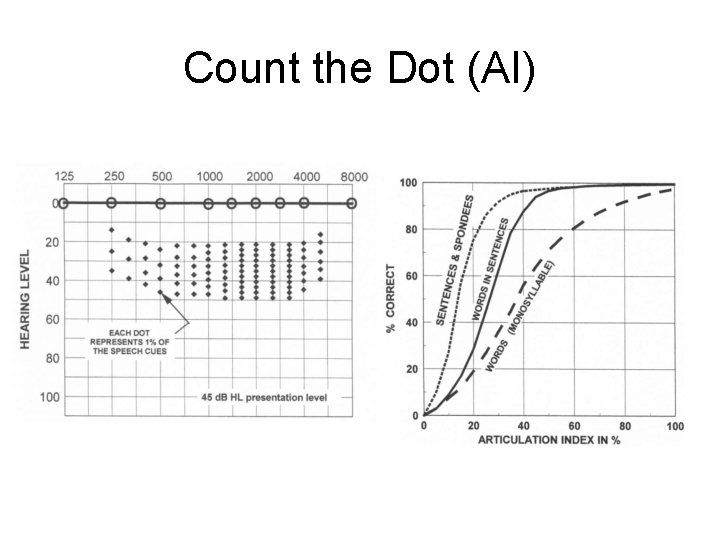
Count the Dot (AI)
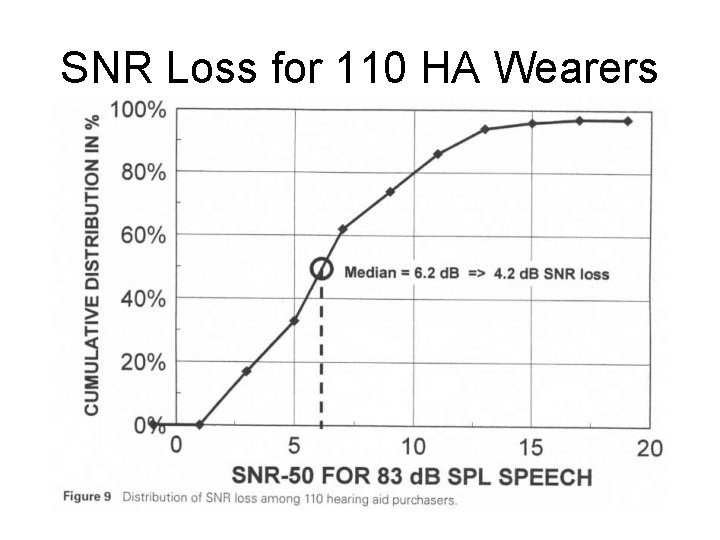
SNR Loss for 110 HA Wearers
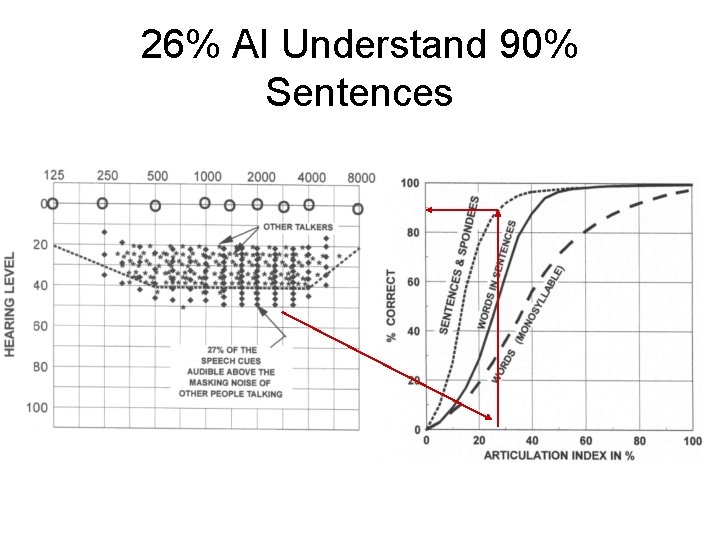
26% AI Understand 90% Sentences
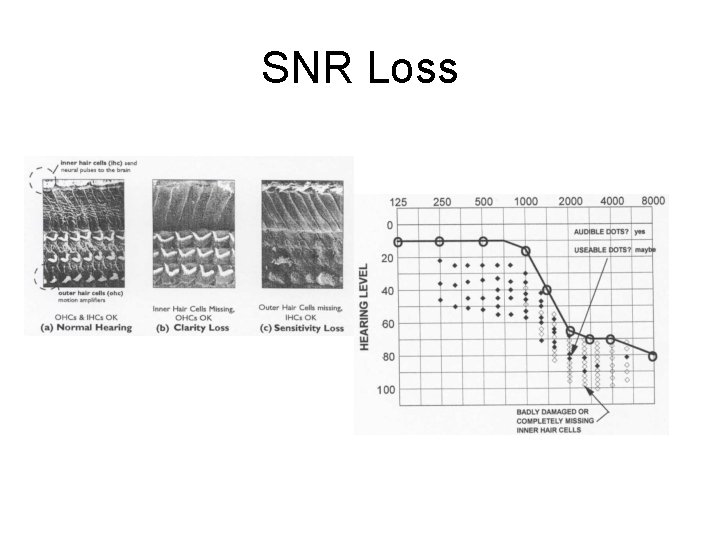
SNR Loss
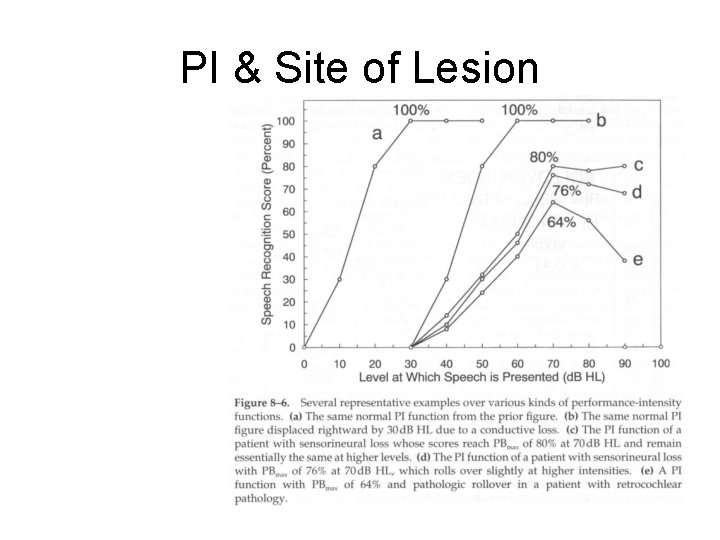
PI & Site of Lesion
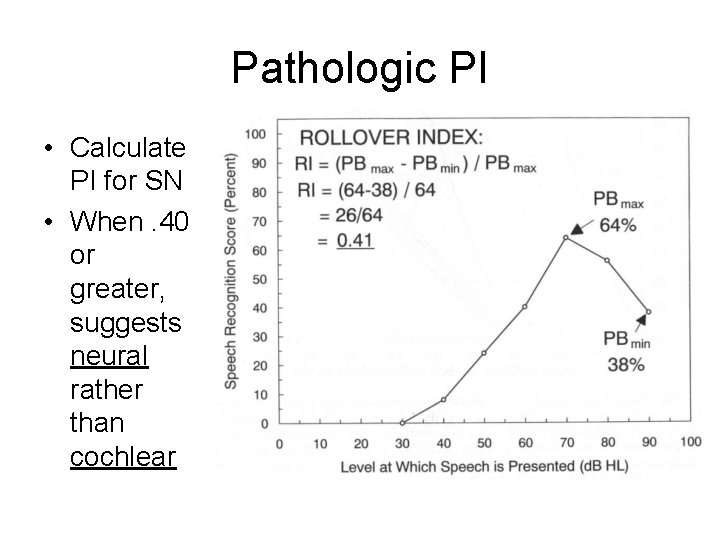
Pathologic PI • Calculate PI for SN • When. 40 or greater, suggests neural rather than cochlear
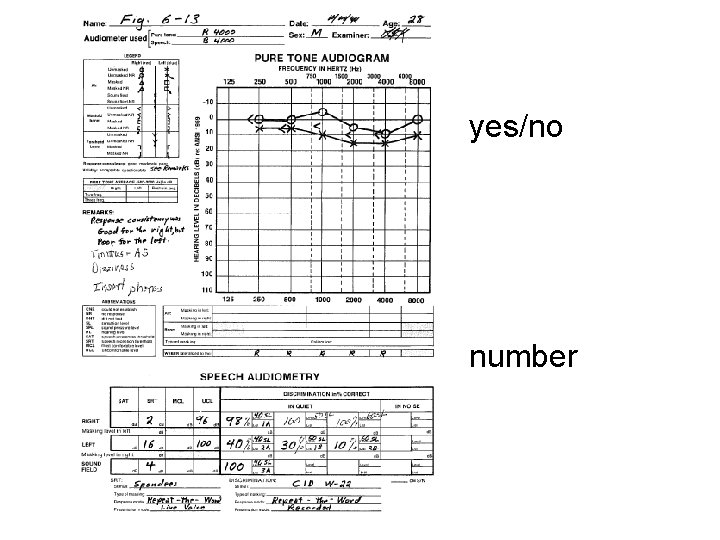
yes/no number
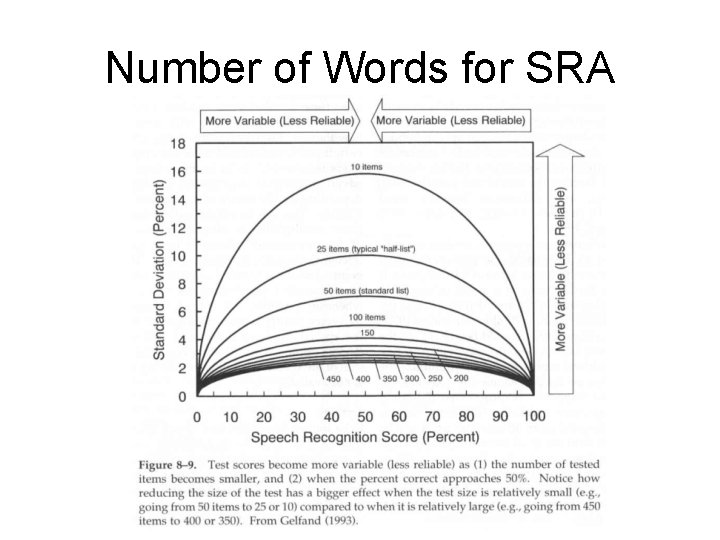
Number of Words for SRA
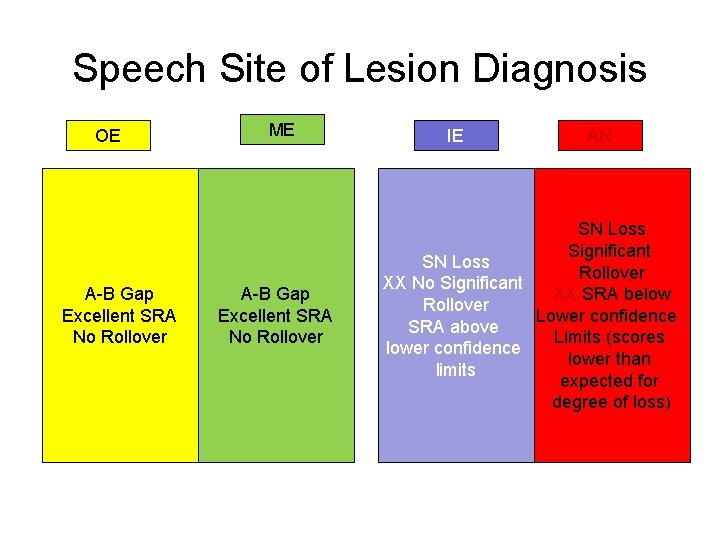
Speech Site of Lesion Diagnosis OE A-B Gap Excellent SRA No Rollover ME A-B Gap Excellent SRA No Rollover IE AN SN Loss Significant SN Loss Rollover XX No Significant XX SRA below Rollover Lower confidence SRA above Limits (scores lower confidence lower than limits expected for degree of loss)
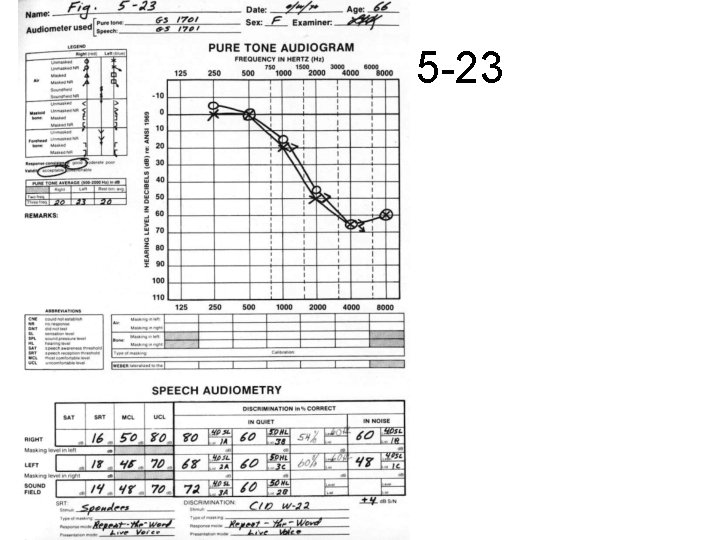
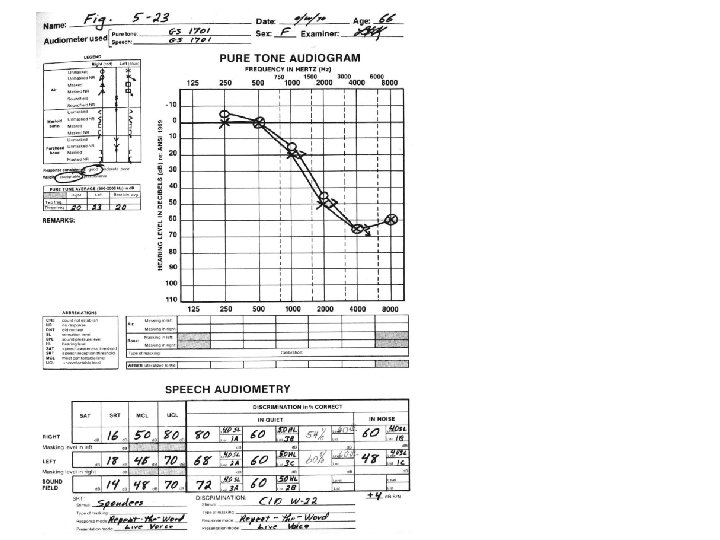
Audigram 5 -23
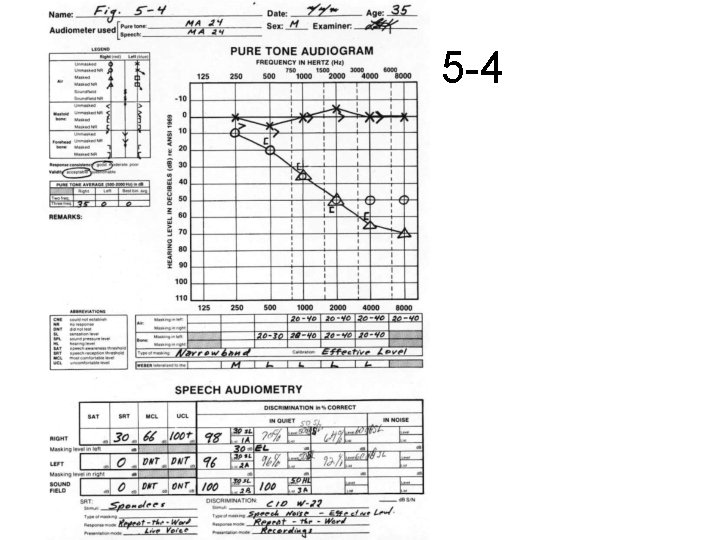
Audiogram 5 -4
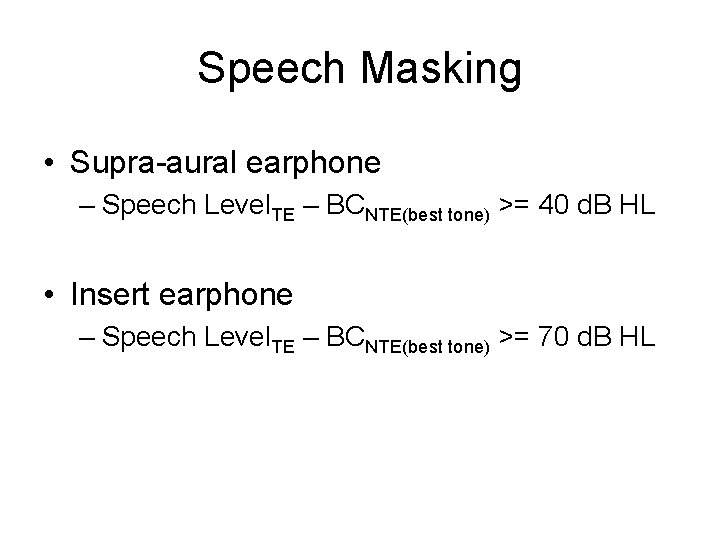
Speech Masking • Supra-aural earphone – Speech Level. TE – BCNTE(best tone) >= 40 d. B HL • Insert earphone – Speech Level. TE – BCNTE(best tone) >= 70 d. B HL
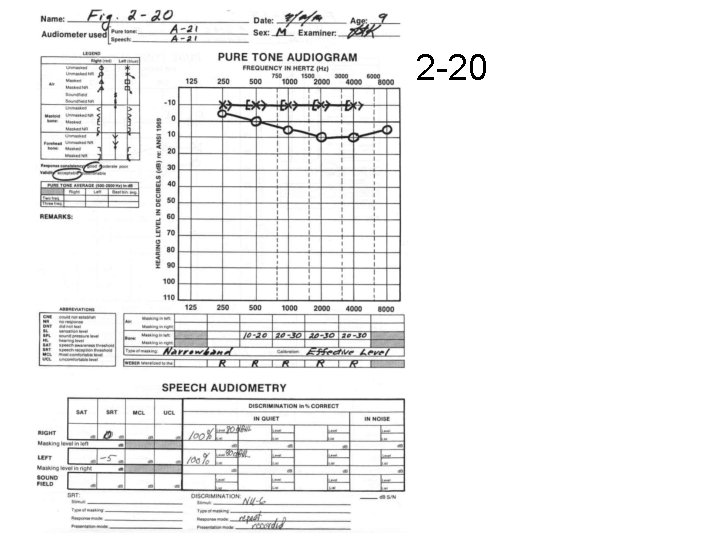
Audiogram 2 -20
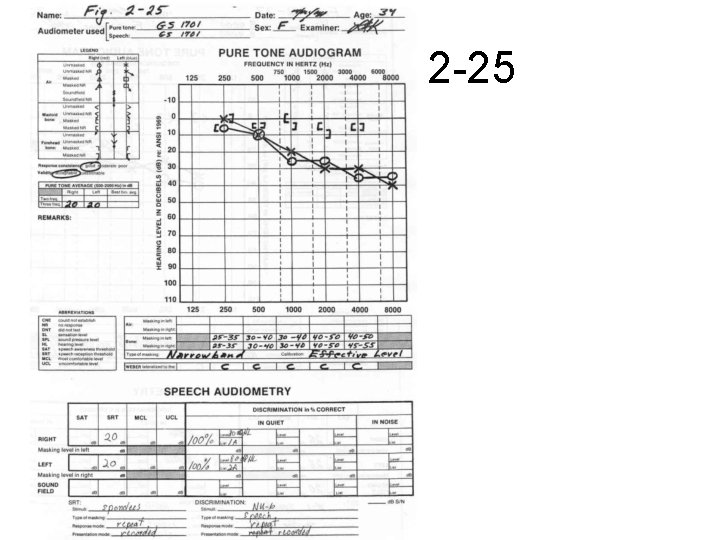
Audiogram 2 -25
- Slides: 76