
Chapters 2526 Imperialism and Transition in Asia What



- Slides: 28
Chapters 25+26 Imperialism and Transition in Asia
What are we going to be focusing on… How can new ideas accelerate economic and political change? How do cultures influence each other?
New Imperialism: ______________________ BEFORE: ________________________ NOW: in new imperialism, desire for direct control Why direct control? Economic Rivalry Social Darwinism and racism “Moral Responsibility” to civilize primitive people (“white man’s burden” ____________________________
Colonial Takeover Great Britain 1819: Founded colony on ____________, the city of the lion, a major shipping point on the way to China Took controlled Burma. France Controlled ____________, and feared the British Vietnamese people saw Christianity as a threat to Confucian doctrine North and south governments divided Country accepted French rule and eventually they took over Saigon and Hanoi Vietnam ________________ Later took over Cambodia, Annam, Tonkin and Laos: ____________________________
Colonial Takeover Thailand Remained only ____________ in southeast Asia Served as independent buffer between British and French possessions, westernized United States After Spanish-American War, felt obligated to ____________________________________________________ Philippines: _____________________________ 3 -year battle for independence that was won by US
Direct vs. Indirect Rule Goal of colonial regimes: exploit natural resources and open up markets Indirect Rule: ___________________________ Dutch East India Trading Company Cheaper…how? Direct Rule: _____________________________________________________________ Great Britain over Burma French Indochina: direct in south, indirect in north “____________” from the West usually were not realized in colonies
Colonial Economies Stressed export of _________________ Didn’t want locals to establish _______________ Plantation agriculture Bad conditions, high taxes Benefits: ______________________________________________________________ Profits: _____________________ Resistance: some peasant rebellions, but none were successful New Class: _______________________ Eventually fought persecution of religious beliefs and limiting of economic opportunities
When we last left Asia… China Mongols had invaded, established the Mongol Dynasty Expanded the empire Japan Established a Shogunate: A strong central government led by a military general “Shogun” Able to hold off Chinese attempts at invasion Southeast Asia Spread of Indian Ocean trade brought an increase in foreign trade and influence to the region.
In the mean time … China Mongolians were overthrown in 1368 Establishment Ming Dynasty 1368 -1644 Arrival of Portuguese traders in 1514 Overthrown in 1644 by the Manchu Established the Qing (Ching) Dynasty Japan Shogunate collapsed in late 15 th century Japanese unification developed in 1582 European traders arrived in 1543, Jesuit’s arrived in 1549 Southeast Asia Europeans began to establish trading colonies within the region Portuguese were the first, didn’t have strength to control large territory Britain and Dutch emerged, forces Portuguese out.
Decline of the Qing Empire Height of their power in early 1800’s Began to decline due to: _________________________________ Qing Dynasty tried to limit the amount of contact with Europeans Limited _____________ Angered British, who wanted to expand their markets in China Turned to ____________
The Opium Wars Opium was grown in British East India Company controlled Northern India ____________________ Shipped them to Chinese markets, demand jumped dramatically Large increase in ________________ China pleaded that for Britain to _____________ China closed ports to European traders Dumped Opium into the Sea Chinese Military ___________________ Long guns destroyed Chinese war junks and coastal forts Sailed Up Yangtze River to ____________
The Opium Wars Ended with Treaty of Nanjing, 1842 Gave Britain: ___________________________________________ ______________________ Said nothing about limiting __________ Offered concessions to Britain and other Western nations Created ________________
The Tai Ping Rebellion Peasant revolts from 1850 -1864 Led by Hong Xiuquan, a Christian convert Believed he was ________________, God told him to destroy Qing Dynasty Wanted to: __________________________________________________________ Seized town of Yongan Wanted to create new Dynasty, “Heavenly Kingdom of Great Peace” 1853 Rebels seized Nanjing Killed 25, 000 civilians _______________ came to the aid of the Qing ____________________________ Recaptured Nanjing in 1856 ___________________ were granted additional trading privileges for their military aid.
Efforts at Reforms 1870’s Qing dynasty tried to reestablish themselves __________had taken control of parts of China Maintained strong armies “_______________” Adapt Western technology, keep Confucian ideals Modernized Military and Manufacturing Kept Chinese government and social value structure
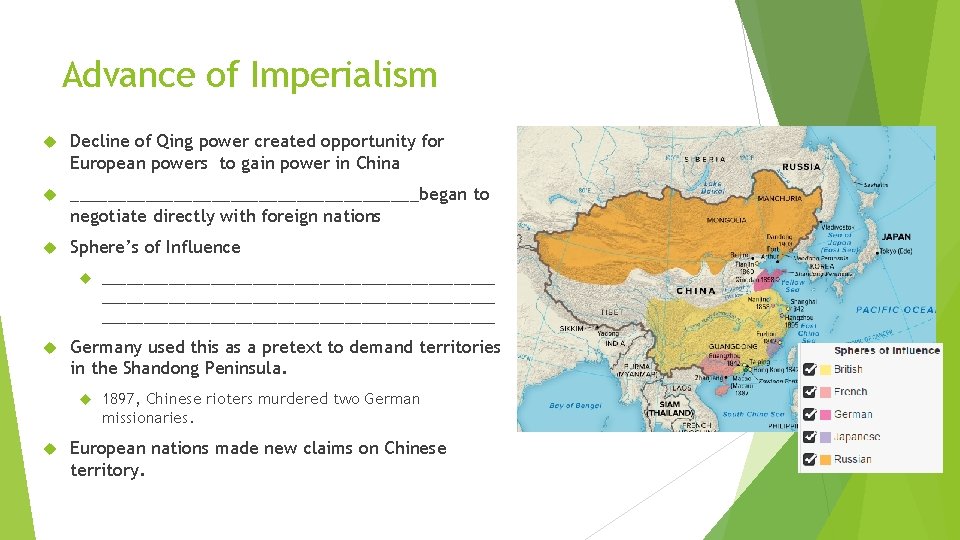
Advance of Imperialism Decline of Qing power created opportunity for European powers to gain power in China ___________________began to negotiate directly with foreign nations Sphere’s of Influence Germany used this as a pretext to demand territories in the Shandong Peninsula. _______________________________________________ 1897, Chinese rioters murdered two German missionaries. European nations made new claims on Chinese territory.
One Hundred Days of Reform 1898, the young emperor Guang Xu launched a massive reform program based on changes in Japan. “One Hundred Days of Reform”: _________________________________________ Guang Xu tried to modernize government bureaucracy Followed _____________, with Western-style schools, banks, and a free press Many conservatives at court opposed these reforms. Empress Dowager Ci Xi (TSUH • SEE), the emperor's aunt. With the aid of the imperial army, she eventually imprisoned the emperor. Ended Guang Xu's reforms.
Response to Imperialism ________________________ feared foreign intervention in China The Chinese government ____________ Concerns for survival of _________________ Open Door Policy: ____________________________________________________ Stated all powers could not set tariffs giving an unfair advantage to the citizens of their own country Lessened fears that Britain, France, Germany, and Russia would try and dominate the China
Boxer Rebellion The Boxers were upset by economic distress and the foreign takeover of Chinese lands Boxers: ______________________ Slogan: “_________________” Desire for return to traditional Chinese customs They especially disliked Christian missionaries and Chinese converts to Christianity. 1900, Boxer bands roamed the countryside and slaughtered foreign missionaries, Chinese Christians, and Foreign business people. An allied army of ______ troops attacked Beijing The army restored order, demanded more concessions from the Chinese government. The Chinese government pay large penalties for damages The imperial government was now weaker than ever.
Unsuccessful Reforms After the Boxer Rebellion, Empress Dowager Ci Xi supported reforms _____________: Civil service examinations were dropped educational system was reformed along Western lines. Limits on assemblies: Local and national legislative assemblies were formed Didn’t make laws, only advised government Reforms did not address: Peasants and other members of the lower class __________________________________________
Rise of Sun Yat-sen Revolutionary leader who tried to modernize China Developed a three-stage model for changing the government Military takeover > Preparation for democratic rule > Democracy based on constitution Created Nationalist Party from radical groups across China Advocated “Three People’s Principles” _______________________________ In 1911, followers of Sun Yat-sen led a revolt in central China. The weak Qing dynasty collapsed General Yuan Shigai took control of China He ruled like a dictator, and the Nationalists attempted to rebel.
Civil Unrest Yuan resists attempts to move China in democratic direction. Dismisses regional governors Does not consult parliament Nationalists lead unsuccessful revolt against Yuan. Feared a revolt would lead to chaos, the Western intervention. Yuan dies and is succeeded by one of his officers. Warlords seize control in provinces, and central government disintegrates.
Western Influence in China Westerners introduced modern means of transportation and communication Created an export market Brought China into the world economy. Western influence stimulated the modernization of China. Imperialism created state of dependence and limited development. Westernization in cities, such as Shanghai, developed in a way that mirrored Western urban social structures. Educated and wealthy Chinese in cities were the most open to Western culture and thought. Radical reformers condemned traditional culture as oppressive Confucianism waned in influence as some people began adopting European and American ideas. Western books, arts, and ideas were introduced at an increasing rate. Traditional culture remained strong among conservative elements, especially in rural areas.
Japan By the 1900’s Japan was _________________________________________. Had Isolation Policies, only Chinese and Dutch allowed to trade The United States sent _______________ to open relations with Japan. Came with a fleet of warships to deliver message by force if needed. Japanese were afraid, knew of British Navy domination of China Under this military pressure, the Japanese signed the ___________________ Opening two ports to __________. A powerful element of Japanese society resisted contact with the West. The Sat-Cho alliance of samurai eventually forced the shogun from power, Ending the shogunate system and restoring the emperor's power
Meiji Restoration The Sat-Cho leaders realized that Japan must change to survive. Still __________________ The new leaders embarked on a policy of reform that transformed Japan into a modern industrial nation. Reestablished Emperor, still controlled by Sat-Cho Worked to create a modern political system, including a legislative assembly. Liberals: __________________________________________________ Progressives: _________________________________________________ Progressives won
Attempts to Modernize Japan The Meiji government implemented reforms Land reforms forced the ________ to hand land over to peasants in exchange for government bonds. Peasants had to pay a tax on their new land Some were forced to sell the land when harvests were poor. Special privileges for the aristocracy were abolished Government promoted industrial development by providing subsidies. The Meiji government modernized the ___________ Instituted compulsory service. Remodeled the educational system along Western lines Women were allowed to seek an education.
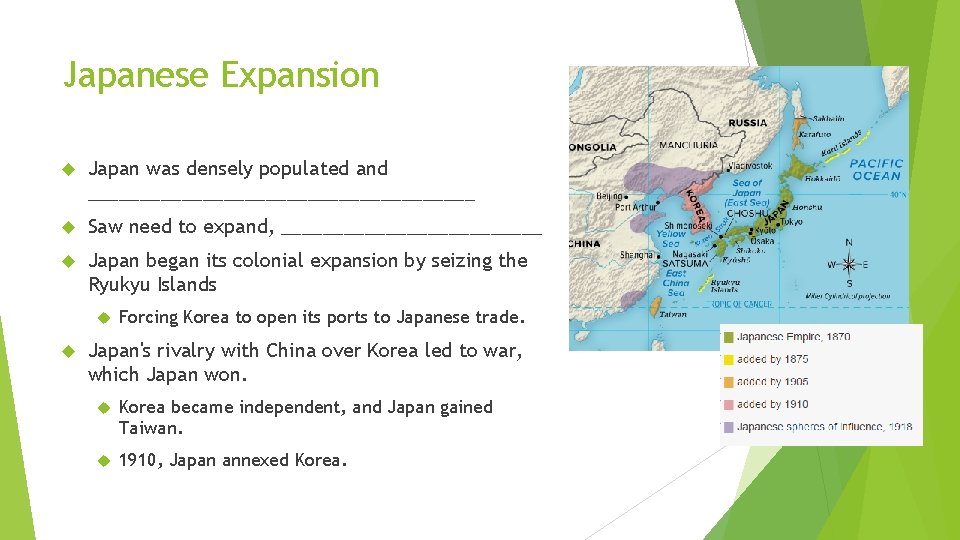
Japanese Expansion Japan was densely populated and ___________________ Saw need to expand, _____________ Japan began its colonial expansion by seizing the Ryukyu Islands Forcing Korea to open its ports to Japanese trade. Japan's rivalry with China over Korea led to war, which Japan won. Korea became independent, and Japan gained Taiwan. 1910, Japan annexed Korea.
Japanese Expansion Russo Japanese War _______ also competed with Japan for influence in Korea. 1904 Japan launched a surprise attack on __________, a Chinese port occupied by Russia. Japan overwhelmed Russia in the resulting conflict Japanese navy ________________ After their humiliating defeat, the Russians agreed to a peace in 1905. The Japanese victory stunned the world. Established themselves as a great world power. Relations between Japan and the United States in the early 1900 s were ________________. The United States recognized ______________ Japan recognized ____________________
Citations Spielvogel, Jackson J. World History & Geography. Bothell: Mc. Graw-Hill Education, 2014. E-Book