
Chapters 2 Part A Tabular and Graphical Presentations
Chapters # 2 (Part A) Tabular and Graphical Presentations Stati stics Slide 1
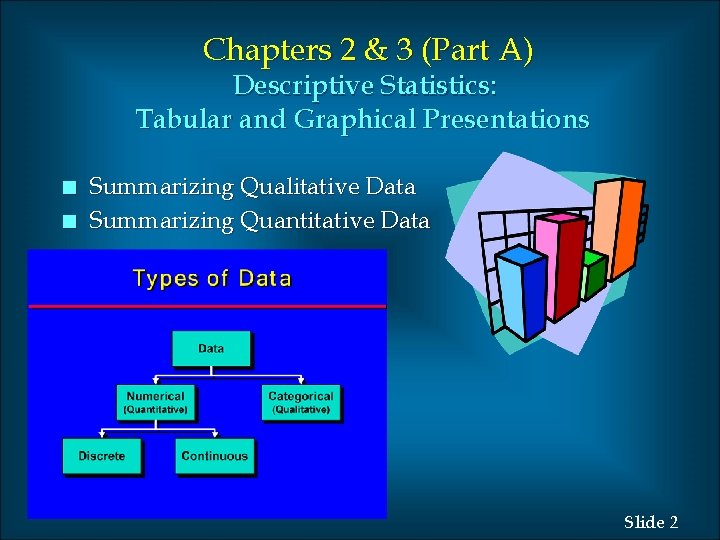
Chapters 2 & 3 (Part A) Descriptive Statistics: Tabular and Graphical Presentations n n Summarizing Qualitative Data Summarizing Quantitative Data Slide 2
Summarizing Qualitative Data n n n Frequency Distribution Relative Frequency Distribution Percent Frequency Distribution Bar Graph Pie Chart Slide 3
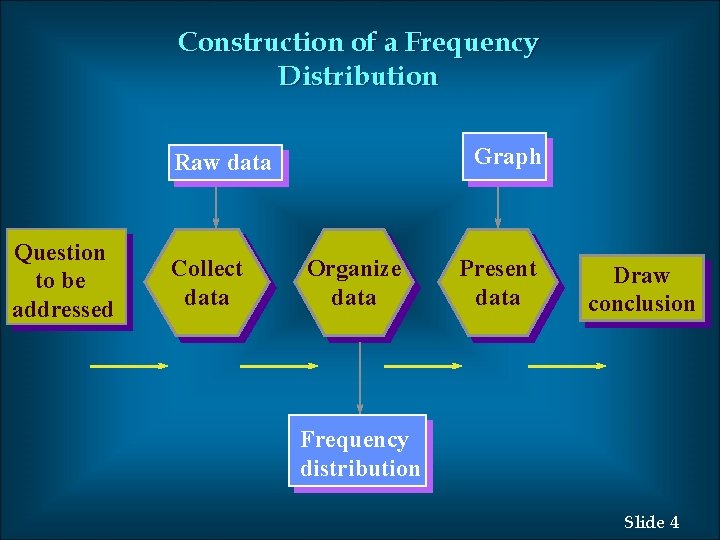
Construction of a Frequency Distribution Graph Raw data Question to be addressed Collect data Organize data Present data Draw conclusion Frequency distribution Slide 4
Frequency Distribution A frequency distribution is a tabular summary of data showing the frequency (or number) of items in each of several non-overlapping classes. The objective is to provide insights about the data that cannot be quickly obtained by looking only at the original data. Slide 5
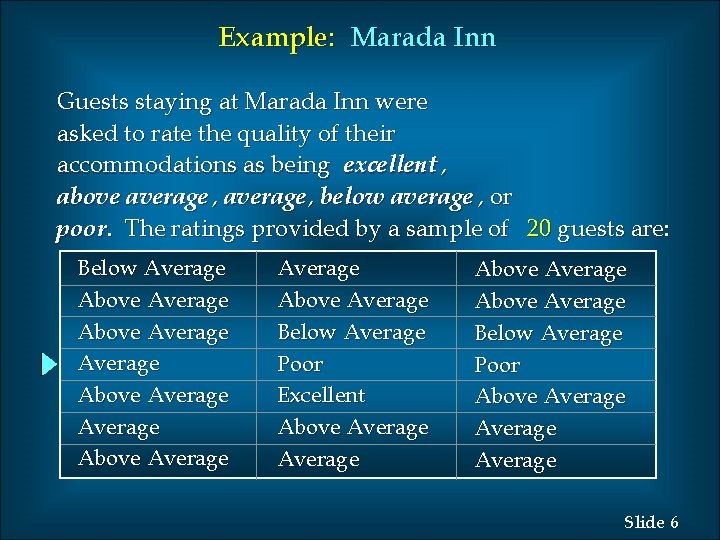
Example: Marada Inn Guests staying at Marada Inn were asked to rate the quality of their accommodations as being excellent , above average , below average , or poor. The ratings provided by a sample of 20 guests are: Below Average Above Average Above Average Below Average Poor Excellent Above Average Below Average Poor Above Average Slide 6
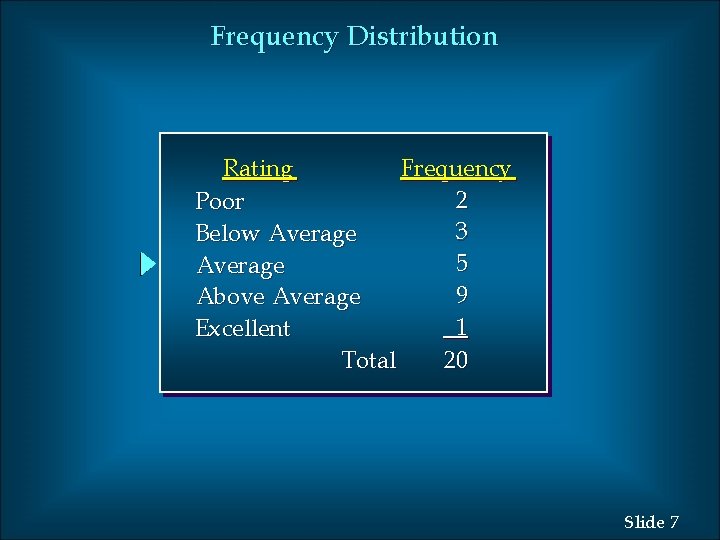
Frequency Distribution Rating Frequency 2 Poor 3 Below Average 5 Average 9 Above Average 1 Excellent Total 20 Slide 7
Relative Frequency Distribution The relative frequency of a class is the fraction or proportion of the total number of data items belonging to the class. A relative frequency distribution is a tabular summary of a set of data showing the relative frequency for each class. Slide 8
Percent Frequency Distribution The percent frequency of a class is the relative frequency multiplied by 100. A percent frequency distribution is a tabular summary of a set of data showing the percent frequency for each class. Slide 9
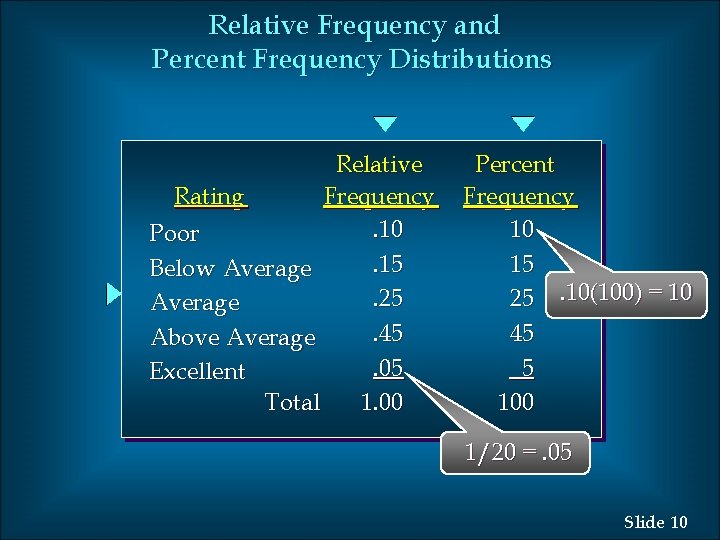
Relative Frequency and Percent Frequency Distributions Relative Rating Frequency. 10 Poor. 15 Below Average. 25 Average. 45 Above Average. 05 Excellent Total 1. 00 Percent Frequency 10 15 25. 10(100) = 10 45 5 100 1/20 =. 05 Slide 10
Bar Graph n A bar graph is a graphical device for presenting qualitative data. n On one axis (usually the horizontal axis), we specify the labels that are used for each of the classes. n A frequency , relative frequency , or percent frequency scale can be used for the other axis (usually the vertical axis). n Using a bar of fixed width drawn above each class label, we extend the height appropriately. n The bars are separated to emphasize the fact that each class is a separate category. Slide 11
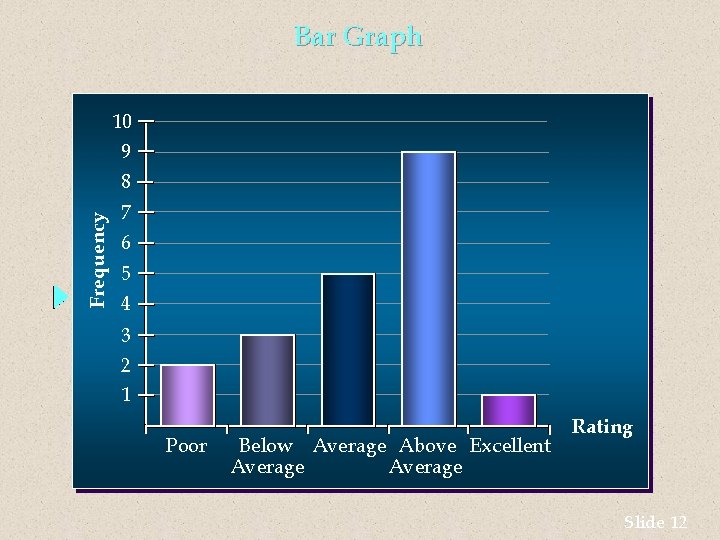
Bar Graph 10 9 Frequency 8 7 6 5 4 3 2 1 Poor Below Average Above Excellent Average Rating Slide 12
Pie Chart n The pie chart is a commonly used graphical device for presenting relative frequency distributions for qualitative data. n First draw a circle ; then use the relative frequencies to subdivide the circle into sectors that correspond to the relative frequency for each class. n Since there are 360 degrees in a circle, a class with a relative frequency of. 25 would consume. 25(360) = 90 degrees of the circle. Slide 13
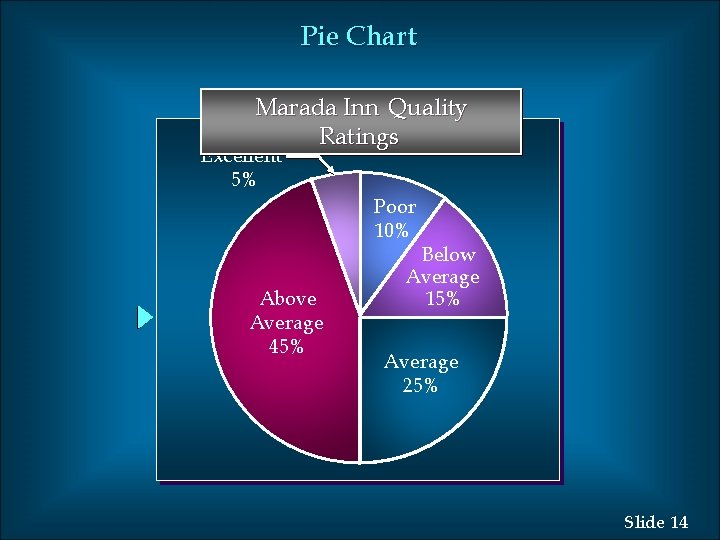
Pie Chart Marada Inn Quality Ratings Excellent 5% Poor 10% Above Average 45% Below Average 15% Average 25% Slide 14
Example: Marada Inn n Insights Gained from the Preceding Pie Chart • One-half of the customers surveyed gave Marada a quality rating of “above average” or “excellent” (looking at the left side of the pie). This might please the manager. • For each customer who gave an “excellent” rating, there were two customers who gave a “poor” rating (looking at the top of the pie). This should displease the manager. Slide 15
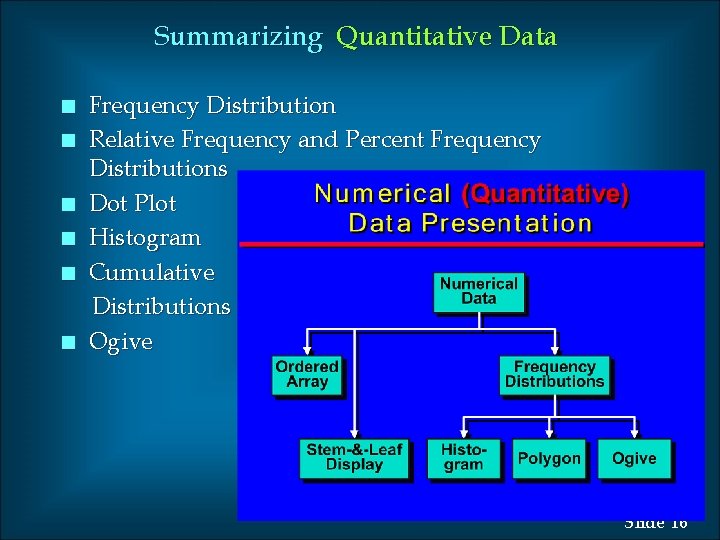
Summarizing Quantitative Data n n n Frequency Distribution Relative Frequency and Percent Frequency Distributions Dot Plot Histogram Cumulative Distributions Ogive Slide 16
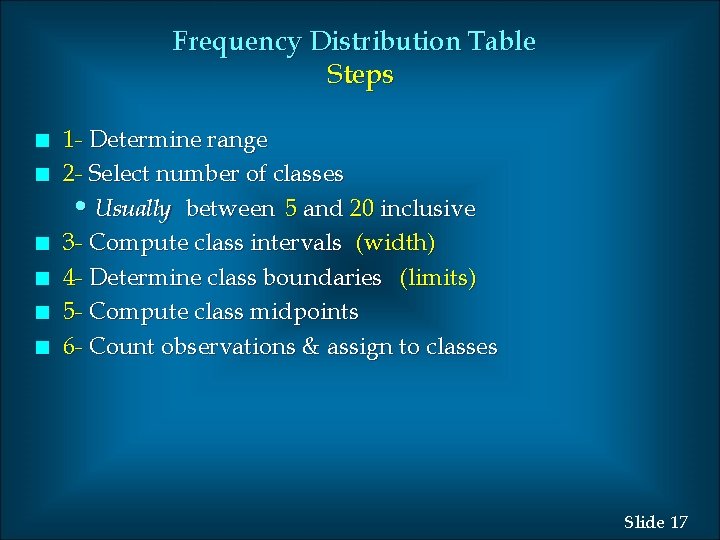
Frequency Distribution Table Steps n n n 1 - Determine range 2 - Select number of classes • Usually between 5 and 20 inclusive 3 - Compute class intervals (width) 4 - Determine class boundaries (limits) 5 - Compute class midpoints 6 - Count observations & assign to classes Slide 17
Example: Hudson Auto Repair The manager of Hudson Auto would like to have a better understanding of the cost of parts used in the engine tune-ups performed in the shop. She examines 50 customer invoices for tune-ups. The costs of parts, rounded to the nearest dollar, are listed on the next slide. Slide 18
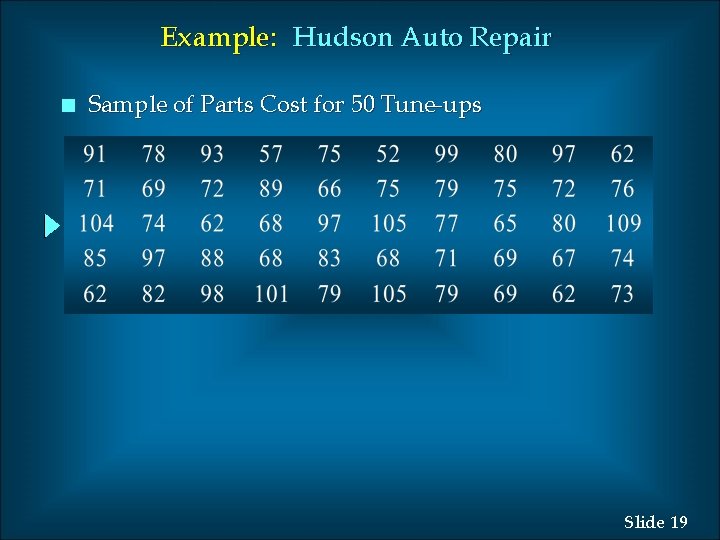
Example: Hudson Auto Repair n Sample of Parts Cost for 50 Tune-ups Slide 19
Frequency Distribution n Guidelines for Selecting Number of Classes • Use between 5 and 20 classes. • Data sets with a larger number of elements usually require a larger number of classes. • Smaller data sets usually require fewer classes Slide 20
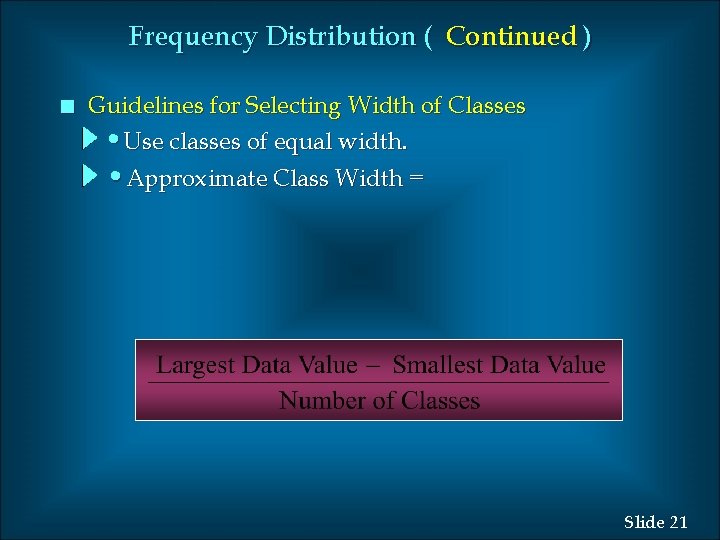
Frequency Distribution ( Continued ) n Guidelines for Selecting Width of Classes • Use classes of equal width. • Approximate Class Width = Slide 21
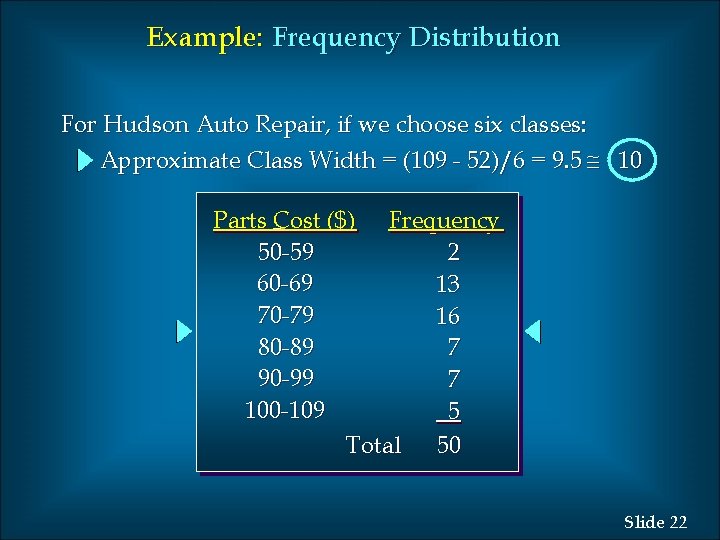
Example: Frequency Distribution For Hudson Auto Repair, if we choose six classes: Approximate Class Width = (109 - 52)/6 = 9. 5 10 Parts Cost ($) Frequency 50 -59 2 60 -69 13 70 -79 16 80 -89 7 90 -99 7 100 -109 5 Total 50 Slide 22
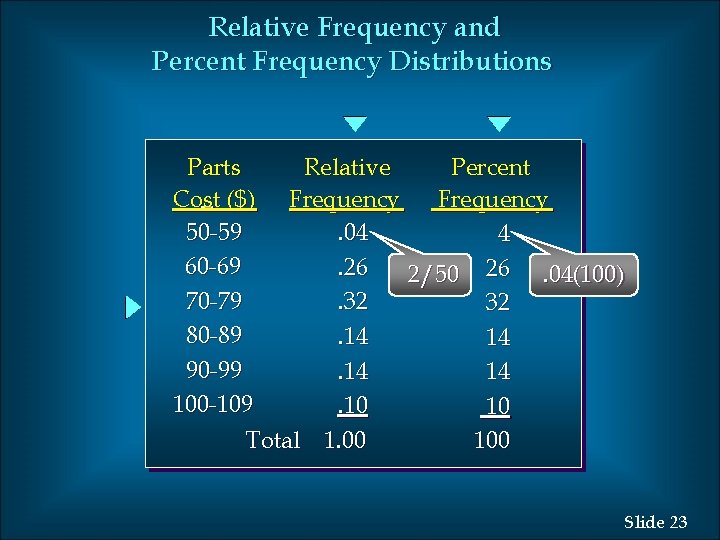
Relative Frequency and Percent Frequency Distributions Parts Relative Percent Cost ($) Frequency 50 -59. 04 4 60 -69. 26 2/50 26. 04(100) 70 -79. 32 32 80 -89. 14 14 90 -99. 14 14 100 -109. 10 10 Total 1. 00 100 Slide 23
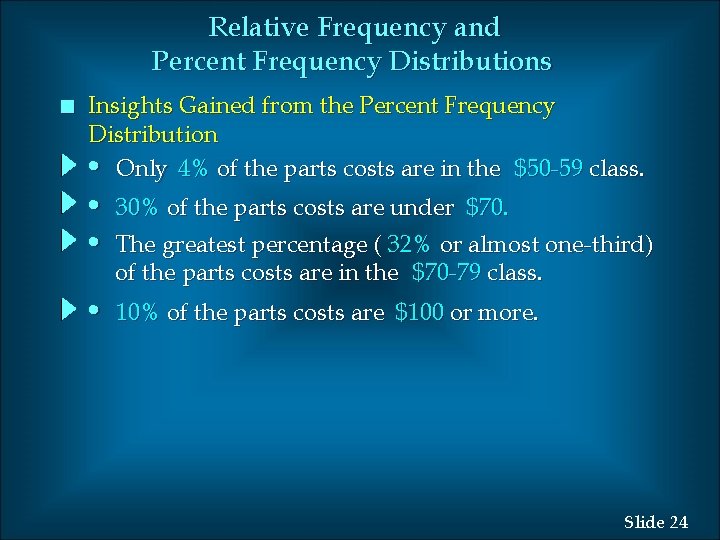
Relative Frequency and Percent Frequency Distributions n Insights Gained from the Percent Frequency Distribution • Only 4% of the parts costs are in the $50 -59 class. • • 30% of the parts costs are under $70. The greatest percentage ( 32% or almost one-third) of the parts costs are in the $70 -79 class. • 10% of the parts costs are $100 or more. Slide 24
Dot Plot n n n One of the simplest graphical summaries of data is a dot plot. A horizontal axis shows the range of data values. Then each data value is represented by a dot placed above the axis. Slide 25
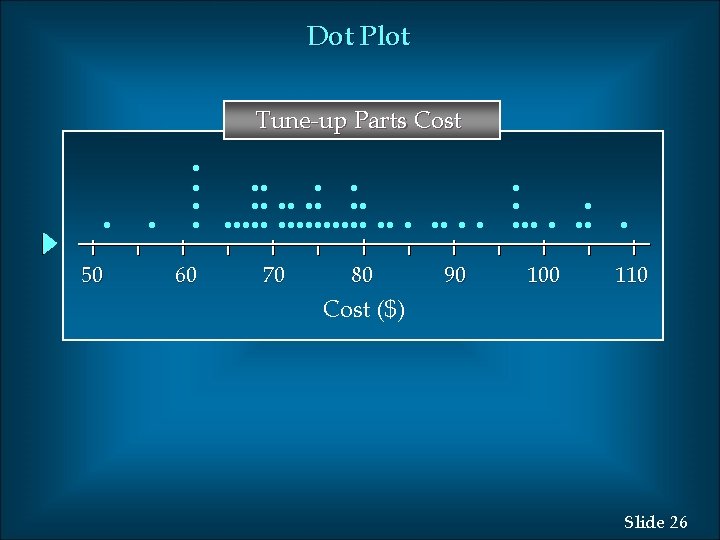
Dot Plot Tune-up Parts Cost . . . 50 60 70 80 90 100 110 Cost ($) Slide 26
Histogram n Another common graphical presentation of quantitative data is a histogram. n The variable of interest is placed on the horizontal axis. n A rectangle is drawn above each class interval with its height corresponding to the interval’s frequency , relative frequency , or percent frequency. n Unlike a bar graph, a histogram has no natural separation between rectangles of adjacent classes. Slide 27
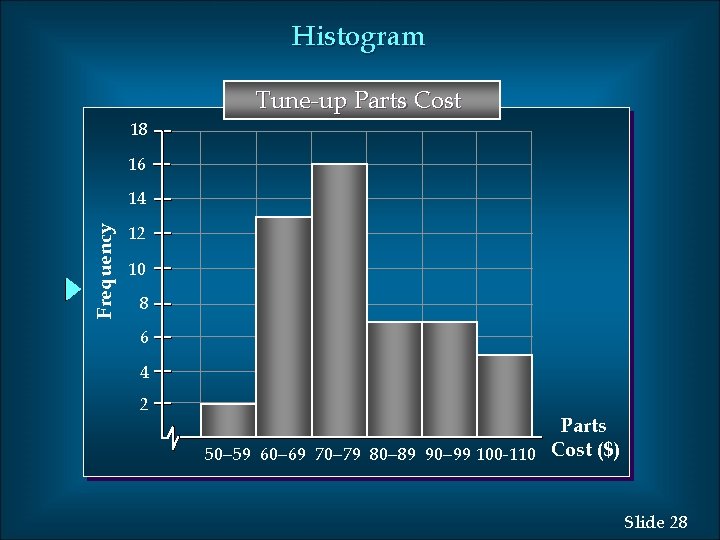
Histogram Tune-up Parts Cost 18 16 Frequency 14 12 10 8 6 4 2 Parts 50 -59 60 -69 70 -79 80 -89 90 -99 100 -110 Cost ($) Slide 28
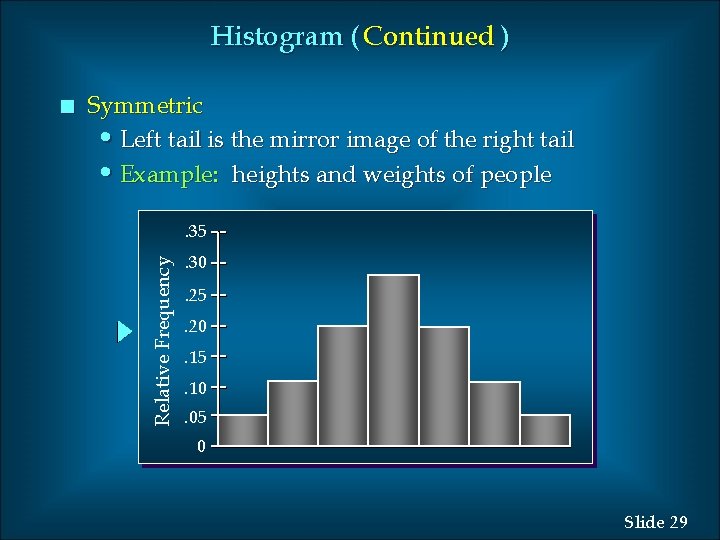
Histogram ( Continued ) Symmetric • Left tail is the mirror image of the right tail • Example: heights and weights of people. 35 Relative Frequency n . 30. 25. 20. 15. 10. 05 0 Slide 29
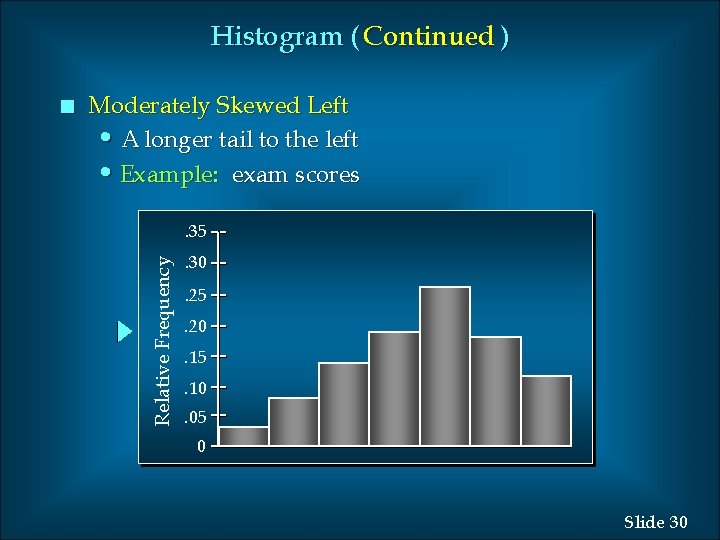
Histogram ( Continued ) Moderately Skewed Left • A longer tail to the left • Example: exam scores. 35 Relative Frequency n . 30. 25. 20. 15. 10. 05 0 Slide 30
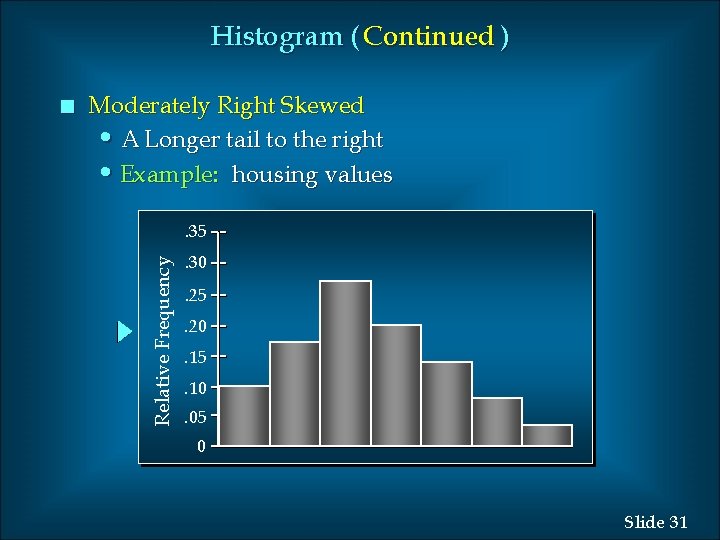
Histogram ( Continued ) Moderately Right Skewed • A Longer tail to the right • Example: housing values. 35 Relative Frequency n . 30. 25. 20. 15. 10. 05 0 Slide 31
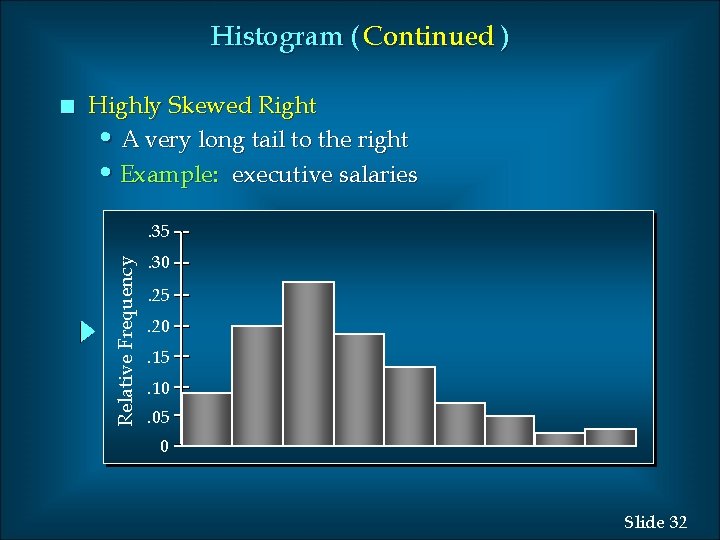
Histogram ( Continued ) Highly Skewed Right • A very long tail to the right • Example: executive salaries. 35 Relative Frequency n . 30. 25. 20. 15. 10. 05 0 Slide 32
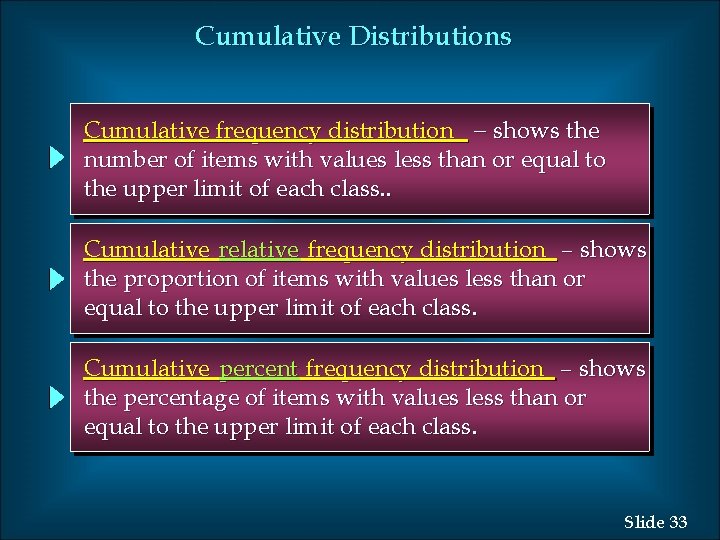
Cumulative Distributions Cumulative frequency distribution - shows the number of items with values less than or equal to the upper limit of each class. . Cumulative relative frequency distribution – shows the proportion of items with values less than or equal to the upper limit of each class. Cumulative percent frequency distribution – shows the percentage of items with values less than or equal to the upper limit of each class. Slide 33
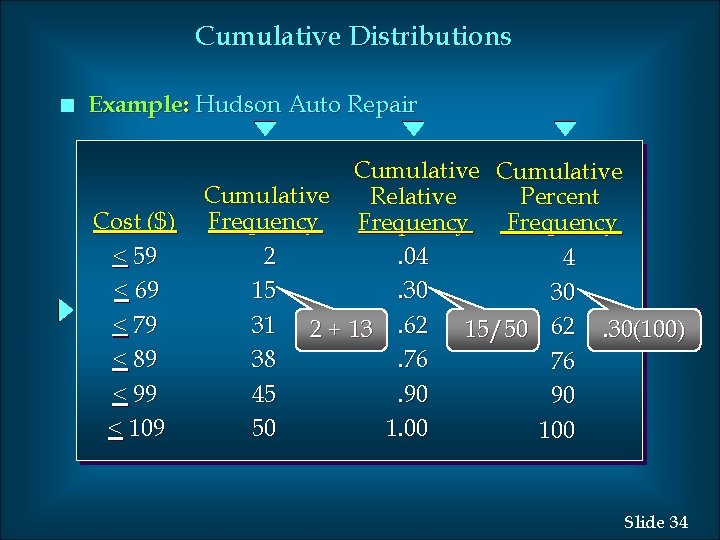
Cumulative Distributions n Example: Hudson Auto Repair Cost ($) < 59 < 69 < 79 < 89 < 99 < 109 Cumulative Relative Percent Frequency 2. 04 4 15. 30 30 31 2 + 13. 62 15/50 62. 30(100) 38. 76 76 45. 90 90 50 1. 00 100 Slide 34
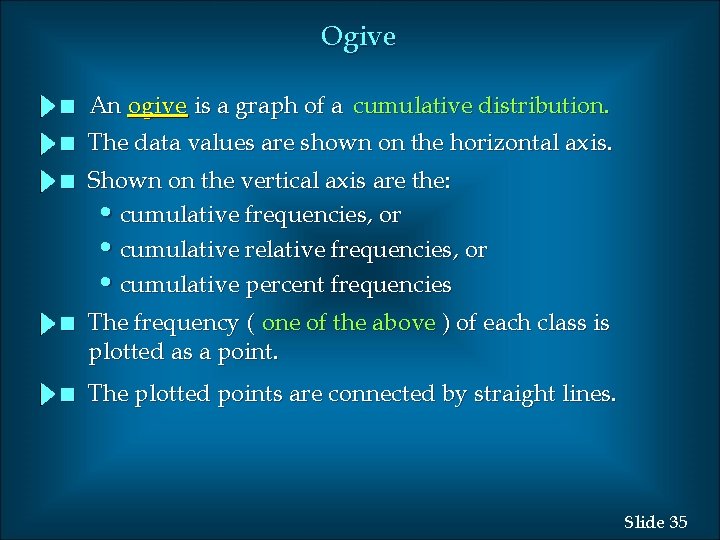
Ogive n An ogive is a graph of a cumulative distribution. n The data values are shown on the horizontal axis. n Shown on the vertical axis are the: • cumulative frequencies, or • cumulative relative frequencies, or • cumulative percent frequencies n The frequency ( one of the above ) of each class is plotted as a point. n The plotted points are connected by straight lines. Slide 35
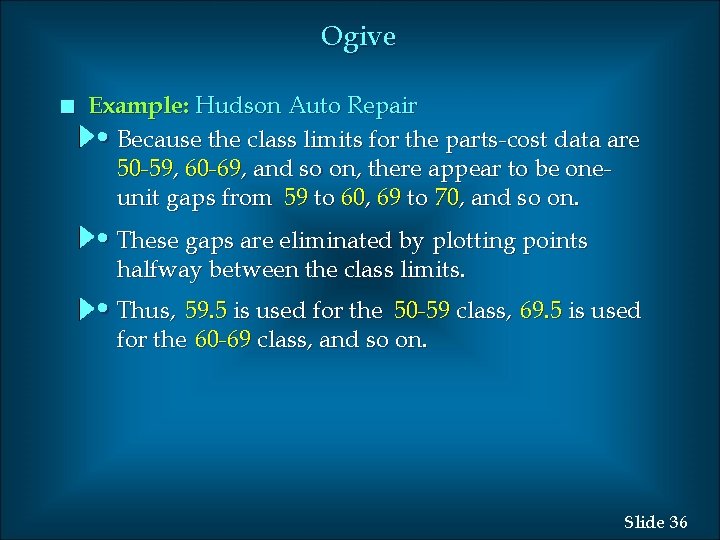
Ogive n Example: Hudson Auto Repair • Because the class limits for the parts-cost data are 50 -59, 60 -69, and so on, there appear to be oneunit gaps from 59 to 60, 69 to 70, and so on. • These gaps are eliminated by plotting points halfway between the class limits. • Thus, 59. 5 is used for the 50 -59 class, 69. 5 is used for the 60 -69 class, and so on. Slide 36
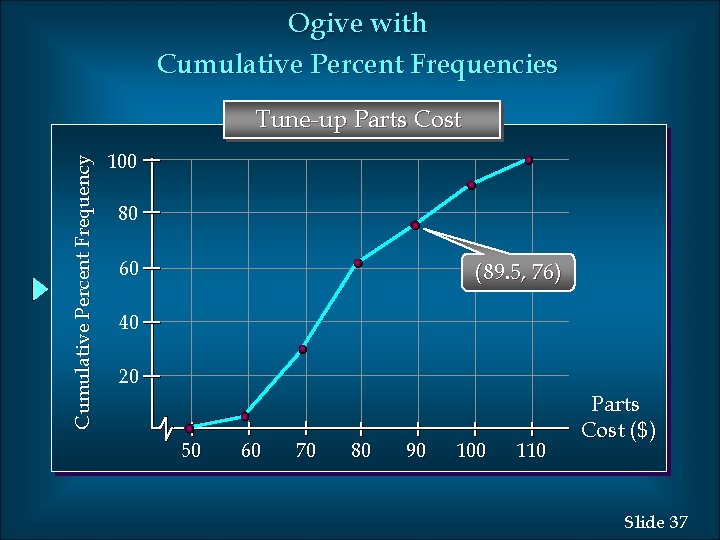
Ogive with Cumulative Percent Frequencies Cumulative Percent Frequency Tune-up Parts Cost 100 80 60 (89. 5, 76) 40 20 50 60 70 80 90 100 110 Parts Cost ($) Slide 37
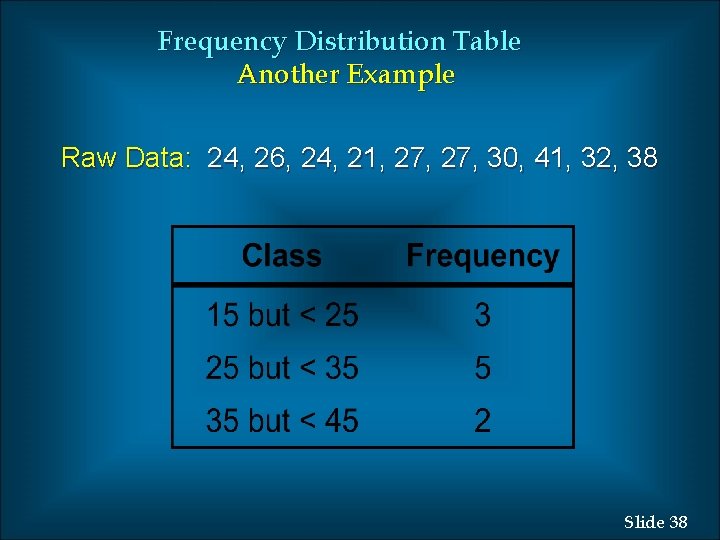
Frequency Distribution Table Another Example Raw Data: 24, 26, 24, 21, 27, 30, 41, 32, 38 Slide 38
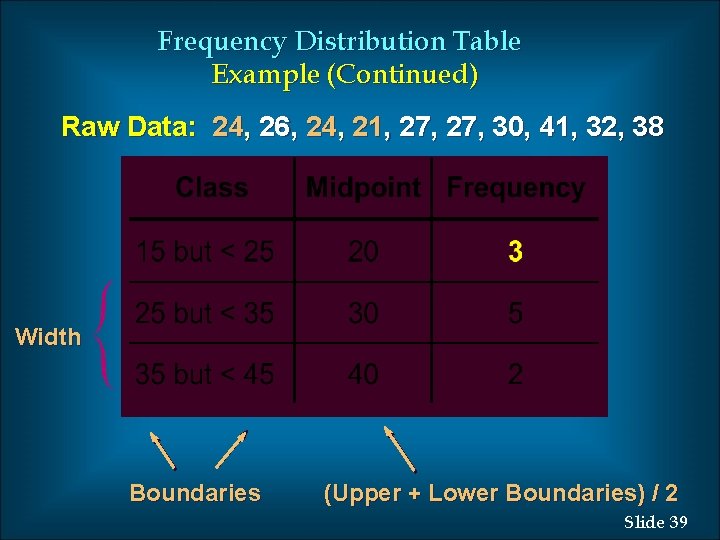
Frequency Distribution Table Example (Continued) Raw Data: 24, 26, 24, 21, 27, 30, 41, 32, 38 Width Boundaries (Upper + Lower Boundaries) / 2 Slide 39
Stated and True (or Real) Class Limits True Classes: Are those classes such that the upper true limit of a class is the same as the lower true limit of the next class. Ø For comparison, the stated class limits and true class limits are given in the following table—next slide: Ø Slide 40
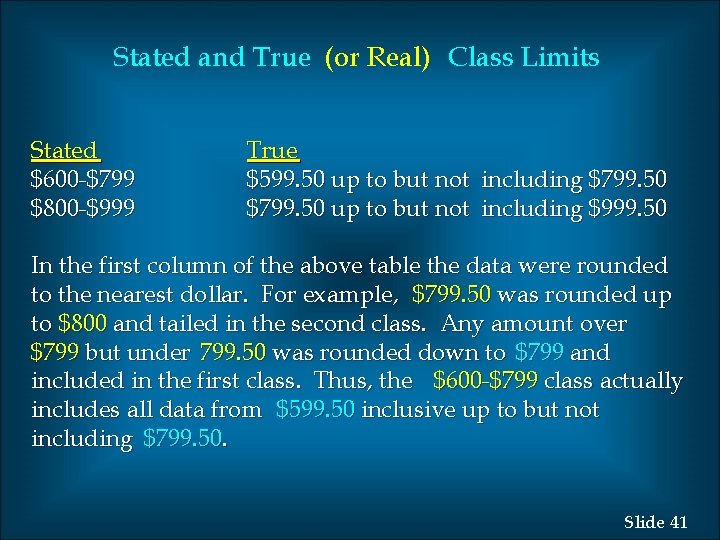
Stated and True (or Real) Class Limits Stated $600 -$799 $800 -$999 True $599. 50 up to but not including $799. 50 up to but not including $999. 50 In the first column of the above table the data were rounded to the nearest dollar. For example, $799. 50 was rounded up to $800 and tailed in the second class. Any amount over $799 but under 799. 50 was rounded down to $799 and included in the first class. Thus, the $600 -$799 class actually includes all data from $599. 50 inclusive up to but not including $799. 50. Slide 41
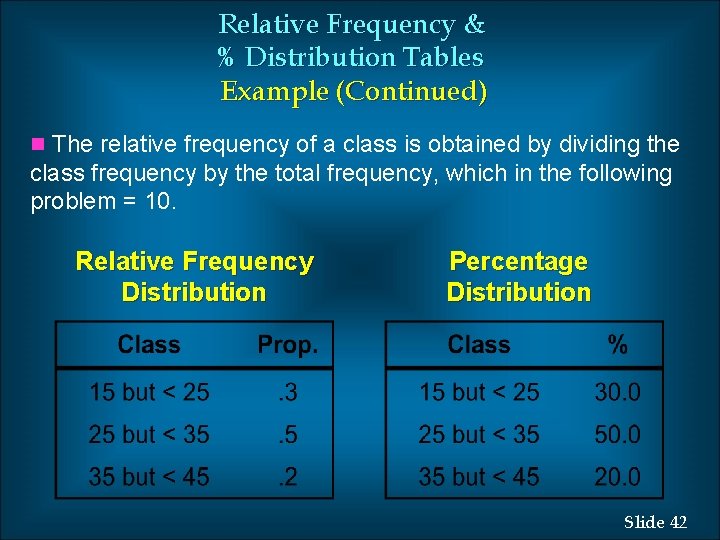
Relative Frequency & % Distribution Tables Example (Continued) n The relative frequency of a class is obtained by dividing the class frequency by the total frequency, which in the following problem = 10. Relative Frequency Distribution Percentage Distribution Slide 42
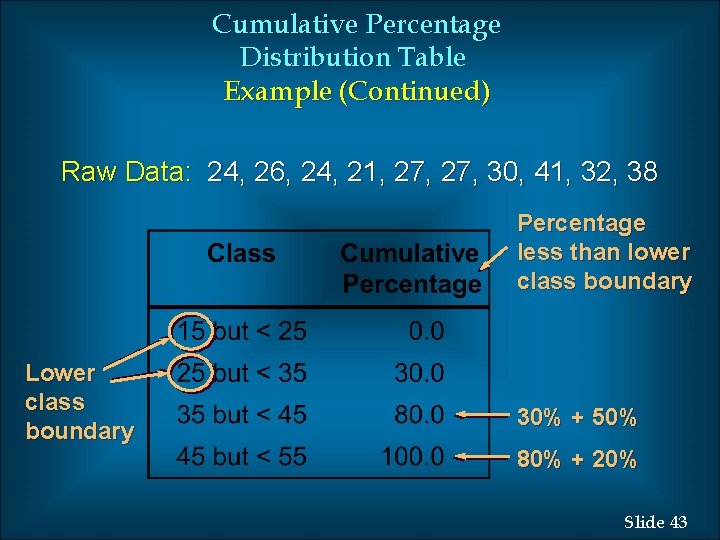
Cumulative Percentage Distribution Table Example (Continued) Raw Data: 24, 26, 24, 21, 27, 30, 41, 32, 38 Percentage less than lower class boundary Lower class boundary 30% + 50% 80% + 20% Slide 43
End of Chapters 2 Part A Slide 44
- Slides: 44