
Chapters 12 15 Thermodynamics Introduction 1 Equilibrium of
Chapters 12 -15 Thermodynamics Introduction 1

Equilibrium of mechanical systems: the concept of temperature • Three parameters were needed to describe the motion and equilibrium states of bodies length, mass, and time • To describe thermal or heat effects in systems we need another fundamental parameter temperature: T 2

Example: thermal equilibrium ICE • Block of ice and the balloon are each in mechanical equilibrium: F = 0 • Now put them in contact • Both systems now undergo changes • The volume of ice decreases (it melts) and the pressure and volume of the balloon decrease • They come to a final state of thermal equilibrium which must be characterized by a new physical property called temperature T • In thermal equilibrium: Tice = Tballoon 3
Thermodynamics • Deals with very practical phenomenon, e. g. , engines, power generation systems • The study of heat and work and the transformation of one into the other • Based on observations of energy exchanges between macroscopic systems • Macroscopic – systems with very large numbers of particles in 1 m 3 there are over 1025 air molecules 4

Macroscopic Parameters • The macroscopic parameters are those that can be measured directly – temperature, pressure, volume • The macroscopic parameters reflect the average behavior of the microscopic constituents of the system, for example, the velocities of the molecules which cannot be directly measured • Newton’s laws cannot be used to solve problems involving 1023 particles 5
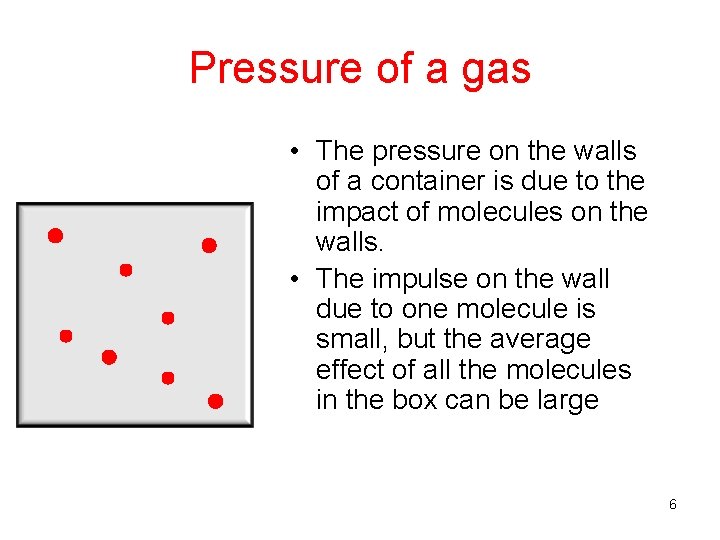
Pressure of a gas • The pressure on the walls of a container is due to the impact of molecules on the walls. • The impulse on the wall due to one molecule is small, but the average effect of all the molecules in the box can be large 6
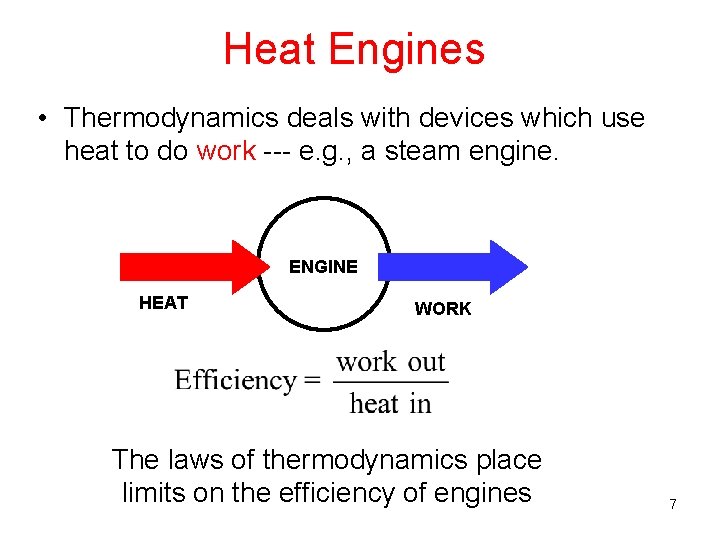
Heat Engines • Thermodynamics deals with devices which use heat to do work --- e. g. , a steam engine. ENGINE HEAT WORK The laws of thermodynamics place limits on the efficiency of engines 7
Laws of Thermodynamics • First Law The transformation of heat into work obeys the Principle of Conservation of Energy • Second Law – The heat going into an engine cannot all be converted to work, some heat is wasted – Heat flows spontaneously from hot to cold, (ice always melts when placed in water); and work must be done to make heat flow from cold to hot (refrigerators & air conditioners) 8
Internal Energy • The molecules in a system, like a gas, are in constant motion. Each molecule has a kinetic energy ½ mv 2. The KE of an individual molecule cannot be measured • The internal energy of a system is the sum of all the kinetic energy of all the molecules in the system 9
Temperature • Temperature is a macroscopic parameter that is a measure of the average KE of the molecules in a system. • Temperature is the macroscopic measure of the internal energy of a system 10
Heat • Heat is the energy that flows from one system to another system because one is hotter than the other • Heat flows from the hot system (lowering its internal energy and temperature) to a cold system (raising its internal energy and temperature). • Heat stops flowing when the two systems reach a common temperature. 11
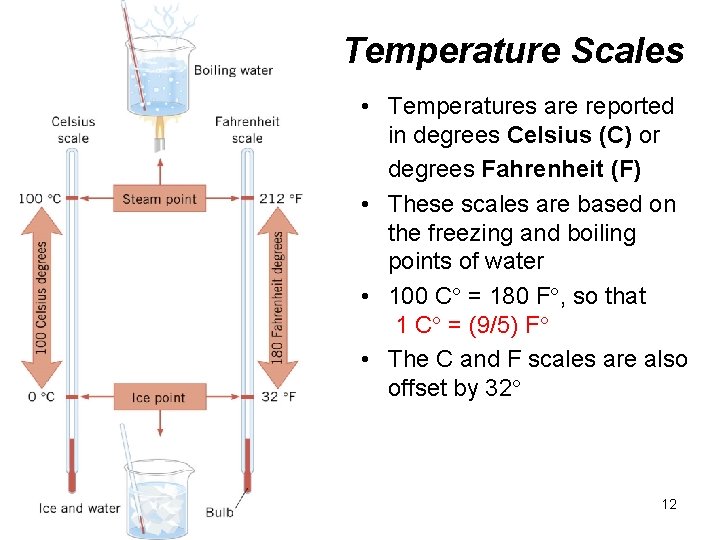
Temperature Scales • Temperatures are reported in degrees Celsius (C) or degrees Fahrenheit (F) • These scales are based on the freezing and boiling points of water • 100 C = 180 F , so that 1 C = (9/5) F • The C and F scales are also offset by 32 12
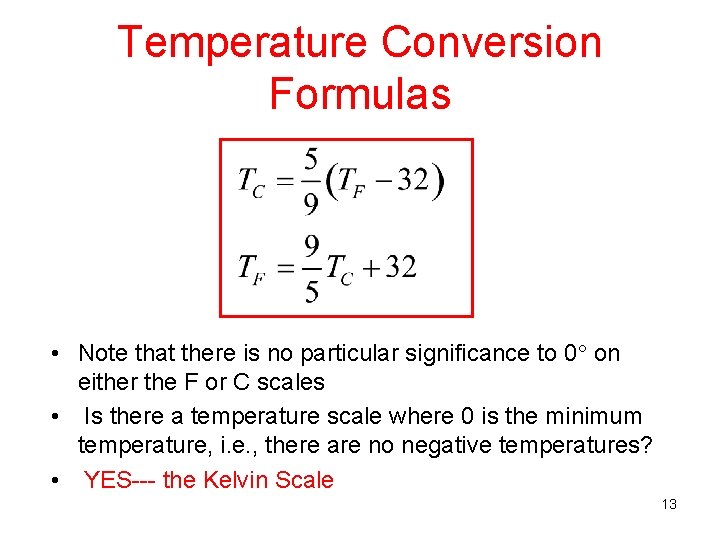
Temperature Conversion Formulas • Note that there is no particular significance to 0 on either the F or C scales • Is there a temperature scale where 0 is the minimum temperature, i. e. , there are no negative temperatures? • YES--- the Kelvin Scale 13
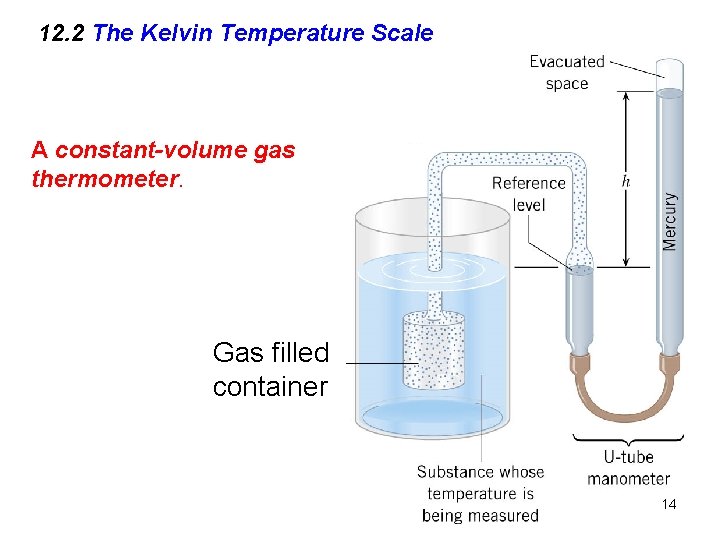
12. 2 The Kelvin Temperature Scale A constant-volume gas thermometer. Gas filled container 14
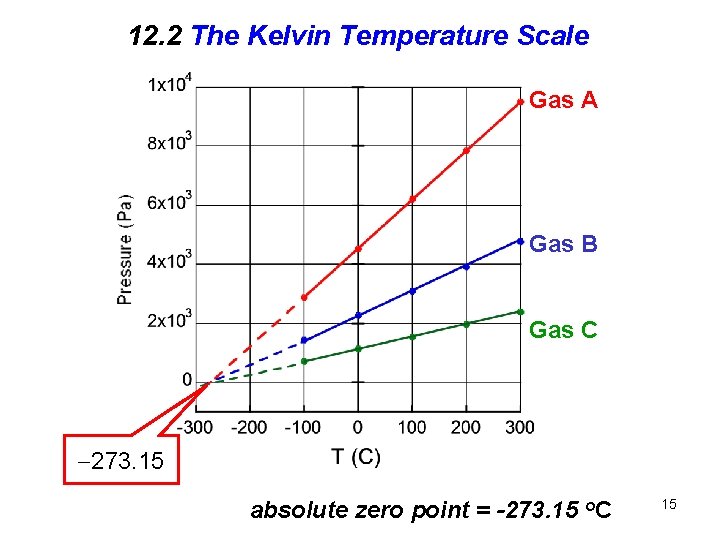
12. 2 The Kelvin Temperature Scale Gas A Gas B Gas C 273. 15 absolute zero point = -273. 15 o. C 15
Kelvin scale • One degree C = one degree K • Scales offset by 273. 15 • T(K) = T(C) + 273. 15 16
Example: Liquid N 2 • TF = 321 F • TC = (5/9)(TF 32) = (5/9)( 321 32) = (5/9) ( 353) = 196 C • TK = TC + 273 = 77 K 17
Thermometers • Certain materials have properties (thermometric properties) that change with temperature --- these can be used to make thermometers – Length of a column of liquid – Thermocouple – electrical ---digital thermometer – Infrared radiation detectors – thermometers that are placed into your ear 18
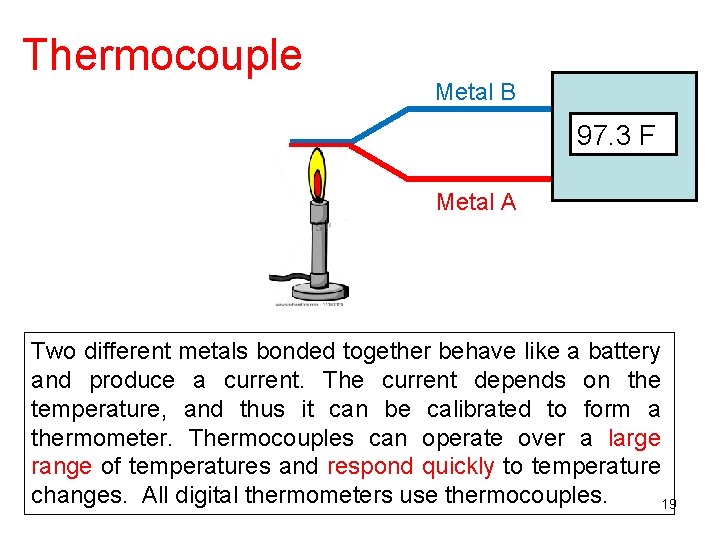
Thermocouple Metal B 97. 3 F Metal A Two different metals bonded together behave like a battery and produce a current. The current depends on the temperature, and thus it can be calibrated to form a thermometer. Thermocouples can operate over a large range of temperatures and respond quickly to temperature changes. All digital thermometers use thermocouples. 19
- Slides: 19