
Chapters 10 11 Lessons from the Great Depression

- Slides: 22
Chapters 10 & 11
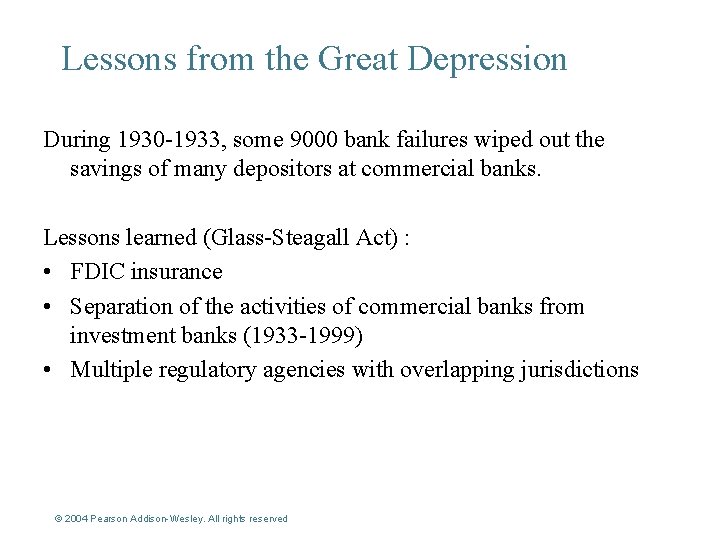
Lessons from the Great Depression During 1930 -1933, some 9000 bank failures wiped out the savings of many depositors at commercial banks. Lessons learned (Glass-Steagall Act) : • FDIC insurance • Separation of the activities of commercial banks from investment banks (1933 -1999) • Multiple regulatory agencies with overlapping jurisdictions © 2004 Pearson Addison-Wesley. All rights reserved 2
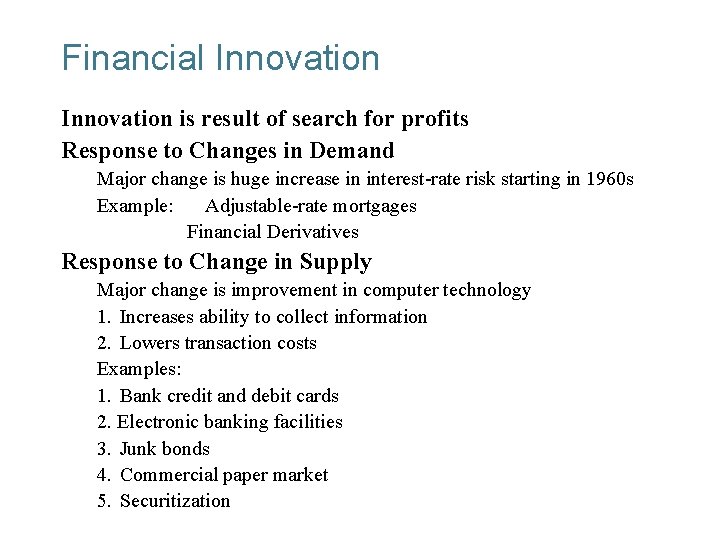
Financial Innovation is result of search for profits Response to Changes in Demand Major change is huge increase in interest-rate risk starting in 1960 s Example: Adjustable-rate mortgages Financial Derivatives Response to Change in Supply Major change is improvement in computer technology 1. Increases ability to collect information 2. Lowers transaction costs Examples: 1. Bank credit and debit cards 2. Electronic banking facilities 3. Junk bonds 4. Commercial paper market 5. Securitization 3
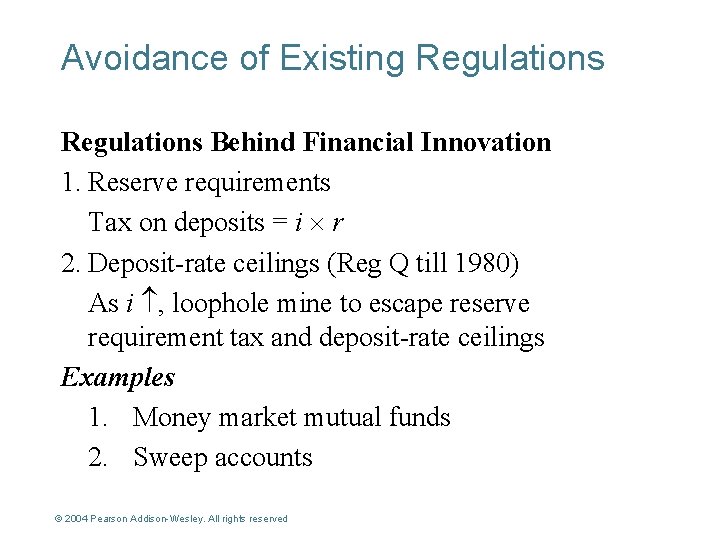
Avoidance of Existing Regulations Behind Financial Innovation 1. Reserve requirements Tax on deposits = i r 2. Deposit-rate ceilings (Reg Q till 1980) As i , loophole mine to escape reserve requirement tax and deposit-rate ceilings Examples 1. Money market mutual funds 2. Sweep accounts © 2004 Pearson Addison-Wesley. All rights reserved 4
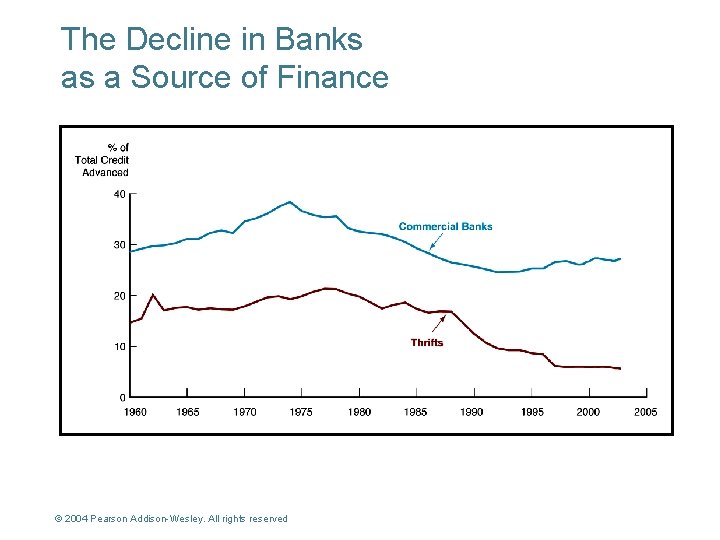
The Decline in Banks as a Source of Finance © 2004 Pearson Addison-Wesley. All rights reserved 5
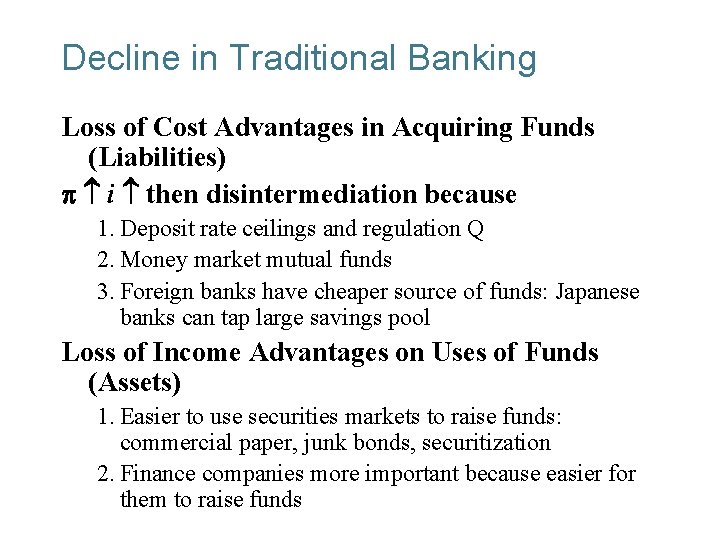
Decline in Traditional Banking Loss of Cost Advantages in Acquiring Funds (Liabilities) i then disintermediation because 1. Deposit rate ceilings and regulation Q 2. Money market mutual funds 3. Foreign banks have cheaper source of funds: Japanese banks can tap large savings pool Loss of Income Advantages on Uses of Funds (Assets) 1. Easier to use securities markets to raise funds: commercial paper, junk bonds, securitization 2. Finance companies more important because easier for them to raise funds 6
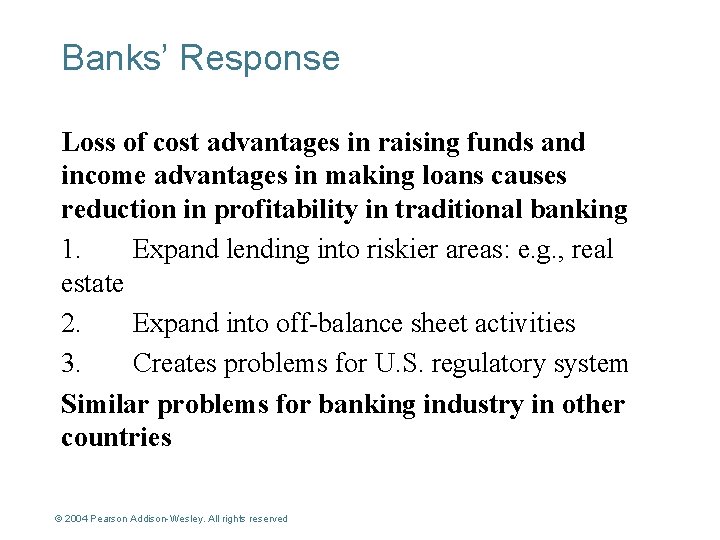
Banks’ Response Loss of cost advantages in raising funds and income advantages in making loans causes reduction in profitability in traditional banking 1. Expand lending into riskier areas: e. g. , real estate 2. Expand into off-balance sheet activities 3. Creates problems for U. S. regulatory system Similar problems for banking industry in other countries © 2004 Pearson Addison-Wesley. All rights reserved 7
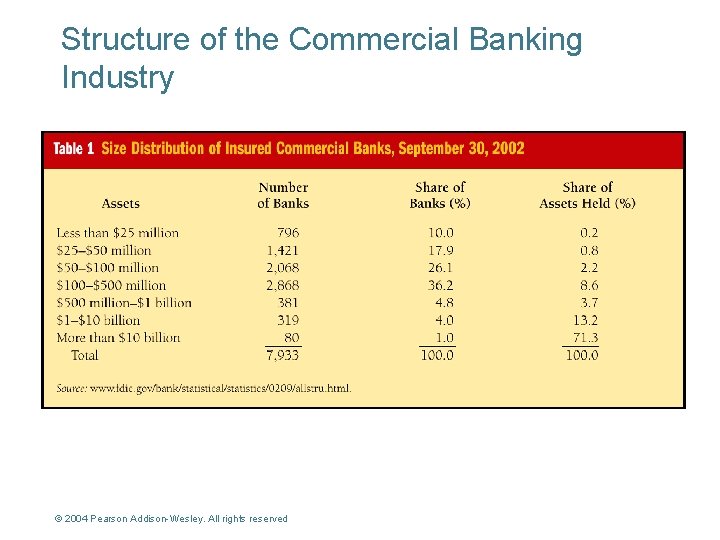
Structure of the Commercial Banking Industry © 2004 Pearson Addison-Wesley. All rights reserved 8
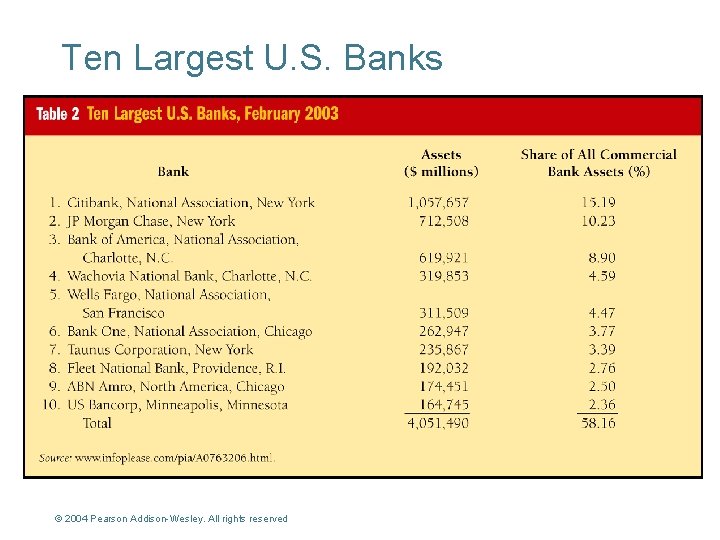
Ten Largest U. S. Banks © 2004 Pearson Addison-Wesley. All rights reserved 9
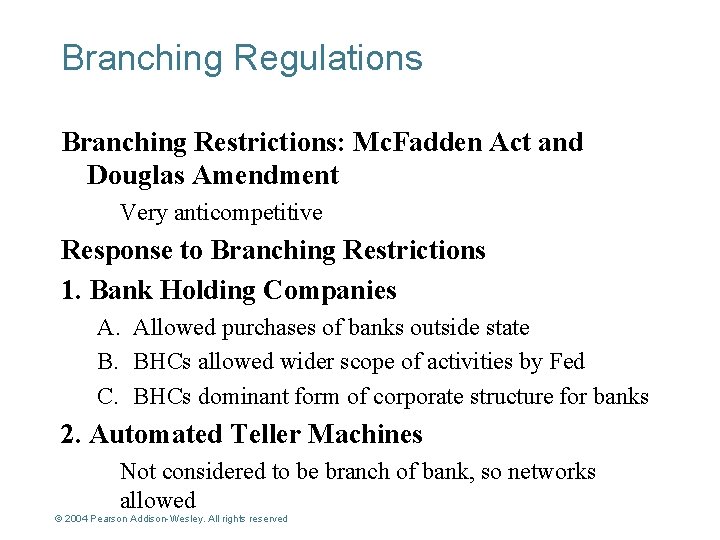
Branching Regulations Branching Restrictions: Mc. Fadden Act and Douglas Amendment Very anticompetitive Response to Branching Restrictions 1. Bank Holding Companies A. Allowed purchases of banks outside state B. BHCs allowed wider scope of activities by Fed C. BHCs dominant form of corporate structure for banks 2. Automated Teller Machines Not considered to be branch of bank, so networks allowed © 2004 Pearson Addison-Wesley. All rights reserved 10
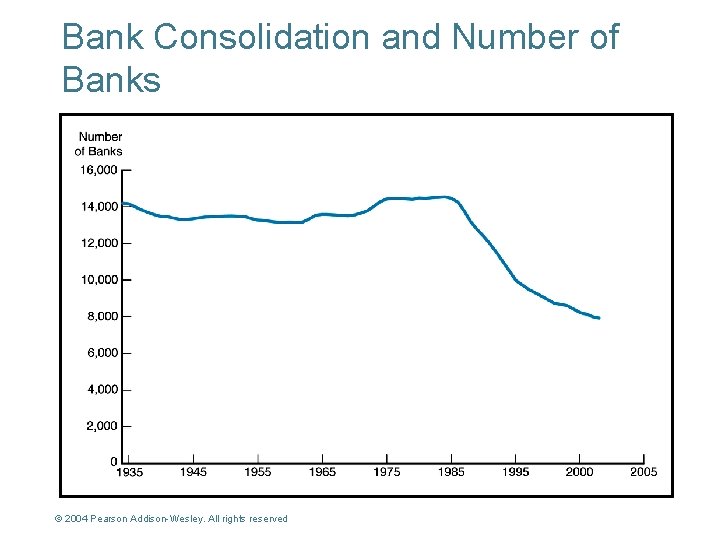
Bank Consolidation and Number of Banks © 2004 Pearson Addison-Wesley. All rights reserved 11
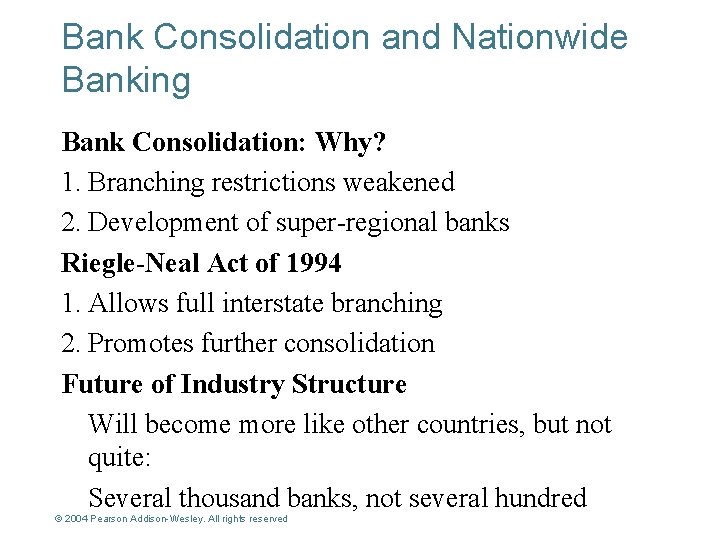
Bank Consolidation and Nationwide Banking Bank Consolidation: Why? 1. Branching restrictions weakened 2. Development of super-regional banks Riegle-Neal Act of 1994 1. Allows full interstate branching 2. Promotes further consolidation Future of Industry Structure Will become more like other countries, but not quite: Several thousand banks, not several hundred © 2004 Pearson Addison-Wesley. All rights reserved 12
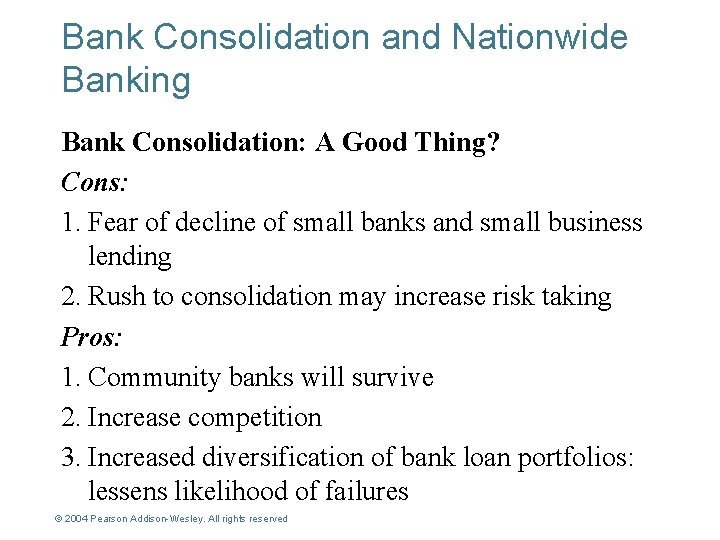
Bank Consolidation and Nationwide Banking Bank Consolidation: A Good Thing? Cons: 1. Fear of decline of small banks and small business lending 2. Rush to consolidation may increase risk taking Pros: 1. Community banks will survive 2. Increase competition 3. Increased diversification of bank loan portfolios: lessens likelihood of failures © 2004 Pearson Addison-Wesley. All rights reserved 13
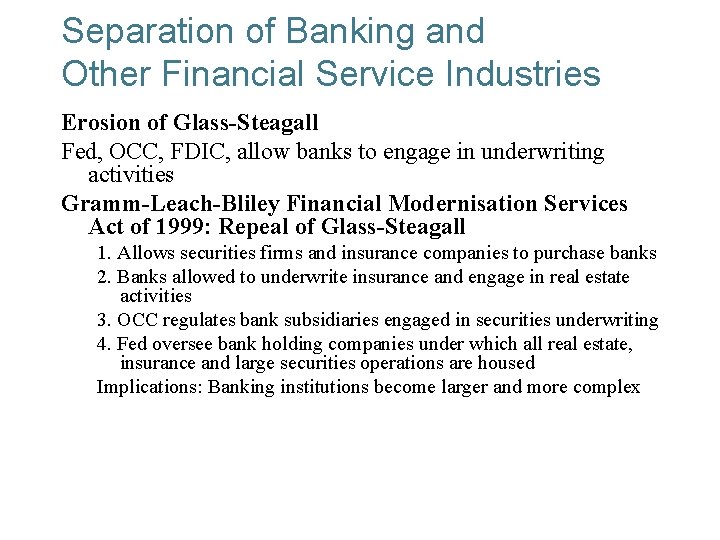
Separation of Banking and Other Financial Service Industries Erosion of Glass-Steagall Fed, OCC, FDIC, allow banks to engage in underwriting activities Gramm-Leach-Bliley Financial Modernisation Services Act of 1999: Repeal of Glass-Steagall 1. Allows securities firms and insurance companies to purchase banks 2. Banks allowed to underwrite insurance and engage in real estate activities 3. OCC regulates bank subsidiaries engaged in securities underwriting 4. Fed oversee bank holding companies under which all real estate, insurance and large securities operations are housed Implications: Banking institutions become larger and more complex 14
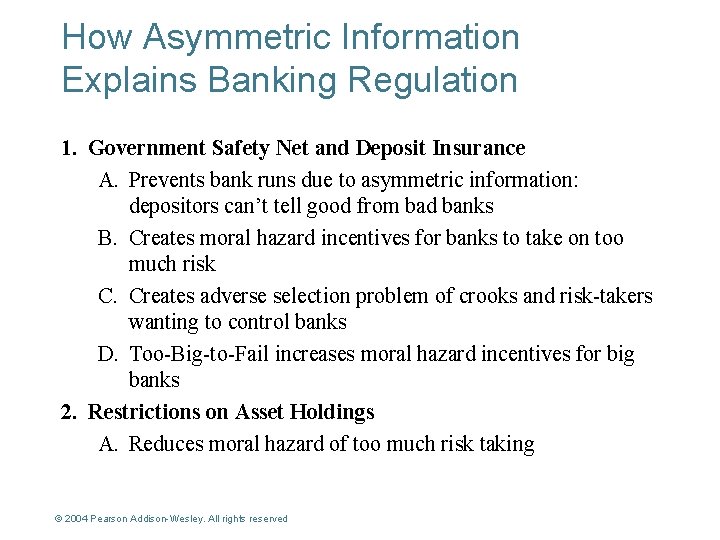
How Asymmetric Information Explains Banking Regulation 1. Government Safety Net and Deposit Insurance A. Prevents bank runs due to asymmetric information: depositors can’t tell good from bad banks B. Creates moral hazard incentives for banks to take on too much risk C. Creates adverse selection problem of crooks and risk-takers wanting to control banks D. Too-Big-to-Fail increases moral hazard incentives for big banks 2. Restrictions on Asset Holdings A. Reduces moral hazard of too much risk taking © 2004 Pearson Addison-Wesley. All rights reserved 15
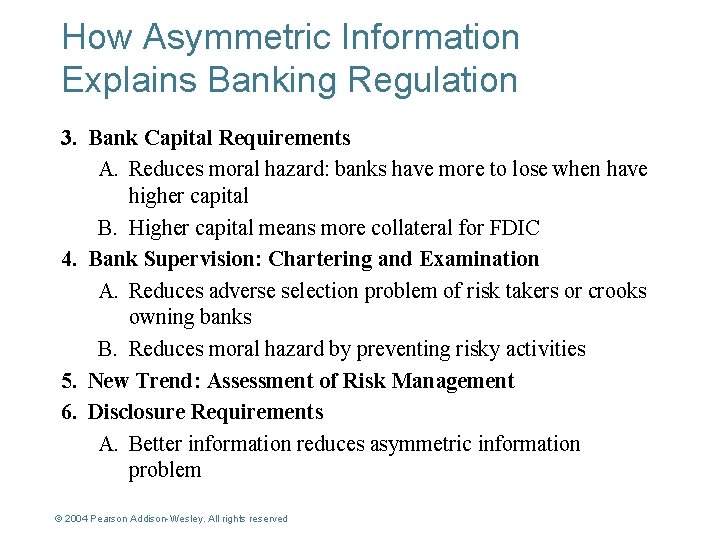
How Asymmetric Information Explains Banking Regulation 3. Bank Capital Requirements A. Reduces moral hazard: banks have more to lose when have higher capital B. Higher capital means more collateral for FDIC 4. Bank Supervision: Chartering and Examination A. Reduces adverse selection problem of risk takers or crooks owning banks B. Reduces moral hazard by preventing risky activities 5. New Trend: Assessment of Risk Management 6. Disclosure Requirements A. Better information reduces asymmetric information problem © 2004 Pearson Addison-Wesley. All rights reserved 16
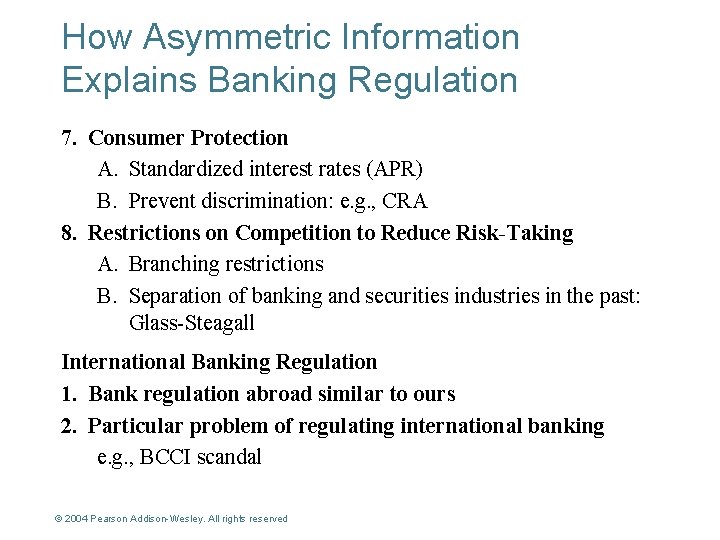
How Asymmetric Information Explains Banking Regulation 7. Consumer Protection A. Standardized interest rates (APR) B. Prevent discrimination: e. g. , CRA 8. Restrictions on Competition to Reduce Risk-Taking A. Branching restrictions B. Separation of banking and securities industries in the past: Glass-Steagall International Banking Regulation 1. Bank regulation abroad similar to ours 2. Particular problem of regulating international banking e. g. , BCCI scandal © 2004 Pearson Addison-Wesley. All rights reserved 17
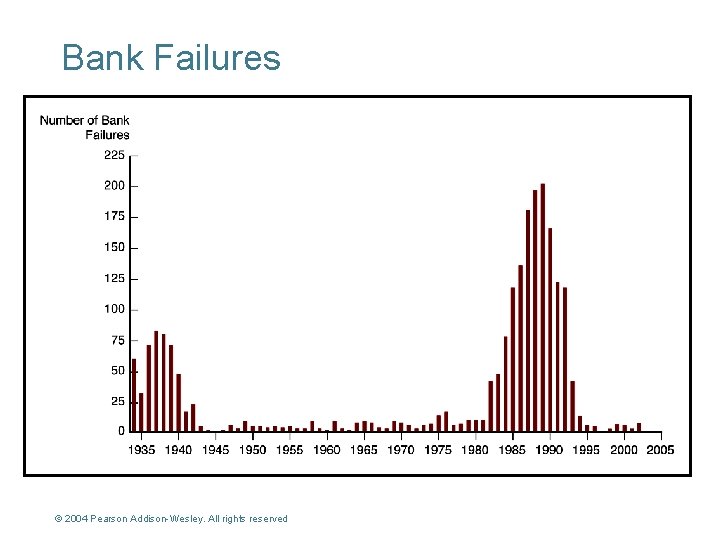
Bank Failures © 2004 Pearson Addison-Wesley. All rights reserved 18
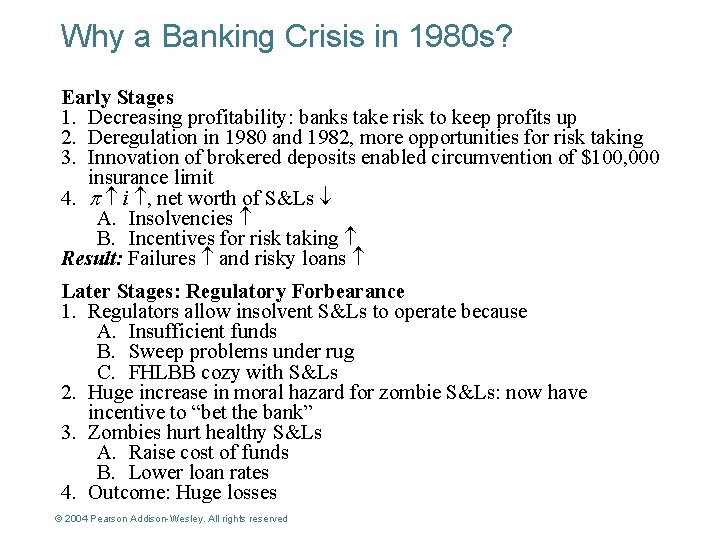
Why a Banking Crisis in 1980 s? Early Stages 1. Decreasing profitability: banks take risk to keep profits up 2. Deregulation in 1980 and 1982, more opportunities for risk taking 3. Innovation of brokered deposits enabled circumvention of $100, 000 insurance limit 4. i , net worth of S&Ls A. Insolvencies B. Incentives for risk taking Result: Failures and risky loans Later Stages: Regulatory Forbearance 1. Regulators allow insolvent S&Ls to operate because A. Insufficient funds B. Sweep problems under rug C. FHLBB cozy with S&Ls 2. Huge increase in moral hazard for zombie S&Ls: now have incentive to “bet the bank” 3. Zombies hurt healthy S&Ls A. Raise cost of funds B. Lower loan rates 4. Outcome: Huge losses © 2004 Pearson Addison-Wesley. All rights reserved 19
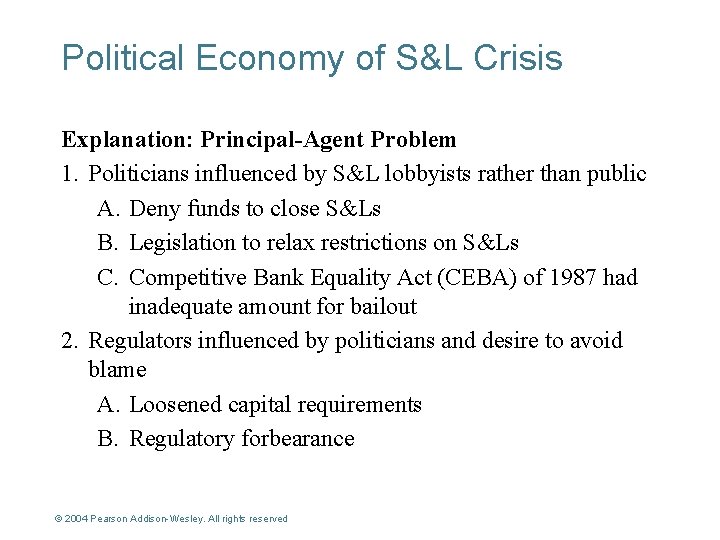
Political Economy of S&L Crisis Explanation: Principal-Agent Problem 1. Politicians influenced by S&L lobbyists rather than public A. Deny funds to close S&Ls B. Legislation to relax restrictions on S&Ls C. Competitive Bank Equality Act (CEBA) of 1987 had inadequate amount for bailout 2. Regulators influenced by politicians and desire to avoid blame A. Loosened capital requirements B. Regulatory forbearance © 2004 Pearson Addison-Wesley. All rights reserved 20
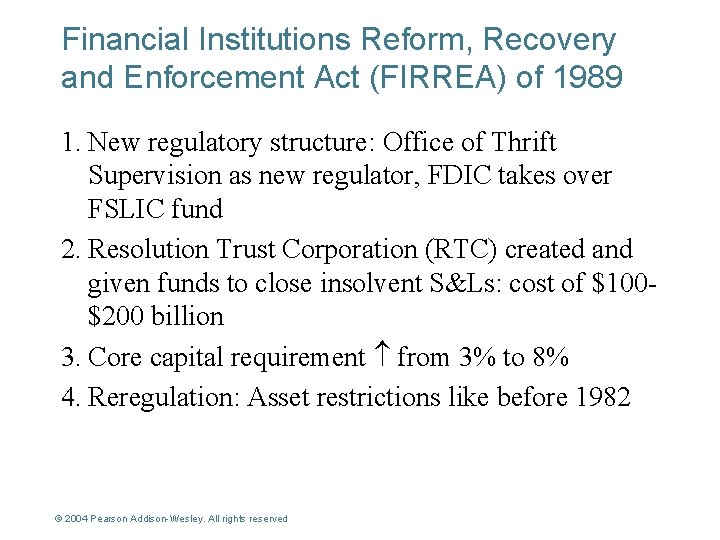
Financial Institutions Reform, Recovery and Enforcement Act (FIRREA) of 1989 1. New regulatory structure: Office of Thrift Supervision as new regulator, FDIC takes over FSLIC fund 2. Resolution Trust Corporation (RTC) created and given funds to close insolvent S&Ls: cost of $100$200 billion 3. Core capital requirement from 3% to 8% 4. Reregulation: Asset restrictions like before 1982 © 2004 Pearson Addison-Wesley. All rights reserved 21
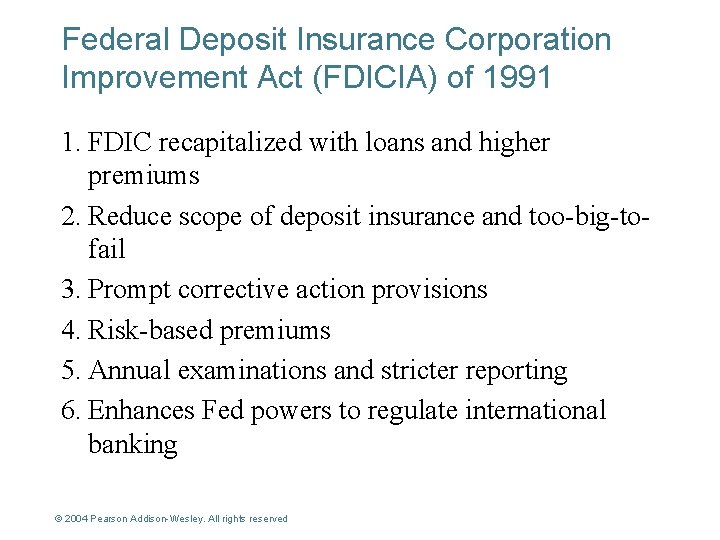
Federal Deposit Insurance Corporation Improvement Act (FDICIA) of 1991 1. FDIC recapitalized with loans and higher premiums 2. Reduce scope of deposit insurance and too-big-tofail 3. Prompt corrective action provisions 4. Risk-based premiums 5. Annual examinations and stricter reporting 6. Enhances Fed powers to regulate international banking © 2004 Pearson Addison-Wesley. All rights reserved 22