
Chapters 10 11 Abruscato De Rosa The EarthSpace
Chapters 10& 11 Abruscato & De. Rosa The Earth/Space Sciences
History and Nature of Earth/Space Sciences • We see the same night sky generations of humans have experiences and ask: “why? ” “How? ” and “Why? ” • Branches of Earth/Space Sciences: astronomy, geology, oceanography, meteorology, and astronomy. • Careers: Geologist, Oceanographer, Meteorologist, Astronomer
Chapter 10 Earth’s Surface, Atmosphere, and Weather • Spaceship Earth: What Is It made Of? 1. The Earth Beneath Your Feet: Earth’s Layerscrust (7 -20 miles), mantle (1780 miles), core (mass of molten metal) (use peach or avocado with large seed for core) 2. Gradual Changes in the Earth’s Surface: Continental drift- supercontinent-Pangaea, Wegener (1912), (use map of continents- cut out and piece N. A. /S. A. /Africa/Europe together) Continents are still moving 1 -5 cm per year.
Gradual Changes in the Earth’s Surface 1. Weathering and Erosion- water, wind, ice, sand 2. Internal forces, which come from heat and pressure, push rock layers upward and sideways to form mountains.
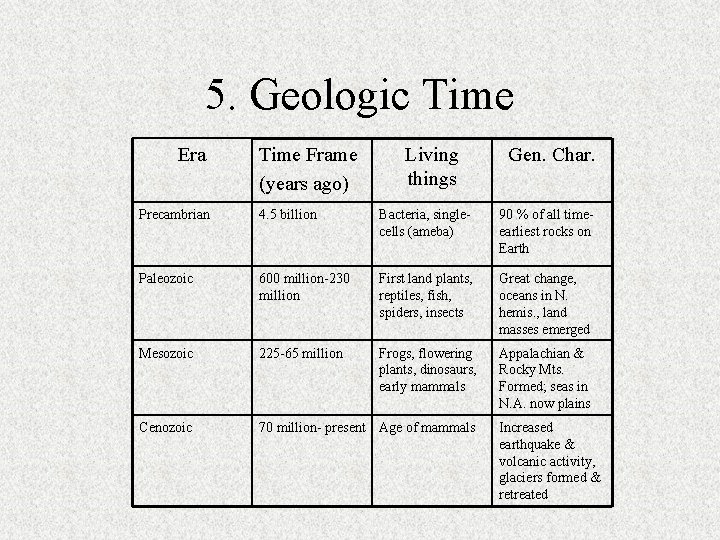
5. Geologic Time Era Time Frame (years ago) Living things Gen. Char. Precambrian 4. 5 billion Bacteria, singlecells (ameba) 90 % of all timeearliest rocks on Earth Paleozoic 600 million-230 million First land plants, reptiles, fish, spiders, insects Great change, oceans in N. hemis. , land masses emerged Mesozoic 225 -65 million Frogs, flowering plants, dinosaurs, early mammals Appalachian & Rocky Mts. Formed; seas in N. A. now plains Cenozoic 70 million- present Age of mammals Increased earthquake & volcanic activity, glaciers formed & retreated
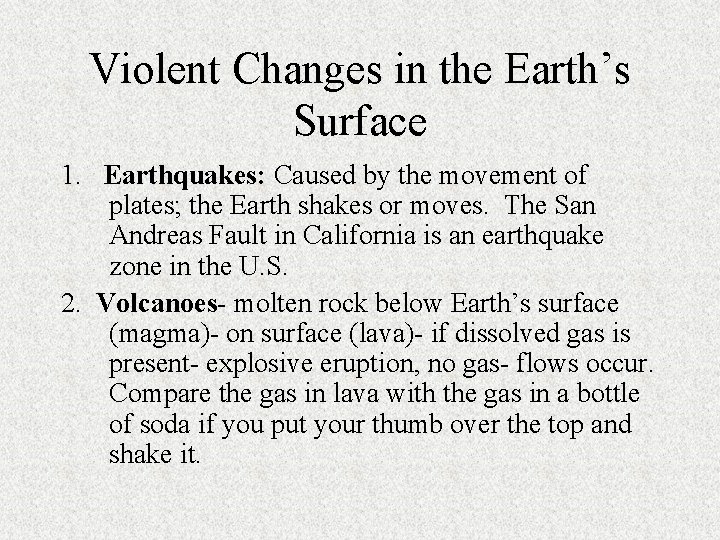
Violent Changes in the Earth’s Surface 1. Earthquakes: Caused by the movement of plates; the Earth shakes or moves. The San Andreas Fault in California is an earthquake zone in the U. S. 2. Volcanoes- molten rock below Earth’s surface (magma)- on surface (lava)- if dissolved gas is present- explosive eruption, no gas- flows occur. Compare the gas in lava with the gas in a bottle of soda if you put your thumb over the top and shake it.
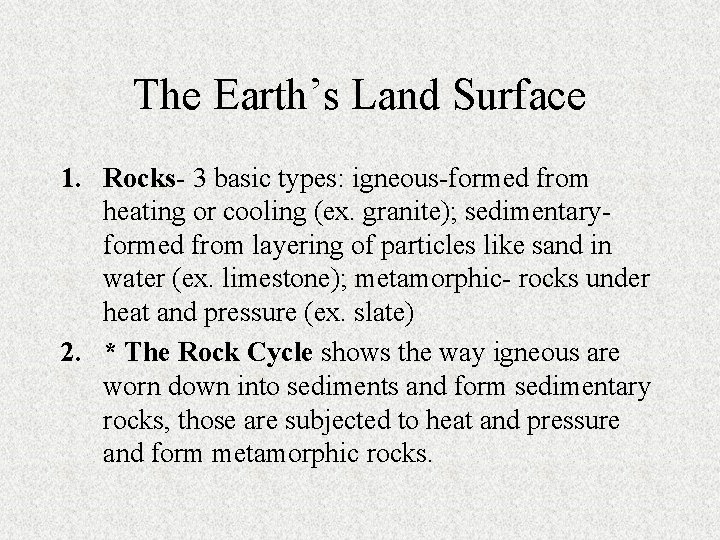
The Earth’s Land Surface 1. Rocks- 3 basic types: igneous-formed from heating or cooling (ex. granite); sedimentaryformed from layering of particles like sand in water (ex. limestone); metamorphic- rocks under heat and pressure (ex. slate) 2. * The Rock Cycle shows the way igneous are worn down into sediments and form sedimentary rocks, those are subjected to heat and pressure and form metamorphic rocks.
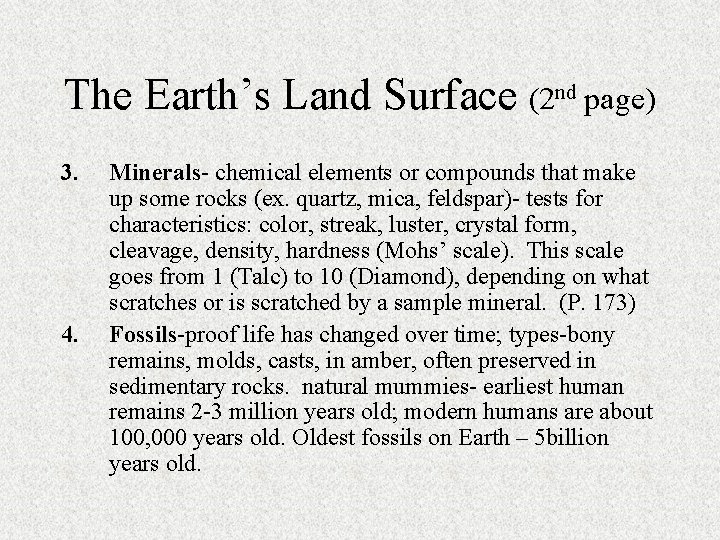
The Earth’s Land Surface (2 nd page) 3. 4. Minerals- chemical elements or compounds that make up some rocks (ex. quartz, mica, feldspar)- tests for characteristics: color, streak, luster, crystal form, cleavage, density, hardness (Mohs’ scale). This scale goes from 1 (Talc) to 10 (Diamond), depending on what scratches or is scratched by a sample mineral. (P. 173) Fossils-proof life has changed over time; types-bony remains, molds, casts, in amber, often preserved in sedimentary rocks. natural mummies- earliest human remains 2 -3 million years old; modern humans are about 100, 000 years old. Oldest fossils on Earth – 5 billion years old.
The Earth’s Land Surface (3 rd page) 5. Dinosaurs- children love this topic!Tyrannosaurus, apatosaurus, stegosaurus, triceratops- why extinct? (Peaked in the Mesozoic era (65 million years ago). Asteroid impact theory, too big to adapt to climate changes? A group of top scientists in this field recently held a symposium and their consensus was that at this time the Asteroid Impact Theory best explains the sudden demise of the dinosaurs. This is a good example to emphasize of how scientists collaborate, which is one of the goals in teaching at all levels!
The Earth’s Oceans 1. 2. 3. The Ocean Floor- continental shelves, mid-ocean ridges (formed by molten rock- where ocean is expanding & continental drift is occurring), abyssal plains, ocean trenches (push downward) Ocean Currents- due to uneven heating of Earth’s surface; the equatorial regions receive more sunlight, absorb a tremendous amount of energy become warm. The warm waters move away from the equator, moving clockwise in Northern hemisphere & counterclockwise in Southern hemisphere. Ocean Resources- food, minerals, water (must be desalinated), future energy sources, problem- wise conservation practices must preserve this resource!
The Earth’s Atmosphere and Weather 1. Atmosphere- thin layer of air around earth; changes continuously 2. Weather- condition of atmosphere at a given time 3. Climate- total effect of day to day changes 4. Sun is principal cause of weather- Heat energy & temperature differences cause wind, evaporation & precipitation. 5. Meteorologists study & predict weather.
Water in the Atmosphere 1. Relative humidity- colder air holds less moisture, temperature. of saturation is dew point, where condensation may occur. Forms of precipitation-rain, snow, hail, sleet. 2. Clouds- when drops of water accumulate around particles of dust; main types- cumulus, stratus, cirrus, nimbus & combinations of these
Violent Weather Thunderstorms, tornadoes, snow storms, hurricanes can have a great impact on the surface of the Earth and all of life on it These topics, including storm safety are interesting and practical topics to study with children.
Tomorrow’s Weather 1. 2. 3. Weather map- an important tool to predict tomorrow’s weather- have basic symbols for pressure, temperature, humidity, wind direction, wind velocity, and cloud types. In the middle latitudes (NE PA) the upper air moves from west to east; storms tend to enter from the west. Basic weather instruments- barometer (pressure), wind vane (direction), anemometer (wind speed), hygrometer(moisture in air), rain & snow gauges, radiosondes (determine the characteristics of air high above the earth & are radio transmitters carried aloft by balloons or small rockets), weather satellites (photograph clouds) SUMMARY OUTLINE (PP> 178 -180)
Chapter 11 Abruscato & De. Rosa The Cosmos Are We Alone?
What Is the Universe and How Was It Formed? • The Universe is all the matter, energy, & space that exists. One formation theory is the Big Bang- 8 -20 billion years ago a fiery explosion created it & we are still hurling out into space from this; our core is still molten partially due to this. All matter of universe was once packed together. • Studies by Geller & Huchra have found some organized structures of galaxies, which according to the Big Bang Theory should not exist. 3. Magnetars are neutron stars with magnetic fields billions fo times more powerful than the Earth’s.
What is the Universe and How Was It Formed? (2 nd page) 3. 4. 5. 6. Quasars-extremely bright objects in the universe made of gases & remnants of stars spiraling into black holes Pulsars- dense, rapidly spinning remnants of supernova explosions Supernovas-exploding stars that at peak intensities can outshine their galaxies, faint blue remnants exist Black Holes-cannot be seen, but are vacuums that take in all that is around them *These topics are not in PA standards for elementary, but are interesting topics in explaining the universe.
What Is the Universe and How Was It formed? (3 rd page) 7. Galaxies- clusters of stars and nebulae (huge bodies of dust and gas); ours is the Milky Way; light year- distance light travels in one year- 6 trillion miles 8. Constellations- groups of starts that seem to form a pattern; 88 are named from mythology or resemblance to animals & objects- Big Dipper, Little Dipper, Orion, Great Bear, Signs of Zodiac; important star- Polaris (North Star)
Our Solar System 1. 2. Includes: The Sun, Moon, Planets, Meteors, Comets, Asteroids (4. 6 billion years old); sun’s gravitational pull is the most dominant force Our Sun, a Star-it is a medium-sized, middle-aged star; it is 93 million miles away from Earth; it will live another 5 billion years; it is fueled by fusion powerhydrogen is being changed into helium; it is 100 x bigger than the Earth in diameter, 330, 000 times heavier in mass, and over 1 million times bigger in volume As the sun cools, & expands its surface color will become deep red (red giant), and will eventually becomes a white dwarf (no bigger than the earth, but very dense, then a black cinder. This will occur over the next 5 billion years.
Our Solar System 3. 4. nd (2 page) The moon-a natural satellite; orbits Earth every 27. 3 days; a moon day is about 27 earth days so we always see the same side; man first set foot on the moon in 1969 - Apollo 11 mission; it was bombarded by asteroids & meteors 4 billion years ago, creating the craters; it is ¼ the size of the earth (about 2000 miles- Earth 8000 miles); it’s gravitational pull is responsible (along with the sun) for tides of Earth’s oceans The Planets- 8 planets orbit the sun- Pluto was demoted a few years ago because it is smaller in size than originally thought; Mercury is closest to the sun and the smallest; Neptune the farthest; Jupiter is the largest and has a big red Spot that is a giant storm; Saturn, Uranus, & Neptune have rings. The planets are not in the 4 th grade PSSA.
Our Solar System 5. 6. 7. rd (3 page) Meteors- masses of stone and iron from space that may strike the Earth; few reach the surface- most burn from friction before landing- are meteorites if they land Comets- heavenly bodies made of gases and ice that move in large orbits around the sun; they have a head and tail that points away from the sun; energy from the sun causes their heads & tails to give off light Asteroids-objects that orbit between Mars and Jupiter; Some scientists hypothesize that they are the remnants of a planet that once existed.
Exploring Space: The First Steps 1. 2. 3. 4. 5. 6. 7. Sputnik 1 - first satellite by Soviet Union (1957) –started “Space Race” Apollo Space program- U. S. - 1969 - Neil Armstrong 1 st man to set foot; watch “Apollo 13!” (1969 -1972) Mariner 9 (1971)- placed in orbit about Mars, took pictures Mariner 10 (1974)- took photos of Mercury Viking I & 2 (1976)- dropped instruments on surface of Mars Pioneer Venus I (1978)- orbited Venus Voyager 1 & 2 (launched in 1977)- still going- observing Jupiter, Saturn, Uranus, Neptune
Exploring Space: The First Steps (2 nd page) 8. 9. Hubble Space Telescope- (1990)- was designed to give sharpest pictures ever of space; had a defect in a mirror that was fixed; is still sending photos back to Earth The Space Shuttle- can orbit earth like a spacecraft and like an airplane; can repair satellites; and do lots of scientific studies; main units: orbiter (carries crew & cargo), external tank, two solid rocket boosters; 1 st mission- Columbia (1981); Challenger (1986) exploded with teacher Christa Mc. Auliffe & 6 other crew members killed; Columbia (2003) exploded on reentry- 7 crew members killed
Exploring Space: The Next Steps 1. 2. The X-37 A Starting Place- experimental test vehicle, a “spaceplane, ” will be ferried to Earth’s orbit by a shuttle, will remain in earth’s orbit, and then land on its own on a conventional runway; will carry non-astronaut private citizens The International Space Station- A rest Stop on the Road to Mars? space laboratory permanently orbiting the Earth 200 miles up; scientists study the effects of prolonged space exposure to the human body & perform experiments in space; is a cooperative venture of several countries, the U. S. plays an integral part.
Cosmos Content ( on PA Standards, not in Abruscato) 1. 2. 3. What is a day? It is the time it takes the earth to rotate once on it’s axis (24 hours). What is a year? It is the time it takes the Earth to make one complete revolution around the sun (365 ¼ days) What causes the seasons? It is due to the 23. 5 degree tilt of the Earth on its axis. In summer the N. hemisphere is tilted towards the sun, so the sun’s rays are more direct and the days are longer and it is warmer, in winter it is tilted away from the sum. The equator is always hot because the sun’s rays are always direct; the S. hemisphere has the opposite seasons- summer in January and winter in June, again due to the tilt of the Earth.
Cosmos Content (continued) 4. 5. What causes a lunar eclipse? When the Earth is in a special alignment between the sun and the moon and the Earth blocks the sun’s light from the moon. In a complete eclipse you will see the round shadow of the Earth move across one side of the moon, then the moon will become completely dark, and then the shadow will move across the other side of the moon. This process takes a few hours. This is one way Galileo first realized the earth was round. What causes a solar eclipse? When the moon is in a special alignment between the Earth and the sun and the moon blocks the sun’s light from the Earth. In a complete eclipse you will see the round shadow of the moon move across one side of the sun, then the sun will become completely dark, the shadow ill move across the other side of the sun. It is dangerous to a person’s eyesight to view a solar eclipse without special equipment.
Cosmos Content 6. What causes the phases of the moon? The phases the Moon goes through are caused by two things: 1) the Moon revolving around the Earth, and 2) the Moon reflecting sunlight towards the Earth. Half of the Moon is always lit, not just the portion we see: however, sometimes we only see a profile of the lit portion of the Moon. Certain phases of the Moon result depending on its orbit around the Earth, and the Moon's orbit is responsible for the phase changes we see.
3 B The Cosmos: Attention Getters, Discovery Activities, and Demonstrations Attention Getters: • • Can you Move Like the Planets? Can You Move Like the Moon? Why is Earth Called the “Blue Planet? ” Is Day Always as Long as Night? Can You Draw an Orbit? Where Does the Sun Rise and Set? Earth Centered versus Sun Centered: the Great Debate
Discovery Activities • • Planets on Parade Making a Simple Sundial Sunlight in Winter versus Summer Make a Solar System Mobile How to Build an Altitude Finder (Astrolabe) How to build an Azimuth Finder Using Altitude and Azimuth Finders to follow the Motion of a Planet
Demonstrations • • Moon Watcher The Shoebox Planetarium Space Journey What is a Light-Year?
- Slides: 30