
CHAPTERS 1 2 Introduction and the Chemistry of
- Slides: 9
CHAPTERS 1 & 2 Introduction and the Chemistry of Life
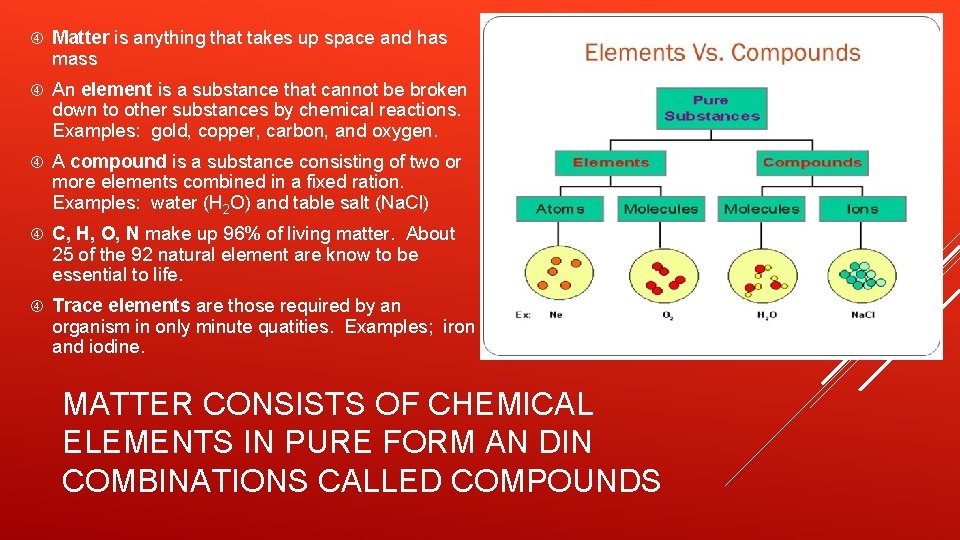
Matter is anything that takes up space and has mass An element is a substance that cannot be broken down to other substances by chemical reactions. Examples: gold, copper, carbon, and oxygen. A compound is a substance consisting of two or more elements combined in a fixed ration. Examples: water (H 2 O) and table salt (Na. Cl) C, H, O, N make up 96% of living matter. About 25 of the 92 natural element are know to be essential to life. Trace elements are those required by an organism in only minute quatities. Examples; iron and iodine. MATTER CONSISTS OF CHEMICAL ELEMENTS IN PURE FORM AN DIN COMBINATIONS CALLED COMPOUNDS
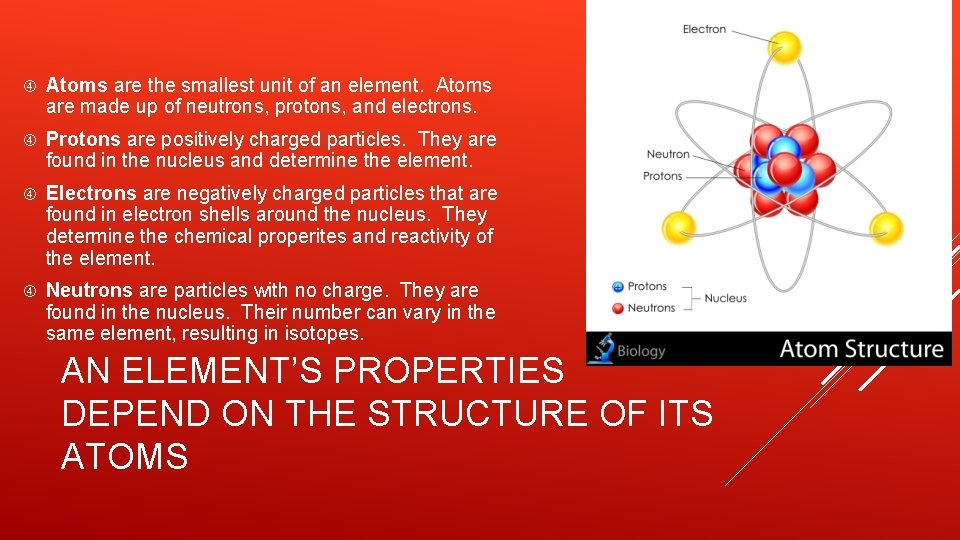
Atoms are the smallest unit of an element. Atoms are made up of neutrons, protons, and electrons. Protons are positively charged particles. They are found in the nucleus and determine the element. Electrons are negatively charged particles that are found in electron shells around the nucleus. They determine the chemical properites and reactivity of the element. Neutrons are particles with no charge. They are found in the nucleus. Their number can vary in the same element, resulting in isotopes. AN ELEMENT’S PROPERTIES DEPEND ON THE STRUCTURE OF ITS ATOMS
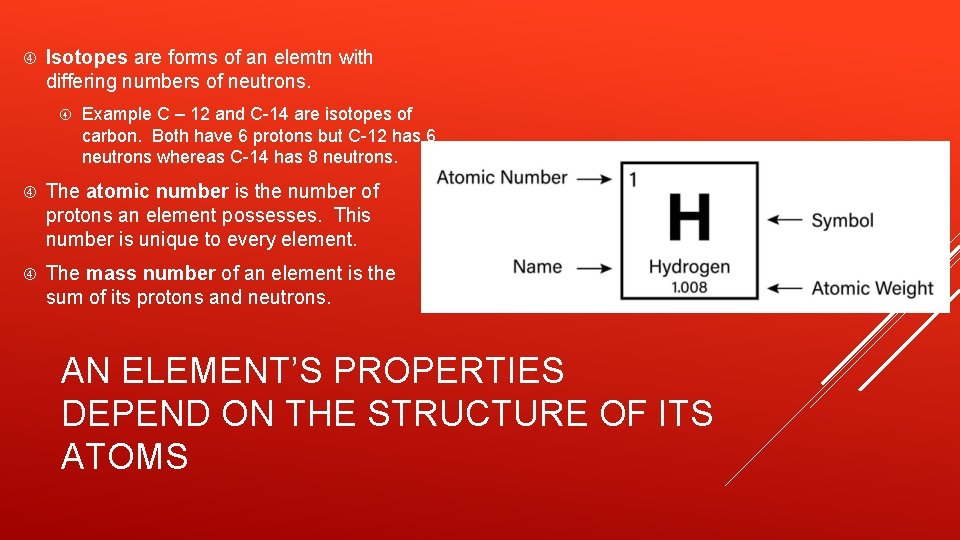
Isotopes are forms of an elemtn with differing numbers of neutrons. Example C – 12 and C-14 are isotopes of carbon. Both have 6 protons but C-12 has 6 neutrons whereas C-14 has 8 neutrons. The atomic number is the number of protons an element possesses. This number is unique to every element. The mass number of an element is the sum of its protons and neutrons. AN ELEMENT’S PROPERTIES DEPEND ON THE STRUCTURE OF ITS ATOMS
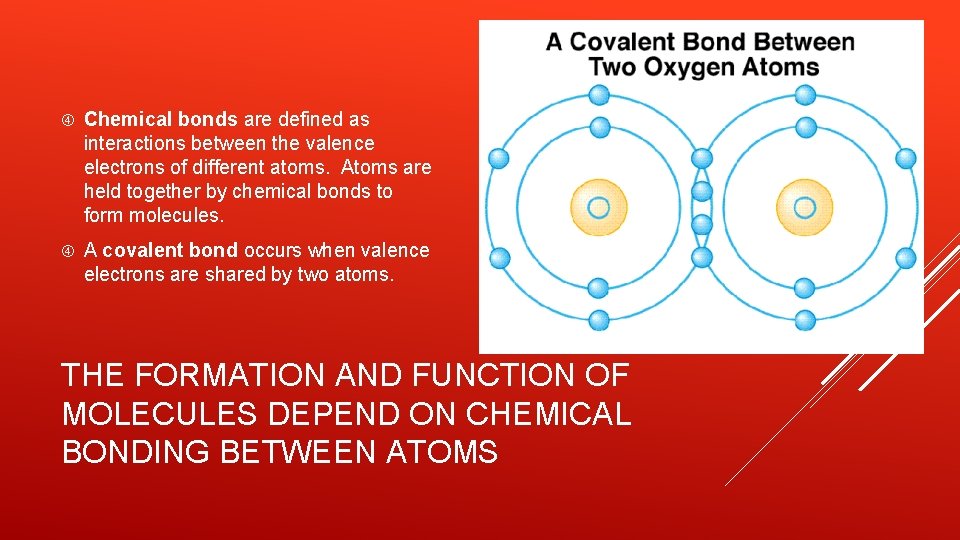
Chemical bonds are defined as interactions between the valence electrons of different atoms. Atoms are held together by chemical bonds to form molecules. A covalent bond occurs when valence electrons are shared by two atoms. THE FORMATION AND FUNCTION OF MOLECULES DEPEND ON CHEMICAL BONDING BETWEEN ATOMS
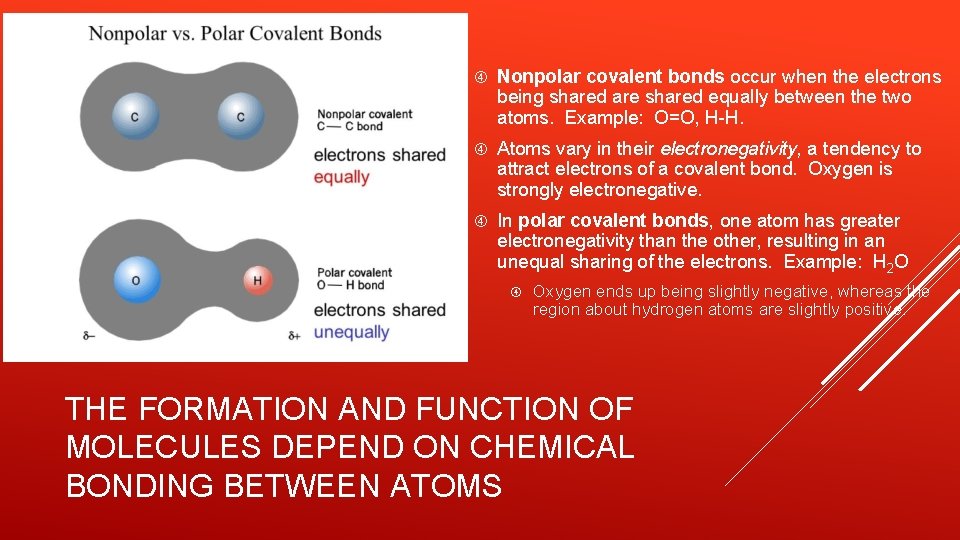
Nonpolar covalent bonds occur when the electrons being shared are shared equally between the two atoms. Example: O=O, H-H. Atoms vary in their electronegativity, a tendency to attract electrons of a covalent bond. Oxygen is strongly electronegative. In polar covalent bonds, one atom has greater electronegativity than the other, resulting in an unequal sharing of the electrons. Example: H 2 O Oxygen ends up being slightly negative, whereas the region about hydrogen atoms are slightly positive. THE FORMATION AND FUNCTION OF MOLECULES DEPEND ON CHEMICAL BONDING BETWEEN ATOMS
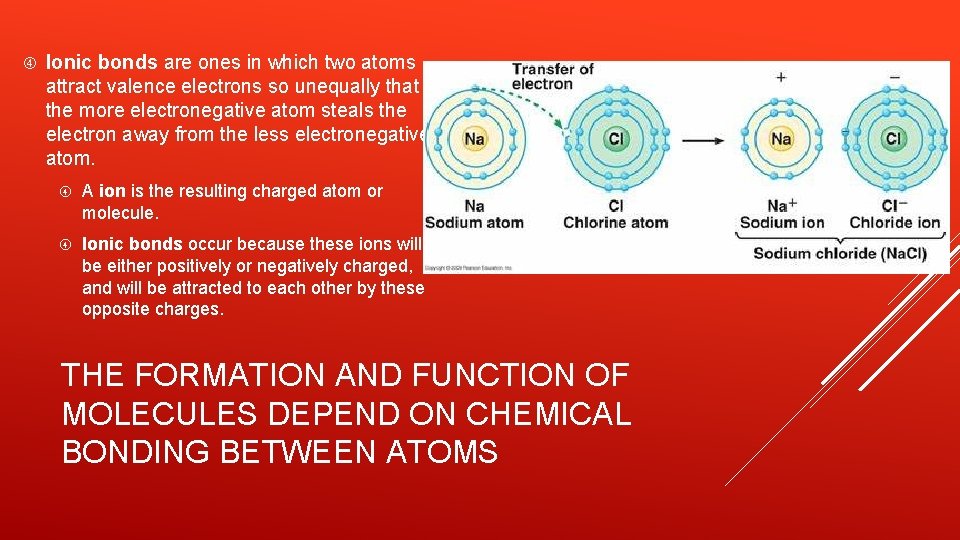
Ionic bonds are ones in which two atoms attract valence electrons so unequally that the more electronegative atom steals the electron away from the less electronegative atom. A ion is the resulting charged atom or molecule. Ionic bonds occur because these ions will be either positively or negatively charged, and will be attracted to each other by these opposite charges. THE FORMATION AND FUNCTION OF MOLECULES DEPEND ON CHEMICAL BONDING BETWEEN ATOMS
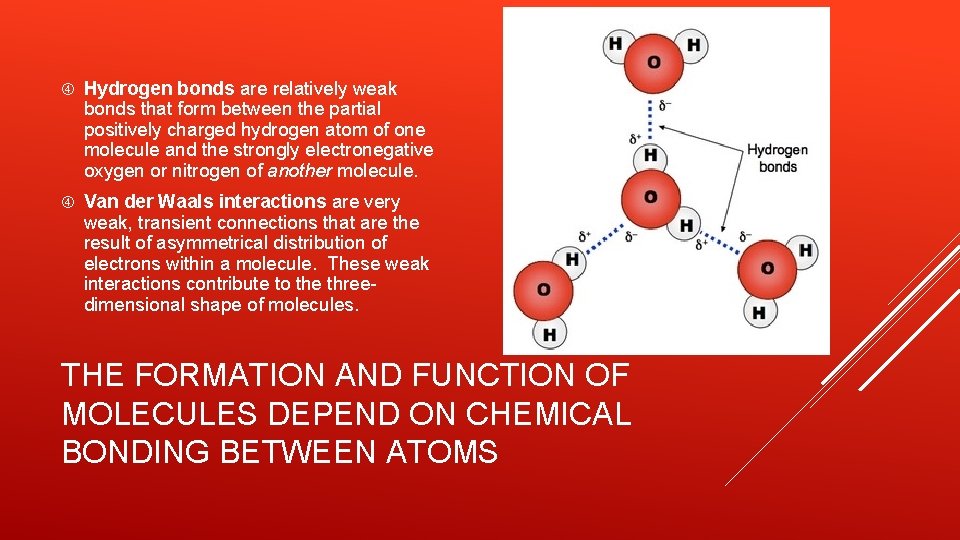
Hydrogen bonds are relatively weak bonds that form between the partial positively charged hydrogen atom of one molecule and the strongly electronegative oxygen or nitrogen of another molecule. Van der Waals interactions are very weak, transient connections that are the result of asymmetrical distribution of electrons within a molecule. These weak interactions contribute to the threedimensional shape of molecules. THE FORMATION AND FUNCTION OF MOLECULES DEPEND ON CHEMICAL BONDING BETWEEN ATOMS
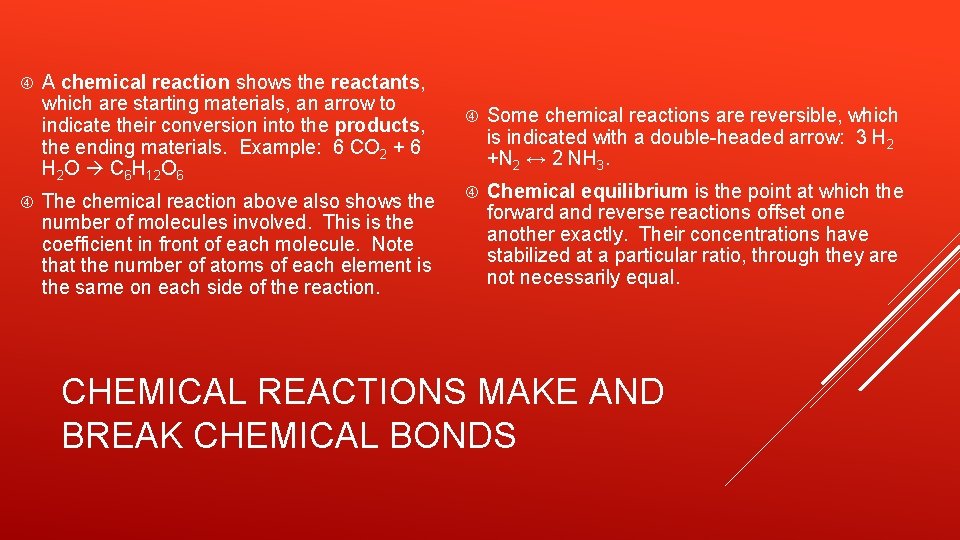
A chemical reaction shows the reactants, which are starting materials, an arrow to indicate their conversion into the products, the ending materials. Example: 6 CO 2 + 6 H 2 O C 6 H 12 O 6 The chemical reaction above also shows the number of molecules involved. This is the coefficient in front of each molecule. Note that the number of atoms of each element is the same on each side of the reaction. Some chemical reactions are reversible, which is indicated with a double-headed arrow: 3 H 2 +N 2 ↔ 2 NH 3. Chemical equilibrium is the point at which the forward and reverse reactions offset one another exactly. Their concentrations have stabilized at a particular ratio, through they are not necessarily equal. CHEMICAL REACTIONS MAKE AND BREAK CHEMICAL BONDS