
ChapterFive Training Design DESIGN PHASE Input Process Output
- Slides: 12
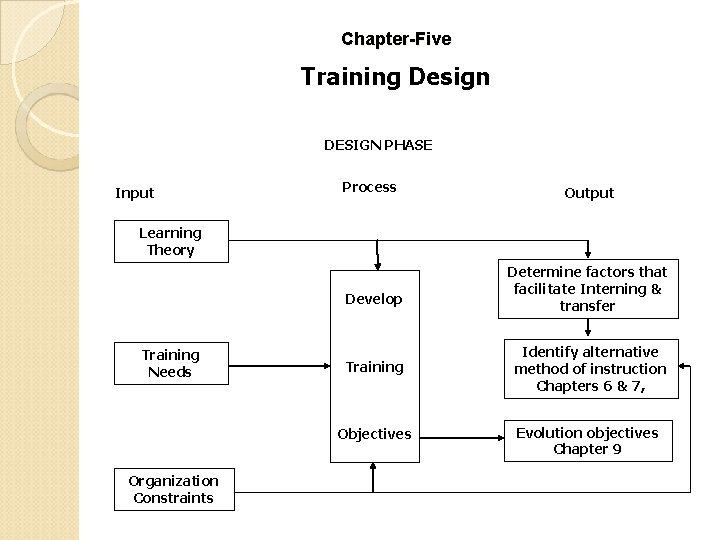
Chapter-Five Training Design DESIGN PHASE Input Process Output Learning Theory Develop Training Needs Training Objectives Organization Constraints Determine factors that facilitate Interning & transfer Identify alternative method of instruction Chapters 6 & 7, Evolution objectives Chapter 9
Training Design Introduction to the Design of Training The design phase of training is a process of identifying the set of specifications that will be used in the development phase for creating the training modules. In the simplest terms, the design phase answers the following questions: Ø Ø Ø Why is training needed? Who will be rained? What are that training objectives, and what methods will be used? When and where will training take place? What are the principles that will be used to facilitate the learning of the material and its transfer to the job?
Training Design Introduction to the Design of Training/Cont. . . Suppose that an HRD deportment completed a TNA that identified hat supervisors need training in effective communication skills. The next decisions to be made include the following: • What will the training achieve • What method of training will be used • How much time will be allotted for the training • How many trainees will be trained at the same time • Whether this training will be conducted on company time or overtime • Whether this training will be voluntary or mandatory • Where to locate training Organizational constraints will influence many of these decisions. For example, if the HRD department does not have the resources to develop the program, or if supervisors cannot be off the job for more a half-day, then these factors will help shape what the training will look like and how will be offered.
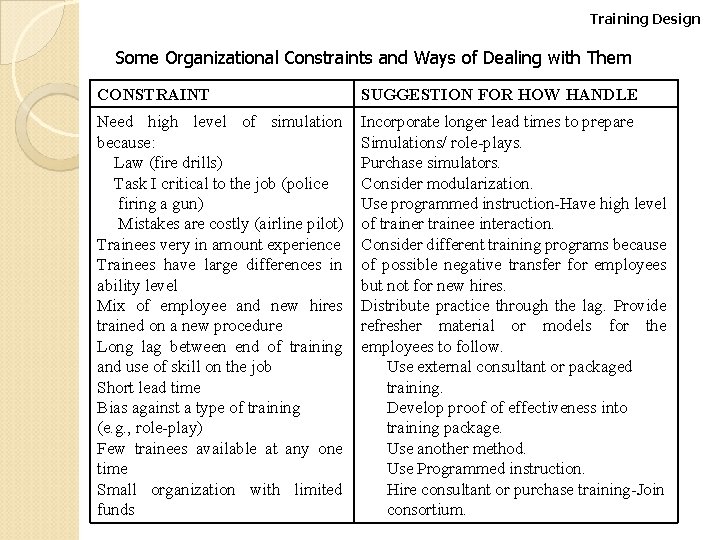
Training Design Some Organizational Constraints and Ways of Dealing with Them CONSTRAINT SUGGESTION FOR HOW HANDLE Need high level of simulation because: Law (fire drills) Task I critical to the job (police firing a gun) Mistakes are costly (airline pilot) Trainees very in amount experience Trainees have large differences in ability level Mix of employee and new hires trained on a new procedure Long lag between end of training and use of skill on the job Short lead time Bias against a type of training (e. g. , role-play) Few trainees available at any one time Small organization with limited funds Incorporate longer lead times to prepare Simulations/ role-plays. Purchase simulators. Consider modularization. Use programmed instruction-Have high level of trainer trainee interaction. Consider different training programs because of possible negative transfer for employees but not for new hires. Distribute practice through the lag. Provide refresher material or models for the employees to follow. Use external consultant or packaged training. Develop proof of effectiveness into training package. Use another method. Use Programmed instruction. Hire consultant or purchase training-Join consortium.
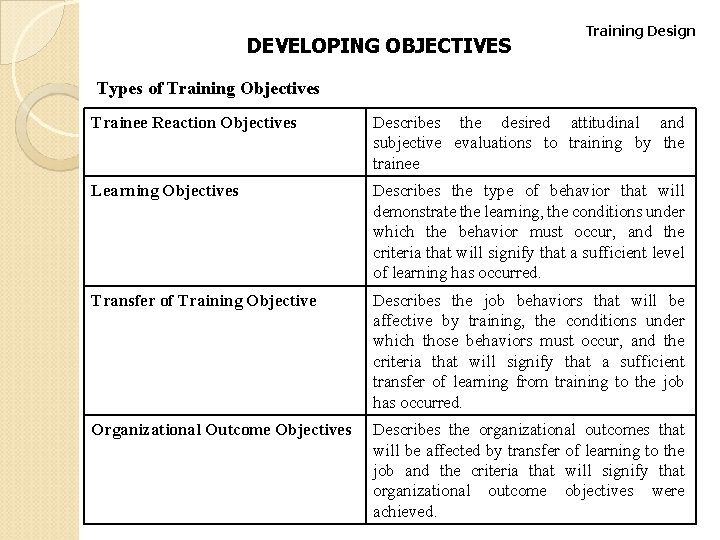
DEVELOPING OBJECTIVES Training Design Types of Training Objectives Trainee Reaction Objectives Describes the desired attitudinal and subjective evaluations to training by the trainee Learning Objectives Describes the type of behavior that will demonstrate the learning, the conditions under which the behavior must occur, and the criteria that will signify that a sufficient level of learning has occurred. Transfer of Training Objective Describes the job behaviors that will be affective by training, the conditions under which those behaviors must occur, and the criteria that will signify that a sufficient transfer of learning from training to the job has occurred. Organizational Outcome Objectives Describes the organizational outcomes that will be affected by transfer of learning to the job and the criteria that will signify that organizational outcome objectives were achieved.
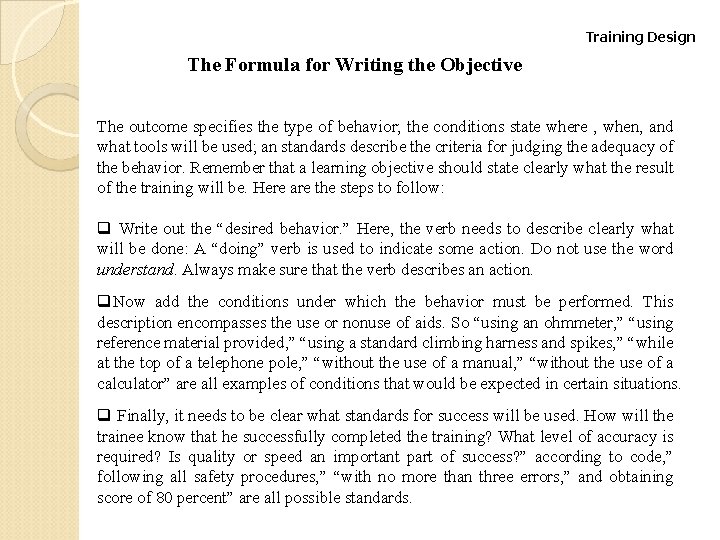
Training Design The Formula for Writing the Objective The outcome specifies the type of behavior; the conditions state where , when, and what tools will be used; an standards describe the criteria for judging the adequacy of the behavior. Remember that a learning objective should state clearly what the result of the training will be. Here are the steps to follow: q Write out the “desired behavior. ” Here, the verb needs to describe clearly what will be done: A “doing” verb is used to indicate some action. Do not use the word understand. Always make sure that the verb describes an action. q. Now add the conditions under which the behavior must be performed. This description encompasses the use or nonuse of aids. So “using an ohmmeter, ” “using reference material provided, ” “using a standard climbing harness and spikes, ” “while at the top of a telephone pole, ” “without the use of a manual, ” “without the use of a calculator” are all examples of conditions that would be expected in certain situations. q Finally, it needs to be clear what standards for success will be used. How will the trainee know that he successfully completed the training? What level of accuracy is required? Is quality or speed an important part of success? ” according to code, ” following all safety procedures, ” “with no more than three errors, ” and obtaining score of 80 percent” are all possible standards.
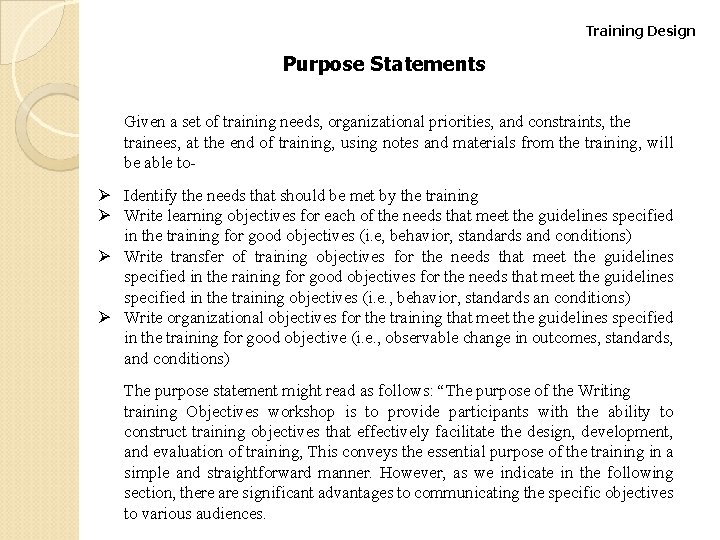
Training Design Purpose Statements Given a set of training needs, organizational priorities, and constraints, the trainees, at the end of training, using notes and materials from the training, will be able to- Ø Identify the needs that should be met by the training Ø Write learning objectives for each of the needs that meet the guidelines specified in the training for good objectives (i. e, behavior, standards and conditions) Ø Write transfer of training objectives for the needs that meet the guidelines specified in the raining for good objectives for the needs that meet the guidelines specified in the training objectives (i. e. , behavior, standards an conditions) Ø Write organizational objectives for the training that meet the guidelines specified in the training for good objective (i. e. , observable change in outcomes, standards, and conditions) The purpose statement might read as follows: “The purpose of the Writing training Objectives workshop is to provide participants with the ability to construct training objectives that effectively facilitate the design, development, and evaluation of training, This conveys the essential purpose of the training in a simple and straightforward manner. However, as we indicate in the following section, there are significant advantages to communicating the specific objectives to various audiences.
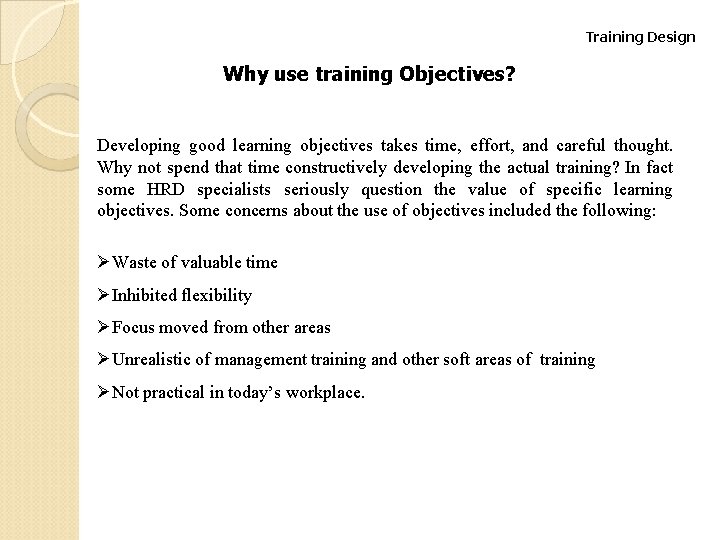
Training Design Why use training Objectives? Developing good learning objectives takes time, effort, and careful thought. Why not spend that time constructively developing the actual training? In fact some HRD specialists seriously question the value of specific learning objectives. Some concerns about the use of objectives included the following: ØWaste of valuable time ØInhibited flexibility ØFocus moved from other areas ØUnrealistic of management training and other soft areas of training ØNot practical in today’s workplace.
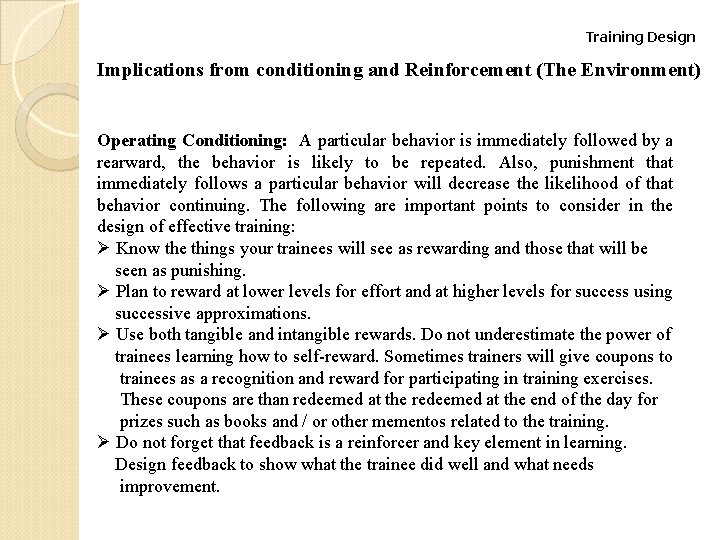
Training Design Implications from conditioning and Reinforcement (The Environment) Operating Conditioning: A particular behavior is immediately followed by a rearward, the behavior is likely to be repeated. Also, punishment that immediately follows a particular behavior will decrease the likelihood of that behavior continuing. The following are important points to consider in the design of effective training: Ø Know the things your trainees will see as rewarding and those that will be seen as punishing. Ø Plan to reward at lower levels for effort and at higher levels for success using successive approximations. Ø Use both tangible and intangible rewards. Do not underestimate the power of trainees learning how to self-reward. Sometimes trainers will give coupons to trainees as a recognition and reward for participating in training exercises. These coupons are than redeemed at the end of the day for prizes such as books and / or other mementos related to the training. Ø Do not forget that feedback is a reinforcer and key element in learning. Design feedback to show what the trainee did well and what needs improvement.
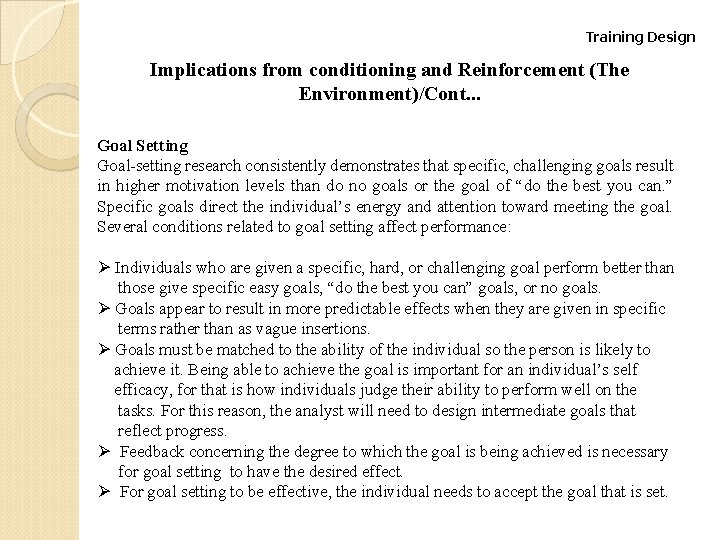
Training Design Implications from conditioning and Reinforcement (The Environment)/Cont. . . Goal Setting Goal-setting research consistently demonstrates that specific, challenging goals result in higher motivation levels than do no goals or the goal of “do the best you can. ” Specific goals direct the individual’s energy and attention toward meeting the goal. Several conditions related to goal setting affect performance: Ø Individuals who are given a specific, hard, or challenging goal perform better than those give specific easy goals, “do the best you can” goals, or no goals. Ø Goals appear to result in more predictable effects when they are given in specific terms rather than as vague insertions. Ø Goals must be matched to the ability of the individual so the person is likely to achieve it. Being able to achieve the goal is important for an individual’s self efficacy, for that is how individuals judge their ability to perform well on the tasks. For this reason, the analyst will need to design intermediate goals that reflect progress. Ø Feedback concerning the degree to which the goal is being achieved is necessary for goal setting to have the desired effect. Ø For goal setting to be effective, the individual needs to accept the goal that is set.
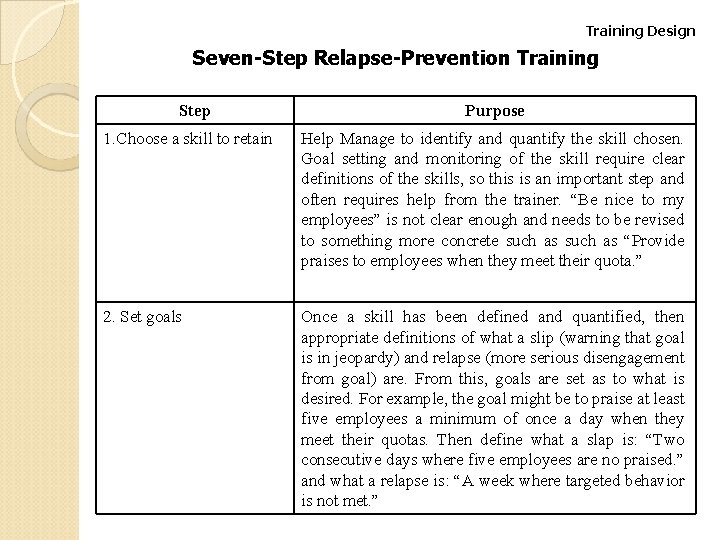
Training Design Seven-Step Relapse-Prevention Training Step Purpose 1. Choose a skill to retain Help Manage to identify and quantify the skill chosen. Goal setting and monitoring of the skill require clear definitions of the skills, so this is an important step and often requires help from the trainer. “Be nice to my employees” is not clear enough and needs to be revised to something more concrete such as “Provide praises to employees when they meet their quota. ” 2. Set goals Once a skill has been defined and quantified, then appropriate definitions of what a slip (warning that goal is in jeopardy) and relapse (more serious disengagement from goal) are. From this, goals are set as to what is desired. For example, the goal might be to praise at least five employees a minimum of once a day when they meet their quotas. Then define what a slap is: “Two consecutive days where five employees are no praised. ” and what a relapse is: “A week where targeted behavior is not met. ”
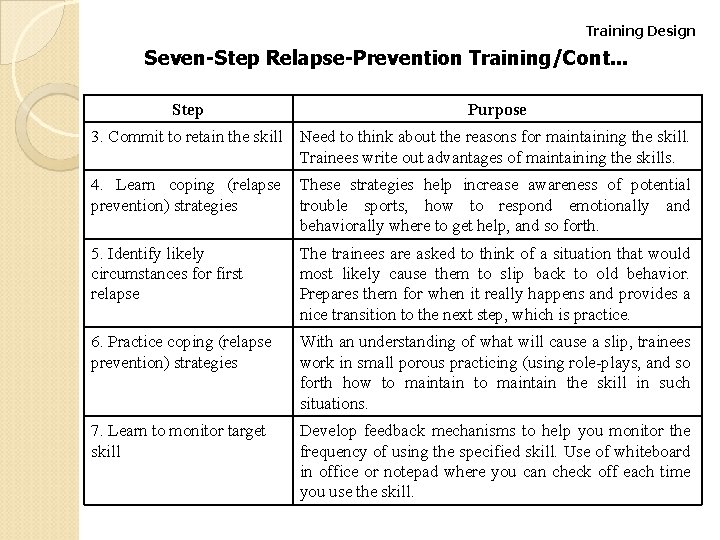
Training Design Seven-Step Relapse-Prevention Training/Cont. . . Step Purpose 3. Commit to retain the skill Need to think about the reasons for maintaining the skill. Trainees write out advantages of maintaining the skills. 4. Learn coping (relapse prevention) strategies These strategies help increase awareness of potential trouble sports, how to respond emotionally and behaviorally where to get help, and so forth. 5. Identify likely circumstances for first relapse The trainees are asked to think of a situation that would most likely cause them to slip back to old behavior. Prepares them for when it really happens and provides a nice transition to the next step, which is practice. 6. Practice coping (relapse prevention) strategies With an understanding of what will cause a slip, trainees work in small porous practicing (using role-plays, and so forth how to maintain the skill in such situations. 7. Learn to monitor target skill Develop feedback mechanisms to help you monitor the frequency of using the specified skill. Use of whiteboard in office or notepad where you can check off each time you use the skill.