
CHAPTER6 LEARNING INTRODUCTION Agent can improve their behavior
CHAPTER-6 LEARNING
INTRODUCTION • Agent can improve their behavior through diligent study of their own experiences. • The idea behind learning is that percepts should be used not only for acting, but also for improving the agent's ability to act in the future. • Learning is essential for unknown environments - i. e when designer lacks omniscience ( state of knowing everything) • Learning is useful as a system construction method - i. e expose the agent to reality rather than trying to write it down • Learning modifies the agent’s decision mechanisms to improve performance
FORMS OF LEARNING • A learning agent contains performance element that is PEAS – decides what actions to take – a learning element that modifies the performance element so that it makes better decisions.
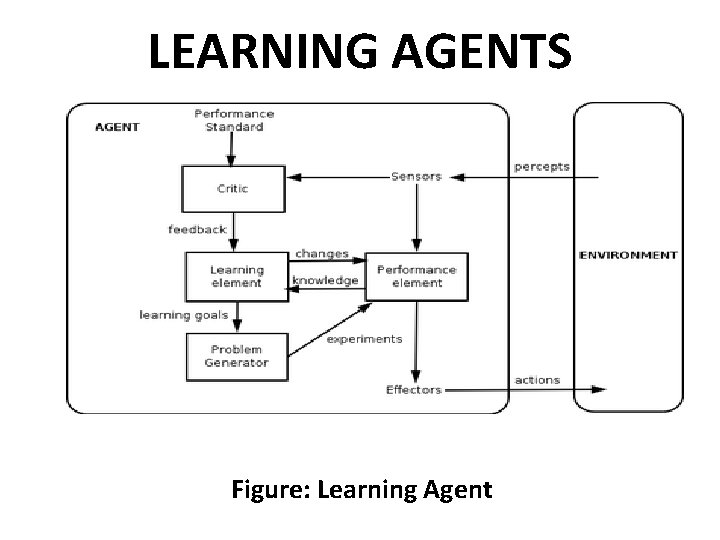
LEARNING AGENTS Figure: Learning Agent
FOUR IMPORTANT COMPONENTS OF LEARNING AGENT • Learning Elementresponsible for making improvements • Performance Element -responsible for selecting external action. • Critic - designed to tell the learning element how well the agent is doing. The critic employs a fixed standard of performance. Performance Standard is a fixed measure that is conceptually outside the agent • Problem Generator -responsible for suggesting actions that will lead to new and informative experiences
TYPE OF FEEDBACK • Supervised learning: correct answers for each example • Unsupervised learning: correct answers not given • Reinforcement learning: occasional rewards
LEARNING CATEGORIES • Supervised Learning- An agent can learn effects of it actions through condition. Eg: Taxi Driver- instructor shouts “Brake” • Unsupervised Learning-Involves learning patterns in the input when no specific output values are supplied. Unsupervised agent cannot learn what to do because it has no information as to what constitutes a correct action or a desirable state.
REINFORCEMENT LEARNING • Reinforcement Learning –Rather than being told what to do, a reinforcement learning agent must learn from reinforcement. Reinforcement learning includes the sub-problem of learning how the environment works. • Example: – Chess game the reinforcement is received only at the end of the game. – In ping-pong, each point scored can be considered a reward; when learning to crawl, any forward motion is an achievement.
INDUCTIVE LEARNING • Inductive learning using a particular set of facts or ideas to form a general principle. • An algorithm for deterministic supervised learning is given as input the correct value of the unknown function or for particular inputs and try to recover something close to it. • Simplest form: learn a function from examples
INDUCTIVE LEARNING • Simplest form: learn a function from examples f is the target function An example is a pair (x, f(x)) Problem: find a hypothesis h such that h ≈ f given a training set of examples This is a highly simplified model of real learning: • Ignores prior knowledge • Assumes a deterministic, observable environment • Assumes examples are given • Assume that the agent wants to learn m f

THANK YOU !
- Slides: 11