
Chapter4 Software Security Why Software Why is software
![Example char array[10]; for(i = 0; i < 10; ++i) array[i] = `A`; array[10]](https://slidetodoc.com/presentation_image_h/9d304a0cc53b9d145b458c339360ce44/image-7.jpg "Example char array[10]; for(i = 0; i < 10; ++i) array[i] = `A`; array[10]")
![Buffer Overflow int main(){ int buffer[10]; buffer[20] = 37; } Q: What happens when](https://slidetodoc.com/presentation_image_h/9d304a0cc53b9d145b458c339360ce44/image-16.jpg "Buffer Overflow int main(){ int buffer[10]; buffer[20] = 37; } Q: What happens when")
![Simplified Stack Example low : : void func(int a, int b){ char buffer[10]; }](https://slidetodoc.com/presentation_image_h/9d304a0cc53b9d145b458c339360ce44/image-22.jpg "Simplified Stack Example low : : void func(int a, int b){ char buffer[10]; }")
- Slides: 45
Chapter-4 Software Security
Why Software? Why is software as important to security as crypto, access control and protocols? Virtually all of information security is implemented in software If your software is subject to attack, your security is broken Regardless of strength of crypto, access control or protocols Software is a poor foundation for security
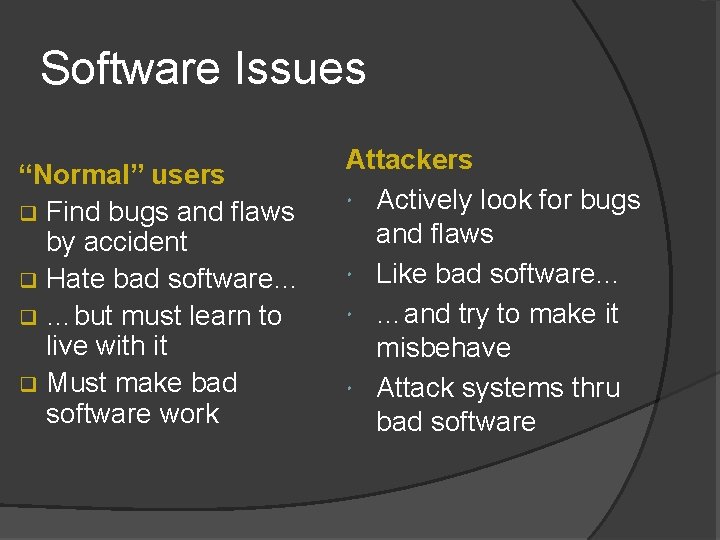
Software Issues “Normal” users q Find bugs and flaws by accident q Hate bad software… q …but must learn to live with it q Must make bad software work Attackers Actively look for bugs and flaws Like bad software… …and try to make it misbehave Attack systems thru bad software
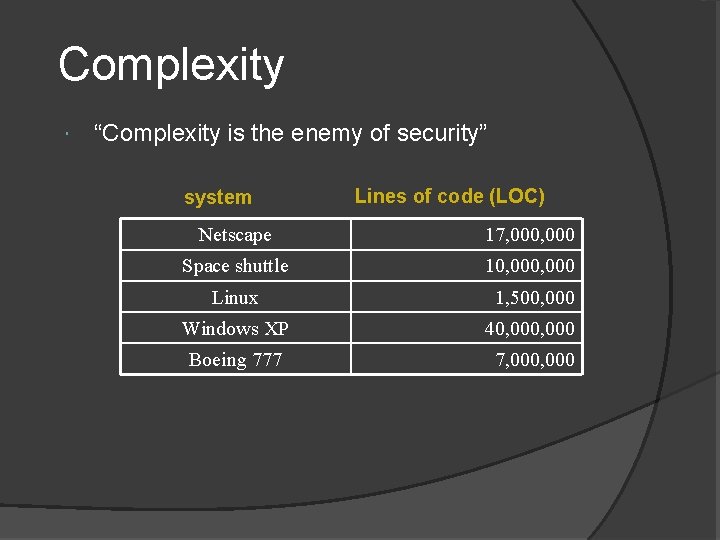
Complexity “Complexity is the enemy of security” system Lines of code (LOC) Netscape 17, 000 Space shuttle 10, 000 Linux 1, 500, 000 Windows XP 40, 000 Boeing 777 7, 000
Software Security Topics Program flaws (unintentional) Buffer overflow Incomplete mediation Race conditions Malicious software (intentional) Viruses Worms
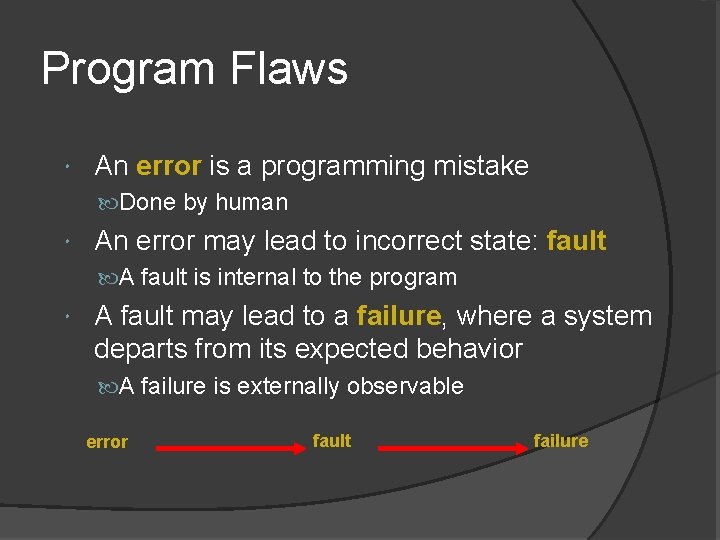
Program Flaws An error is a programming mistake Done by human An error may lead to incorrect state: fault A fault is internal to the program A fault may lead to a failure, where a system departs from its expected behavior A failure is externally observable error fault failure
Example char array[10]; for(i = 0; i < 10; ++i) array[i] = `A`; array[10] = `B`; This program has an error q This error might cause a fault q o Incorrect internal state q If a fault occurs, it might lead to a failure o Program behaves incorrectly (external) q We use the term flaw for all of the above
Secure Software In software engineering, try to insure that a program does what is intended Secure software engineering requires that the software does what is intended… …and nothing more Absolutely secure software is impossible Absolute security is almost never possible
Program Flaws Program flaws are unintentional But still create security risks We’ll consider 3 types of flaws Buffer overflow (smashing the stack) Incomplete mediation Race conditions Many other flaws can occur These are most common
Buffer Overflow • In computer security and programming, a buffer overflow, or buffer overrun, is an anomaly where a program, while writing data to a buffer, overruns the buffer's boundary and overwrites adjacent memory. • This may result in abnormal program behavior, including memory access errors, incorrect results, a crash, or a breach of system security.
Buffer Overflow Programming languages commonly associated with buffer overflows include C and C++, which provide no built-in protection against accessing or overwriting data in any part of memory and do not automatically check that data written to an array (the built-in buffer type) is within the boundaries of that array.
Buffer Overflow Most commonly this occurs when copying strings of characters from one buffer to another.
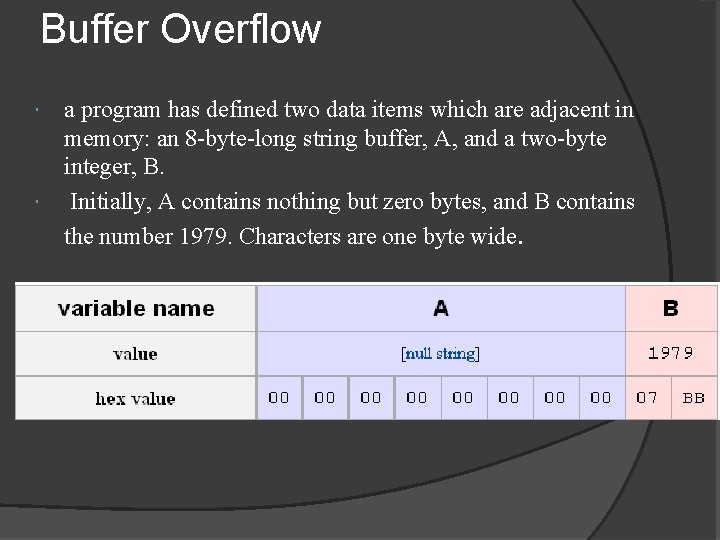
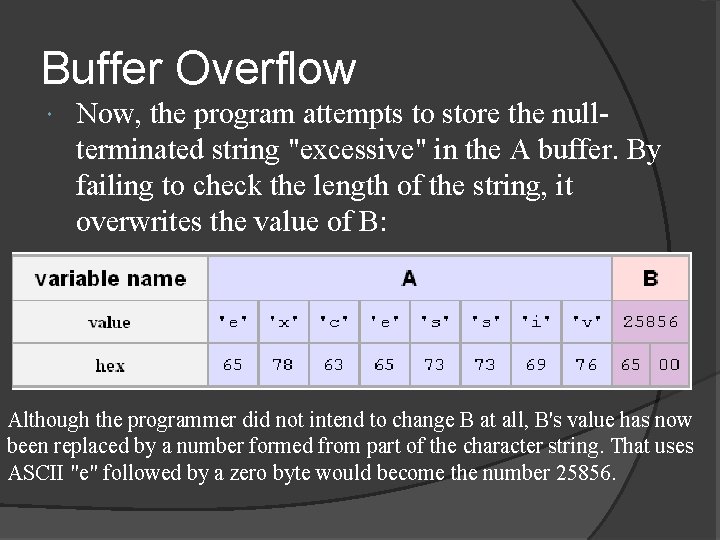
Buffer Overflow a program has defined two data items which are adjacent in memory: an 8 -byte-long string buffer, A, and a two-byte integer, B. Initially, A contains nothing but zero bytes, and B contains the number 1979. Characters are one byte wide.
Buffer Overflow Now, the program attempts to store the nullterminated string "excessive" in the A buffer. By failing to check the length of the string, it overwrites the value of B: Although the programmer did not intend to change B at all, B's value has now been replaced by a number formed from part of the character string. That uses ASCII "e" followed by a zero byte would become the number 25856.
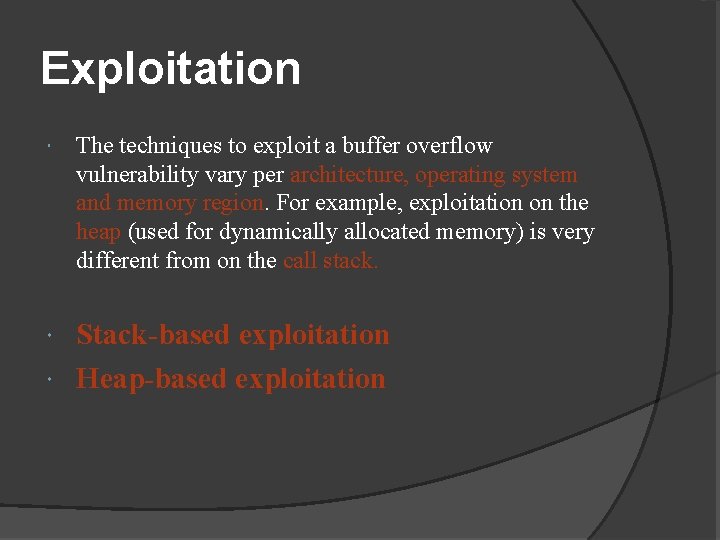
Exploitation The techniques to exploit a buffer overflow vulnerability vary per architecture, operating system and memory region. For example, exploitation on the heap (used for dynamically allocated memory) is very different from on the call stack. Stack-based exploitation Heap-based exploitation
Buffer Overflow int main(){ int buffer[10]; buffer[20] = 37; } Q: What happens when this is executed? A: Depending on what resides in memory at location “buffer[20]” Might overwrite user data or code Might overwrite system data or code
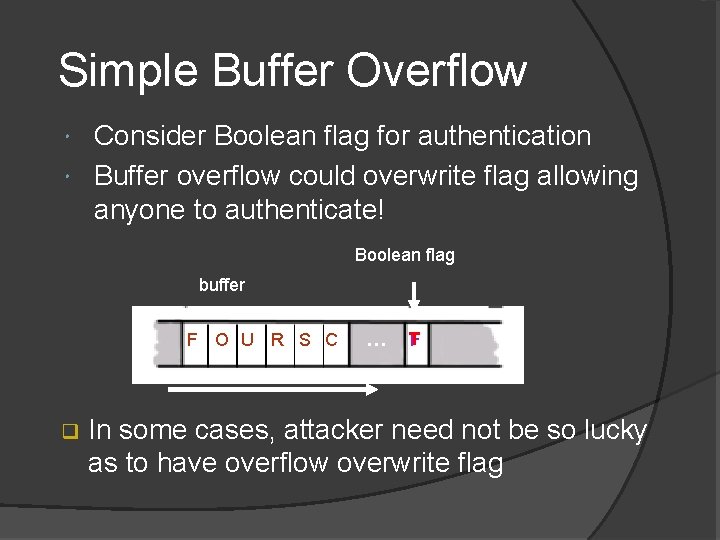
Simple Buffer Overflow Consider Boolean flag for authentication Buffer overflow could overwrite flag allowing anyone to authenticate! Boolean flag buffer F O U R S C q … T F In some cases, attacker need not be so lucky as to have overflow overwrite flag
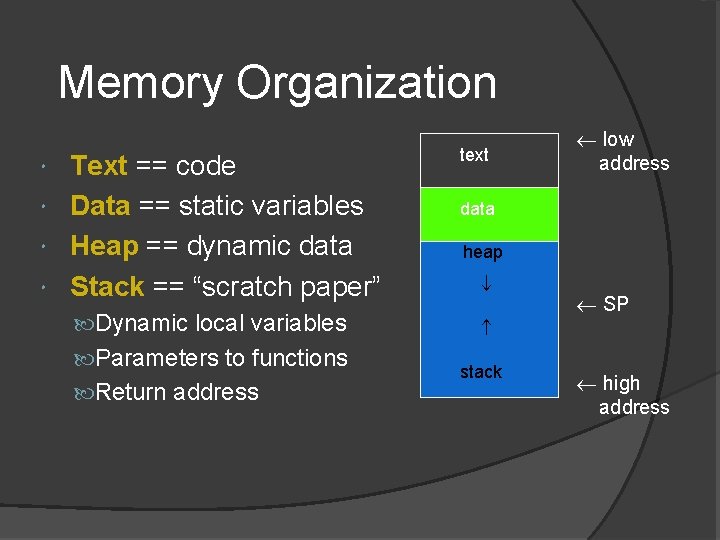
Memory Organization Text == code Data == static variables Heap == dynamic data Stack == “scratch paper” Dynamic local variables Parameters to functions Return address text ¬ low address data heap ¬ SP stack ¬ high address
Stack-based exploitation The malicious user may exploit stack-based buffer overflows to manipulate the program in one of the following method By overwriting a local variable that is near the buffer in memory on the stack to change the behavior of the program which may benefit the attacker. By overwriting the return address in a stack frame. Once the function returns, execution will resume at the return address as specified by the attacker. By overwriting a function pointer
Heap-based exploitation A buffer overflow occurring in the heap data area is referred to as a heap overflow and is exploitable in a different manner to that of stack-based overflows. Memory on the heap is dynamically allocated by the application at run-time and typically contains program data. Exploitation is performed by corrupting this data in specific ways to cause the application to overwrite internal structures such as linked list pointers.
Typical Attack Scenario Users enter data into a Web form is sent to server Server writes data to buffer, without checking length of input data Data overflows from buffer Sometimes, overflow can enable an attack Web form attack could be carried out by anyone with an Internet connection
Simplified Stack Example low : : void func(int a, int b){ char buffer[10]; } void main(){ func(1, 2); } buffer a ¬ return SP address ¬ SP b ¬ SP ret high ¬ SP
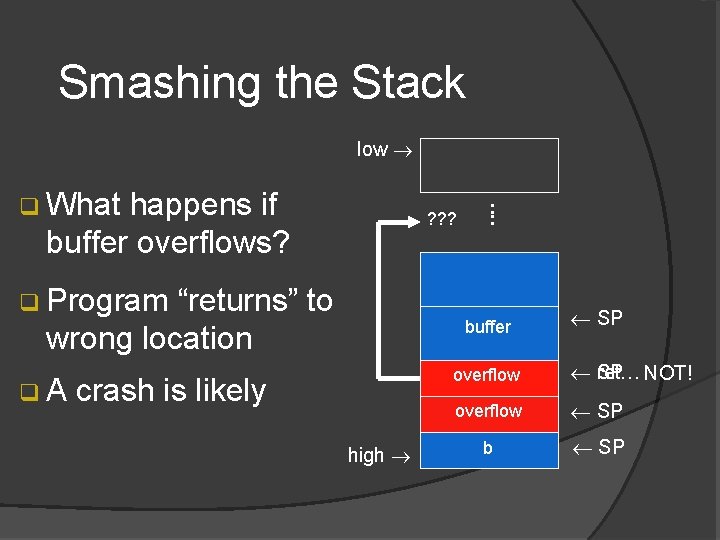
Smashing the Stack low q What happens if buffer overflows? ? ? ? q Program “returns” to wrong location q. A : : buffer crash is likely high ¬ SP overflow ret… NOT! ¬ SP overflow a ¬ SP b ¬ SP
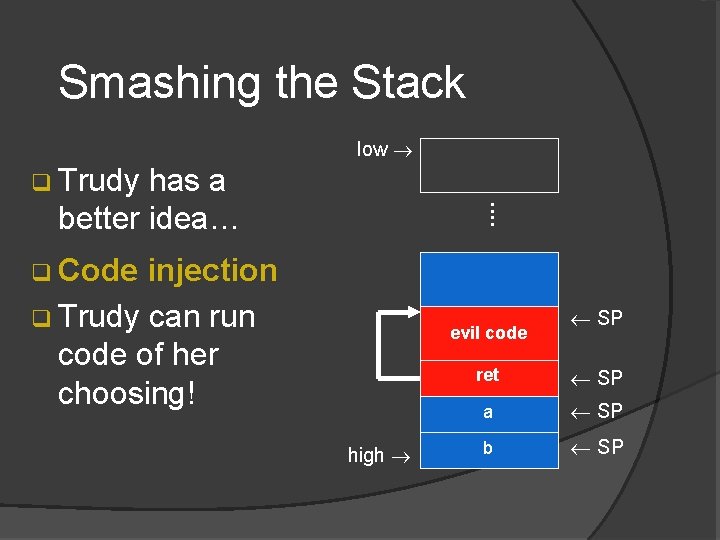
Smashing the Stack low q Trudy has a better idea… : : q Code injection q Trudy can run code of her choosing! evil code high ¬ SP ret ¬ SP a ¬ SP b ¬ SP
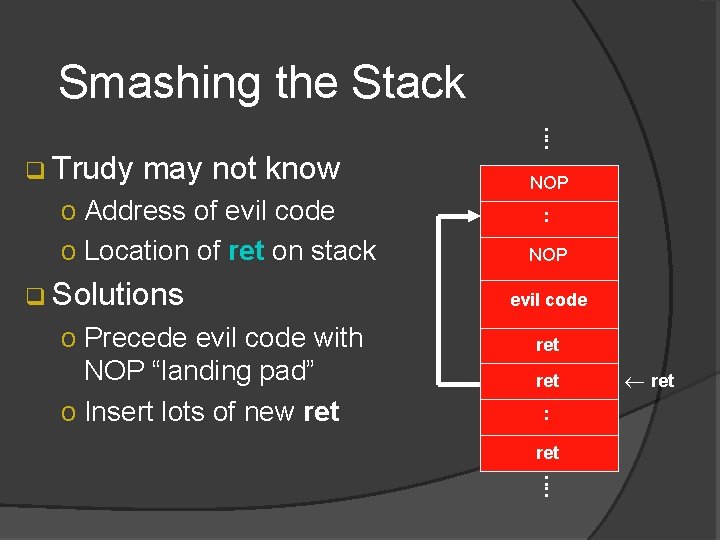
Smashing the Stack q Trudy may not know o Address of evil code o Location of ret on stack q Solutions o Precede evil code with NOP “landing pad” o Insert lots of new ret : : NOP evil code ret : : ¬ ret
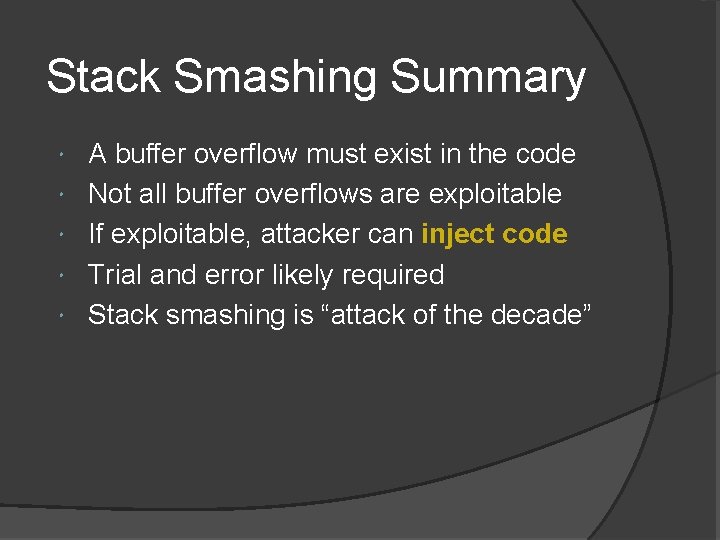
Stack Smashing Summary A buffer overflow must exist in the code Not all buffer overflows are exploitable If exploitable, attacker can inject code Trial and error likely required Stack smashing is “attack of the decade”
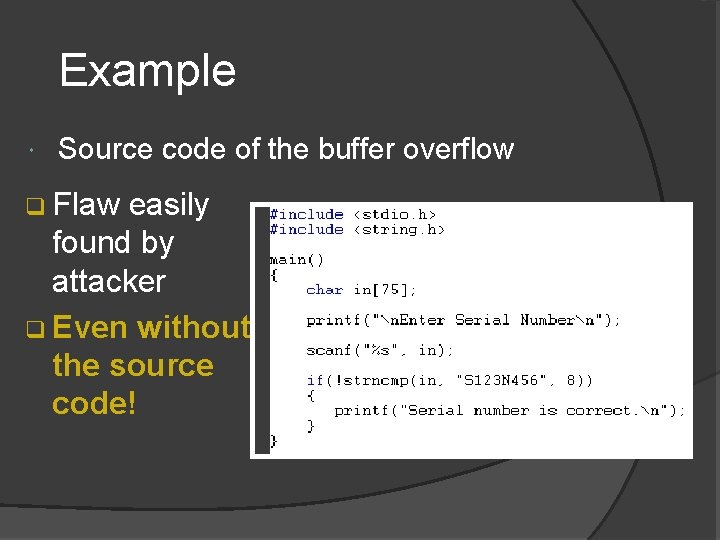
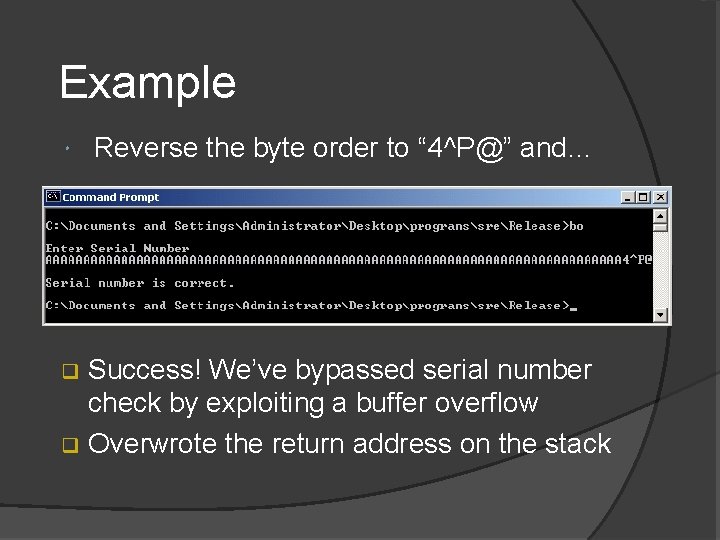
Example Source code of the buffer overflow q Flaw easily found by attacker q Even without the source code!
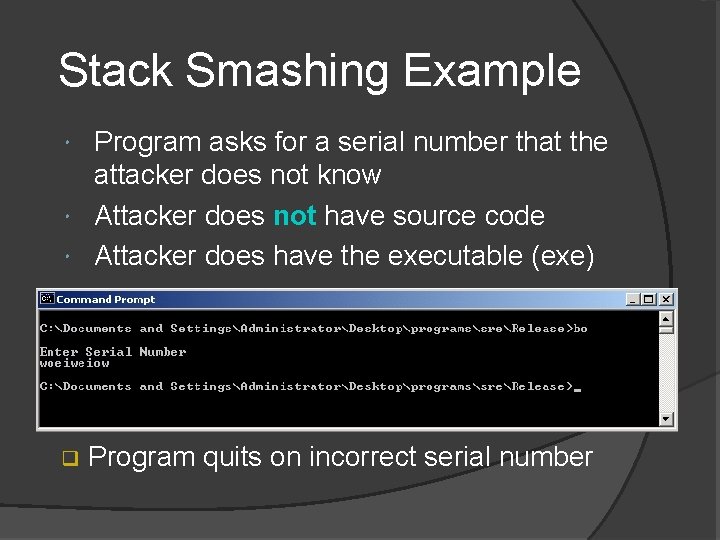
Stack Smashing Example Program asks for a serial number that the attacker does not know Attacker does not have source code Attacker does have the executable (exe) q Program quits on incorrect serial number
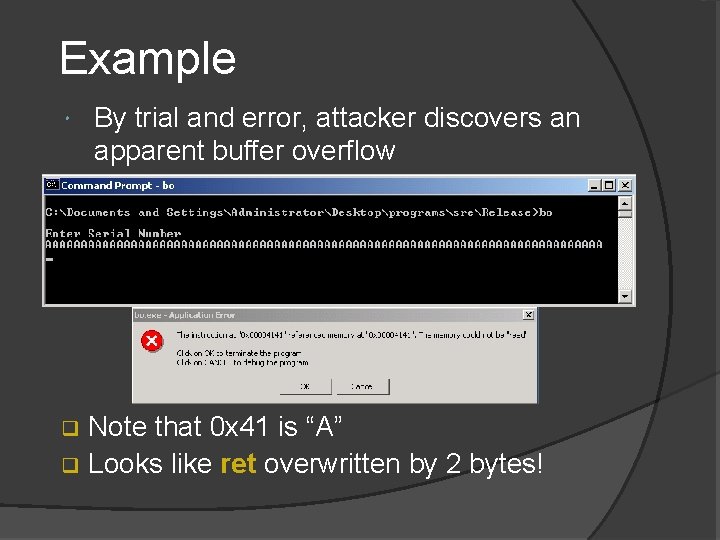
Example By trial and error, attacker discovers an apparent buffer overflow Note that 0 x 41 is “A” q Looks like ret overwritten by 2 bytes! q
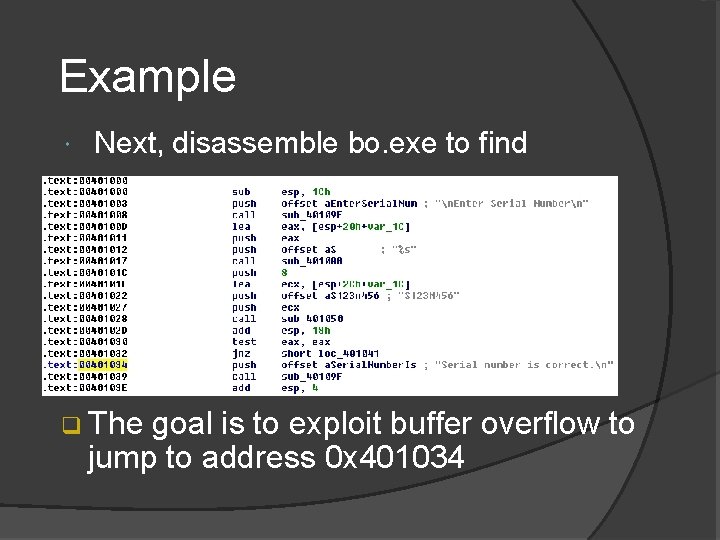
Example Next, disassemble bo. exe to find q The goal is to exploit buffer overflow to jump to address 0 x 401034
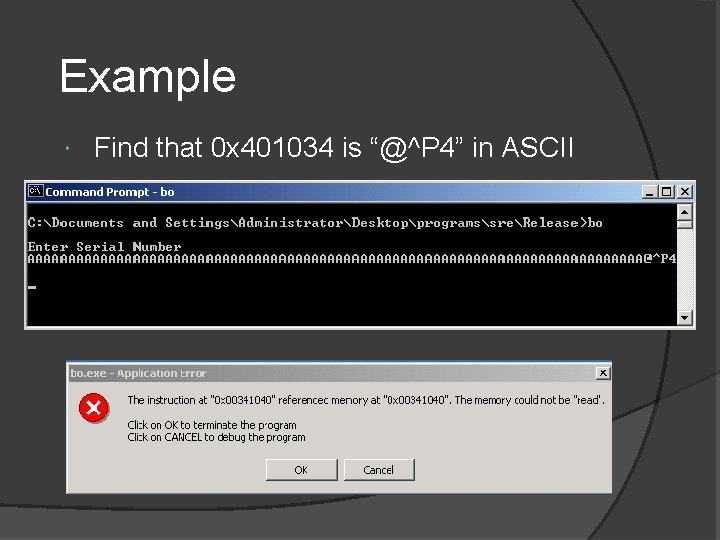
Example Find that 0 x 401034 is “@^P 4” in ASCII
Example Reverse the byte order to “ 4^P@” and… Success! We’ve bypassed serial number check by exploiting a buffer overflow q Overwrote the return address on the stack q
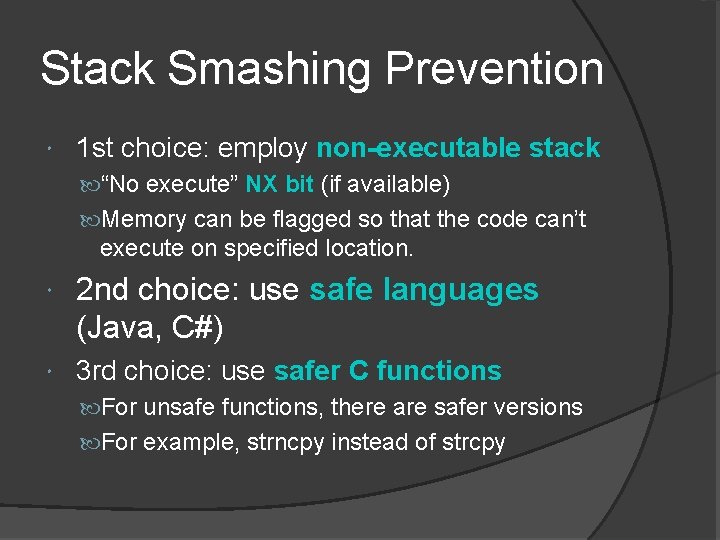
Stack Smashing Prevention 1 st choice: employ non-executable stack “No execute” NX bit (if available) Memory can be flagged so that the code can’t execute on specified location. 2 nd choice: use safe languages (Java, C#) 3 rd choice: use safer C functions For unsafe functions, there are safer versions For example, strncpy instead of strcpy
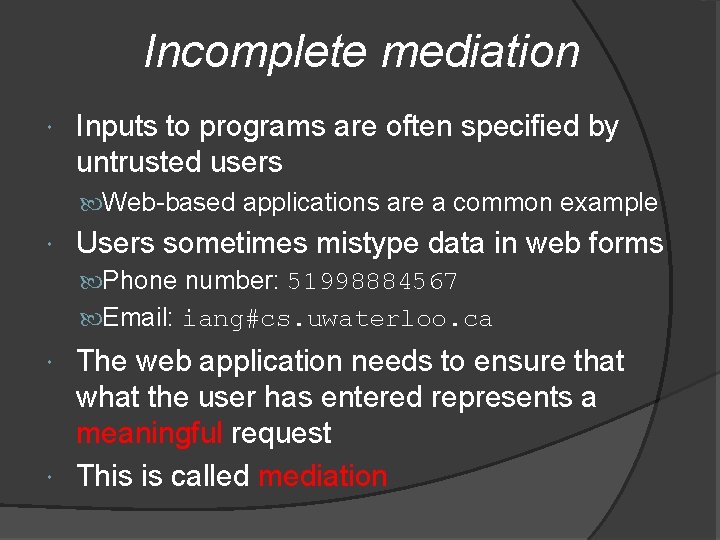
Incomplete mediation Inputs to programs are often specified by untrusted users Web-based applications are a common example Users sometimes mistype data in web forms Phone number: 51998884567 Email: iang#cs. uwaterloo. ca The web application needs to ensure that what the user has entered represents a meaningful request This is called mediation
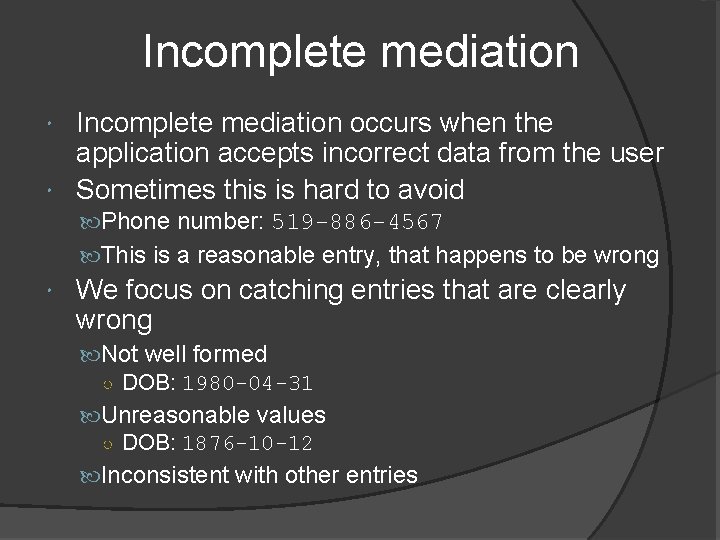
Incomplete mediation occurs when the application accepts incorrect data from the user Sometimes this is hard to avoid Phone number: 519 -886 -4567 This is a reasonable entry, that happens to be wrong We focus on catching entries that are clearly wrong Not well formed ○ DOB: 1980 -04 -31 Unreasonable values ○ DOB: 1876 -10 -12 Inconsistent with other entries
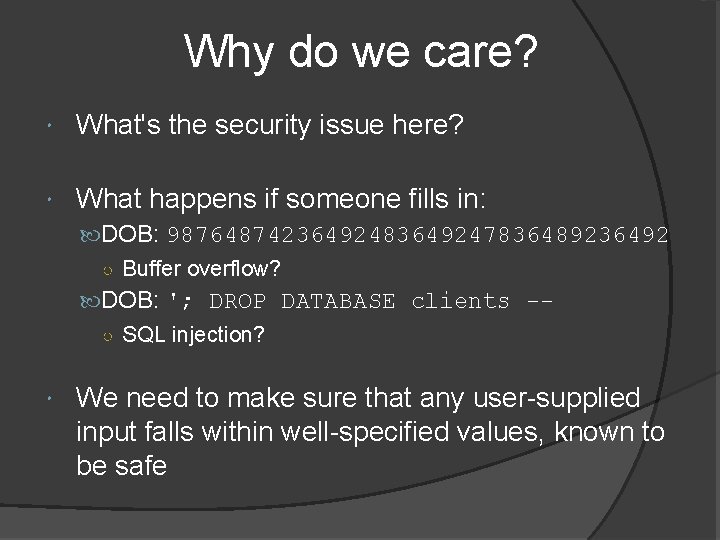
Why do we care? What's the security issue here? What happens if someone fills in: DOB: 98764874236492483649247836489236492 ○ Buffer overflow? DOB: '; DROP DATABASE clients -○ SQL injection? We need to make sure that any user-supplied input falls within well-specified values, known to be safe
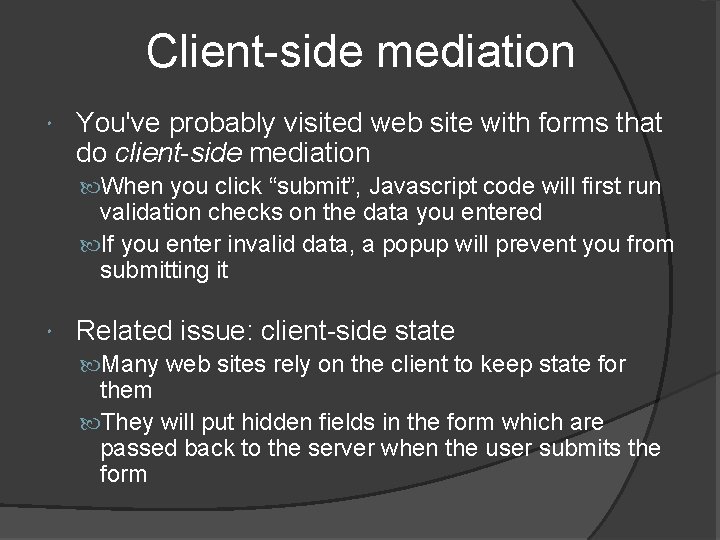
Client-side mediation You've probably visited web site with forms that do client-side mediation When you click “submit”, Javascript code will first run validation checks on the data you entered If you enter invalid data, a popup will prevent you from submitting it Related issue: client-side state Many web sites rely on the client to keep state for them They will put hidden fields in the form which are passed back to the server when the user submits the form
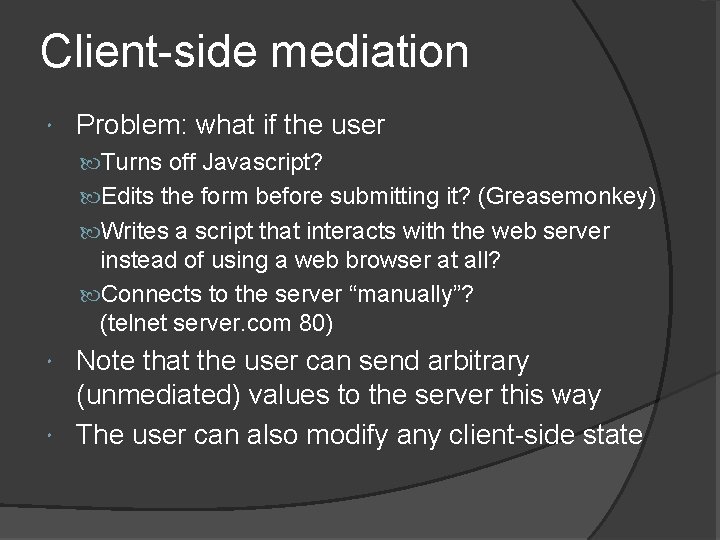
Client-side mediation Problem: what if the user Turns off Javascript? Edits the form before submitting it? (Greasemonkey) Writes a script that interacts with the web server instead of using a web browser at all? Connects to the server “manually”? (telnet server. com 80) Note that the user can send arbitrary (unmediated) values to the server this way The user can also modify any client-side state
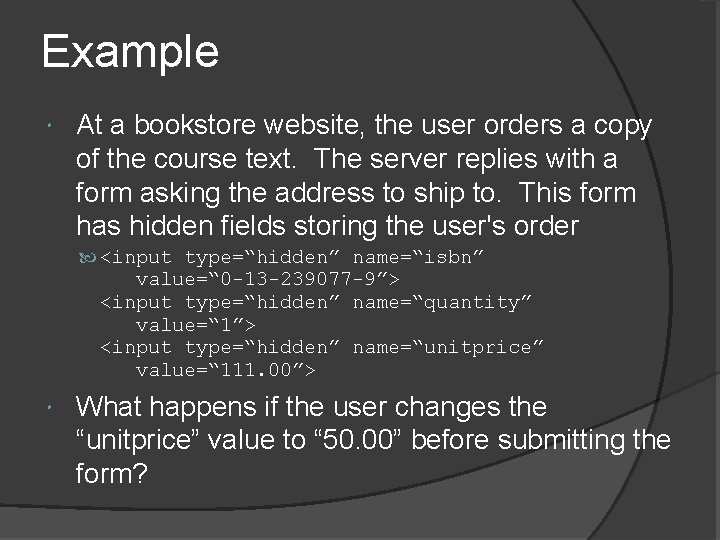
Example At a bookstore website, the user orders a copy of the course text. The server replies with a form asking the address to ship to. This form has hidden fields storing the user's order <input type=“hidden” name=“isbn” value=“ 0 -13 -239077 -9”> <input type=“hidden” name=“quantity” value=“ 1”> <input type=“hidden” name=“unitprice” value=“ 111. 00”> What happens if the user changes the “unitprice” value to “ 50. 00” before submitting the form?
Defences against incomplete mediation Client-side mediation is an OK method to use in order to have a friendlier user interface, but is useless for security purposes. You have to do server-side mediation, whether or not you also do client-side. For values entered by the user: Always do very careful checks on the values of all fields For state stored by the client: Make sure the client has not modified the data in any way
TOCTTOU errors / Race Condition TOCTTOU (“TOCK-too”) errors Time-Of-Check To Time-Of-Use Also known as “race condition” errors These errors occur when the following happens: User requests the system to perform an action The system verifies the user is allowed to perform the action The system performs the action
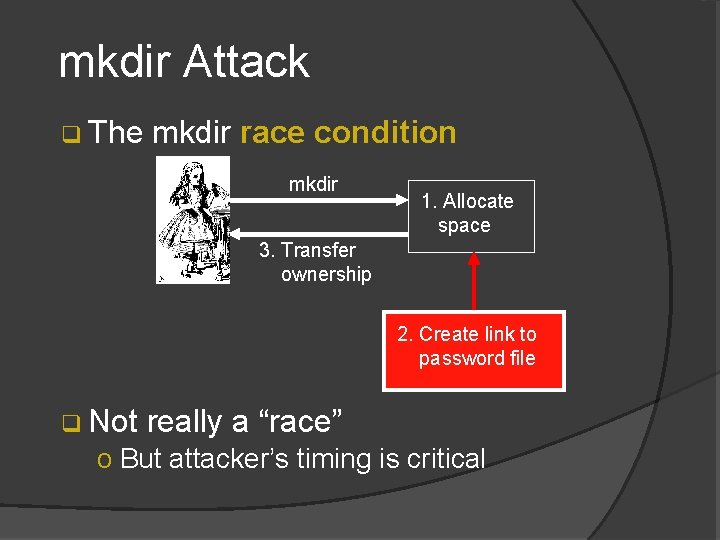
Race Condition Security processes should be atomic Occur “all at once” Race conditions can arise when securitycritical process occurs in stages Attacker makes change between stages Often, between stage that gives authorization, but before stage that transfers ownership Example: Unix mkdir
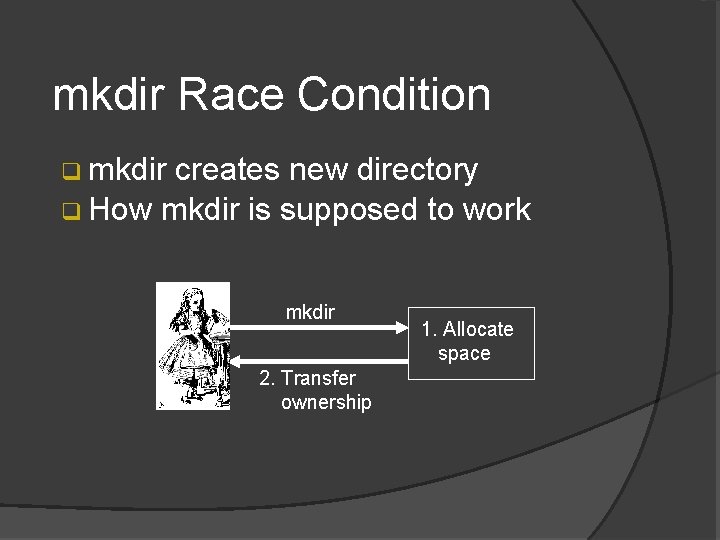
mkdir Race Condition q mkdir creates new directory q How mkdir is supposed to work mkdir 2. Transfer ownership 1. Allocate space
mkdir Attack q The mkdir race condition mkdir 1. Allocate space 3. Transfer ownership 2. Create link to password file q Not really a “race” o But attacker’s timing is critical
Race Conditions Race conditions are common Race conditions may be more common than buffer overflows But race conditions harder to exploit To prevent race conditions, make securitycritical processes atomic Occur all at once, not in stages