
Chapter2 The Planar Imaging Gamma Camera The Components








- Slides: 49
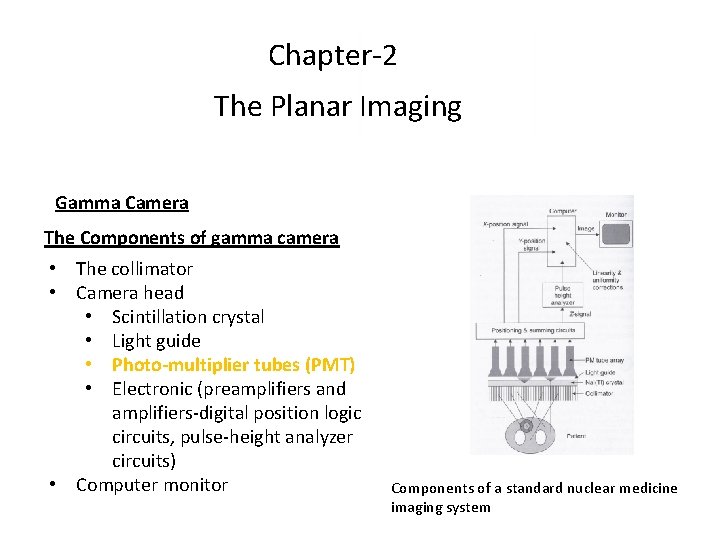
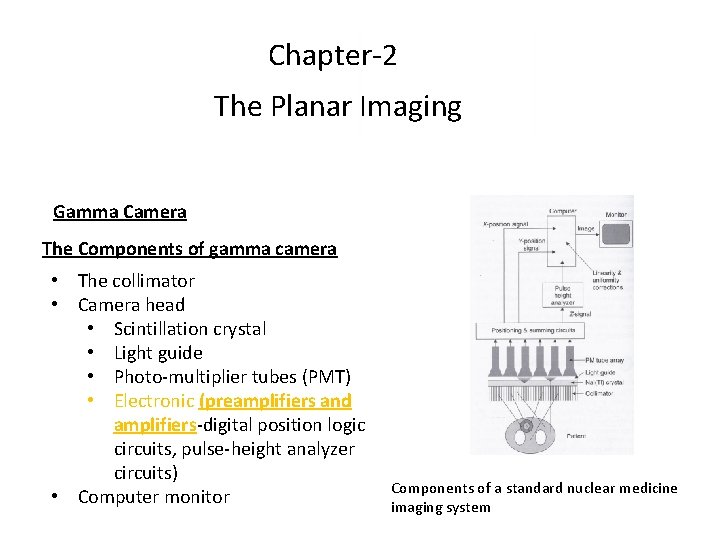
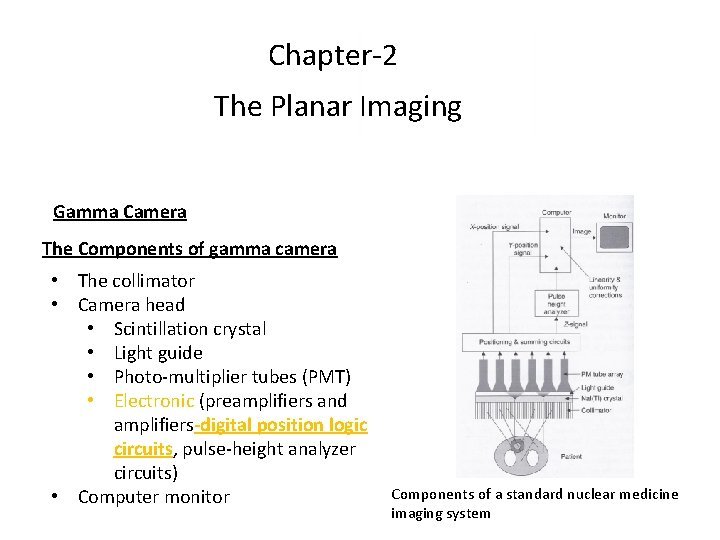
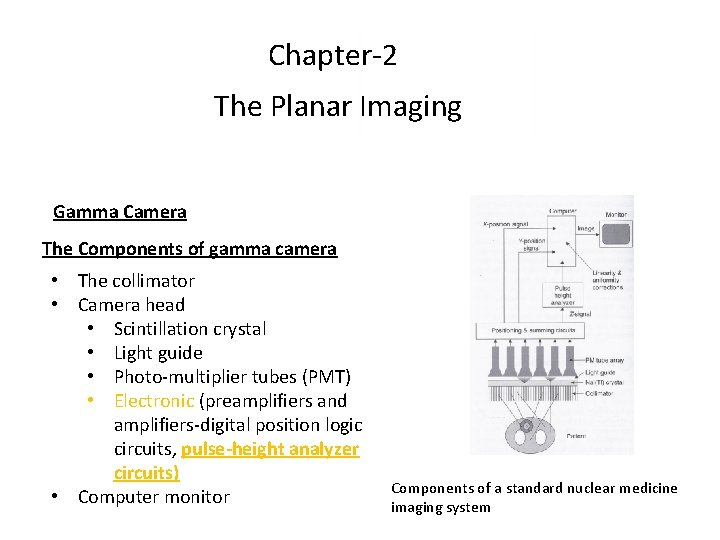
Chapter-2 The Planar Imaging Gamma Camera The Components of gamma camera • The collimator • Camera head • Scintillation crystal • Light guide • Photo-multiplier tubes (PMT) • Electronic (preamplifiers and amplifiers-digital position logic circuits, pulse-height analyzer circuits) • Computer monitor Components of a standard nuclear medicine imaging system
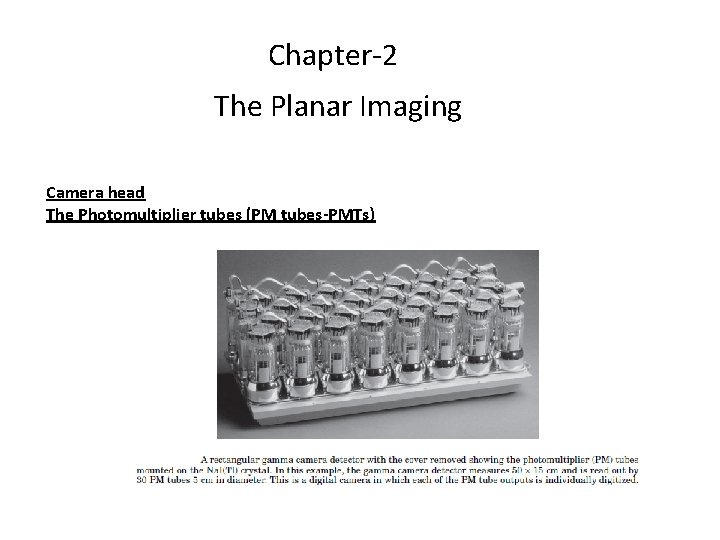
Chapter-2 The Planar Imaging Camera head The Photomultiplier tubes (PM tubes-PMTs)
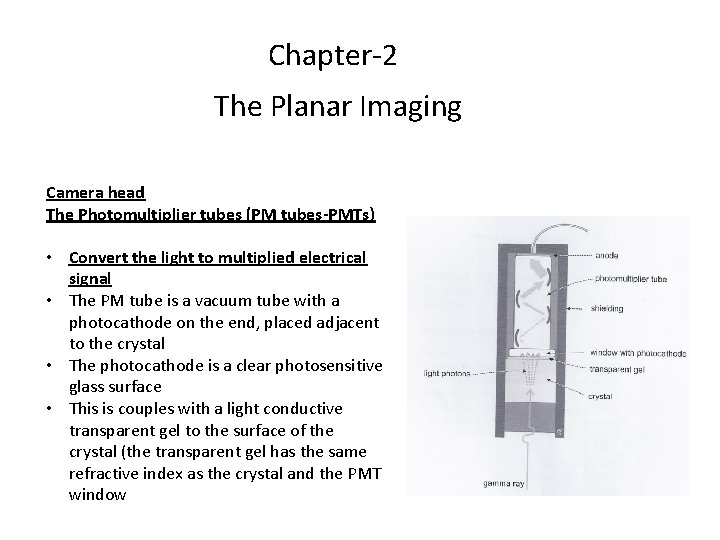
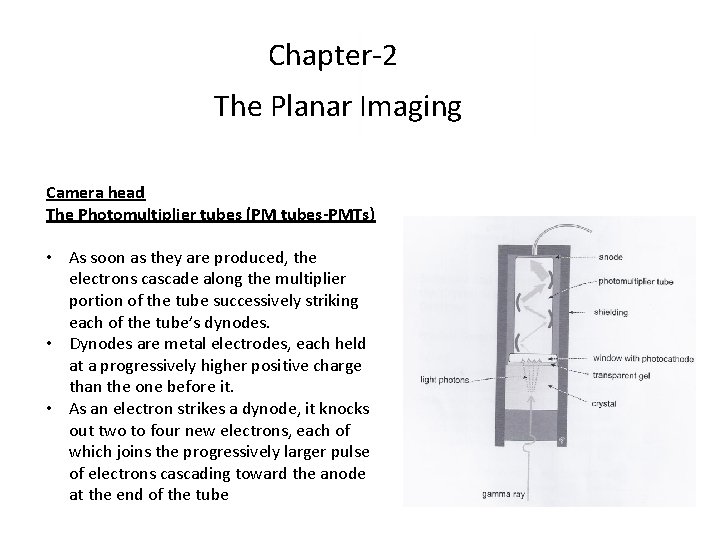
Chapter-2 The Planar Imaging Camera head The Photomultiplier tubes (PM tubes-PMTs) • Convert the light to multiplied electrical signal • The PM tube is a vacuum tube with a photocathode on the end, placed adjacent to the crystal • The photocathode is a clear photosensitive glass surface • This is couples with a light conductive transparent gel to the surface of the crystal (the transparent gel has the same refractive index as the crystal and the PMT window
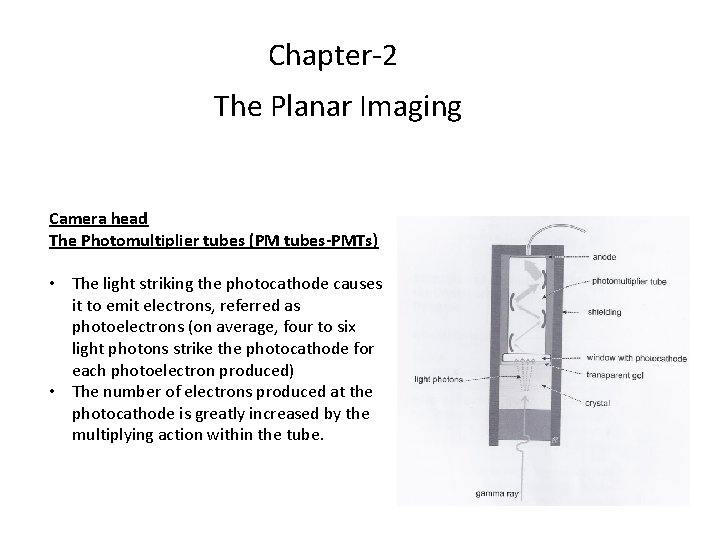
Chapter-2 The Planar Imaging Camera head The Photomultiplier tubes (PM tubes-PMTs) • The light striking the photocathode causes it to emit electrons, referred as photoelectrons (on average, four to six light photons strike the photocathode for each photoelectron produced) • The number of electrons produced at the photocathode is greatly increased by the multiplying action within the tube.
Chapter-2 The Planar Imaging Camera head The Photomultiplier tubes (PM tubes-PMTs) • As soon as they are produced, the electrons cascade along the multiplier portion of the tube successively striking each of the tube’s dynodes. • Dynodes are metal electrodes, each held at a progressively higher positive charge than the one before it. • As an electron strikes a dynode, it knocks out two to four new electrons, each of which joins the progressively larger pulse of electrons cascading toward the anode at the end of the tube
Chapter-2 The Planar Imaging Gamma Camera The Components of gamma camera • The collimator • Camera head • Scintillation crystal • Light guide • Photo-multiplier tubes (PMT) • Electronic (preamplifiers and amplifiers-digital position logic circuits, pulse-height analyzer circuits) • Computer monitor Components of a standard nuclear medicine imaging system
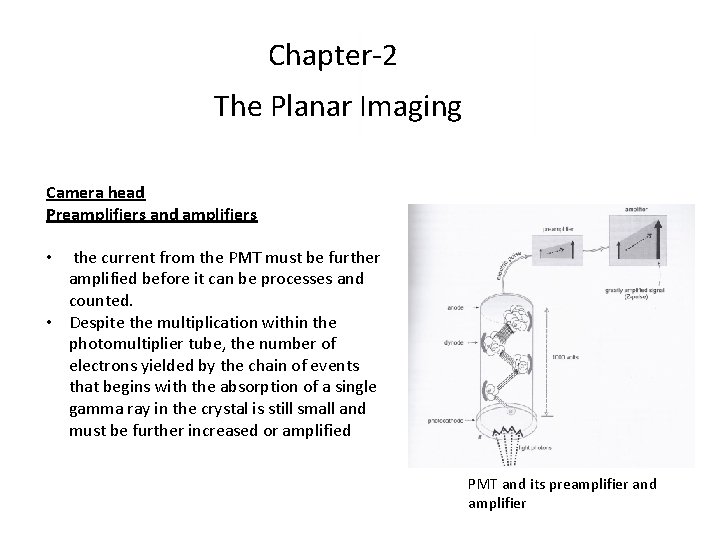
Chapter-2 The Planar Imaging Camera head Preamplifiers and amplifiers the current from the PMT must be further amplified before it can be processes and counted. • Despite the multiplication within the photomultiplier tube, the number of electrons yielded by the chain of events that begins with the absorption of a single gamma ray in the crystal is still small and must be further increased or amplified • PMT and its preamplifier and amplifier
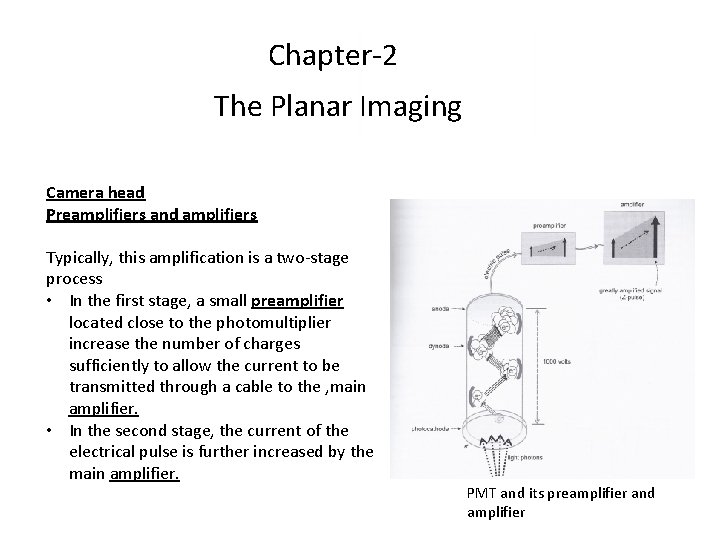
Chapter-2 The Planar Imaging Camera head Preamplifiers and amplifiers Typically, this amplification is a two-stage process • In the first stage, a small preamplifier located close to the photomultiplier increase the number of charges sufficiently to allow the current to be transmitted through a cable to the , main amplifier. • In the second stage, the current of the electrical pulse is further increased by the main amplifier. PMT and its preamplifier and amplifier
Chapter-2 The Planar Imaging Gamma Camera The Components of gamma camera • The collimator • Camera head • Scintillation crystal • Light guide • Photo-multiplier tubes (PMT) • Electronic (preamplifiers and amplifiers-digital position logic circuits, pulse-height analyzer circuits) • Computer monitor Components of a standard nuclear medicine imaging system
Chapter-2 The Planar Imaging Camera head Positioning Circuit • The amount of light received by PMT is related to the proximity of the tube to the site of interaction of the gamma ray in the crystal the PMT closet to the site of interaction receive the greatest number of photons and generates the greatest output pulse; the tube farthest from the nuclide source receives the fewest light photons and generates the smallest pulse. • Although an image can be composed solely of the point corresponding to the PMT with the highest output at each photon interaction, the number of resolvable points is then limited to the total number of PMT tubes (up to 128 per cameras)
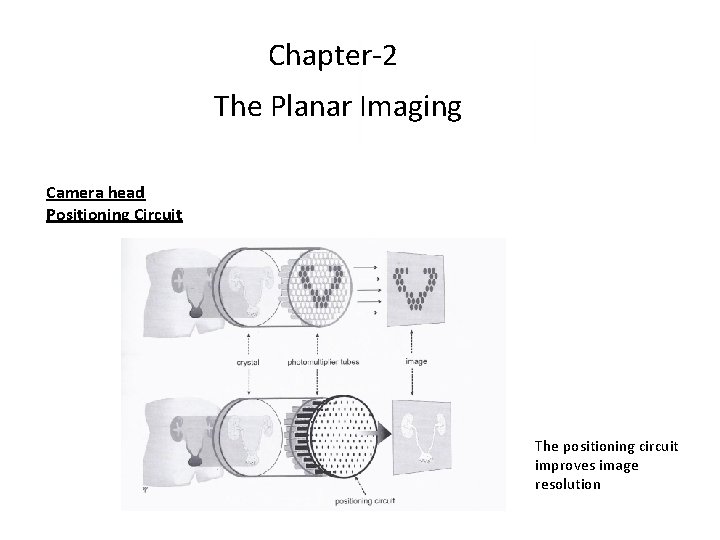
Chapter-2 The Planar Imaging Camera head Positioning Circuit The positioning circuit improves image resolution
Chapter-2 The Planar Imaging Camera head Positioning Circuit • The positioning circuit improves resolution by factoring in the output from adjacent tubes. • The positioning circuit uses a “voltage divider” to weigh the output of each tube in relation to its position on the face of the crystal (a simple voltage divider can be constructed from an electrical resister).
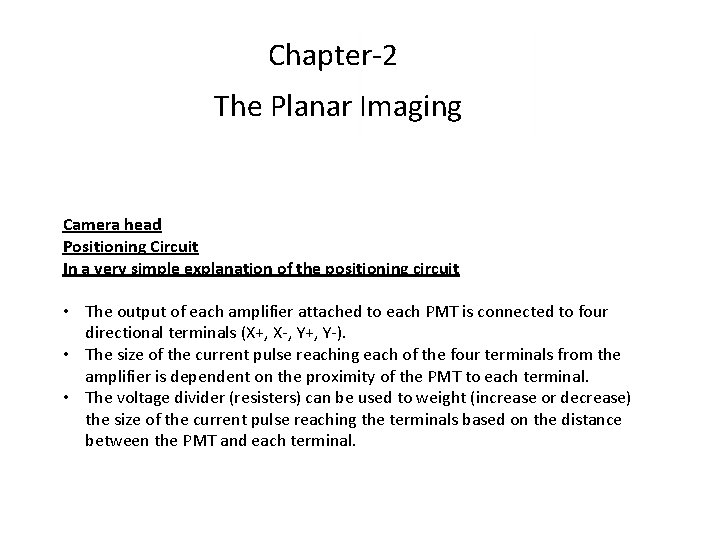
Chapter-2 The Planar Imaging Camera head Positioning Circuit In a very simple explanation of the positioning circuit • The output of each amplifier attached to each PMT is connected to four directional terminals (X+, X-, Y+, Y-). • The size of the current pulse reaching each of the four terminals from the amplifier is dependent on the proximity of the PMT to each terminal. • The voltage divider (resisters) can be used to weight (increase or decrease) the size of the current pulse reaching the terminals based on the distance between the PMT and each terminal.
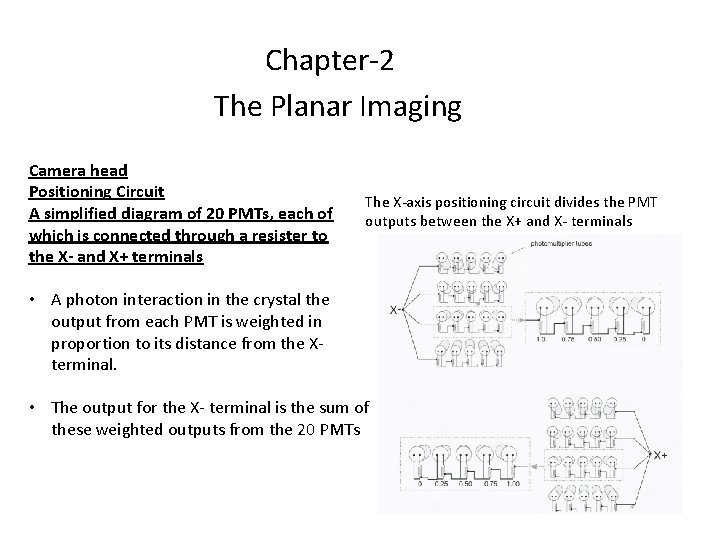
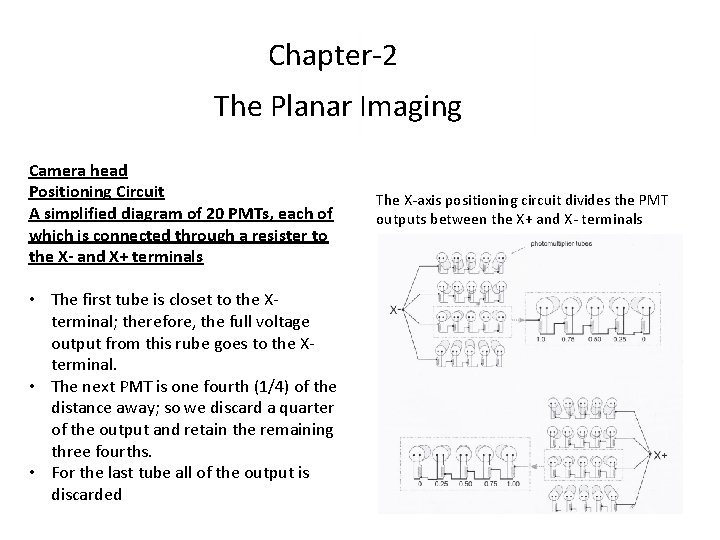
Chapter-2 The Planar Imaging Camera head Positioning Circuit A simplified diagram of 20 PMTs, each of which is connected through a resister to the X- and X+ terminals The X-axis positioning circuit divides the PMT outputs between the X+ and X- terminals • A photon interaction in the crystal the output from each PMT is weighted in proportion to its distance from the Xterminal. • The output for the X- terminal is the sum of these weighted outputs from the 20 PMTs
Chapter-2 The Planar Imaging Camera head Positioning Circuit A simplified diagram of 20 PMTs, each of which is connected through a resister to the X- and X+ terminals • The first tube is closet to the Xterminal; therefore, the full voltage output from this rube goes to the Xterminal. • The next PMT is one fourth (1/4) of the distance away; so we discard a quarter of the output and retain the remaining three fourths. • For the last tube all of the output is discarded The X-axis positioning circuit divides the PMT outputs between the X+ and X- terminals
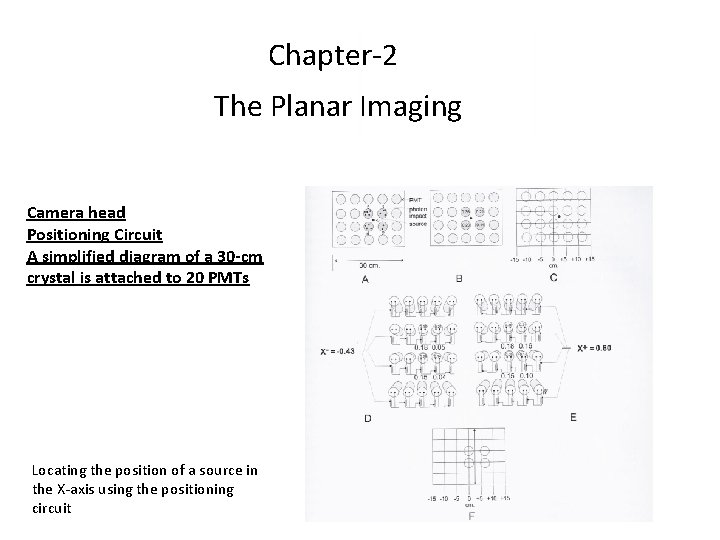
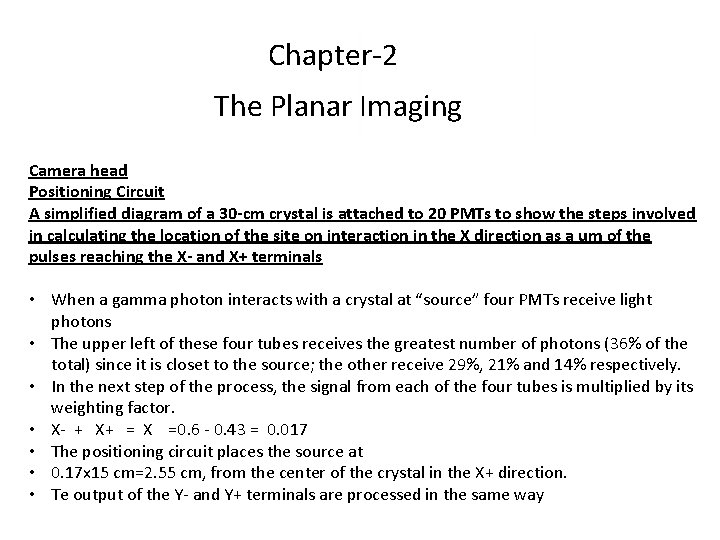
Chapter-2 The Planar Imaging Camera head Positioning Circuit A simplified diagram of a 30 -cm crystal is attached to 20 PMTs Locating the position of a source in the X-axis using the positioning circuit
Chapter-2 The Planar Imaging Camera head Positioning Circuit A simplified diagram of a 30 -cm crystal is attached to 20 PMTs to show the steps involved in calculating the location of the site on interaction in the X direction as a um of the pulses reaching the X- and X+ terminals • When a gamma photon interacts with a crystal at “source” four PMTs receive light photons • The upper left of these four tubes receives the greatest number of photons (36% of the total) since it is closet to the source; the other receive 29%, 21% and 14% respectively. • In the next step of the process, the signal from each of the four tubes is multiplied by its weighting factor. • X- + X+ = X =0. 6 - 0. 43 = 0. 017 • The positioning circuit places the source at • 0. 17 x 15 cm=2. 55 cm, from the center of the crystal in the X+ direction. • Te output of the Y- and Y+ terminals are processed in the same way
Chapter-2 The Planar Imaging Gamma Camera The Components of gamma camera • The collimator • Camera head • Scintillation crystal • Light guide • Photo-multiplier tubes (PMT) • Electronic (preamplifiers and amplifiers-digital position logic circuits, pulse-height analyzer circuits) • Computer monitor Components of a standard nuclear medicine imaging system
Chapter-2 The Planar Imaging Camera head Pulse-height analyzer circuit (Pulse-height analyzer) • The amplifiers are designed to ensure that the amplitude of each pulse is proportional to the energy absorbed in the crystal from the gamma radiation • The amplitude of each electrical pulse from the amplifiers is measured in the electrical circuits of the pulse-height analyzer. • A tally is kept showing the number of pulses of each height • A plot of the number of pulses against their height that is their energy is called the pulse height spectrum
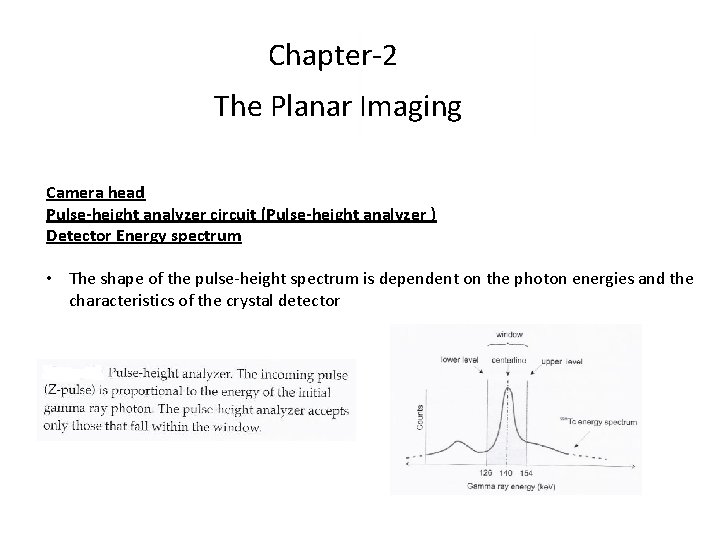
Chapter-2 The Planar Imaging Camera head Pulse-height analyzer circuit (Pulse-height analyzer ) Detector Energy spectrum • The shape of the pulse-height spectrum is dependent on the photon energies and the characteristics of the crystal detector
Chapter-2 The Planar Imaging Camera head Pulse-height analyzer circuit (Pulse-height analyzer) • The pulse-height analyzer is often used to “select” only pulses (conventionally called Z-pulses) that correspond to a range of the acceptable energies. This range is called the energy window. • A window setting of 20% for the 140 Ke. V photopeak of 99 m-Tc means that Zpulses corresponding to a 28 Ke. V range centered on the 140 Ke. V will be accepted and counted
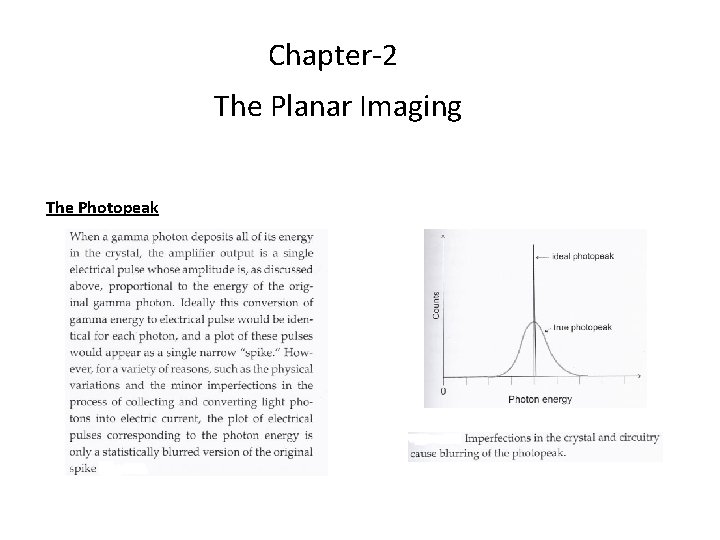
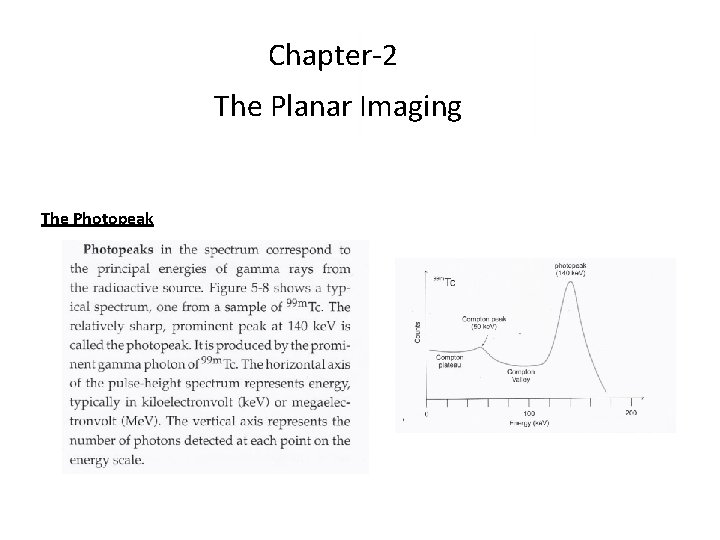
Chapter-2 The Planar Imaging The Photopeak
Chapter-2 The Planar Imaging The Photopeak
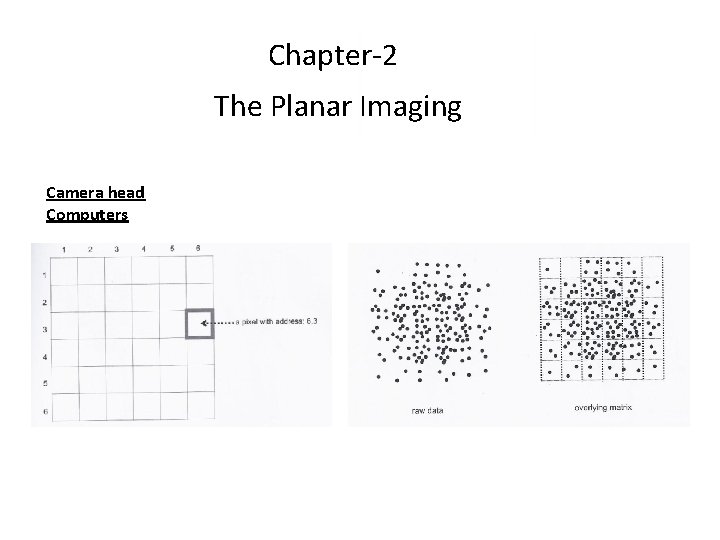
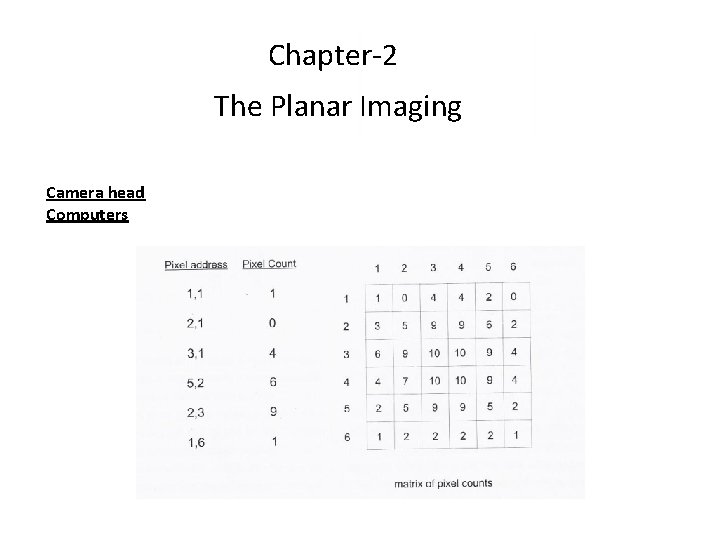
Chapter-2 The Planar Imaging Camera head Computers • Nuclear medicine computers are used for the acquisition, storage and processing of the data • The image data are stored in digital form (digitized) as for each Z-pulse that is accepted by the pulse-height analyzer, one count is added to the storage location that corresponds to its x, y location determined by the positioning circuit. • The data storage can be visualized as a matrix (a kind of 2 D checkerboard) • Each position within the matrix corresponds to a pixel within the image and is assigned a unique “address” composed of the row and column of its location.
Chapter-2 The Planar Imaging Camera head Computers
Chapter-2 The Planar Imaging Camera head Computers
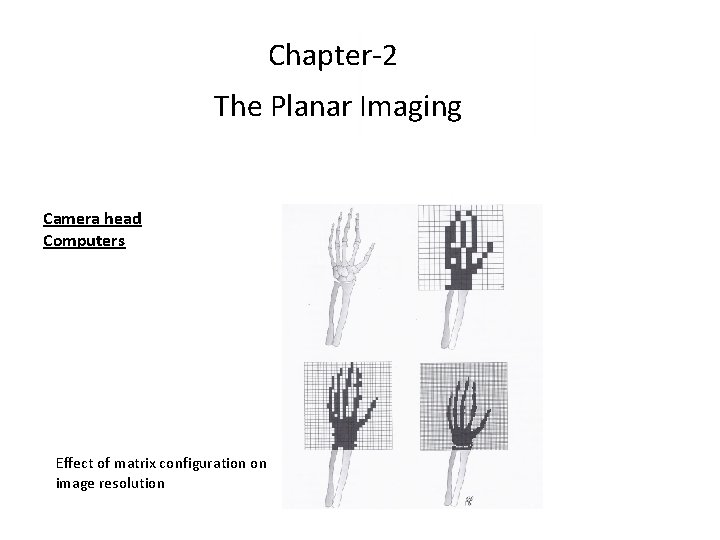
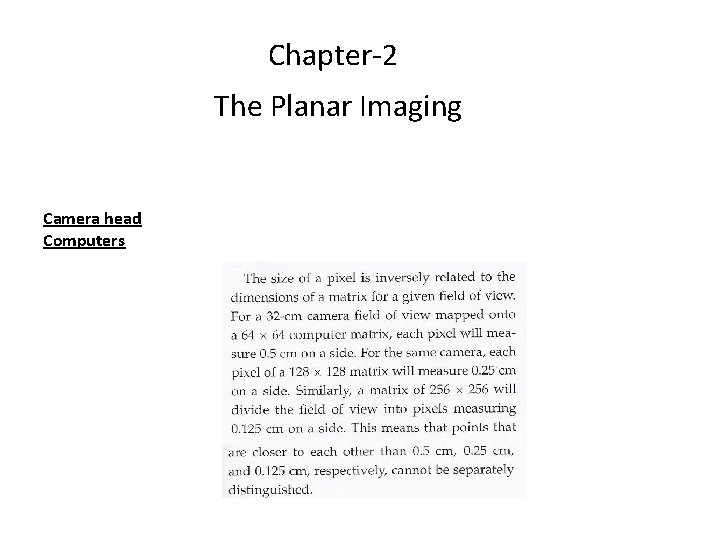
Chapter-2 The Planar Imaging Camera head Computers • Matrices are defined by the number of subdivisions along each axis. • The operator can select from several matrix configuration of successively finer divisions; 64 x 64, 128 x 128, 256 x 256 and 512 x 512 or more (these numbers refer to the number of columns and rows in a square matrix. • The outside dimensions of all matrices are the same size. What varies is the pixel size and hence the total number of pixel • Example; A 64 x 64 matrix has 4096 pixel ; a 128 x 128 matrix has 16384 pixels.
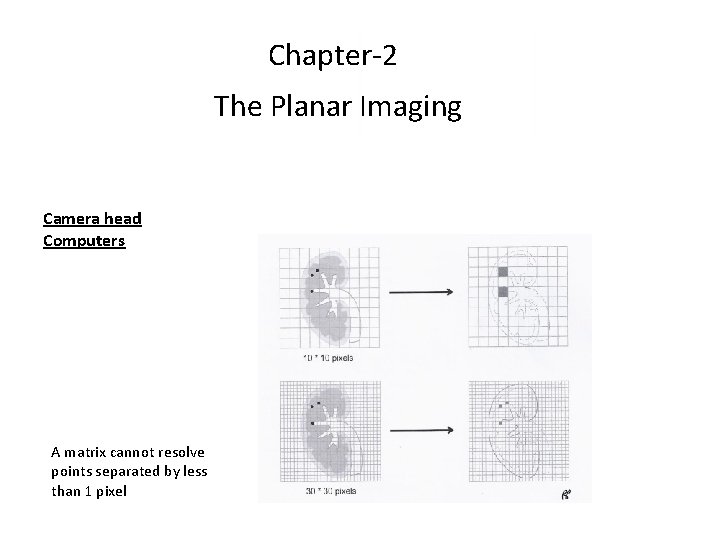
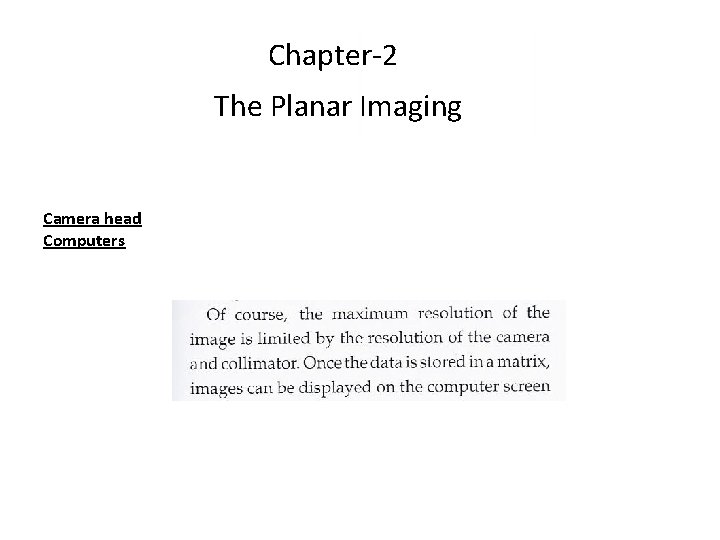
Chapter-2 The Planar Imaging Camera head Computers • The greater the number of pixels the smaller is each pixel for a given field of view (FOV) and the better preserved is the resolution of the image. • The camera and computer system cannot reliably distinguish between two points that are separated by less than 1 pixel.
Chapter-2 The Planar Imaging Camera head Computers Effect of matrix configuration on image resolution
Chapter-2 The Planar Imaging Camera head Computers A matrix cannot resolve points separated by less than 1 pixel
Chapter-2 The Planar Imaging Camera head Computers
Chapter-2 The Planar Imaging Camera head Computers
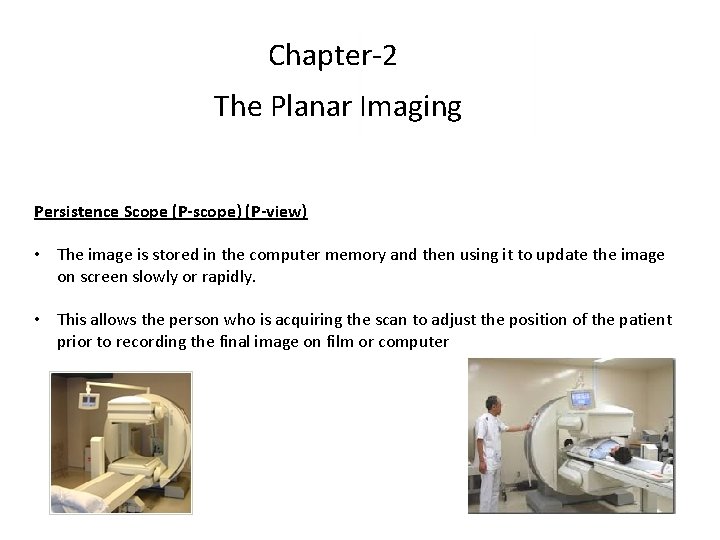
Chapter-2 The Planar Imaging Persistence Scope (P-scope) (P-view) • The image is stored in the computer memory and then using it to update the image on screen slowly or rapidly. • This allows the person who is acquiring the scan to adjust the position of the patient prior to recording the final image on film or computer
Chapter-2 The Planar Imaging Some useful videos https: //www. youtube. com/watch? v=I 0 re 3 nc. CKv. M (gamma camera animation) http: //www. youtube. com/watch? v=MTZi. Hq. PKSm 8 (gamma camera) https: //www. youtube. com/watch? v=ZRvz. Hi-GY 7 c (gamma camera) http: //www. youtube. com/watch? v=1 spo 1 Yei. U 7 Q (Nuclear Medicine) http: //www. youtube. com/watch? v=c 716 Sj 1 HYVE (Nuclear Medicine)
Chapter-2 The Planar Imaging Types of Image acquisition The gamma photons emitted by the patients may be acquired in various forms 1. Static imaging 2. Dynamic imaging 3. Gated imaging
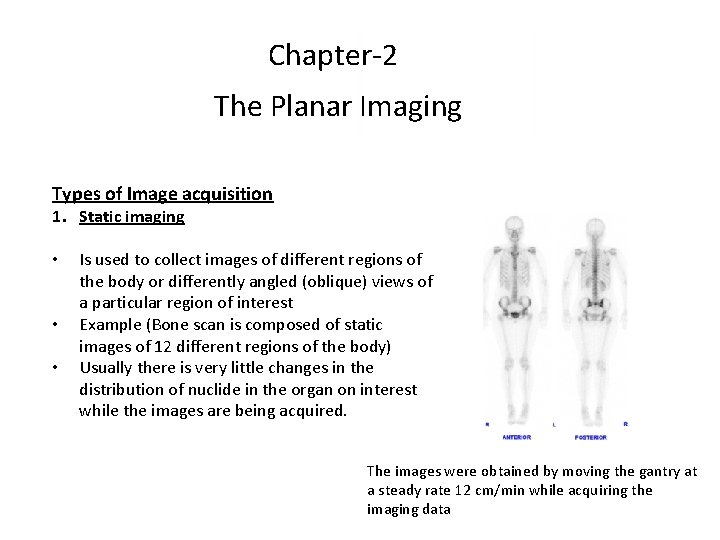
Chapter-2 The Planar Imaging Types of Image acquisition 1. Static imaging • • • Is used to collect images of different regions of the body or differently angled (oblique) views of a particular region of interest Example (Bone scan is composed of static images of 12 different regions of the body) Usually there is very little changes in the distribution of nuclide in the organ on interest while the images are being acquired. The images were obtained by moving the gantry at a steady rate 12 cm/min while acquiring the imaging data
Chapter-2 The Planar Imaging Types of Image acquisition 2. Dynamic imaging • If the distribution of nuclide in the organ is changing rapidly and it is important to record this change, multiple rapid images of a particular region on interest are acquired • Example: it is used to collect sequential 1 -second frame (called frame) of the flow of nuclide through the kidney • Dynamic imaging can be thought of as a type of video recording to “catch” images of fast action; static images are similar to photograph http: //www. youtube. com/watch? v=1 Amt. L 0 OESuk (example of Dynamic imaging in clinic)
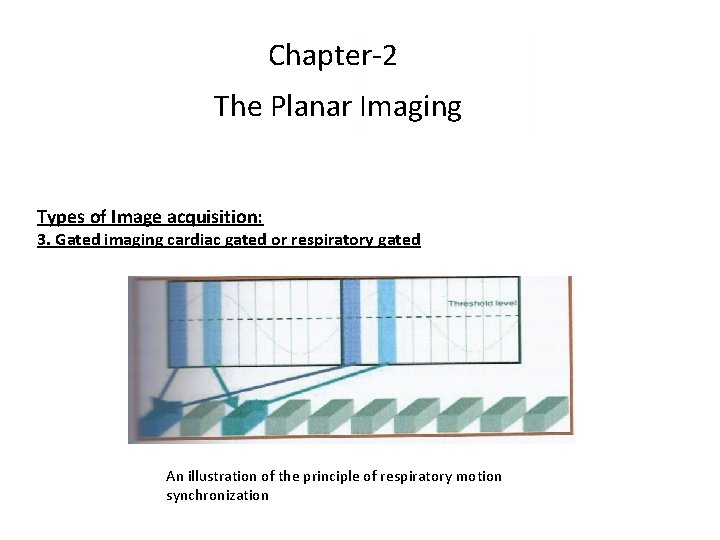
Chapter-2 The Planar Imaging Types of Image acquisition: 3. Gated imaging cardiac gated or respiratory gated • Gated images area a variation of dynamic images • Data are divided into frames but different from the dynamic frames • Continuous images are obtained of a moving organ and data are coordinated with the rate of heart beat or respiratory cycle
Chapter-2 The Planar Imaging Types of Image acquisition: 3. Gated imaging cardiac gated or respiratory gated An illustration of the principle of respiratory motion synchronization
Chapter-2 The Planar Imaging Types of Image acquisition: 3. Gated imaging cardiac gated or respiratory gated https: //www. youtube. com/watch? v=n 9 O 1 q. Niy. O 6 Q (gated imaging) https: //www. youtube. com/watch? v=X-3 GOx. Uw. Nj 8 (respiratory gating)
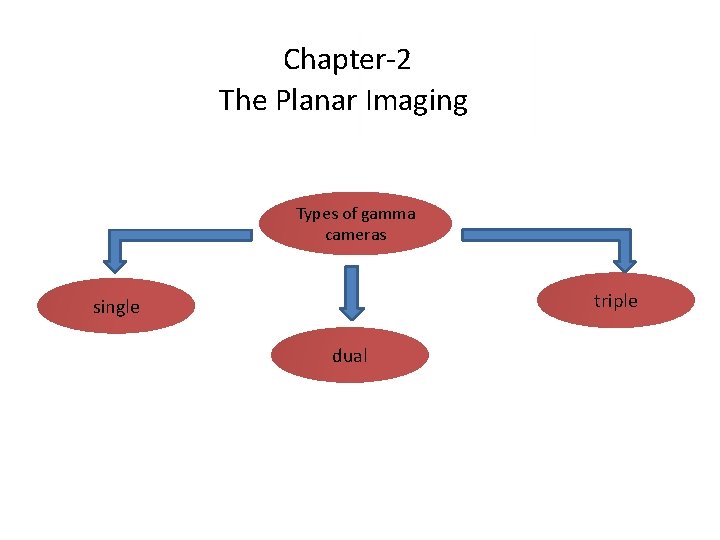
Chapter-2 The Planar Imaging Types of gamma cameras triple single dual
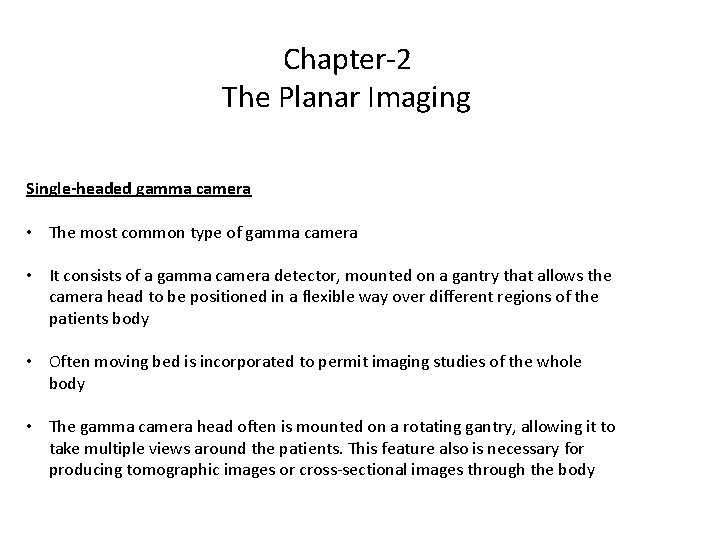
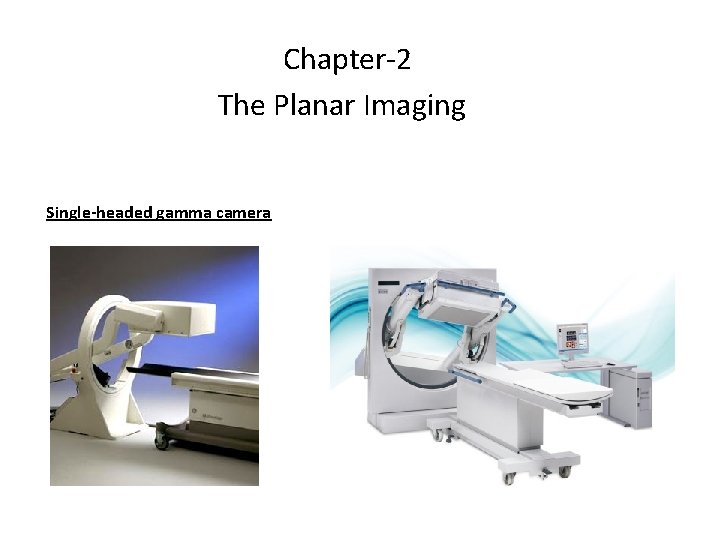
Chapter-2 The Planar Imaging Single-headed gamma camera • The most common type of gamma camera • It consists of a gamma camera detector, mounted on a gantry that allows the camera head to be positioned in a flexible way over different regions of the patients body • Often moving bed is incorporated to permit imaging studies of the whole body • The gamma camera head often is mounted on a rotating gantry, allowing it to take multiple views around the patients. This feature also is necessary for producing tomographic images or cross-sectional images through the body
Chapter-2 The Planar Imaging Single-headed gamma camera
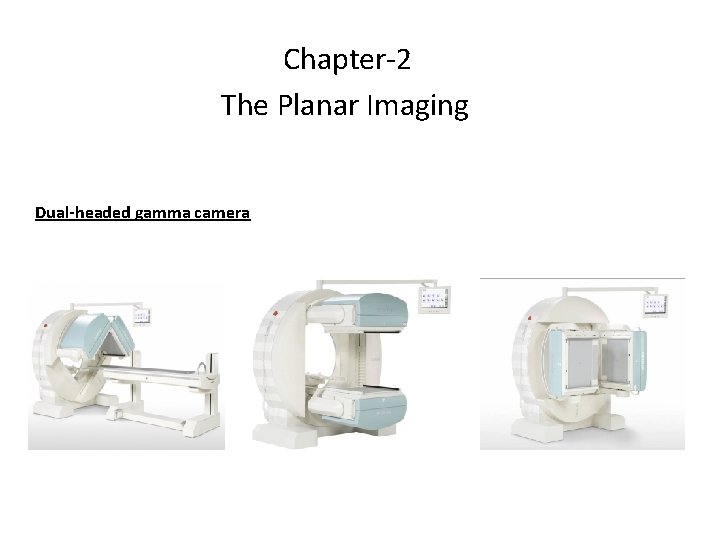
Chapter-2 The Planar Imaging Dual-headed gamma camera • In these systems two gamma heads are mounted onto the gantry • Usually, the two heads can be positioned at a variety of locations on the circular gantry • An obvious advantage of a dual-headed camera is that two different views of the patients can be acquired at the same time • For example, in whole-body imaging, the two detector head can be placed at 180 degrees to each other to provide anterior and posterior views simultaneously
Chapter-2 The Planar Imaging Dual-headed gamma camera
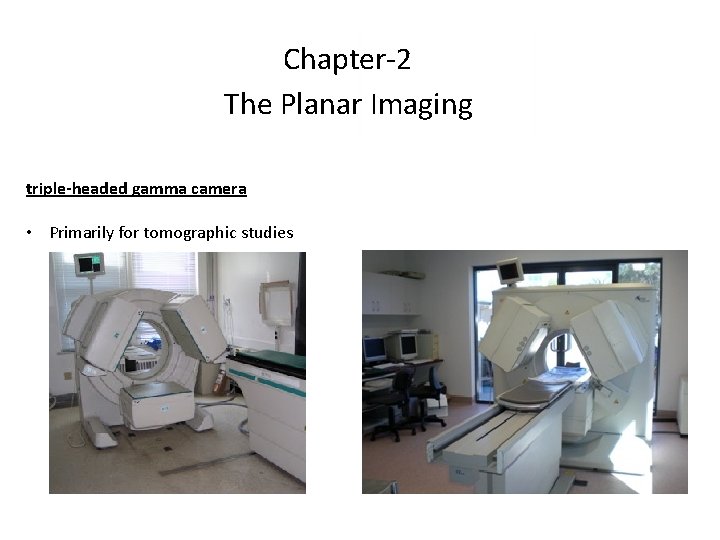
Chapter-2 The Planar Imaging triple-headed gamma camera • Primarily for tomographic studies
Chapter-2 The Planar Imaging a range of specialty gamma cameras have been or are being, developed for specific imaging tasks.
Chapter-2 The Planar Imaging Important points in chapter 2 • The gamma camera (the basic principles of the gamma camera) • The types of gamma camera • The type of image acquisitions
Chapter-2 The Planar Imaging End of chapter 2