
CHAPTER2 ACCOUNTING PRINCIPLES n n n n Business
CHAPTER-2 ACCOUNTING PRINCIPLES n n n n Business entity principle Money measurement principle Going concern principle Accounting period principle Verifiable objective evidence principle Revenue realization principle-sale bases, cash bases, production bases Principle of matching of cost and revenue Principle of full disclosure The double aspect v Principle of materiality Principle of consistency Principle of conservatism Principle of timeliness Principle of industry practice
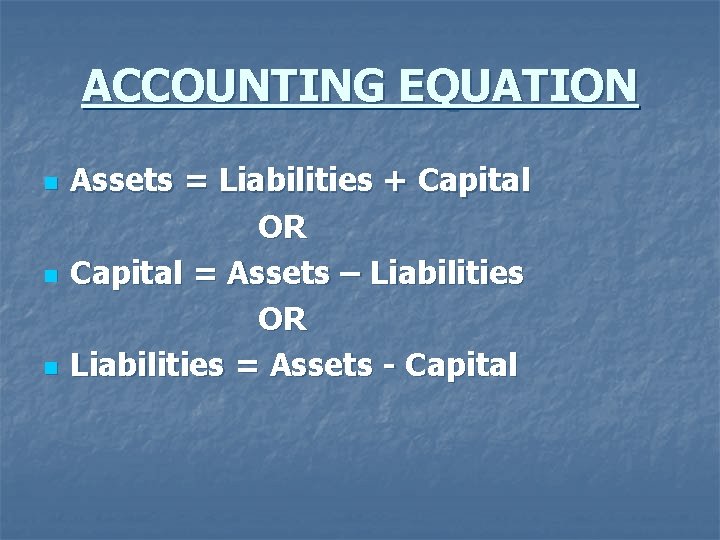
ACCOUNTING EQUATION n n n Assets = Liabilities + Capital OR Capital = Assets – Liabilities OR Liabilities = Assets - Capital
Double Entry System According to J. R. Batliboi-” Every business transaction has a two fold effect and that it effect to accounts in opposite directions and if a complete record was to be made of each such transactions, it would be necessary to debit one account and credit another account. It is that recording to the two fold effect of every transaction that has given rise to the term double entry.
Advantages n n n n n Complete record of every transactions Suitability to all type of organizations Reliable information's Scientific system Arithmetic accuracy Knowledge of profit Knowledge of financial position Comparative study Less chance of fraud Helpful to management

RULES n n n Personal Accounts“ Debit the receiver and Credit the giver”. Real Accounts“ Debit what comes in and Credit what goes out”. Nominal Accounts“ Debit all expenses and losses and Credit all incomes and gains”.
- Slides: 5