
CHAPTER2 AC DC METERS 24 MARKS Mrs V

- Slides: 56
CHAPTER-2 AC DC METERS (24 MARKS) Mrs. V. S. Kharote. Chavan, E&Tc, PC poly 1
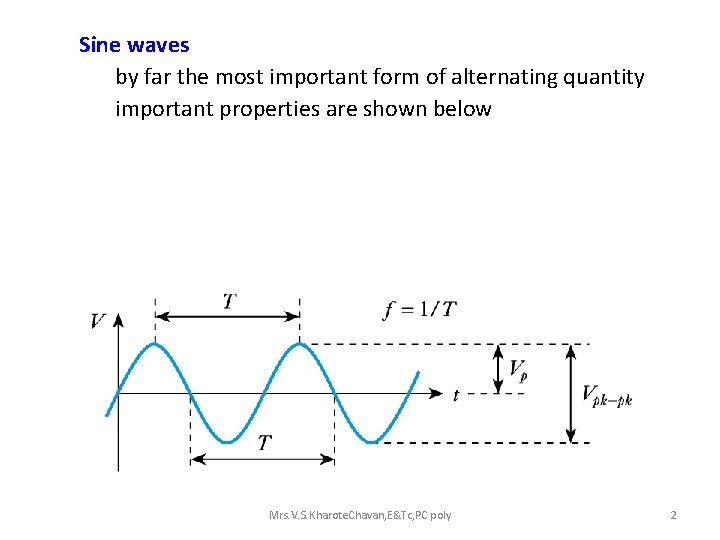
Sine waves by far the most important form of alternating quantity important properties are shown below Mrs. V. S. Kharote. Chavan, E&Tc, PC poly 2
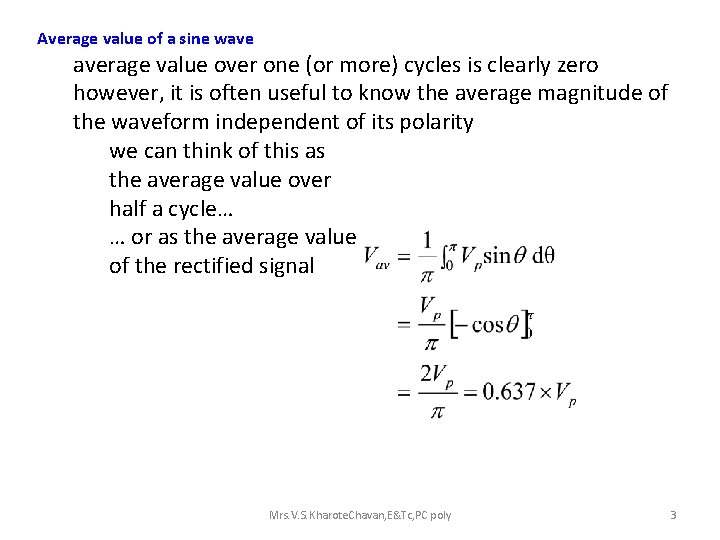
Average value of a sine wave average value over one (or more) cycles is clearly zero however, it is often useful to know the average magnitude of the waveform independent of its polarity we can think of this as the average value over half a cycle… … or as the average value of the rectified signal Mrs. V. S. Kharote. Chavan, E&Tc, PC poly 3
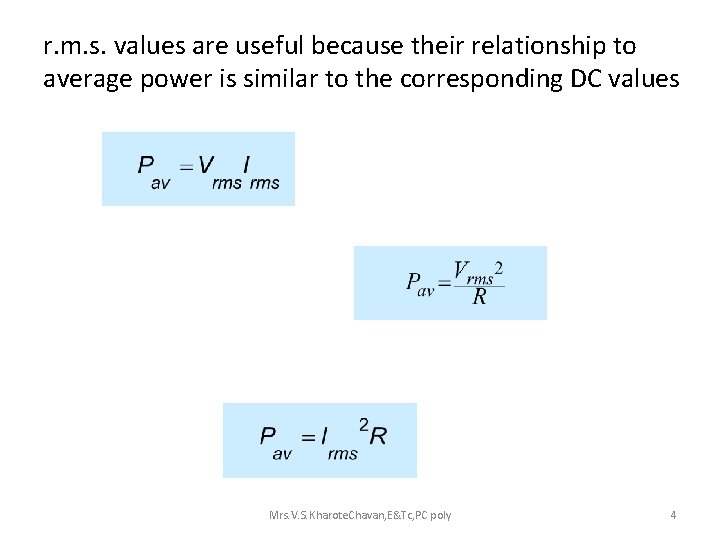
r. m. s. values are useful because their relationship to average power is similar to the corresponding DC values Mrs. V. S. Kharote. Chavan, E&Tc, PC poly 4
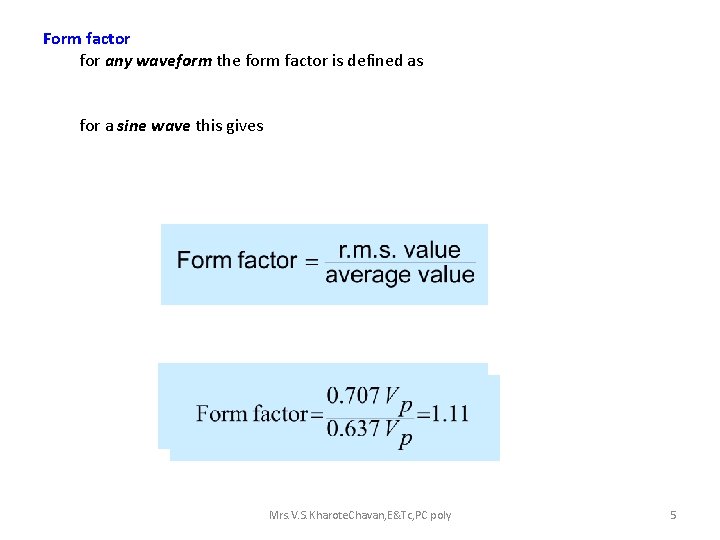
Form factor for any waveform the form factor is defined as for a sine wave this gives Mrs. V. S. Kharote. Chavan, E&Tc, PC poly 5
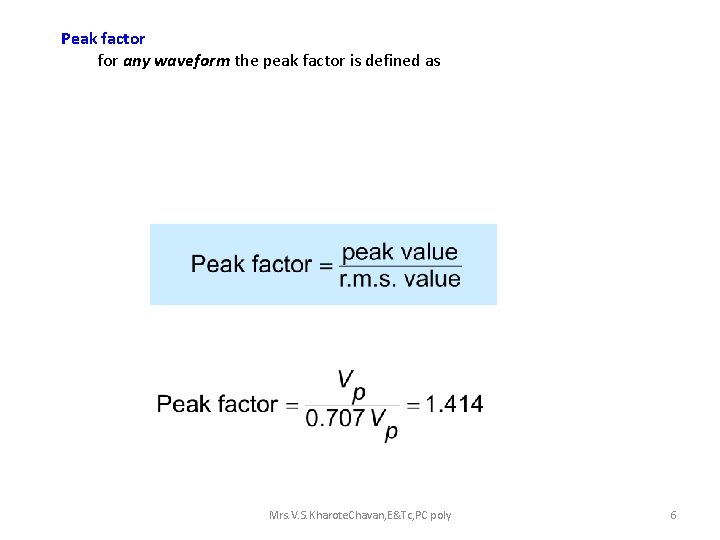
Peak factor for any waveform the peak factor is defined as Mrs. V. S. Kharote. Chavan, E&Tc, PC poly 6
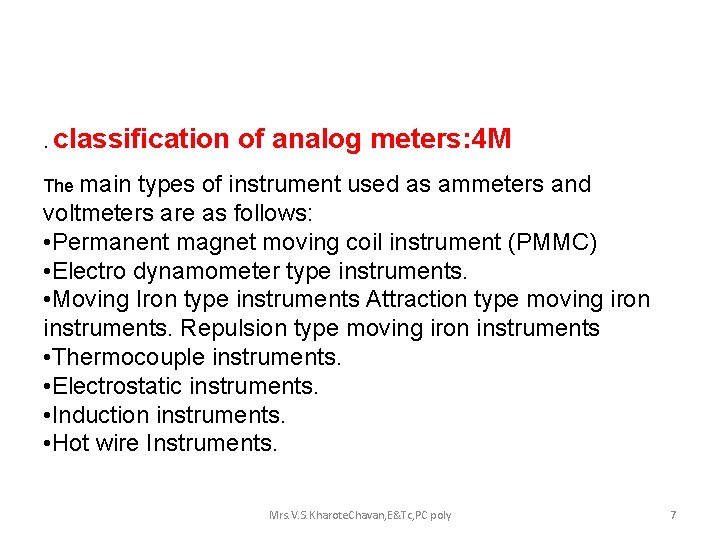
. classification of analog meters: 4 M The main types of instrument used as ammeters and voltmeters are as follows: • Permanent magnet moving coil instrument (PMMC) • Electro dynamometer type instruments. • Moving Iron type instruments Attraction type moving iron instruments. Repulsion type moving iron instruments • Thermocouple instruments. • Electrostatic instruments. • Induction instruments. • Hot wire Instruments. Mrs. V. S. Kharote. Chavan, E&Tc, PC poly 7
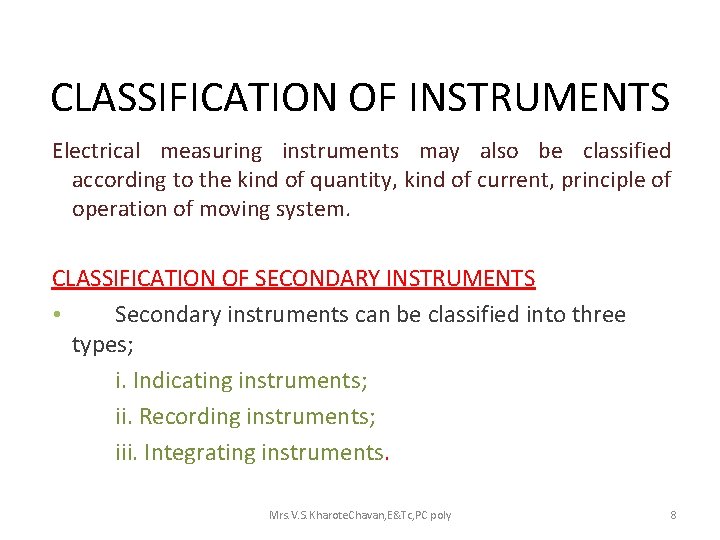
CLASSIFICATION OF INSTRUMENTS Electrical measuring instruments may also be classified according to the kind of quantity, kind of current, principle of operation of moving system. CLASSIFICATION OF SECONDARY INSTRUMENTS • Secondary instruments can be classified into three types; i. Indicating instruments; ii. Recording instruments; iii. Integrating instruments. Mrs. V. S. Kharote. Chavan, E&Tc, PC poly 8
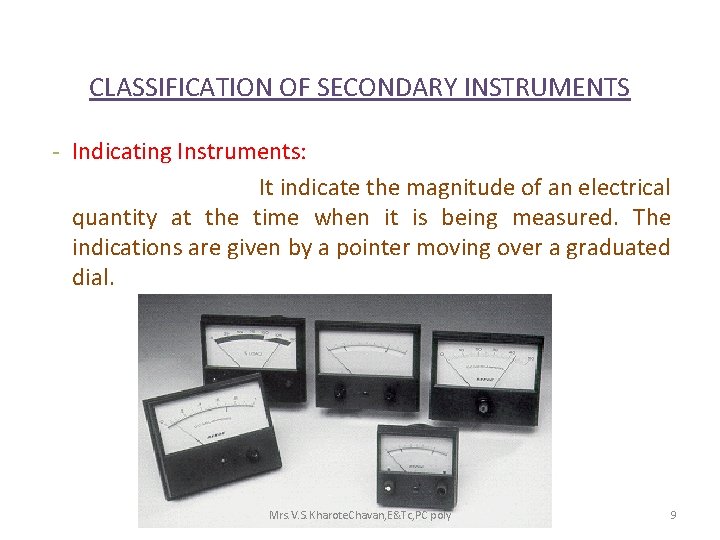
CLASSIFICATION OF SECONDARY INSTRUMENTS - Indicating Instruments: It indicate the magnitude of an electrical quantity at the time when it is being measured. The indications are given by a pointer moving over a graduated dial. Mrs. V. S. Kharote. Chavan, E&Tc, PC poly 9
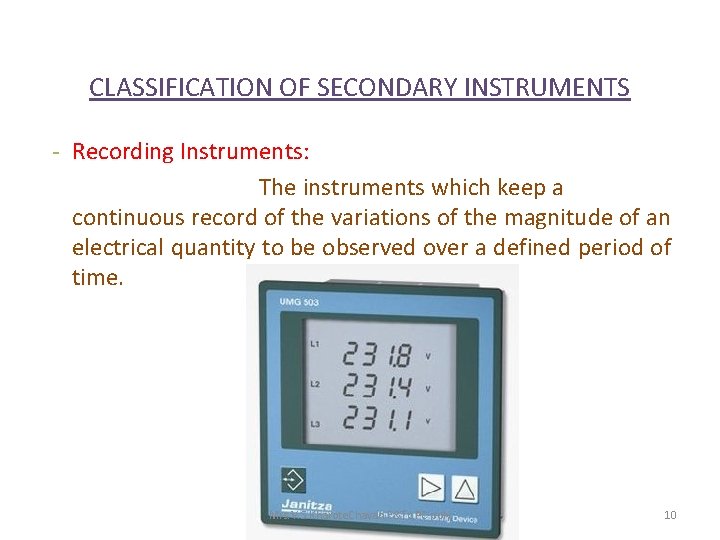
CLASSIFICATION OF SECONDARY INSTRUMENTS - Recording Instruments: The instruments which keep a continuous record of the variations of the magnitude of an electrical quantity to be observed over a defined period of time. Mrs. V. S. Kharote. Chavan, E&Tc, PC poly 10
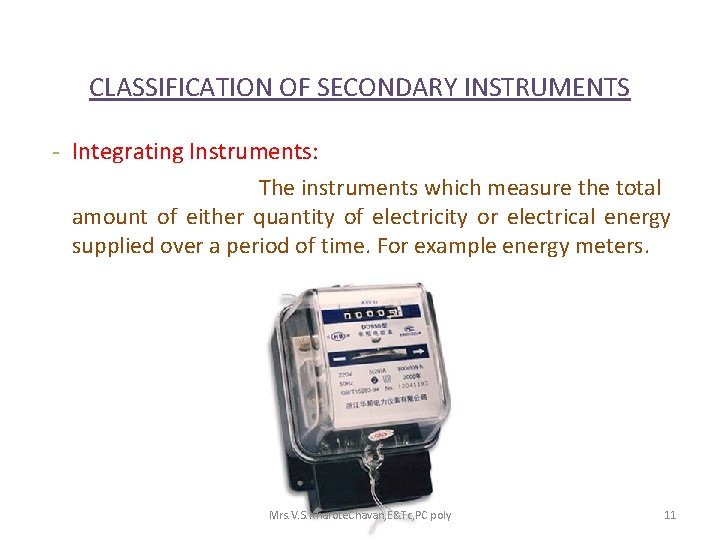
CLASSIFICATION OF SECONDARY INSTRUMENTS - Integrating Instruments: The instruments which measure the total amount of either quantity of electricity or electrical energy supplied over a period of time. For example energy meters. Mrs. V. S. Kharote. Chavan, E&Tc, PC poly 11
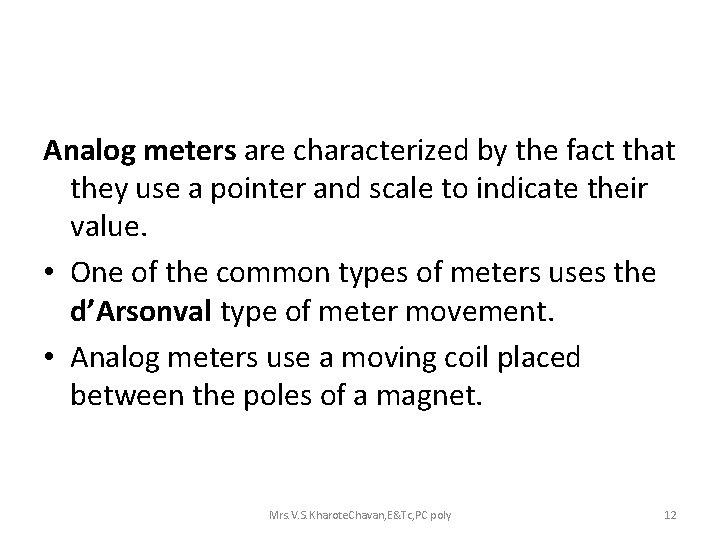
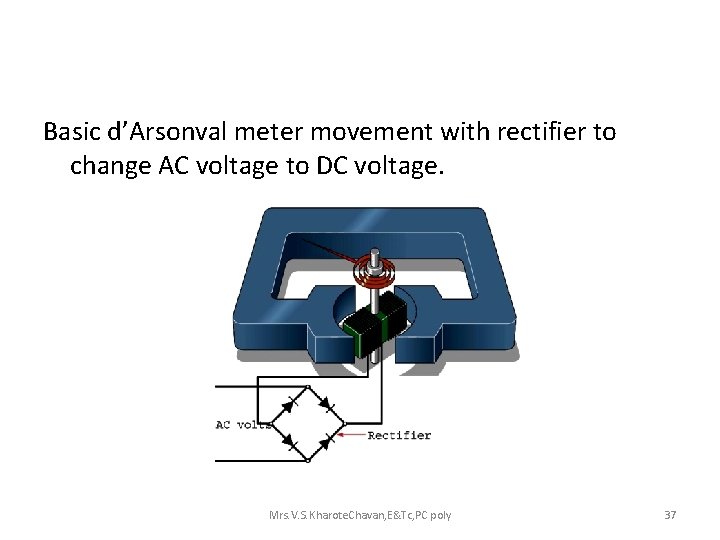
Analog meters are characterized by the fact that they use a pointer and scale to indicate their value. • One of the common types of meters uses the d’Arsonval type of meter movement. • Analog meters use a moving coil placed between the poles of a magnet. Mrs. V. S. Kharote. Chavan, E&Tc, PC poly 12
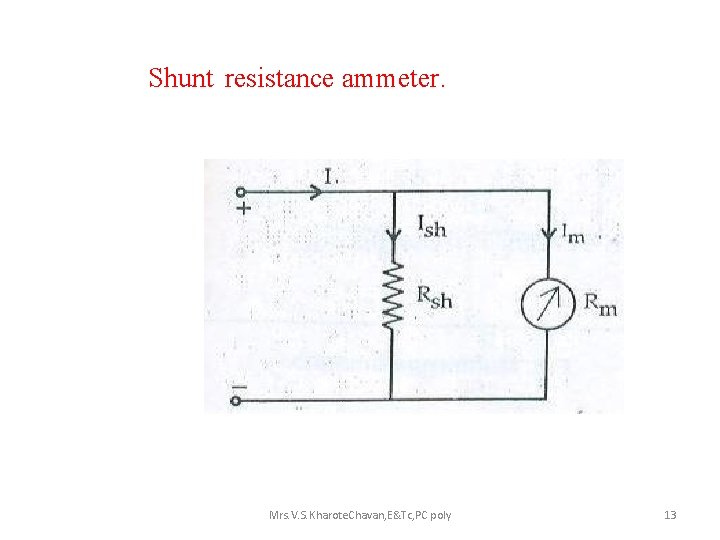
Shunt resistance ammeter. Mrs. V. S. Kharote. Chavan, E&Tc, PC poly 13
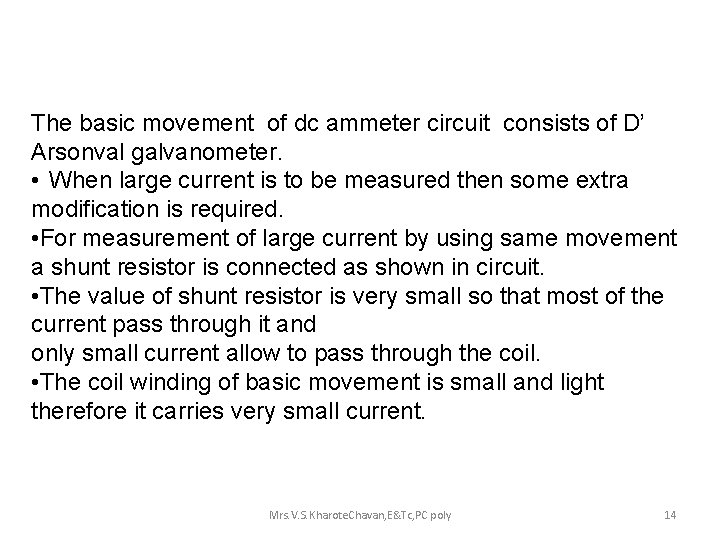
The basic movement of dc ammeter circuit consists of D’ Arsonval galvanometer. • When large current is to be measured then some extra modification is required. • For measurement of large current by using same movement a shunt resistor is connected as shown in circuit. • The value of shunt resistor is very small so that most of the current pass through it and only small current allow to pass through the coil. • The coil winding of basic movement is small and light therefore it carries very small current. Mrs. V. S. Kharote. Chavan, E&Tc, PC poly 14
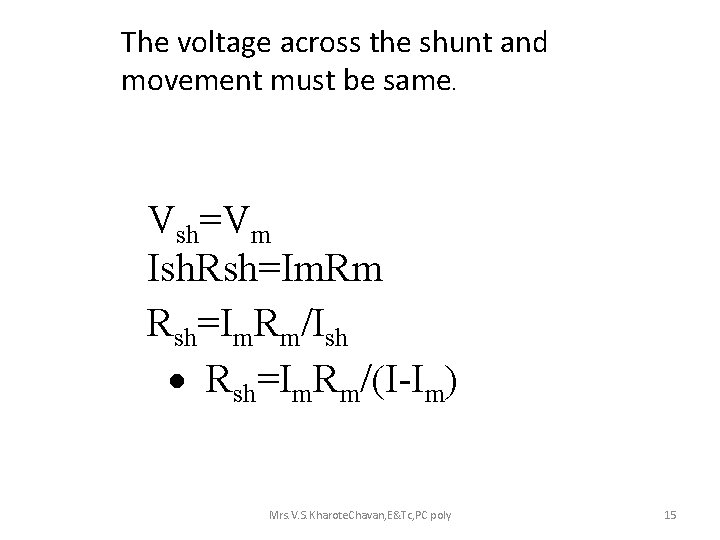
The voltage across the shunt and movement must be same. Vsh=Vm Ish. Rsh=Im. Rm/Ish · Rsh=Im. Rm/(I-Im) Mrs. V. S. Kharote. Chavan, E&Tc, PC poly 15
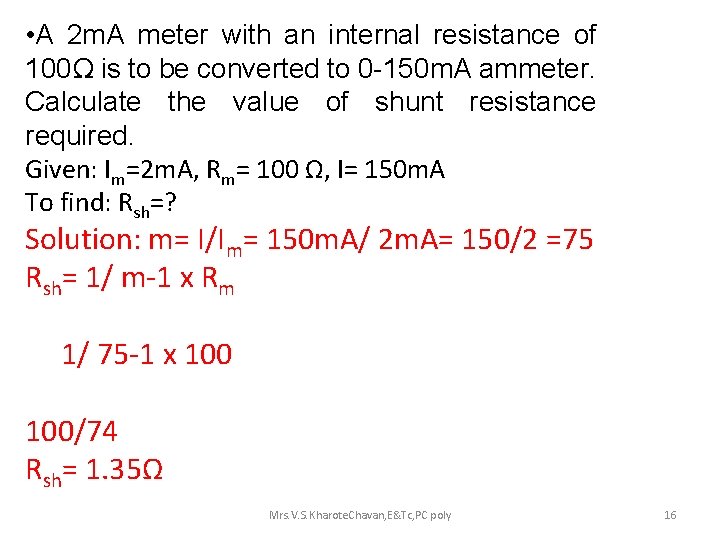
• A 2 m. A meter with an internal resistance of 100Ω is to be converted to 0 -150 m. A ammeter. Calculate the value of shunt resistance required. Given: Im=2 m. A, Rm= 100 Ω, I= 150 m. A To find: Rsh=? Solution: m= I/Im= 150 m. A/ 2 m. A= 150/2 =75 Rsh= 1/ m-1 x Rm 1/ 75 -1 x 100/74 Rsh= 1. 35Ω Mrs. V. S. Kharote. Chavan, E&Tc, PC poly 16
Calculate the value of multiplier resistance on the 50 V range of a dc voltmeter that uses a 200μA meter movement with an internal resistance of 100Ώ. Mrs. V. S. Kharote. Chavan, E&Tc, PC poly 17
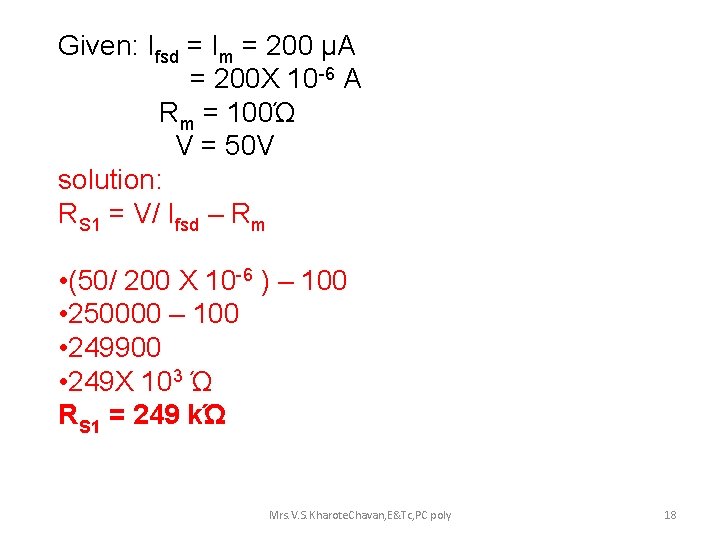
Given: Ifsd = Im = 200 μA = 200 X 10 -6 A Rm = 100Ώ V = 50 V solution: RS 1 = V/ Ifsd – Rm • (50/ 200 X 10 -6 ) – 100 • 250000 – 100 • 249900 • 249 X 103 Ώ RS 1 = 249 kΏ Mrs. V. S. Kharote. Chavan, E&Tc, PC poly 18
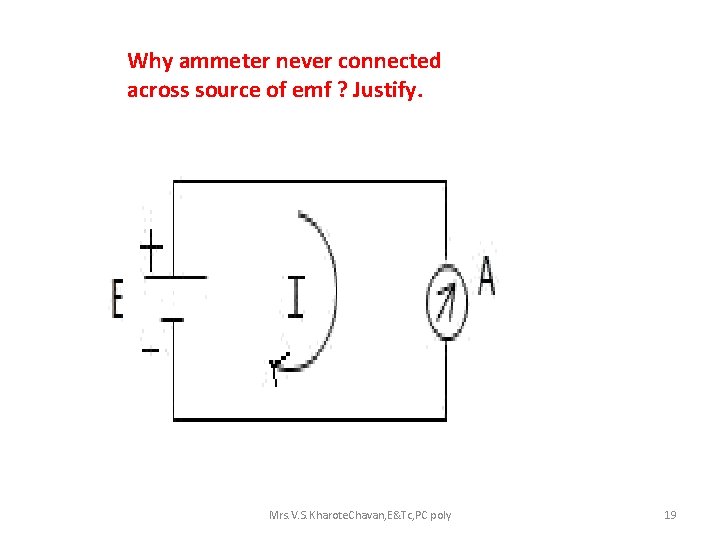
Why ammeter never connected across source of emf ? Justify. Mrs. V. S. Kharote. Chavan, E&Tc, PC poly 19
1. While connecting an ammeter across the emf source always a series resistance should be used. 2. This is necessary to limit the current passing through the meter movement maybe damaged. This is because the meter is having a small internal resistance. So it maydraw very high current from the emf source. 3. The polarity of the meter should be first observed and then it should be connected Mrs. V. S. Kharote. Chavan, E&Tc, PC poly 20
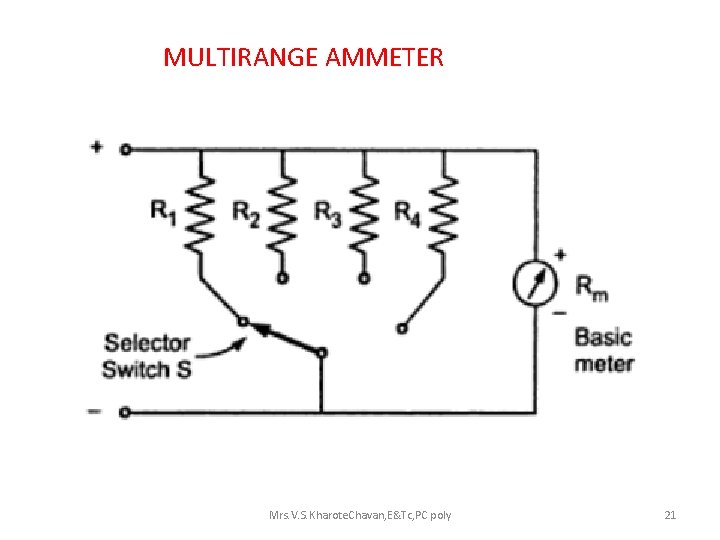
MULTIRANGE AMMETER Mrs. V. S. Kharote. Chavan, E&Tc, PC poly 21
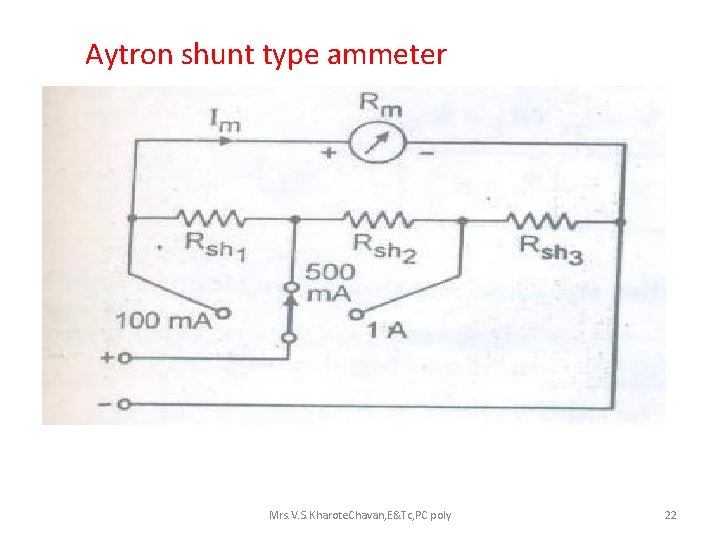
Aytron shunt type ammeter Mrs. V. S. Kharote. Chavan, E&Tc, PC poly 22
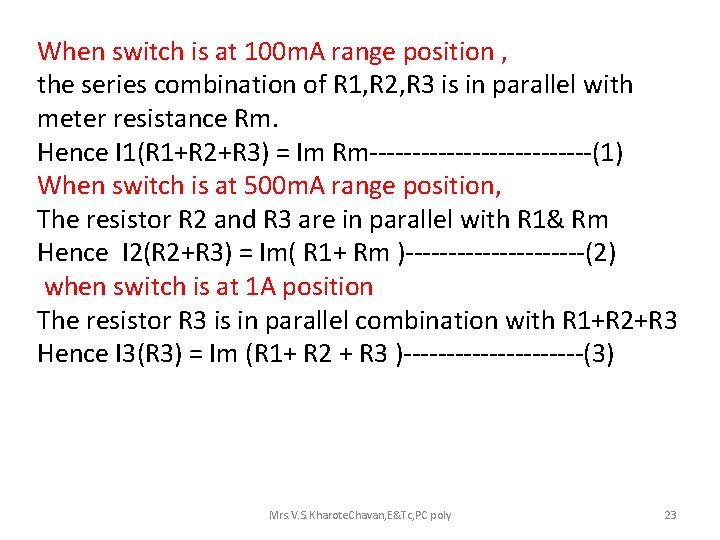
When switch is at 100 m. A range position , the series combination of R 1, R 2, R 3 is in parallel with meter resistance Rm. Hence I 1(R 1+R 2+R 3) = Im Rm-------------(1) When switch is at 500 m. A range position, The resistor R 2 and R 3 are in parallel with R 1& Rm Hence I 2(R 2+R 3) = Im( R 1+ Rm )-----------(2) when switch is at 1 A position The resistor R 3 is in parallel combination with R 1+R 2+R 3 Hence I 3(R 3) = Im (R 1+ R 2 + R 3 )-----------(3) Mrs. V. S. Kharote. Chavan, E&Tc, PC poly 23
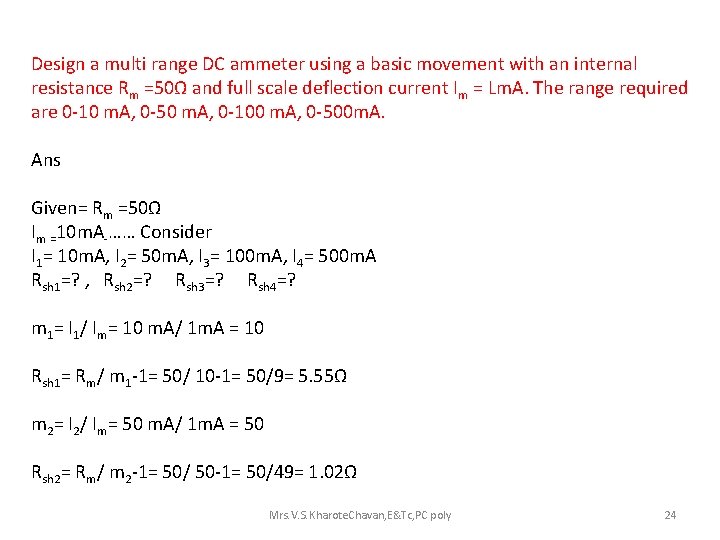
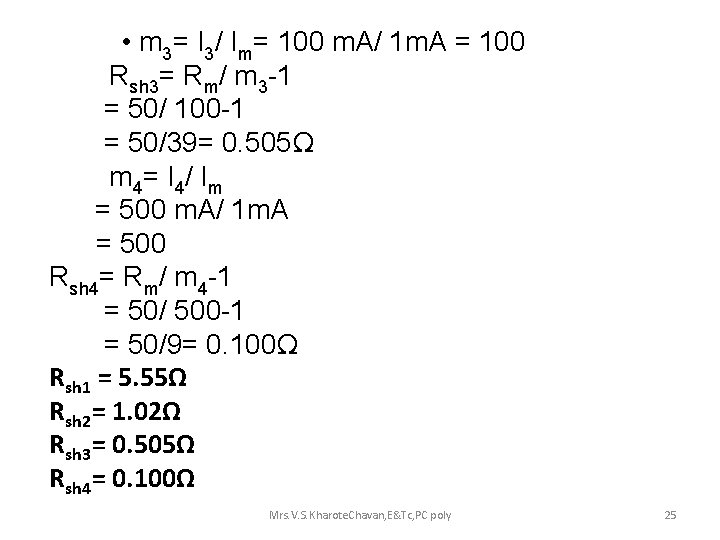
Design a multi range DC ammeter using a basic movement with an internal resistance Rm =50Ω and full scale deflection current Im = Lm. A. The range required are 0 -10 m. A, 0 -50 m. A, 0 -100 m. A, 0 -500 m. A. Ans Given= Rm =50Ω Im =10 m. A-…… Consider I 1= 10 m. A, I 2= 50 m. A, I 3= 100 m. A, I 4= 500 m. A Rsh 1=? , Rsh 2=? Rsh 3=? Rsh 4=? m 1= I 1/ Im= 10 m. A/ 1 m. A = 10 Rsh 1= Rm/ m 1 -1= 50/ 10 -1= 50/9= 5. 55Ω m 2= I 2/ Im= 50 m. A/ 1 m. A = 50 Rsh 2= Rm/ m 2 -1= 50/ 50 -1= 50/49= 1. 02Ω Mrs. V. S. Kharote. Chavan, E&Tc, PC poly 24
• m 3= I 3/ Im= 100 m. A/ 1 m. A = 100 Rsh 3= Rm/ m 3 -1 = 50/ 100 -1 = 50/39= 0. 505Ω m 4 = I 4 / I m = 500 m. A/ 1 m. A = 500 Rsh 4= Rm/ m 4 -1 = 50/ 500 -1 = 50/9= 0. 100Ω Rsh 1 = 5. 55Ω Rsh 2= 1. 02Ω Rsh 3= 0. 505Ω Rsh 4= 0. 100Ω Mrs. V. S. Kharote. Chavan, E&Tc, PC poly 25
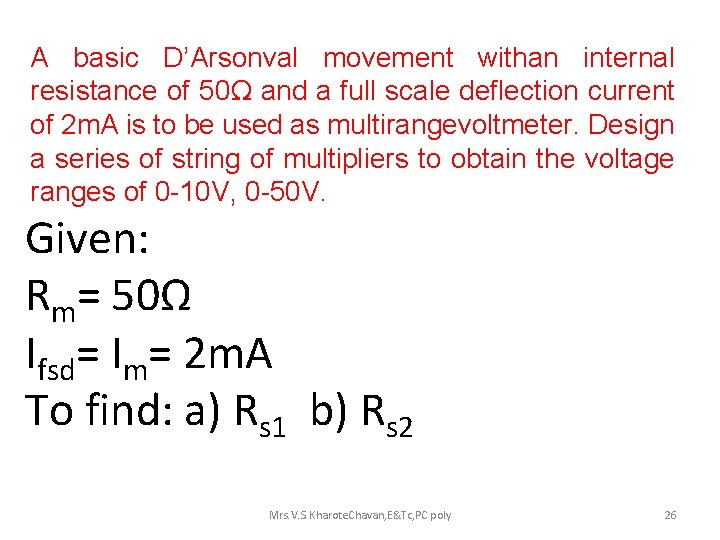
A basic D’Arsonval movement withan internal resistance of 50Ω and a full scale deflection current of 2 m. A is to be used as multirangevoltmeter. Design a series of string of multipliers to obtain the voltage ranges of 0 -10 V, 0 -50 V. Given: Rm= 50Ω Ifsd= Im= 2 m. A To find: a) Rs 1 b) Rs 2 Mrs. V. S. Kharote. Chavan, E&Tc, PC poly 26
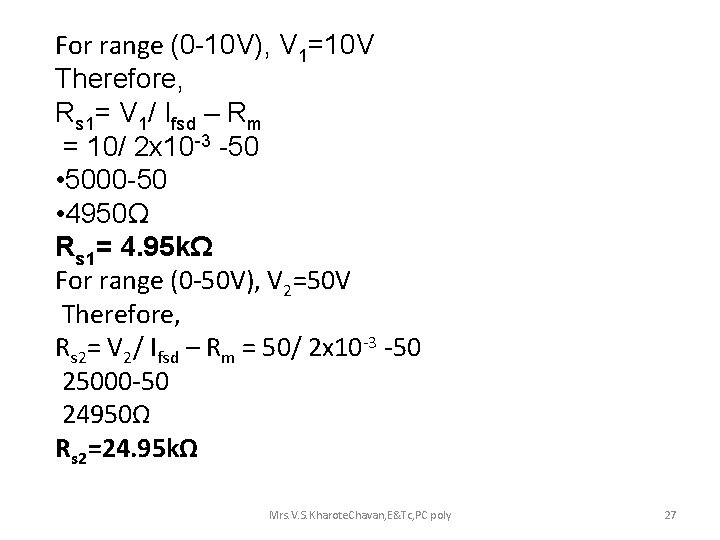
For range (0 -10 V), V 1=10 V Therefore, Rs 1= V 1/ Ifsd – Rm = 10/ 2 x 10 -3 -50 • 5000 -50 • 4950Ω Rs 1= 4. 95 kΩ For range (0 -50 V), V 2=50 V Therefore, Rs 2= V 2/ Ifsd – Rm = 50/ 2 x 10 -3 -50 25000 -50 24950Ω Rs 2=24. 95 kΩ Mrs. V. S. Kharote. Chavan, E&Tc, PC poly 27
• Sensitivity is high as compared to normal shunt type ammeter Mrs. V. S. Kharote. Chavan, E&Tc, PC poly 28
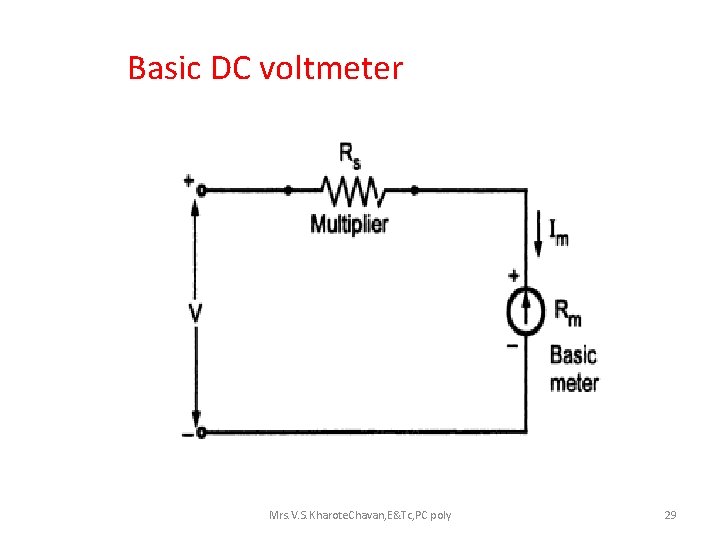
Basic DC voltmeter Mrs. V. S. Kharote. Chavan, E&Tc, PC poly 29
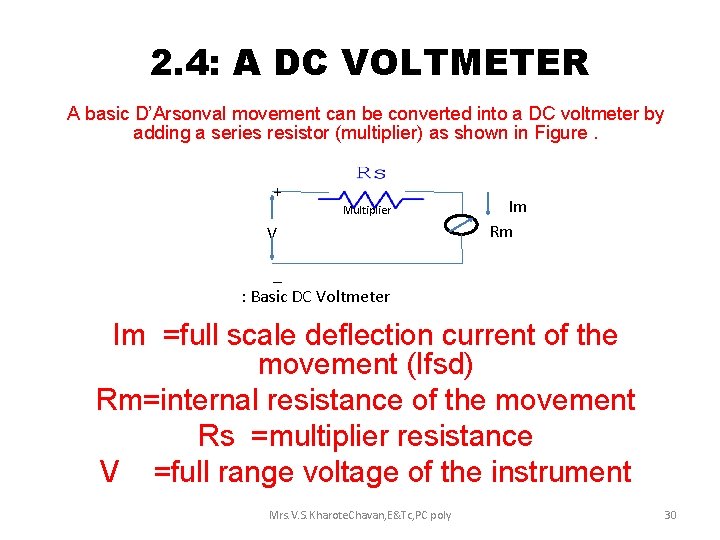
2. 4: A DC VOLTMETER A basic D’Arsonval movement can be converted into a DC voltmeter by adding a series resistor (multiplier) as shown in Figure. + Multiplier V Im Rm _ : Basic DC Voltmeter Im =full scale deflection current of the movement (Ifsd) Rm=internal resistance of the movement Rs =multiplier resistance V =full range voltage of the instrument Mrs. V. S. Kharote. Chavan, E&Tc, PC poly 30
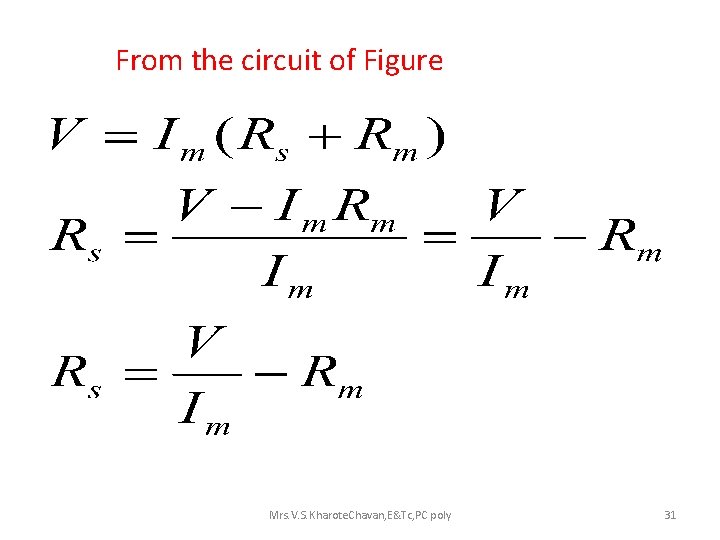
From the circuit of Figure Mrs. V. S. Kharote. Chavan, E&Tc, PC poly 31
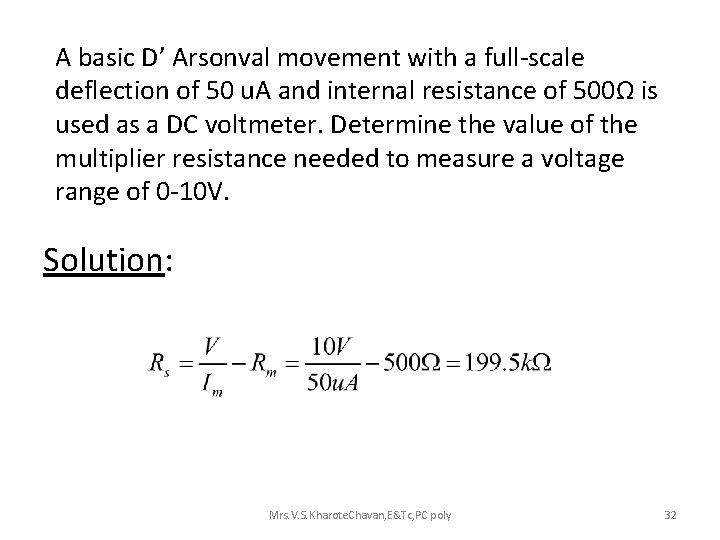
A basic D’ Arsonval movement with a full-scale deflection of 50 u. A and internal resistance of 500Ω is used as a DC voltmeter. Determine the value of the multiplier resistance needed to measure a voltage range of 0 -10 V. Solution: Mrs. V. S. Kharote. Chavan, E&Tc, PC poly 32
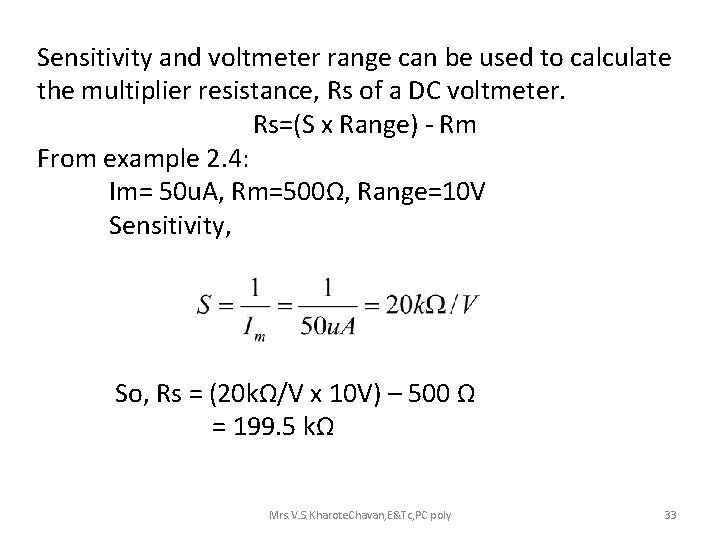
Sensitivity and voltmeter range can be used to calculate the multiplier resistance, Rs of a DC voltmeter. Rs=(S x Range) - Rm From example 2. 4: Im= 50 u. A, Rm=500Ω, Range=10 V Sensitivity, So, Rs = (20 kΩ/V x 10 V) – 500 Ω = 199. 5 kΩ Mrs. V. S. Kharote. Chavan, E&Tc, PC poly 33
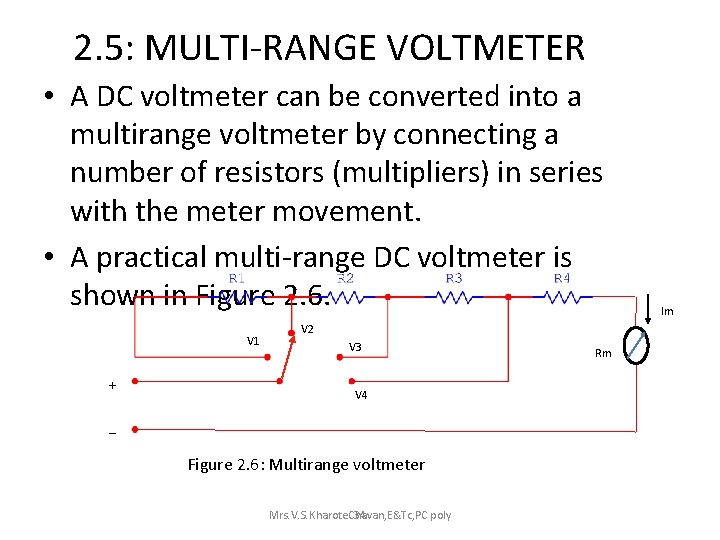
2. 5: MULTI-RANGE VOLTMETER • A DC voltmeter can be converted into a multirange voltmeter by connecting a number of resistors (multipliers) in series with the meter movement. • A practical multi-range DC voltmeter is shown in Figure 2. 6. V 1 + V 2 V 3 V 4 _ Figure 2. 6: Multirange voltmeter Mrs. V. S. Kharote. Chavan, E&Tc, PC poly 34 Rm Im
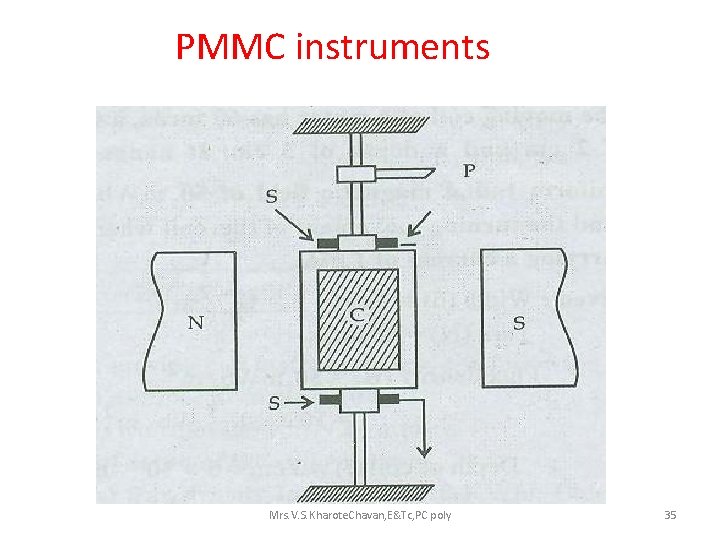
PMMC instruments Mrs. V. S. Kharote. Chavan, E&Tc, PC poly 35
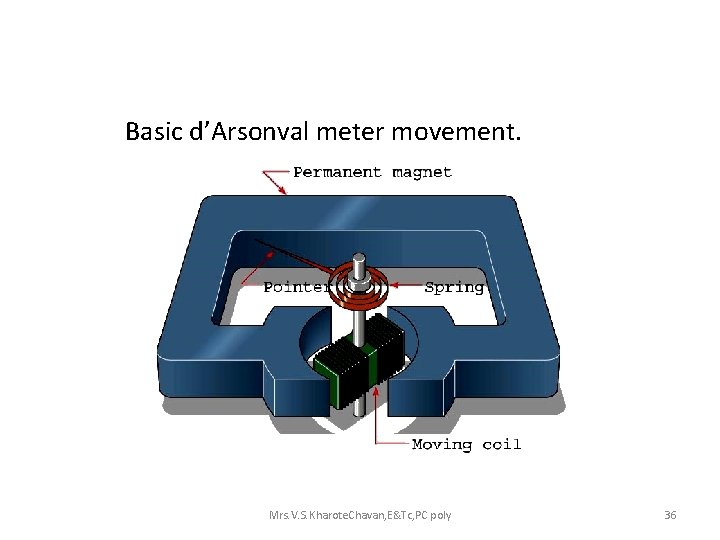
Basic d’Arsonval meter movement. Mrs. V. S. Kharote. Chavan, E&Tc, PC poly 36
Basic d’Arsonval meter movement with rectifier to change AC voltage to DC voltage. Mrs. V. S. Kharote. Chavan, E&Tc, PC poly 37
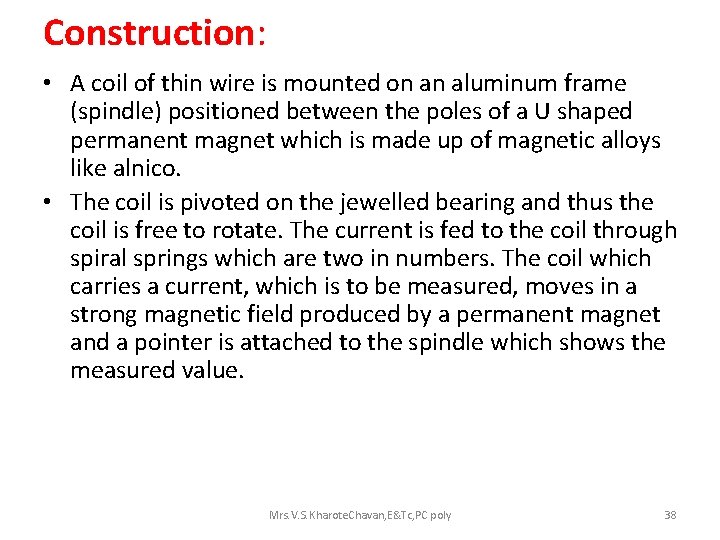
Construction: • A coil of thin wire is mounted on an aluminum frame (spindle) positioned between the poles of a U shaped permanent magnet which is made up of magnetic alloys like alnico. • The coil is pivoted on the jewelled bearing and thus the coil is free to rotate. The current is fed to the coil through spiral springs which are two in numbers. The coil which carries a current, which is to be measured, moves in a strong magnetic field produced by a permanent magnet and a pointer is attached to the spindle which shows the measured value. Mrs. V. S. Kharote. Chavan, E&Tc, PC poly 38
Principle of Operation When a current carrying conductor is placed in a magnetic field, it experiences a force and tends to move in the direction as per Fleming’s left hand rule. Mrs. V. S. Kharote. Chavan, E&Tc, PC poly 39
Advantages of PMMC meter: • It has uniform scale. • Power consumption is low • It can be obtained in wide ranges. • High sensitivity & accuracy • It is unaffected by external magnetic field. • Additional damping device not required. • Hysteresis problem is not there. Mrs. V. S. Kharote. Chavan, E&Tc, PC poly 40
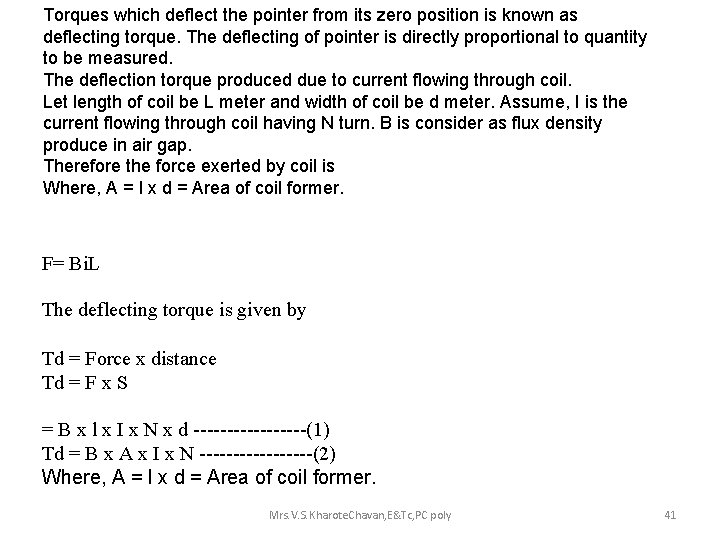
Torques which deflect the pointer from its zero position is known as deflecting torque. The deflecting of pointer is directly proportional to quantity to be measured. The deflection torque produced due to current flowing through coil. Let length of coil be L meter and width of coil be d meter. Assume, I is the current flowing through coil having N turn. B is consider as flux density produce in air gap. Therefore the force exerted by coil is Where, A = l x d = Area of coil former. F= Bi. L The deflecting torque is given by Td = Force x distance Td = F x S = B x l x I x N x d ---------(1) Td = B x A x I x N ---------(2) Where, A = l x d = Area of coil former. Mrs. V. S. Kharote. Chavan, E&Tc, PC poly 41
Disadvantages of PMMC meter: 1. It is suitable for d. c. measurement only. 2. Comparatively highcost than moving iron type instrument. 3. Ageing of permanentmagnet & spring introduce errors. 4. Friction due to jewel- pivot suspension. Mrs. V. S. Kharote. Chavan, E&Tc, PC poly 42
Applications: Ammeter: Voltmeter: Ohm Meter: Mrs. V. S. Kharote. Chavan, E&Tc, PC poly 43
Sensitivity AND Loading effect of voltmeter. The sensitivity of voltmeter means the response given by a voltmeter to input signal. It is the ratio of total resistance (RT) to the voltage range S = RT / V Where, RT – Total resistance…… RT = RS + Rm V= Voltage range. OR It is also defined as the reciprocal of full scale deflection current of the basic movement. S = 1 / Ifsd = full scale deflection current. Mrs. V. S. Kharote. Chavan, E&Tc, PC poly 44
Mrs. V. S. Kharote. Chavan, E&Tc, PC poly 45
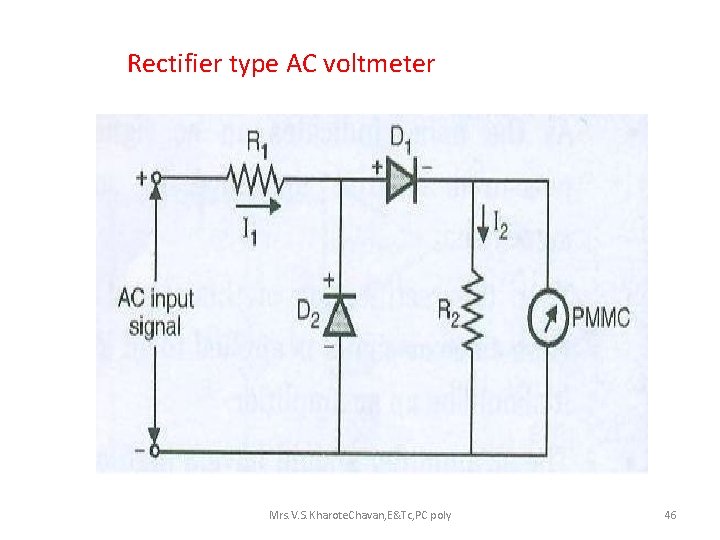
Rectifier type AC voltmeter Mrs. V. S. Kharote. Chavan, E&Tc, PC poly 46
• Basic rectifier type AC voltmeter is a general rectifier type of voltmeter. In this case for the rectification action two diodes namely D 1 and D 2 are used. An a. c input signal to be measured is applied. If a current passing through the diode is small then there is a non- linearity problem. But for higher current the diode shows linearity. So to increase the current passing through diode; a resistance R 2 is connected in parallel with the meter. Now during positive half cycle of input signal, diode D 1 is forward biased with the polarities. Mrs. V. S. Kharote. Chavan, E&Tc, PC poly 47
• While the diode D 2 is reversed biased. So during this cycle the current passes the deflection. rough diode D 1 and the meter. Thus the meter shows • During the negative half cycle diode D 1 is reversed biased and diode D 2 is forward biased. • So the current flows in opposite direction. • In this case the meter is bypassed. Because of the diode action an a. c input signal is converted into pulsating dc. • Thus the meter shows average value of an input signal. Mrs. V. S. Kharote. Chavan, E&Tc, PC poly 48
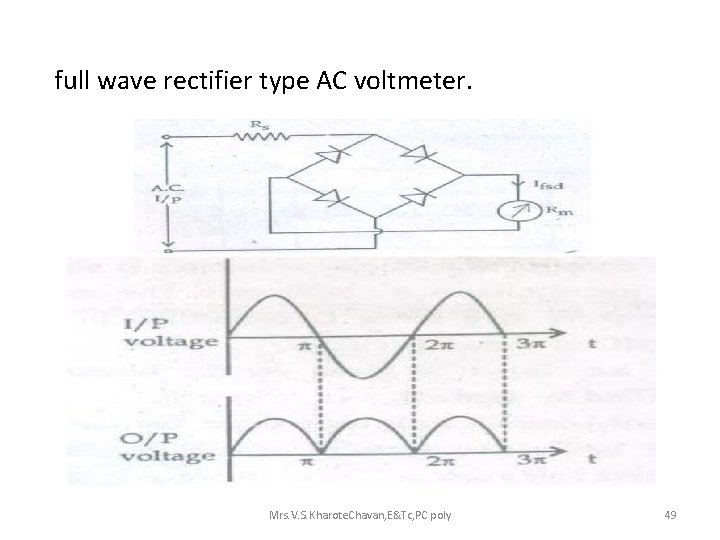
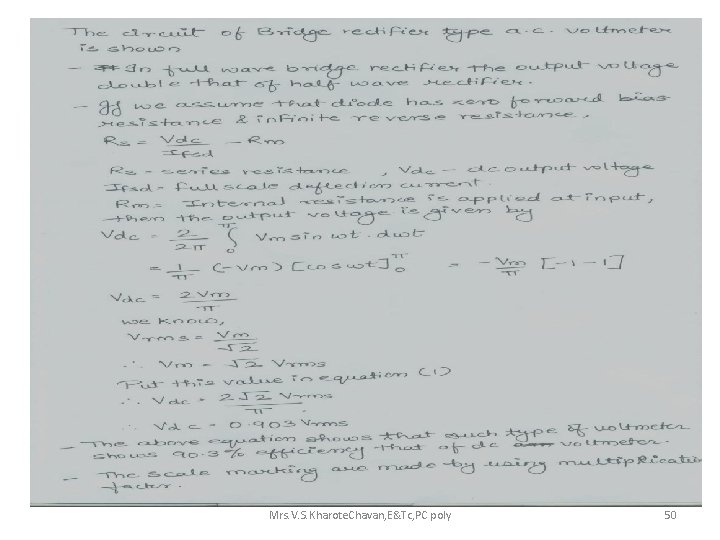
full wave rectifier type AC voltmeter. Mrs. V. S. Kharote. Chavan, E&Tc, PC poly 49
Mrs. V. S. Kharote. Chavan, E&Tc, PC poly 50
Mrs. V. S. Kharote. Chavan, E&Tc, PC poly 51
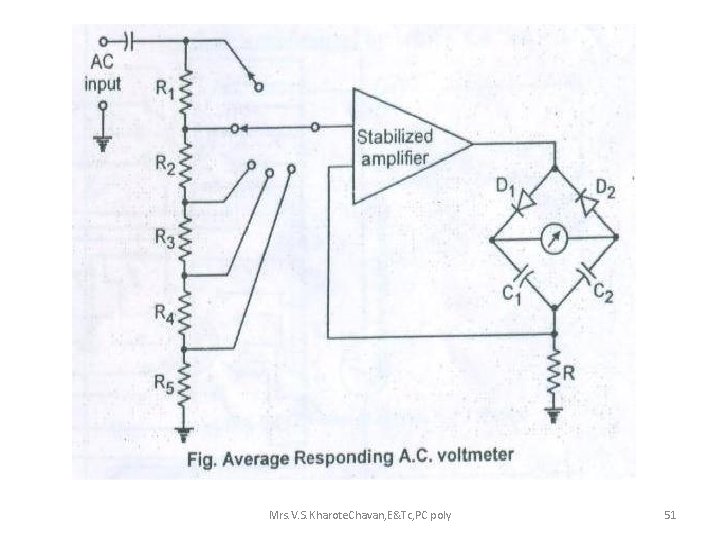
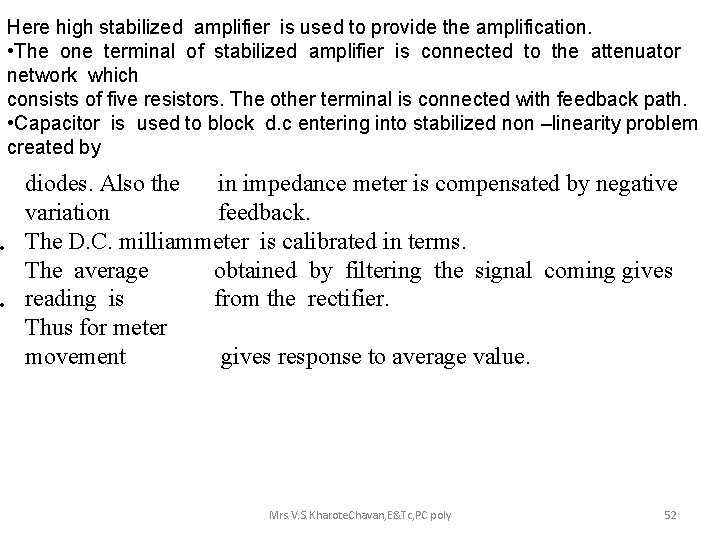
· · Here high stabilized amplifier is used to provide the amplification. • The one terminal of stabilized amplifier is connected to the attenuator network which consists of five resistors. The other terminal is connected with feedback path. • Capacitor is used to block d. c entering into stabilized non –linearity problem created by diodes. Also the in impedance meter is compensated by negative variation feedback. The D. C. milliammeter is calibrated in terms. The average obtained by filtering the signal coming gives reading is from the rectifier. Thus for meter movement gives response to average value. Mrs. V. S. Kharote. Chavan, E&Tc, PC poly 52
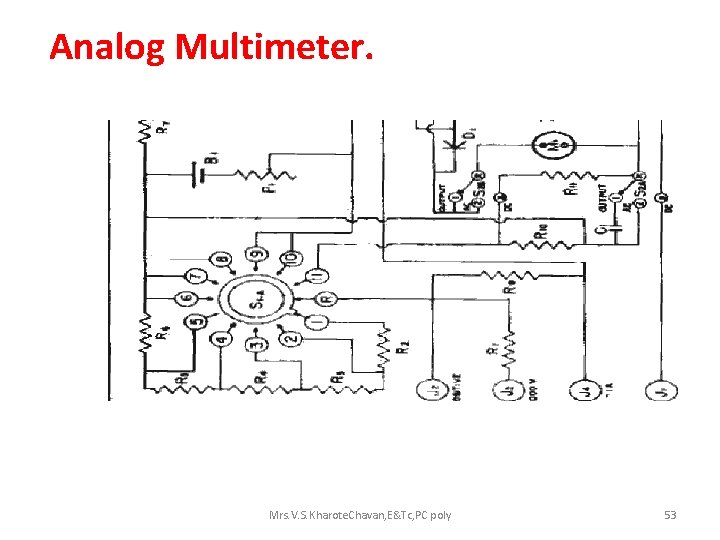
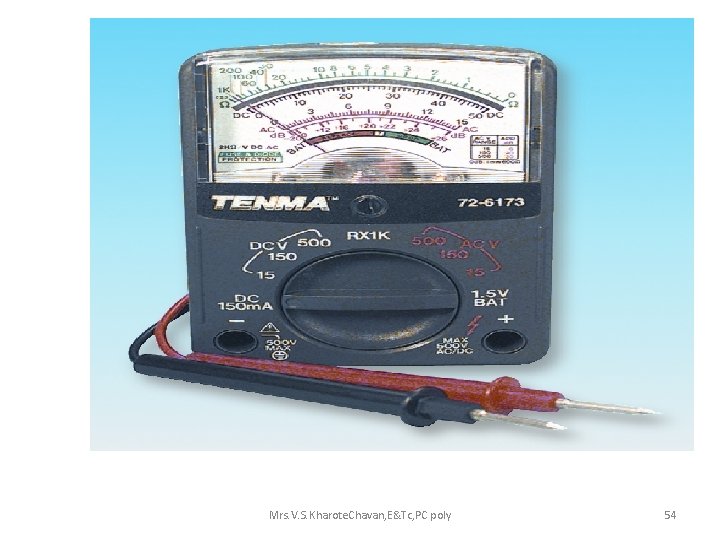
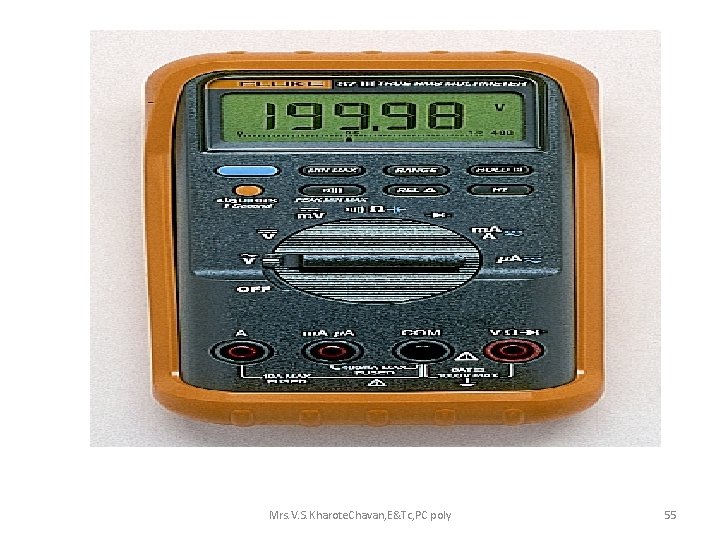
Analog Multimeter. Mrs. V. S. Kharote. Chavan, E&Tc, PC poly 53
Mrs. V. S. Kharote. Chavan, E&Tc, PC poly 54
Mrs. V. S. Kharote. Chavan, E&Tc, PC poly 55
Mrs. V. S. Kharote. Chavan, E&Tc, PC poly 56