
CHAPTER14 Fluids Ch 14 2 3 Fluid Density
- Slides: 10
CHAPTER-14 Fluids
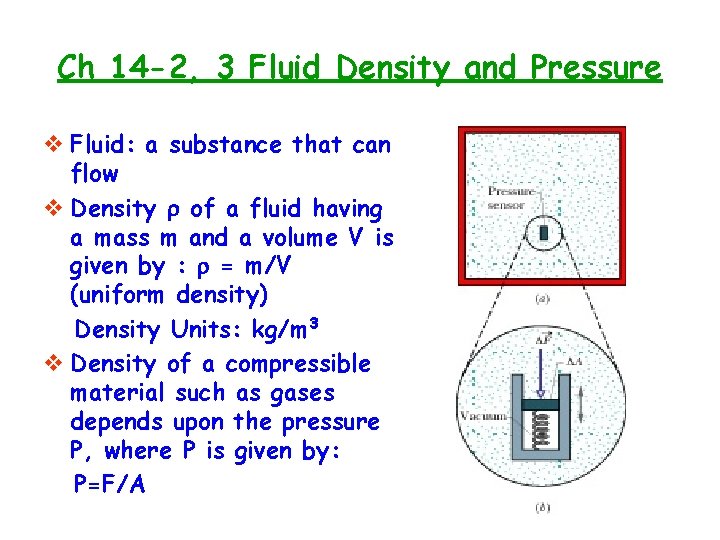
Ch 14 -2, 3 Fluid Density and Pressure v Fluid: a substance that can flow v Density of a fluid having a mass m and a volume V is given by : = m/V (uniform density) Density Units: kg/m 3 v Density of a compressible material such as gases depends upon the pressure P, where P is given by: P=F/A
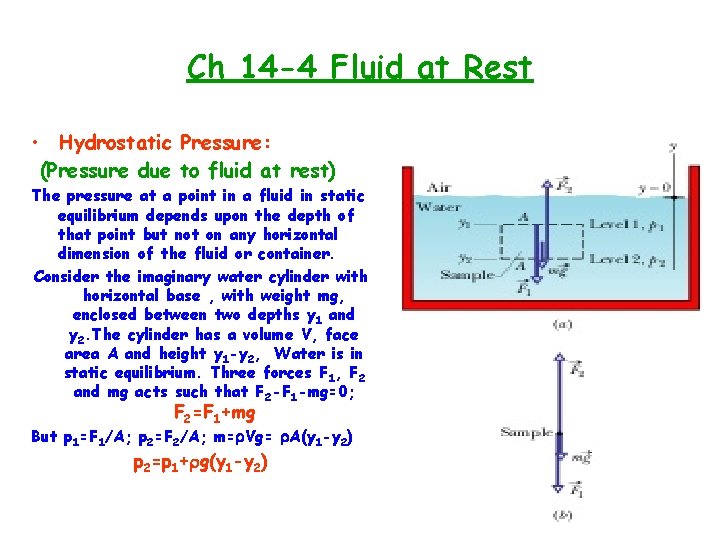
Ch 14 -4 Fluid at Rest • Hydrostatic Pressure: (Pressure due to fluid at rest) The pressure at a point in a fluid in static equilibrium depends upon the depth of that point but not on any horizontal dimension of the fluid or container. Consider the imaginary water cylinder with horizontal base , with weight mg, enclosed between two depths y 1 and y 2. The cylinder has a volume V, face area A and height y 1 -y 2, Water is in static equilibrium. Three forces F 1, F 2 and mg acts such that F 2 -F 1 -mg=0; F 2=F 1+mg But p 1=F 1/A; p 2=F 2/A; m= Vg= A(y 1 -y 2) p 2=p 1+ g(y 1 -y 2)
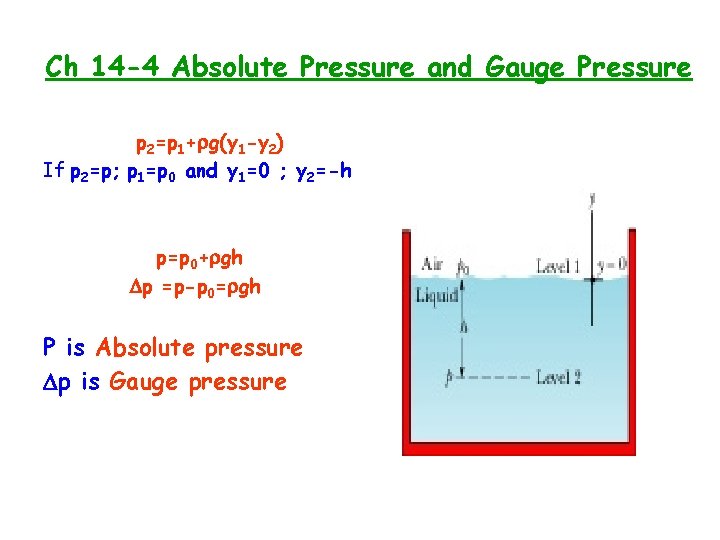
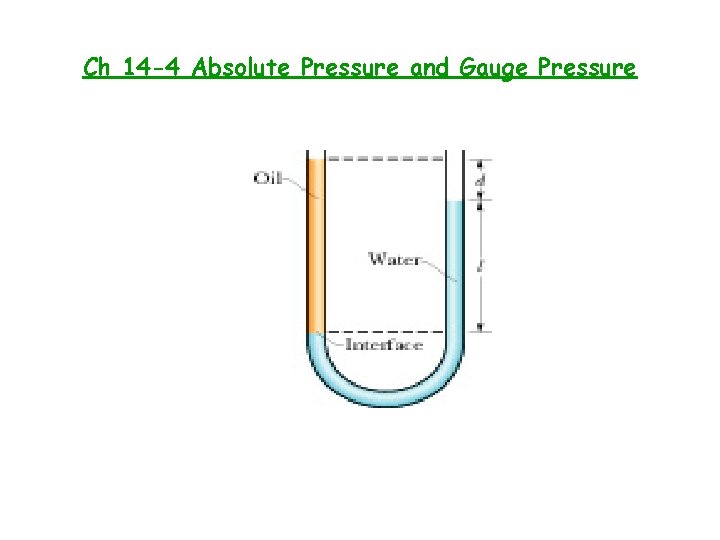
Ch 14 -4 Absolute Pressure and Gauge Pressure p 2=p 1+ g(y 1 -y 2) If p 2=p; p 1=p 0 and y 1=0 ; y 2=-h p=p 0+ gh p =p-p 0= gh P is Absolute pressure p is Gauge pressure
Ch 14 -4 Absolute Pressure and Gauge Pressure
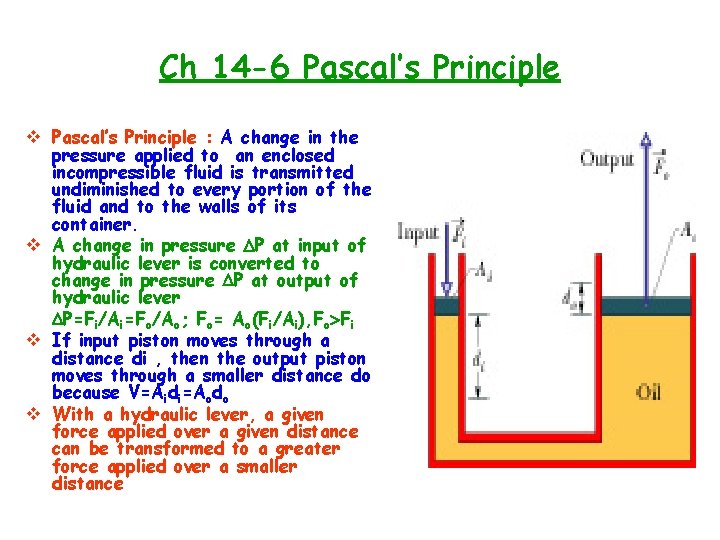
Ch 14 -6 Pascal’s Principle v Pascal’s Principle : A change in the pressure applied to an enclosed incompressible fluid is transmitted undiminished to every portion of the fluid and to the walls of its container. v A change in pressure P at input of hydraulic lever is converted to change in pressure P at output of hydraulic lever P=Fi/Ai=Fo/Ao; Fo= Ao(Fi/Ai), Fo Fi v If input piston moves through a distance di , then the output piston moves through a smaller distance do because V=Aidi=Aodo v With a hydraulic lever, a given force applied over a given distance can be transformed to a greater force applied over a smaller distance
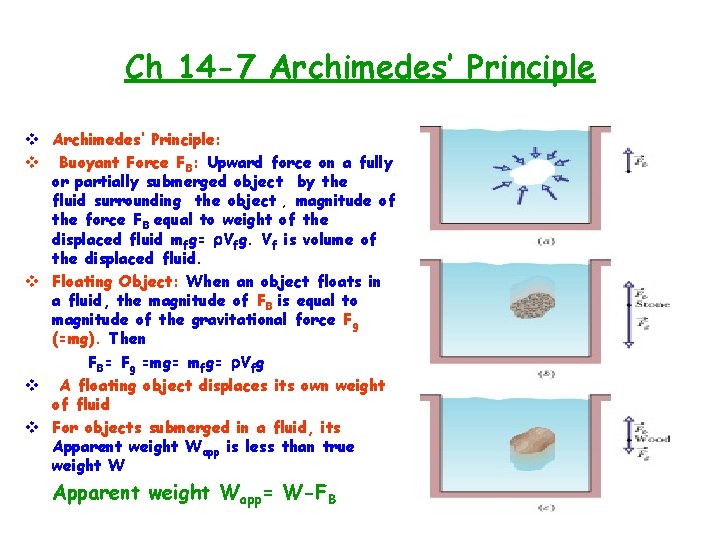
Ch 14 -7 Archimedes’ Principle v Archimedes’ Principle: v Buoyant Force FB: Upward force on a fully or partially submerged object by the fluid surrounding the object , magnitude of the force FB equal to weight of the displaced fluid mfg= Vfg. Vf is volume of the displaced fluid. v Floating Object: When an object floats in a fluid, the magnitude of FB is equal to magnitude of the gravitational force Fg (=mg). Then FB= Fg =mg= mfg= Vfg v A floating object displaces its own weight of fluid v For objects submerged in a fluid, its Apparent weight Wapp is less than true weight W Apparent weight Wapp= W-FB
Ch 14 -8 Ideal Fluid in Motion Four assumptions related to ideal flow: v Steady flow: the velocity of the moving fluid at any fixed point does not change with time v Incompressible Flow: Fluid has constant density v Nonviscous flow: an object can move through the fluid at constant speed- no resistive force within the fluid to moving objects through it v Irrotational flow: Objects moving through the fluid do not rotate about an axis through its center of mass
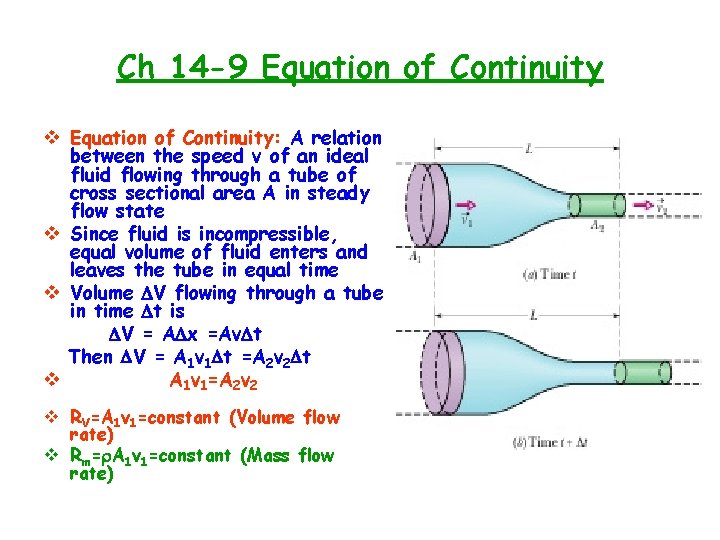
Ch 14 -9 Equation of Continuity v Equation of Continuity: A relation between the speed v of an ideal fluid flowing through a tube of cross sectional area A in steady flow state v Since fluid is incompressible, equal volume of fluid enters and leaves the tube in equal time v Volume V flowing through a tube in time t is V = A x =Av t Then V = A 1 v 1 t =A 2 v 2 t v A 1 v 1=A 2 v 2 v RV=A 1 v 1=constant (Volume flow rate) v Rm= A 1 v 1=constant (Mass flow rate)
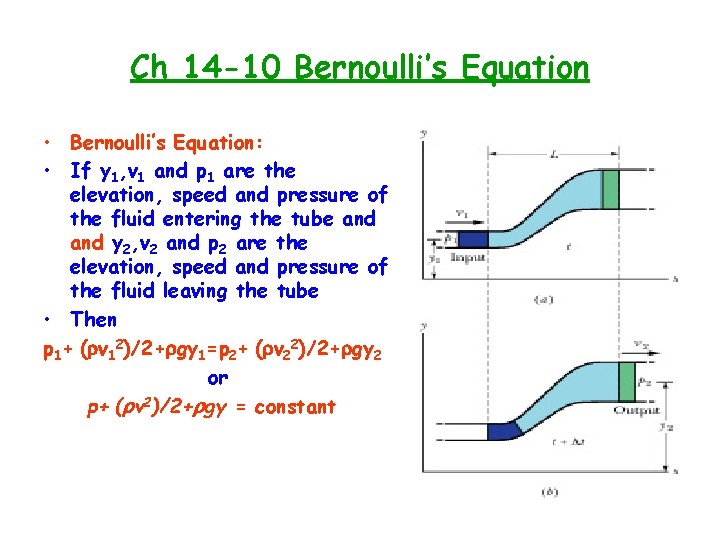
Ch 14 -10 Bernoulli’s Equation • Bernoulli’s Equation: • If y 1, v 1 and p 1 are the elevation, speed and pressure of the fluid entering the tube and y 2, v 2 and p 2 are the elevation, speed and pressure of the fluid leaving the tube • Then p 1+ ( v 12)/2+ gy 1=p 2+ ( v 22)/2+ gy 2 or p+ ( v 2)/2+ gy = constant