
Chapter12 India After Independence Class VIII History Challenges

- Slides: 17
Chapter-12: India After Independence Class VIII: History
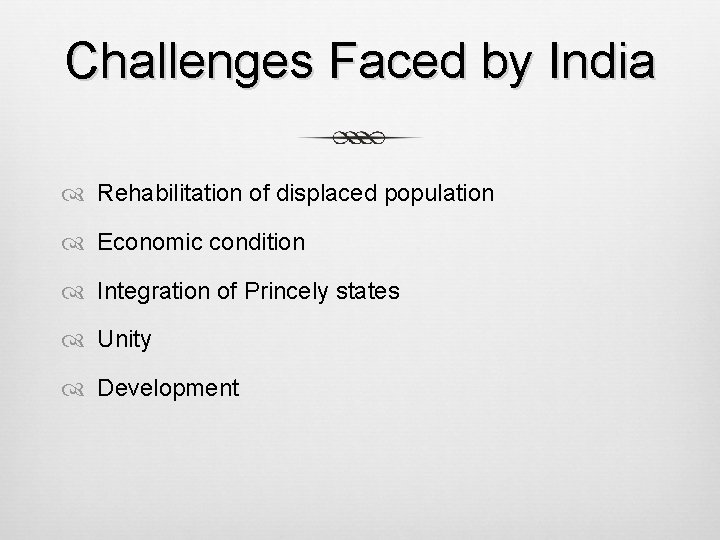
Challenges Faced by India Rehabilitation of displaced population Economic condition Integration of Princely states Unity Development
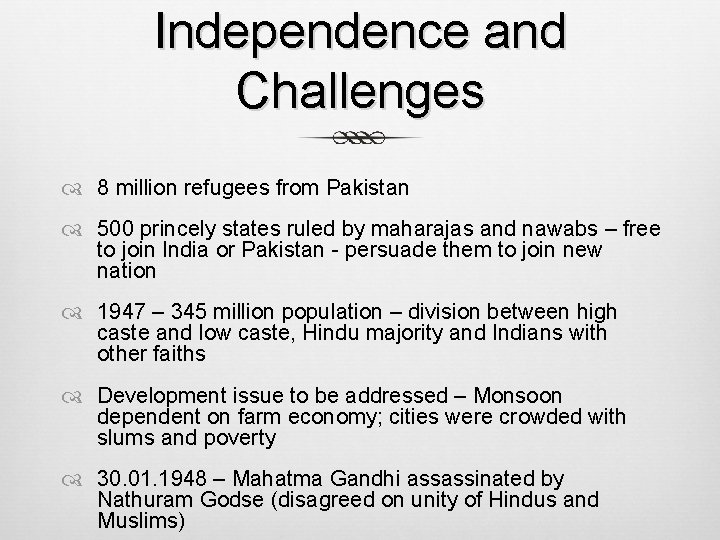
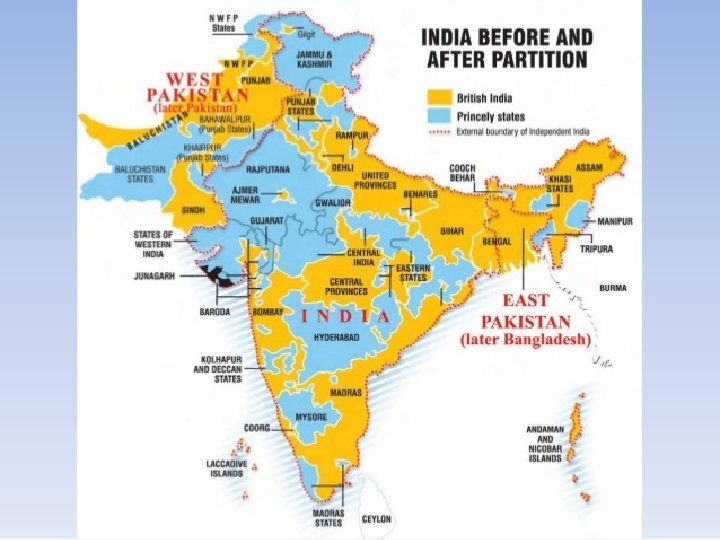
Independence and Challenges 8 million refugees from Pakistan 500 princely states ruled by maharajas and nawabs – free to join India or Pakistan - persuade them to join new nation 1947 – 345 million population – division between high caste and low caste, Hindu majority and Indians with other faiths Development issue to be addressed – Monsoon dependent on farm economy; cities were crowded with slums and poverty 30. 01. 1948 – Mahatma Gandhi assassinated by Nathuram Godse (disagreed on unity of Hindus and Muslims)
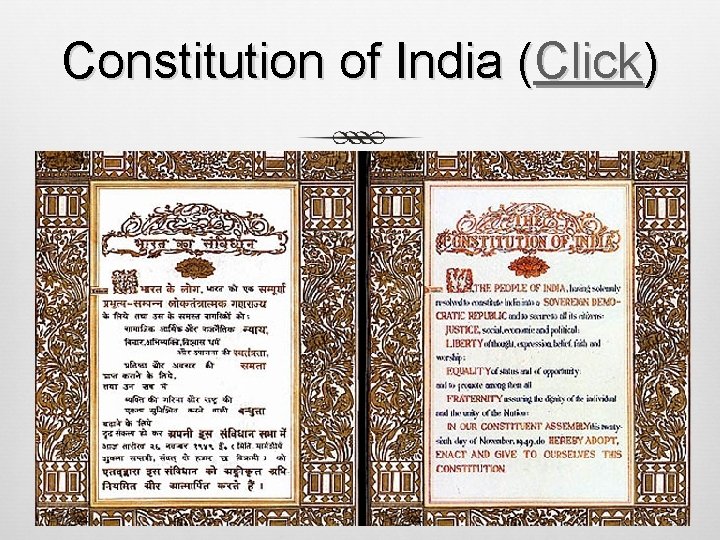
Constitution of India (Click)
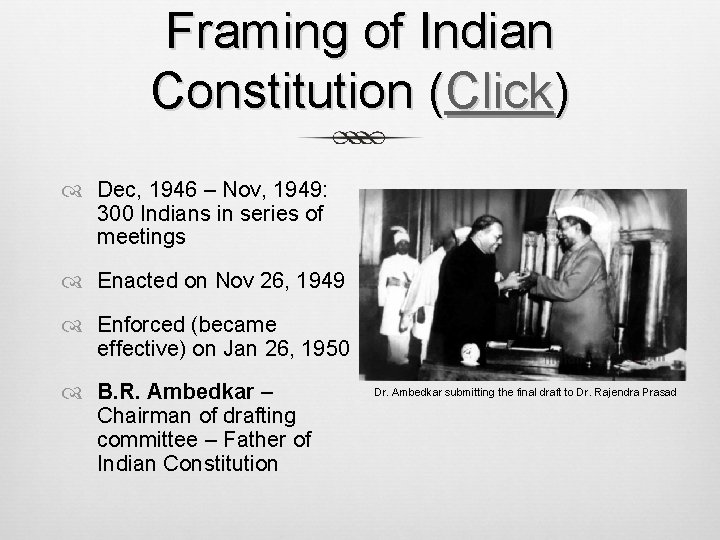
Framing of Indian Constitution (Click) Dec, 1946 – Nov, 1949: 300 Indians in series of meetings Enacted on Nov 26, 1949 Enforced (became effective) on Jan 26, 1950 B. R. Ambedkar – Chairman of drafting committee – Father of Indian Constitution Dr. Ambedkar submitting the final draft to Dr. Rajendra Prasad
Key Features of Indian Constitution Adoption of Universal Adult Franchisee: All above 21 years age would vote in elections (In US/UK, stage-wise escalation – 1 st men with property, then to educated class and finally to working class after a lot of struggle) Equality to all citizens (all religions) Special privilege to poorest and most disadvantaged: Abolished untouchability (Hindu temples were now open to former untouchables), Reservation of seats in legislature and jobs, Reservation to STs and Adivasis
Key Features of Indian Constitution Contd… Powers of Central and State Governments: Provinces with greater economy and freedom 3 Lists: Union (tax, defence, foreign affairs); State (education and health); Concurrent (forest and agriculture) Hindi to be official language of India and English to be used in courts, services and inter-state communications [T. T. Krishnamachari conveyed a warning “warning on behalf of people of South” ~ threatening to separate India if Hindi was imposed on them
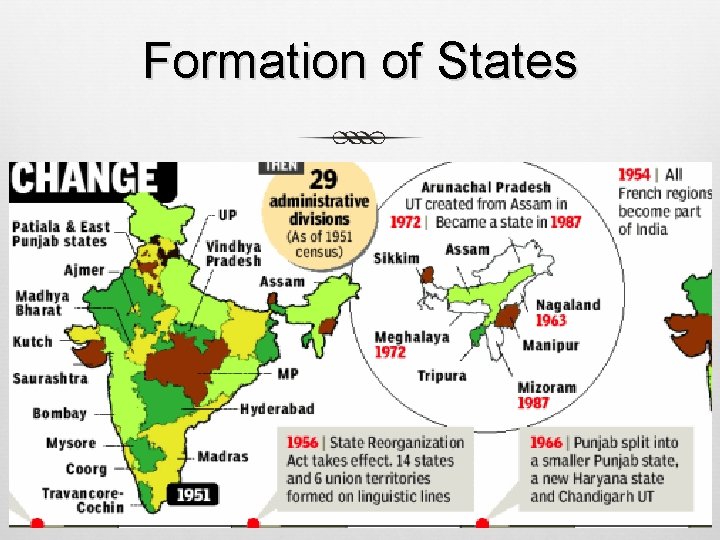
Formation of States
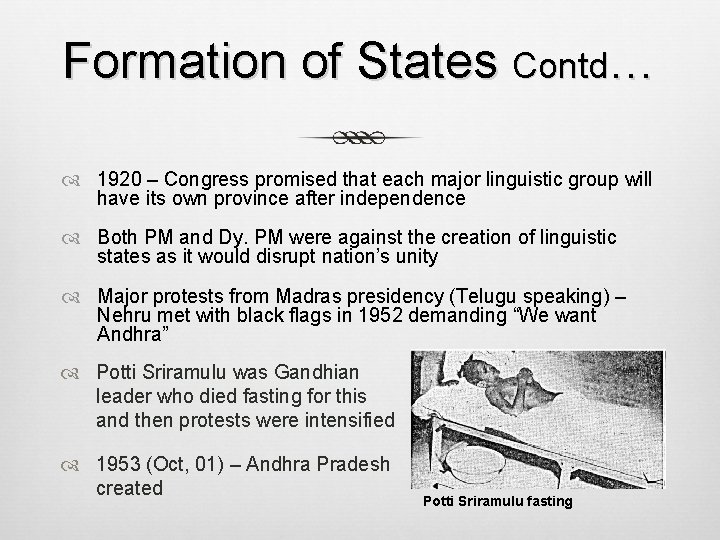
Formation of States Contd… 1920 – Congress promised that each major linguistic group will have its own province after independence Both PM and Dy. PM were against the creation of linguistic states as it would disrupt nation’s unity Major protests from Madras presidency (Telugu speaking) – Nehru met with black flags in 1952 demanding “We want Andhra” Potti Sriramulu was Gandhian leader who died fasting for this and then protests were intensified 1953 (Oct, 01) – Andhra Pradesh created Potti Sriramulu fasting
Formation of States Contd… 1953 – States Reorganization Commission was appointed 1956 (Aug 31) - The States Reorganization Act was enacted on District and provincial boundaries were re-drawn to form compact provinces of Assamese, Bengali, Oriya, Tamil, Malayalam, Kannada and Telugu speakers 1960 – Bilingual state of Bombay was divided into Marathi and Gujarati 1966 – Punjab was divided into Punjab (Sikhs) and Haryana (Haryanvis and Hindi) 2000 – Formation of Chhattisgarh, Jharkhand Uttarakhand 2014 – Separation of Telangana state from Andhra Pradesh
Planning for Development Modern technical and industrial base 1950 – Planning Commission (today’s NITI AYOG) was established to execute policies for economic development Both state and private sector – to increase productivity and create jobs 1956 – Second Five Year Plan was formulated – focus on iron & steel and heavy industry (Bhilai Steel plant with USSR in 1959) PC Mahalanobis (Architect of Five Year Plans) 1949 – Mira Behn stated that with science will come desolation, nature’s balance is a must to be studied
Foreign Policy United Nation’s formed in 1945 was in infancy 1950 -1960 – Emergence of cold-war, Power rivalries and ideological conflicts between USA and USSR, both created military alliances Nehru developed India’s foreign policy – Non-Alignment Movement (NAM) NAM - India took neutral stand not to form alliance with any of the major powers and remain isolated NAM members countries – Egypt, Yugoslavia, Indonesia, Ghana and India – many other countries joined by 1970 s
Foreign Policy Contd… India – Major role in mediating between American and Soviet alliances Krishna Menon – Led Indian delegation to UN between 1952 to 1962 and argued for a policy of non -alignment 1955 (Bandung, Indonesia) – 29 newly independent states participated in this famous conference to discuss how Afro-Asian countries could continue to oppose colonialism and Western dominance
Present Situation Free Press Independent Judiciary Difference Languages Check violence against Dalits Check discrimination Clashes between religious groups to be checked Bridge gap between rich and poor (Dharavi – among the biggest slums in the world)
Sri Lanka 1956 – Sri Lanka introduced act recognizing Sinhala as official language For several decades, a civil war has raged in Sri Lanka whose roots lie in imposition of Sinhala language on the Tamil speaking minority If Hindi was imposed on South India like Sinhala in northern Sri-Lanka and Urdu in East Pakistan, India too might had seen civil war and fragmentation
Thank You !! Any Queries/ Doubts? ?