
CHAPTER1 MEANING AND SCOPE OF ACCOUNTING 1 Need
- Slides: 6
CHAPTER-1 MEANING AND SCOPE OF ACCOUNTING 1. Need: 2. Book keeping: - According to R. N. Carter, ” Book keeping is the science and art of correctly recording in books of accounts all those transactions that result in the transfer of money or money's worth”. 3. Accounting: - According to R. N. Anthony, “ nearly every business enterprise has accounting system. It is a means of collecting, summarizing, analyzing, and reporting in monitory terms, information about business”.
Branches of Accounting. Financial Accounting n Cost Accounting n Social Responsibility Accounting n Tax Accounting n Management Accounting n
Objectives/Functions of Accountingn n n Systematic records Ascertainment of profit or loss Ascertainment of financial position Communication of results to interested parties Compliance with legal formalities Characteristics of Accountingn n n n Economic events -External events -Internal events Identification of economic events Recording Classification Preparation of financial accounts Accounting in terms of money Interpretation of final results
ADVANTAGES OF ACCOUNTINGn n n Helpful in remembering Helpful in planning and controlling Helpful in decision making Helpful in tax assessment Comparative study Proof in court Helpful in sale of business Helpful in determination of Goodwill Helpful in realization of debts Helpful in case of insolvency Check on errors and frauds Assessment of progress
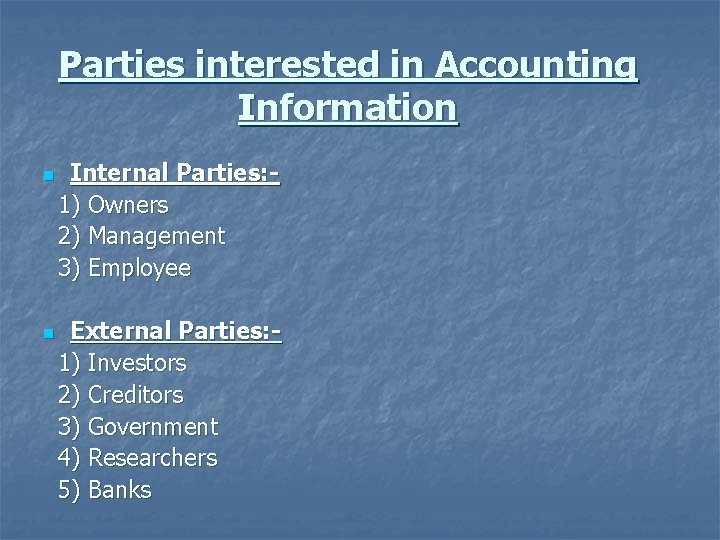
Parties interested in Accounting Information n n Internal Parties: 1) Owners 2) Management 3) Employee External Parties: 1) Investors 2) Creditors 3) Government 4) Researchers 5) Banks
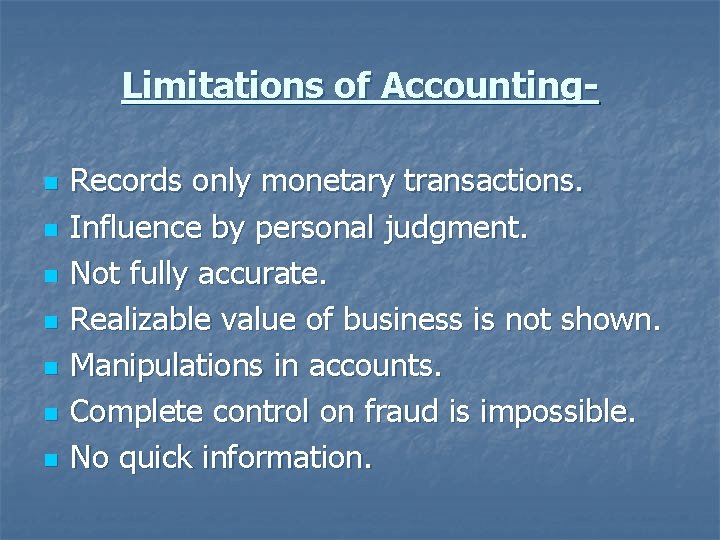
Limitations of Accountingn n n n Records only monetary transactions. Influence by personal judgment. Not fully accurate. Realizable value of business is not shown. Manipulations in accounts. Complete control on fraud is impossible. No quick information.