
CHAPTER Work System Design Reid Sanders Operations Management


- Slides: 23
CHAPTER Work System Design Reid & Sanders, Operations Management © Wiley 2002 11
Learning Objectives • • Describe work system design Describe relevant job design issues Describe methods analysis Describe how to conduct a time study Describe work sampling Demonstrate the use of work standards Describe compensation plans Describe learning curves Reid & Sanders, Operations Management © Wiley 2002 2
Job Design • Specify the contents of the job: – Identify the purpose of the job – Define duties & responsibilities – Specify the required credentials, skills, & training Reid & Sanders, Operations Management © Wiley 2002 3
Feasibility Issues • Technical feasibility: – Whether the job is within physical & mental capabilities of the workforce • Economic feasibility: – Whether the cost of performing the job is less than its added value • Behavioral feasibility: – Whether the job is intrinsically satisfying Reid & Sanders, Operations Management © Wiley 2002 4
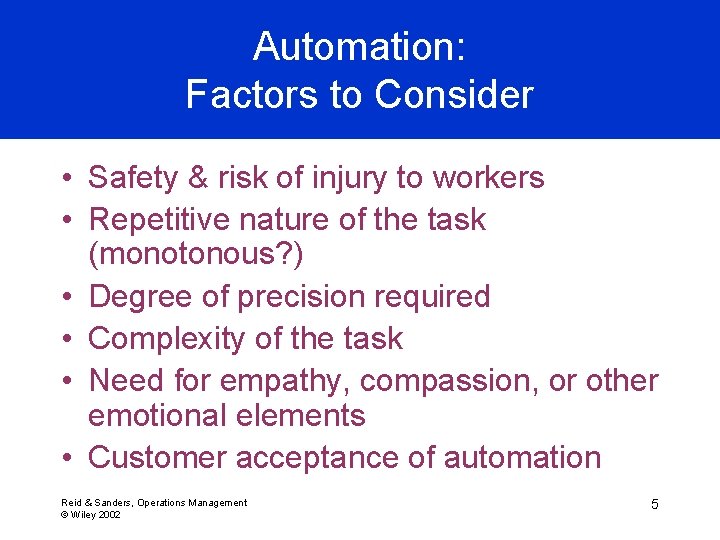
Automation: Factors to Consider • Safety & risk of injury to workers • Repetitive nature of the task (monotonous? ) • Degree of precision required • Complexity of the task • Need for empathy, compassion, or other emotional elements • Customer acceptance of automation Reid & Sanders, Operations Management © Wiley 2002 5
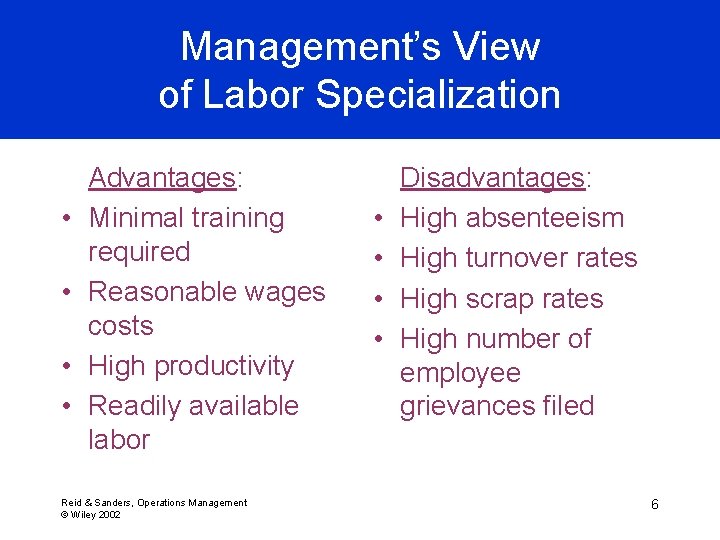
Management’s View of Labor Specialization • • Advantages: Minimal training required Reasonable wages costs High productivity Readily available labor Reid & Sanders, Operations Management © Wiley 2002 • • Disadvantages: High absenteeism High turnover rates High scrap rates High number of employee grievances filed 6
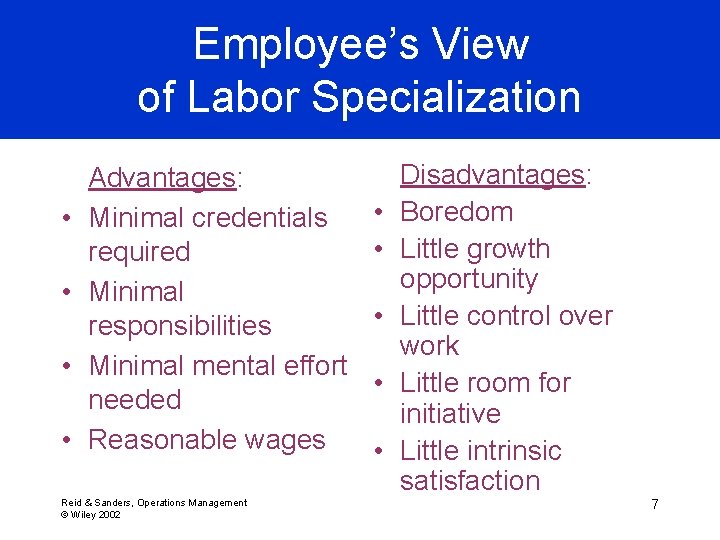
Employee’s View of Labor Specialization • • Advantages: Minimal credentials required Minimal responsibilities Minimal mental effort needed Reasonable wages Reid & Sanders, Operations Management © Wiley 2002 • • • Disadvantages: Boredom Little growth opportunity Little control over work Little room for initiative Little intrinsic satisfaction 7
Addressing Boredom • Job enlargement • Job enrichment • Job rotation Reid & Sanders, Operations Management © Wiley 2002 8
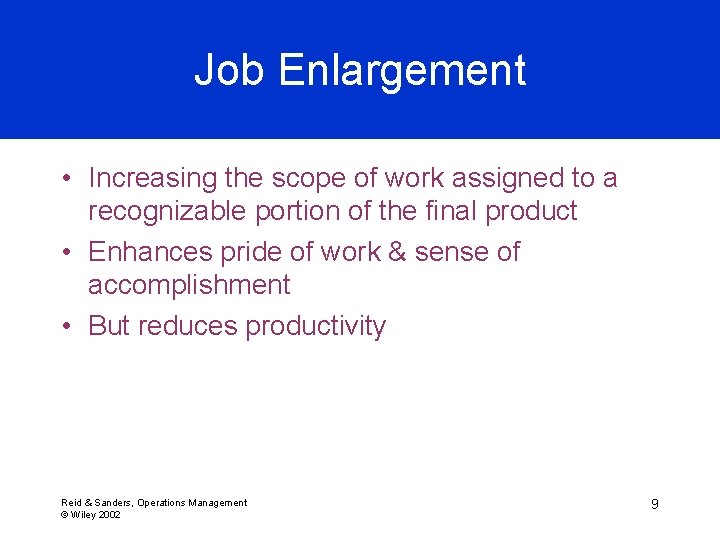
Job Enlargement • Increasing the scope of work assigned to a recognizable portion of the final product • Enhances pride of work & sense of accomplishment • But reduces productivity Reid & Sanders, Operations Management © Wiley 2002 9
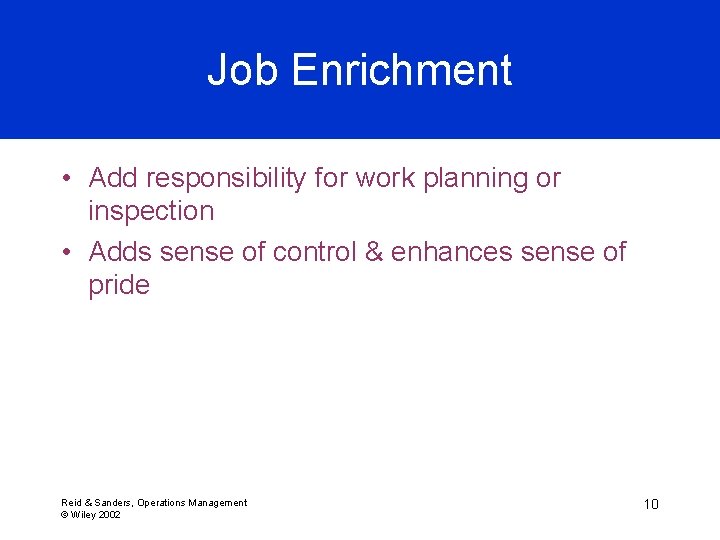
Job Enrichment • Add responsibility for work planning or inspection • Adds sense of control & enhances sense of pride Reid & Sanders, Operations Management © Wiley 2002 10
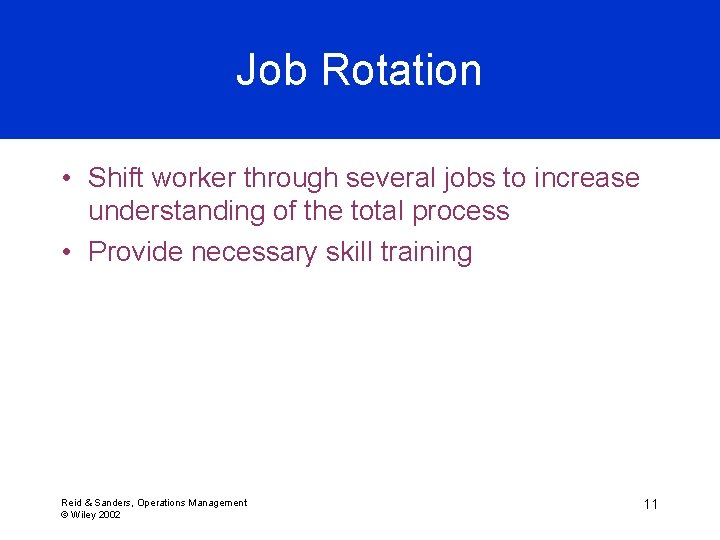
Job Rotation • Shift worker through several jobs to increase understanding of the total process • Provide necessary skill training Reid & Sanders, Operations Management © Wiley 2002 11
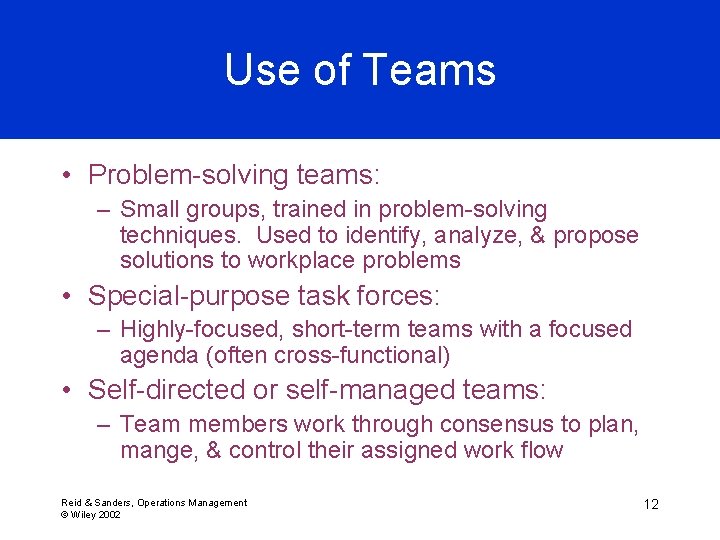
Use of Teams • Problem-solving teams: – Small groups, trained in problem-solving techniques. Used to identify, analyze, & propose solutions to workplace problems • Special-purpose task forces: – Highly-focused, short-term teams with a focused agenda (often cross-functional) • Self-directed or self-managed teams: – Team members work through consensus to plan, mange, & control their assigned work flow Reid & Sanders, Operations Management © Wiley 2002 12
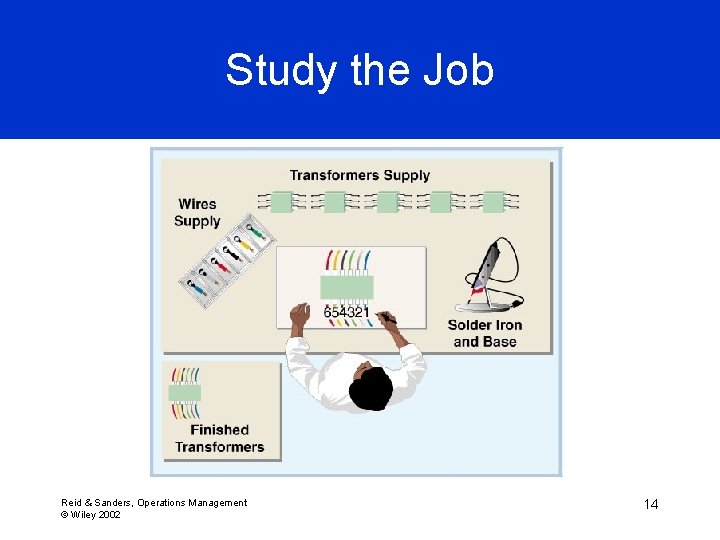
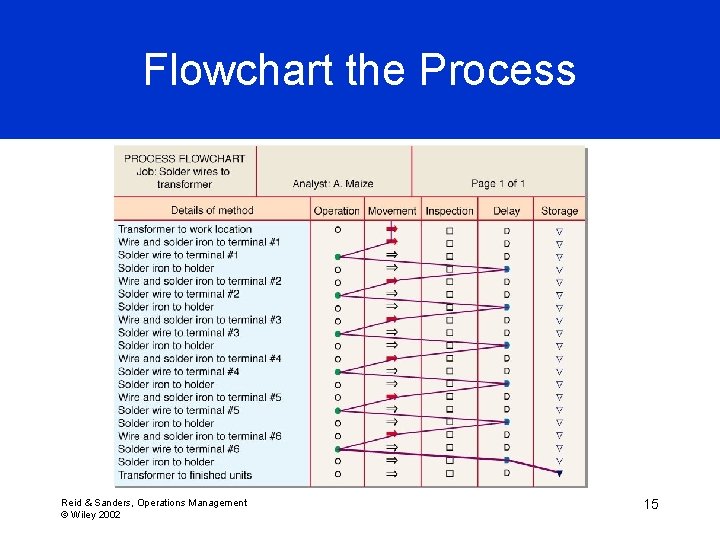
Methods Analysis • A detailed step-by-step analysis of how a given job is performed • Distinguish between value-added & non -value-added steps • Revise the procedure to improve productivity • Document the revised standard operating procedure Reid & Sanders, Operations Management © Wiley 2002 13
Study the Job Reid & Sanders, Operations Management © Wiley 2002 14
Flowchart the Process Reid & Sanders, Operations Management © Wiley 2002 15
Work Measurement • Standard time: – The length of time a qualified worker, using appropriate tools & procedures, will take to complete a job • Standard time is used in: – Costing the labor component of products – Tracking employee performance – Scheduling & planning required resources Reid & Sanders, Operations Management © Wiley 2002 16
Time Studies • • • Choose the specific job to be studied Inform the worker of the study Break the job into distinguishable elements Calculate the number of cycles to observe Time each element, record data & rate the worker’s performance • Compute the standard time Reid & Sanders, Operations Management © Wiley 2002 17
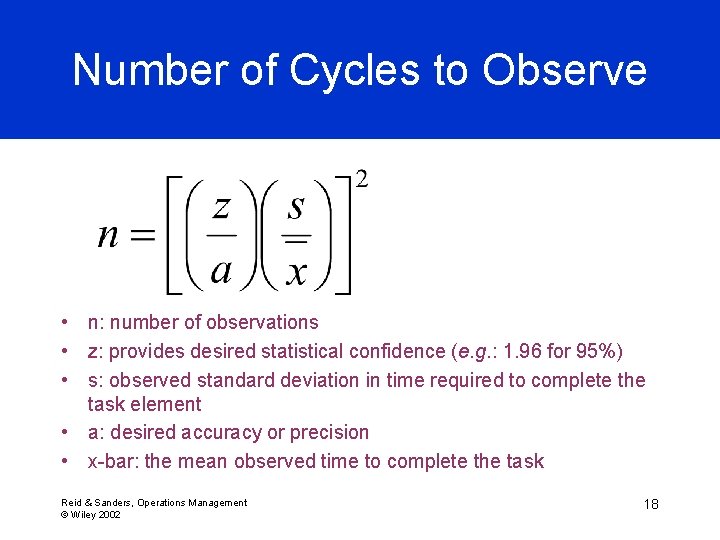
Number of Cycles to Observe • n: number of observations • z: provides desired statistical confidence (e. g. : 1. 96 for 95%) • s: observed standard deviation in time required to complete the task element • a: desired accuracy or precision • x-bar: the mean observed time to complete the task Reid & Sanders, Operations Management © Wiley 2002 18
Performance Rating Factor • Often a worker speeds up (or sometimes slows down) when they know they’re being observed • Performance rating factors are used to subjectively assess the worker’s performance – 100% = an average work pace Reid & Sanders, Operations Management © Wiley 2002 19
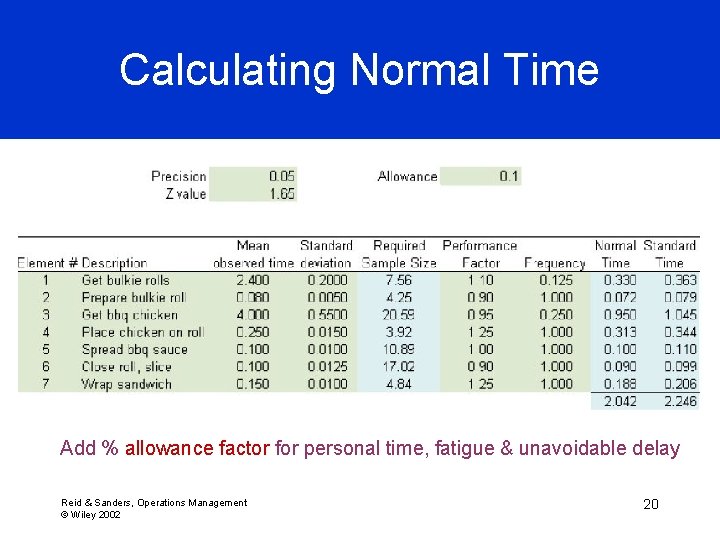
Calculating Normal Time Add % allowance factor for personal time, fatigue & unavoidable delay Reid & Sanders, Operations Management © Wiley 2002 20
Compensation • Time-based versus output-based (incentive) systems • Group incentive plans: profit sharing & gain sharing • Issues to consider: – Does the compensation system undermine teamwork? – Prevent free-riders? – Encourage to support the long-term health of the organization? Reid & Sanders, Operations Management © Wiley 2002 21
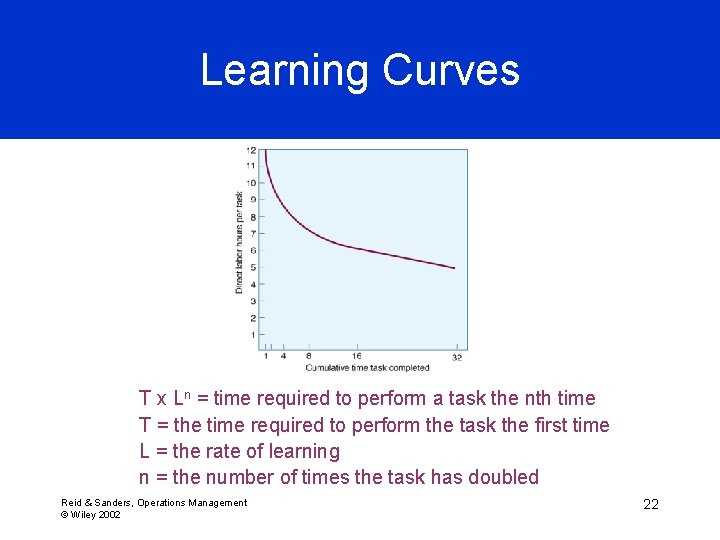
Learning Curves T x Ln = time required to perform a task the nth time T = the time required to perform the task the first time L = the rate of learning n = the number of times the task has doubled Reid & Sanders, Operations Management © Wiley 2002 22
The End Copyright © 2002 John Wiley & Sons, Inc. All rights reserved. Reproduction or translation of this work beyond that permitted in Section 117 of the 1976 United State Copyright Act without the express written permission of the copyright owner is unlawful. Request for further information should be addressed to the Permissions Department, John Wiley & Sons, Inc. The purchaser may make back-up copies for his/her own use only and not for distribution or resale. The Publisher assumes no responsibility for errors, omissions, or damages, caused by the use of these programs or from the use of the information contained herein. Reid & Sanders, Operations Management © Wiley 2002 23