
Chapter VI Descriptive Research Design Survey and Observation
Chapter VI Descriptive Research Design Survey and Observation
Chapter Outline 1) Overview 2) Survey Methods 3) Survey Methods Classified by Mode of Administration i. Telephone Methods a. Traditional Telephone Interviews b. Computer-Assisted Telephone Interviewing (CATI) ii. Personal Methods a. Personal In-home Interviews b. Mall-Intercept Personal Interviews c. Computer-Assisted Personal Interviewing (CAPI) iii. Mail Methods a. Mail Interviews b. Mail Panels iv. Electronic Methods a. E-mail Surveys b. Internet Surveys
4) A Comparative Evaluation of Survey Methods i. Flexibility of Data Collection ii. Diversity of Questions iii. Use of Physical Stimuli iv. Sample Control v. Control of the Data Collection Environment vi. Control of Field Force vii. Quantity of Data viii. Response Rate ix. Perceived Anonymity x. Social Desirability/ Sensitive Information xi. Potential for Interviewer Bias xii. Speed xiii. Cost
5) Selection of Survey Method(s) 6) Observation Methods i. Structured vs. Unstructured Observation ii. Disguised vs. Undisguised Observation iii. Natural vs. Contrived Observation 7) Observational Methods Classified by Mode of Administration i. Personal Observation ii. Mechanical Observation iii. Audit iv. Content Analysis v. Trace Analysis
8) A Comparative Evaluation of Observational Methods i. Degree of Structure ii. Degree of Disguise iii. Ability to Observe in Natural Setting iv. Analysis Bias v. General Remarks 9) A Comparison of Survey and Observational Methods i. Relative Advantages of Observation ii. Relative Disadvantages of Observation
10) International Marketing Research 11) Ethics in Marketing Research 12) Internet and Computer Applications 13) Focus on Burke 14) Summary 15) Key Terms and Concepts 16) Acronyms
RIP 6. 1 Survey Research is in the Cards for DEC Digital Equipment Corporation (DEC) has made a conscious effort in the past years to shift from a product-driven focus to a more market-and consumer-driven focus. The product focus is not unusual in companies manufacturing hi-tech products. There is a serious need for market research in these hi-tech companies as they direct their products to the market. Still, market research in this arena is difficult. It is complicated by the rapid change of technology as well as the sheer size of the application market. Often the technology will be employed in many different industries.
RIP 6. 1 Contd. This holds true for the computer market where DEC is a key player. Computers are bought by individuals in every walk of life as well as by businesses in every market imaginable. The breadth of the market makes useful market research a formidable task. This task is being undertaken at DEC in their Corporate Marketing Services (CMS) Division, however. research data are used.
6. 1 contd. . “Digital’s Corporate Marketing Services Division has been a core element in the company’s transition to a market-driven strategy. ” CMS is coordinating the company’s strategy to redefine their product from simply computers to a broader view of the business solutions. The CMS has employed many research techniques to gain a better understanding of the “business solutions” market. Both primary and secondary
RIP 6. 1 Contd. �Primary data are obtained through the use of phone and mail surveys as well as seminars and focus groups. Phone surveys have been used to define customer needs better and to direct products to the customers better. Mail surveys have been used to study customer purchasing habits as well as future purchasing plans. Seminars are held to gain feedback on the long-term production plans at DEC. Finally, focus groups are used to determine whether the chosen strategy is good and one that will effectively manage and use the market’s potential. Without CMS and marketing research, DEC would be facing the unknowns of their technology as well as the market. This combination of obstacles would have made the transition from a product-focused to a market- and consumer-focused company an impossibility.
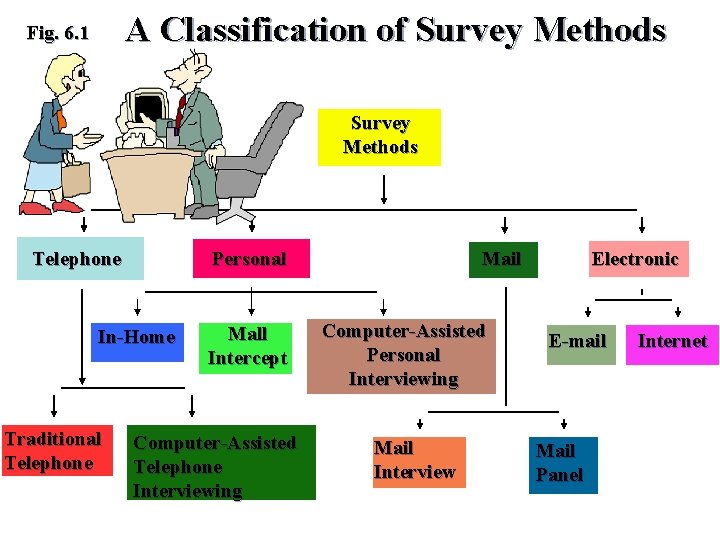
A Classification of Survey Methods Fig. 6. 1 Survey Methods Telephone Personal In-Home Traditional Telephone Mall Intercept Computer-Assisted Telephone Interviewing Mail Computer-Assisted Personal Interviewing Mail Interview Electronic E-mail Mail Panel Internet
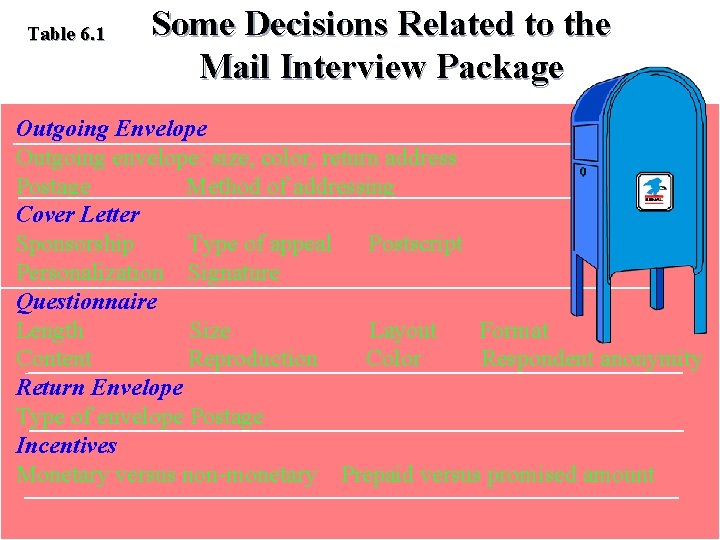
Table 6. 1 Some Decisions Related to the Mail Interview Package Outgoing Envelope Outgoing envelope: size, color, return address Postage Method of addressing Cover Letter Sponsorship Type of appeal Postscript Personalization Signature Questionnaire Length Size Layout Format Content Reproduction Color Respondent anonymity Return Envelope Type of envelope Postage Incentives Monetary versus non-monetary Prepaid versus promised amount
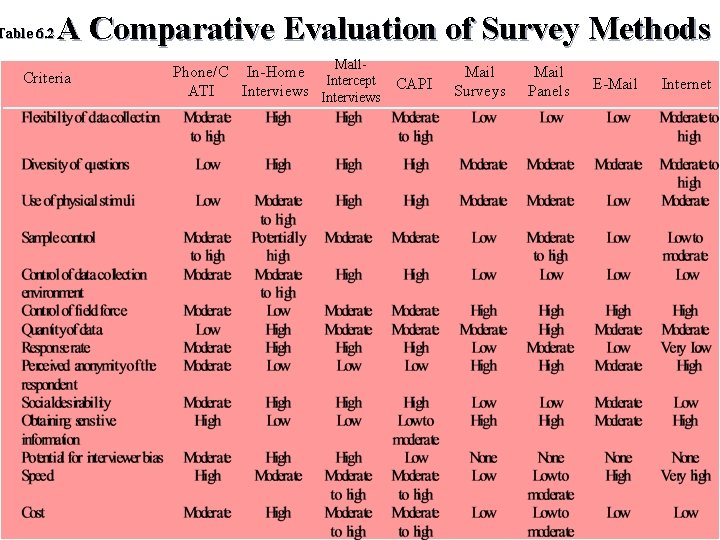
Table 6. 2 A Comparative Evaluation of Survey Methods Criteria Mall. Phone/C In-Home Intercept ATI Interviews CAPI Mail Surveys Mail Panels E-Mail Internet
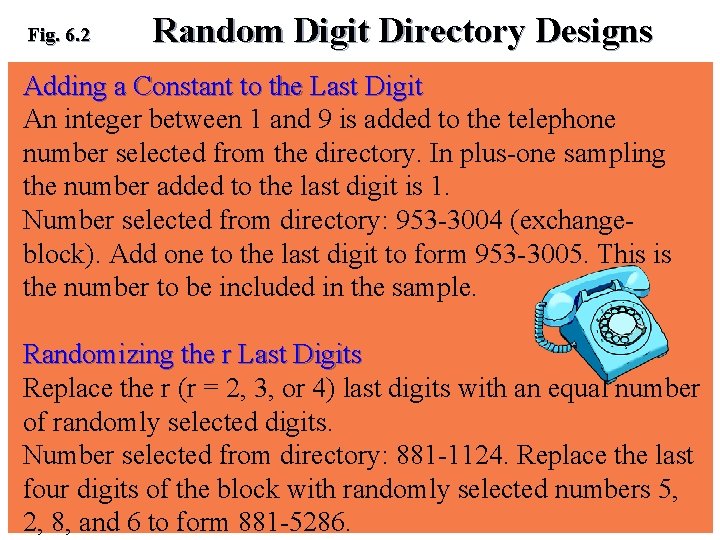
Fig. 6. 2 Random Digit Directory Designs Adding a Constant to the Last Digit An integer between 1 and 9 is added to the telephone number selected from the directory. In plus-one sampling the number added to the last digit is 1. Number selected from directory: 953 -3004 (exchangeblock). Add one to the last digit to form 953 -3005. This is the number to be included in the sample. Randomizing the r Last Digits Replace the r (r = 2, 3, or 4) last digits with an equal number of randomly selected digits. Number selected from directory: 881 -1124. Replace the last four digits of the block with randomly selected numbers 5, 2, 8, and 6 to form 881 -5286.
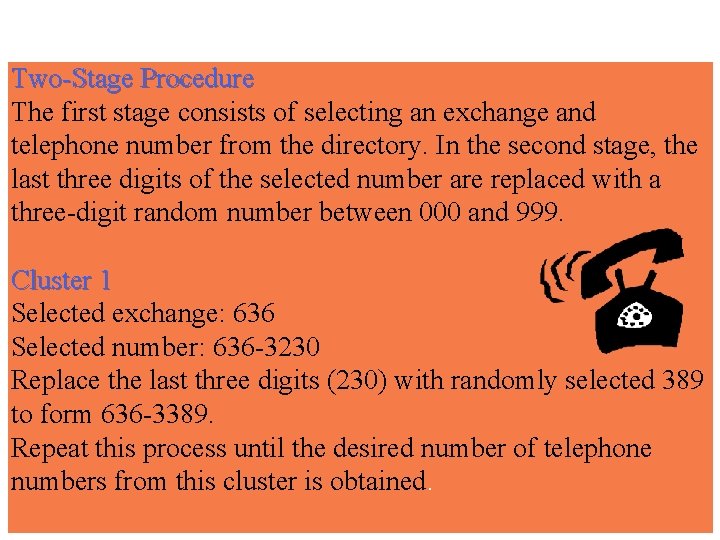
Two-Stage Procedure The first stage consists of selecting an exchange and telephone number from the directory. In the second stage, the last three digits of the selected number are replaced with a three-digit random number between 000 and 999. Cluster 1 Selected exchange: 636 Selected number: 636 -3230 Replace the last three digits (230) with randomly selected 389 to form 636 -3389. Repeat this process until the desired number of telephone numbers from this cluster is obtained.
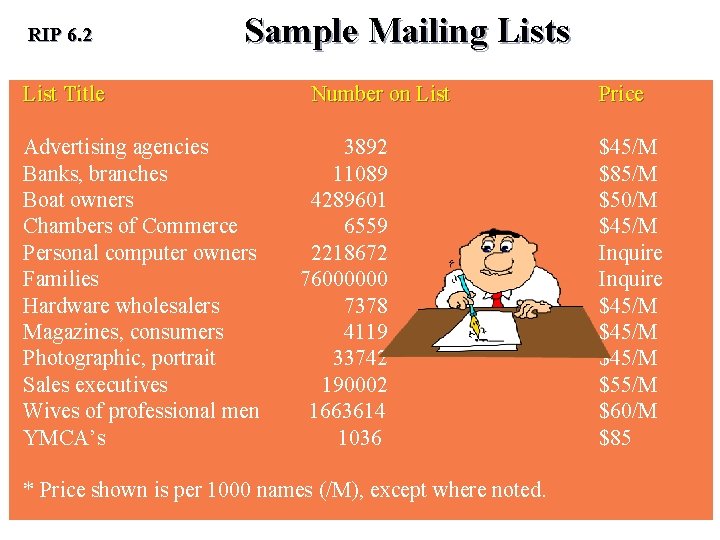
RIP 6. 2 Sample Mailing Lists List Title Advertising agencies Banks, branches Boat owners Chambers of Commerce Personal computer owners Families Hardware wholesalers Magazines, consumers Photographic, portrait Sales executives Wives of professional men YMCA’s Number on List 3892 11089 4289601 6559 2218672 76000000 7378 4119 33742 190002 1663614 1036 * Price shown is per 1000 names (/M), except where noted. Price $45/M $85/M $50/M $45/M Inquire $45/M $55/M $60/M $85
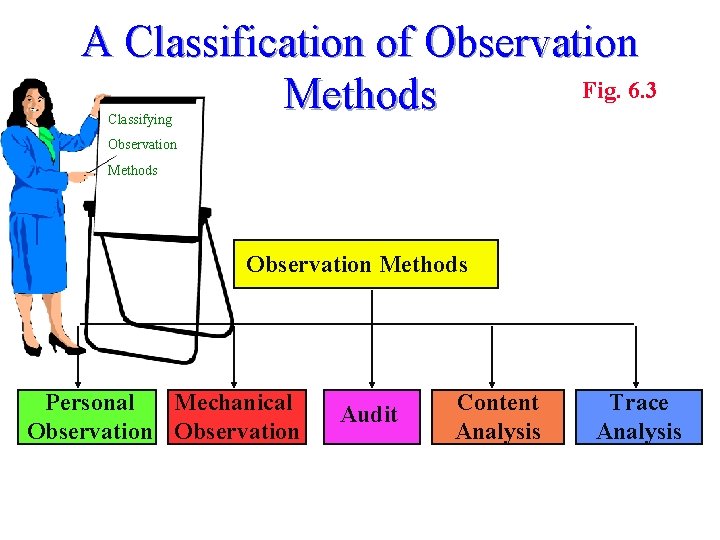
A Classification of Observation Fig. 6. 3 Methods Classifying Observation Methods Personal Mechanical Observation Audit Content Analysis Trace Analysis
RIP 6. 3 Building According to Personal Observation Honda Motor Co. had a lot of complaints on their sporty, restyled Accord (not big enough for U. S. drivers, not stylish enough for the Japanese drivers). Being afraid to lose its market, Honda sent teams to visit U. S. families and observe how the Americans used their Honda Accords. By personal observation, the teams found out that the Americans like lots of compartments for storing maps and change. The teams also actually took U. S. road trips in Accord and in Ford Taurus and Toyota Camry as its rivals in midsize cars. The results of this observation study were used to design a new 1998 Accord for U. S. drivers which has 101. 7 cubic feet for passenger space compared to 101. 5 cubic feet for Ford Taurus and 97. 9 cubic feet for Toyota Camry. Moreover, Accord also delivered higher customer value by cutting the price. With these changes, Honda executives are expecting to increase U. S. sales to total of 1 million units by the year 2000.
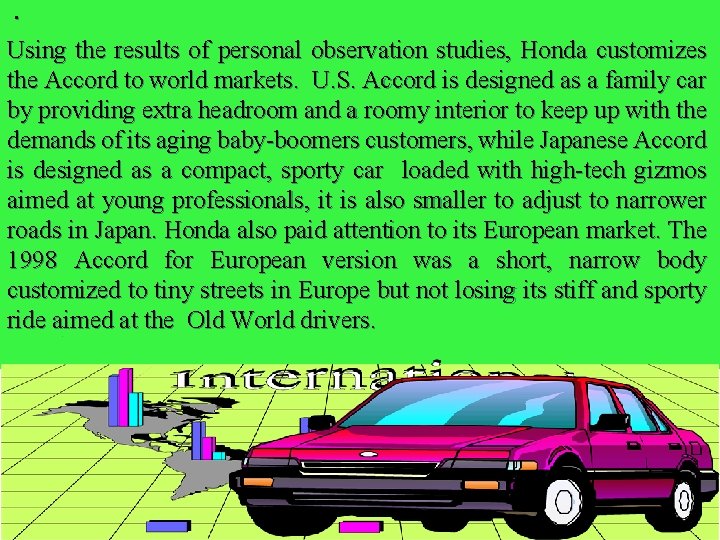
. Using the results of personal observation studies, Honda customizes the Accord to world markets. U. S. Accord is designed as a family car by providing extra headroom and a roomy interior to keep up with the demands of its aging baby-boomers customers, while Japanese Accord is designed as a compact, sporty car loaded with high-tech gizmos aimed at young professionals, it is also smaller to adjust to narrower roads in Japan. Honda also paid attention to its European market. The 1998 Accord for European version was a short, narrow body customized to tiny streets in Europe but not losing its stiff and sporty ride aimed at the Old World drivers.
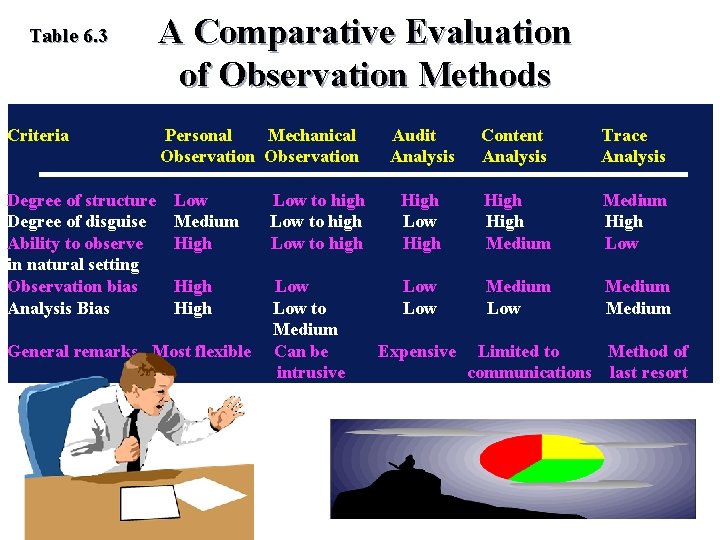
Table 6. 3 Criteria A Comparative Evaluation of Observation Methods Personal Mechanical Observation Degree of structure Low Degree of disguise Medium Ability to observe High in natural setting Observation bias High Analysis Bias High General remarks Most flexible Audit Analysis Content Analysis Trace Analysis Low to high High Low High Medium High Low Low to Medium Can be intrusive Low Medium Expensive Limited to Method of communications last resort
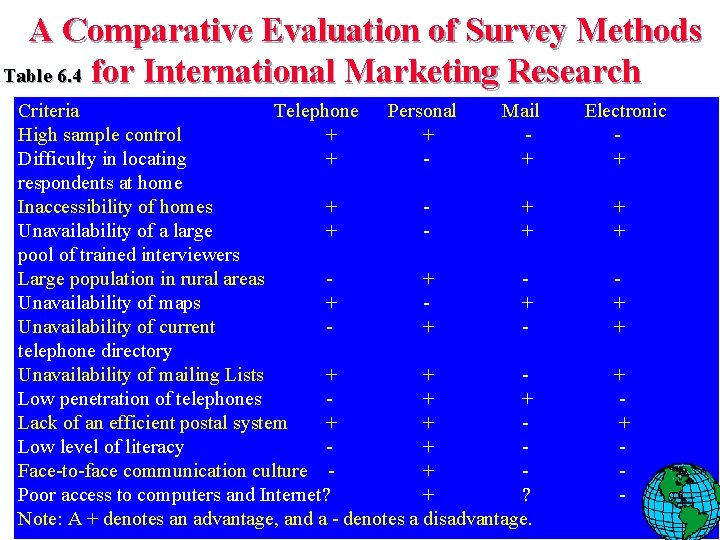
A Comparative Evaluation of Survey Methods Table 6. 4 for International Marketing Research Criteria Telephone Personal Mail High sample control + + Difficulty in locating + + respondents at home Inaccessibility of homes + + Unavailability of a large + + pool of trained interviewers Large population in rural areas + Unavailability of maps + + Unavailability of current + telephone directory Unavailability of mailing Lists + + Low penetration of telephones + + Lack of an efficient postal system + + Low level of literacy + Face-to-face communication culture + Poor access to computers and Internet? + ? Note: A + denotes an advantage, and a - denotes a disadvantage. Electronic + + + + -
- Slides: 21