
Chapter V Conflict Management developing individuals transforming organizations
![§ A] Task interdependence§ It refers to the extent to which two department dependents](https://slidetodoc.com/presentation_image/3c0a9c41c916c399630f9da79ff9e7c3/image-34.jpg "§ A] Task interdependence§ It refers to the extent to which two department dependents")
![§ B] Task ambiguity – — when it is not clear § C] Goal](https://slidetodoc.com/presentation_image/3c0a9c41c916c399630f9da79ff9e7c3/image-35.jpg "§ B] Task ambiguity – — when it is not clear § C] Goal")
![Strategies for conflict management § A] Strategies for resolving intra-personal conflict § B] Resolving](https://slidetodoc.com/presentation_image/3c0a9c41c916c399630f9da79ff9e7c3/image-36.jpg "Strategies for conflict management § A] Strategies for resolving intra-personal conflict § B] Resolving")




- Slides: 105
Chapter V: Conflict Management developing individuals, transforming organizations
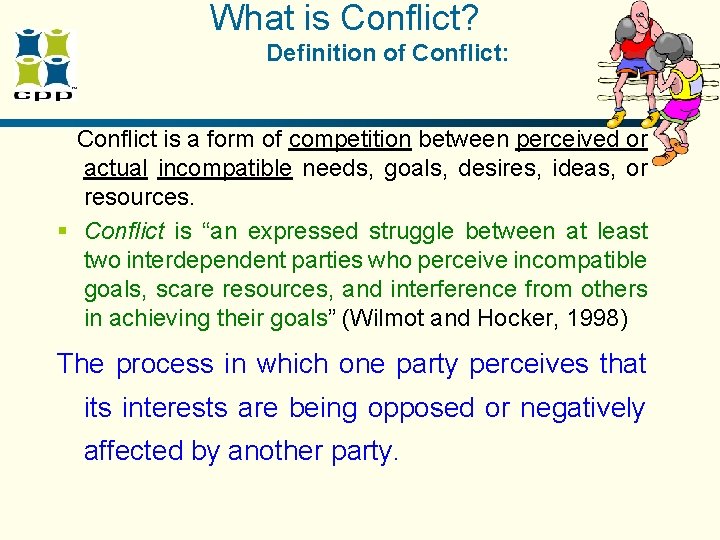
What is Conflict? Definition of Conflict: Conflict is a form of competition between perceived or actual incompatible needs, goals, desires, ideas, or resources. § Conflict is “an expressed struggle between at least two interdependent parties who perceive incompatible goals, scare resources, and interference from others in achieving their goals” (Wilmot and Hocker, 1998) The process in which one party perceives that its interests are being opposed or negatively affected by another party.
Conflict Defined § — Is a process that begins when one party perceives that another party has negatively affected, or is about to negatively affect, something that the first party cares about. o Is that point in an ongoing activity when an interaction “crosses over” to become an inter-party conflict. — Encompasses a wide range of conflicts that people experience in organizations o o o Incompatibility of goals Differences over interpretations of facts Disagreements based on behavioral expectations
§ Conflicts exist whenever incompatible activities occur. § Conflicts may originate from a number of different sources, including: o o o Differences in information, beliefs, values, interests, or desires. A scarcity of some resource. Rivalries in which one person or group competes with another. § § Conflict must be PERCEIVED to exist Exists when one person (party) PERCEIVES that another person (party) has deliberately blocked (or about to block) their goals § § § Is a struggle or contest Can be functional or dysfunctional Happens whenever people work, play or live together Many writers believe that conflict in a group is desirable. Conflict helps eliminate or reduce the likelihood of groupthink. § A moderate level of conflict across tasks within a group resulted in increased group performance while conflict among personalities resulted in lower group performance (Peterson and Behfar, 2003 § Conflict occurs whenever: — Disagreements exist in a social situation over issues of substance. — Emotional antagonisms (hatred causing opposition and ill will) cause frictions between individuals or groups.
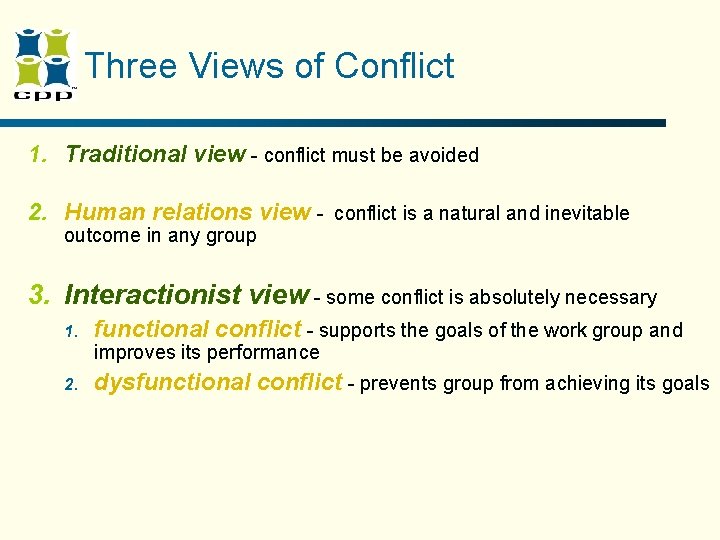
Three Views of Conflict 1. Traditional view - conflict must be avoided 2. Human relations view - conflict is a natural and inevitable outcome in any group 3. Interactionist view - some conflict is absolutely necessary 1. functional conflict - supports the goals of the work group and improves its performance 2. dysfunctional conflict - prevents group from achieving its goals
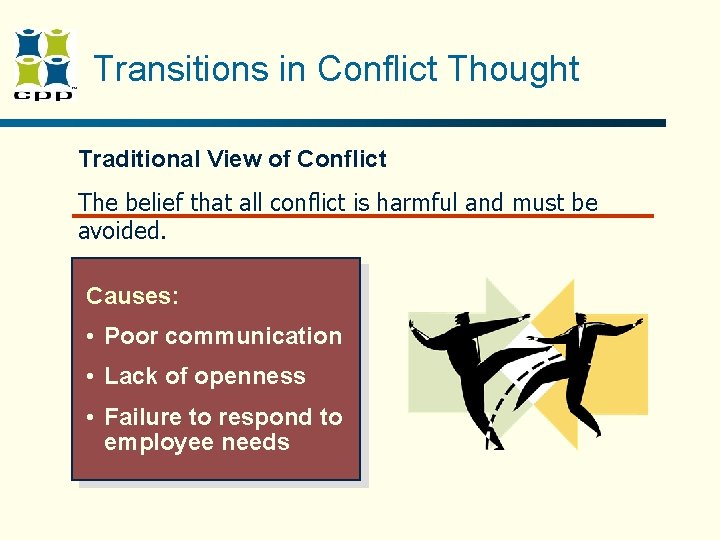
Transitions in Conflict Thought Traditional View of Conflict The belief that all conflict is harmful and must be avoided. Causes: • Poor communication • Lack of openness • Failure to respond to employee needs
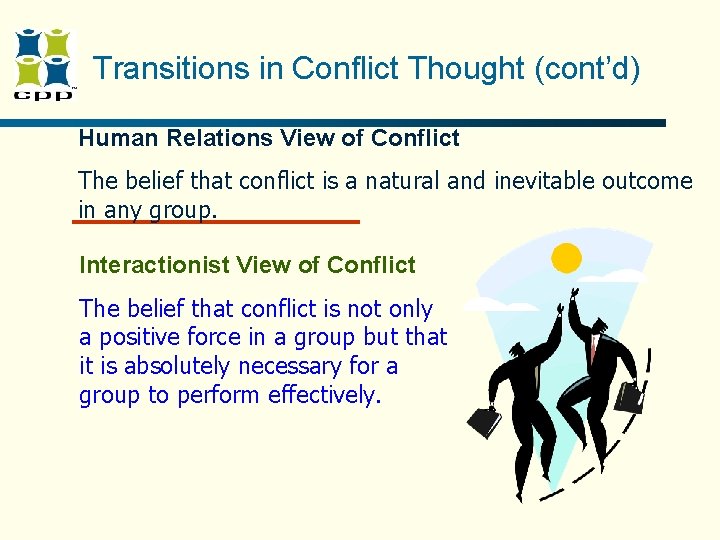
Transitions in Conflict Thought (cont’d) Human Relations View of Conflict The belief that conflict is a natural and inevitable outcome in any group. Interactionist View of Conflict The belief that conflict is not only a positive force in a group but that it is absolutely necessary for a group to perform effectively.
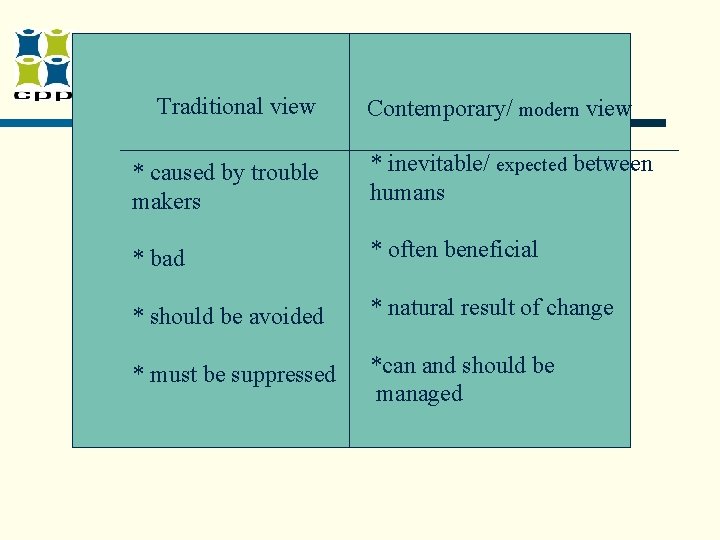
Traditional view Contemporary/ modern view * caused by trouble makers * inevitable/ expected between humans * bad * often beneficial * should be avoided * natural result of change * must be suppressed *can and should be managed
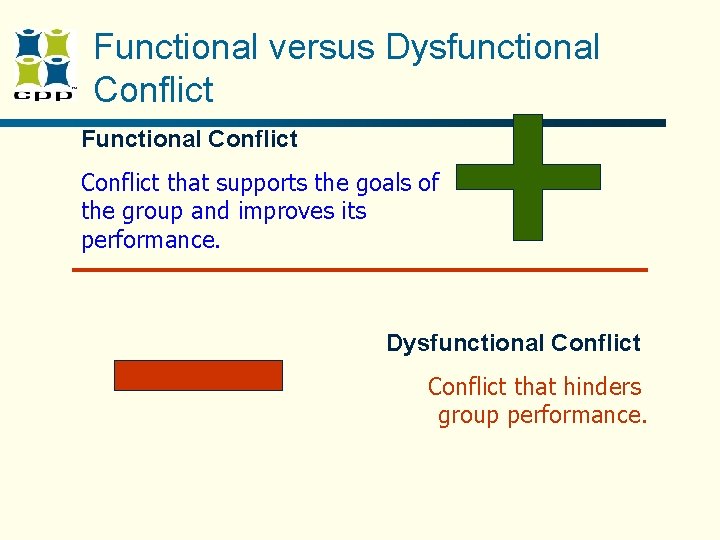
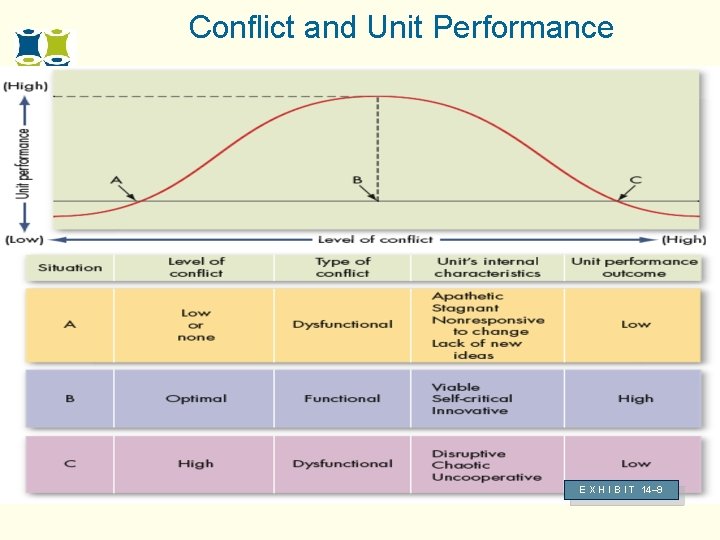
Functional versus Dysfunctional Conflict Functional Conflict that supports the goals of the group and improves its performance. Dysfunctional Conflict that hinders group performance.
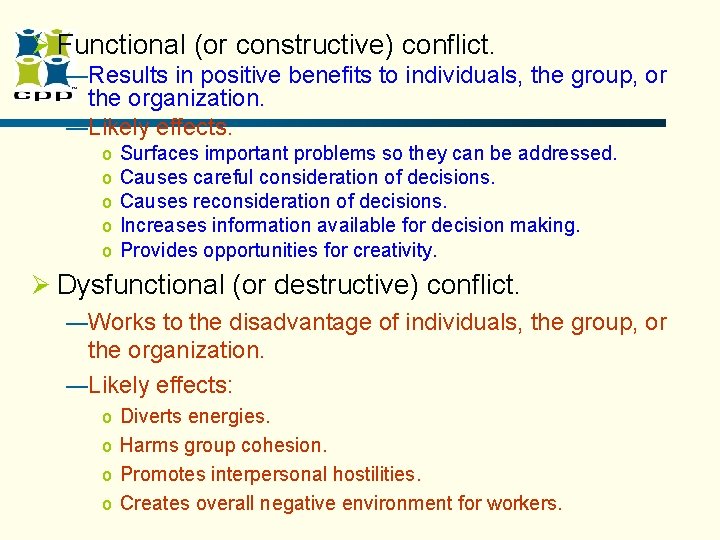
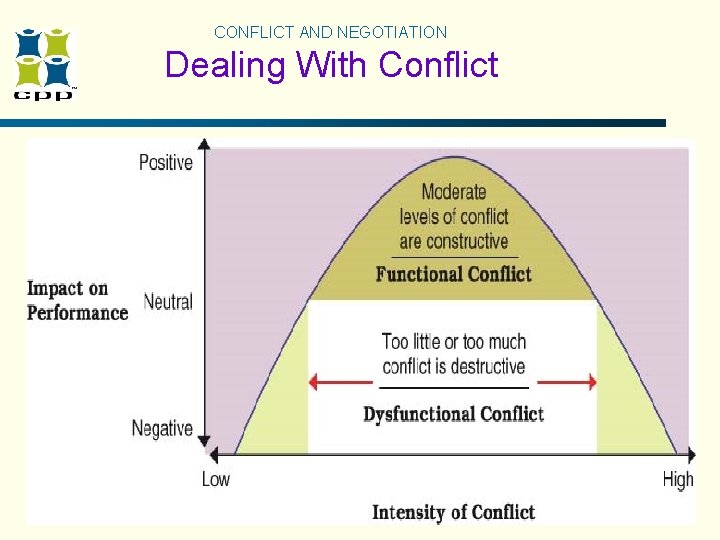
Ø Functional (or constructive) conflict. —Results in positive benefits to individuals, the group, or the organization. —Likely effects. o o o Surfaces important problems so they can be addressed. Causes careful consideration of decisions. Causes reconsideration of decisions. Increases information available for decision making. Provides opportunities for creativity. Ø Dysfunctional (or destructive) conflict. —Works to the disadvantage of individuals, the group, or the organization. —Likely effects: o Diverts energies. o Harms group cohesion. o Promotes interpersonal hostilities. o Creates overall negative environment for workers.
CONFLICT AND NEGOTIATION Dealing With Conflict
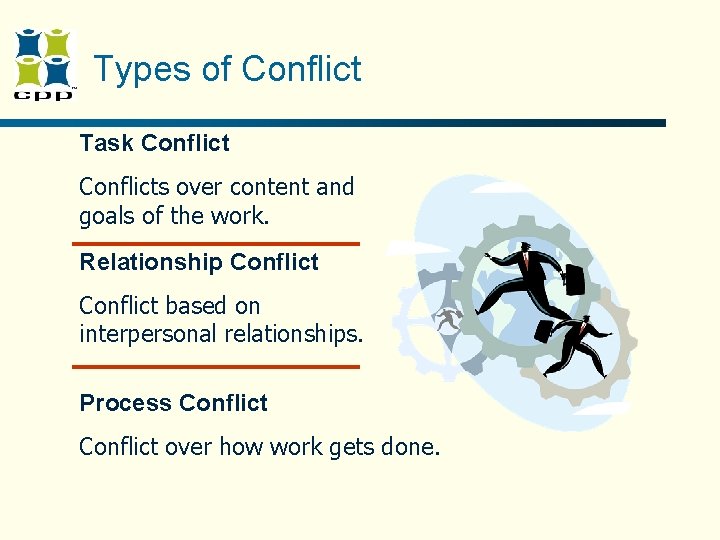
Types of Conflict Task Conflicts over content and goals of the work. Relationship Conflict based on interpersonal relationships. Process Conflict over how work gets done.
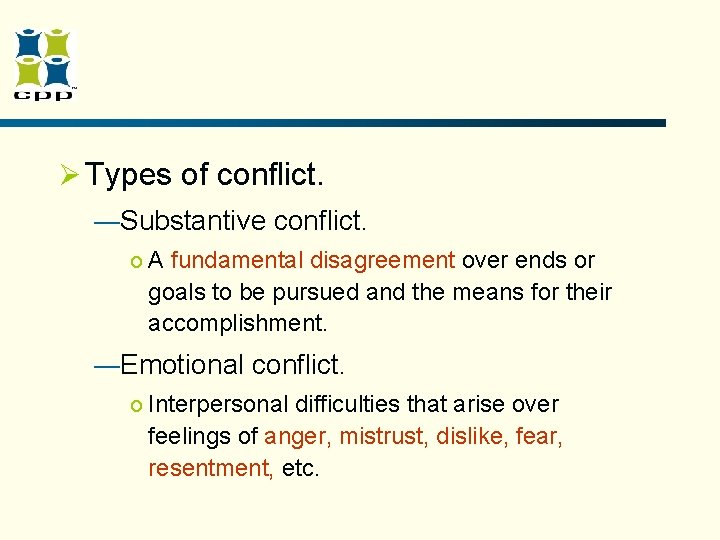
Ø Types of conflict. —Substantive conflict. o A fundamental disagreement over ends or goals to be pursued and the means for their accomplishment. —Emotional conflict. o Interpersonal difficulties that arise over feelings of anger, mistrust, dislike, fear, resentment, etc.
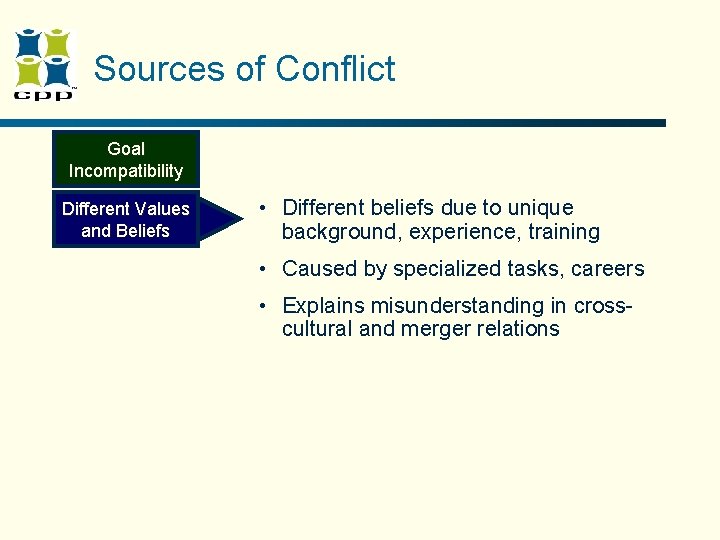
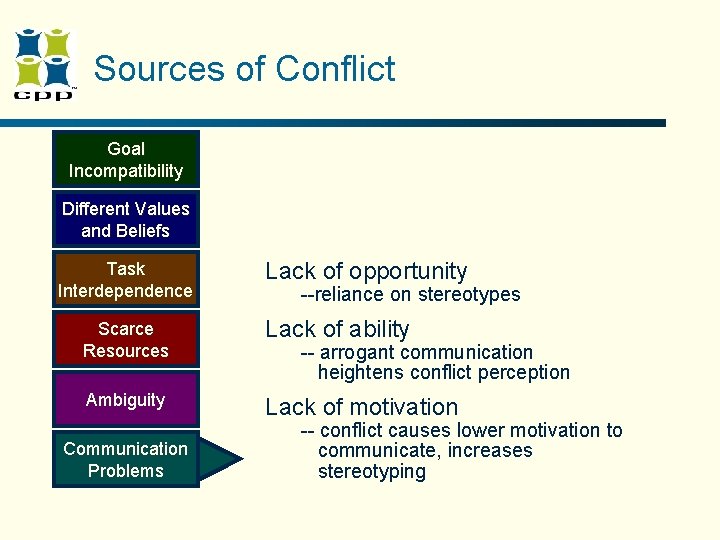
Sources of Conflict Goal Incompatibility • Goals conflict with goals of others Different Values and Beliefs • Different beliefs due to unique background, experience, training • Caused by specialized tasks, careers • Explains misunderstanding in crosscultural and merger relations
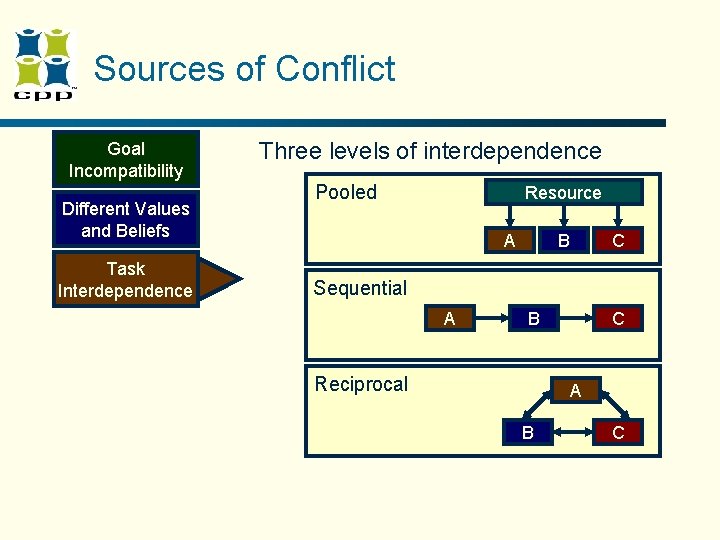
Sources of Conflict Goal Incompatibility Different Values and Beliefs Task Interdependence Three levels of interdependence Pooled Resource A B C Sequential A B Reciprocal C A B C
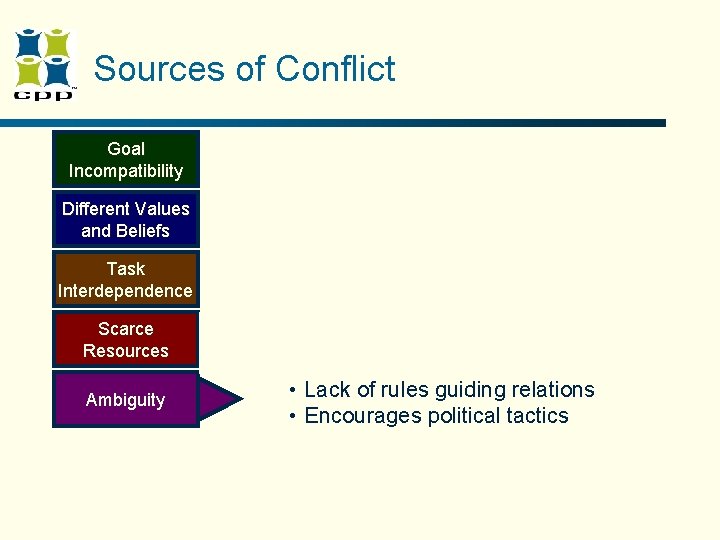
Sources of Conflict Goal Incompatibility Different Values and Beliefs Task Interdependence Scarce Resources Ambiguity • Increases competition for resources to fulfill goals • Lack of rules guiding relations • Encourages political tactics
Sources of Conflict Goal Incompatibility Different Values and Beliefs Task Interdependence Lack of opportunity --reliance on stereotypes Scarce Resources Lack of ability Ambiguity Lack of motivation Communication Problems -- arrogant communication heightens conflict perception -- conflict causes lower motivation to communicate, increases stereotyping
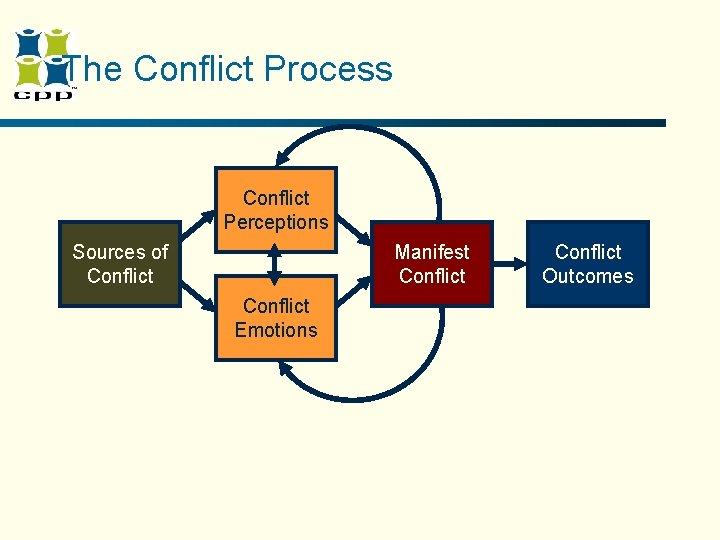
The Conflict Process Conflict Perceptions Sources of Conflict Manifest Conflict Emotions Conflict Outcomes
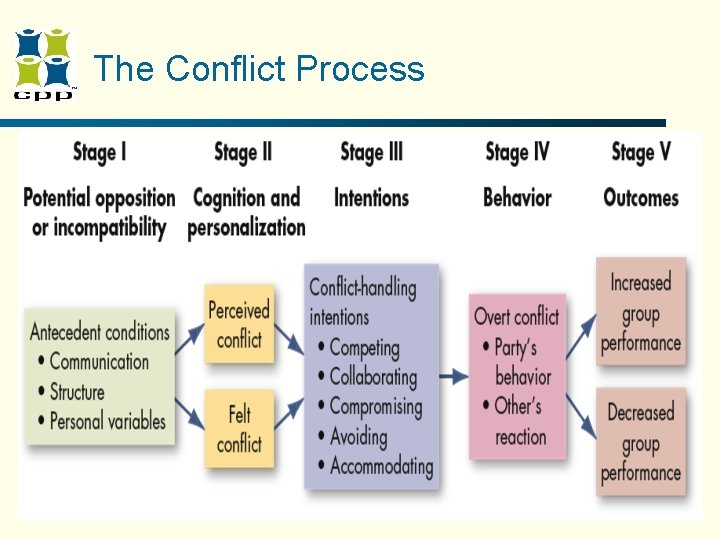
The Conflict Process E X H I B I T 14– 1
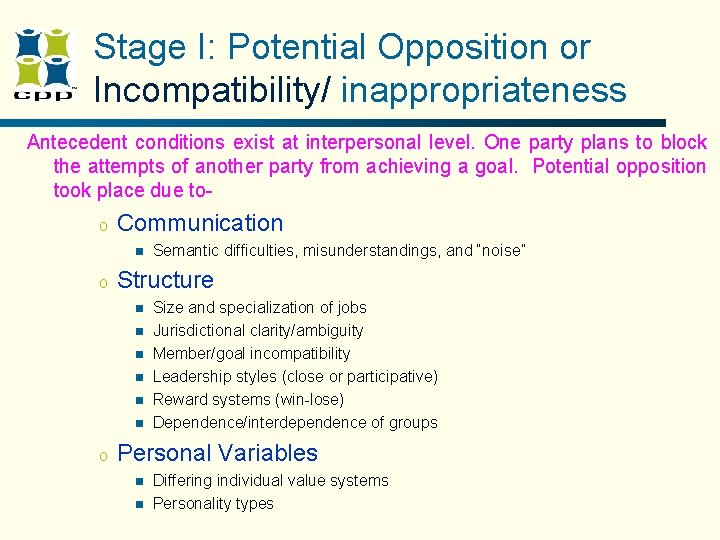
Stage I: Potential Opposition or Incompatibility/ inappropriateness Antecedent conditions exist at interpersonal level. One party plans to block the attempts of another party from achieving a goal. Potential opposition took place due too Communication n o Structure n n n o Semantic difficulties, misunderstandings, and “noise” Size and specialization of jobs Jurisdictional clarity/ambiguity Member/goal incompatibility Leadership styles (close or participative) Reward systems (win-lose) Dependence/interdependence of groups Personal Variables n n Differing individual value systems Personality types
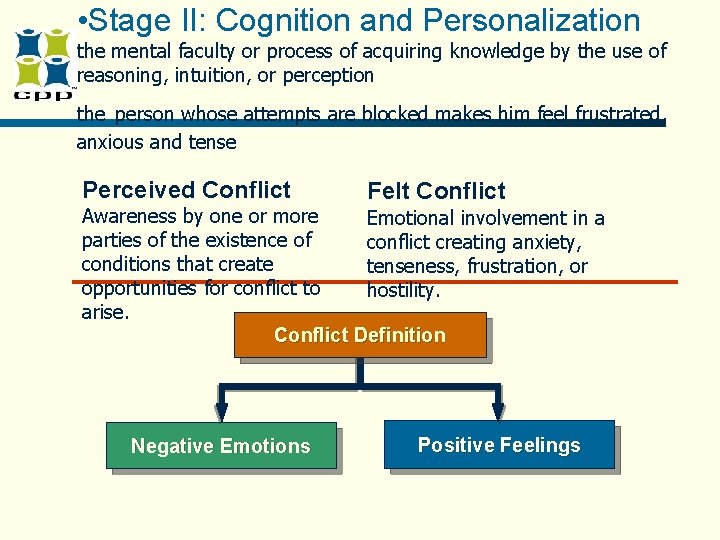
• Stage II: Cognition and Personalization the mental faculty or process of acquiring knowledge by the use of reasoning, intuition, or perception the person whose attempts are blocked makes him feel frustrated, anxious and tense Perceived Conflict Felt Conflict Awareness by one or more Emotional involvement in a parties of the existence of conflict creating anxiety, conditions that create tenseness, frustration, or opportunities for conflict to hostility. arise. Conflict Definition Negative Emotions Positive Feelings
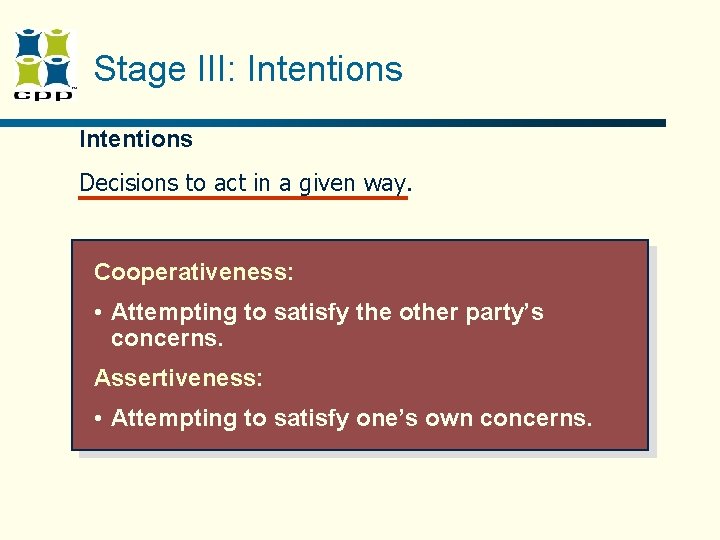
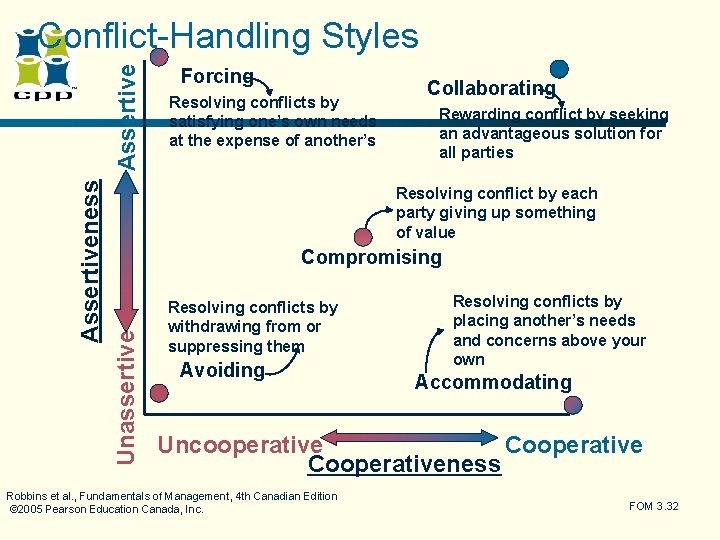
Stage III: Intentions Decisions to act in a given way. Cooperativeness: • Attempting to satisfy the other party’s concerns. Assertiveness: • Attempting to satisfy one’s own concerns.
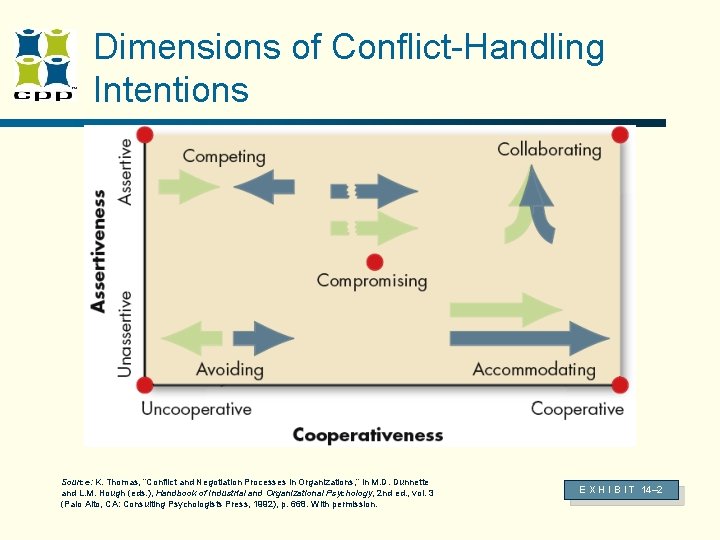
Dimensions of Conflict-Handling Intentions Source: K. Thomas, “Conflict and Negotiation Processes in Organizations, ” in M. D. Dunnette and L. M. Hough (eds. ), Handbook of Industrial and Organizational Psychology, 2 nd ed. , vol. 3 (Palo Alto, CA: Consulting Psychologists Press, 1992), p. 668. With permission. E X H I B I T 14– 2
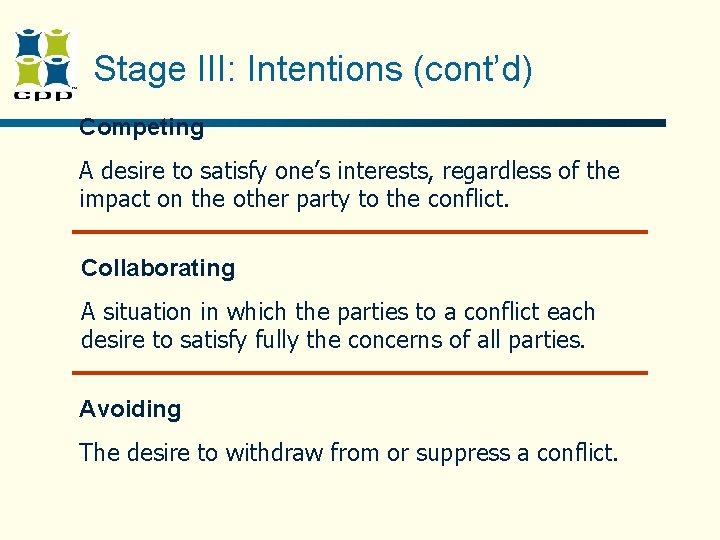
Stage III: Intentions (cont’d) Competing A desire to satisfy one’s interests, regardless of the impact on the other party to the conflict. Collaborating A situation in which the parties to a conflict each desire to satisfy fully the concerns of all parties. Avoiding The desire to withdraw from or suppress a conflict.
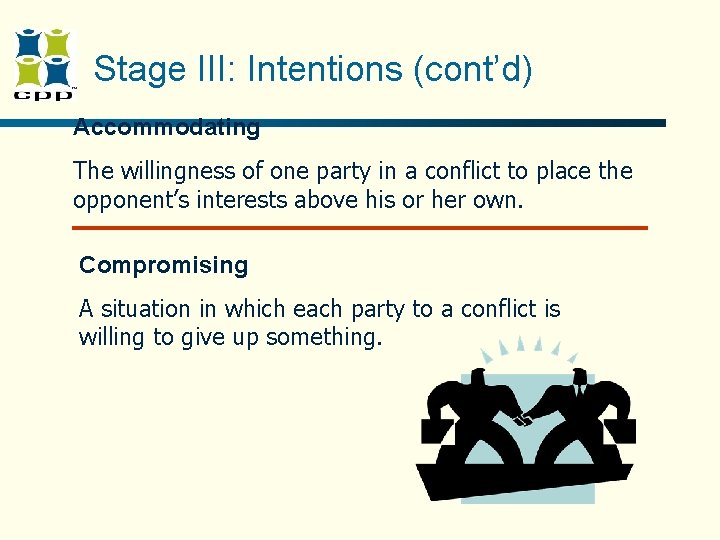
Stage III: Intentions (cont’d) Accommodating The willingness of one party in a conflict to place the opponent’s interests above his or her own. Compromising A situation in which each party to a conflict is willing to give up something.
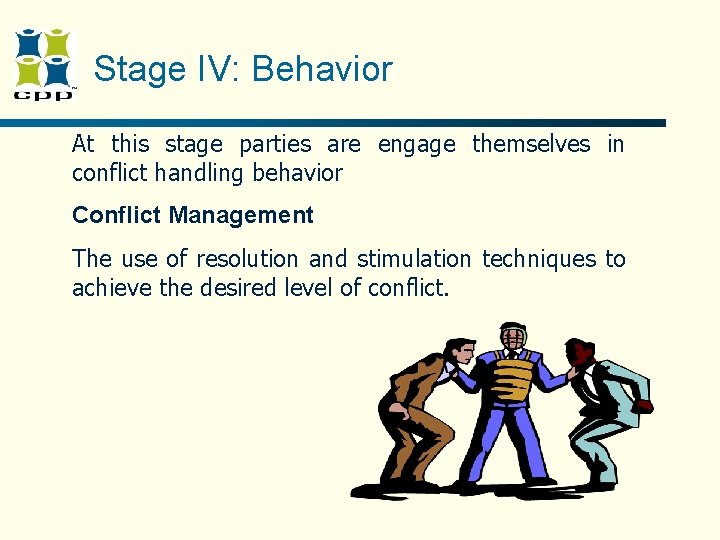
Stage IV: Behavior At this stage parties are engage themselves in conflict handling behavior Conflict Management The use of resolution and stimulation techniques to achieve the desired level of conflict.
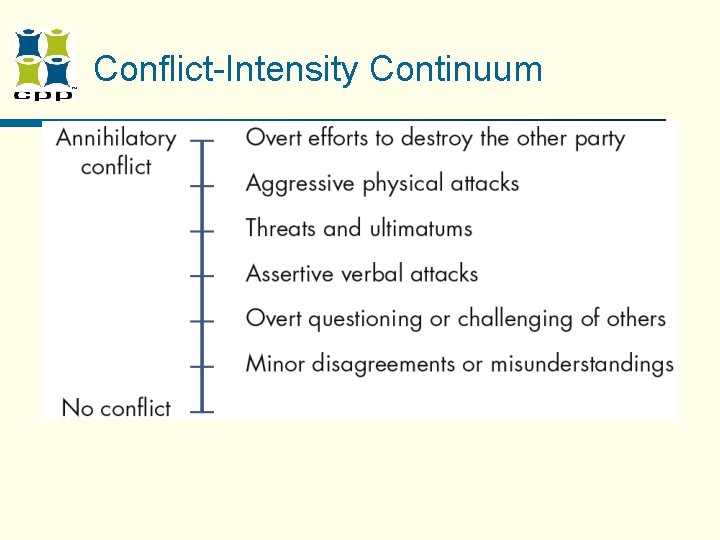
Conflict-Intensity Continuum
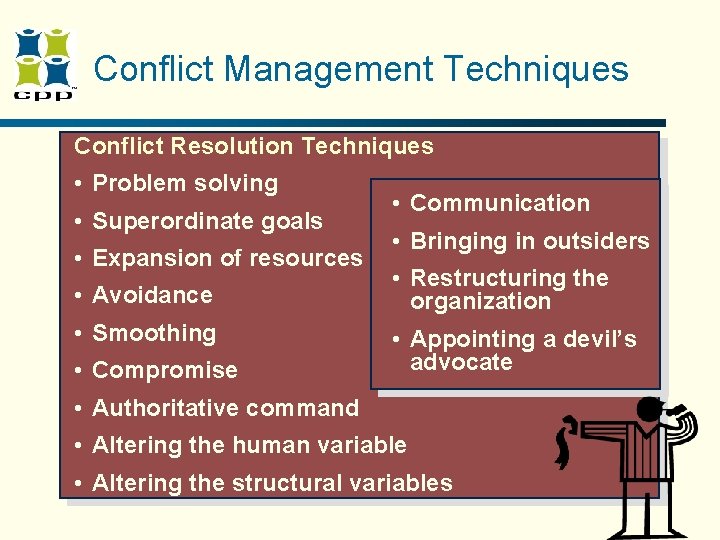
Conflict Management Techniques Conflict Resolution Techniques • Problem solving • Superordinate goals • Expansion of resources • Avoidance • Smoothing • Compromise • Communication • Bringing in outsiders • Restructuring the organization • Appointing a devil’s advocate • Authoritative command • Altering the human variable • Altering the structural variables
Stage V: Outcomes The conflict finally results in an outcomes which may be - § § Functional Outcomes from Conflict — — — Increased group performance Improved quality of decisions Stimulation of creativity and innovation Encouragement of interest and curiosity Provision of a medium for problem-solving Creation of an environment for self-evaluation and change § Creating Functional Conflict - Reward dissent/ oppose and punish conflict avoiders. § Dysfunctional Outcomes from Conflict — — — Development of discontent, -- Reduced group effectiveness Retarded communication, -- Reduced group cohesiveness Infighting among group members overcomes group goals
Levels of conflict § There are three levels of conflict – 1. Intra-individual conflict 2. Inter-Individual/ personal conflict 3. Inter-Group conflict
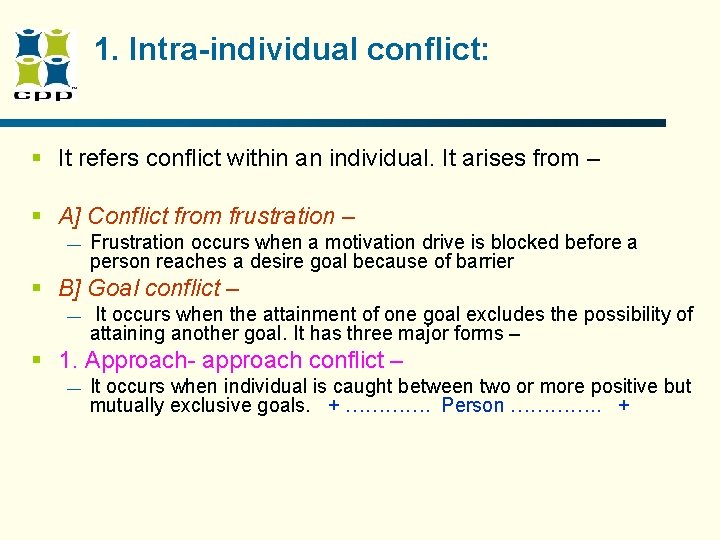
1. Intra-individual conflict: § It refers conflict within an individual. It arises from – § A] Conflict from frustration – — Frustration occurs when a motivation drive is blocked before a person reaches a desire goal because of barrier § B] Goal conflict – — It occurs when the attainment of one goal excludes the possibility of attaining another goal. It has three major forms – § 1. Approach- approach conflict – — It occurs when individual is caught between two or more positive but mutually exclusive goals. + …………. Person …………. . +
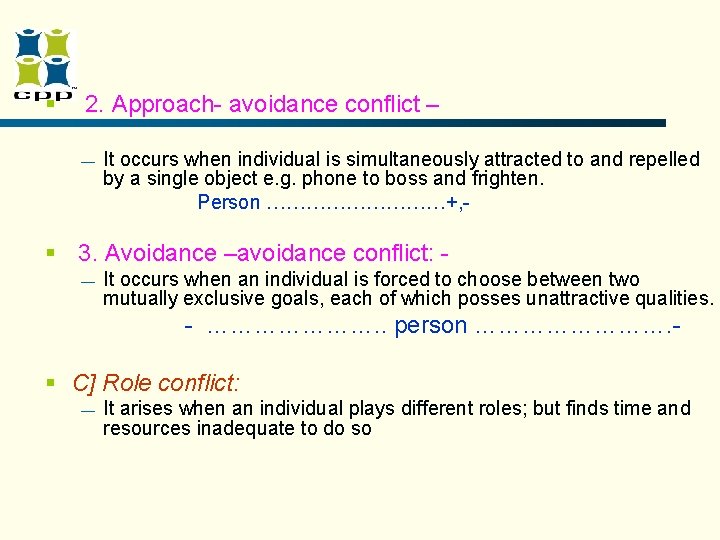
§ 2. Approach- avoidance conflict – — It occurs when individual is simultaneously attracted to and repelled by a single object e. g. phone to boss and frighten. Person ……………+, - § 3. Avoidance –avoidance conflict: — It occurs when an individual is forced to choose between two mutually exclusive goals, each of which posses unattractive qualities. - …………………. . person …………. § C] Role conflict: — It arises when an individual plays different roles; but finds time and resources inadequate to do so
§ 2. Inter-individual / personal conflict: § It occurs between two individuals in an organization. § It arises because of difference in perception, temperaments, personalities, value systems, socio-cultural factor and role ambiguities. § Transactional analysis, (TA), Johari window, stroking, and life positions seek to explain the phenomenon of inter-personal conflicts. § 3. Inter-group conflict: § It refers to the conflict between two groups, department or sections in organization. It is also called as organizational conflict. Interorganizational conflict. — Occurs in the competition and rivalry that characterize firms operating in the same markets. — Occurs between unions and organizations employing their members. — Occurs between government regulatory agencies and organizations subject to their surveillance. — Occurs between organizations and suppliers of raw materials. § The important reasons are –
§ A] Task interdependence§ It refers to the extent to which two department dependents on each other for assistance, information, compliance etc. task interdependence may be – § 1. Pooled interdependence — — — two groups functions relatively independent but their combined out put contributes to the overall performance A overall performance B § 2. Sequential interdependence — — one groups performance depends on another groups prior performance A ……. . B…………. C……………… overall performance § 3. Reciprocal interdependence — — — Departments are exchange outputs and hence are mutually interdependent in accomplishing their tasks. A …………. . . . . overall performance ………………… B
§ B] Task ambiguity – — when it is not clear § C] Goal incompatibility— § § when organization is growing, or changing environment D] Competition or limited resources E] Line and staff organization structure F] Intra-personal and inter-personal conflict G] Competitive reward system— for individual or department; group effort; no cooperation; conflict.
Strategies for conflict management § A] Strategies for resolving intra-personal conflict § B] Resolving inter-personal conflict § C] Resolving inter-group conflict
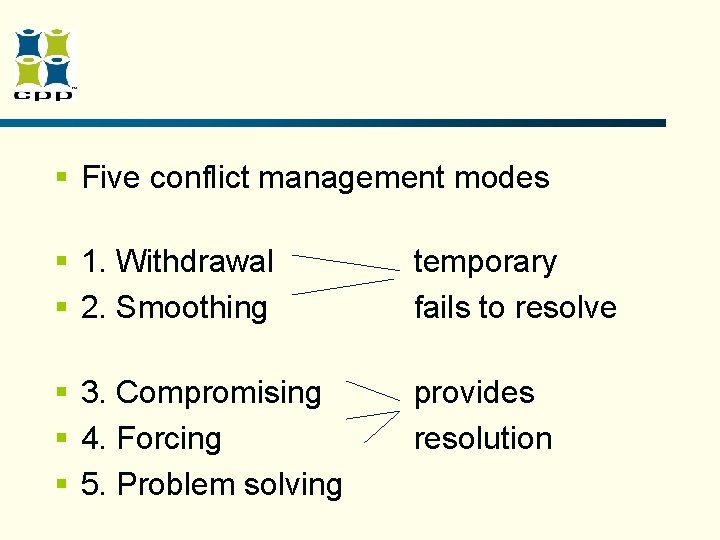
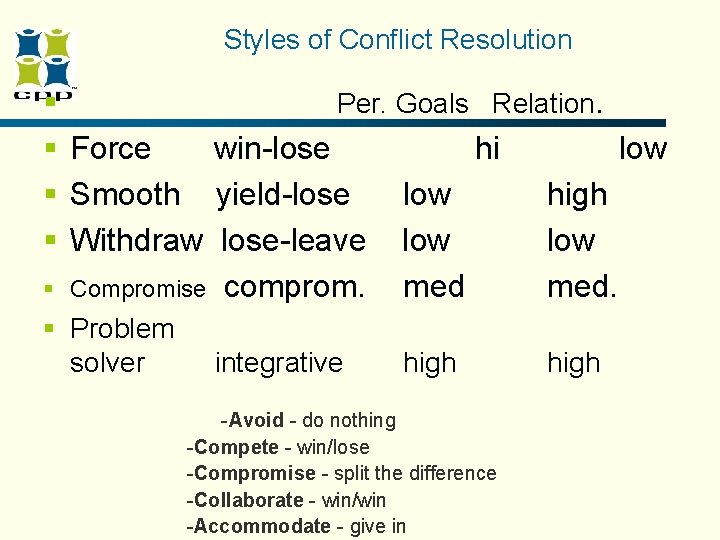
§ Five conflict management modes § 1. Withdrawal § 2. Smoothing temporary fails to resolve § 3. Compromising § 4. Forcing § 5. Problem solving provides resolution
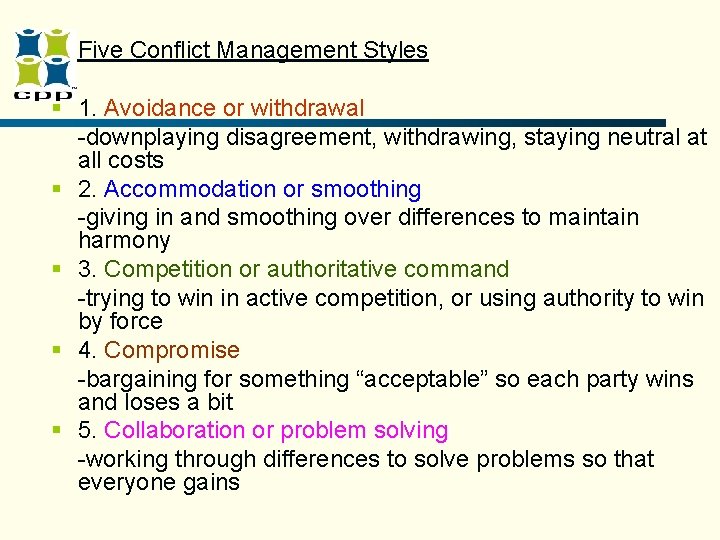
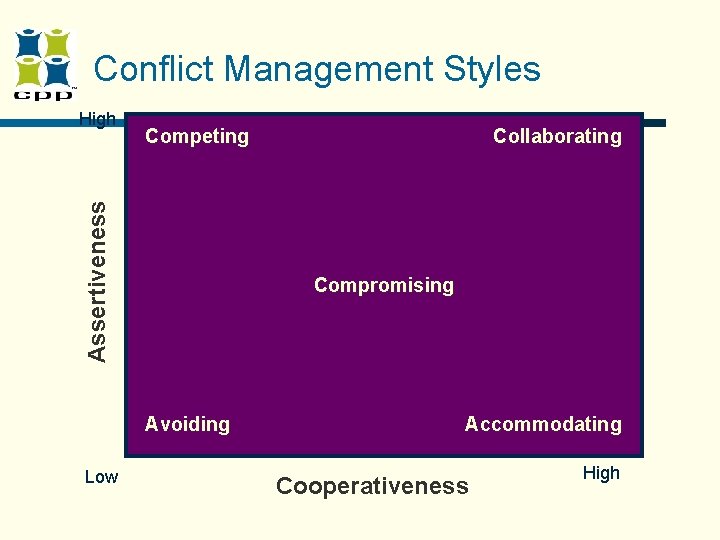
§ Five Conflict Management Styles § 1. Avoidance or withdrawal -downplaying disagreement, withdrawing, staying neutral at all costs § 2. Accommodation or smoothing -giving in and smoothing over differences to maintain harmony § 3. Competition or authoritative command -trying to win in active competition, or using authority to win by force § 4. Compromise -bargaining for something “acceptable” so each party wins and loses a bit § 5. Collaboration or problem solving -working through differences to solve problems so that everyone gains
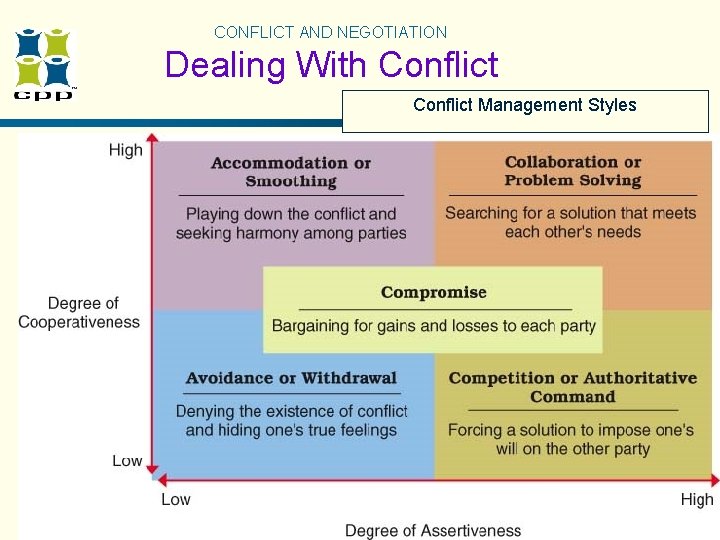
CONFLICT AND NEGOTIATION Dealing With Conflict Management Styles
Styles of Conflict Resolution § Per. Goals Relation. § Force win-lose hi low § Smooth yield-lose low high § Withdraw lose-leave low § Compromise comprom. med. § Problem solver integrative high -Avoid - do nothing -Compete - win/lose -Compromise - split the difference -Collaborate - win/win -Accommodate - give in high
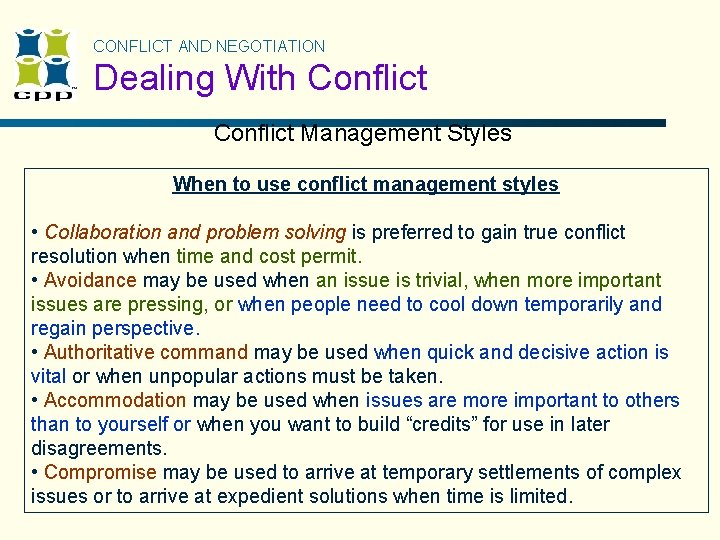
CONFLICT AND NEGOTIATION Dealing With Conflict Management Styles When to use conflict management styles • Collaboration and problem solving is preferred to gain true conflict resolution when time and cost permit. • Avoidance may be used when an issue is trivial, when more important issues are pressing, or when people need to cool down temporarily and regain perspective. • Authoritative command may be used when quick and decisive action is vital or when unpopular actions must be taken. • Accommodation may be used when issues are more important to others than to yourself or when you want to build “credits” for use in later disagreements. • Compromise may be used to arrive at temporary settlements of complex issues or to arrive at expedient solutions when time is limited.
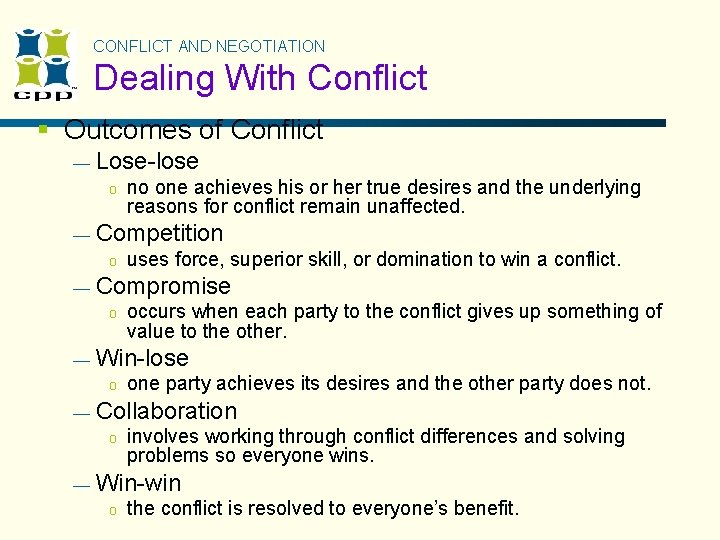
CONFLICT AND NEGOTIATION Dealing With Conflict § Outcomes of Conflict — Lose-lose o — Competition o — one party achieves its desires and the other party does not. Collaboration o — occurs when each party to the conflict gives up something of value to the other. Win-lose o — uses force, superior skill, or domination to win a conflict. Compromise o — no one achieves his or her true desires and the underlying reasons for conflict remain unaffected. involves working through conflict differences and solving problems so everyone wins. Win-win o the conflict is resolved to everyone’s benefit.
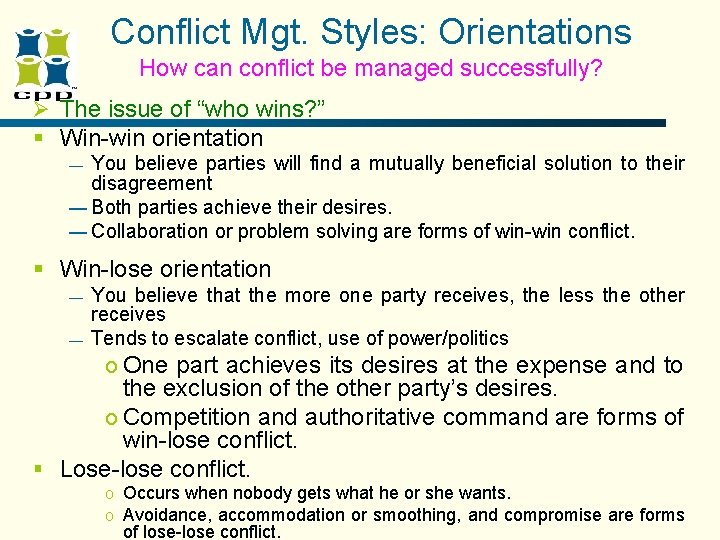
Conflict Mgt. Styles: Orientations How can conflict be managed successfully? Ø The issue of “who wins? ” § Win-win orientation You believe parties will find a mutually beneficial solution to their disagreement — Both parties achieve their desires. — Collaboration or problem solving are forms of win-win conflict. — § Win-lose orientation — — You believe that the more one party receives, the less the other receives Tends to escalate conflict, use of power/politics o One part achieves its desires at the expense and to the exclusion of the other party’s desires. o Competition and authoritative command are forms of win-lose conflict. § Lose-lose conflict. o Occurs when nobody gets what he or she wants. o Avoidance, accommodation or smoothing, and compromise are forms of lose-lose conflict.
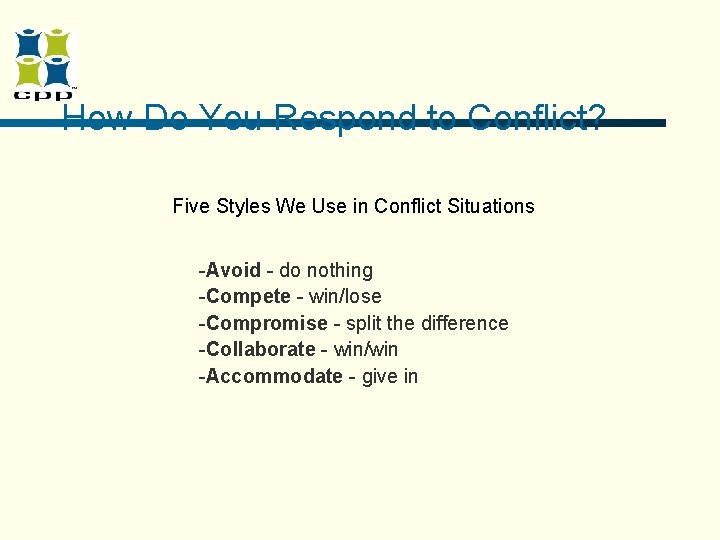
How Do You Respond to Conflict? Five Styles We Use in Conflict Situations -Avoid - do nothing -Compete - win/lose -Compromise - split the difference -Collaborate - win/win -Accommodate - give in
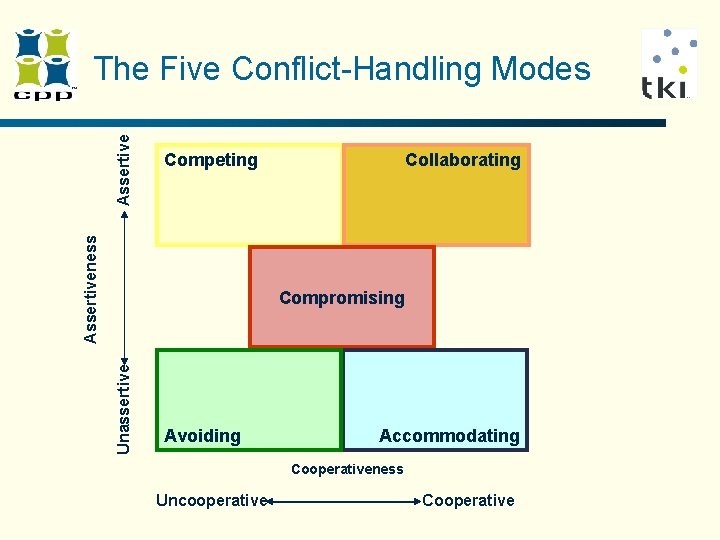
Conflict Management Styles Competing Assertiveness High Compromising Avoiding Low Collaborating Accommodating Cooperativeness High
Assertiveness Unassertive Assertive Conflict-Handling Styles Forcing Resolving conflicts by satisfying one’s own needs at the expense of another’s Collaborating Rewarding conflict by seeking an advantageous solution for all parties Resolving conflict by each party giving up something of value Compromising Resolving conflicts by withdrawing from or suppressing them Avoiding Resolving conflicts by placing another’s needs and concerns above your own Accommodating Uncooperative Cooperativeness Robbins et al. , Fundamentals of Management, 4 th Canadian Edition © 2005 Pearson Education Canada, Inc. FOM 3. 32
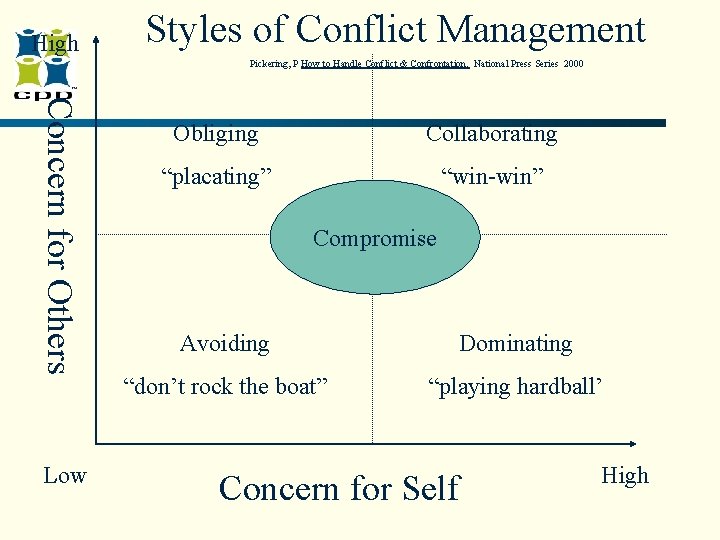
High Styles of Conflict Management Pickering, P How to Handle Conflict & Confrontation. National Press Series 2000 Concern for Others Low Obliging Collaborating “placating” “win-win” Compromise Avoiding Dominating “don’t rock the boat” “playing hardball’ Concern for Self High
Conflict and Unit Performance E X H I B I T 14– 9
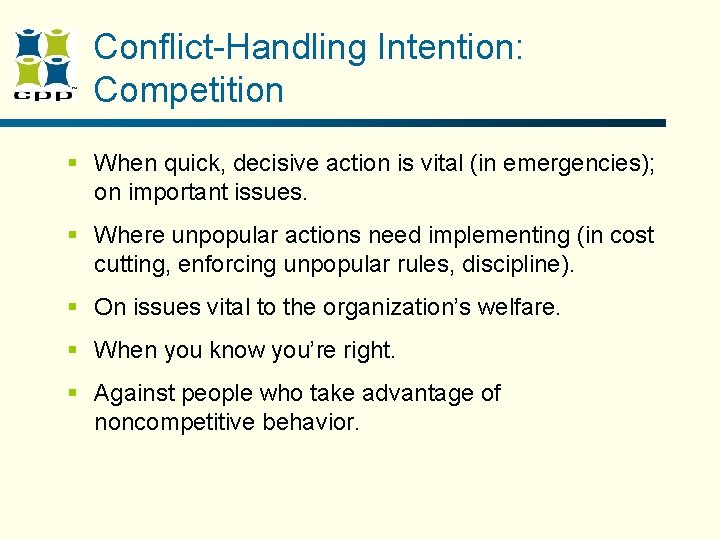
Conflict-Handling Intention: Competition § When quick, decisive action is vital (in emergencies); on important issues. § Where unpopular actions need implementing (in cost cutting, enforcing unpopular rules, discipline). § On issues vital to the organization’s welfare. § When you know you’re right. § Against people who take advantage of noncompetitive behavior.
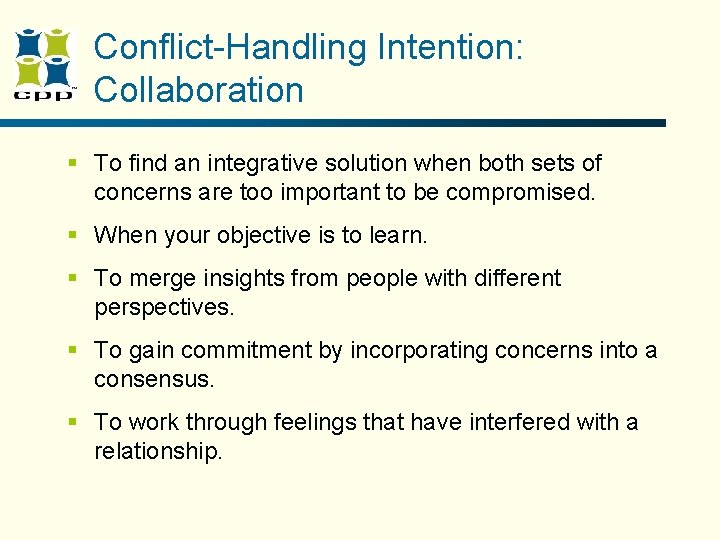
Conflict-Handling Intention: Collaboration § To find an integrative solution when both sets of concerns are too important to be compromised. § When your objective is to learn. § To merge insights from people with different perspectives. § To gain commitment by incorporating concerns into a consensus. § To work through feelings that have interfered with a relationship.
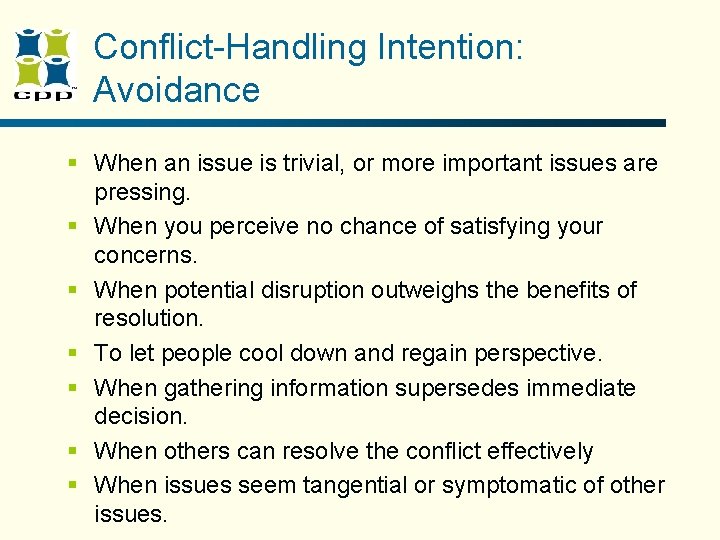
Conflict-Handling Intention: Avoidance § When an issue is trivial, or more important issues are pressing. § When you perceive no chance of satisfying your concerns. § When potential disruption outweighs the benefits of resolution. § To let people cool down and regain perspective. § When gathering information supersedes immediate decision. § When others can resolve the conflict effectively § When issues seem tangential or symptomatic of other issues.
Conflict-Handling Intention: Accommodation § When you find you’re wrong and to allow a better position to be heard. § To learn, and to show your reasonableness. § When issues are more important to others than to yourself and to satisfy others and maintain cooperation. § To build social credits for later issues. § To minimize loss when outmatched and losing. § When harmony and stability are especially important. § To allow employees to develop by learning from mistakes.
Conflict-Handling Intention: Compromise § When goals are important but not worth the effort of potential disruption of more assertive approaches. § When opponents with equal power are committed to mutually exclusive goals. § To achieve temporary settlements to complex issues. § To arrive at expedient solutions under time pressure. § As a backup when collaboration or competition is unsuccessful.
What is conflict? Ø Levels of conflict — cont. — Interpersonal conflict. o Occurs between two or more individuals who are in opposition to one another. — Intergroup conflict. o Occurs among members of different teams or groups.
What is conflict? Ø Levels of conflict — cont. — Interorganizational conflict. o Occurs in the competition and rivalry that characterize firms operating in the same markets. o Occurs between unions and organizations employing their members. o Occurs between government regulatory agencies and organizations subject to their surveillance. o Occurs between organizations and suppliers of raw materials.
Conflict Management Conflict Resolution Methods • Confronting / Problem Solving • Compromising • Forcing • Smoothing / Accommodating • Withdrawing / Avoiding 8
Conflict Management Confronting / Problem Solving • Sometimes referred to as “collaborating” • Generally viewed as the best method for conflict resolution 8 • Looks to solve the conflict at the source so it will not be an issue for the project
Conflict Management Confronting / Problem-Solving when… • When conflicting parties can get at least what they want and maybe more • To reduce cost • To create a common power base • To attack a common foe 8 • When skills are complimentary
Conflict Management Confronting / Problem-Solving when… • When there is enough time • When there is trust • When you have confidence in the other’s ability • When the ultimate objective is to learn 8
Conflict Management Compromising • To negotiate or bargain for a solution to give both parties some degree of satisfaction • “Give and take” or “win-win” • Neither party gets everything they want or need (“lose-lose”) 8
Conflict Management Compromising when… • When both parties need to be “winners” • When you can’t win • When others are as strong as you are • When you haven’t time to win • To maintain the relationship 8
Conflict Management Compromising when… • When you are not sure you are right • When you get nothing if you don’t • When stakes are moderate • To avoid giving the impression of “fighting” 8
Conflict Management Forcing • When one party imposes the solution on the other party • “win-lose” situation, wins at the expense of the loser 9 • Does not always address the underlying source of conflict and often reduces team morale
Conflict Management Forcing when… • When you are right • When a do-or-die situation exists • When stakes are high • When important principles are at stake • When you are stronger 9
Conflict Management Forcing when… • To gain status or power • In short term (one time) deals • When the relationship is unimportant • When a quick decision must be made 9
Conflict Management Smoothing / Accommodating • Emphasize areas of agreement • Tends to downplay conflict instead of solving conflict • May make sacrifices to satisfy the needs of the other party 9
Conflict Management Smoothing / Accommodating when… • To reach an overarching or higher goal • To create obligation for a trade-off at a later date • When the stakes are low • When liability is limited 9
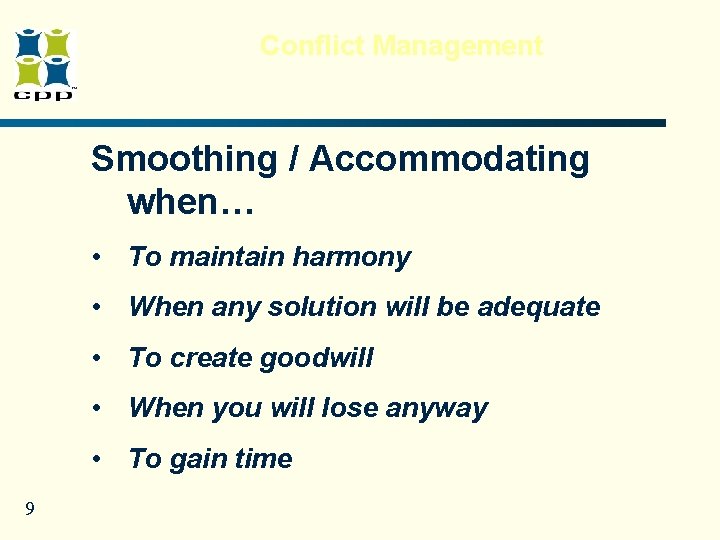
Conflict Management Smoothing / Accommodating when… • To maintain harmony • When any solution will be adequate • To create goodwill • When you will lose anyway • To gain time 9
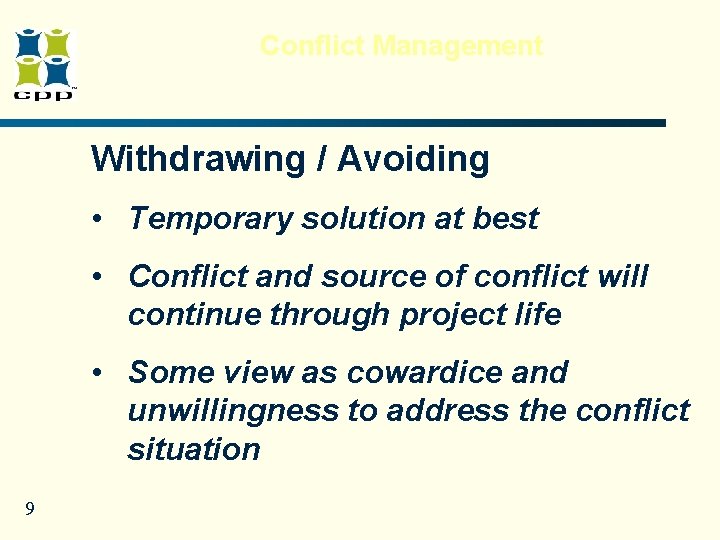
Conflict Management Withdrawing / Avoiding • Temporary solution at best • Conflict and source of conflict will continue through project life • Some view as cowardice and unwillingness to address the conflict situation 9
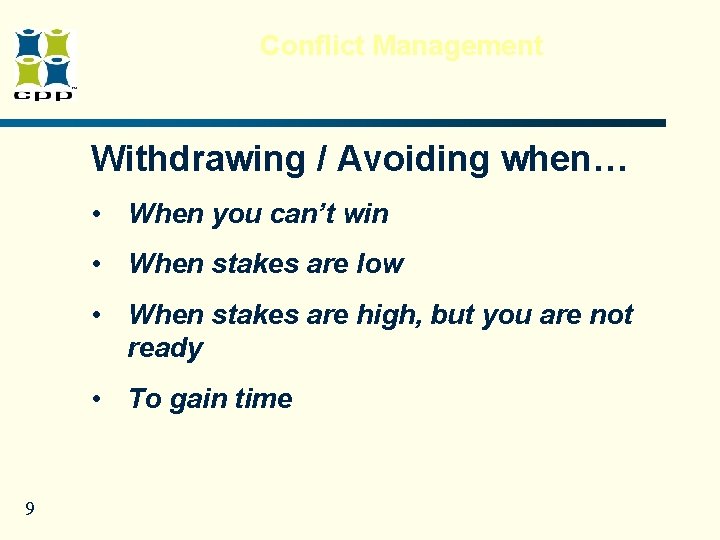
Conflict Management Withdrawing / Avoiding when… • When you can’t win • When stakes are low • When stakes are high, but you are not ready • To gain time 9
Conflict Management Withdrawing / Avoiding when… • To unnerve your opponent • To preserve neutrality or reputation • When you think the problem will “go away” • When you win by delay 9
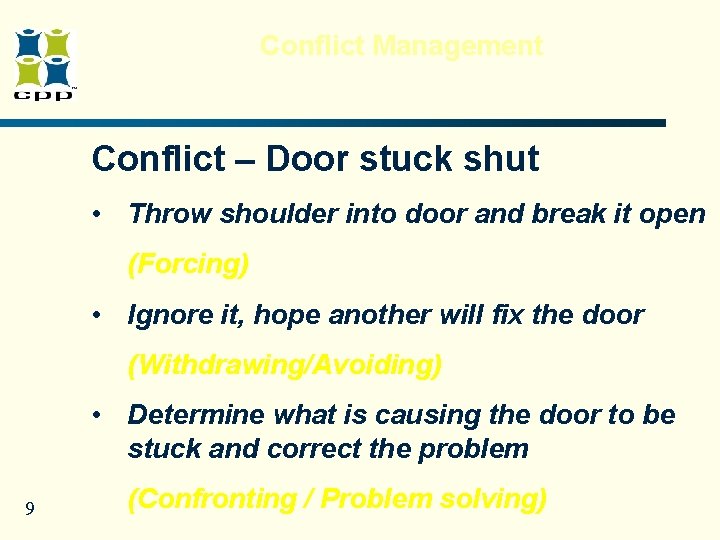
Conflict Management Conflict – Door stuck shut • Throw shoulder into door and break it open (Forcing) • Ignore it, hope another will fix the door (Withdrawing/Avoiding) • Determine what is causing the door to be stuck and correct the problem 9 (Confronting / Problem solving)
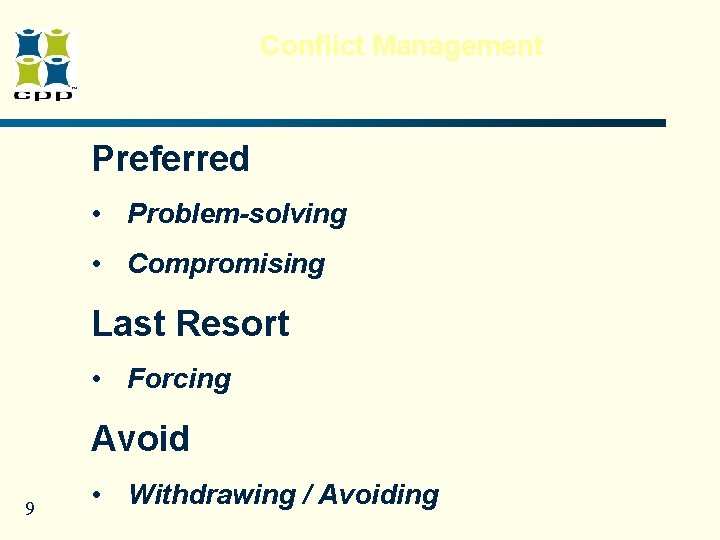
Conflict Management Preferred • Problem-solving • Compromising Last Resort • Forcing Avoid 9 • Withdrawing / Avoiding
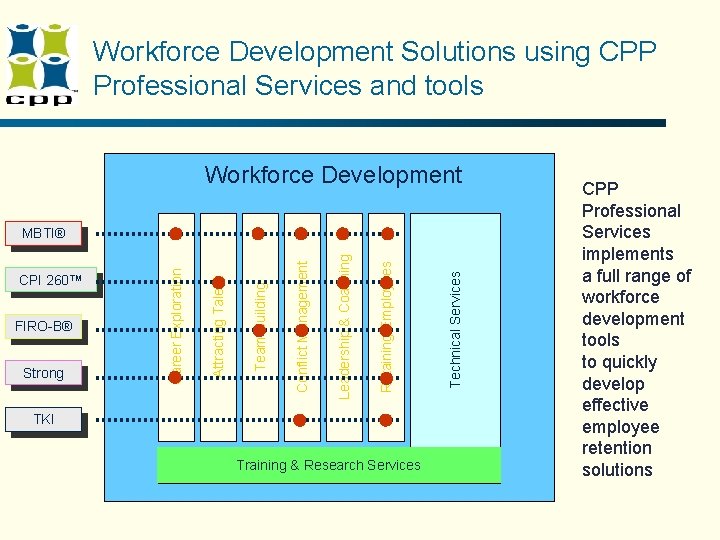
Who is CPP? • • Founded in 1956 Workforce Development tools include • • Myers-Briggs Type Indicator ® assessment Strong Interest Inventory ® tool Thomas-Kilmann Conflict Mode™ assessment CPI 260™ assessment FIRO-B™ tool Delivers more than 1 million research-validated and reliable assessments to business, government and education clients Serves 89 of the Fortune 100 companies
What is Workforce Development? Workforce development § aligns employee interests with corporate goals § to achieve full employee engagement § in delivering value to the customer and the company.
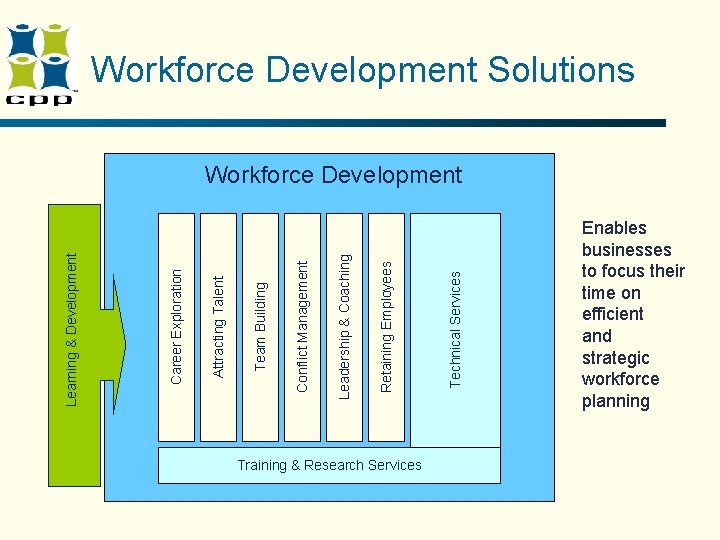
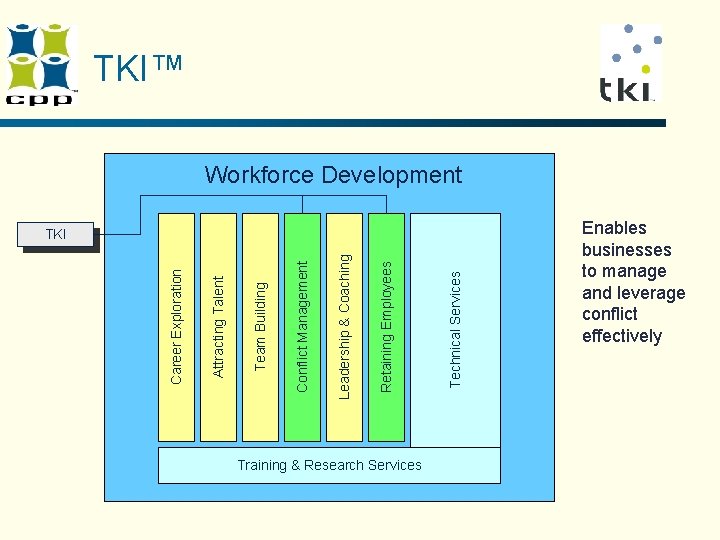
Workforce Development Solutions Training & Research Services Technical Services Retaining Employees Leadership & Coaching Conflict Management Team Building Attracting Talent Career Exploration Learning & Development Workforce Development Enables businesses to focus their time on efficient and strategic workforce planning
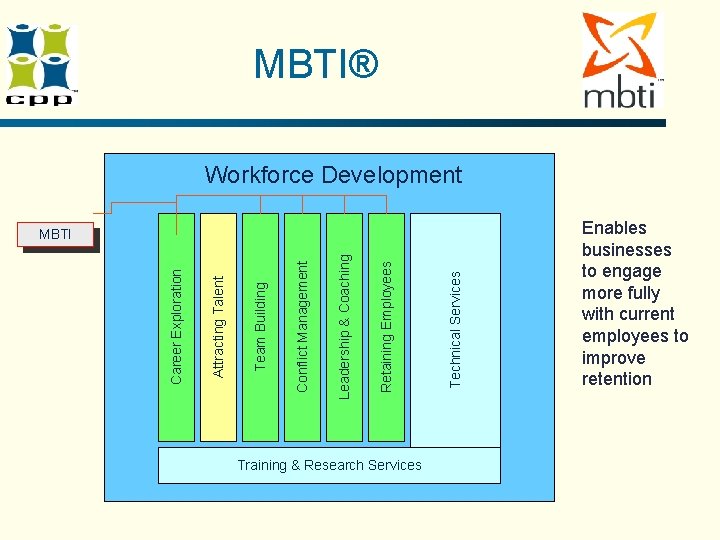
MBTI® Workforce Development Training & Research Services Technical Services Retaining Employees Leadership & Coaching Conflict Management Team Building Attracting Talent Career Exploration MBTI Enables businesses to engage more fully with current employees to improve retention
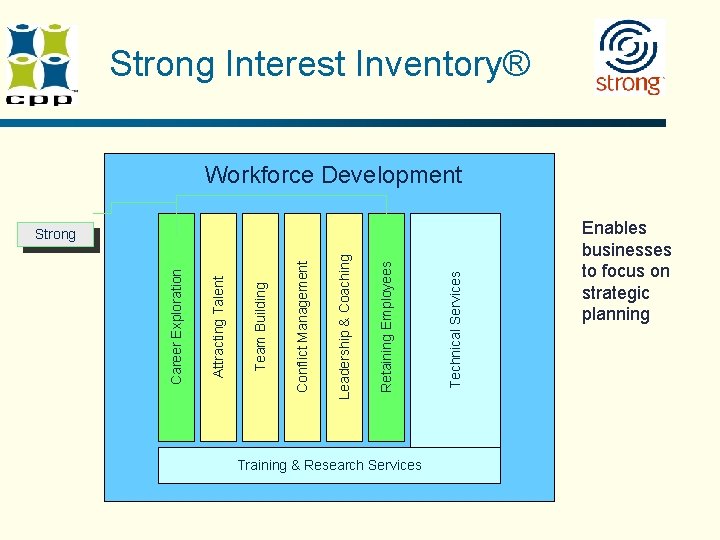
Strong Interest Inventory® Workforce Development Training & Research Services Technical Services Retaining Employees Leadership & Coaching Conflict Management Team Building Attracting Talent Career Exploration Strong Enables businesses to focus on strategic planning
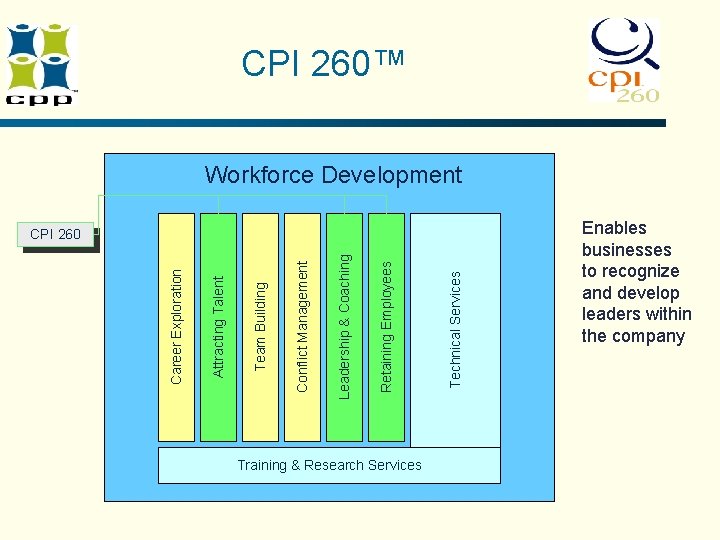
CPI 260™ Workforce Development Training & Research Services Technical Services Retaining Employees Leadership & Coaching Conflict Management Team Building Attracting Talent Career Exploration CPI 260 Enables businesses to recognize and develop leaders within the company
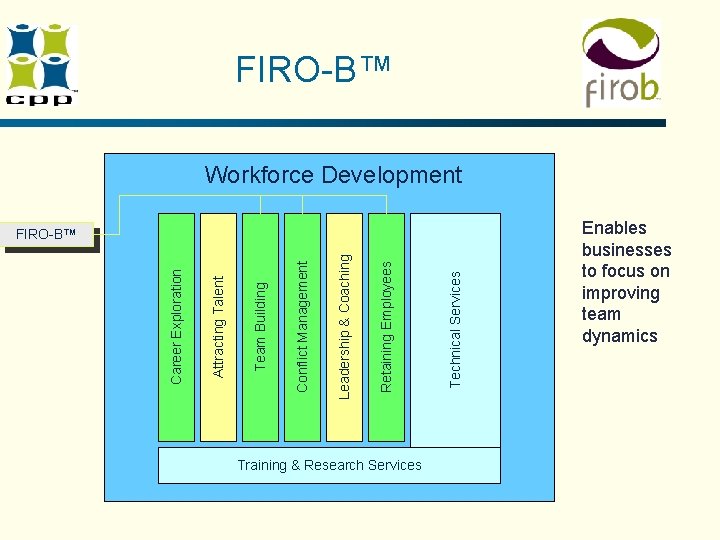
Training & Research Services Technical Services Retaining Employees Leadership & Coaching Conflict Management Team Building Attracting Talent Career Exploration FIRO-B™ Workforce Development FIRO-B™ Enables businesses to focus on improving team dynamics
Training & Research Services Technical Services Retaining Employees Leadership & Coaching Conflict Management Team Building Attracting Talent Career Exploration TKI™ Workforce Development TKI Enables businesses to manage and leverage conflict effectively
Workforce Development Solutions using CPP Professional Services and tools Workforce Development TKI Training & Research Services Technical Services Retaining Employees Leadership & Coaching Conflict Management Strong Team Building FIRO-B® Attracting Talent CPI 260™ Career Exploration MBTI® CPP Professional Services implements a full range of workforce development tools to quickly develop effective employee retention solutions
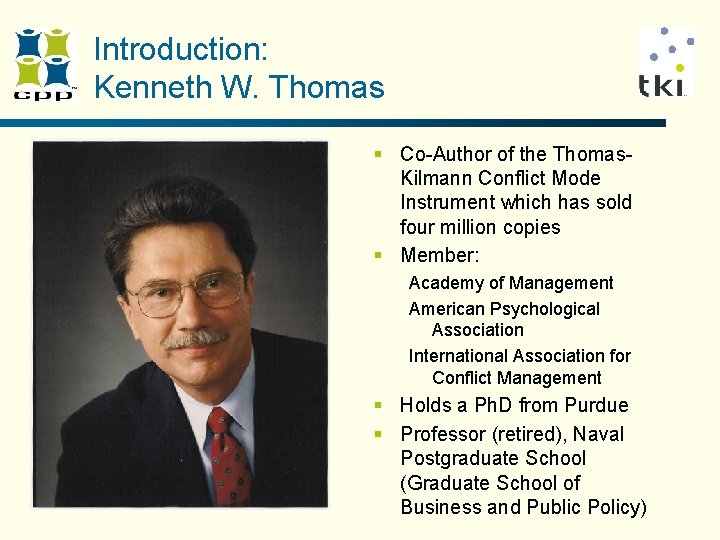
Introduction: Kenneth W. Thomas § Co-Author of the Thomas. Kilmann Conflict Mode Instrument which has sold four million copies § Member: Academy of Management American Psychological Association International Association for Conflict Management § Holds a Ph. D from Purdue § Professor (retired), Naval Postgraduate School (Graduate School of Business and Public Policy)
Teams, teams Ø Organizations face increasingly complex problems Ø One solution is the use of teams, especially diverse teams that offer multiple perspectives Ø According to WSJ “ability to work in a team” is the second most important skill for graduating MBA’s Ø Our work with teams surfaced the need for conflict management
Teams and Conflict Research shows: Ø Diverse teams surface conflict that may decrease the team’s performance Ø Conflict can improve a team’s performance IF the conflict is managed well
Appropriate method for handling conflict Ø Research shows that more collaborative teams tend to outperform less collaborative teams Ø Yet we know this is not true all the time Ø And it is more complex than “just be collaborative”
The Practical Problem: We needed a framework to steer teams through the complexities of conflict management. The framework is boiled down here to five key lessons.
Lesson 1 One’s choices in a conflict. . . the “conflict-handling modes”
Conflict The condition in which the concerns of different team members appear incompatible
Assertive Competing Collaborating Compromising Unassertive Assertiveness The Five Conflict-Handling Modes Avoiding Accommodating Cooperativeness Uncooperative Cooperative
Lesson 2 The positive intentions and values associated with different styles
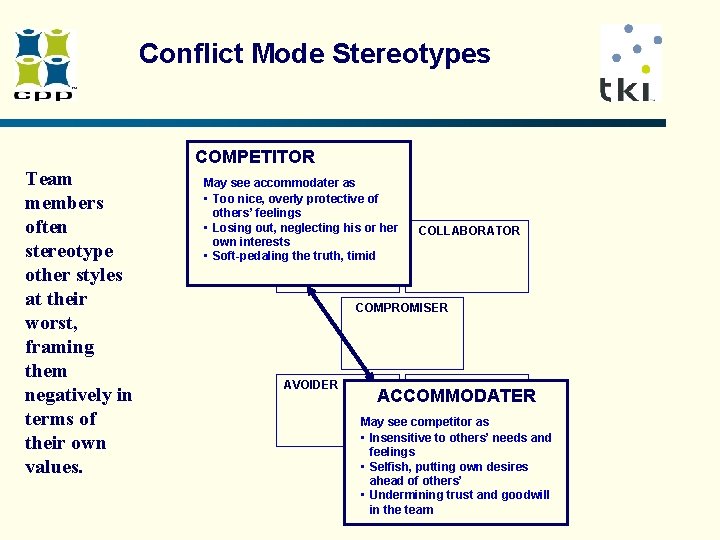
Conflict Mode Stereotypes COMPETITOR Team members often stereotype other styles at their worst, framing them negatively in terms of their own values. May see accommodater as • Too nice, overly protective of others’ feelings • Losing out, neglecting his or her own interests • Soft-pedaling the truth, timid COLLABORATOR COMPROMISER AVOIDER ACCOMMODATER May see competitor as • Insensitive to others’ needs and feelings • Selfish, putting own desires ahead of others’ • Undermining trust and goodwill in the team
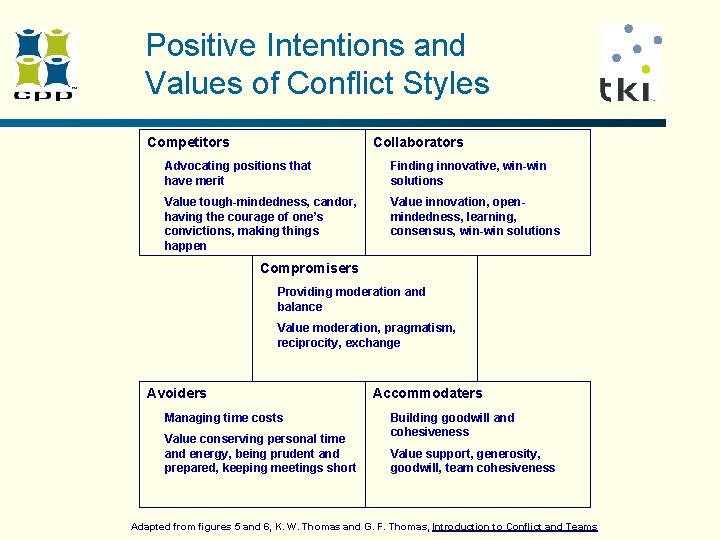
Positive Intentions and Values of Conflict Styles Competitors Collaborators Advocating positions that have merit Finding innovative, win-win solutions Value tough-mindedness, candor, having the courage of one’s convictions, making things happen Value innovation, openmindedness, learning, consensus, win-win solutions Compromisers Providing moderation and balance Value moderation, pragmatism, reciprocity, exchange Avoiders Managing time costs Value conserving personal time and energy, being prudent and prepared, keeping meetings short Accommodaters Building goodwill and cohesiveness Value support, generosity, goodwill, team cohesiveness Adapted from figures 5 and 6, K. W. Thomas and G. F. Thomas, Introduction to Conflict and Teams
Lesson 3 The usefulness of each style in appropriate situations. . . and the need to negotiate among conflict modes.
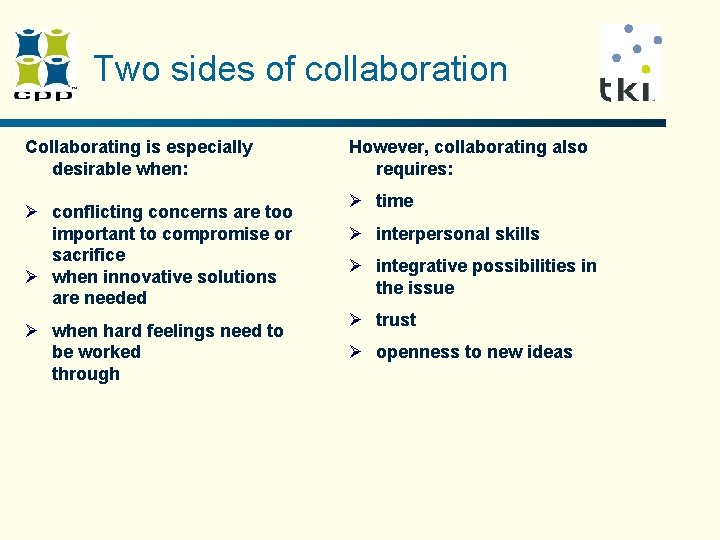
Two sides of collaboration Collaborating is especially desirable when: Ø conflicting concerns are too important to compromise or sacrifice Ø when innovative solutions are needed Ø when hard feelings need to be worked through However, collaborating also requires: Ø time Ø interpersonal skills Ø integrative possibilities in the issue Ø trust Ø openness to new ideas
Lesson 4 Each style has its own “temptations”. . . dysfunctional behaviors that need to be discouraged.
Examples of Dysfunctional Behaviors Ø Competitors monopolizing, not listening, or exaggerating. Ø Collaborators overanalyzing unimportant issues, continuing to problem-solve past the point of usefulness, or not being decisive when required.
Lesson 5 The challenges to problem-solving in teams where different styles predominate. . . and remedies to overcome them.
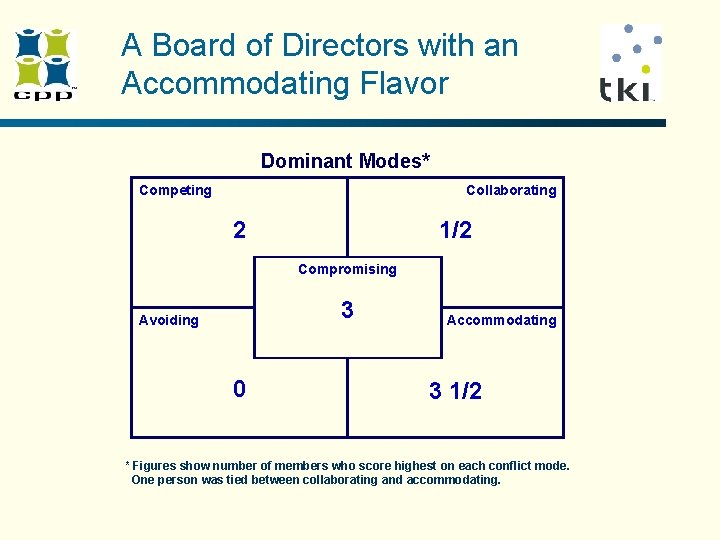
A Board of Directors with an Accommodating Flavor Dominant Modes* Competing Collaborating 2 1/2 Compromising 3 Avoiding 0 Accommodating 3 1/2 * Figures show number of members who score highest on each conflict mode. One person was tied between collaborating and accommodating.
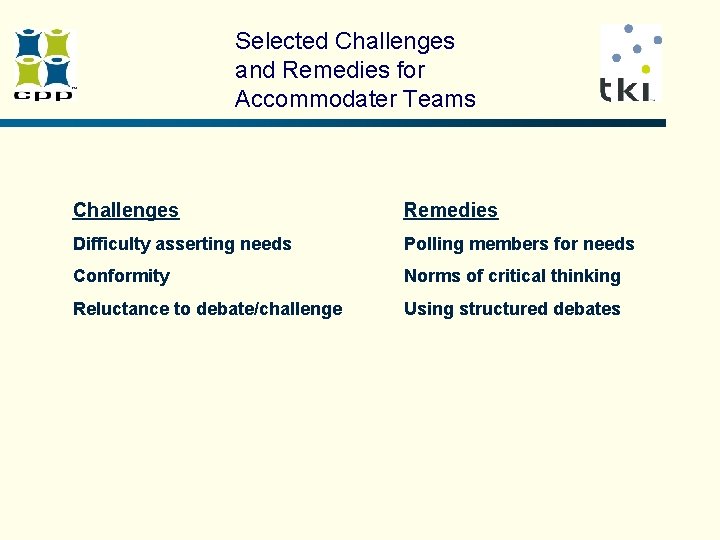
Selected Challenges and Remedies for Accommodater Teams Challenges Remedies Difficulty asserting needs Polling members for needs Conformity Norms of critical thinking Reluctance to debate/challenge Using structured debates
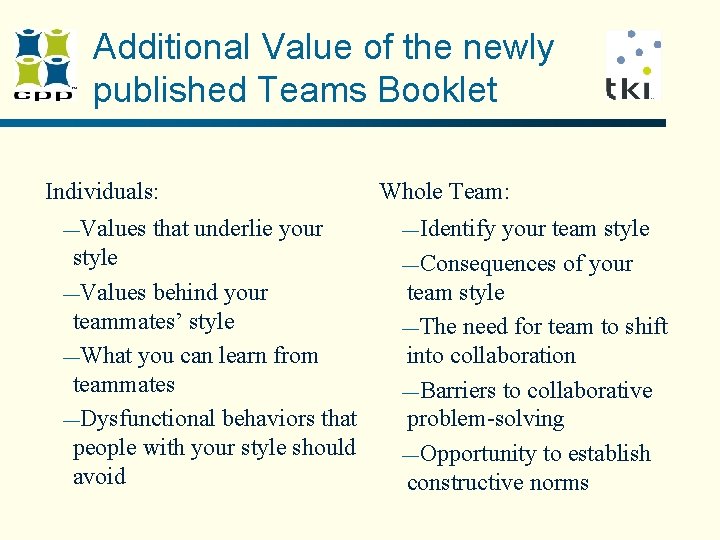
Additional Value of the newly published Teams Booklet Individuals: Whole Team: —Values —Identify that underlie your style —Values behind your teammates’ style —What you can learn from teammates —Dysfunctional behaviors that people with your style should avoid your team style —Consequences of your team style —The need for team to shift into collaboration —Barriers to collaborative problem-solving —Opportunity to establish constructive norms
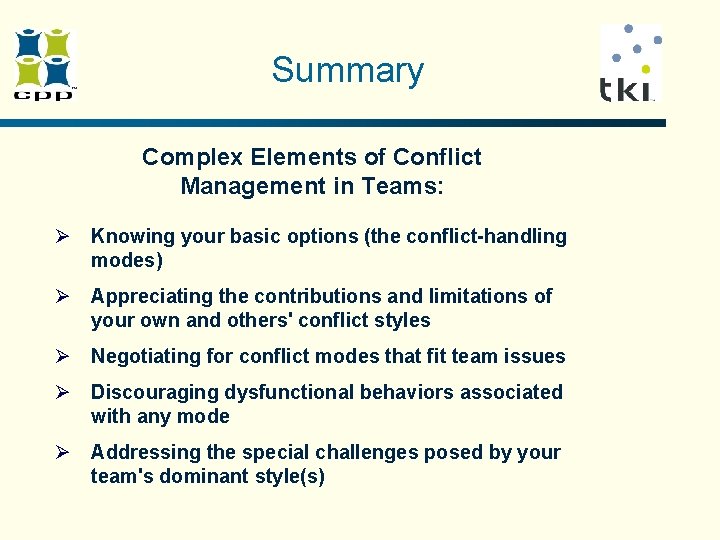
Summary Complex Elements of Conflict Management in Teams: Ø Knowing your basic options (the conflict-handling modes) Ø Appreciating the contributions and limitations of your own and others' conflict styles Ø Negotiating for conflict modes that fit team issues Ø Discouraging dysfunctional behaviors associated with any mode Ø Addressing the special challenges posed by your team's dominant style(s)