
Chapter Two Water The Solvent for Biochemical Reactions
Chapter Two Water: The Solvent for Biochemical Reactions Paul D. Adams • University of Arkansas cengage. com/chemistry/campbell
Chapter Outline 2 -1 Water and Polarity 2 -2 Hydrogen Bonds 2 -3 Acids, Bases and p. H 2 -4 Buffers
Biologically important elements O 1. Organic compounds on most living: O Carbon (C) O Nitrogen (N) O Hydrogen (H) O Oxygen (O) processes depend. O 2. An inorganic ions , which represent only about 0. 5% O Sodium (Na) O Potassium (K) O Chlorine (Cl) O Manganese (Mg) 3
4
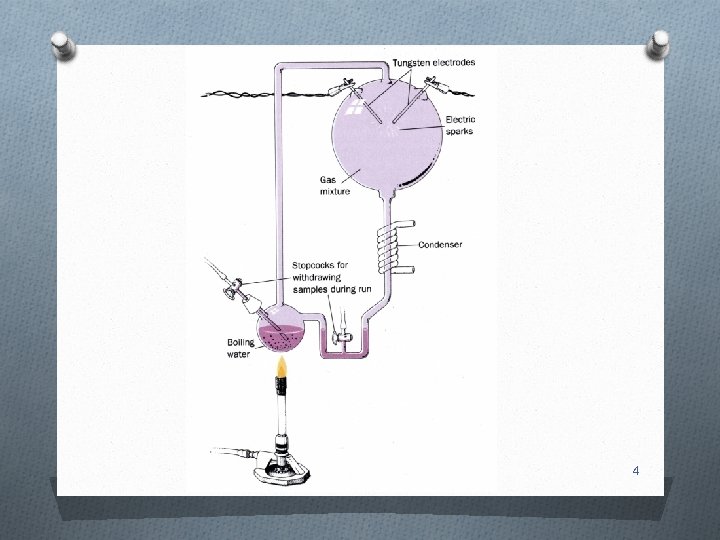
Chemical Evolution. By sparking CH 4, NH 3, H 2 O and H 2 these are formed: v. Glycine v. Glycolic acid v. Sarcosine v. Alanine v. Lactic acid v. N-Methalanine va-Amino-n-butyric acid va - Aminoisobutyric acid vb- Alanine v. Succinic Acid v. Glutamic acid 5 vetc
Interactions between Biomolecules — Chemical Bonds OInteractions between biomolecules depend on the forming and breaking of chemical bonds. 6
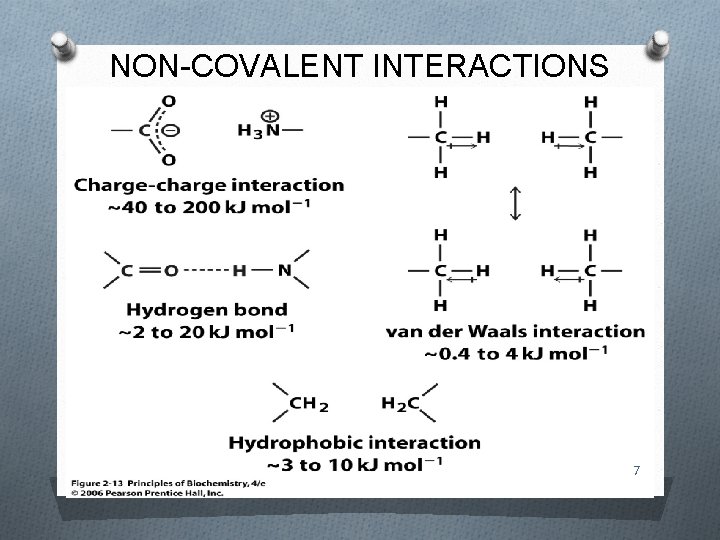
NON-COVALENT INTERACTIONS 7
Water O The medium in which biological systems operate is water O Water is the solvent of life O provides a medium for movement of molecules O separates charged molecules, dissipates heat, and participates in chemical reactions. 8
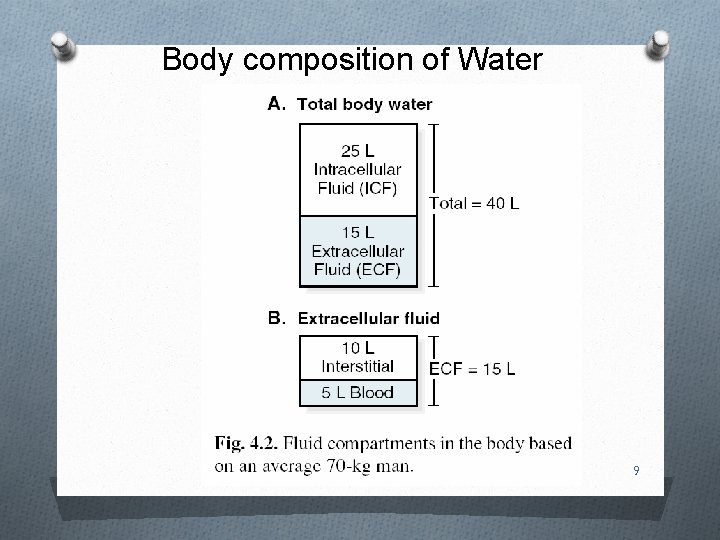
Body composition of Water 9
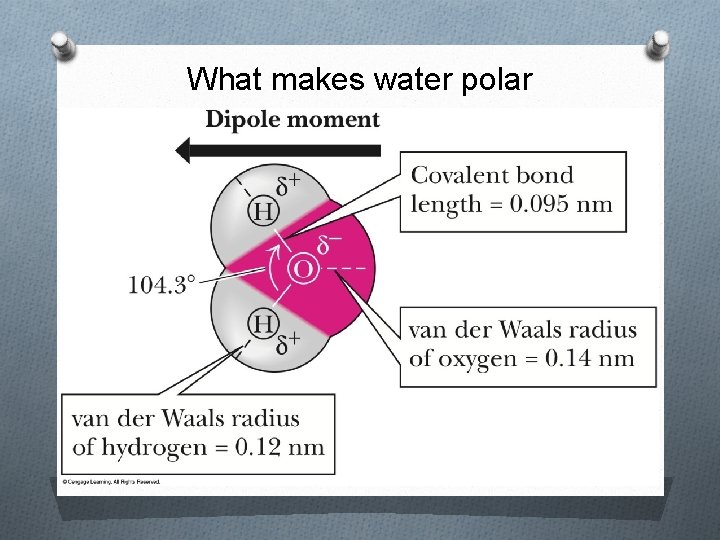
What makes water polar What is a polar bond: • Electrons are unequally shared, more negative charge found closer to one atom. • Due to difference in electronegativity of atoms involved in bond.
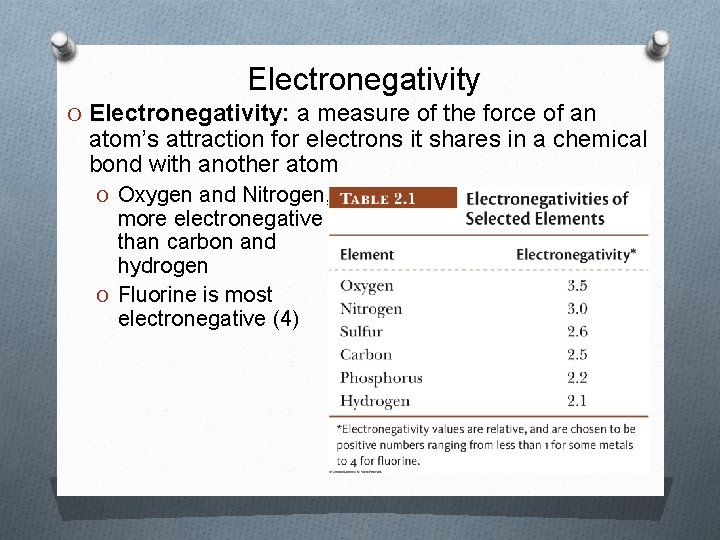
Electronegativity O Electronegativity: a measure of the force of an atom’s attraction for electrons it shares in a chemical bond with another atom O Oxygen and Nitrogen, more electronegative than carbon and hydrogen O Fluorine is most electronegative (4)
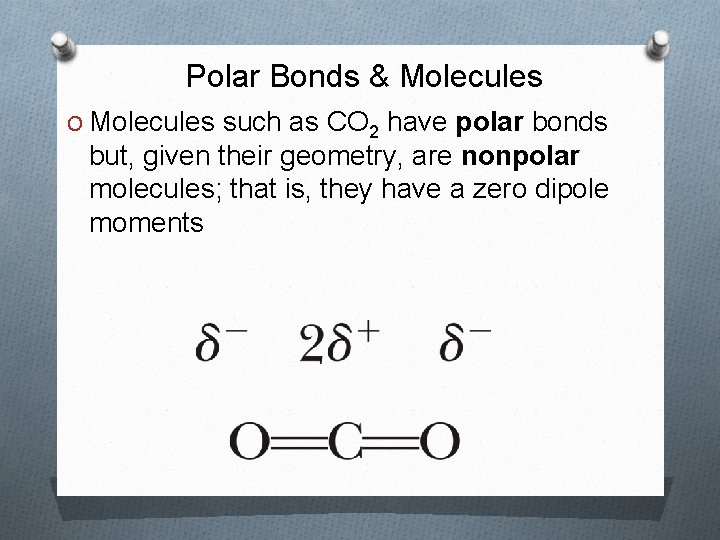
Polar Bonds & Molecules O Molecules such as CO 2 have polar bonds but, given their geometry, are nonpolar molecules; that is, they have a zero dipole moments
Solvent Properties of H 2 O O Ionic Bonds: Held together by positive and negative ions O Salt Bridge: Attraction that occurs when oppositely charged molecules are in close proximity. O Ion-dipole interactions: When ions in solution intreract with molecules with dipoles, e. g. , KCl dissolved in H 2 O O van der Waals Forces: bonds that do not involve electrostatic interactions O Dipole-dipole interactions: Forces that occur between molecules with dipoles, one positive and one negative O Dipole induced-dipole interactions: weak and generally do not lead to solubility in water
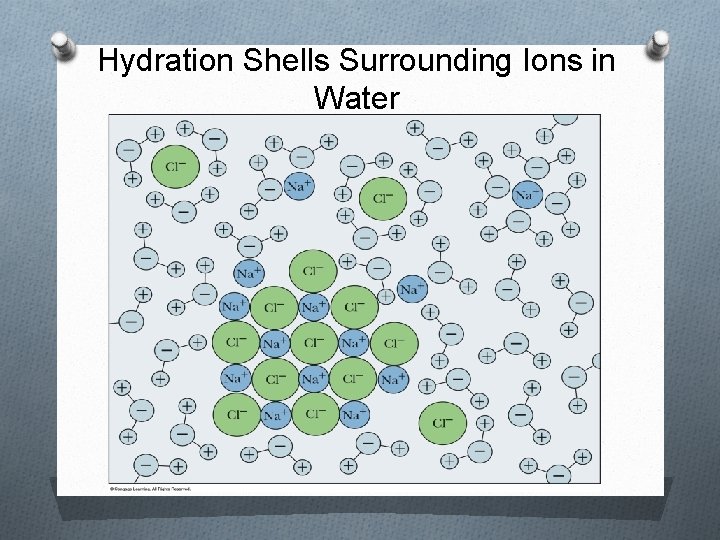
Hydration Shells Surrounding Ions in Water
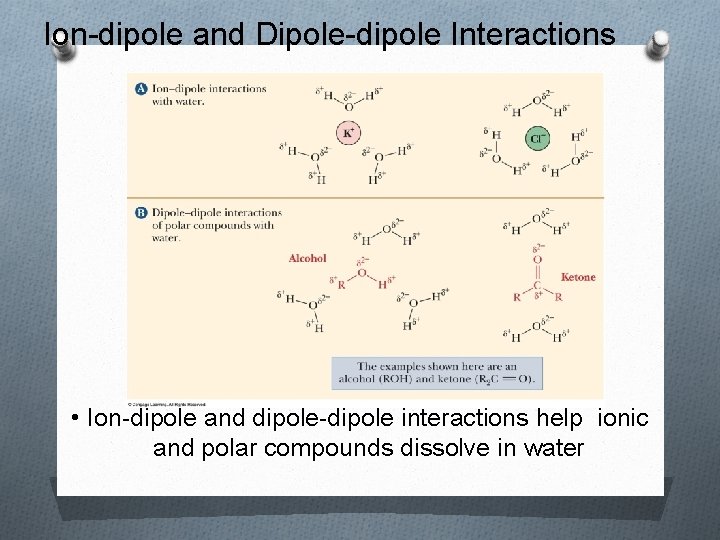
Ion-dipole and Dipole-dipole Interactions • Ion-dipole and dipole-dipole interactions help ionic and polar compounds dissolve in water
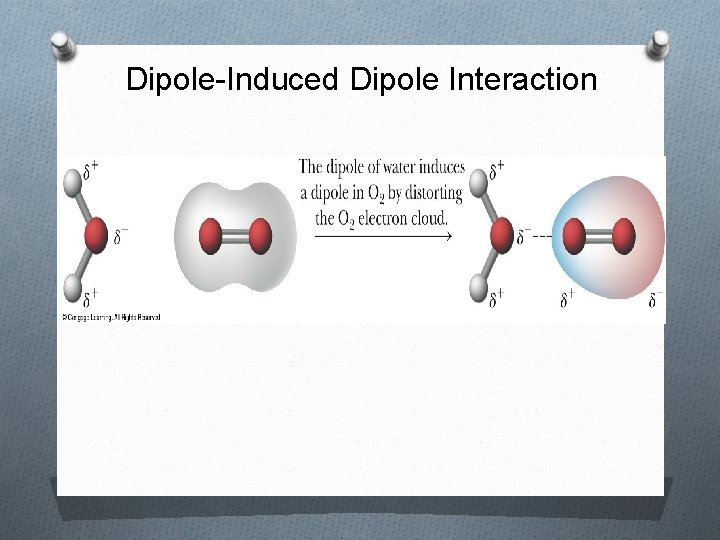
Dipole-Induced Dipole Interaction
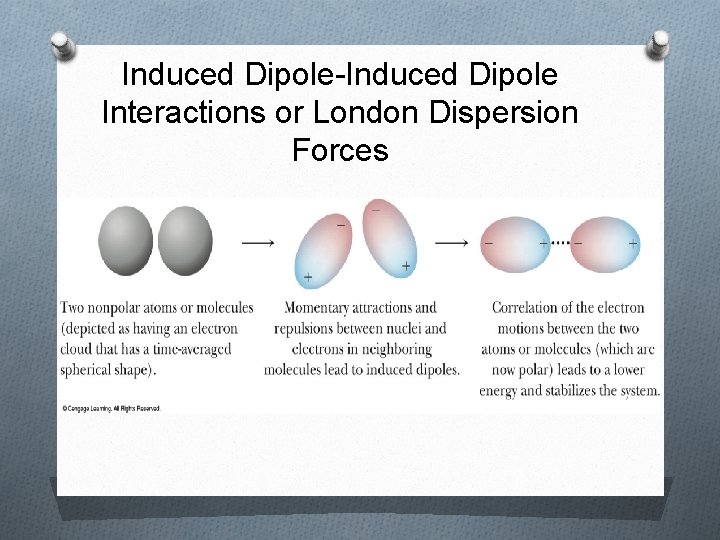
Induced Dipole-Induced Dipole Interactions or London Dispersion Forces
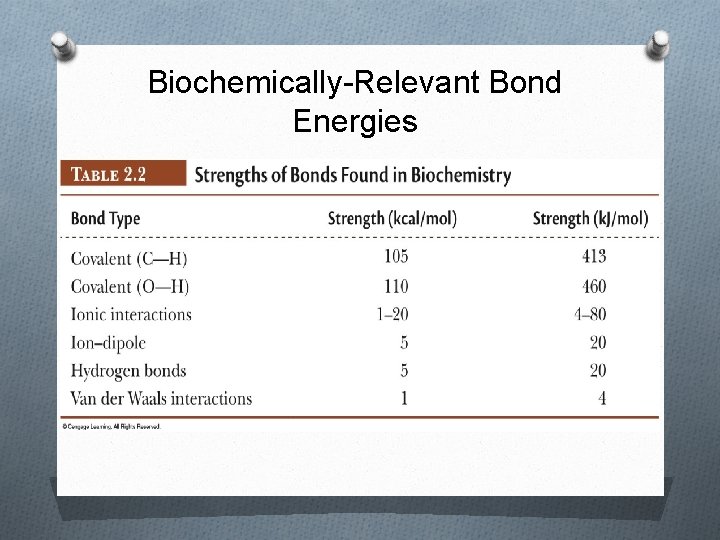
Biochemically-Relevant Bond Energies
Solvent Properties of H 2 O O Hydrophilic: water-loving O tend to dissolve in water O Hydrophobic: water-fearing O tend not to dissolve in water O Amphipathic: has characteristics of both properties O molecules that contain one or more hydrophobic and one or more hydrophilic regions, e. g. , sodium palmitate
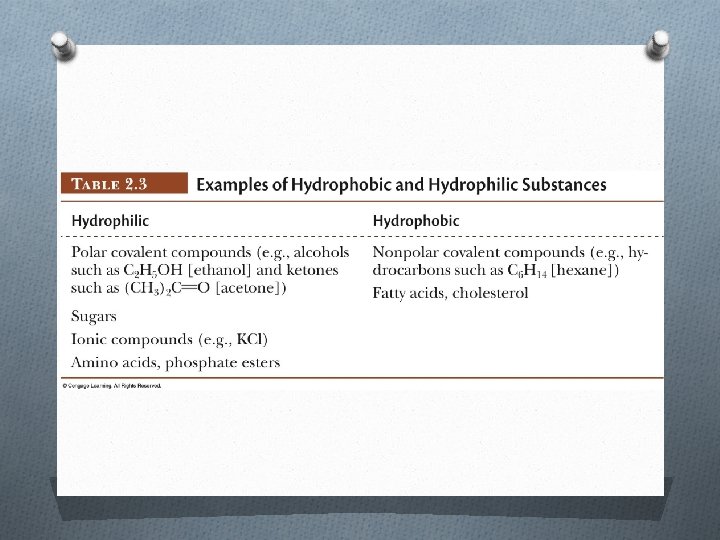
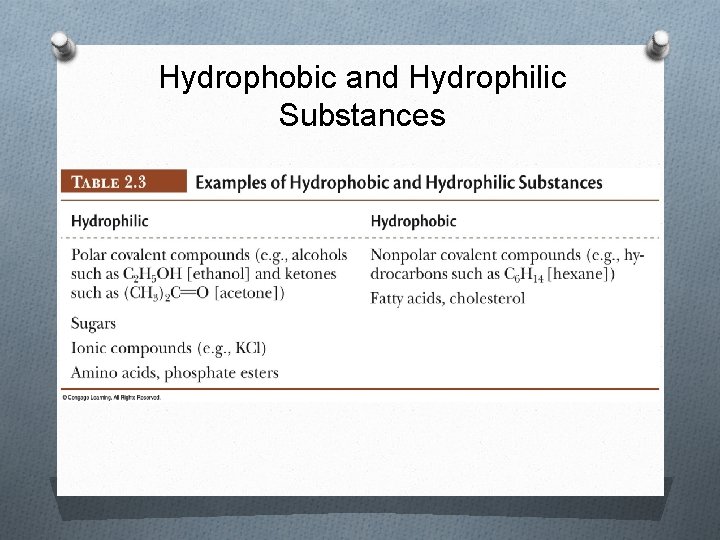
Hydrophobic and Hydrophilic Substances
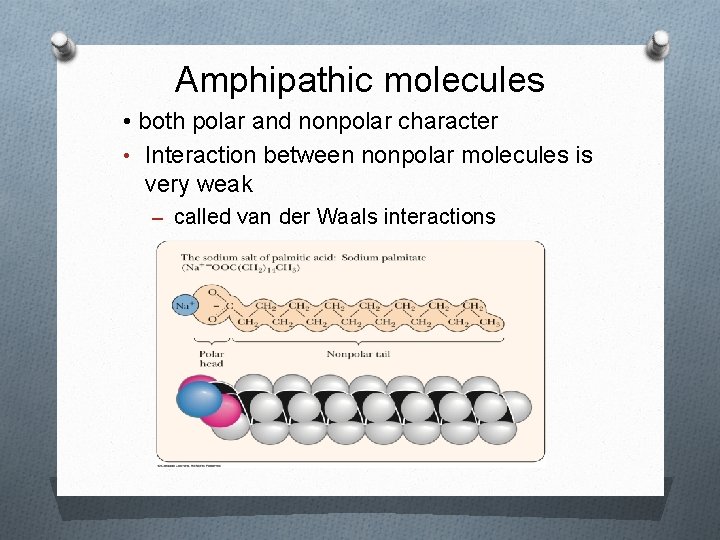
Amphipathic molecules • both polar and nonpolar character • Interaction between nonpolar molecules is very weak – called van der Waals interactions
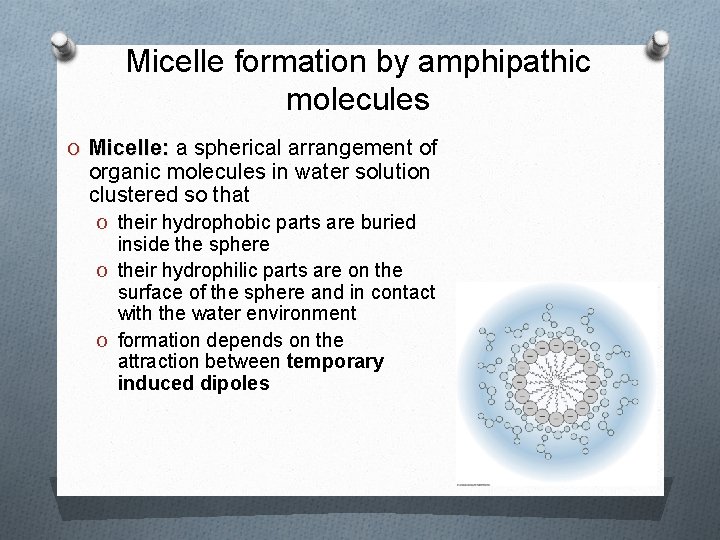
Micelle formation by amphipathic molecules O Micelle: a spherical arrangement of organic molecules in water solution clustered so that O their hydrophobic parts are buried inside the sphere O their hydrophilic parts are on the surface of the sphere and in contact with the water environment O formation depends on the attraction between temporary induced dipoles
24
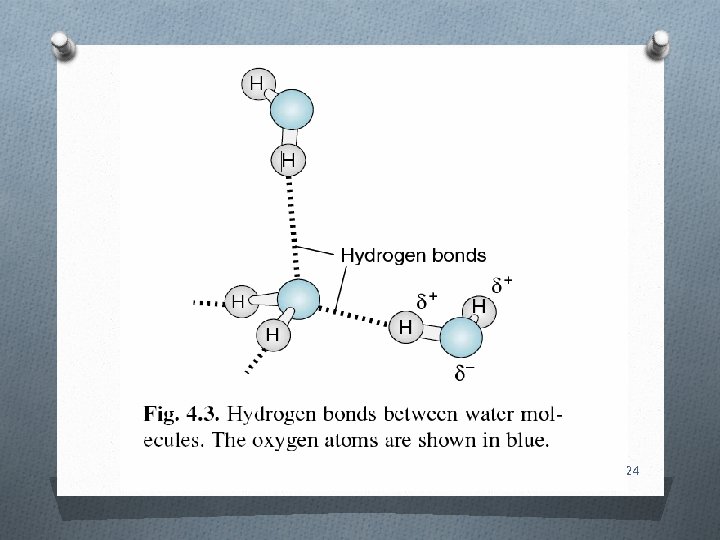
Hydrogen Bond �The hydrogen atoms have a partially positive charge (δ+); the oxygen atom has a partially negative charge (δ–). �This charge distribution is due to the electronegativity difference between hydrogen and oxygen atoms �such partial charges result in a intermolecular force known as a dipole-dipole force, in which the positive end of one molecule attracts the negative end of another molecule. 25
Hydrogen bond �This leads to stronger-than-expected intermolecular forces. �These unexpectedly strong intermolecular forces have a special name: hydrogen bonds. �The interaction of a � hydrogen atom bonded to either oxygen, nitrogen, � fluorine atoms with an oxygen, nitrogen or � fluorine on another molecule (intermolecular) or the same molecule (intramolecular). 26
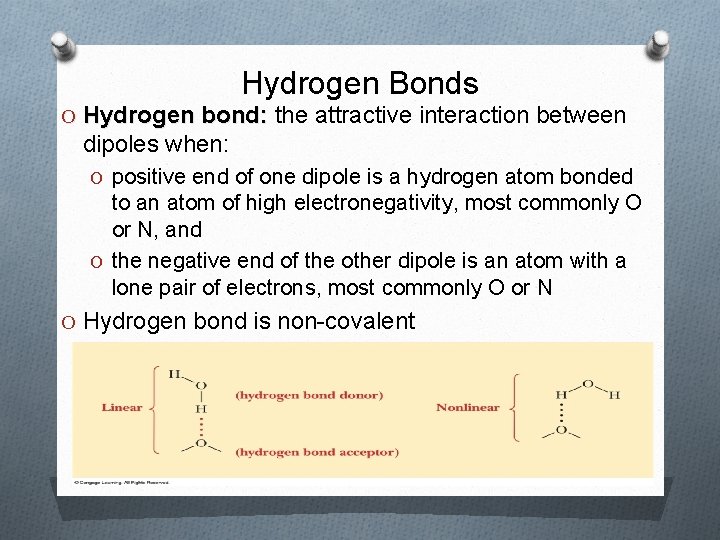
Hydrogen Bonds O Hydrogen bond: the attractive interaction between dipoles when: O positive end of one dipole is a hydrogen atom bonded to an atom of high electronegativity, most commonly O or N, and O the negative end of the other dipole is an atom with a lone pair of electrons, most commonly O or N O Hydrogen bond is non-covalent
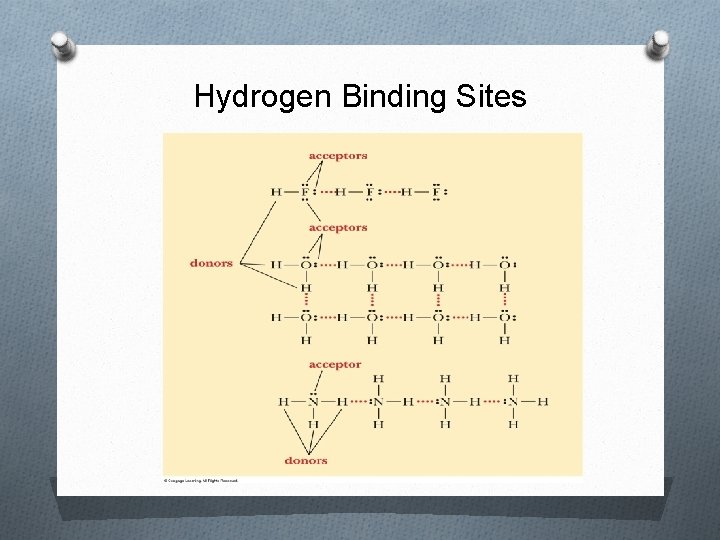
Hydrogen Binding Sites
Hydrogen bonds Physical properties of ice and water are a result of intermolecular hydrogen bonding Heat of sublimation at 0 o. C is 46 k. J/mol yet only 6 k. J/mol is gaseous kinetic energy and the heat of fusion of ice is 6 k. J/mol which is only 15% of the energy needed to melt ice. Liquid water is only 15% less hydrogen bonded than ice CH 4 boils at -164 o. C but water is much higher 29.
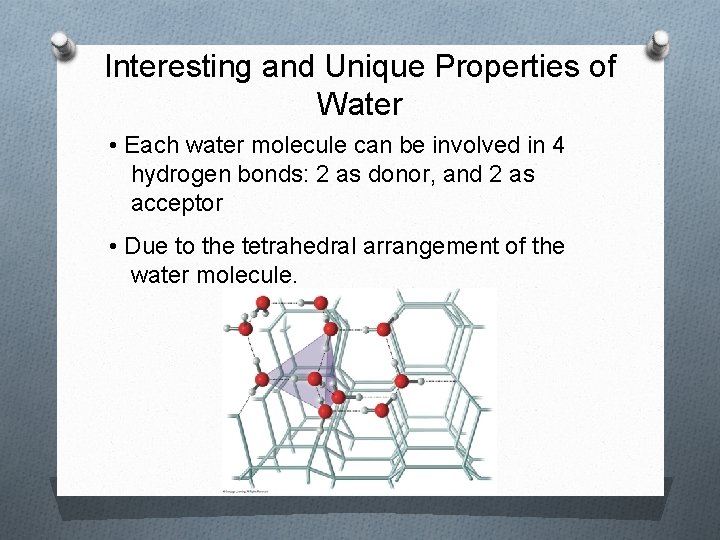
Interesting and Unique Properties of Water • Each water molecule can be involved in 4 hydrogen bonds: 2 as donor, and 2 as acceptor • Due to the tetrahedral arrangement of the water molecule.
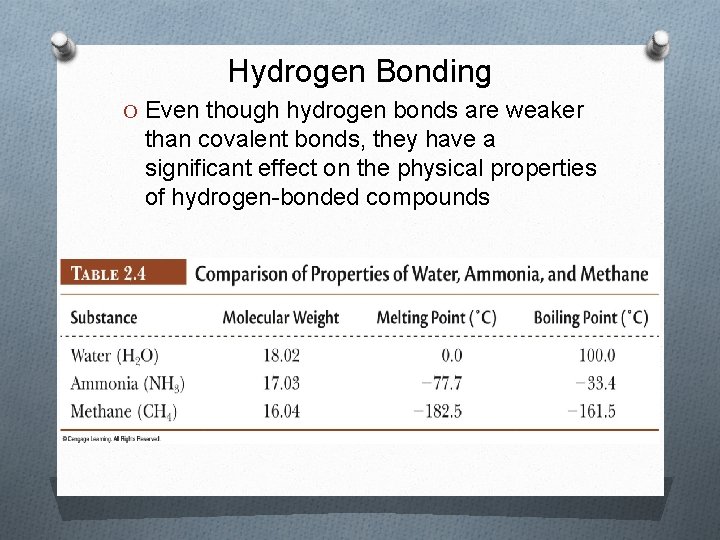
Hydrogen Bonding O Even though hydrogen bonds are weaker than covalent bonds, they have a significant effect on the physical properties of hydrogen-bonded compounds
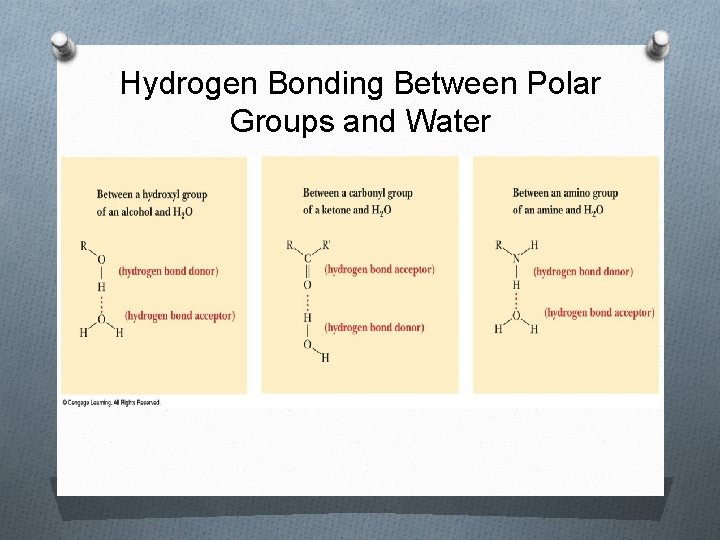
Hydrogen Bonding Between Polar Groups and Water
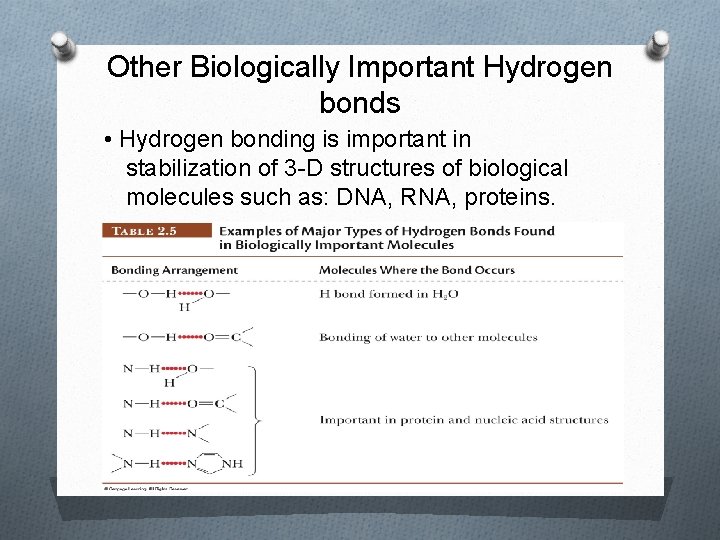
Other Biologically Important Hydrogen bonds • Hydrogen bonding is important in stabilization of 3 -D structures of biological molecules such as: DNA, RNA, proteins.
Hydrogen bonds Physical properties of ice and water are a result of intermolecular hydrogen bonding Heat of sublimation at 0 o. C is 46 k. J/mol yet only 6 k. J/mol is gaseous kinetic energy and the heat of fusion of ice is 6 k. J/mol which is only 15% of the energy needed to melt ice. Liquid water is only 15% less hydrogen bonded than ice CH 4 boils at -164 o. C but water is much higher. 34
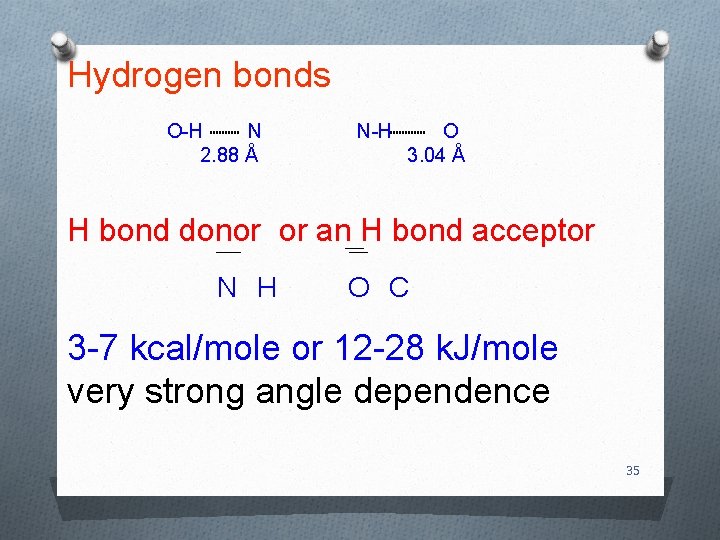
Hydrogen bonds O-H N 2. 88 Å N-H O 3. 04 Å H bond donor or an H bond acceptor N H O C 3 -7 kcal/mole or 12 -28 k. J/mole very strong angle dependence 35
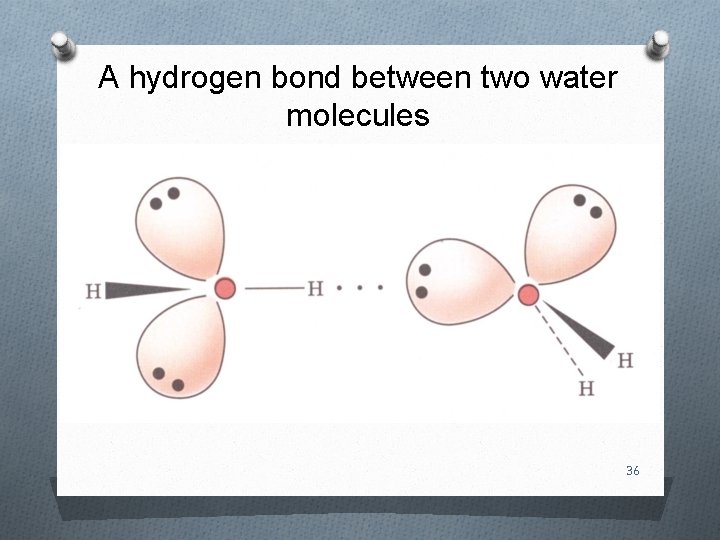
A hydrogen bond between two water molecules 36
Specific heat O is the amount of heat required to change the temperature of a gram of water 1° Celsius. O A high specific heat means it isn’t easy to change the temperature of water. 37
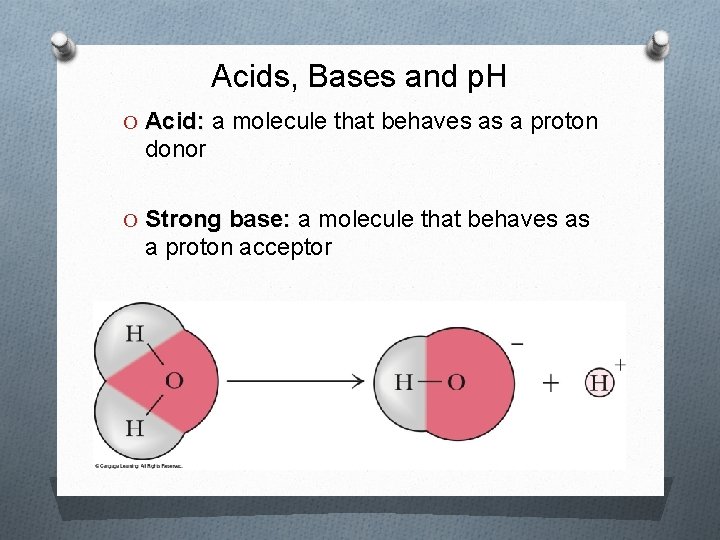
Acids, Bases and p. H O Acid: a molecule that behaves as a proton donor O Strong base: a molecule that behaves as a proton acceptor
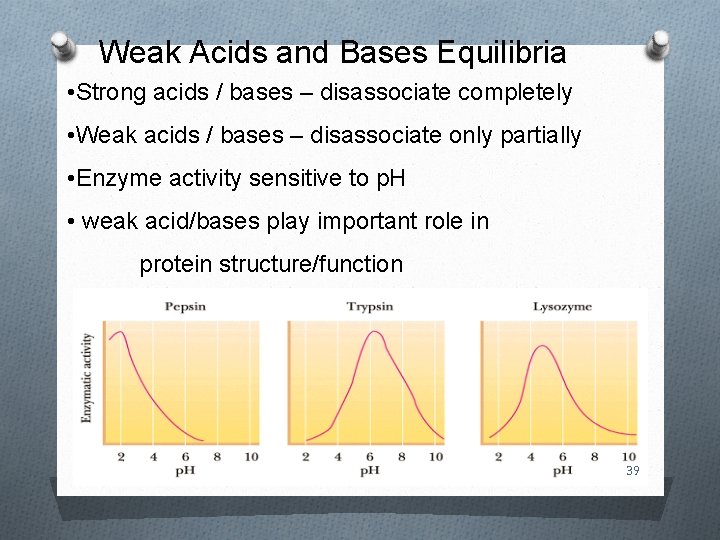
Weak Acids and Bases Equilibria • Strong acids / bases – disassociate completely • Weak acids / bases – disassociate only partially • Enzyme activity sensitive to p. H • weak acid/bases play important role in protein structure/function 39
Equilibrium �When the concentrations of hydrogen ion (H+) and hydroxide ion (OH–) are the same, the solution is neutral. �If the hydrogen ion concentration exceeds the hydroxide ion concentration, the solution is acidic. �If the hydroxide ion concentration is greater, the solution is basic. �Water is a contributor to the hydrogen ion concentration because it undergoes autoionization, 40
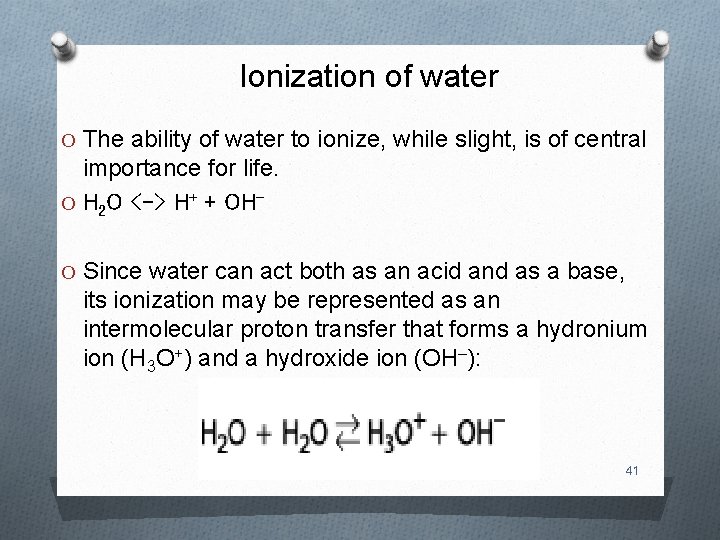
Ionization of water O The ability of water to ionize, while slight, is of central importance for life. O H 2 O <-> H+ + OHO Since water can act both as an acid and as a base, its ionization may be represented as an intermolecular proton transfer that forms a hydronium ion (H 3 O+) and a hydroxide ion (OH–): 41
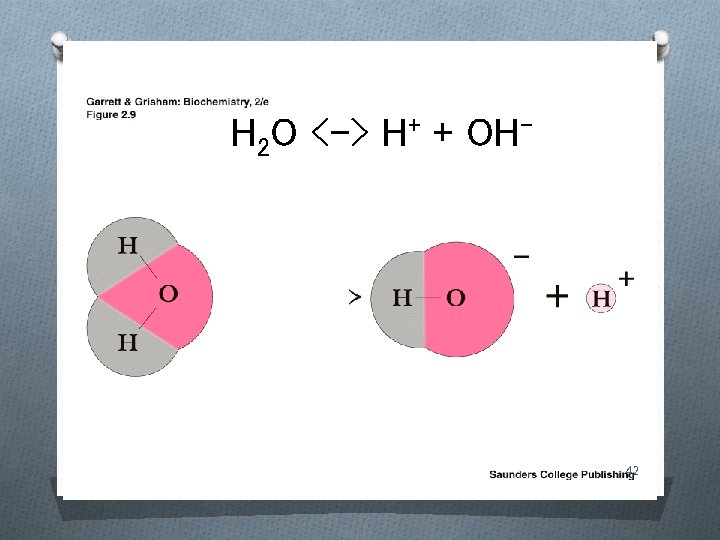
H 2 O <-> H+ + OH- 42
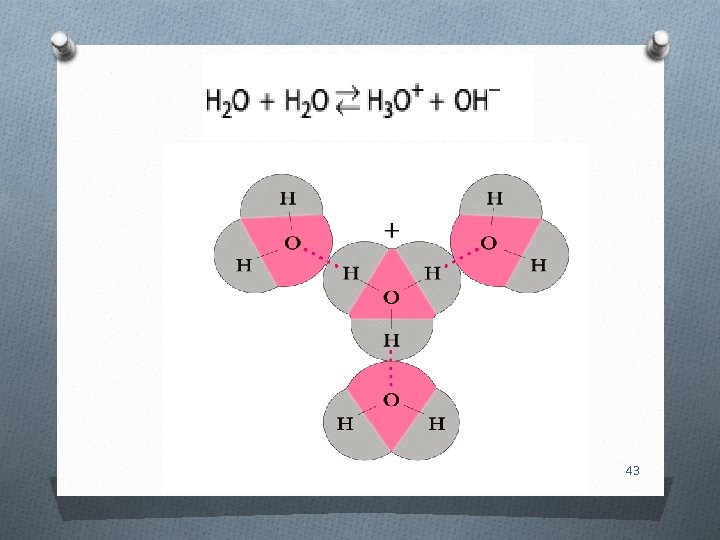
43
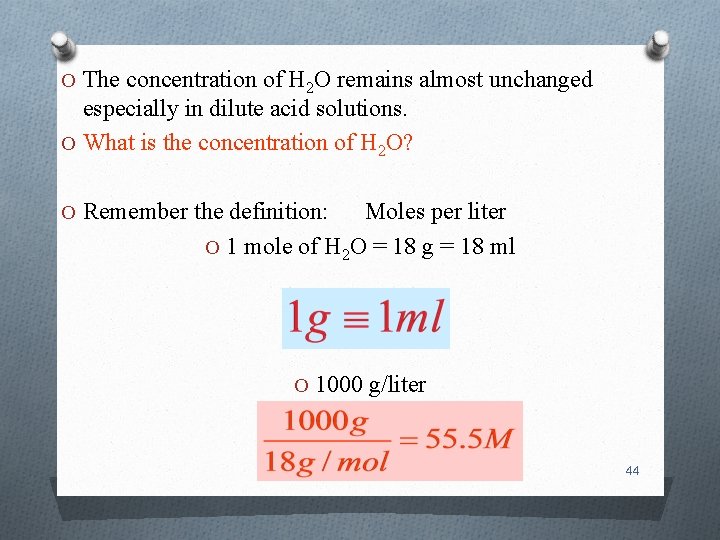
O The concentration of H 2 O remains almost unchanged especially in dilute acid solutions. O What is the concentration of H 2 O? O Remember the definition: Moles per liter O 1 mole of H 2 O = 18 g = 18 ml O 1000 g/liter 44
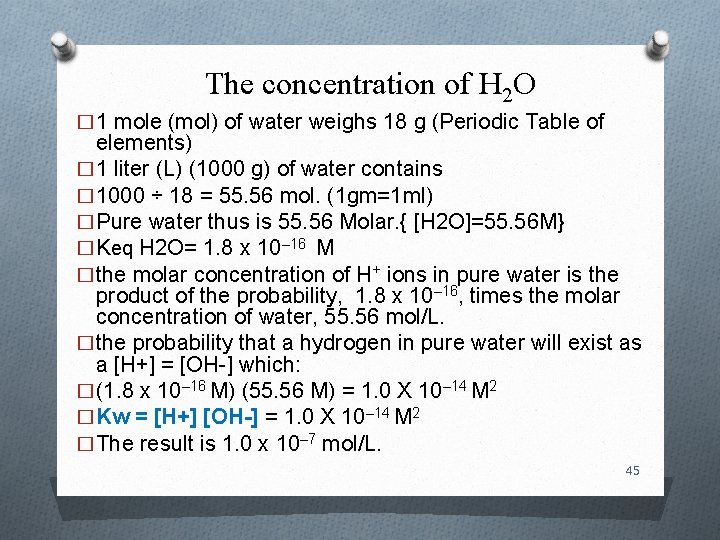
The concentration of H 2 O � 1 mole (mol) of water weighs 18 g (Periodic Table of elements) � 1 liter (L) (1000 g) of water contains � 1000 ÷ 18 = 55. 56 mol. (1 gm=1 ml) � Pure water thus is 55. 56 Molar. { [H 2 O]=55. 56 M} � Keq H 2 O= 1. 8 x 10– 16 M � the molar concentration of H+ ions in pure water is the product of the probability, 1. 8 x 10– 16, times the molar concentration of water, 55. 56 mol/L. � the probability that a hydrogen in pure water will exist as a [H+] = [OH-] which: � (1. 8 x 10– 16 M) (55. 56 M) = 1. 0 X 10– 14 M 2 � Kw = [H+] [OH-] = 1. 0 X 10– 14 M 2 � The result is 1. 0 x 10– 7 mol/L. 45
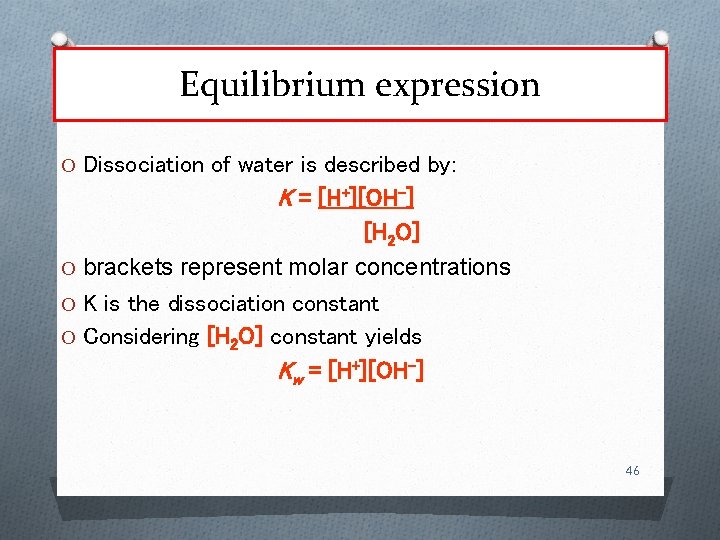
Equilibrium expression O Dissociation of water is described by: K = [H+][OH-] [H 2 O] O brackets represent molar concentrations O K is the dissociation constant O Considering [H 2 O] constant yields Kw = [H+][OH-] 46
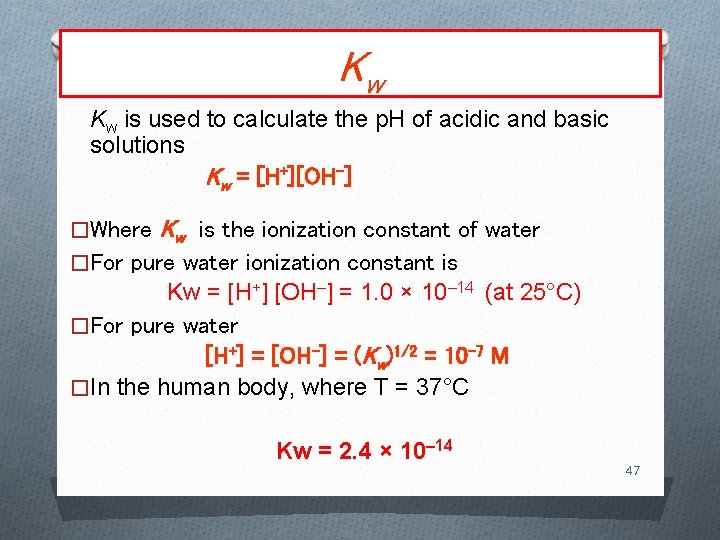
Kw Kw is used to calculate the p. H of acidic and basic solutions Kw = [H+][OH-] �Where Kw is the ionization constant of water �For pure water ionization constant is Kw = [H+] [OH–] = 1. 0 × 10– 14 (at 25°C) �For pure water [H+] = [OH-] = (Kw)1/2 = 10 -7 M �In the human body, where T = 37°C Kw = 2. 4 × 10– 14 47
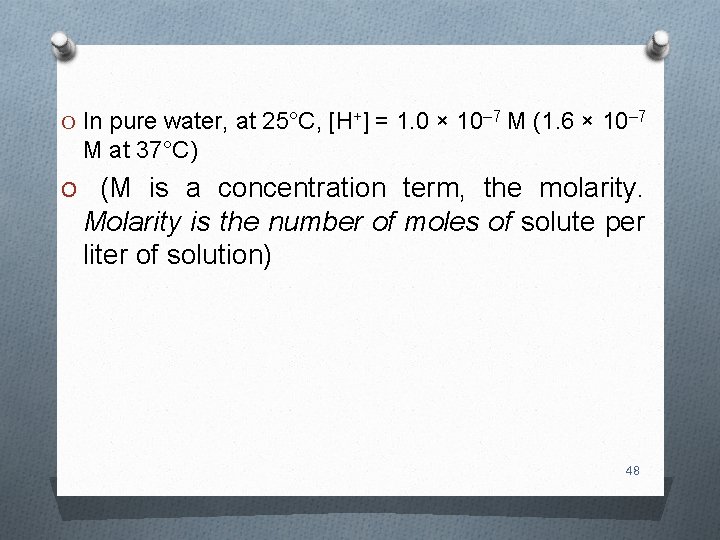
O In pure water, at 25°C, [H+] = 1. 0 × 10– 7 M (1. 6 × 10– 7 M at 37°C) O (M is a concentration term, the molarity. Molarity is the number of moles of solute per liter of solution) 48
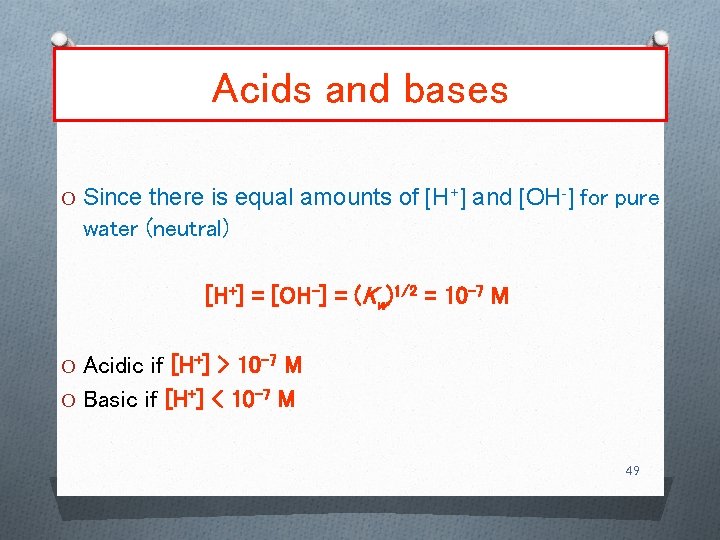
Acids and bases O Since there is equal amounts of [H+] and [OH-] for pure water (neutral) [H+] = [OH-] = (Kw)1/2 = 10 -7 M O Acidic if [H+] > 10 -7 M O Basic if [H+] < 10 -7 M 49
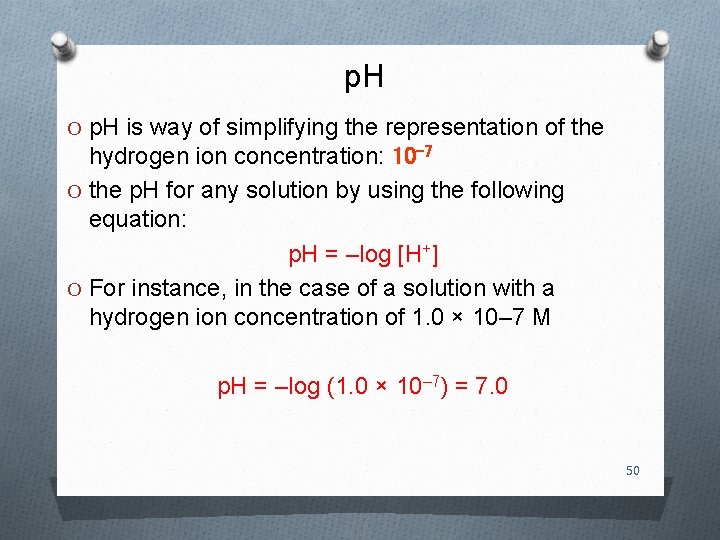
p. H O p. H is way of simplifying the representation of the hydrogen ion concentration: 10 -7 O the p. H for any solution by using the following equation: p. H = –log [H+] O For instance, in the case of a solution with a hydrogen ion concentration of 1. 0 × 10– 7 M p. H = –log (1. 0 × 10– 7) = 7. 0 50
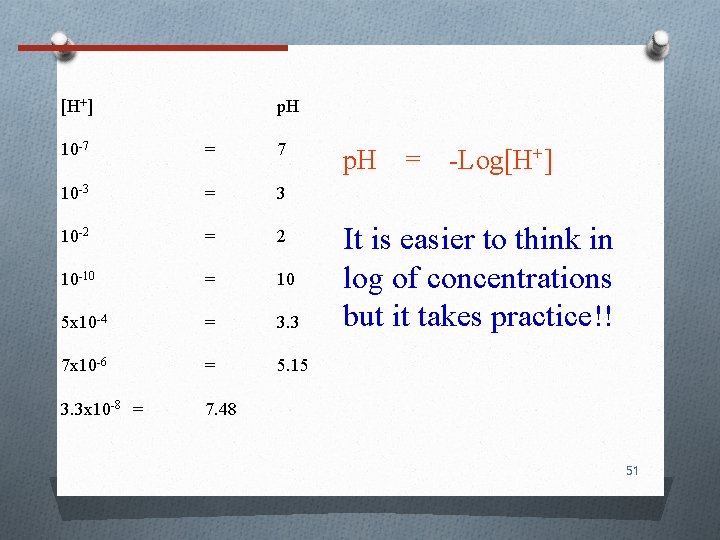
[H+] p. H 10 -7 = 7 10 -3 = 3 10 -2 = 2 10 -10 = 10 5 x 10 -4 = 3. 3 7 x 10 -6 = 5. 15 3. 3 x 10 -8 = 7. 48 p. H = -Log[H+] It is easier to think in log of concentrations but it takes practice!! 51
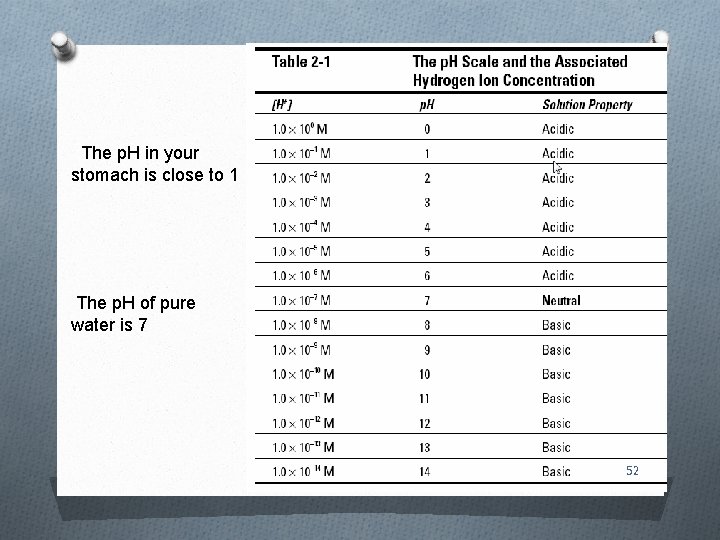
The p. H in your stomach is close to 1 The p. H of pure water is 7 52
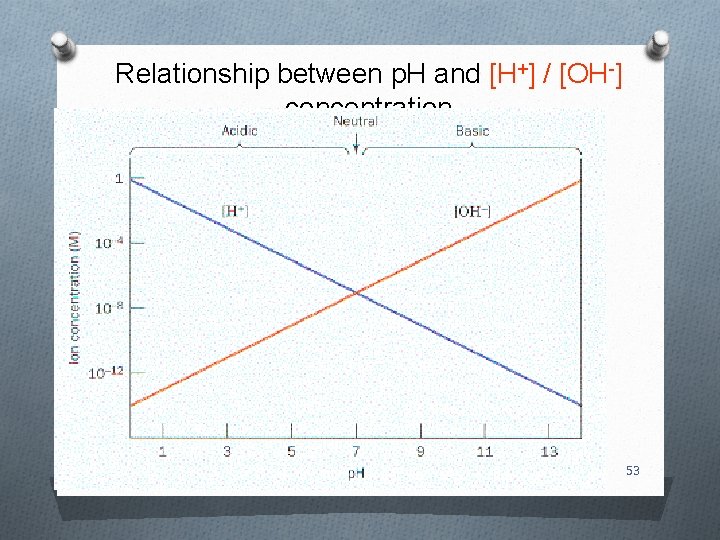
Relationship between p. H and [H+] / [OH-] concentration 53
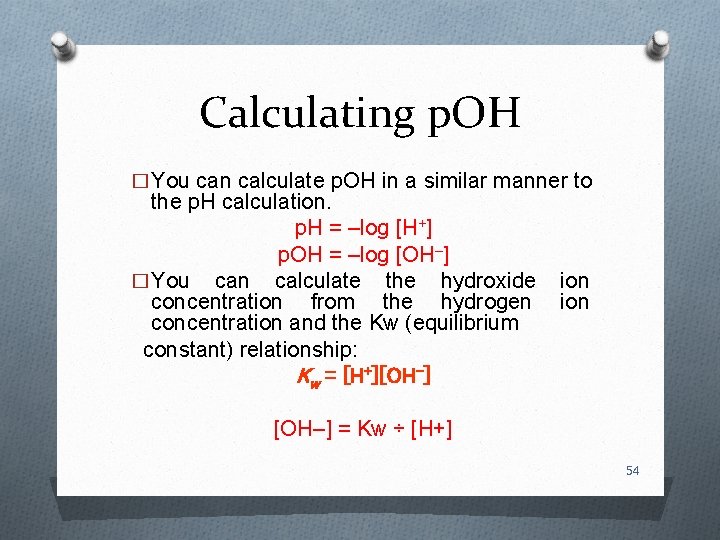
Calculating p. OH � You can calculate p. OH in a similar manner to the p. H calculation. p. H = –log [H+] p. OH = –log [OH–] � You can calculate the hydroxide concentration from the hydrogen concentration and the Kw (equilibrium constant) relationship: Kw = [H+][OH-] ion [OH–] = Kw ÷ [H+] 54
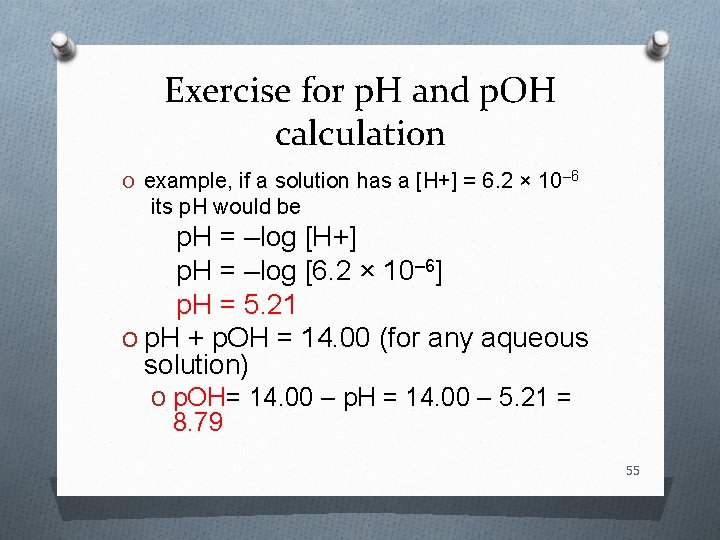
Exercise for p. H and p. OH calculation O example, if a solution has a [H+] = 6. 2 × 10– 6 its p. H would be p. H = –log [H+] p. H = –log [6. 2 × 10– 6] p. H = 5. 21 O p. H + p. OH = 14. 00 (for any aqueous solution) O p. OH= 14. 00 – p. H = 14. 00 – 5. 21 = 8. 79 55
Acids and Bases �Many biochemicals possess functional groups that are weak acids or bases. �Carboxyl groups, amino groups, and phosphate esters, whose second dissociation falls within the physiologic range, are present in proteins and nucleic acids, most coenzymes, and most intermediary metabolites. �Knowledge of the dissociation of weak acids and bases thus is basic to understanding the influence of intracellular p. H on structure and biologic activity. 56
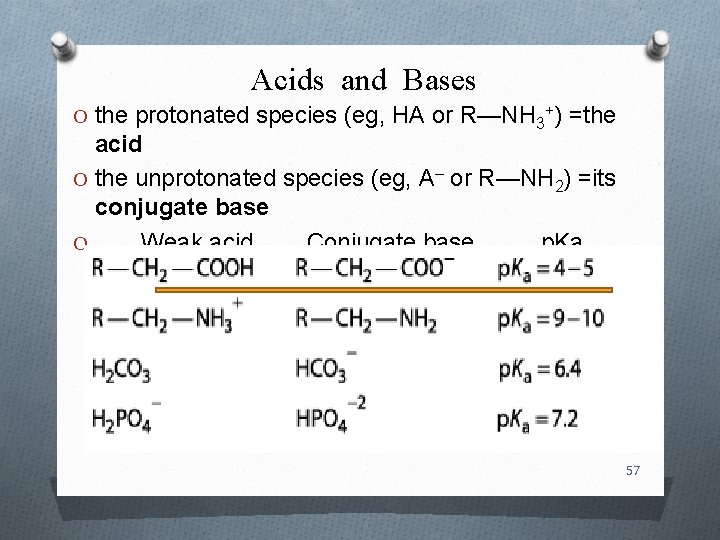
Acids and Bases O the protonated species (eg, HA or R—NH 3+) =the acid O the unprotonated species (eg, A– or R—NH 2) =its conjugate base O Weak acid Conjugate base p. Ka 57
Acids and Bases O p. Ka ; dissociation constants is used to express the relative strengths of both acids and bases. O For any weak acid, its conjugate is a strong base. O the conjugate of a strong base is a weak acid. 58 O The relative strengths of bases are expressed in terms of the p. Ka of their conjugate acids
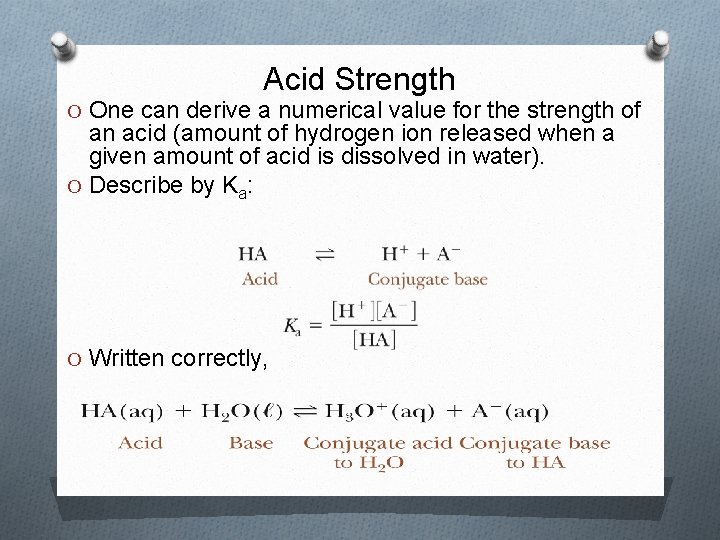
Acid Strength O One can derive a numerical value for the strength of an acid (amount of hydrogen ion released when a given amount of acid is dissolved in water). O Describe by Ka: O Written correctly,
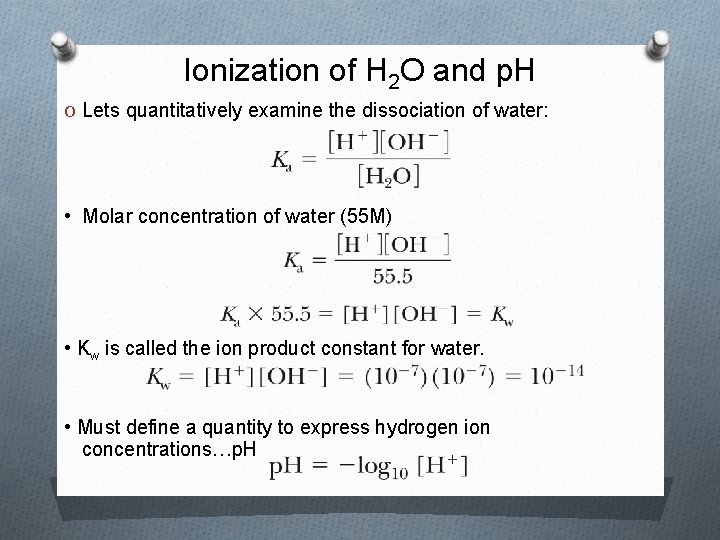
Ionization of H 2 O and p. H O Lets quantitatively examine the dissociation of water: • Molar concentration of water (55 M) • Kw is called the ion product constant for water. • Must define a quantity to express hydrogen ion concentrations…p. H
Henderson-Hasselbalch equation
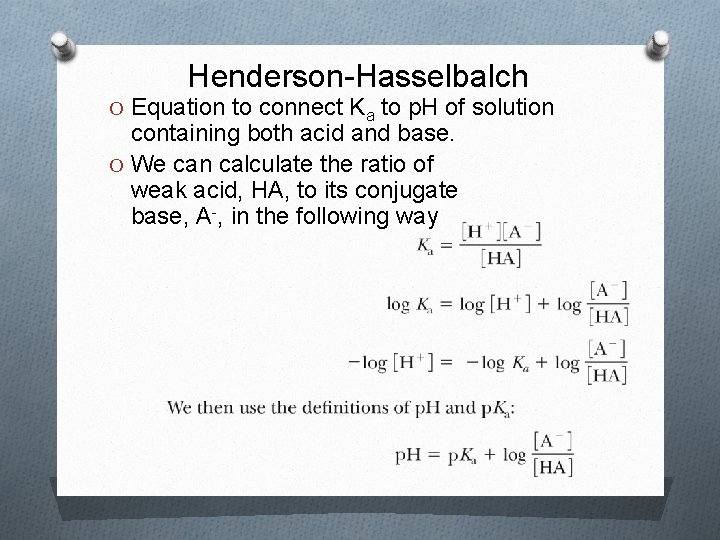
Henderson-Hasselbalch O Equation to connect Ka to p. H of solution containing both acid and base. O We can calculate the ratio of weak acid, HA, to its conjugate base, A-, in the following way
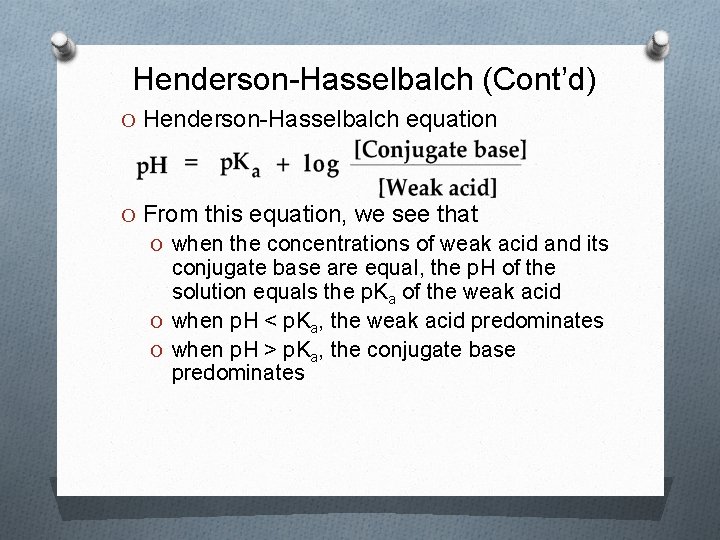
Henderson-Hasselbalch (Cont’d) O Henderson-Hasselbalch equation O From this equation, we see that O when the concentrations of weak acid and its conjugate base are equal, the p. H of the solution equals the p. Ka of the weak acid O when p. H < p. Ka, the weak acid predominates O when p. H > p. Ka, the conjugate base predominates
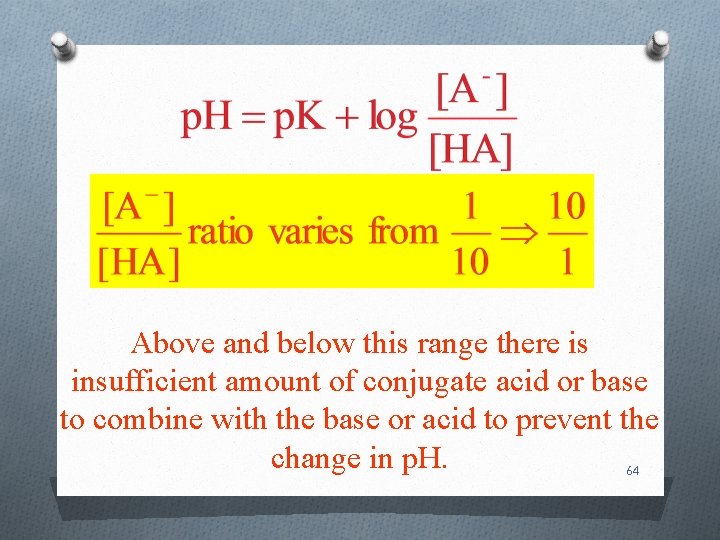
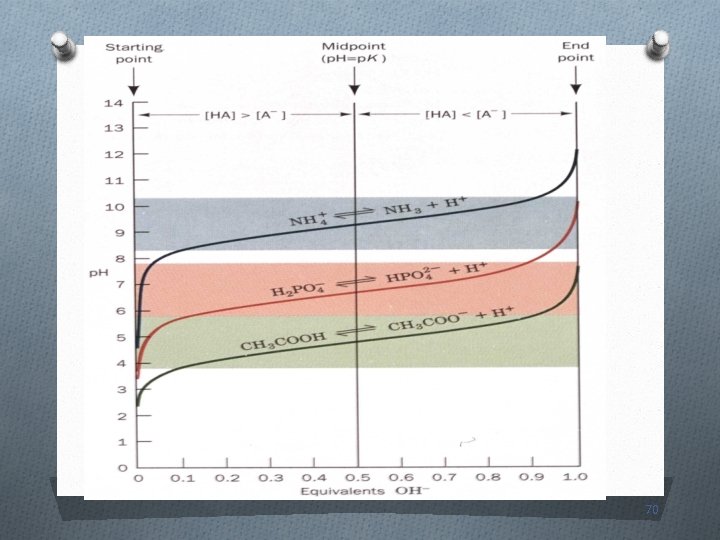
Above and below this range there is insufficient amount of conjugate acid or base to combine with the base or acid to prevent the change in p. H. 64
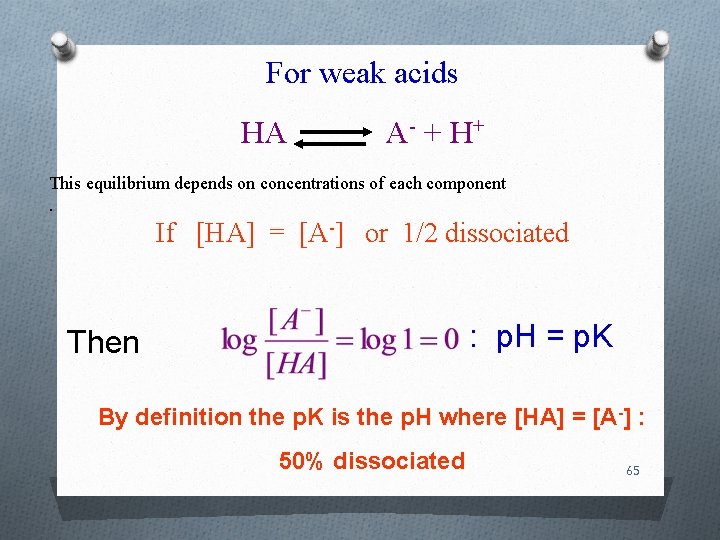
For weak acids HA A- + H + This equilibrium depends on concentrations of each component. If [HA] = [A-] or 1/2 dissociated : p. H = p. K Then By definition the p. K is the p. H where [HA] = [A-] : 50% dissociated 65
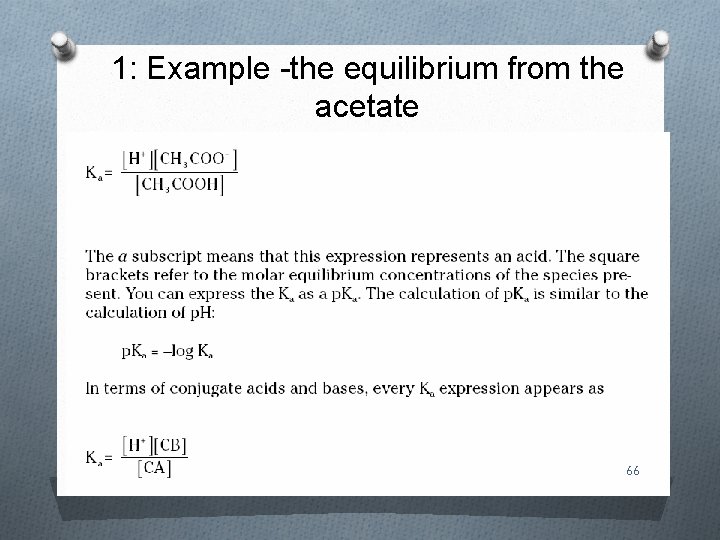
1: Example -the equilibrium from the acetate 66
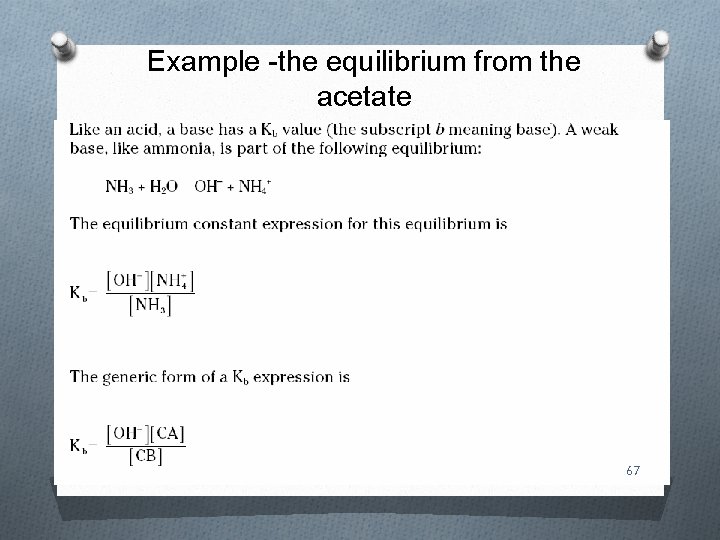
Example -the equilibrium from the acetate 67
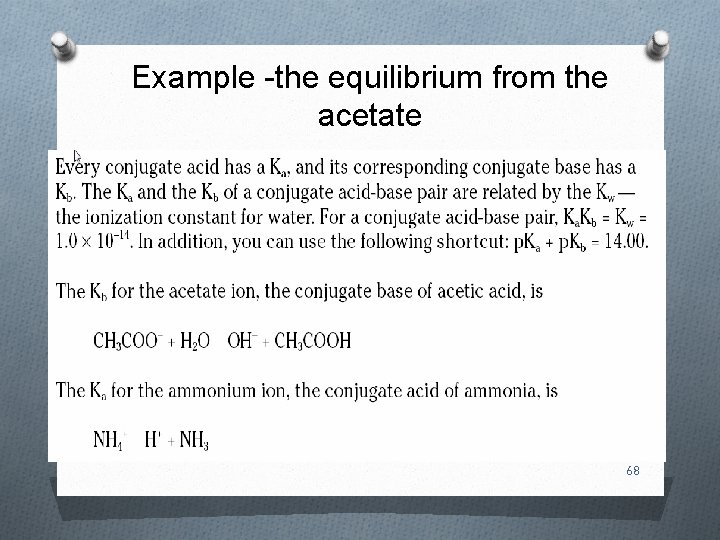
Example -the equilibrium from the acetate 68
The buffer effect can be seen in a titration curve. To a weak acid salt, CH 3 C 00 -, add HC 1 while monitoring p. H vs. the number of equivalents of acid added. or do the opposite with base. Buffer capacity: the molar amount of acid which the buffer can handle without significant changes in p. H. i. e 1 liter of a. 01 M buffer can not buffer 1 liter of a 1 M solution of HCl but 1 liter of a 1 M buffer can buffer 1 liter of a. 01 M solution of HCl 69
70
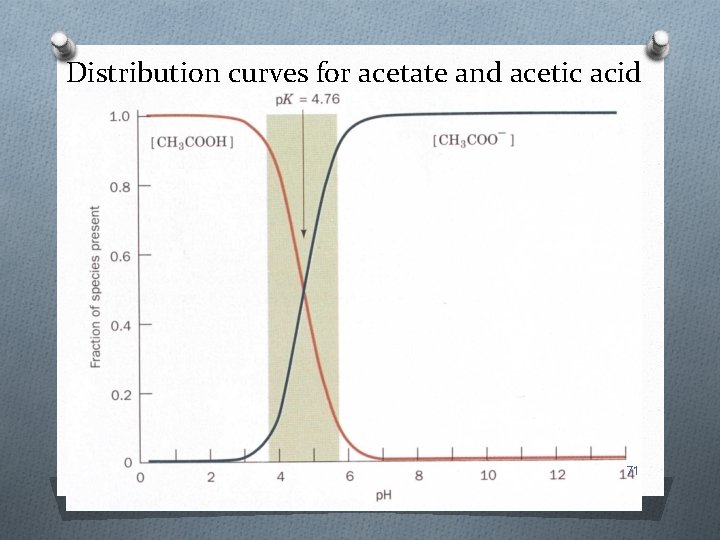
Distribution curves for acetate and acetic acid 71
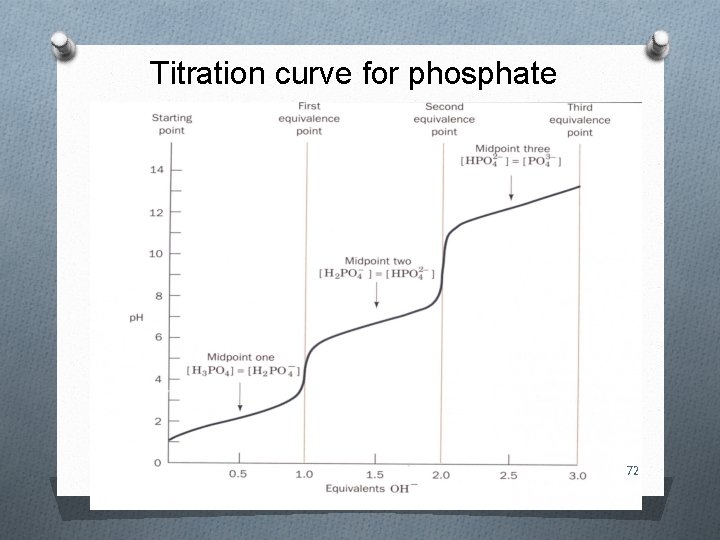
Titration curve for phosphate 72
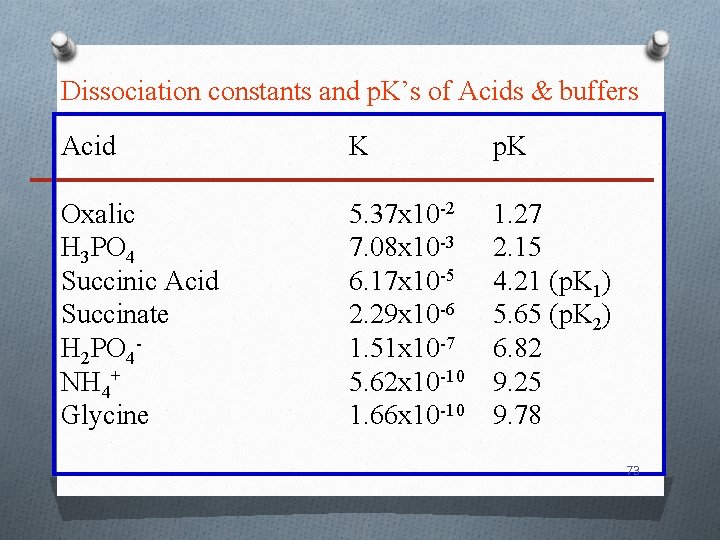
Dissociation constants and p. K’s of Acids & buffers Acid K p. K Oxalic H 3 PO 4 Succinic Acid Succinate H 2 PO 4 NH 4+ Glycine 5. 37 x 10 -2 7. 08 x 10 -3 6. 17 x 10 -5 2. 29 x 10 -6 1. 51 x 10 -7 5. 62 x 10 -10 1. 66 x 10 -10 1. 27 2. 15 4. 21 (p. K 1) 5. 65 (p. K 2) 6. 82 9. 25 9. 78 73
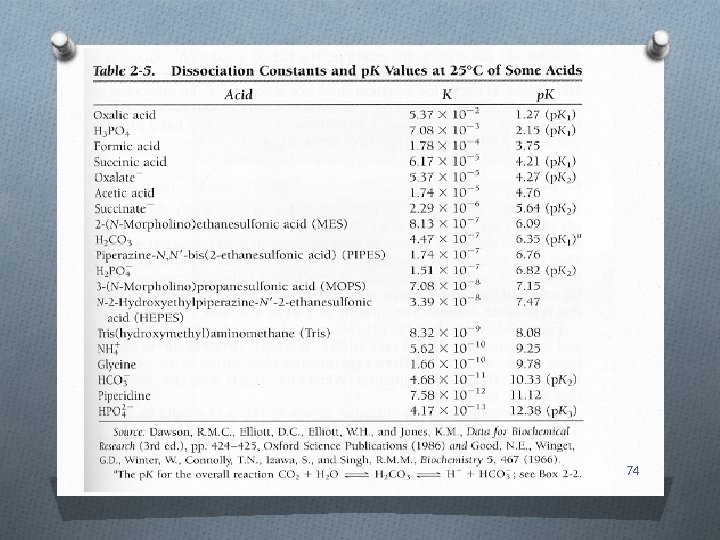
74
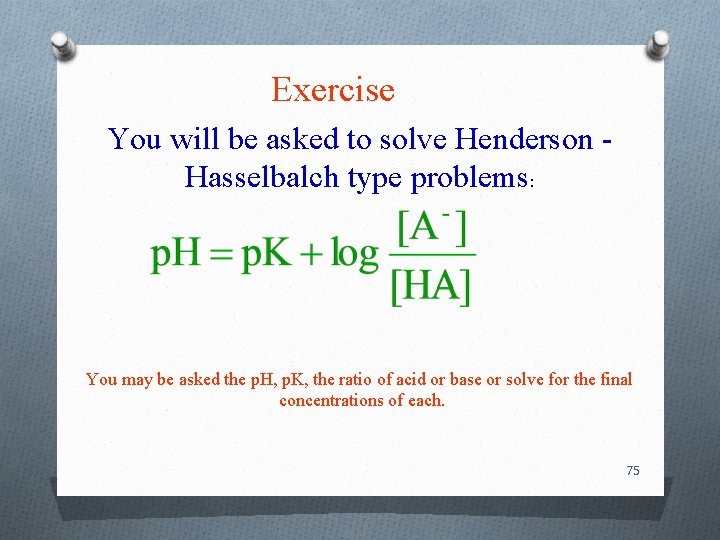
Exercise You will be asked to solve Henderson Hasselbalch type problems: You may be asked the p. H, p. K, the ratio of acid or base or solve for the final concentrations of each. 75
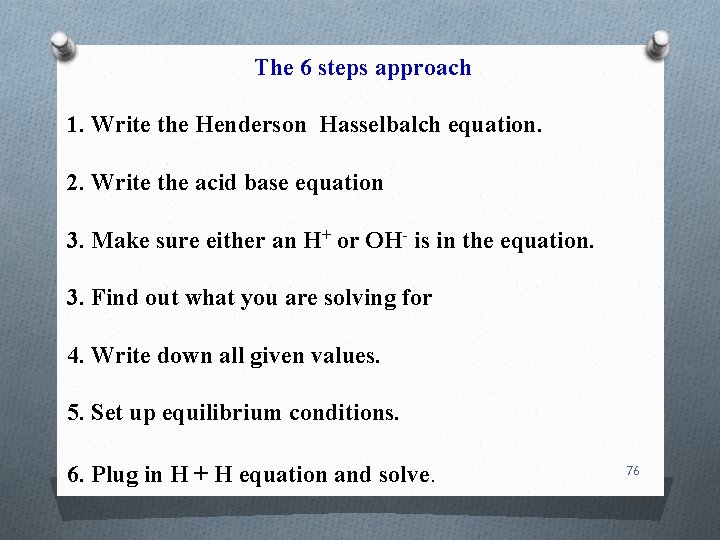
The 6 steps approach 1. Write the Henderson Hasselbalch equation. 2. Write the acid base equation 3. Make sure either an H+ or OH- is in the equation. 3. Find out what you are solving for 4. Write down all given values. 5. Set up equilibrium conditions. 6. Plug in H + H equation and solve. 76
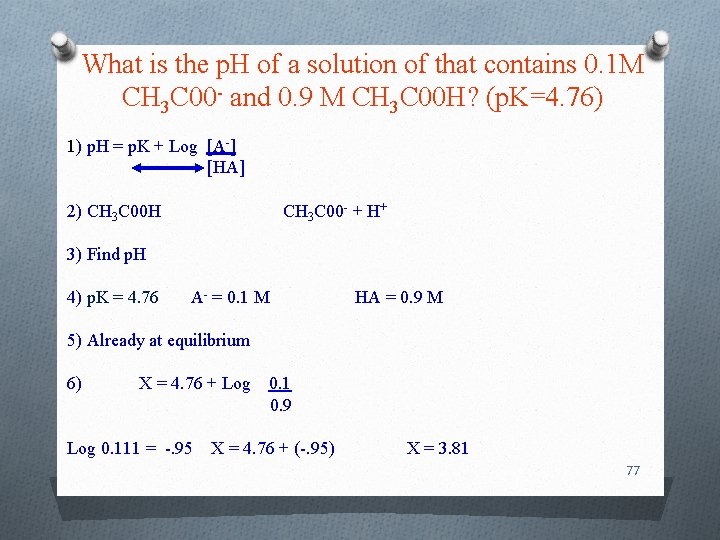
What is the p. H of a solution of that contains 0. 1 M CH 3 C 00 - and 0. 9 M CH 3 C 00 H? (p. K=4. 76) 1) p. H = p. K + Log [A-] [HA] 2) CH 3 C 00 H CH 3 C 00 - + H+ 3) Find p. H 4) p. K = 4. 76 A- = 0. 1 M HA = 0. 9 M 5) Already at equilibrium 6) X = 4. 76 + Log 0. 111 = -. 95 0. 1 0. 9 X = 4. 76 + (-. 95) X = 3. 81 77
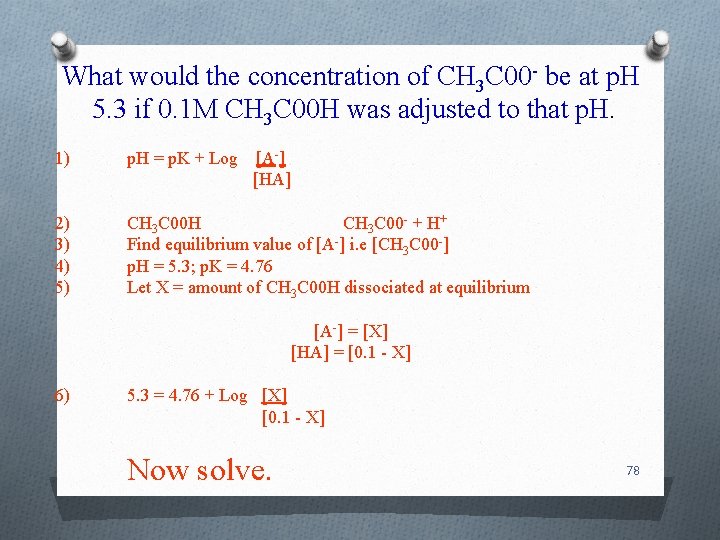
What would the concentration of CH 3 C 00 - be at p. H 5. 3 if 0. 1 M CH 3 C 00 H was adjusted to that p. H. 1) p. H = p. K + Log [A-] [HA] 2) 3) 4) 5) CH 3 C 00 H CH 3 C 00 - + H+ Find equilibrium value of [A-] i. e [CH 3 C 00 -] p. H = 5. 3; p. K = 4. 76 Let X = amount of CH 3 C 00 H dissociated at equilibrium [A-] = [X] [HA] = [0. 1 - X] 6) 5. 3 = 4. 76 + Log [X] [0. 1 - X] Now solve. 78
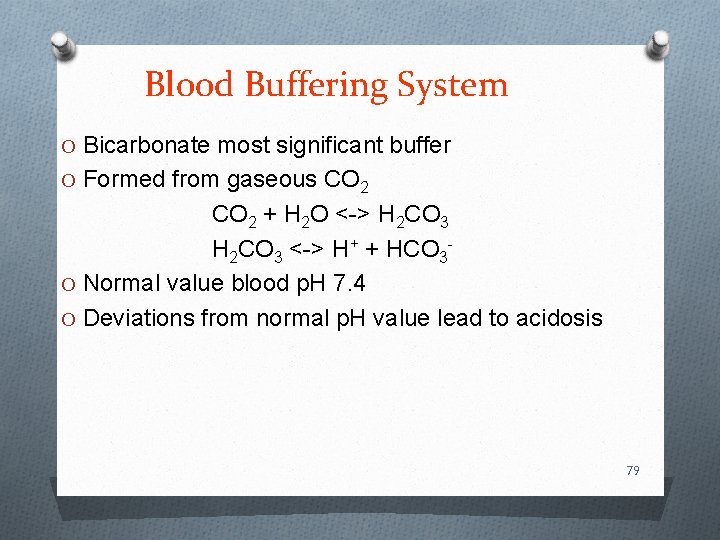
Blood Buffering System O Bicarbonate most significant buffer O Formed from gaseous CO 2 + H 2 O <-> H 2 CO 3 <-> H+ + HCO 3 O Normal value blood p. H 7. 4 O Deviations from normal p. H value lead to acidosis 79
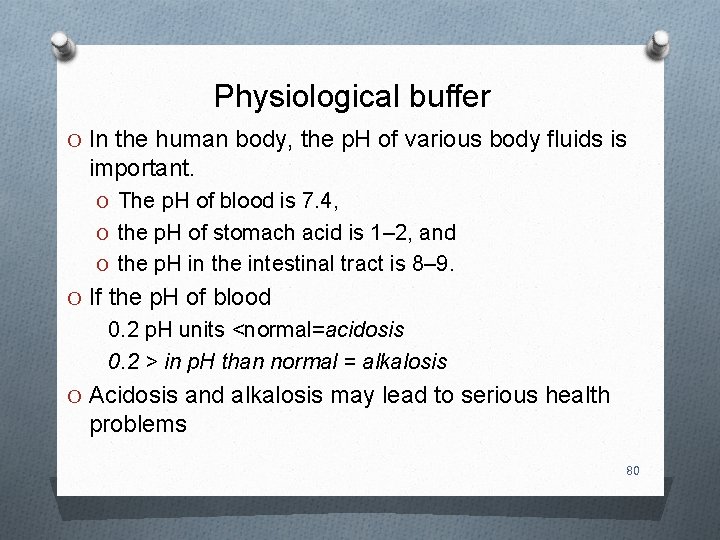
Physiological buffer O In the human body, the p. H of various body fluids is important. O The p. H of blood is 7. 4, O the p. H of stomach acid is 1– 2, and O the p. H in the intestinal tract is 8– 9. O If the p. H of blood 0. 2 p. H units <normal=acidosis 0. 2 > in p. H than normal = alkalosis O Acidosis and alkalosis may lead to serious health problems 80
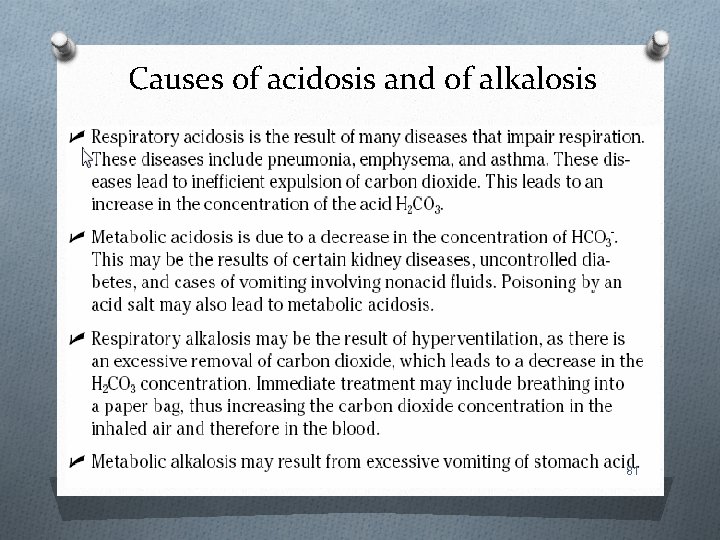
Causes of acidosis and of alkalosis 81
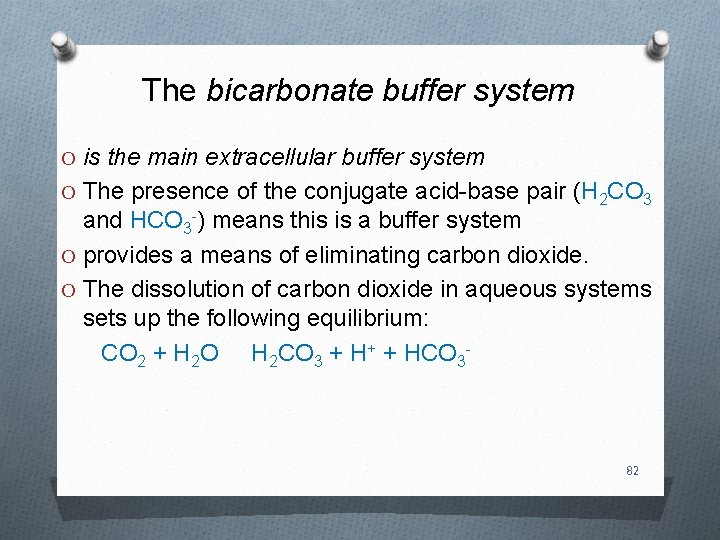
The bicarbonate buffer system O is the main extracellular buffer system O The presence of the conjugate acid-base pair (H 2 CO 3 and HCO 3 -) means this is a buffer system O provides a means of eliminating carbon dioxide. O The dissolution of carbon dioxide in aqueous systems sets up the following equilibrium: CO 2 + H 2 O H 2 CO 3 + H+ + HCO 3 - 82
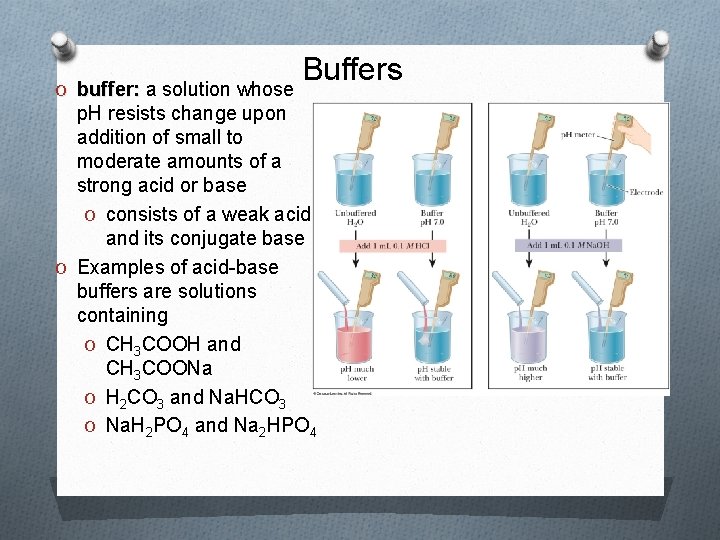
O buffer: a solution whose Buffers p. H resists change upon addition of small to moderate amounts of a strong acid or base O consists of a weak acid and its conjugate base O Examples of acid-base buffers are solutions containing O CH 3 COOH and CH 3 COONa O H 2 CO 3 and Na. HCO 3 O Na. H 2 PO 4 and Na 2 HPO 4
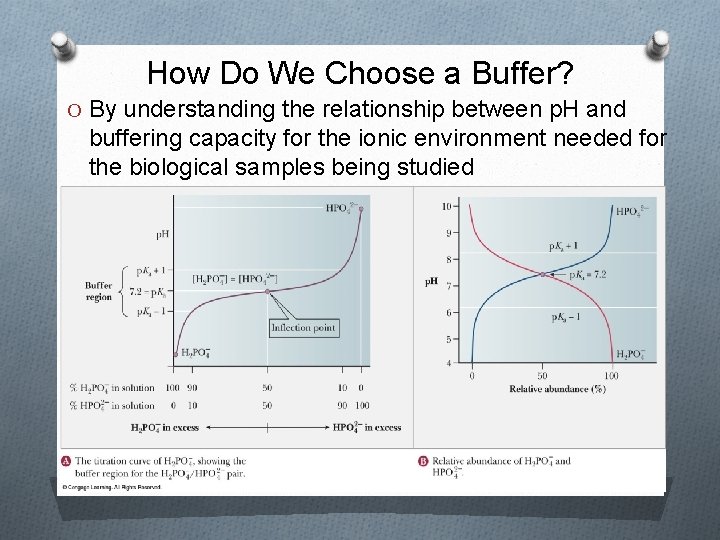
How Do We Choose a Buffer? O By understanding the relationship between p. H and buffering capacity for the ionic environment needed for the biological samples being studied
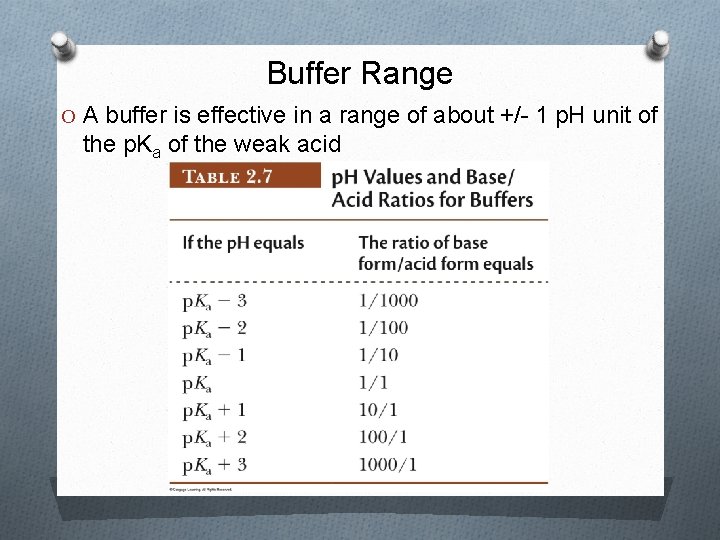
Buffer Range O A buffer is effective in a range of about +/- 1 p. H unit of the p. Ka of the weak acid
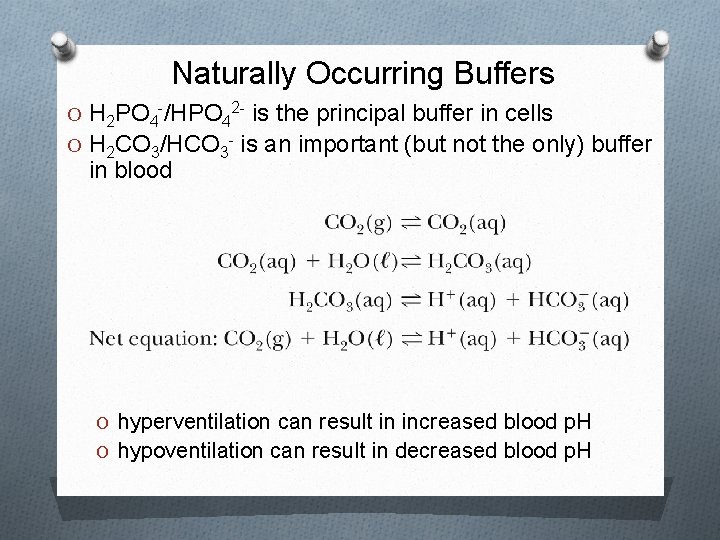
Naturally Occurring Buffers O H 2 PO 4 -/HPO 42 - is the principal buffer in cells O H 2 CO 3/HCO 3 - is an important (but not the only) buffer in blood O hyperventilation can result in increased blood p. H O hypoventilation can result in decreased blood p. H
Selecting a Buffer O The following criteria are typical O suitable p. Ka O no interference with the reaction or detection of the assay O suitable ionic strength O suitable solubility O its non-biological nature
- Slides: 87