
Chapter Two Water The Solvent for Biochemical Reactions
Chapter Two Water: The Solvent for Biochemical Reactions
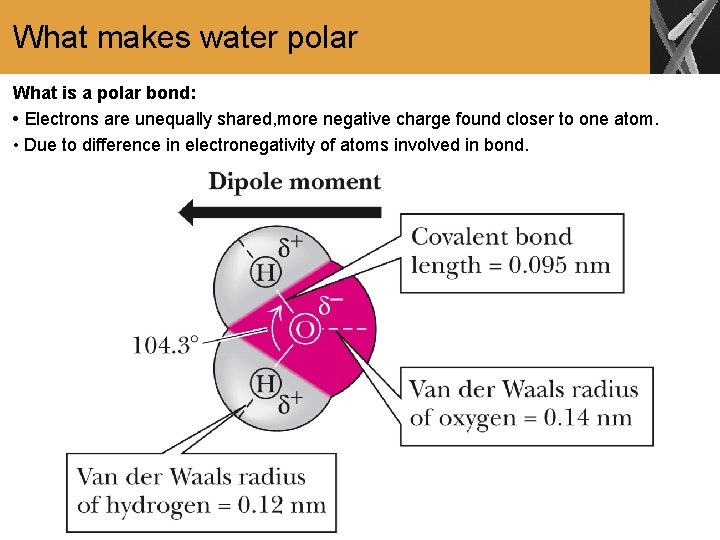
What makes water polar What is a polar bond: • Electrons are unequally shared, more negative charge found closer to one atom. • Due to difference in electronegativity of atoms involved in bond.
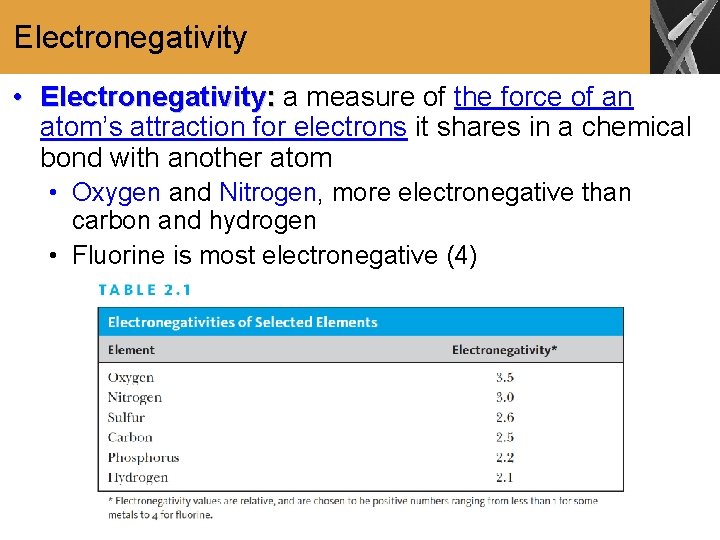
Electronegativity • Electronegativity: a measure of the force of an atom’s attraction for electrons it shares in a chemical bond with another atom • Oxygen and Nitrogen, more electronegative than carbon and hydrogen • Fluorine is most electronegative (4)
Solvent Properties of H 2 O • Ionic compounds (e. g. , KCl) and low-molecularweight polar covalent compounds (e. g. , C 2 H 5 OH and CH 3 COCH 3) tend to dissolve in water • The underlying principle is electrostatic attraction of unlike charges; the positive dipole of water for the negative dipole of another molecule, etc. • ion-dipole interaction: e. g. , KCl dissolved in H 2 O • dipole-dipole interactions: e. g. , ethanol or acetone dissolved in H 2 O • dipole induced-dipole interactions: weak and generally do not lead to solubility in water
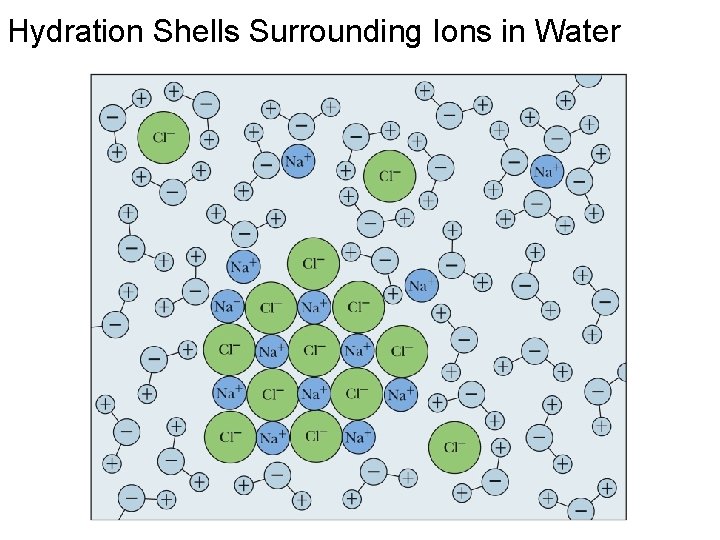
Hydration Shells Surrounding Ions in Water
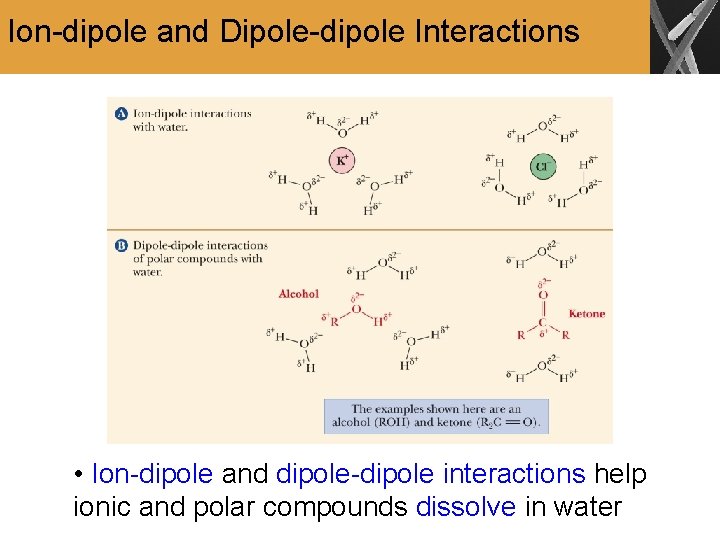
Ion-dipole and Dipole-dipole Interactions • Ion-dipole and dipole-dipole interactions help ionic and polar compounds dissolve in water
Solvent Properties of H 2 O • Hydrophilic: water-loving • tend to dissolve in water • Hydrophobic: water-fearing • tend not to dissolve in water • Amphipathic: has characteristics of both properties • molecules that contain one or more hydrophobic and one or more hydrophilic regions, e. g. , sodium palmitate
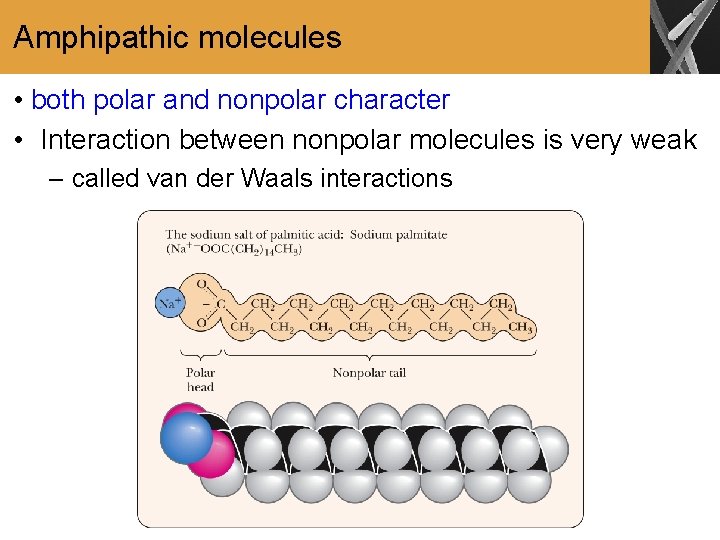
Amphipathic molecules • both polar and nonpolar character • Interaction between nonpolar molecules is very weak – called van der Waals interactions
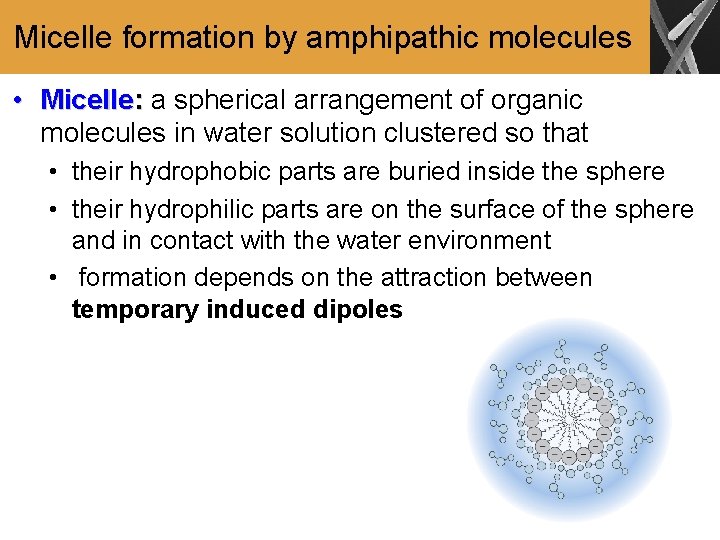
Micelle formation by amphipathic molecules • Micelle: a spherical arrangement of organic molecules in water solution clustered so that • their hydrophobic parts are buried inside the sphere • their hydrophilic parts are on the surface of the sphere and in contact with the water environment • formation depends on the attraction between temporary induced dipoles
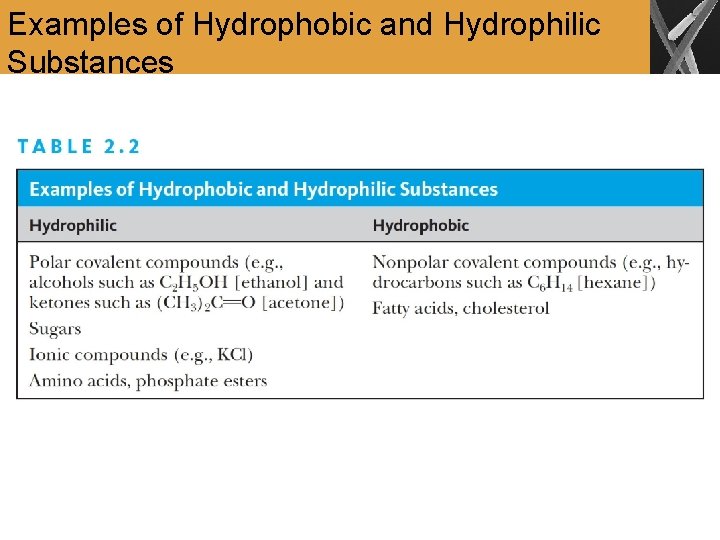
Examples of Hydrophobic and Hydrophilic Substances
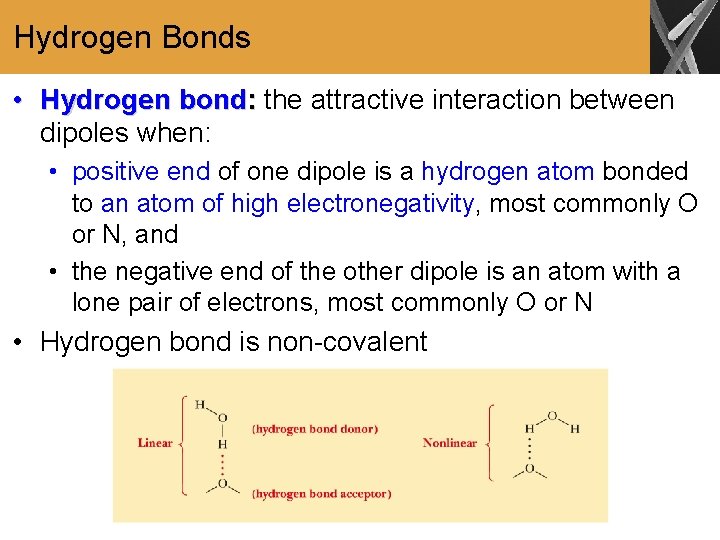
Hydrogen Bonds • Hydrogen bond: the attractive interaction between dipoles when: • positive end of one dipole is a hydrogen atom bonded to an atom of high electronegativity, most commonly O or N, and • the negative end of the other dipole is an atom with a lone pair of electrons, most commonly O or N • Hydrogen bond is non-covalent
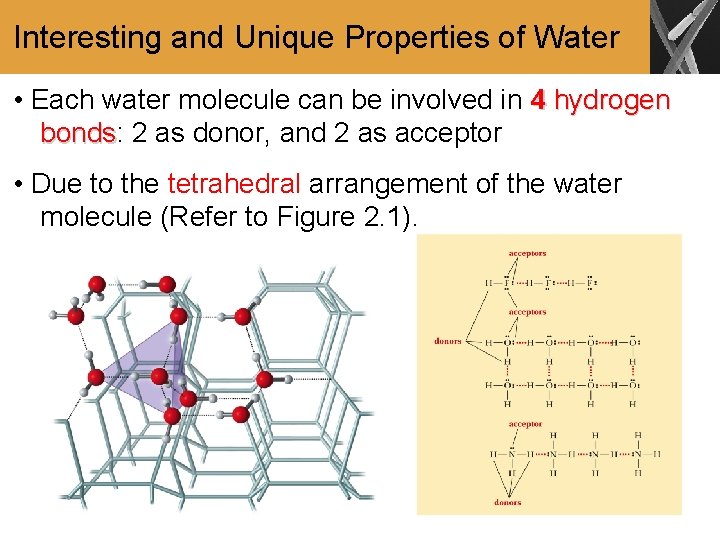
Interesting and Unique Properties of Water • Each water molecule can be involved in 4 hydrogen bonds: bonds 2 as donor, and 2 as acceptor • Due to the tetrahedral arrangement of the water molecule (Refer to Figure 2. 1).
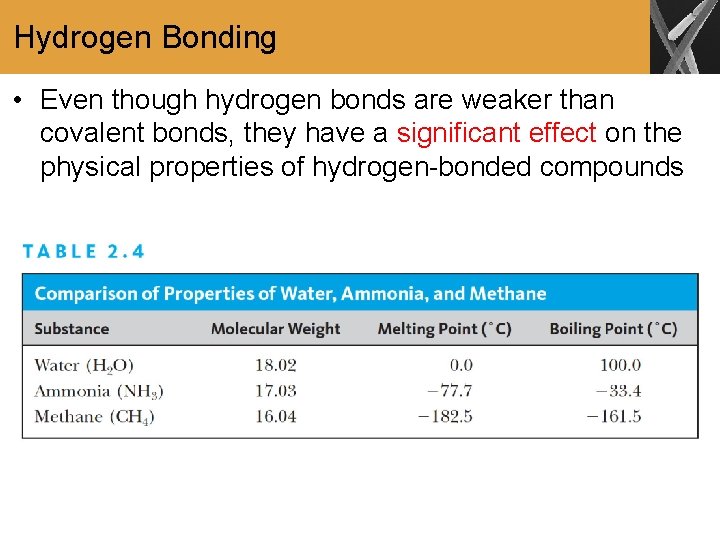
Hydrogen Bonding • Even though hydrogen bonds are weaker than covalent bonds, they have a significant effect on the physical properties of hydrogen-bonded compounds
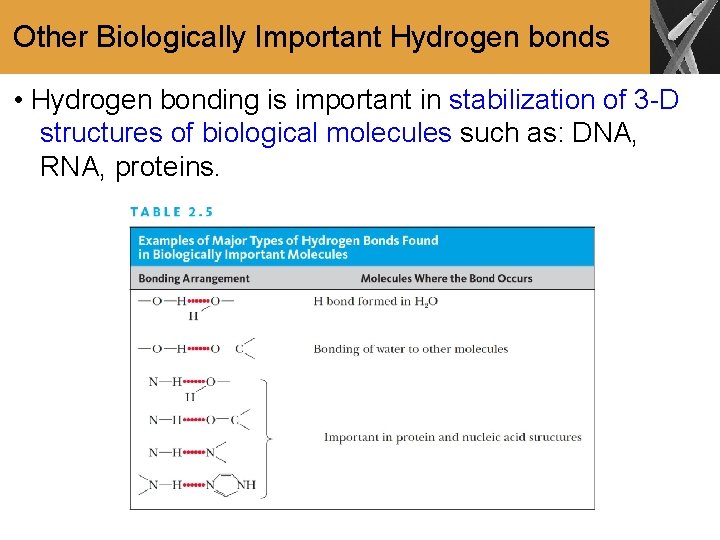
Other Biologically Important Hydrogen bonds • Hydrogen bonding is important in stabilization of 3 -D structures of biological molecules such as: DNA, RNA, proteins.
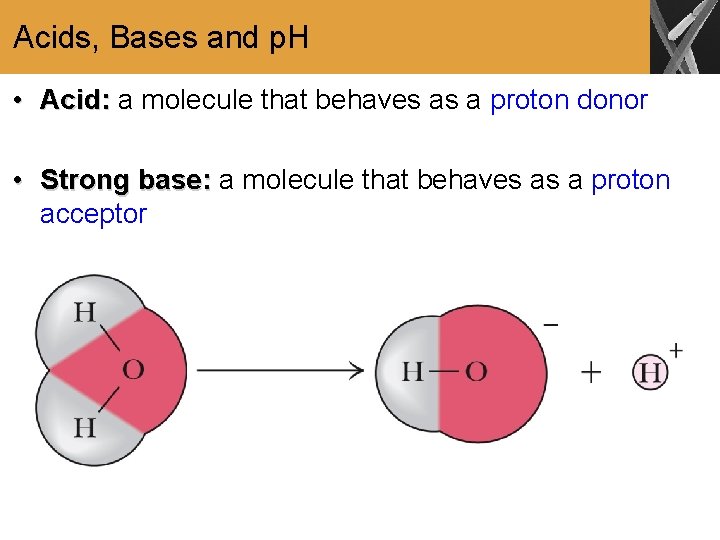
Acids, Bases and p. H • Acid: a molecule that behaves as a proton donor • Strong base: a molecule that behaves as a proton acceptor
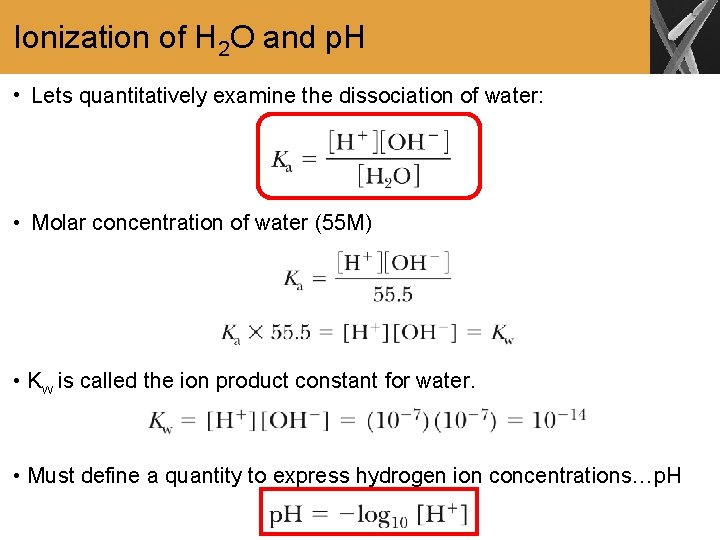
Ionization of H 2 O and p. H • Lets quantitatively examine the dissociation of water: • Molar concentration of water (55 M) • Kw is called the ion product constant for water. • Must define a quantity to express hydrogen ion concentrations…p. H
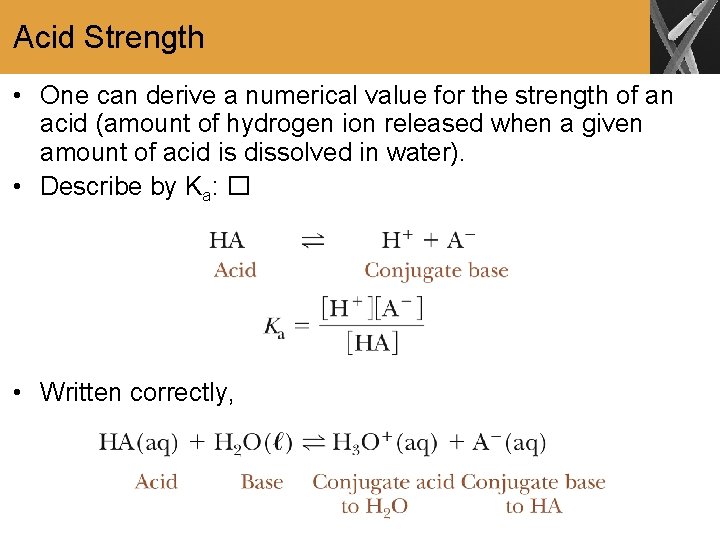
Acid Strength • One can derive a numerical value for the strength of an acid (amount of hydrogen ion released when a given amount of acid is dissolved in water). • Describe by Ka: � • Written correctly,
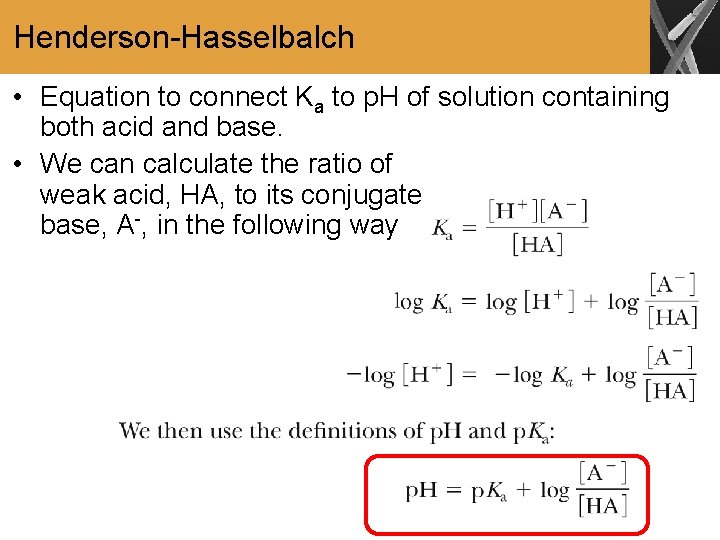
Henderson-Hasselbalch • Equation to connect Ka to p. H of solution containing both acid and base. • We can calculate the ratio of weak acid, HA, to its conjugate base, A-, in the following way
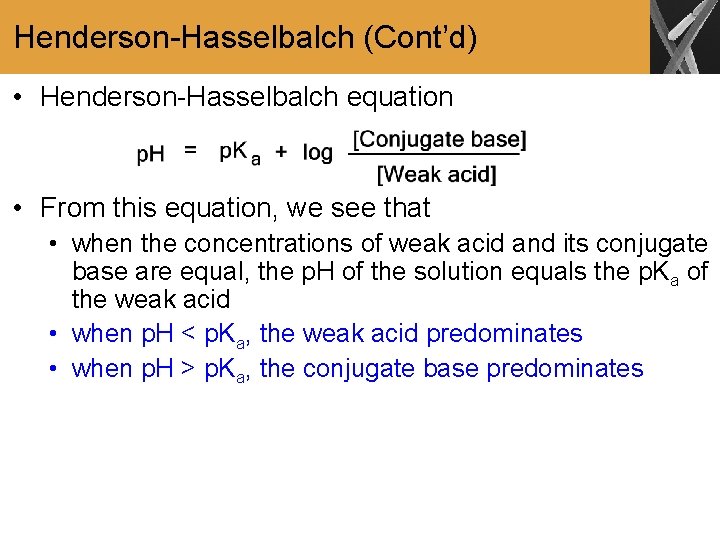
Henderson-Hasselbalch (Cont’d) • Henderson-Hasselbalch equation • From this equation, we see that • when the concentrations of weak acid and its conjugate base are equal, the p. H of the solution equals the p. Ka of the weak acid • when p. H < p. Ka, the weak acid predominates • when p. H > p. Ka, the conjugate base predominates
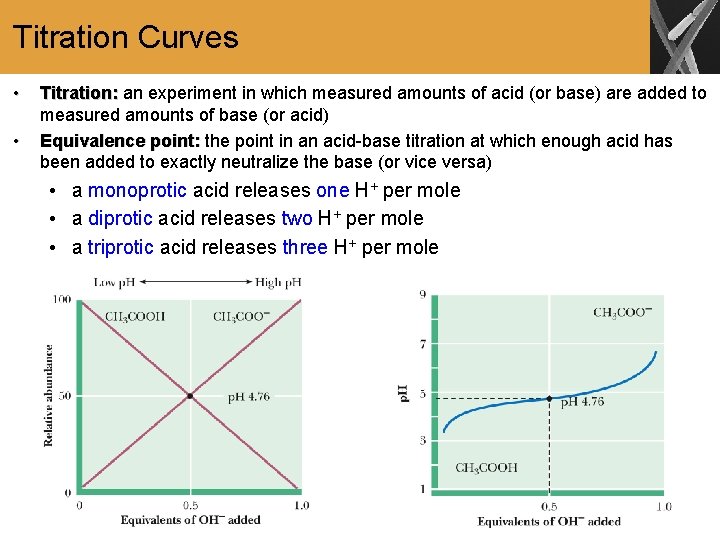
Titration Curves • • Titration: an experiment in which measured amounts of acid (or base) are added to measured amounts of base (or acid) Equivalence point: the point in an acid-base titration at which enough acid has been added to exactly neutralize the base (or vice versa) • a monoprotic acid releases one H+ per mole • a diprotic acid releases two H+ per mole • a triprotic acid releases three H+ per mole
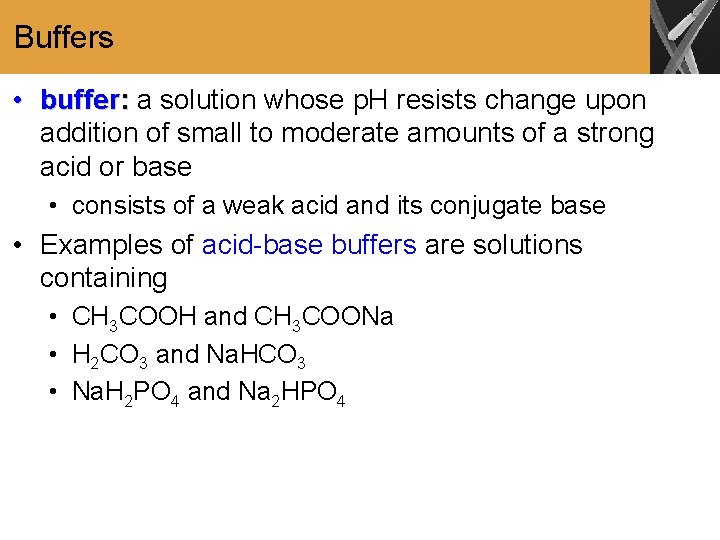
Buffers • buffer: a solution whose p. H resists change upon addition of small to moderate amounts of a strong acid or base • consists of a weak acid and its conjugate base • Examples of acid-base buffers are solutions containing • CH 3 COOH and CH 3 COONa • H 2 CO 3 and Na. HCO 3 • Na. H 2 PO 4 and Na 2 HPO 4
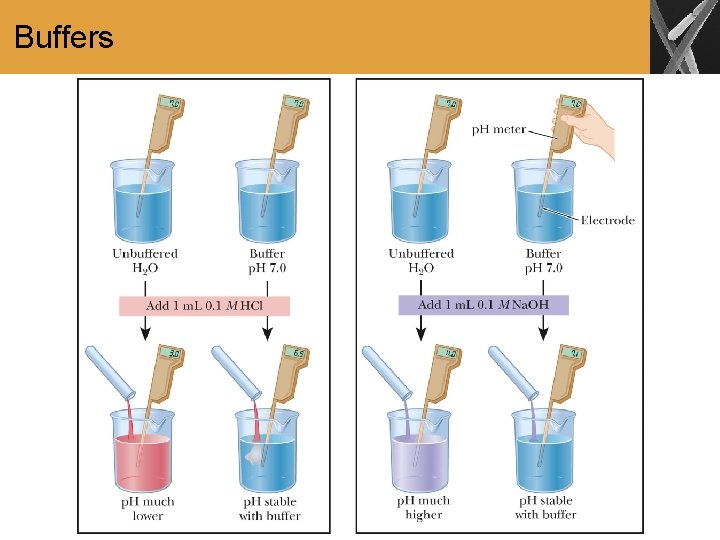
Buffers
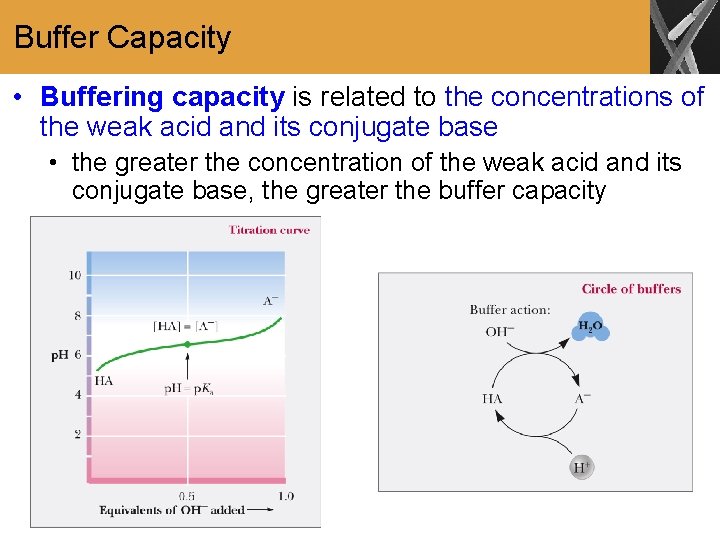
Buffer Capacity • Buffering capacity is related to the concentrations of the weak acid and its conjugate base • the greater the concentration of the weak acid and its conjugate base, the greater the buffer capacity
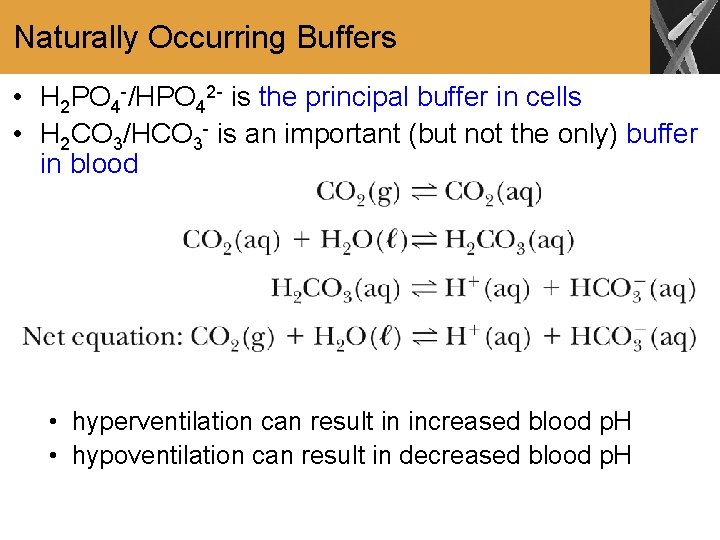
Naturally Occurring Buffers • H 2 PO 4 -/HPO 42 - is the principal buffer in cells • H 2 CO 3/HCO 3 - is an important (but not the only) buffer in blood • hyperventilation can result in increased blood p. H • hypoventilation can result in decreased blood p. H
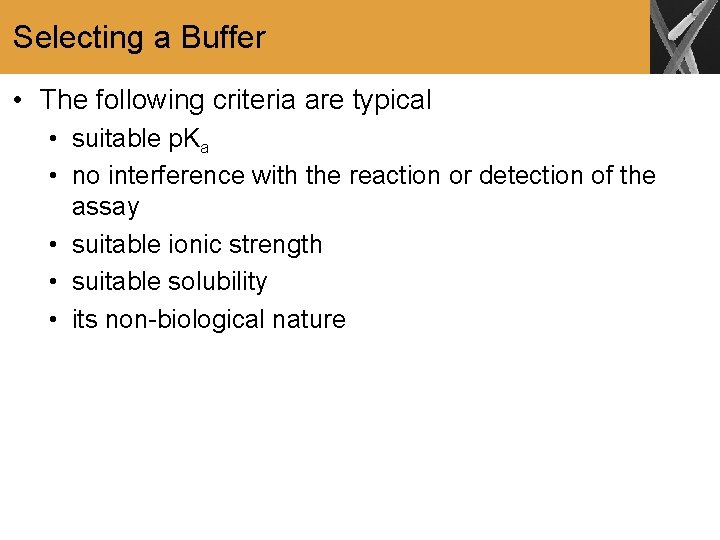
Selecting a Buffer • The following criteria are typical • suitable p. Ka • no interference with the reaction or detection of the assay • suitable ionic strength • suitable solubility • its non-biological nature
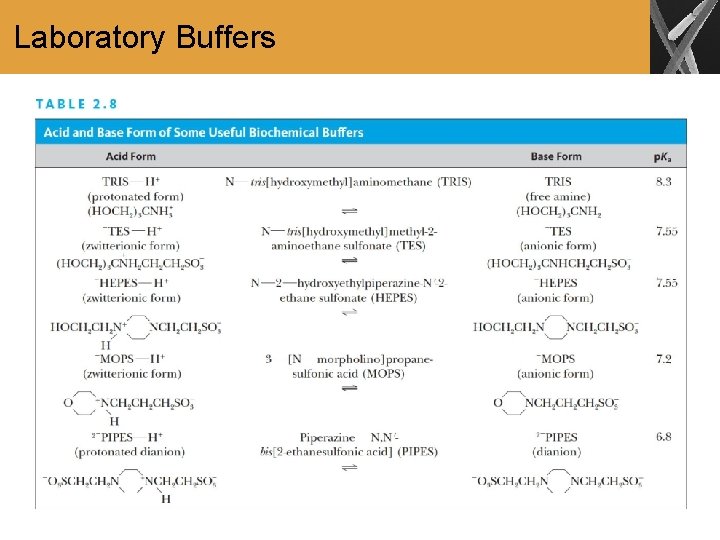
Laboratory Buffers
Problem set • 3, 11, 12, 14, 32
- Slides: 27