
CHAPTER TWO The Consumer Research Process Learning Objectives
CHAPTER TWO The Consumer Research Process
Learning Objectives At the end of this unit you will: 1. Understand the importance of Consumer Research for firms and their brands, as well as Consumers. 2. Understand the steps in the Consumer Research Process. 3. Understand the Importance of establishing specific research objectives as the first step in the design of a consumer research project. Copyright 2010 Pearson Education, Inc. Publishing as Prentice Hall Chapter Two Slide 2
Learning Objectives (continued) 4. Understand the purposes and types of secondary consumer research that is available for making decisions or planning future consumer research. 5. Understand specific features and applications of different research methods to be carried out in consumer research studies. 4. Understand where data analysis and reporting of findings fit in the research process. 5. Understand how each element of the consumer research process adds to the overall outcome of the research study. Copyright 2010 Pearson Education, Inc. Publishing as Prentice Hall Chapter Two Slide 3
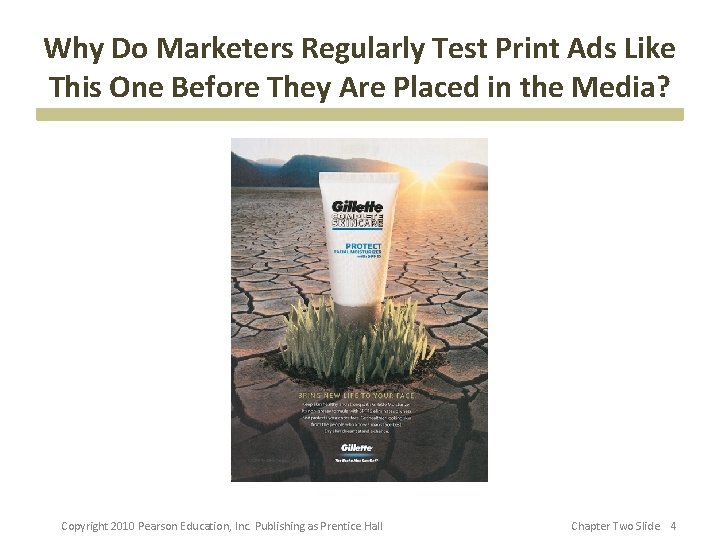
Why Do Marketers Regularly Test Print Ads Like This One Before They Are Placed in the Media? Copyright 2010 Pearson Education, Inc. Publishing as Prentice Hall Chapter Two Slide 4

To Test the Impact of the Message Before Spending Large Amounts of Money Copyright 2010 Pearson Education, Inc. Publishing as Prentice Hall Chapter Two Slide 5
The Importance of the Consumer Research Process • Marketers must understand customers to design effective: – marketing strategies – products – promotional messages Copyright 2010 Pearson Education, Inc. Publishing as Prentice Hall Chapter Two Slide 6
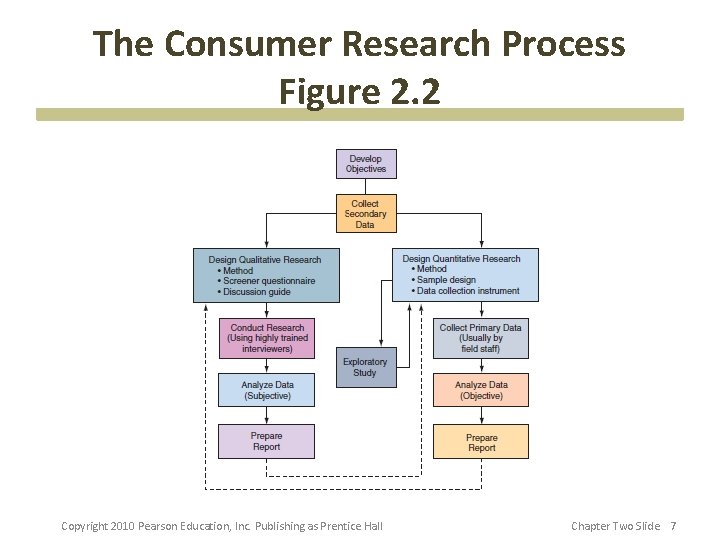
The Consumer Research Process Figure 2. 2 Copyright 2010 Pearson Education, Inc. Publishing as Prentice Hall Chapter Two Slide 7
The Consumer Research Process • Secondary research • Primary research – Qualitative – Quantitative Copyright 2010 Pearson Education, Inc. Publishing as Prentice Hall Chapter Two Slide 8
Developing Research Objectives • Defining purposes and objectives helps ensure an appropriate research design. • A written statement of objectives helps to define the type and level of information needed. Copyright 2010 Pearson Education, Inc. Publishing as Prentice Hall Chapter Two Slide 9
Discussion Questions • Assume you are planning to open a new pizza restaurant near your campus. – What might be three objectives of a research plan for your new business? – How could you gather these data? Copyright 2010 Pearson Education, Inc. Publishing as Prentice Hall Chapter Two Slide 10
Secondary Data • Data that has been collected for reasons other than the specific research project at hand • Includes internal and external data Copyright 2010 Pearson Education, Inc. Publishing as Prentice Hall Chapter Two Slide 11
Types of Secondary Data Internal Data • Data generated in-house • May include analysis of customer files • Useful for calculating customer lifetime value Copyright 2010 Pearson Education, Inc. Publishing as Prentice Hall External Data • Data collected by an outside organization • Includes federal government, periodicals, newspapers, books, search engines • Commercial data is also available from market research firms Chapter Two Slide 12
Discussion Questions Personal Privacy • Many people do not like the fact that their personal data are used for marketing. • How can marketers justify their need for data? • How can they acquire data and maintain customer privacy? Copyright 2010 Pearson Education, Inc. Publishing as Prentice Hall Chapter Two Slide 13
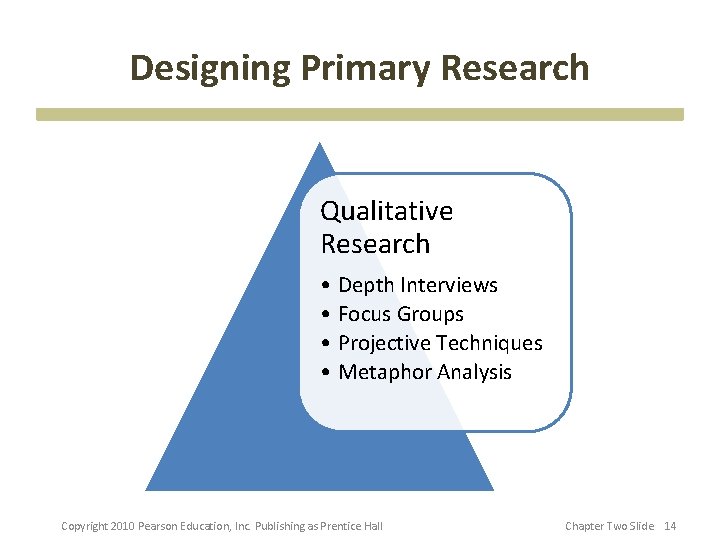
Designing Primary Research Qualitative Research • Depth Interviews • Focus Groups • Projective Techniques • Metaphor Analysis Copyright 2010 Pearson Education, Inc. Publishing as Prentice Hall Chapter Two Slide 14
Qualitative Collection Method Depth Interview Also called one-on-one interview Usually 20 minutes to 1 hour Nonstructured Interviewer will often probe to get more feedback (see following slide for probing) • Session is usually recorded • • Copyright 2010 Pearson Education, Inc. Publishing as Prentice Hall Chapter Two Slide 15
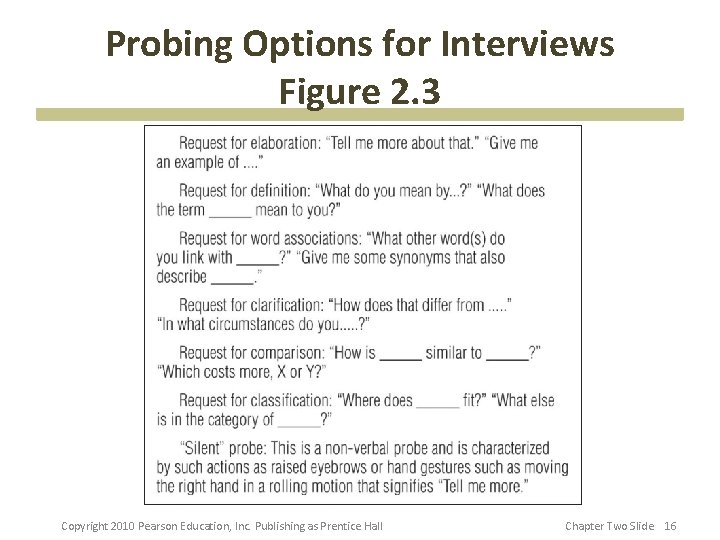
Probing Options for Interviews Figure 2. 3 Copyright 2010 Pearson Education, Inc. Publishing as Prentice Hall Chapter Two Slide 16
Qualitative Collection Method Focus Group • 8 -10 participants • Respondents are recruited through a screener questionnaire • Lasts about 2 hours • Always taped or videotaped to assist analysis • Often held in front of two-way mirrors • Online focus groups are growing Copyright 2010 Pearson Education, Inc. Publishing as Prentice Hall Chapter Two Slide 17
Discussion Guides for Research • Step-by-step outline for depth interviews and focus groups • Interviewers will often “improvise” and go beyond the discussion guide Copyright 2010 Pearson Education, Inc. Publishing as Prentice Hall Chapter Two Slide 18
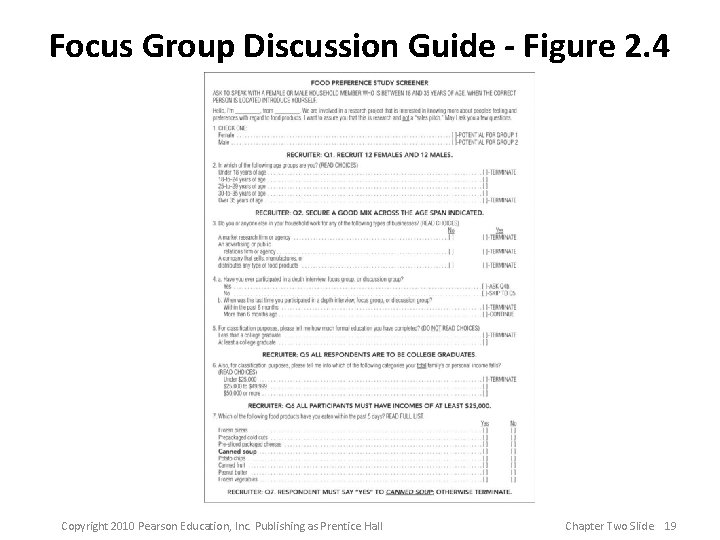
Focus Group Discussion Guide - Figure 2. 4 Copyright 2010 Pearson Education, Inc. Publishing as Prentice Hall Chapter Two Slide 19
Qualitative Collection Method Projective Techniques • Research procedures designed to identify consumers’ subconscious feelings and underlying motivations • Consist of a variety of disguised “tests” Copyright 2010 Pearson Education, Inc. Publishing as Prentice Hall Chapter Two Slide 20
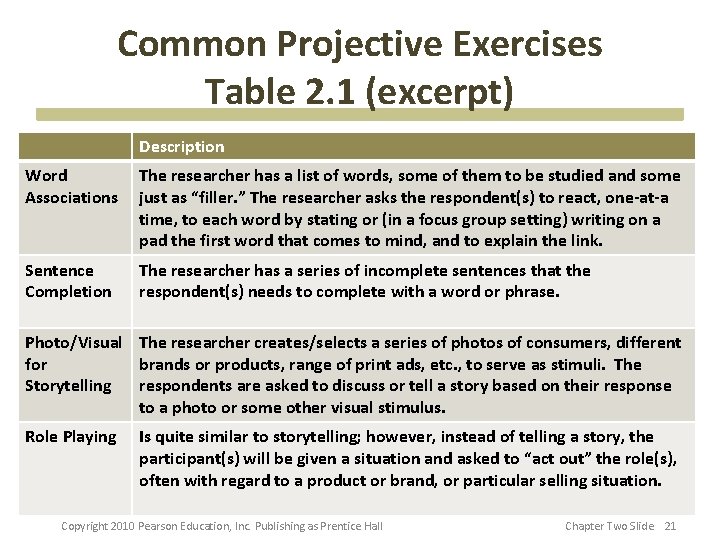
Common Projective Exercises Table 2. 1 (excerpt) Description Word Associations The researcher has a list of words, some of them to be studied and some just as “filler. ” The researcher asks the respondent(s) to react, one-at-a time, to each word by stating or (in a focus group setting) writing on a pad the first word that comes to mind, and to explain the link. Sentence Completion The researcher has a series of incomplete sentences that the respondent(s) needs to complete with a word or phrase. Photo/Visual The researcher creates/selects a series of photos of consumers, different for brands or products, range of print ads, etc. , to serve as stimuli. The Storytelling respondents are asked to discuss or tell a story based on their response to a photo or some other visual stimulus. Role Playing Is quite similar to storytelling; however, instead of telling a story, the participant(s) will be given a situation and asked to “act out” the role(s), often with regard to a product or brand, or particular selling situation. Copyright 2010 Pearson Education, Inc. Publishing as Prentice Hall Chapter Two Slide 21
Qualitative Collection Method Metaphor Analysis • Based on belief that metaphors are the most basic method of thought and communication • Zaltman Metaphor Elicitation Technique (ZMET) combines collage research and metaphor analysis to bring to the surface the mental models and the major themes or constructs that drive consumer thinking and behaviour. Copyright 2010 Pearson Education, Inc. Publishing as Prentice Hall Chapter Two Slide 22
Qualitative Collection Method “Looking-In” • Look at information from threads and postings on social media, including blogs and discussion forums • Methodology to capture consumers’ experiences, opinions, forecasts, needs, and interests Copyright 2010 Pearson Education, Inc. Publishing as Prentice Hall Chapter Two Slide 23
Designing Primary Research Quantitative Research • Observation • Experimentation • Survey questionnaires Copyright 2010 Pearson Education, Inc. Publishing as Prentice Hall Chapter Two Slide 24
Data Collection Methods Observational Research • Helps marketers gain an in-depth understanding of the relationship between people and products by watching them buying and using products • Helps researchers gain a better understanding of what the product symbolises Copyright 2010 Pearson Education, Inc. Publishing as Prentice Hall Chapter Two Slide 25
Data Collection Methods Mechanical Observational Research • Uses mechanical or electronic device to record consumer behaviour or response • Consumers’ increased use of highly convenient technologies will create more records for marketers • Audits are a type of mechanical observation which monitor sales Copyright 2010 Pearson Education, Inc. Publishing as Prentice Hall Chapter Two Slide 26
Data Collection Methods Experimentation • Can be used to test the relative sales appeal of many types of variables • An experiment is usually controlled with only some variables manipulated at a time while the others are constant • Test markets are conducted on a single market area • Experimentation can be conducted in laboratories or in the field Copyright 2010 Pearson Education, Inc. Publishing as Prentice Hall Chapter Two Slide 27
Discussion Questions • What might direct marketers test in experiments? • How can they use the results? Copyright 2010 Pearson Education, Inc. Publishing as Prentice Hall Chapter Two Slide 28
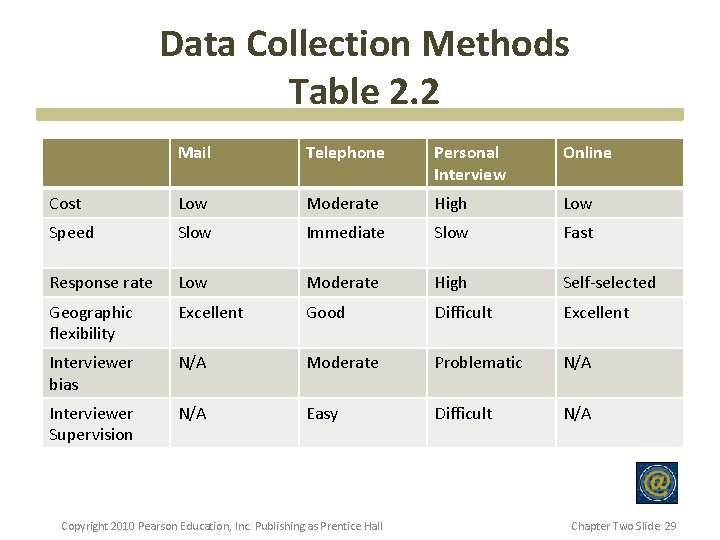
Data Collection Methods Table 2. 2 Mail Telephone Personal Interview Online Cost Low Moderate High Low Speed Slow Immediate Slow Fast Response rate Low Moderate High Self-selected Geographic flexibility Excellent Good Difficult Excellent Interviewer bias N/A Moderate Problematic N/A Interviewer Supervision N/A Easy Difficult N/A Copyright 2010 Pearson Education, Inc. Publishing as Prentice Hall Chapter Two Slide 29
Validity and Reliability • If a study has validity, it collects the appropriate data for the study. • A study has reliability if the same questions, asked of a similar sample, produce the same findings. Copyright 2010 Pearson Education, Inc. Publishing as Prentice Hall Chapter Two Slide 30
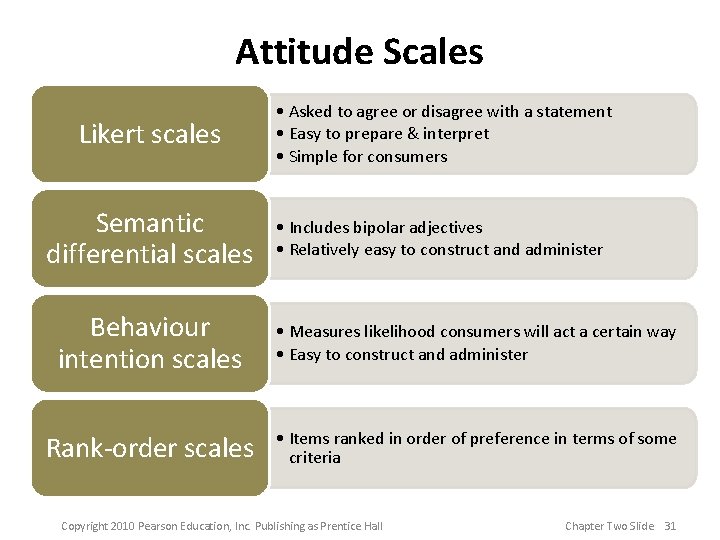
Attitude Scales Likert scales • Asked to agree or disagree with a statement • Easy to prepare & interpret • Simple for consumers Semantic differential scales • Includes bipolar adjectives • Relatively easy to construct and administer Behaviour intention scales • Measures likelihood consumers will act a certain way • Easy to construct and administer Rank-order scales • Items ranked in order of preference in terms of some criteria Copyright 2010 Pearson Education, Inc. Publishing as Prentice Hall Chapter Two Slide 31
Customer Satisfaction Measurement • Customer Satisfaction Surveys – Analysis of Expectations versus Experience • Mystery Shoppers • Customer Complaint Analysis Copyright 2010 Pearson Education, Inc. Publishing as Prentice Hall Chapter Two Slide 32
Sampling and Data Collection • Samples are a subset of the population used to estimate characteristics of the entire population. • A sampling plan addresses: – Whom to survey – How many to survey – How to select them • Researcher must choose probability or nonprobabililty sample. Copyright 2010 Pearson Education, Inc. Publishing as Prentice Hall Chapter Two Slide 33
Data Analysis and Reporting Findings • Open-ended questions are coded and quantified. • All responses are tabulated analyzed. • Final report includes executive summary, body, tables, and graphs. Copyright 2010 Pearson Education, Inc. Publishing as Prentice Hall Chapter Two Slide 34

All rights reserved. No part of this publication may be reproduced, stored in a retrieval system, or transmitted, in any form or by any means, electronic, mechanical, photocopying, recording, or otherwise, without the prior written permission of the publisher. Printed in the United States of America. Copyright © 2010 Pearson Education, Inc. Publishing as Prentice Hall Copyright 2010 Pearson Education, Inc. Publishing as Prentice Hall Chapter Seven Slide 35
- Slides: 35