
Chapter Two Text Operations Statistical Properties of Text
- Slides: 31
Chapter Two Text Operations • Statistical Properties of Text • Index term selection 1
Statistical Properties of Text • How is the frequency of different words distributed? • How fast does vocabulary size grow with the size of a corpus? • There are three well-known researcher who define statistical properties of words in a text: – Zipf’s Law: models word distribution in text corpus – Luhn’s idea: measures word significance – Heap’s Law: shows how vocabulary size grows with the growth corpus size • Such properties of text collection greatly affect the performance of IR system & can be used to select suitable term weights & other aspects of the system. 2
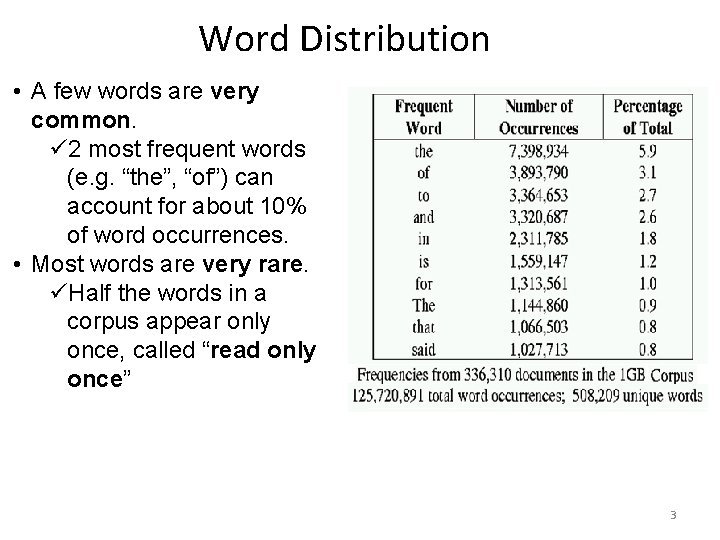
Word Distribution • A few words are very common. ü 2 most frequent words (e. g. “the”, “of”) can account for about 10% of word occurrences. • Most words are very rare. üHalf the words in a corpus appear only once, called “read only once” 3
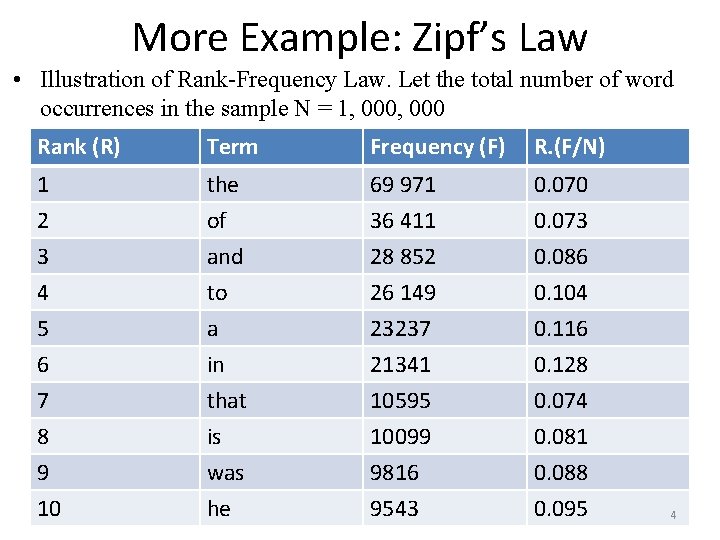
More Example: Zipf’s Law • Illustration of Rank-Frequency Law. Let the total number of word occurrences in the sample N = 1, 000 Rank (R) Term Frequency (F) R. (F/N) 1 2 3 the of and 69 971 36 411 28 852 0. 070 0. 073 0. 086 4 5 6 7 8 9 10 to a in that is was he 26 149 23237 21341 10595 10099 9816 9543 0. 104 0. 116 0. 128 0. 074 0. 081 0. 088 0. 095 4
Text Operations • Not all words in a document are equally significant to represent the contents/meanings of a document – Some word carry more meaning than others – Noun words are the most representative of a document content • Therefore, need to preprocess the text of a document in a collection to be used as index terms • Using the set of all words in a collection to index documents creates too much noise for the retrieval task – Reduce noise means reduce words which can be used to refer to the document • Preprocessing is the process of controlling the size of the vocabulary or the number of distinct words used as index terms – Preprocessing will lead to an improvement in the information retrieval performance • However, some search engines on the Web omit preprocessing – Every word in the document is an index term 15
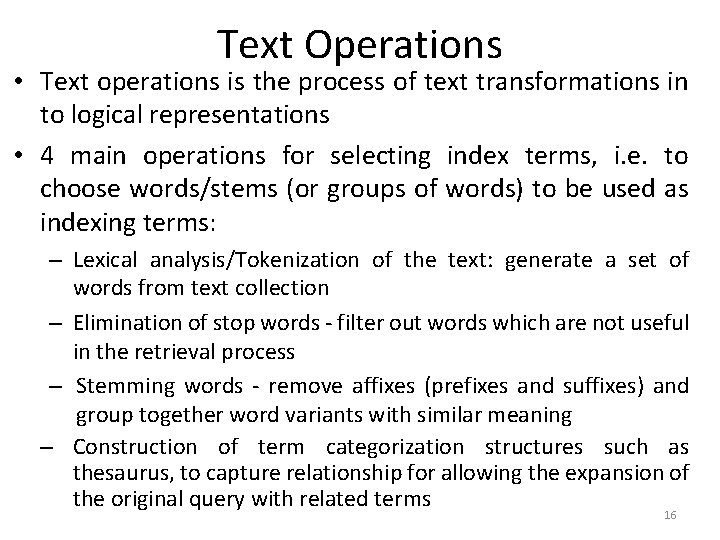
Text Operations • Text operations is the process of text transformations in to logical representations • 4 main operations for selecting index terms, i. e. to choose words/stems (or groups of words) to be used as indexing terms: – Lexical analysis/Tokenization of the text: generate a set of words from text collection – Elimination of stop words - filter out words which are not useful in the retrieval process – Stemming words - remove affixes (prefixes and suffixes) and group together word variants with similar meaning – Construction of term categorization structures such as thesaurus, to capture relationship for allowing the expansion of the original query with related terms 16
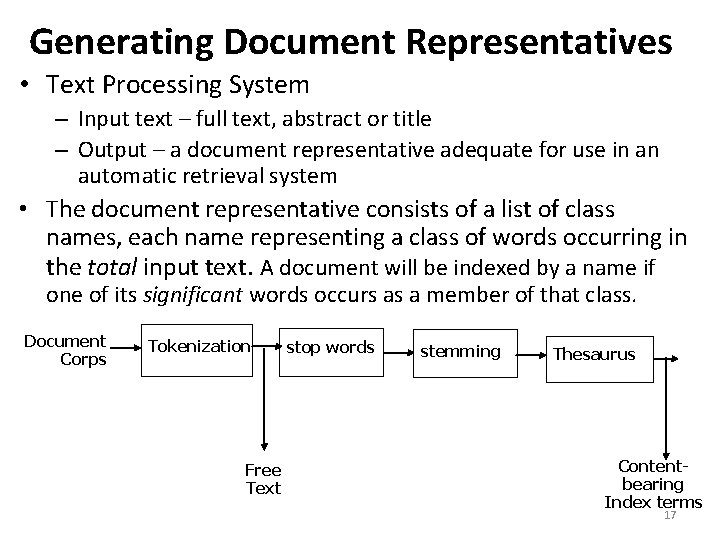
Generating Document Representatives • Text Processing System – Input text – full text, abstract or title – Output – a document representative adequate for use in an automatic retrieval system • The document representative consists of a list of class names, each name representing a class of words occurring in the total input text. A document will be indexed by a name if one of its significant words occurs as a member of that class. Document Corps Tokenization Free Text stop words stemming Thesaurus Contentbearing Index terms 17
Lexical Analysis/Tokenization of Text • Tokenization is one of the step used to convert text of the documents into a sequence of words, w 1, w 2, … wn to be adopted as index terms. – It is the process of demarcating and possibly classifying sections of a string of input characters into words. – How we identify a set of words that exist in a text documents? consider, The quick brown fox jumps over the lazy dog • Objective - identify words in the text –Tokenization greatly depends on how the concept of word defined • Is that a sequence of characters, numbers and alpha-numeric once? A word is a sequence of letters terminated by a separator (period, comma, space, etc). • Definition of letter and separator is flexible; e. g. , hyphen could be defined as a letter or as a separator. • Usually, common words (such as “a”, “the”, “of”, …) are ignored. • Tokenization Issues – numbers, hyphens, punctuations marks, apostrophes … 18
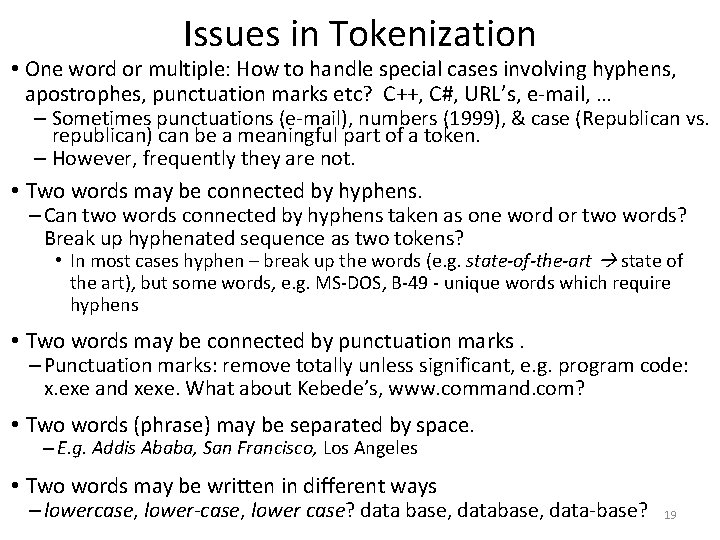
Issues in Tokenization • One word or multiple: How to handle special cases involving hyphens, apostrophes, punctuation marks etc? C++, C#, URL’s, e-mail, … – Sometimes punctuations (e-mail), numbers (1999), & case (Republican vs. republican) can be a meaningful part of a token. – However, frequently they are not. • Two words may be connected by hyphens. – Can two words connected by hyphens taken as one word or two words? Break up hyphenated sequence as two tokens? • In most cases hyphen – break up the words (e. g. state-of-the-art state of the art), but some words, e. g. MS-DOS, B-49 - unique words which require hyphens • Two words may be connected by punctuation marks. – Punctuation marks: remove totally unless significant, e. g. program code: x. exe and xexe. What about Kebede’s, www. command. com? • Two words (phrase) may be separated by space. – E. g. Addis Ababa, San Francisco, Los Angeles • Two words may be written in different ways – lowercase, lower-case, lower case? data base, data-base? 19
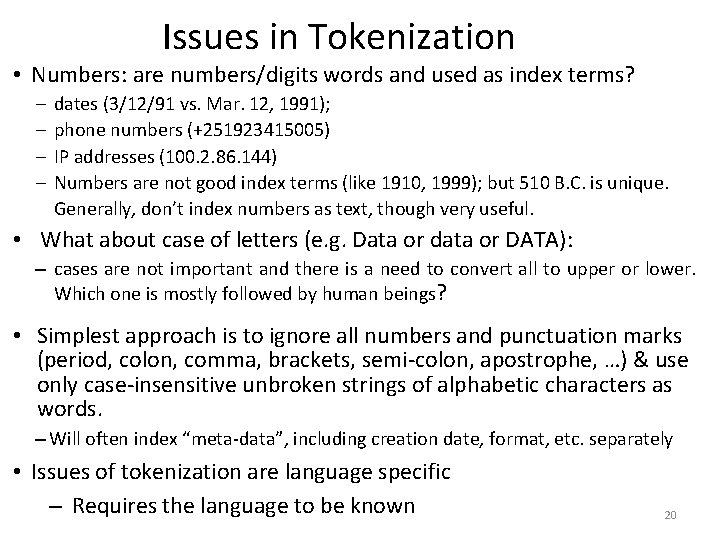
Issues in Tokenization • Numbers: are numbers/digits words and used as index terms? – – dates (3/12/91 vs. Mar. 12, 1991); phone numbers (+251923415005) IP addresses (100. 2. 86. 144) Numbers are not good index terms (like 1910, 1999); but 510 B. C. is unique. Generally, don’t index numbers as text, though very useful. • What about case of letters (e. g. Data or data or DATA): – cases are not important and there is a need to convert all to upper or lower. Which one is mostly followed by human beings? • Simplest approach is to ignore all numbers and punctuation marks (period, colon, comma, brackets, semi-colon, apostrophe, …) & use only case-insensitive unbroken strings of alphabetic characters as words. – Will often index “meta-data”, including creation date, format, etc. separately • Issues of tokenization are language specific – Requires the language to be known 20
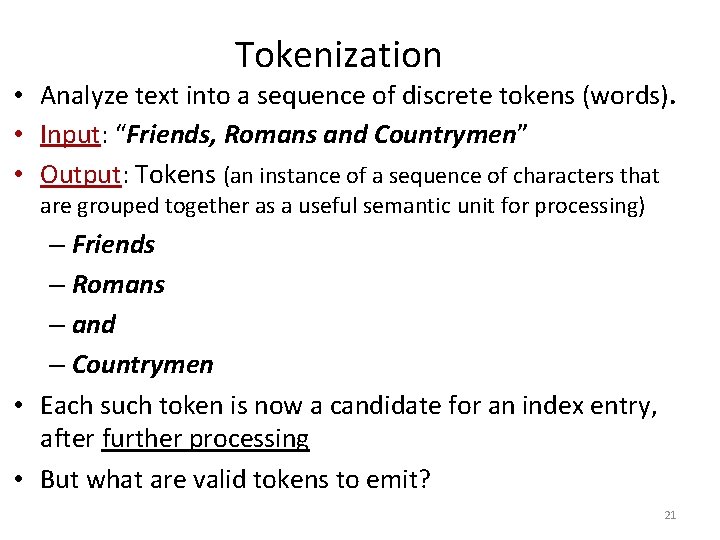
Tokenization • Analyze text into a sequence of discrete tokens (words). • Input: “Friends, Romans and Countrymen” • Output: Tokens (an instance of a sequence of characters that are grouped together as a useful semantic unit for processing) – Friends – Romans – and – Countrymen • Each such token is now a candidate for an index entry, after further processing • But what are valid tokens to emit? 21
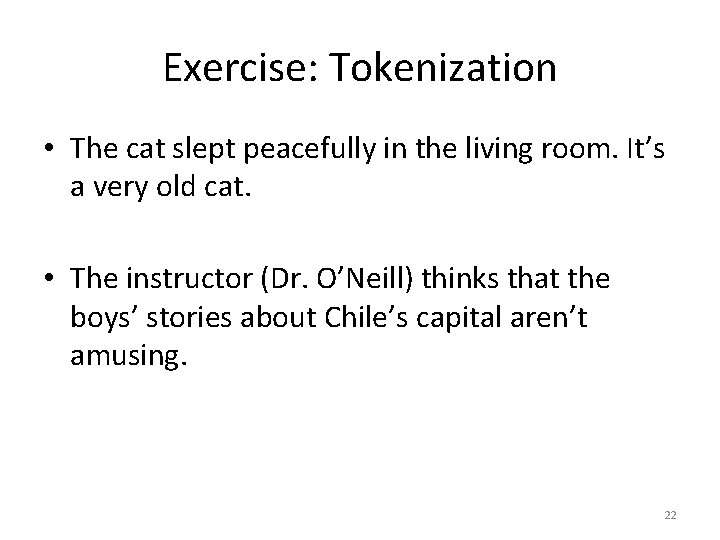
Exercise: Tokenization • The cat slept peacefully in the living room. It’s a very old cat. • The instructor (Dr. O’Neill) thinks that the boys’ stories about Chile’s capital aren’t amusing. 22
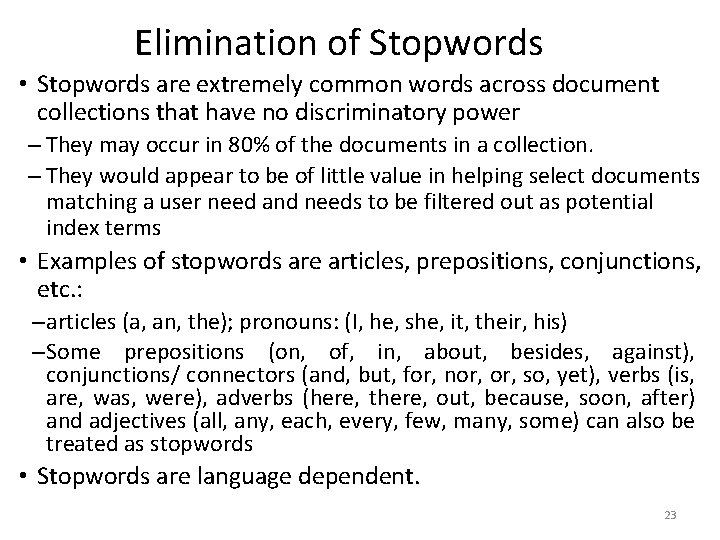
Elimination of Stopwords • Stopwords are extremely common words across document collections that have no discriminatory power – They may occur in 80% of the documents in a collection. – They would appear to be of little value in helping select documents matching a user need and needs to be filtered out as potential index terms • Examples of stopwords are articles, prepositions, conjunctions, etc. : – articles (a, an, the); pronouns: (I, he, she, it, their, his) – Some prepositions (on, of, in, about, besides, against), conjunctions/ connectors (and, but, for, nor, so, yet), verbs (is, are, was, were), adverbs (here, there, out, because, soon, after) and adjectives (all, any, each, every, few, many, some) can also be treated as stopwords • Stopwords are language dependent. 23
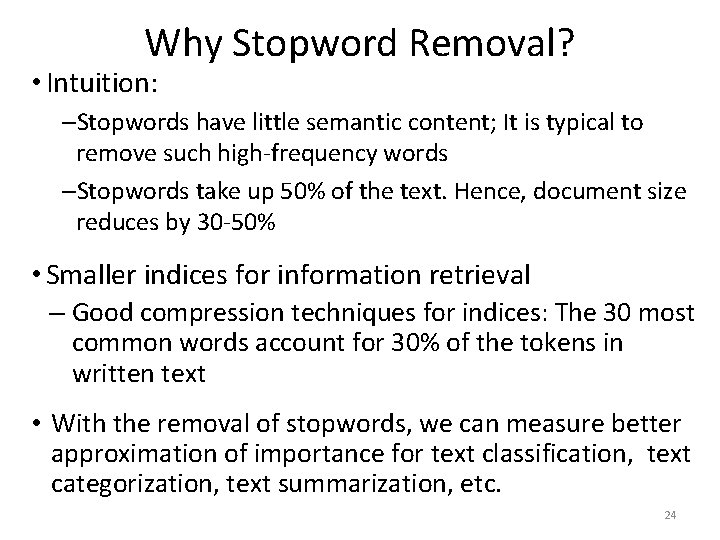
Why Stopword Removal? • Intuition: –Stopwords have little semantic content; It is typical to remove such high-frequency words –Stopwords take up 50% of the text. Hence, document size reduces by 30 -50% • Smaller indices for information retrieval – Good compression techniques for indices: The 30 most common words account for 30% of the tokens in written text • With the removal of stopwords, we can measure better approximation of importance for text classification, text categorization, text summarization, etc. 24
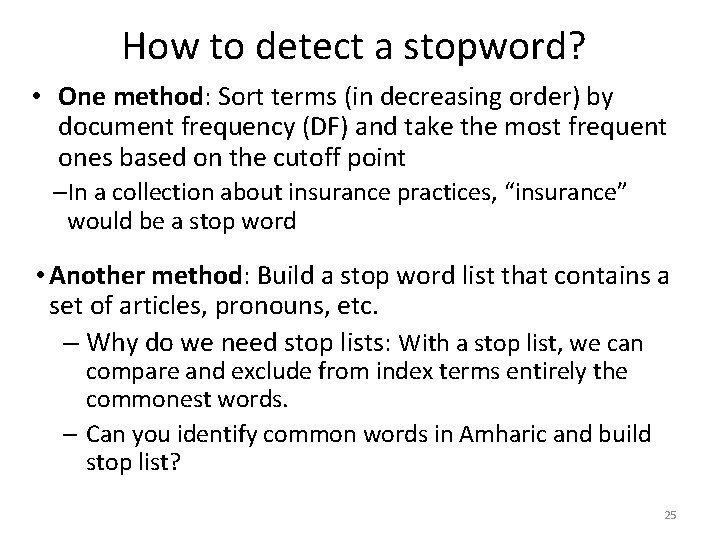
How to detect a stopword? • One method: Sort terms (in decreasing order) by document frequency (DF) and take the most frequent ones based on the cutoff point –In a collection about insurance practices, “insurance” would be a stop word • Another method: Build a stop word list that contains a set of articles, pronouns, etc. – Why do we need stop lists: With a stop list, we can compare and exclude from index terms entirely the commonest words. – Can you identify common words in Amharic and build stop list? 25
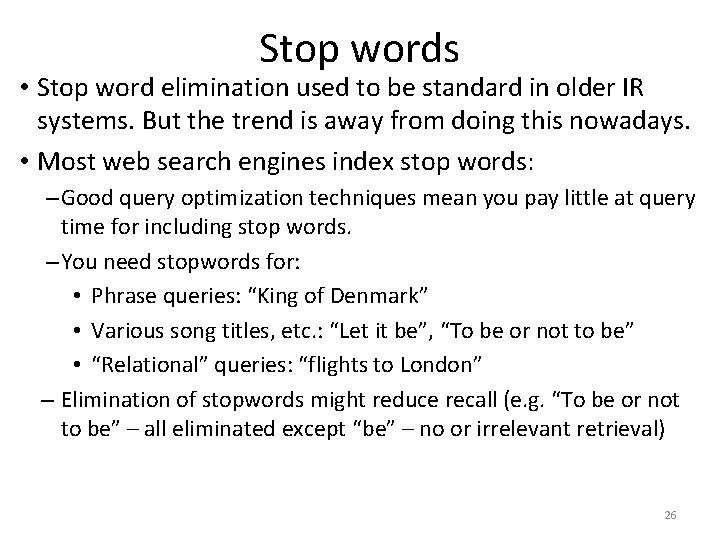
Stop words • Stop word elimination used to be standard in older IR systems. But the trend is away from doing this nowadays. • Most web search engines index stop words: – Good query optimization techniques mean you pay little at query time for including stop words. – You need stopwords for: • Phrase queries: “King of Denmark” • Various song titles, etc. : “Let it be”, “To be or not to be” • “Relational” queries: “flights to London” – Elimination of stopwords might reduce recall (e. g. “To be or not to be” – all eliminated except “be” – no or irrelevant retrieval) 26
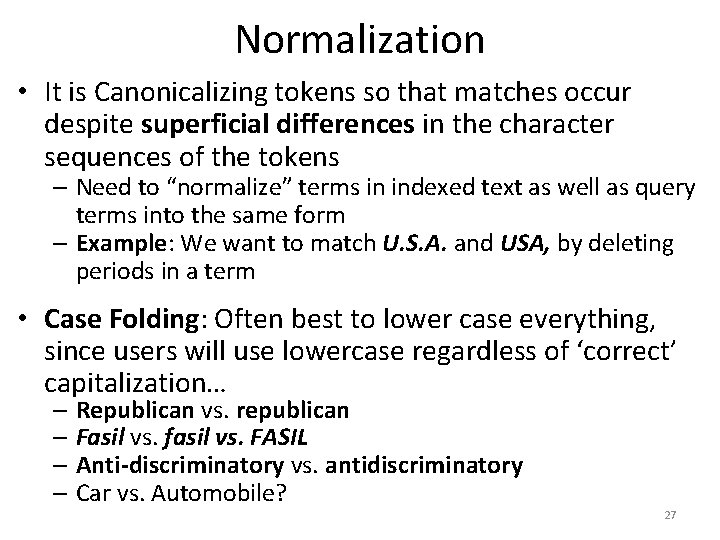
Normalization • It is Canonicalizing tokens so that matches occur despite superficial differences in the character sequences of the tokens – Need to “normalize” terms in indexed text as well as query terms into the same form – Example: We want to match U. S. A. and USA, by deleting periods in a term • Case Folding: Often best to lower case everything, since users will use lowercase regardless of ‘correct’ capitalization… – Republican vs. republican – Fasil vs. fasil vs. FASIL – Anti-discriminatory vs. antidiscriminatory – Car vs. Automobile? 27
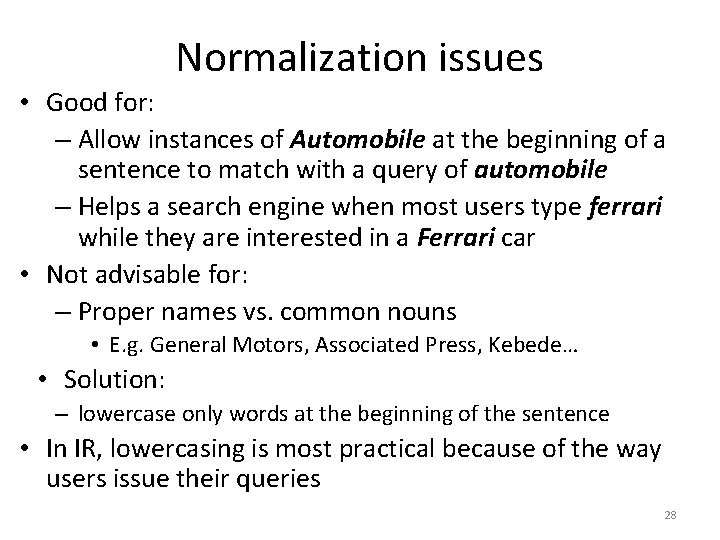
Normalization issues • Good for: – Allow instances of Automobile at the beginning of a sentence to match with a query of automobile – Helps a search engine when most users type ferrari while they are interested in a Ferrari car • Not advisable for: – Proper names vs. common nouns • E. g. General Motors, Associated Press, Kebede… • Solution: – lowercase only words at the beginning of the sentence • In IR, lowercasing is most practical because of the way users issue their queries 28
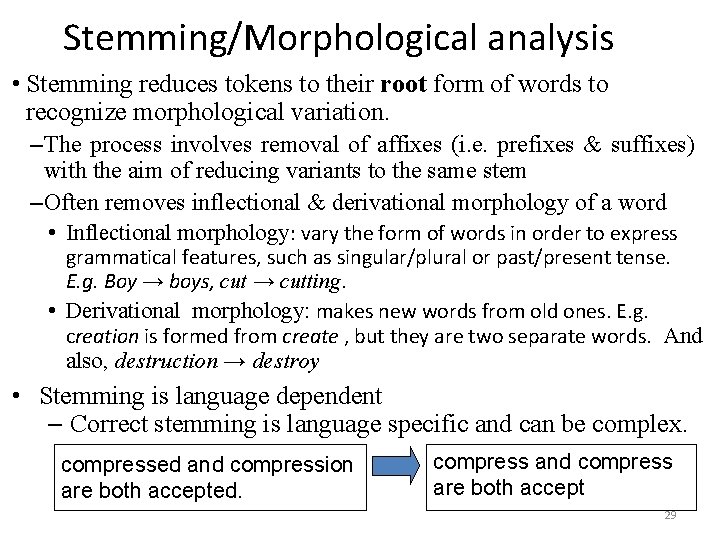
Stemming/Morphological analysis • Stemming reduces tokens to their root form of words to recognize morphological variation. – The process involves removal of affixes (i. e. prefixes & suffixes) with the aim of reducing variants to the same stem – Often removes inflectional & derivational morphology of a word • Inflectional morphology: vary the form of words in order to express grammatical features, such as singular/plural or past/present tense. E. g. Boy → boys, cut → cutting. • Derivational morphology: makes new words from old ones. E. g. creation is formed from create , but they are two separate words. And also, destruction → destroy • Stemming is language dependent – Correct stemming is language specific and can be complex. compressed and compression are both accepted. compress and compress are both accept 29
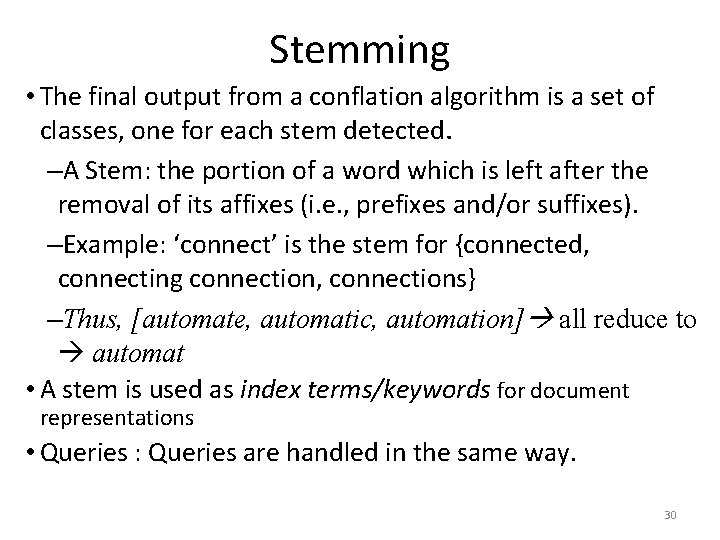
Stemming • The final output from a conflation algorithm is a set of classes, one for each stem detected. –A Stem: the portion of a word which is left after the removal of its affixes (i. e. , prefixes and/or suffixes). –Example: ‘connect’ is the stem for {connected, connecting connection, connections} –Thus, [automate, automatic, automation] all reduce to automat • A stem is used as index terms/keywords for document representations • Queries : Queries are handled in the same way. 30
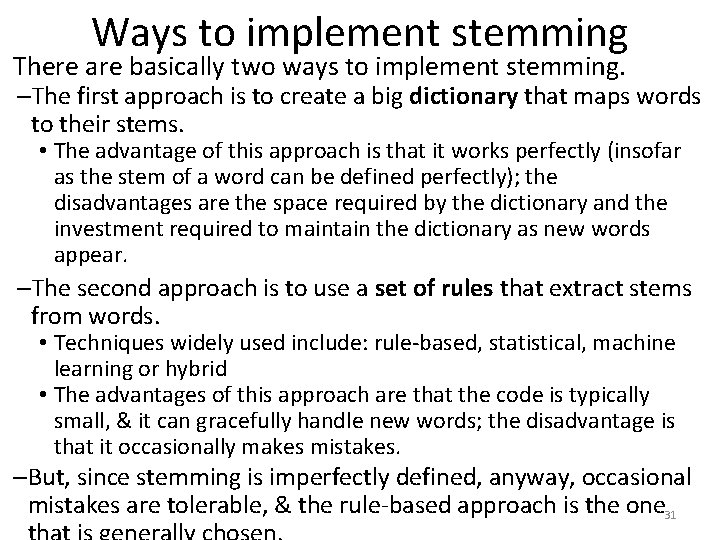
Ways to implement stemming There are basically two ways to implement stemming. –The first approach is to create a big dictionary that maps words to their stems. • The advantage of this approach is that it works perfectly (insofar as the stem of a word can be defined perfectly); the disadvantages are the space required by the dictionary and the investment required to maintain the dictionary as new words appear. –The second approach is to use a set of rules that extract stems from words. • Techniques widely used include: rule-based, statistical, machine learning or hybrid • The advantages of this approach are that the code is typically small, & it can gracefully handle new words; the disadvantage is that it occasionally makes mistakes. –But, since stemming is imperfectly defined, anyway, occasional mistakes are tolerable, & the rule-based approach is the one 31
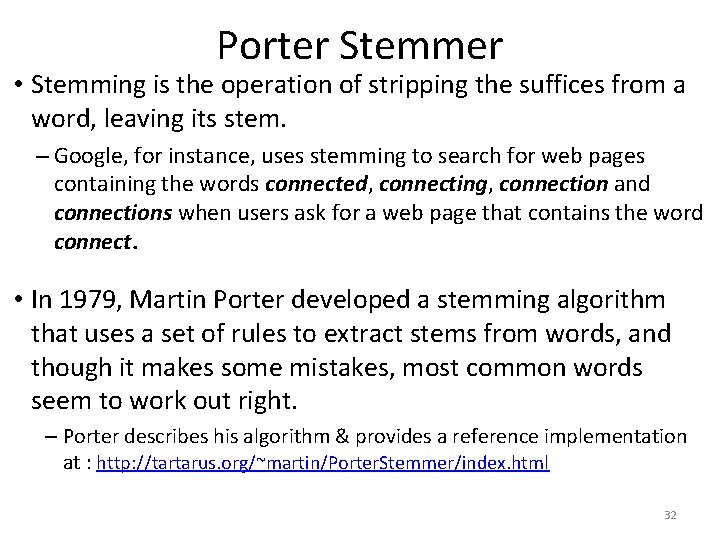
Porter Stemmer • Stemming is the operation of stripping the suffices from a word, leaving its stem. – Google, for instance, uses stemming to search for web pages containing the words connected, connecting, connection and connections when users ask for a web page that contains the word connect. • In 1979, Martin Porter developed a stemming algorithm that uses a set of rules to extract stems from words, and though it makes some mistakes, most common words seem to work out right. – Porter describes his algorithm & provides a reference implementation at : http: //tartarus. org/~martin/Porter. Stemmer/index. html 32
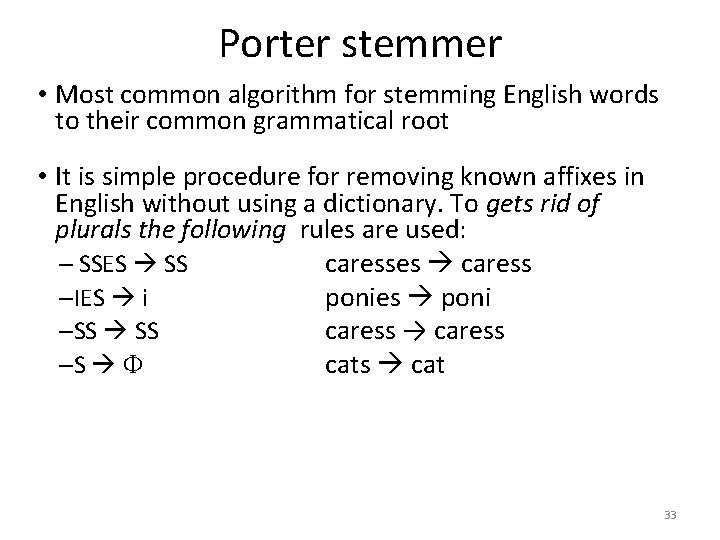
Porter stemmer • Most common algorithm for stemming English words to their common grammatical root • It is simple procedure for removing known affixes in English without using a dictionary. To gets rid of plurals the following rules are used: – SSES SS caresses caress –IES i ponies poni –SS SS caress → caress –S cats cat 33
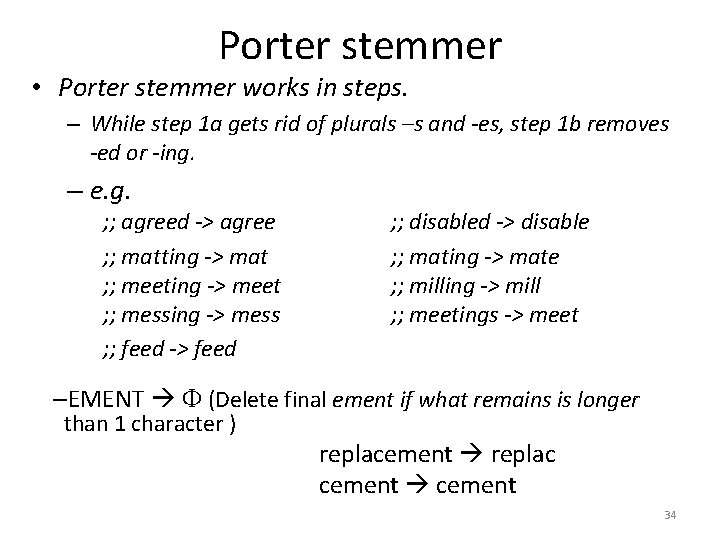
Porter stemmer • Porter stemmer works in steps. – While step 1 a gets rid of plurals –s and -es, step 1 b removes -ed or -ing. – e. g. ; ; agreed -> agree ; ; matting -> mat ; ; meeting -> meet ; ; messing -> mess ; ; feed -> feed ; ; disabled -> disable ; ; mating -> mate ; ; milling -> mill ; ; meetings -> meet –EMENT (Delete final ement if what remains is longer than 1 character ) replacement replac cement 34
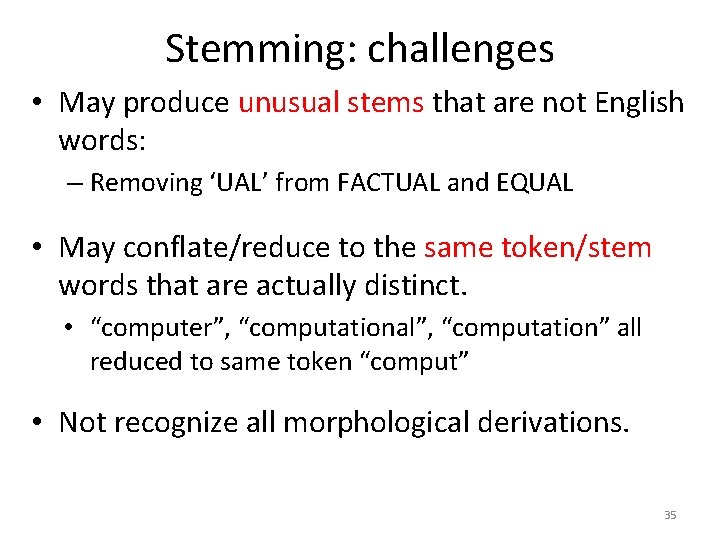
Stemming: challenges • May produce unusual stems that are not English words: – Removing ‘UAL’ from FACTUAL and EQUAL • May conflate/reduce to the same token/stem words that are actually distinct. • “computer”, “computational”, “computation” all reduced to same token “comput” • Not recognize all morphological derivations. 35
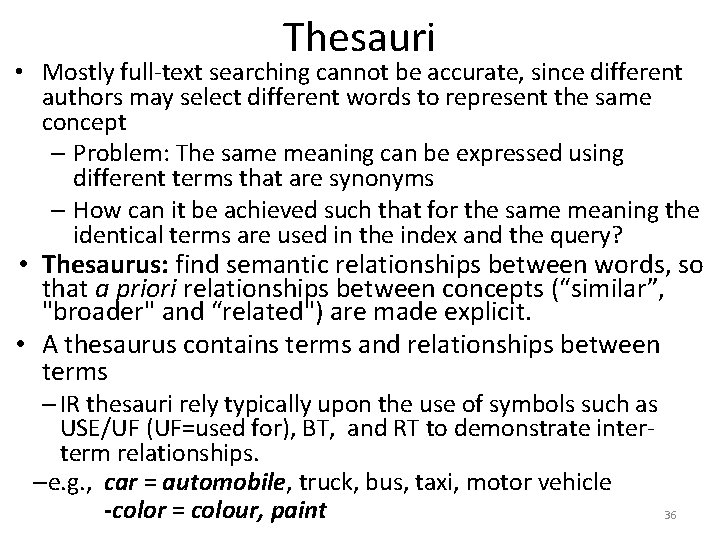
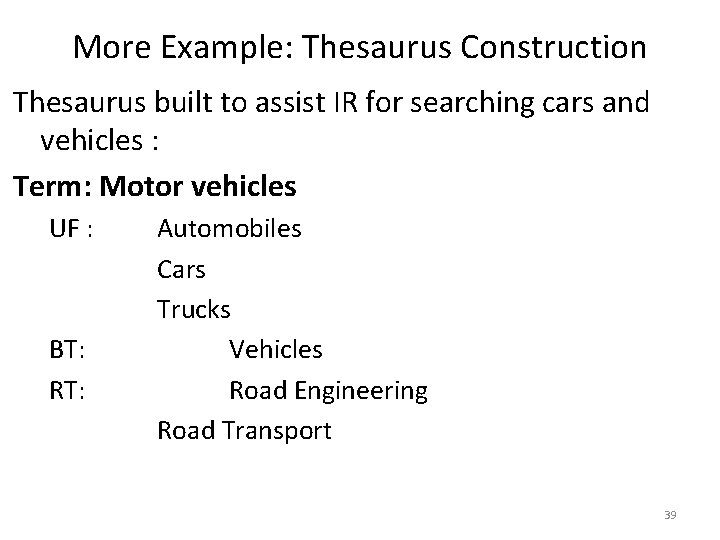
Thesauri • Mostly full-text searching cannot be accurate, since different authors may select different words to represent the same concept – Problem: The same meaning can be expressed using different terms that are synonyms – How can it be achieved such that for the same meaning the identical terms are used in the index and the query? • Thesaurus: find semantic relationships between words, so that a priori relationships between concepts (“similar”, "broader" and “related") are made explicit. • A thesaurus contains terms and relationships between terms – IR thesauri rely typically upon the use of symbols such as USE/UF (UF=used for), BT, and RT to demonstrate interterm relationships. –e. g. , car = automobile, truck, bus, taxi, motor vehicle -color = colour, paint 36
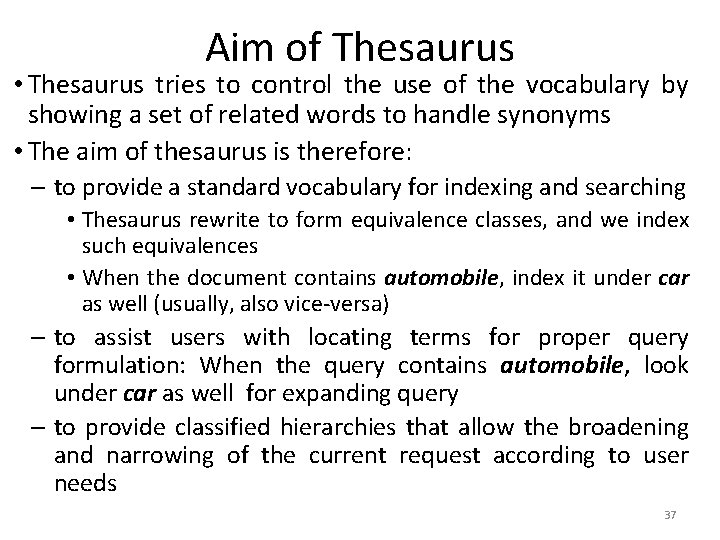
Aim of Thesaurus • Thesaurus tries to control the use of the vocabulary by showing a set of related words to handle synonyms • The aim of thesaurus is therefore: – to provide a standard vocabulary for indexing and searching • Thesaurus rewrite to form equivalence classes, and we index such equivalences • When the document contains automobile, index it under car as well (usually, also vice-versa) – to assist users with locating terms for proper query formulation: When the query contains automobile, look under car as well for expanding query – to provide classified hierarchies that allow the broadening and narrowing of the current request according to user needs 37
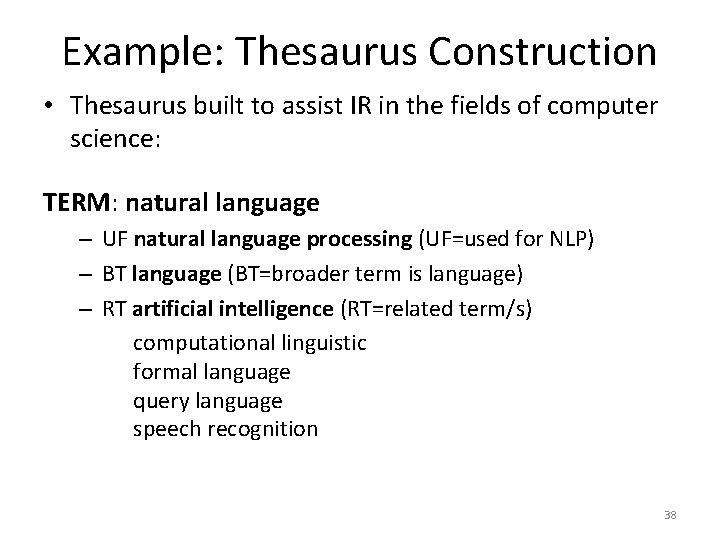
Example: Thesaurus Construction • Thesaurus built to assist IR in the fields of computer science: TERM: natural language – UF natural language processing (UF=used for NLP) – BT language (BT=broader term is language) – RT artificial intelligence (RT=related term/s) computational linguistic formal language query language speech recognition 38
More Example: Thesaurus Construction Thesaurus built to assist IR for searching cars and vehicles : Term: Motor vehicles UF : BT: RT: Automobiles Cars Trucks Vehicles Road Engineering Road Transport 39
Language-specificity • Many of the above features embody transformations that are – Language-specific and – Often, application-specific • These are “plug-in” addenda to the indexing process • Both open source and commercial plug-ins are available for handling these 40
Index Term Selection • Index language is the language used to describe documents and requests • Elements of the index language are index terms which may be derived from the text of the document to be described, or may be arrived at independently. – If a full text representation of the text is adopted, then all words in the text are used as index terms = full text indexing – Otherwise, need to select the words to be used as index terms for reducing the size of the index file which is basic to design an efficient searching IR system 41