
Chapter Two Studying Human Sexuality Copyright 2008 by
Chapter Two Studying Human Sexuality Copyright © 2008 by the Mc. Graw-Hill Companies, Inc.
Sex, Advice Columnists, and Pop Psychology • The sex information/advice genre seeks to: – Inform – Entertain • Often includes moral judgments • Use social science and psychiatry to give authority Copyright © 2008 by the Mc. Graw-Hill Companies, Inc.
Use and Abuse of Statistics • Popular media may oversimplify or distort research – Sensationalize findings – Over generalize results of research – Report statistics that agree with widely-held preconceptions • Popular media may not emphasize the importance of replication Copyright © 2008 by the Mc. Graw-Hill Companies, Inc.
Thinking Critically about Sex • Commitment to principle of Objectivity – observation of reality while excluding researchers’ feelings or beliefs • Subjectivity is to be avoided – Sexuality can bring out powerful emotions and moral ambivalence Copyright © 2008 by the Mc. Graw-Hill Companies, Inc.
Value Judgments: Limitations • Do not tell us what motivates people • Do not tell us how frequently people behave in a given way • Do not tell us how people feel • Only tell us how we ourselves feel Copyright © 2008 by the Mc. Graw-Hill Companies, Inc.

Value Judgments vs. Objectivity • Value judgments only reveal the thoughts or feelings of one person • Objectivity describes reality • Objective positions can be tested • Cultural relativity requires that we examine appropriateness within the cultural norms where it exists Copyright © 2008 by the Mc. Graw-Hill Companies, Inc.
Value Judgments vs. Objectivity • Value judgments imply how a person ought to behave • Objective statements describe how people actually behave • Value judgments cannot be empirically evaluated • Objective statements can be empirically evaluated Copyright © 2008 by the Mc. Graw-Hill Companies, Inc.
Opinions, Biases, and Stereotypes • Opinions are unsubstantiated beliefs or conclusions based on an individual’s thoughts • Biases are personal leanings or inclinations • Stereotypes are sets of overgeneralized beliefs about an individual, a group, or an idea, etc. Copyright © 2008 by the Mc. Graw-Hill Companies, Inc.
Stereotypes • Sexual stereotyping is often used to justify discrimination or social groups • Women • Poor people • African Americans, Latino/as, Asian Americans • Gay men, lesbians, bisexuals, transgender people Copyright © 2008 by the Mc. Graw-Hill Companies, Inc.
Stereotypes • Stereotypes structure our knowledge by shaping: – What we see – What we notice – What we remember – How we explain things Copyright © 2008 by the Mc. Graw-Hill Companies, Inc.
Attitudes and Behavior • Attitude: a predisposition a person has to act, think, or feel in certain ways • Behavior: the way a person acts • Behavior does not always predict attitude and vice versa • Frequent discrepancies exist Copyright © 2008 by the Mc. Graw-Hill Companies, Inc.
Common Fallacies: Egocentrism and Ethnocentrism • Fallacy: an error in reasoning that affects our understanding of a subject – Egocentric fallacy: the belief that our own personal experience and values are generally held by others – Ethnocentric fallacy: the belief that one’s own ethnic group, nation, or culture’s values and customs are innately superior to others’ Copyright © 2008 by the Mc. Graw-Hill Companies, Inc.
Sex Research Methods • Scientific Method: the method by which a hypothesis is formed from impartially gathered data and tested empirically. – Induction: drawing a general conclusion from specific facts – Seeks to describe the world rather than to evaluate or judge it Copyright © 2008 by the Mc. Graw-Hill Companies, Inc.
Research Concerns • Ethical – Concerns use of human beings as subjects of research • Methodological – Concerns center on information-gathering techniques and accuracy – A representative sample of people is necessary to draw accurate conclusions Copyright © 2008 by the Mc. Graw-Hill Companies, Inc.
Ethical Issues • Informed consent – Full disclosure of purpose, risk, benefits – Agreement to participate may be withdrawn • Protection from harm – Emotional distress must be avoided – Identity of subjects must be confidential Copyright © 2008 by the Mc. Graw-Hill Companies, Inc.
Sampling • Sample: a portion of a larger group of people are observed or studied • Inferences are made to the larger group • Good samples are: • Random • Representative • Unbiased Copyright © 2008 by the Mc. Graw-Hill Companies, Inc.
Limitations of Samples Restrict Generalizations • Depend on volunteers or clients • Takes place at universities or colleges with student volunteers • Some ethnic groups are underrepresented • Gay men, lesbian women, bisexual and transgendered people may not be publicly identified Copyright © 2008 by the Mc. Graw-Hill Companies, Inc.
Clinical Research • An in-depth examination of an individual or group that comes to a specialist for assistance with disorders and problems • Limited by an emphasis on pathological behavior • Shaped by cultural definitions of what is pathological Copyright © 2008 by the Mc. Graw-Hill Companies, Inc.
Survey Research • Questionnaires – Administered quickly – Forced choice allows many formats • Interviews – Allow more information to be gathered – Allow subjects to guide topics • Sexual diaries – Collect richer information – May work well with some subjects but not all Copyright © 2008 by the Mc. Graw-Hill Companies, Inc.
Survey Research Limitations • Subjects may report self behavior with bias • Interviewers may collect information with a bias • Subjects may be embarrassed in an interview • Accuracy of subjects’ memory fades as time passes • Difficult for subjects to accurately estimate factors such as how long sexual encounters last Copyright © 2008 by the Mc. Graw-Hill Companies, Inc.
Observational Research • The researcher unobtrusively observes and makes notes about people’s behavior • Serious ethical issues in observing sexual behavior without subjects’ knowledge or consent • Known observation generally affects behavior Copyright © 2008 by the Mc. Graw-Hill Companies, Inc.
Participant Observation • The researcher participates in the behaviors which she or he is studying • Used frequently by anthropologists • Is sex research controversial because it compromises objectivity? Copyright © 2008 by the Mc. Graw-Hill Companies, Inc.
Experimental Research • The systematic manipulation of variables to examine the effect on behavior • Independent variables: factors that can be manipulated and changed by the experimenter • Dependent variables: factors that are likely to be affected by changes in the independent variable Copyright © 2008 by the Mc. Graw-Hill Companies, Inc.
The Sex Researchers • In 19 th century, Western sexuality began to be studied from a scientific framework – “pathologies” of sex: fetishism, sadism, masturbation, homosexuality • 20 th century researchers viewed sexuality more positively Copyright © 2008 by the Mc. Graw-Hill Companies, Inc.
The Sex Researchers • Belief that sexual expression is essential to an individual’s well being • Desire to broaden the range of legitimate sexual activity, including homosexuality • Belief that female sexuality is equal to male sexuality Copyright © 2008 by the Mc. Graw-Hill Companies, Inc.
Richard von Krafft-Ebing (1840 -1902) • Psychopathia Sexualis (1886): – A collection of the case histories of fetishists, sadists, masochists, and homosexuals – Attributed variations in Victorian sexuality to “hereditary taint, ” “moral degeneracy, ” and masturbation Copyright © 2008 by the Mc. Graw-Hill Companies, Inc.
Sigmund Freud (1856 -1939) • Dramatically impacted Western ideas • Sexuality begins at birth with five-stage development: • • • Oral stage (birth to 1 year) Anal stage (age 1 -3) Phallic stage (age 3 -5) Latency stage (age 6 -puberty) Genital stage (puberty onward) Copyright © 2008 by the Mc. Graw-Hill Companies, Inc.
Sigmund Freud: Phallic stage • Oedipal Complex: Boy develops sexual desires for mother and fears father • Castration anxiety: Fears his father will cut off his penis • Electra complex: Girl develops sexual desire for father and fears mother • Penis envy: Girls never acquire the “lost penis” and therefore fail to develop an independent character like that of boys • By age 6, boys and girls resolve their complexes and identify with their same-sex parent Copyright © 2008 by the Mc. Graw-Hill Companies, Inc.
Sigmund Freud: Impact – Freud was pioneering in commitment to science and explorations of the unconscious – Over the past generation, his influence among American sex researchers has dwindled – In the field of sex research, his work is now primarily of historical interest Copyright © 2008 by the Mc. Graw-Hill Companies, Inc.
Havelock Ellis (1859 -1939) • Studies in the Psychology of Sex (1897 -1910) • Pointed out the relativity of sexual values • Appealed to case studies as well as studies in animal behavior, anthropology, and history • Challenged view that masturbation was abnormal • Documented existence of women’s sexual desires • Reevaluated homosexuality as a congenital condition Copyright © 2008 by the Mc. Graw-Hill Companies, Inc.
Alfred Kinsey (1894 -1956) • The Kinsey Reports – Sexual Behavior in the Human Male (1948) – Sexual Behavior in the Human Female (1953) – Showed a significant discrepancy between public standards and actual standards of sexual behavior Copyright © 2008 by the Mc. Graw-Hill Companies, Inc.
Alfred Kinsey: Impact • Sexual Diversity and Variation • Extraordinary diversity in behaviors of subjects • Many subjects (e. g. 50% of men) had sexual experiences with members of the same-sex • Reevaluation of Masturbation • Important for women • Harmless • Pleasurable Copyright © 2008 by the Mc. Graw-Hill Companies, Inc.
Alfred Kinsey: Controversy • Same sex behavior – Labels of “heterosexual” and “homosexual” were inadequate – Devised the “Kinsey Scale” • Rejection of normal/abnormal dichotomy – Sexual differences are a matter of degree, not kind – Became an advocate of the tolerance • Decline of society Copyright © 2008 by the Mc. Graw-Hill Companies, Inc.
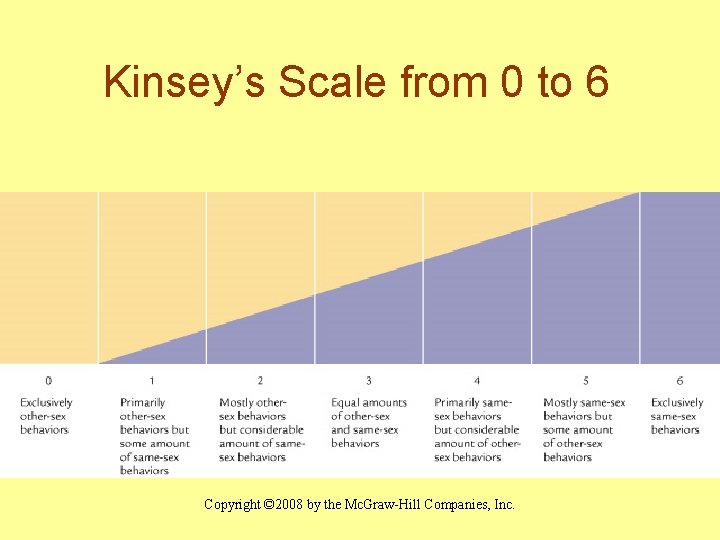
Kinsey’s Scale from 0 to 6 Copyright © 2008 by the Mc. Graw-Hill Companies, Inc.
Alfred Kinsey: Criticisms • Statistical methodology: unrepresentative sampling • Emphasis on quantification of sexual behavior • Rejection of the psychological dimension (reducing behavior to genital activity) Copyright © 2008 by the Mc. Graw-Hill Companies, Inc.
William Masters (1915 -2001) and Virginia Johnson (1925 -) • Human Sexual Response (1966) • Detailed the sexual response cycles of hundreds of male and female research subjects • Combined clinical observation with direct measurement of genital arousal using electronic devices Copyright © 2008 by the Mc. Graw-Hill Companies, Inc.
Masters and Johnson: Outcomes • Similarity of male and female sexual responses • Women achieve orgasms via clitoral stimulation • Legitimized female masturbation Copyright © 2008 by the Mc. Graw-Hill Companies, Inc.
Masters and Johnson: Outcomes • Human Sexual Inadequacy (1970) – Argued that sexual problems were not the result of neuroses or personality disorders – Rather, lack of information, poor communication, or relationship conflict contributed – Used behavioral therapy to treat sexual problems with great success Copyright © 2008 by the Mc. Graw-Hill Companies, Inc.
Contemporary Research Studies – Several large, national, or multi-site sexuality related studies have recently been conducted • The National Health and Social Life Survey (1994) • The Youth Risk Behavior Survey (biannual) • The Behavioral Risk Factor Surveillance System (annual) • The National Survey of Family Growth (periodic) • College Alcohol Study (every few years) • Community Intervention Trial for Youth Project Copyright © 2008 by the Mc. Graw-Hill Companies, Inc.
The National Health and Social Life Survey 1994 • Americans are largely monogamous • On average, Americans have sex about once a week • Adultery is the exception, not the rule • Most Americans rank vaginal intercourse as most preferred activity Copyright © 2008 by the Mc. Graw-Hill Companies, Inc.
The National Health and Social Life Survey (cont. ) • Homosexuality less prevalent than originally believed • Orgasms appear to be the rule for men and the exception for women • Forced sex and the misperception of it remain critical problems • 3% of Americans claim never to have had sex Copyright © 2008 by the Mc. Graw-Hill Companies, Inc.
The National Survey of Family Growth 2002 • A majority of Americans report experiencing a great deal of diverse sexual activity • A small percentage of Americans report experiencing homosexual activity • American men report more partners then women • A large group of Americans do not report using condoms in the last year Copyright © 2008 by the Mc. Graw-Hill Companies, Inc.
The Youth Risk Behavior Survey 2003 • Almost half report having had sexual intercourse • Few report having had sexual intercourse with four or more partners • Over half report using a condom during their last sexual intercourse • One fourth report of sexually active students report using alcohol or drugs during most recent sexual experience Copyright © 2008 by the Mc. Graw-Hill Companies, Inc.
National College Health Assessment 2005 • Majority report a new sex partner in the last year • Half report experiencing oral sex within the last month • Half report experiencing vaginal sex within the last month • Students do not routinely use condoms • Birth control pills and condoms are the most commonly used contraceptive Copyright © 2008 by the Mc. Graw-Hill Companies, Inc.
Feminist Scholarship Principles • • Gender is significant Female experience devalued Power is critical in relationships Different methodologies must be incorporated • Ethnic diversity must be addressed Copyright © 2008 by the Mc. Graw-Hill Companies, Inc.
Directions for Future Research • Global perspective • Inclusion of other fields of scientific study Copyright © 2008 by the Mc. Graw-Hill Companies, Inc.
Ethnicity and Sexuality • Researchers have begun to recognize differences among ethnic groups • Related factors: socioeconomic status, environment, methodology, researcher’s stereotypes Copyright © 2008 by the Mc. Graw-Hill Companies, Inc.
African Americans and Research • • Sexual stereotypes Socioeconomic status Racism Black subcultures Copyright © 2008 by the Mc. Graw-Hill Companies, Inc.
Latinos and Research • • Sexual stereotypes Traditional cultures Catholicism Acculturation Copyright © 2008 by the Mc. Graw-Hill Companies, Inc.
Asian Americans and Pacific Islanders • • Increase in population Collectivist culture Immigration Sexual stereotypes Copyright © 2008 by the Mc. Graw-Hill Companies, Inc.
- Slides: 50