
Chapter Two Parts of Sentences In order to


- Slides: 5
Chapter Two Parts of Sentences In order to understand how sentences are made and how they function, it is convenient to divide them into smaller manageable units. The first division divides the sentence into TWO parts: subject and predicate.
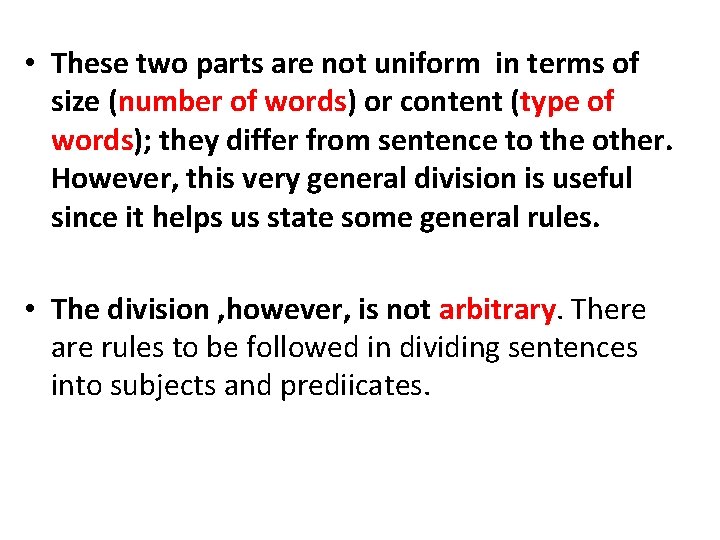
• These two parts are not uniform in terms of size (number of words) or content (type of words); they differ from sentence to the other. However, this very general division is useful since it helps us state some general rules. • The division , however, is not arbitrary. There are rules to be followed in dividing sentences into subjects and prediicates.
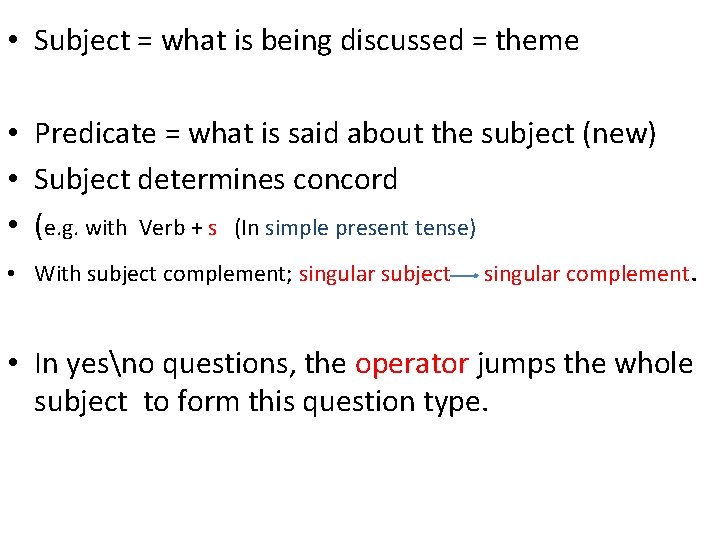
• Subject = what is being discussed = theme • Predicate = what is said about the subject (new) • Subject determines concord • (e. g. with Verb + s (In simple present tense) • With subject complement; singular subject singular complement. • In yesno questions, the operator jumps the whole subject to form this question type.
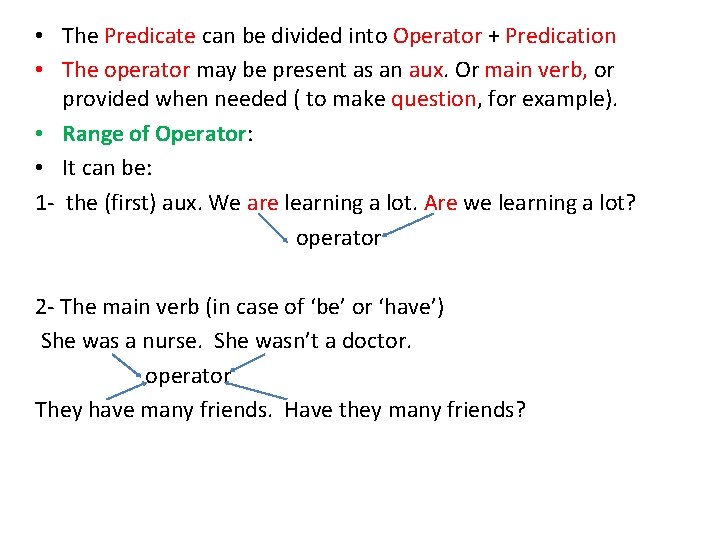
• The Predicate can be divided into Operator + Predication • The operator may be present as an aux. Or main verb, or provided when needed ( to make question, for example). • Range of Operator: • It can be: 1 - the (first) aux. We are learning a lot. Are we learning a lot? operator 2 - The main verb (in case of ‘be’ or ‘have’) She was a nurse. She wasn’t a doctor. operator They have many friends. Have they many friends?
Operator is the verb (aux. or main) that helps us form the negative, interrogative , and emphatic forms. As well, it helps us place certain adjuncts. In the following sentences the operator is in red: The haven’t made any progress. Were you a friend of mine? Are you listening to the T. V. ? Jack hasn’t many friends. I did call you last night.