
CHAPTER TWO OVERVIEW Chapter 2 SECTION 2 1


- Slides: 37
CHAPTER TWO OVERVIEW Chapter 2 • SECTION 2. 1 - DECISION-MAKING SYSTEMS § Decision Making § Transaction Processing Systems § Decision Support Systems § Executive Information Systems • SECTION 2. 2 – BUSINESS PROCESSES § Understanding the Importance of Business Processes § Business Process Improvement § Business Process Reengineering § Business Process Modeling § Business Process Management 2 -1
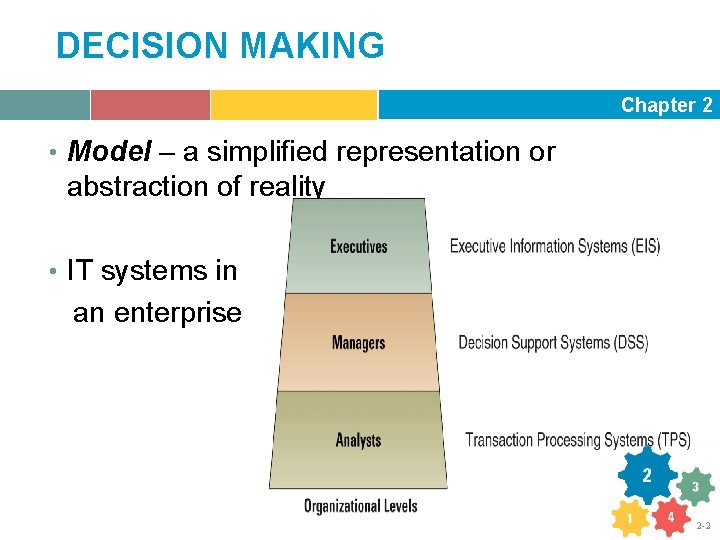
DECISION MAKING Chapter 2 • Model – a simplified representation or abstraction of reality • IT systems in an enterprise 2 -2
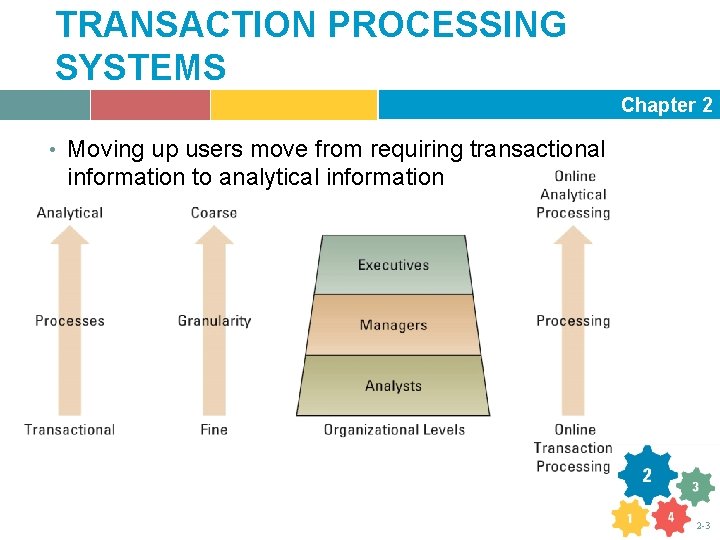
TRANSACTION PROCESSING SYSTEMS Chapter 2 • Moving up users move from requiring transactional information to analytical information 2 -3
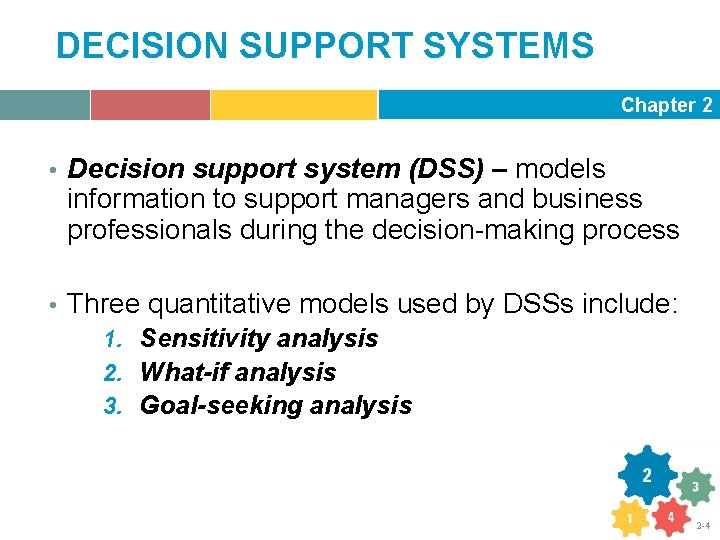
DECISION SUPPORT SYSTEMS Chapter 2 • Decision support system (DSS) – models information to support managers and business professionals during the decision-making process • Three quantitative models used by DSSs include: 1. Sensitivity analysis 2. What-if analysis 3. Goal-seeking analysis 2 -4
EXECUTIVE INFORMATION SYSTEMS Chapter 2 • Executive information system (EIS) – a specialized DSS that supports senior level executives within the organization • Most EISs offering the following capabilities: § • Consolidation; Drill-down ; Slice-and-dice Digital dashboard – a common feature of EIS that integrates information from multiple components 2 -5
ARTIFICIAL INTELLIGENCE (AI) Chapter 2 Artificial intelligence (AI) – simulates human intelligence such as the ability to reason and learn Four most common categories of AI include: • • § § • Expert system Neural Network Genetic algorithm Intelligent agent Data-mining systems sift instantly through information to uncover patterns and relationships, and include many forms of AI such as neural networks and expert systems 2 -6
UNDERSTANDING THE IMPORTANCE OF BUSINESS PROCESS Chapter 2 • Business process – a standardized set of activities that accomplish a specific task, such as processing a customer’s order § Customer facing process - results in a product or service that is received by an organization’s external customer § Business facing process - invisible to the external customer but essential to the effective management of the business 2 -7
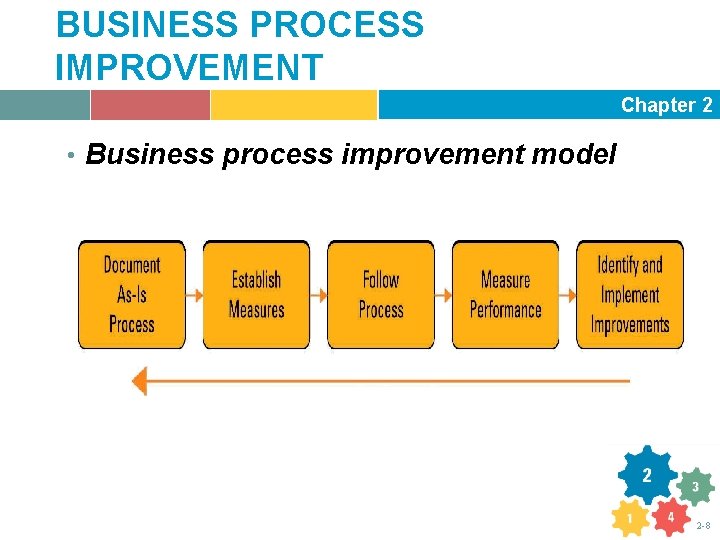
BUSINESS PROCESS IMPROVEMENT Chapter 2 • Business process improvement model 2 -8
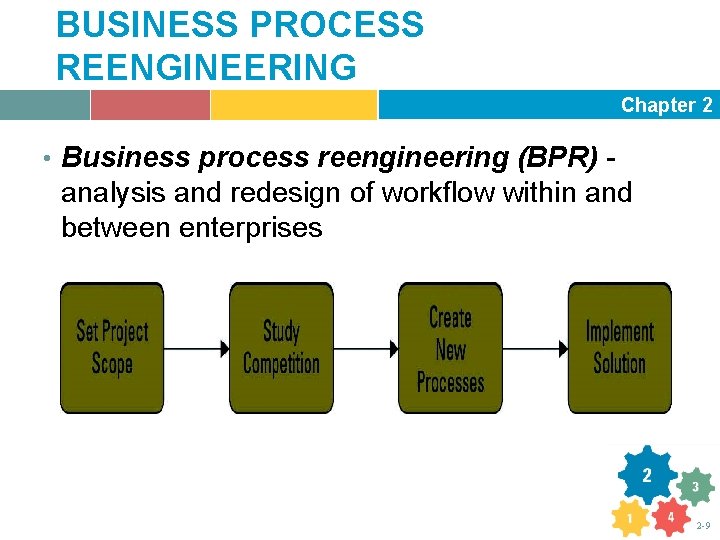
BUSINESS PROCESS REENGINEERING Chapter 2 • Business process reengineering (BPR) - analysis and redesign of workflow within and between enterprises 2 -9
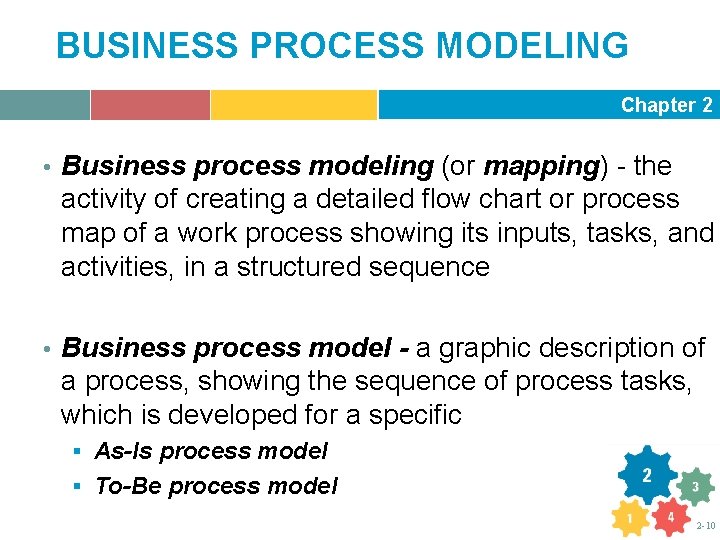
BUSINESS PROCESS MODELING Chapter 2 • Business process modeling (or mapping) - the activity of creating a detailed flow chart or process map of a work process showing its inputs, tasks, and activities, in a structured sequence • Business process model - a graphic description of a process, showing the sequence of process tasks, which is developed for a specific § As-Is process model § To-Be process model 2 -10
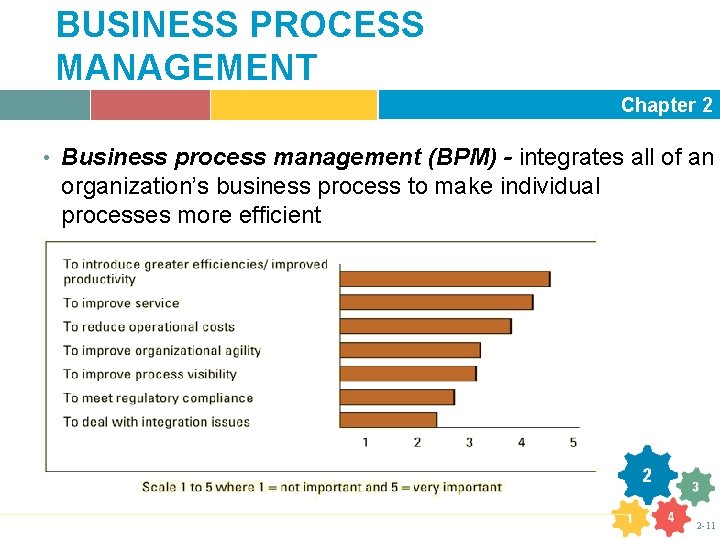
BUSINESS PROCESS MANAGEMENT Chapter 2 • Business process management (BPM) - integrates all of an organization’s business process to make individual processes more efficient 2 -11
Brainpower for Your DECISION SUPPORT Business & ARTIFICIAL INTELLIGENCE Business Information to Business Intelligence It is replacing human brainpower to a limited degree Chapter 2
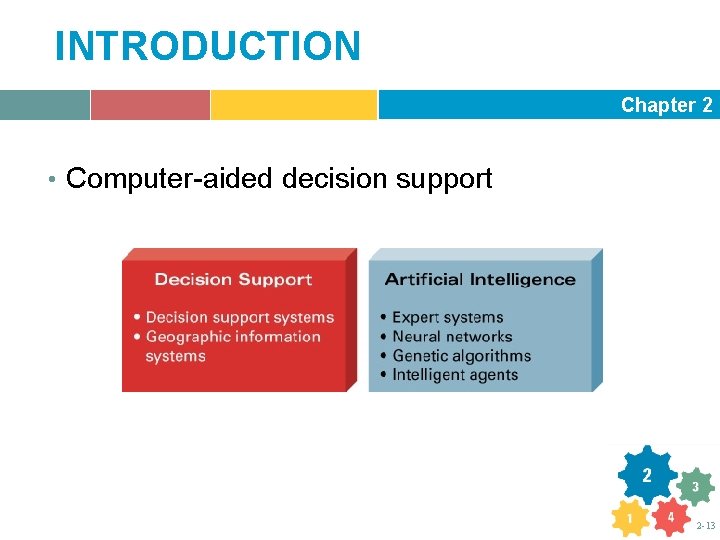
INTRODUCTION Chapter 2 • Computer-aided decision support 2 -13
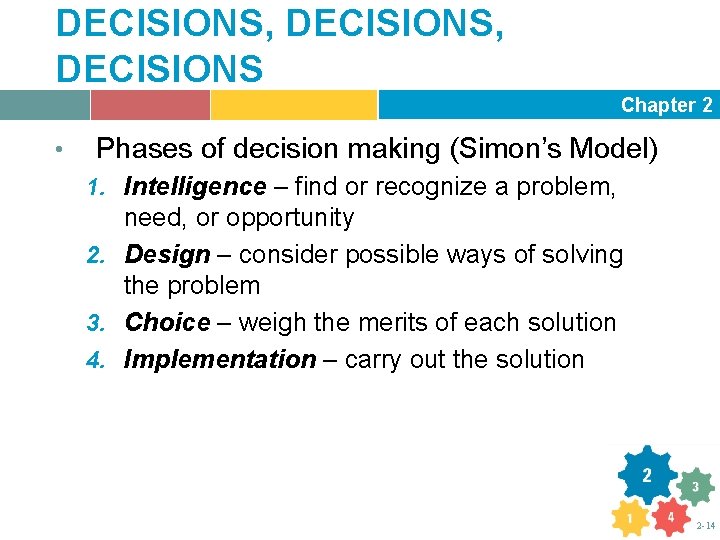
DECISIONS, DECISIONS Chapter 2 • Phases of decision making (Simon’s Model) 1. Intelligence – find or recognize a problem, need, or opportunity 2. Design – consider possible ways of solving the problem 3. Choice – weigh the merits of each solution 4. Implementation – carry out the solution 2 -14
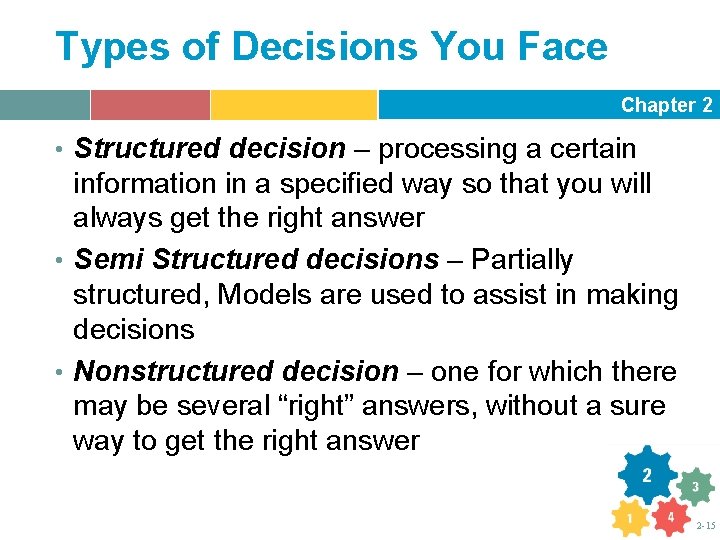
Types of Decisions You Face Chapter 2 • Structured decision – processing a certain information in a specified way so that you will always get the right answer • Semi Structured decisions – Partially structured, Models are used to assist in making decisions • Nonstructured decision – one for which there may be several “right” answers, without a sure way to get the right answer 2 -15
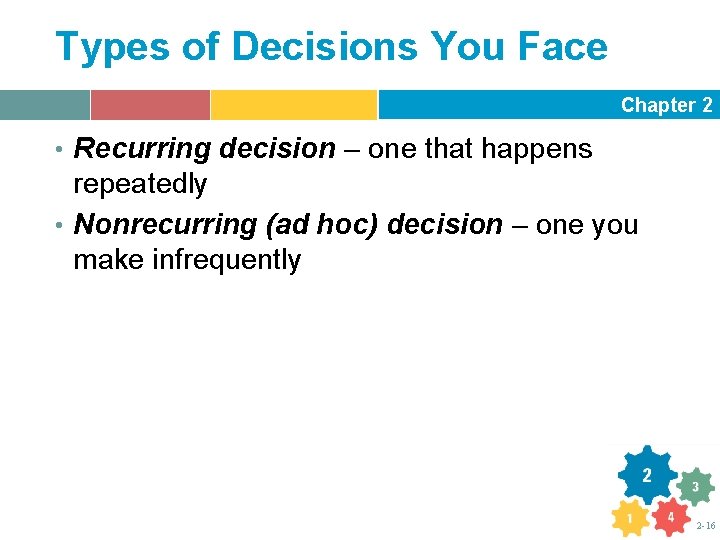
Types of Decisions You Face Chapter 2 • Recurring decision – one that happens repeatedly • Nonrecurring (ad hoc) decision – one you make infrequently 2 -16
DECISION SUPPORT SYSTEMS Chapter 2 • Decision support system (DSS) – a highly flexible and interactive system that is designed to support decision making when the problem is not structured • Decision support systems help you analyze, but you must know how to solve the problem, and how to use the results of the analysis 2 -17
Components of a DSS Chapter 2 • Model management component – consists of both the DSS models and the model management system • Data management component – stores and maintains the information that you want your DSS to use • User interface management component – allows you to communicate with the DSS 2 -18
Decision Support Systems Using Decision Support Chapter 2 • What-if Analysis • Sensitivity Analysis • Goal-Seeking Analysis • Optimization Analysis 2 -19
GEOGRAPHIC INFORMATION SYSTEMS Chapter 2 • Geographic information system (GIS) – DSS designed specifically to analyze spatial information • Spatial information is any information in map form • Businesses use GIS software to analyze information, generate business intelligence, and make decisions • San Francisco Police Beat system was the first DSS That used GIS to allocate officers based on crime statistics 2 -20
ARTIFICIAL INTELLIGENCE Chapter 2 • Artificial intelligence (AI) – the science of making machines imitate human thinking and behavior • Robot – a mechanical device equipped with simulated human senses and the ability to take action on its own 2 -21
ARTIFICIAL INTELLIGENCE Chapter 2 • Types of AI systems used in business 1. Expert systems 2. Neural networks 3. Genetic algorithms 4. Intelligent agents • AI systems deliver the conclusion (rather than helping you analyze the options) 2 -22
EXPERT SYSTEMS Chapter 2 • Expert (knowledge-based) system – an artificial intelligence system that applies reasoning capabilities to reach a conclusion (used extensively in business) • Used for § Diagnostic problems (what’s wrong? ) § Prescriptive problems (what to do? ) Mc. Graw-Hill 2 -23 © 2007 The Mc. Graw-Hill Companies, Inc. All rights reserved.
What Expert Systems Can and Can’t Do Chapter 2 • An expert system can § Reduce errors § Improve customer service § Reduce cost • An expert system can’t § Use common sense § Automate all processes 2 -24
An Example Chapter 2 • http: //www. aiinc. ca/demos/whale. shtml 2 -25
NEURAL NETWORKS AND FUZZY LOGIC Chapter 2 • Neural network (artificial neural network or ANN) – an artificial intelligence system that is capable of finding and differentiating patterns 2 -26
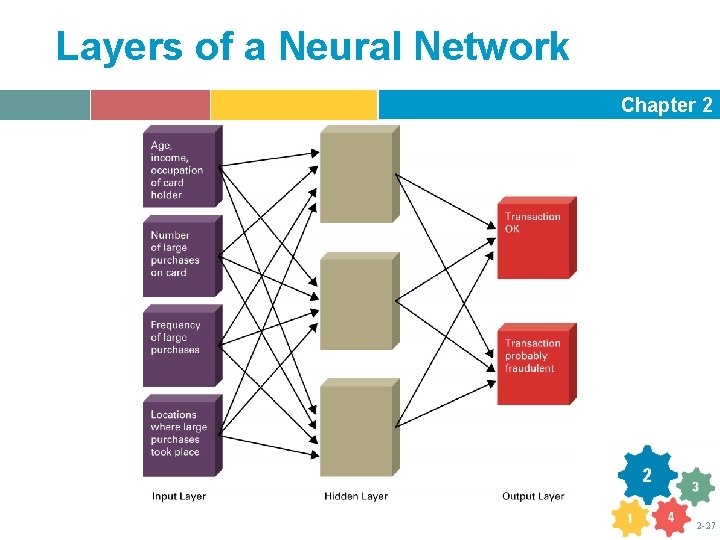
Layers of a Neural Network Chapter 2 2 -27
Neural Networks Can… Chapter 2 • Learn and adjust to new circumstances on their • • own Take part in massive parallel processing Function without complete information Cope with huge volumes of information Analyze nonlinear relationships 2 -28
Fuzzy Logic Chapter 2 • Fuzzy logic – a mathematical method of handling imprecise or subjective information • Used to make ambiguous information such as “short” usable in computer systems • Applications § Google’s search engine § Washing machines § Antilock breaks 2 -29
GENETIC ALGORITHMS Chapter 2 • Genetic algorithm – an artificial intelligence system that mimics the evolutionary, survival-of -the-fittest process to generate increasingly better solutions to a problem 2 -30
INTELLIGENT AGENTS Chapter 2 • Intelligent agent – software that assists you, or acts on your behalf, in performing repetitive computer-related tasks • Types § Information agents § Monitoring-and-surveillance or predictive agents § Data-mining agents § User or personal agents 2 -31
Information Agents Chapter 2 • Information Agents – intelligent agents that search for information of some kind and bring it back • Ex: Buyer agent or shopping bot – an intelligent agent on a Web site that helps you, the customer, find products and services you want 2 -32
Monitoring-and-Surveillance Agents Chapter 2 Monitoring-and-surveillance (predictive) agents – intelligent agents that constantly observe and report on some entity of interest, a network, or manufacturing equipment, for example 2 -33
Data-Mining Agents Chapter 2 Data-mining agent – operates in a data warehouse discovering information 2 -34
User Agents Chapter 2 • User or personal agent – intelligent agent that takes action on your behalf • Examples: § Prioritize e-mail § Act as gaming partner § Assemble customized news reports § Fill out forms for you § “Discuss” topics with you Mc. Graw-Hill 2 -35 © 2007 The Mc. Graw-Hill Companies, Inc. All rights reserved.
MULTI-AGENT SYSTEMS AND AGENT-BASED MODELING Chapter 2 Biomimicry – learning from ecosystems and adapting their characteristics to human and organizational situations Used to • • 1. Learn how people-based systems behave 2. Predict how they will behave under certain circumstances 3. Improve human systems to make them more efficient and effective Mc. Graw-Hill 2 -36 © 2007 The Mc. Graw-Hill Companies, Inc. All rights reserved.
Agent-Based Modeling Chapter 2 • Agent-based modeling – a way of simulating human organizations using multiple intelligent agents, each of which follows a set of simple rules and can adapt to changing conditions • Multi-agent system – groups of intelligent agents have the ability to work independently and to interact with each other Mc. Graw-Hill 2 -37 © 2007 The Mc. Graw-Hill Companies, Inc. All rights reserved.