
Chapter Two Operation and Functional Verification of Automated

- Slides: 41
Chapter Two Operation and Functional Verification of Automated Micropipettes
Acknowledgements n n n n Addisa Ababa University Jimma University Hawassa University Haramaya University of Gondar American Society for Clinical Pathology Center for Disease Control and Prevention. Ethiopia
Learning Objectives At the end of this topic students will be able to; n Describe the key components of a micropipettes n Discuss operation feature of micropipette n Describe different pipetting techniques n Describe methods used to verify pipette calibration n Calculate statistical data to verify pipette accuracy and precision
Chapter Outline 1. 2. 3. 4. 5. 6. Introduction Operating procedure Pipetting techniques Pipette troubleshooting General working remarks Principles of inspection and calibration
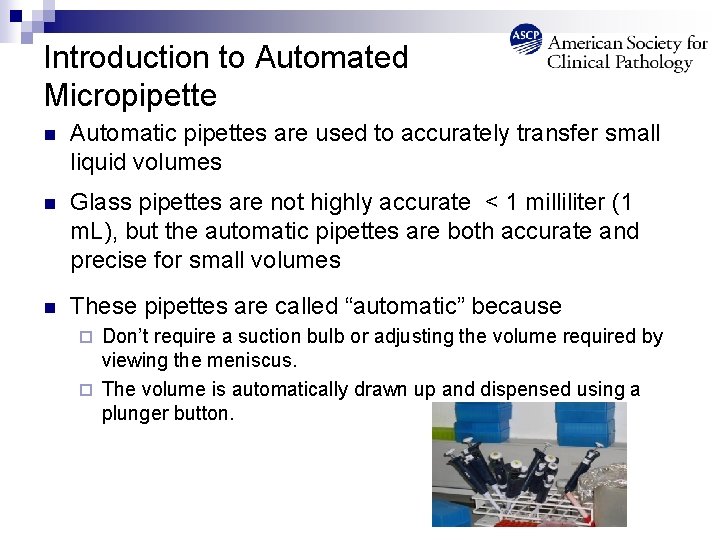
Introduction to Automated Micropipette n Automatic pipettes are used to accurately transfer small liquid volumes n Glass pipettes are not highly accurate < 1 milliliter (1 m. L), but the automatic pipettes are both accurate and precise for small volumes n These pipettes are called “automatic” because Don’t require a suction bulb or adjusting the volume required by viewing the meniscus. ¨ The volume is automatically drawn up and dispensed using a plunger button. ¨
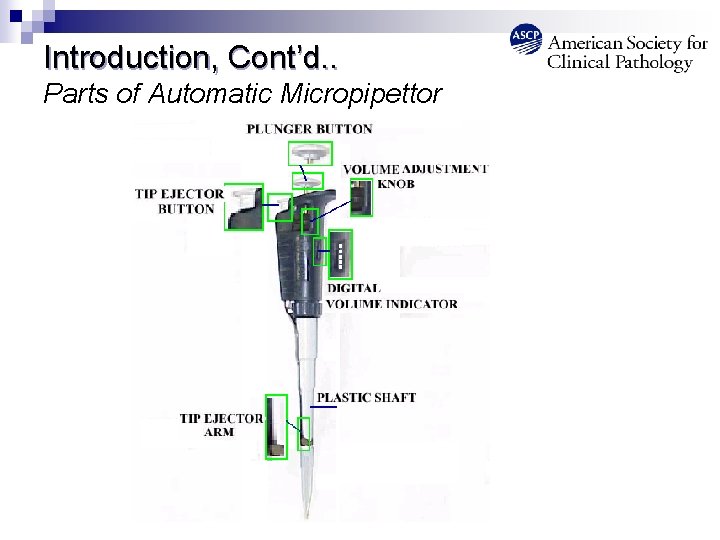
Introduction, Cont’d. . Parts of Automatic Micropipettor
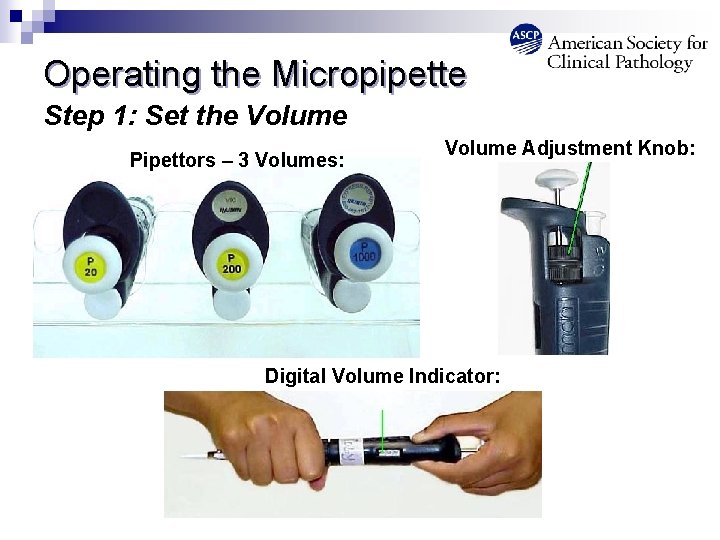
Operating the Micropipette Step 1: Set the Volume Pipettors – 3 Volumes: Volume Adjustment Knob: Digital Volume Indicator:
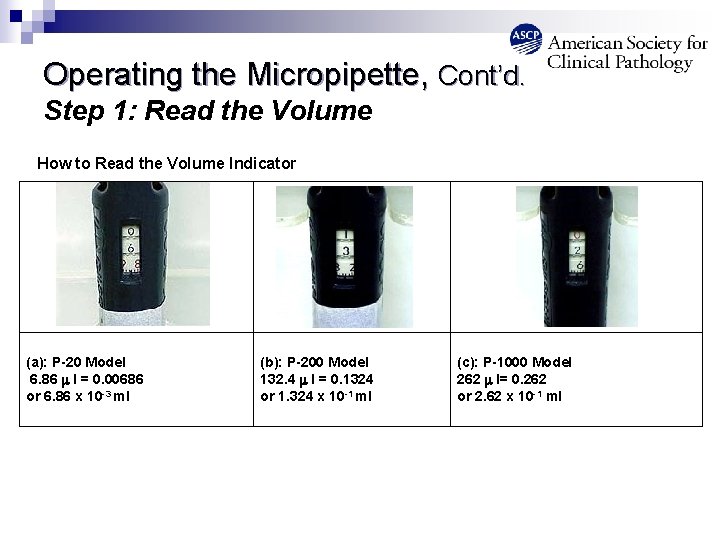
Operating the Micropipette, Cont’d. Step 1: Read the Volume How to Read the Volume Indicator: (a): P-20 Model 6. 86 m l = 0. 00686 or 6. 86 x 10 -3 ml (b): P-200 Model 132. 4 m l = 0. 1324 or 1. 324 x 10 -1 ml (c): P-1000 Model 262 m l= 0. 262 or 2. 62 x 10 -1 ml
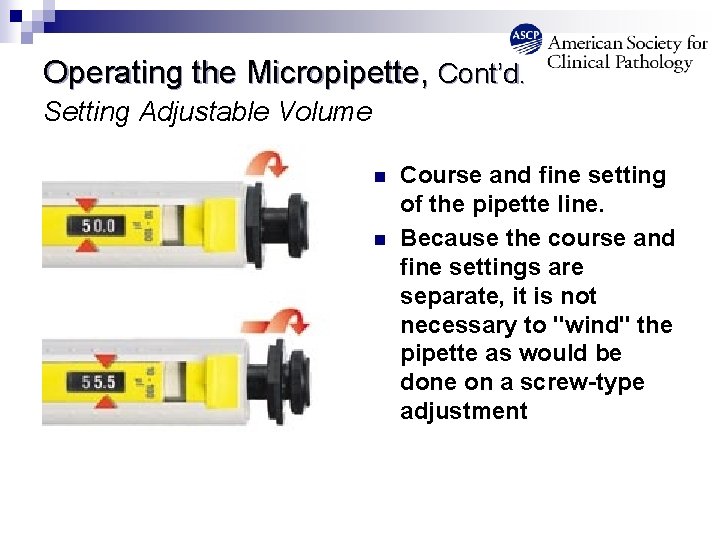
Operating the Micropipette, Cont’d. Setting Adjustable Volume n n Course and fine setting of the pipette line. Because the course and fine settings are separate, it is not necessary to "wind" the pipette as would be done on a screw-type adjustment
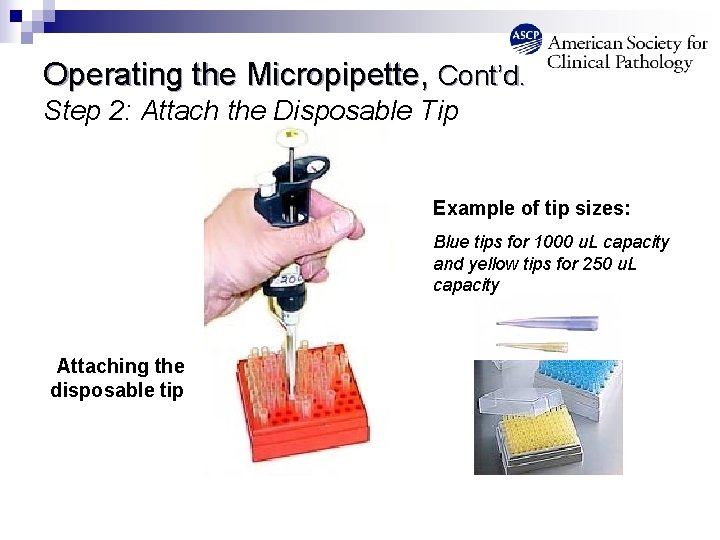
Operating the Micropipette, Cont’d. Step 2: Attach the Disposable Tip Example of tip sizes: Blue tips for 1000 u. L capacity and yellow tips for 250 u. L capacity Attaching the disposable tip
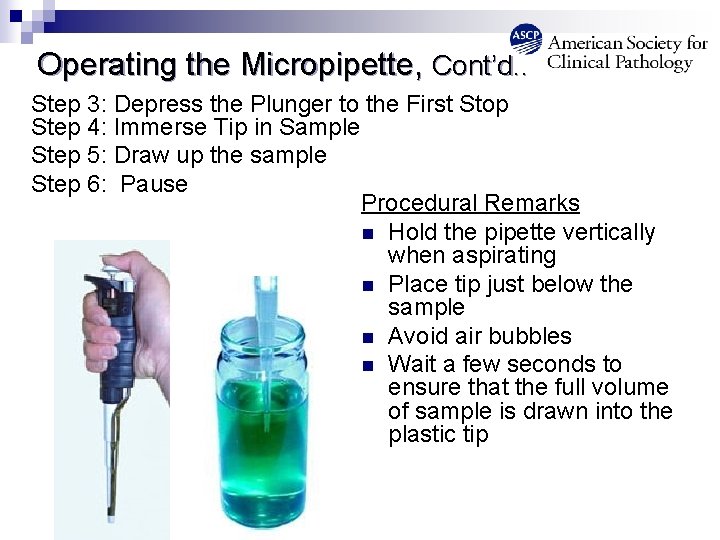
Operating the Micropipette, Cont’d. . Step 3: Depress the Plunger to the First Stop Step 4: Immerse Tip in Sample Step 5: Draw up the sample Step 6: Pause Procedural Remarks n Hold the pipette vertically when aspirating n Place tip just below the sample n Avoid air bubbles n Wait a few seconds to ensure that the full volume of sample is drawn into the plastic tip
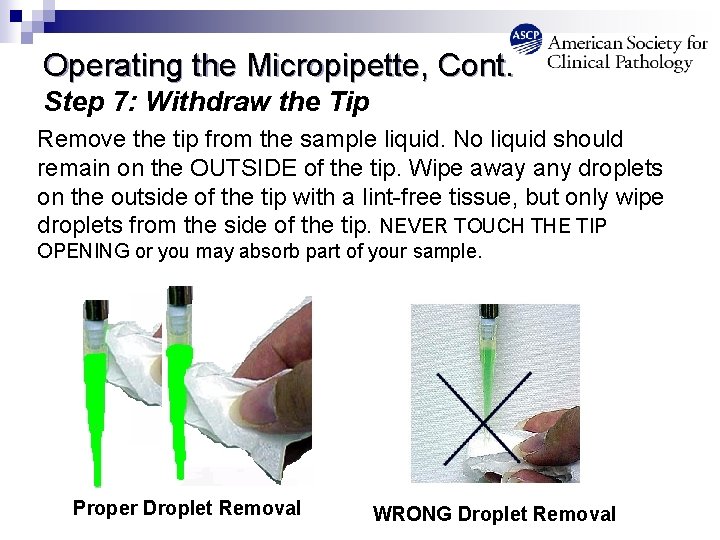
Operating the Micropipette, Cont. Step 7: Withdraw the Tip Remove the tip from the sample liquid. No liquid should remain on the OUTSIDE of the tip. Wipe away any droplets on the outside of the tip with a lint-free tissue, but only wipe droplets from the side of the tip. NEVER TOUCH THE TIP OPENING or you may absorb part of your sample. Proper Droplet Removal WRONG Droplet Removal
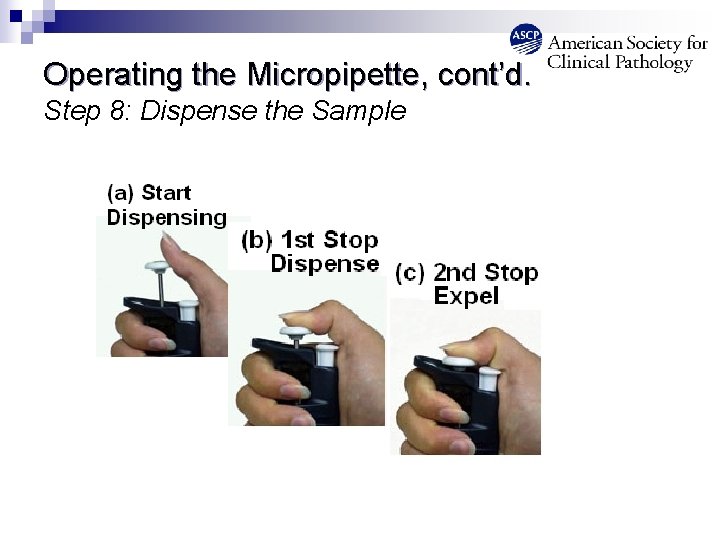
Operating the Micropipette, cont’d. Step 8: Dispense the Sample
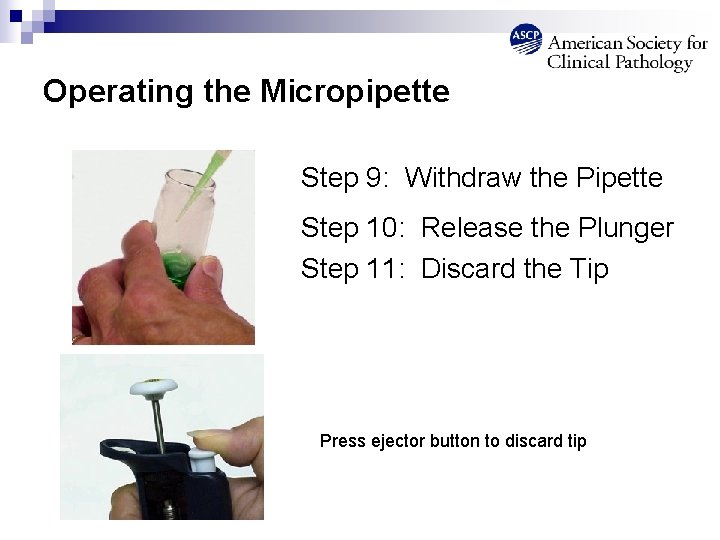
Operating the Micropipette Step 9: Withdraw the Pipette Step 10: Release the Plunger Step 11: Discard the Tip Press ejector button to discard tip.
Pipetting Techniques n n n Commonly, there are two types of pipetting techniques; ¨ Forward pipetting ¨ Reverse pipetting Forward pipetting is recommended for aqueous solutions like buffers, diluted acids or alkalis Reverse pipetting is recommended for small volumes ¨ Avoids the risk of splashing, foam or bubble formation ¨ Is used for solutions with a high viscosity or a tendency to foam
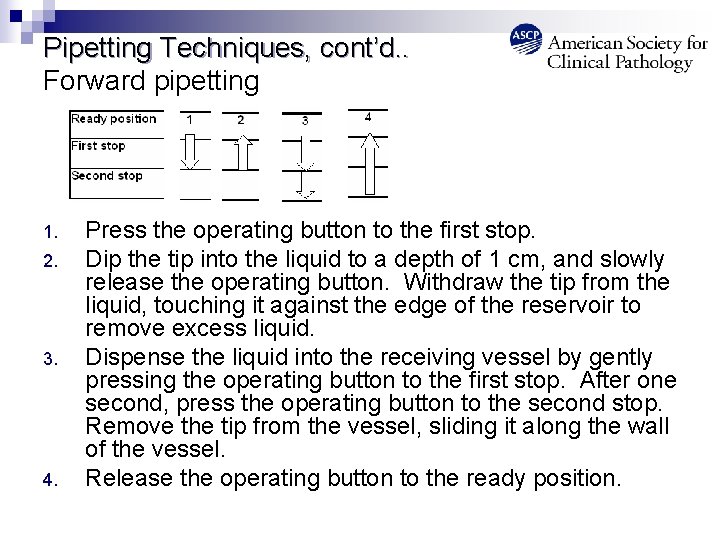
Pipetting Techniques, cont’d. . Forward pipetting 1. 2. 3. 4. Press the operating button to the first stop. Dip the tip into the liquid to a depth of 1 cm, and slowly release the operating button. Withdraw the tip from the liquid, touching it against the edge of the reservoir to remove excess liquid. Dispense the liquid into the receiving vessel by gently pressing the operating button to the first stop. After one second, press the operating button to the second stop. Remove the tip from the vessel, sliding it along the wall of the vessel. Release the operating button to the ready position.
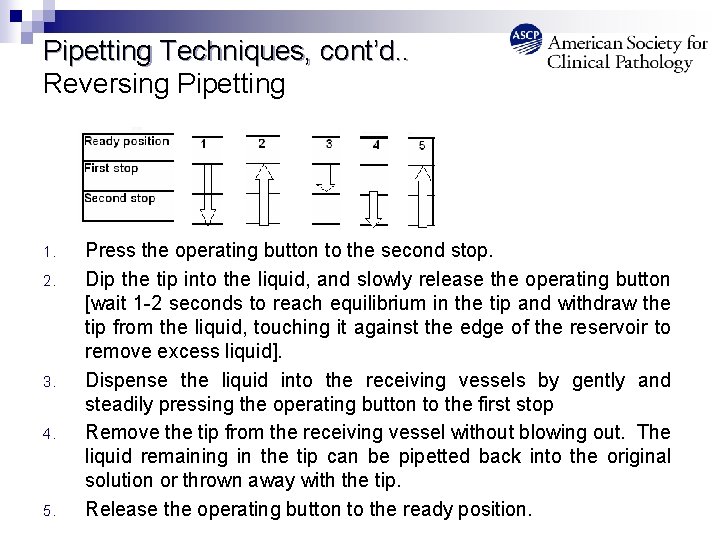
Pipetting Techniques, cont’d. . Reversing Pipetting 1. 2. 3. 4. 5. Press the operating button to the second stop. Dip the tip into the liquid, and slowly release the operating button [wait 1 -2 seconds to reach equilibrium in the tip and withdraw the tip from the liquid, touching it against the edge of the reservoir to remove excess liquid]. Dispense the liquid into the receiving vessels by gently and steadily pressing the operating button to the first stop Remove the tip from the receiving vessel without blowing out. The liquid remaining in the tip can be pipetted back into the original solution or thrown away with the tip. Release the operating button to the ready position.
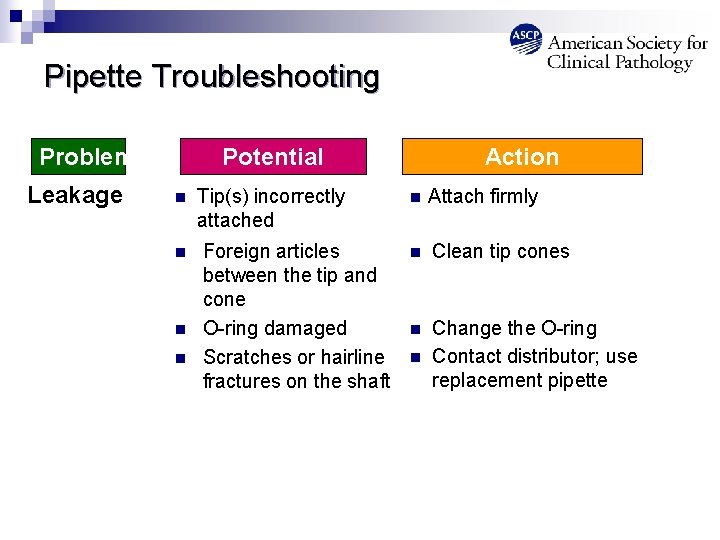
Pipette Troubleshooting Problem Leakage n Potential Cause Tip(s) incorrectly Action n Attach firmly n Clean tip cones n Change the O-ring Contact distributor; use replacement pipette attached n n n Foreign articles between the tip and cone O-ring damaged Scratches or hairline fractures on the shaft n
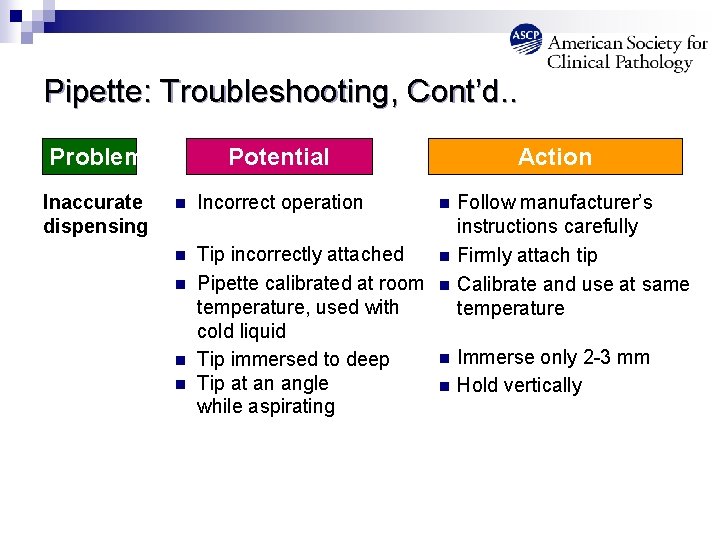
Pipette: Troubleshooting, Cont’d. . Problem Inaccurate dispensing Potential Cause Action n Incorrect operation n n Tip incorrectly attached Pipette calibrated at room temperature, used with cold liquid Tip immersed to deep Tip at an angle while aspirating n n n n Follow manufacturer’s instructions carefully Firmly attach tip Calibrate and use at same temperature Immerse only 2 -3 mm Hold vertically
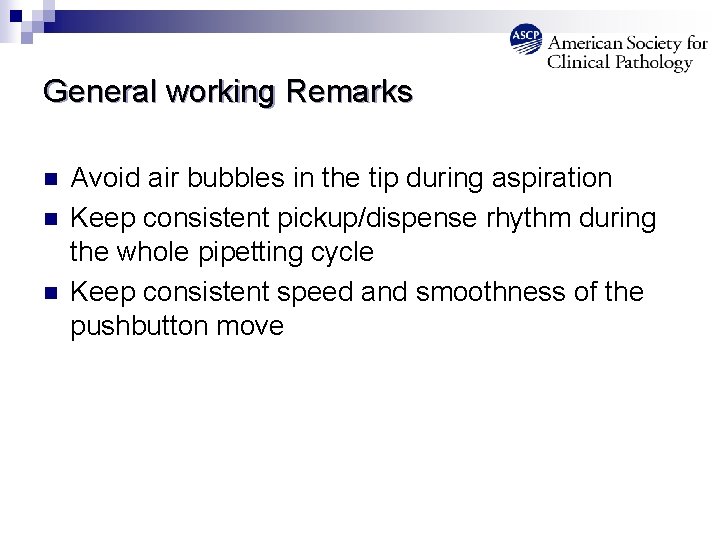
General working Remarks n n n Avoid air bubbles in the tip during aspiration Keep consistent pickup/dispense rhythm during the whole pipetting cycle Keep consistent speed and smoothness of the pushbutton move
General working Remarks , Cont’d. . n n n Maintain consistent angle of pipette when aspirating (min. 30º) Discard contaminated tips in appropriate container after completion of task Store in an appropriate rack or stand
Principles of Preventive Maintenance n n n Select the appropriate pipette for the volume required Always use your pipette with a proper tip on Ensure that the pipette, tips, and specimen are at the same temperature
Principles of Preventive, Preventive Cont’d. Routine Maintenance n n Check at the beginning of each workday for dust and dirt on the outside surfaces. Pay particular attention to the tip cone In addition to routine calibration, pipettes should be cleaned and lubricated as recommended by the manufacturer
Inspection and Calibration of Pipettes n Inspect the pipette for scratches or other damage to the nose cone n Check for leaks by aspirating the maximum listed volume of distilled water n If the pipette is dropped or you suspect any type of damage, do calibration n Calibrate at least once or twice a year
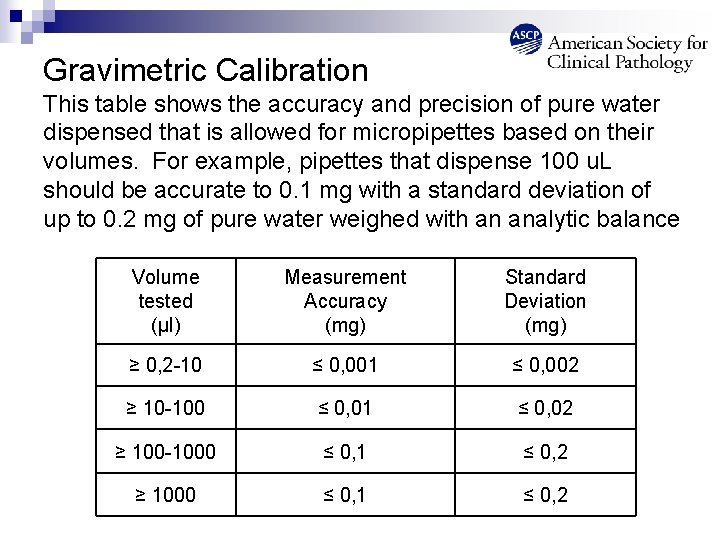
Gravimetric Calibration This table shows the accuracy and precision of pure water dispensed that is allowed for micropipettes based on their volumes. For example, pipettes that dispense 100 u. L should be accurate to 0. 1 mg with a standard deviation of up to 0. 2 mg of pure water weighed with an analytic balance Volume tested (µl) Measurement Accuracy (mg) Standard Deviation (mg) ≥ 0, 2 -10 ≤ 0, 001 ≤ 0, 002 ≥ 10 -100 ≤ 0, 01 ≤ 0, 02 ≥ 100 -1000 ≤ 0, 1 ≤ 0, 2 ≥ 1000 ≤ 0, 1 ≤ 0, 2
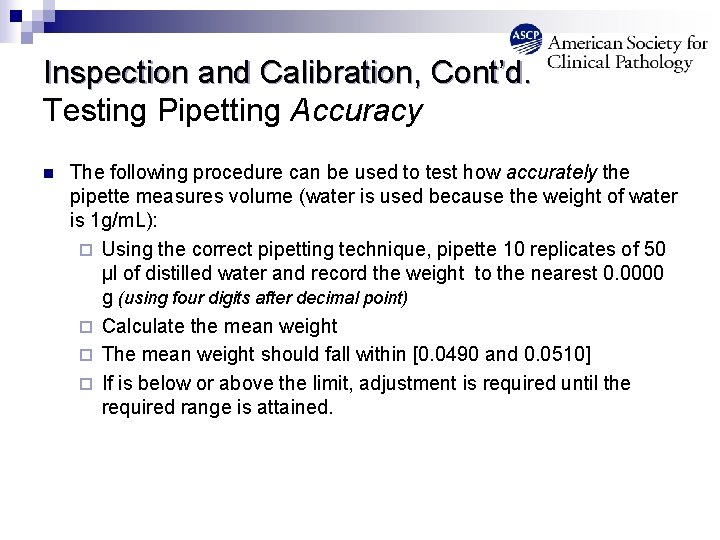
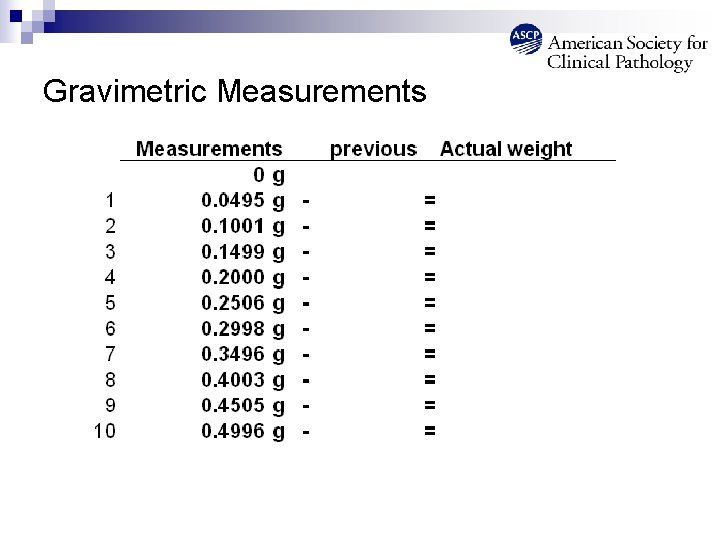
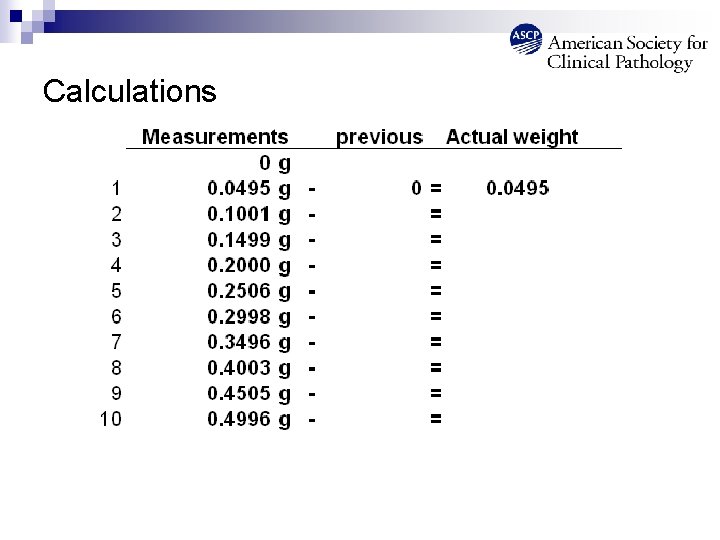
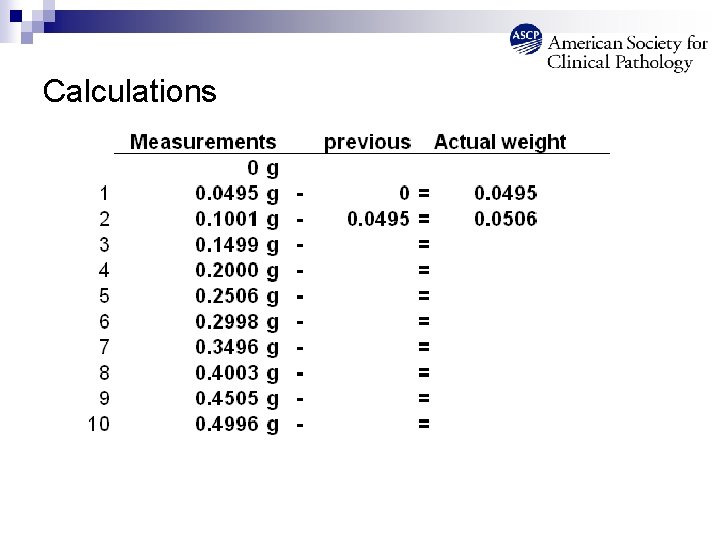
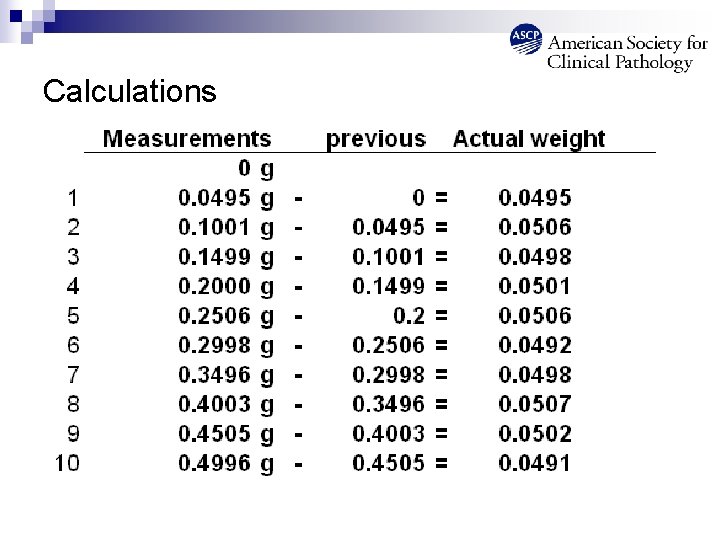
Inspection and Calibration, Cont’d. Testing Pipetting Accuracy n The following procedure can be used to test how accurately the pipette measures volume (water is used because the weight of water is 1 g/m. L): ¨ Using the correct pipetting technique, pipette 10 replicates of 50 μl of distilled water and record the weight to the nearest 0. 0000 g (using four digits after decimal point) ¨ Calculate the mean weight ¨ The mean weight should fall within [0. 0490 and 0. 0510] ¨ If is below or above the limit, adjustment is required until the required range is attained.
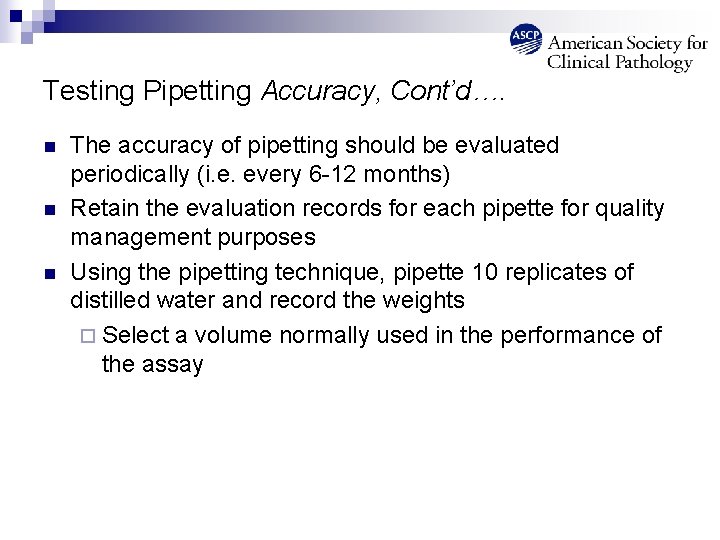
Testing Pipetting Accuracy, Cont’d…. n n n The accuracy of pipetting should be evaluated periodically (i. e. every 6 -12 months) Retain the evaluation records for each pipette for quality management purposes Using the pipetting technique, pipette 10 replicates of distilled water and record the weights ¨ Select a volume normally used in the performance of the assay
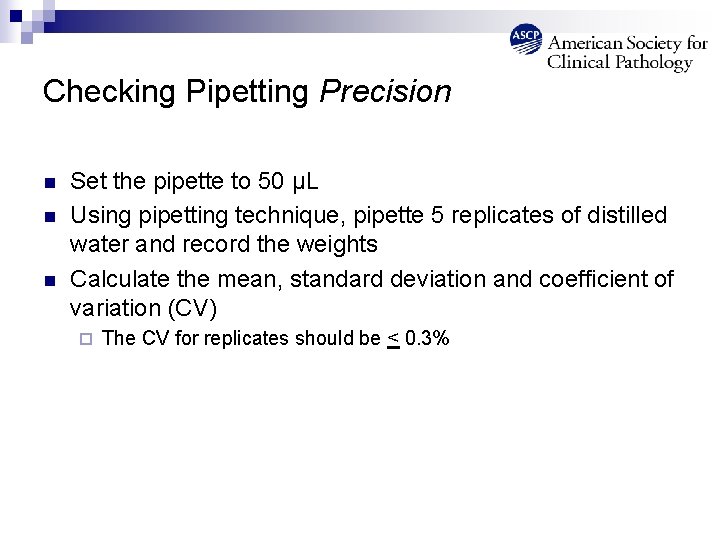
Checking Pipetting Precision n Set the pipette to 50 µL Using pipetting technique, pipette 5 replicates of distilled water and record the weights Calculate the mean, standard deviation and coefficient of variation (CV) ¨ The CV for replicates should be < 0. 3%
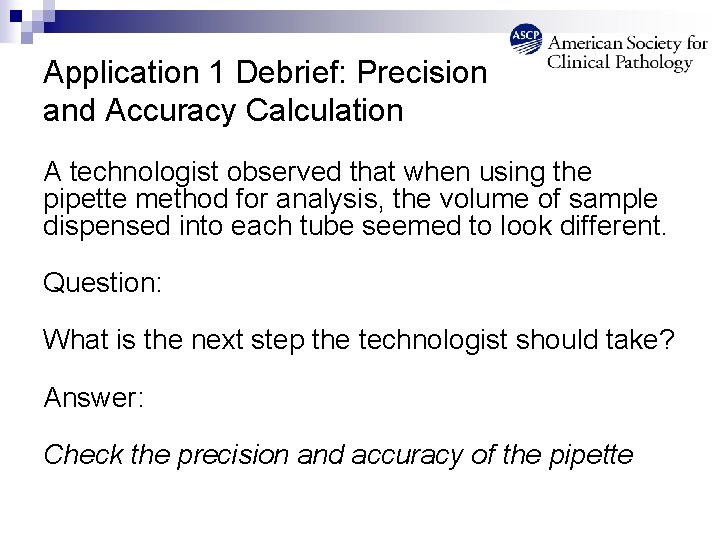
Application 1 Debrief: Precision and Accuracy Calculation A technologist observed that when using the pipette method for analysis, the volume of sample dispensed into each tube seemed to look different. Question: What is the next step the technologist should take? Answer: Check the precision and accuracy of the pipette
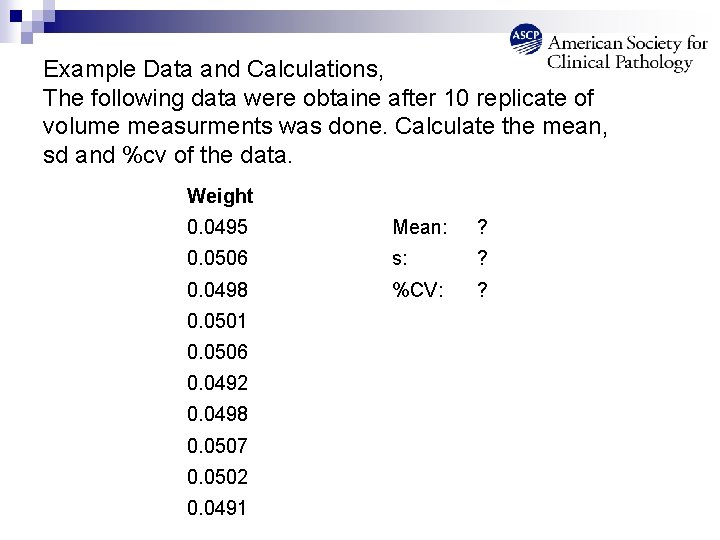
Example Data and Calculations, The following data were obtaine after 10 replicate of volume measurments was done. Calculate the mean, sd and %cv of the data. Weight 0. 0495 Mean: ? 0. 0506 s: ? 0. 0498 %CV: ? 0. 0501 0. 0506 0. 0492 0. 0498 0. 0507 0. 0502 0. 0491
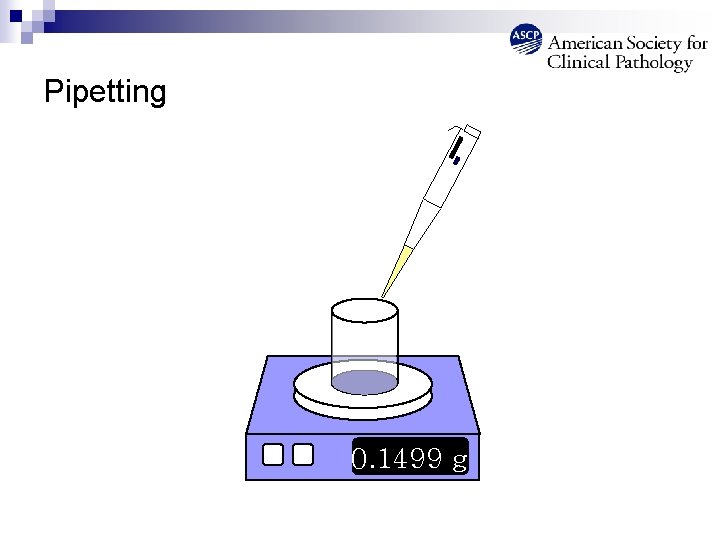
Pipetting 0. 0000 g 0. 1499 0. 0495 0. 1001
Gravimetric Measurements
Calculations
Calculations
Calculations
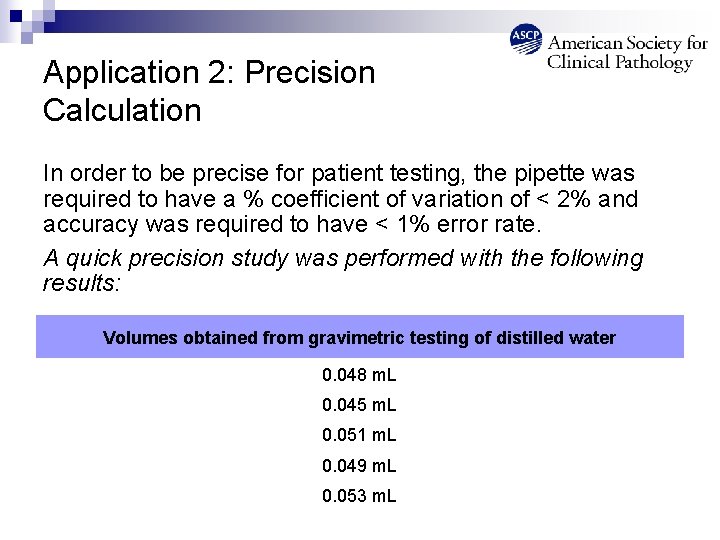
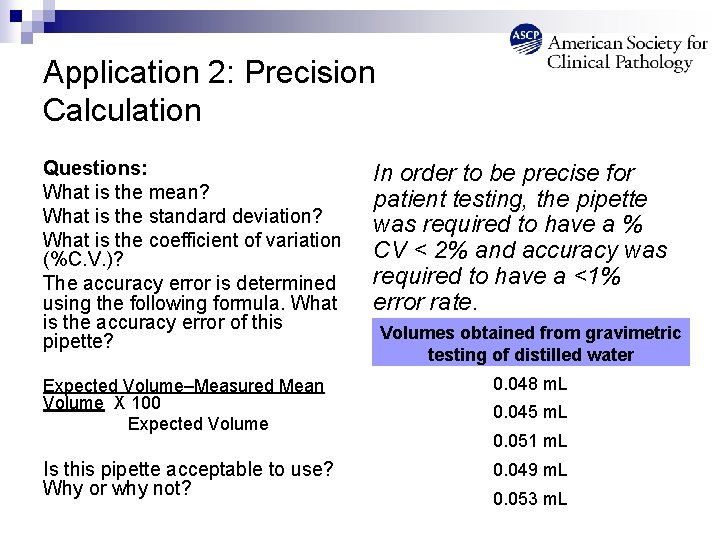
Application 2: Precision Calculation In order to be precise for patient testing, the pipette was required to have a % coefficient of variation of < 2% and accuracy was required to have < 1% error rate. A quick precision study was performed with the following results: Volumes obtained from gravimetric testing of distilled water 0. 048 m. L 0. 045 m. L 0. 051 m. L 0. 049 m. L 0. 053 m. L
Application 2: Precision Calculation Questions: What is the mean? What is the standard deviation? What is the coefficient of variation (%C. V. )? The accuracy error is determined using the following formula. What is the accuracy error of this pipette? In order to be precise for patient testing, the pipette was required to have a % CV < 2% and accuracy was required to have a <1% error rate. Volumes obtained from gravimetric testing of distilled water Expected Volume–Measured Mean Volume X 100 Expected Volume 0. 048 m. L Is this pipette acceptable to use? Why or why not? 0. 049 m. L 0. 045 m. L 0. 051 m. L 0. 053 m. L
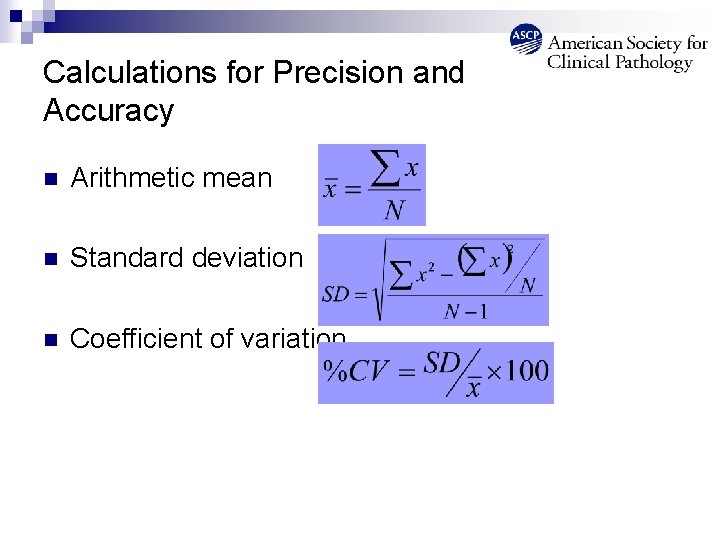
Calculations for Precision and Accuracy n Arithmetic mean n Standard deviation n Coefficient of variation
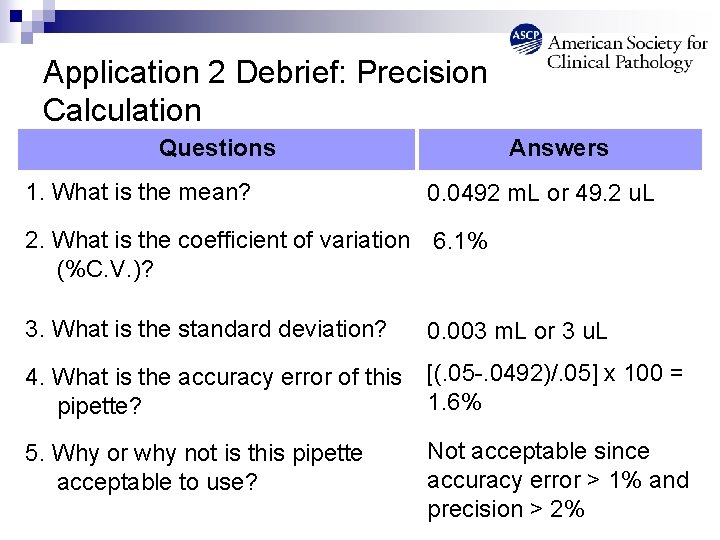
Application 2 Debrief: Precision Calculation Questions 1. What is the mean? Answers 0. 0492 m. L or 49. 2 u. L 2. What is the coefficient of variation 6. 1% (%C. V. )? 3. What is the standard deviation? 0. 003 m. L or 3 u. L 4. What is the accuracy error of this pipette? [(. 05 -. 0492)/. 05] x 100 = 1. 6% 5. Why or why not is this pipette acceptable to use? Not acceptable since accuracy error > 1% and precision > 2%
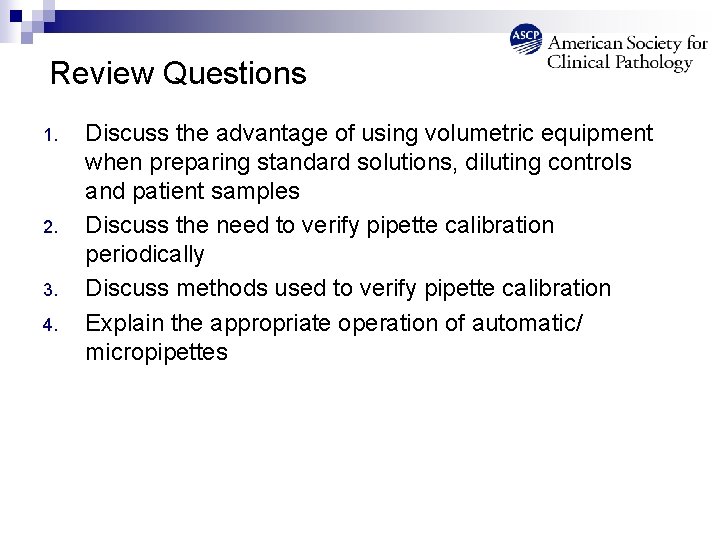
Review Questions 1. 2. 3. 4. Discuss the advantage of using volumetric equipment when preparing standard solutions, diluting controls and patient samples Discuss the need to verify pipette calibration periodically Discuss methods used to verify pipette calibration Explain the appropriate operation of automatic/ micropipettes
Next Chapter (three) will be dealing with Principles and application of Spectroscopic Techniques What are applications of electromagnetic radiation in spectroscopic techniques?