
Chapter Two Networking Standards and the OSI Model

- Slides: 42
Chapter Two Networking Standards and the OSI Model
Objectives Identify organizations that set standards for networking Explain the layers of OSI Model Describe specific networking services within each layer of OSI Model
Objectives Explain how two systems communicate through OSI Model Discuss the structure and purpose of data frames Describe the two types of addressing contained in OSI Model
Standards Documented agreements containing technical specifications or other precise criteria that stipulate how a particular product or service should be designed or performed Many different industries use standards to ensure that products, processes, and services suit their purpose
Networking Standards Organizations American National Standards Institute (ANSI) n n Comprised of industry and government representatives Determine standards for electronics industry in addition to other fields Electronic Industries Alliance (EIA) n n Trade organization composed of representatives from electronics manufacturing firms across United States Sets standards for members, helps write ANSI standards, and lobbies for legislation favorable
Networking Standards Organizations Institute of Electrical and Electronic Engineers (IEEE) n n International society of engineering professionals Promotes development and education in electrical engineering and computer science fields International Organization for Standardization (ISO) n n Collection of standards organizations Goal is to establish international technological standards to facilitate global exchange of information and barrier-free trade
Networking Standards Organizations International Telecommunication Union (ITU) n n n Formerly called Consultative Committee on International Telegraph and Telephony (CCITT) United Nations agency that regulates international telecommunications Assists developing countries
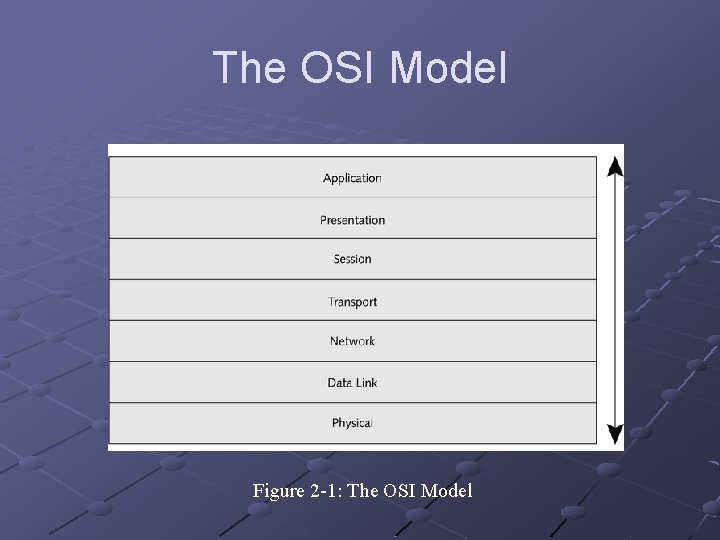
The OSI Model Open Systems Interconnection (OSI) Model n n n Model for understanding and developing computer-to-computer communication Developed in the 1980 s by ISO Divides network architecture into seven layers Network architect n Professional involved in network design
The OSI Model Figure 2 -1: The OSI Model
Physical Layer Data Link Layer Physical layer n n First layer of OSI Model Contains physical networking media Data Link layer n n Second layer of OSI Model Primary function is to divide data it receives from Network layer into distinct frames that can be transmitted by Physical layer
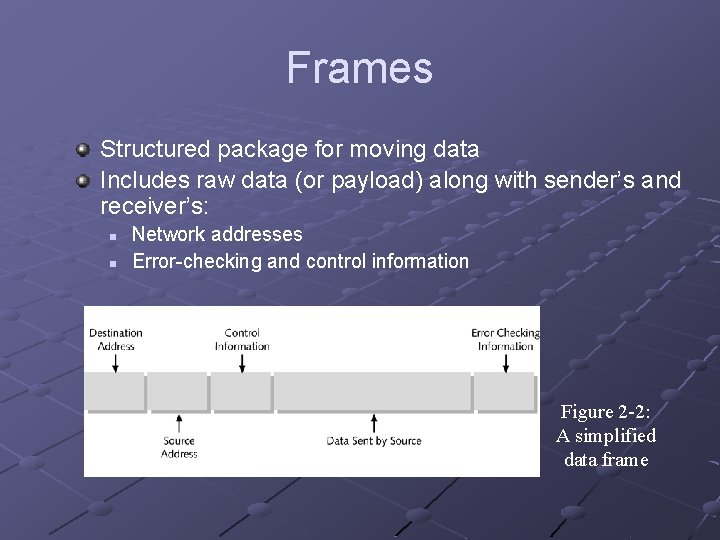
Frames Structured package for moving data Includes raw data (or payload) along with sender’s and receiver’s: n n Network addresses Error-checking and control information Figure 2 -2: A simplified data frame
Network Layer Third layer of OSI Model Translates network addresses into their physical counterparts Decides how to route data from sender to receiver
Network Layer Because Network layer handles routing, routers belong in Network layer n To route means to direct data based on addressing, usage patterns, and availability Network layer protocols also accomplish: n n Segmentation Reassembly
Transport Layer Fourth layer of OSI Model Ensures that data are transferred between points reliably and without errors Handles flow control n Method of gauging appropriate rate of data transmission
Transport Layer Sequencing n Process of assigning a placeholder to each piece of a data block to allowing receiving node’s Transport layer to reassemble data in correct order Acknowledgement (ACK) n n Response generated in Transport layer Confirms to sender that its frame was received
Session Layer Fifth layer of OSI Model Establishes and maintains communication between two nodes on the network Session n n Refers to a connection for data exchange between two parties Term session is most often used in context of terminal and mainframe communications
Presentation Layer Application Layer Presentation layer n n Sixth layer of OSI Model Translates between application and network Application layer n n Seventh, or top, layer of OSI Model Provides interface to software enabling programs to use network devices
Application Program Interface (API) Routine that allows a program to interact with the operating system Belongs to Application layer of OSI Model Microsoft Message Queueing (MSMQ) n n n API used in network environment Stores messages sent between nodes in queues Forwards these messages to their destination
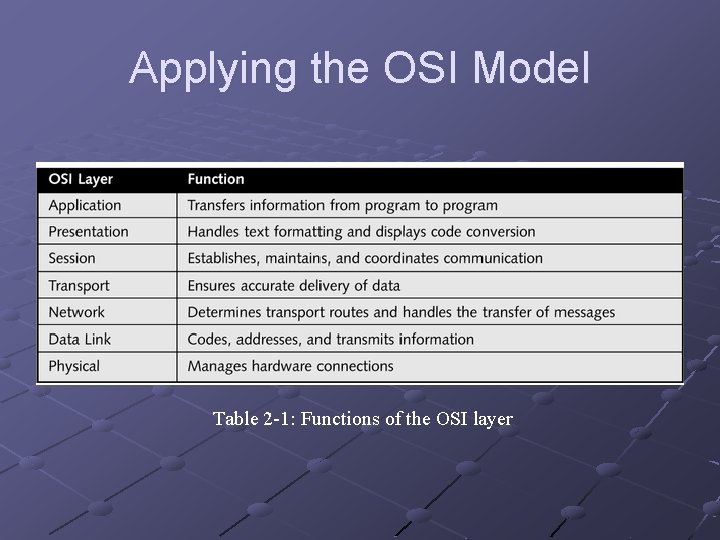
Applying the OSI Model Table 2 -1: Functions of the OSI layer
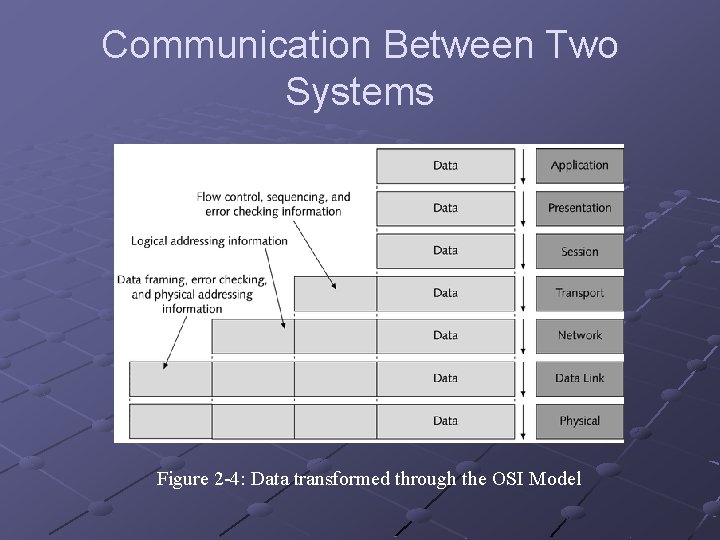
Communication Between Two Systems Token n Special control frame indicating to rest of network that a particular node has right to transmit data Frame Check Sequence (FCS) n Field in a frame responsible for ensuring that data carried by frame arrives intact
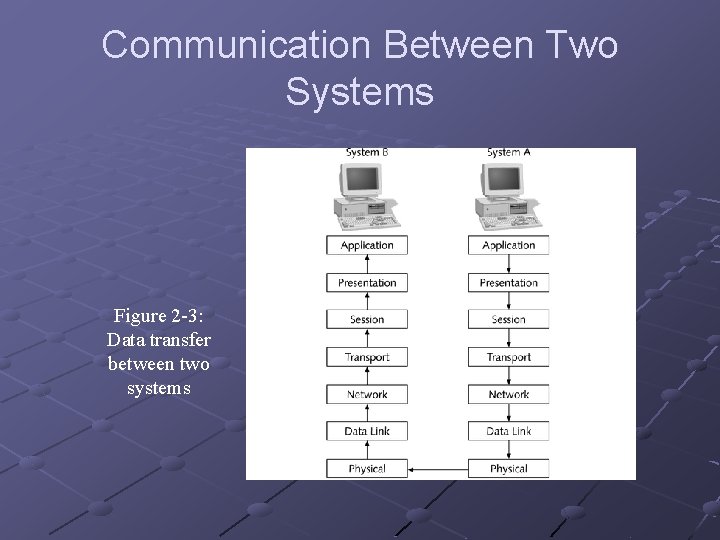
Communication Between Two Systems Figure 2 -3: Data transfer between two systems
Communication Between Two Systems Figure 2 -4: Data transformed through the OSI Model
Frame Specifications Ethernet n n Networking technology originally developed in 1970 s by Xerox Four types of Ethernet technology are used on LANs today Each type is governed by a set of IEEE standards
Frame Specifications Token Ring n n Networking technology developed by IBM in the 1980 s Relies upon direct links between nodes and a ring topology, using tokens to allow nodes to transmit data
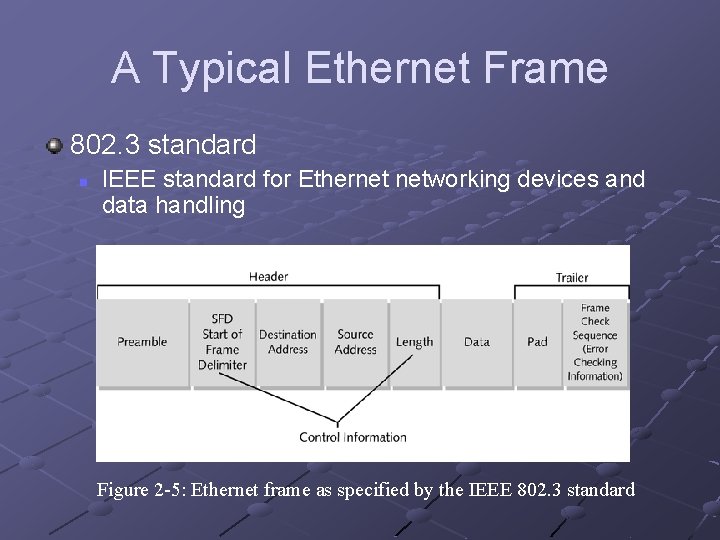
A Typical Ethernet Frame 802. 3 standard n IEEE standard for Ethernet networking devices and data handling Figure 2 -5: Ethernet frame as specified by the IEEE 802. 3 standard
Components of the Ethernet 802. 3 Frame Preamble n Marks beginning of entire frame Start of Frame Delimiter (SFD) n Indicates beginning of addressing frame Destination Address n Contains destination node address
Components of the Ethernet 802. 3 Frame Source Address n Contains address of originating node Length (LEN) n Indicates length of packet Data n Contains data, or segmented part of data, transmitted from originating node
Components of the Ethernet 802. 3 Frame Pad n Used to increase size of the frame to its minimum size requirement of 46 bytes Frame Check Sequence (FCS) n Provides an algorithm to determine whether data were correctly received Most commonly used algorithm is Cyclic Redundancy Check (CRC)
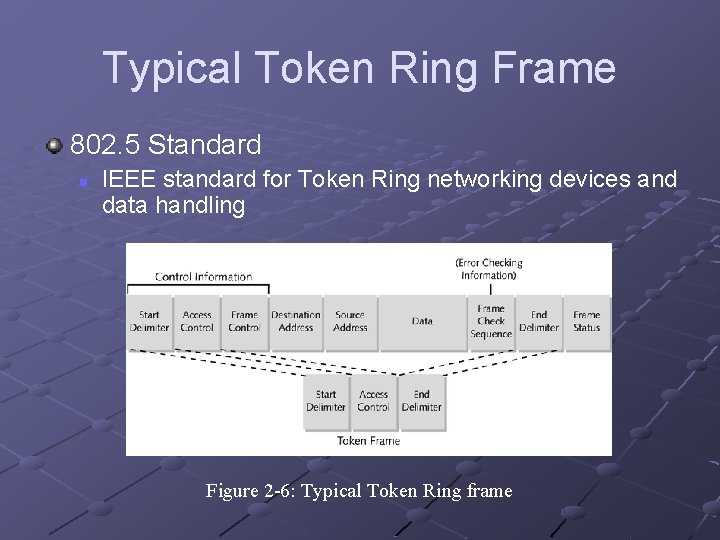
Typical Token Ring Frame 802. 5 Standard n IEEE standard for Token Ring networking devices and data handling Figure 2 -6: Typical Token Ring frame
Components of Token Ring Frame Start Delimiter (SD) n Signifies beginning of packet Access Control (AC) n Contains information about priority of the frame Frame Control (FC) n Defines type of frame
Components of Token Ring Frame Destination Address n Contains destination node address Source Address n Contains address of originating node Data n Contains data transmitted from originating node
Components of Token Ring Frame Check Sequence (FCS) n Used to check integrity of the frame End Delimiter (ED) n Indicates end of the frame Frame Status (FS) n Indicates whether destination node recognized and correctly copied the frame
Addressing Through the Layers Data Link layer address n Also called MAC address, after Media Access Control (MAC) sublayer n n n Number uniquely defining a network node Composed of Block ID and Device ID Manufacturer-hard codes the address on the NIC
Addressing Through the Layers Network layer address n n n Resides at Network level of OSI Model Follows hierarchical addressing scheme Can be assigned through operating system software
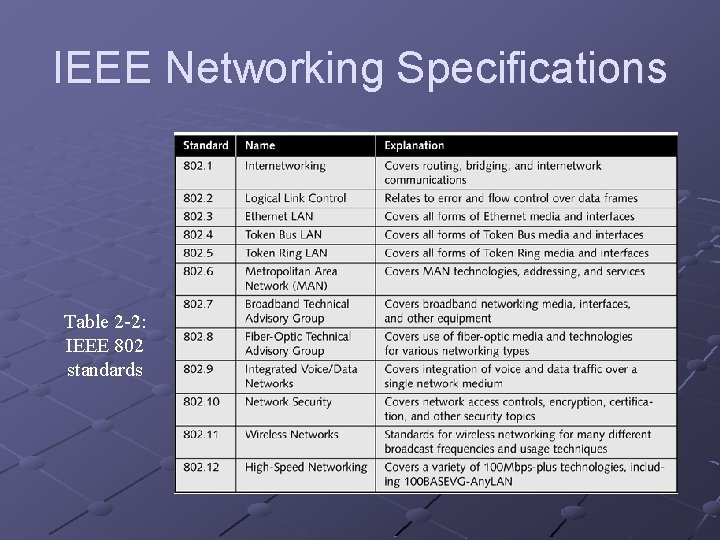
IEEE Networking Specifications Table 2 -2: IEEE 802 standards
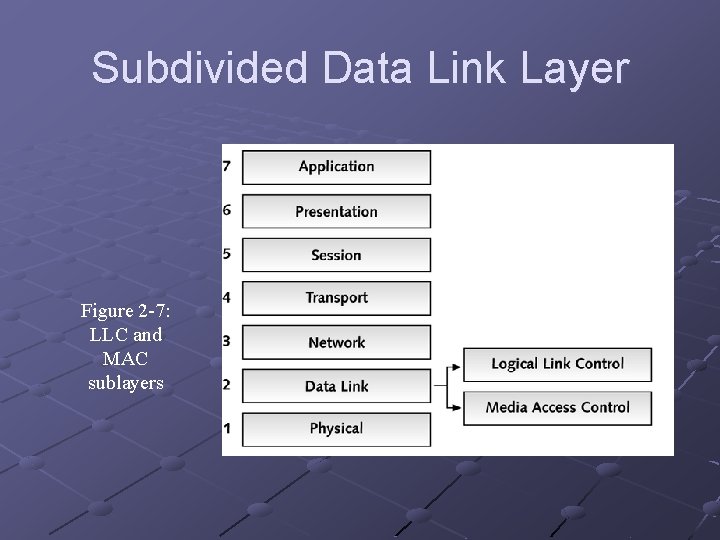
IEEE Networking Specifications To accommodate shared access for multiple network nodes, IEEE expanded OSI Model by separating Data Link layer into two sublayers: n n Logical Link Control (LLC) sublayer Media Access Control (MAC) sublayer
Data Link Layer Sublayers LLC n n n Upper sublayer Provides common interface Supplies reliability and flow control services MAC n n Lower sublayer Appends physical address of destination computer onto the frame
Subdivided Data Link Layer Figure 2 -7: LLC and MAC sublayers
Chapter Summary Standards are documented agreements containing technical specifications or other precise criteria used as guidelines to ensure materials, products, processes, and services suit their purpose Prominent standards organization include: n n n ANSI EIA IEEE ISO ITU
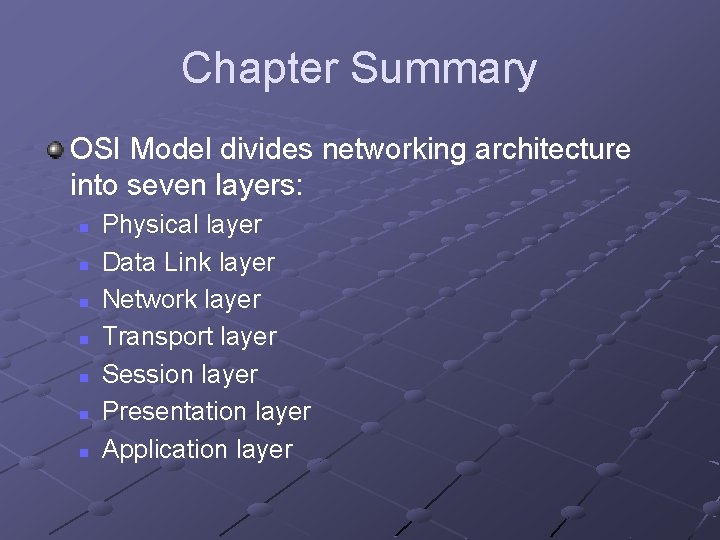
Chapter Summary OSI Model divides networking architecture into seven layers: n n n n Physical layer Data Link layer Network layer Transport layer Session layer Presentation layer Application layer
Chapter Summary A data request from a software program is received by Application layer services and is transferred down through layers of OSI Model until it reaches the Physical layer Data frames are small blocks of data with control, addressing, and handling information attached to them Each node on a network can be identified by two types of addresses: n n Network layer address Data Link layer address
Chapter Summary In addition to frame types, IEEE networking specifications apply to connectivity, networking media, error checking algorithms, encryption, emerging technologies, and more ISO expanded OSI Model by separating the Data Link layer into sublayers: n n LLC layer MAC layer