
Chapter Two Literature Review Title The application for
![• HUANG, Y. –L. [黃郁倫], & ZHONG, Q. –Q. [鍾啟泉]. (Trans. ). (2012)](https://slidetodoc.com/presentation_image_h2/b9c589a0e7870992afbdad9e1bc1390d/image-26.jpg "• HUANG, Y. –L. [黃郁倫], & ZHONG, Q. –Q. [鍾啟泉]. (Trans. ). (2012)")
![• Liao, Y. -J. [廖詠潔], Lin, T. -J. [林騰蛟], Ye, Y. J. [葉永菁],](https://slidetodoc.com/presentation_image_h2/b9c589a0e7870992afbdad9e1bc1390d/image-28.jpg "• Liao, Y. -J. [廖詠潔], Lin, T. -J. [林騰蛟], Ye, Y. J. [葉永菁],")
- Slides: 32
Chapter Two Literature Review Title: The application for Collaborative of Learning Community of Syuejia Elementary School Students in the EFL Classroom MA 2 C 0203 謝易修
Introduction 1 Learning Community 2 6 5 3 Collaborative Instruction 4 EFL Learner Conclusion References
Introduction • 1. Teaching Instruction • 2. Problems with Education (Sato, 2012) • 3. Listening is as learning (Ou, 2013)
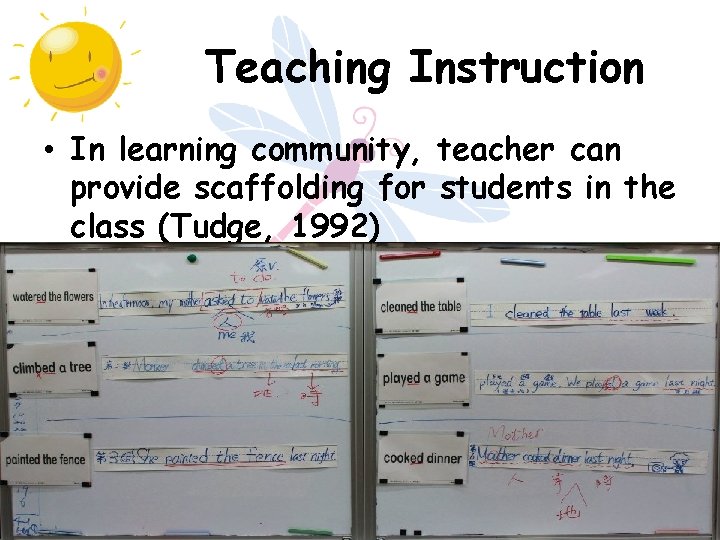
Teaching Instruction • In learning community, teacher can provide scaffolding for students in the class (Tudge, 1992)
Problems with Education • Students lose the learning motivation and escape from learning. • As Sato (2012) inferred that these problems with education not just occurred in Japan but also happened in the other Asian countries.
Listening is as learning • Through listening to others’ voices, dialogic communication, and collaborative learning, learning community is the best strategy to solve these problems (Sato, 2013)
Learning Community • 1. public philosophy, democracy, and excellence. (Sato, 2013) • 2. preparing, teaching, and discussion
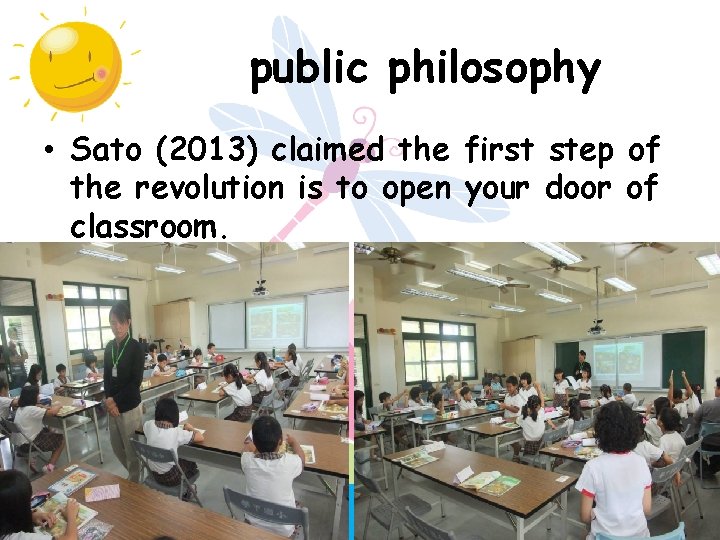
public philosophy • Sato (2013) claimed the first step of the revolution is to open your door of classroom.
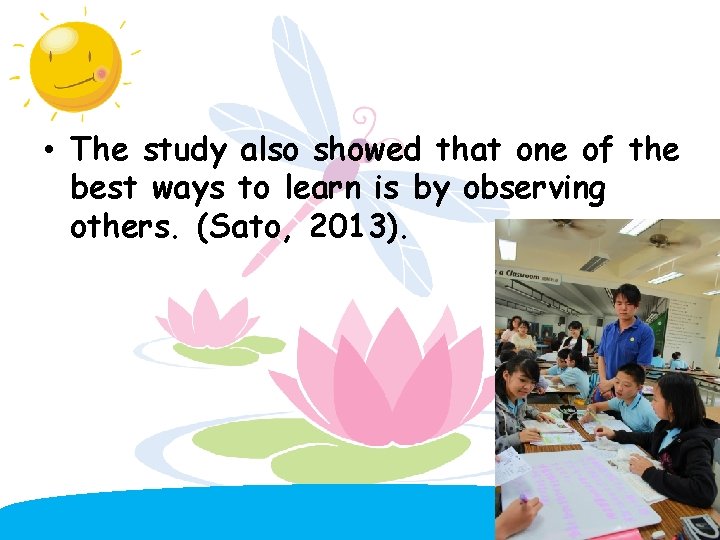
• The study also showed that one of the best ways to learn is by observing others. (Sato, 2013).
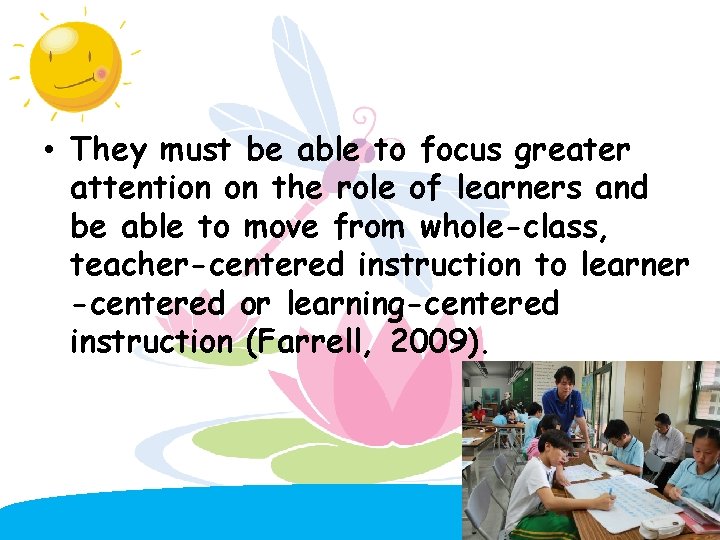
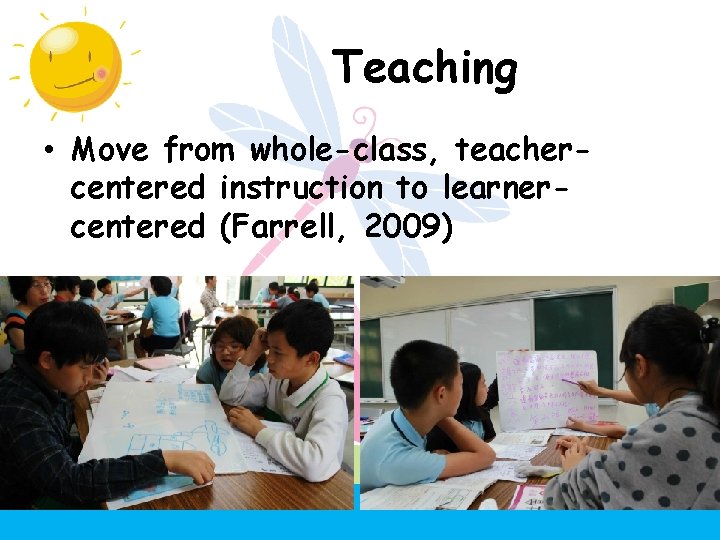
• They must be able to focus greater attention on the role of learners and be able to move from whole-class, teacher-centered instruction to learner -centered or learning-centered instruction (Farrell, 2009).
Democracy • As the educator Deborah Meier proposed that teaching is mostly listening, learning is mostly telling. In good teaching, students are responsible for their learning; they are accountable for their understanding.
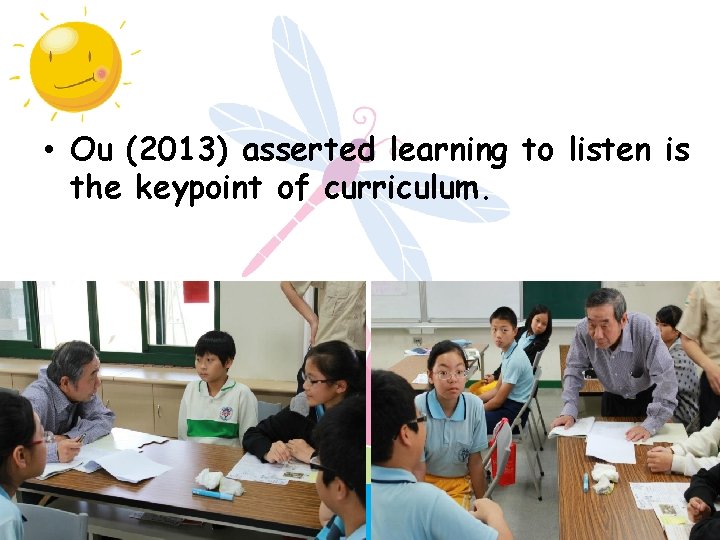
• Ou (2013) asserted learning to listen is the keypoint of curriculum.
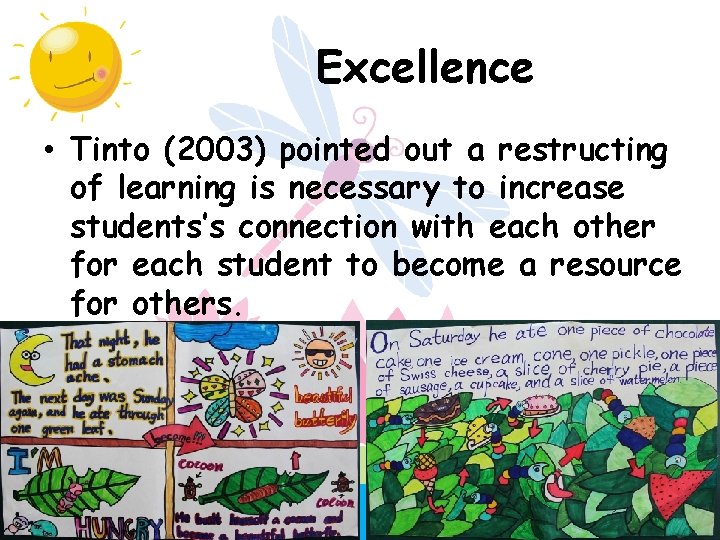
Excellence • Tinto (2003) pointed out a restructing of learning is necessary to increase students’s connection with each other for each student to become a resource for others.
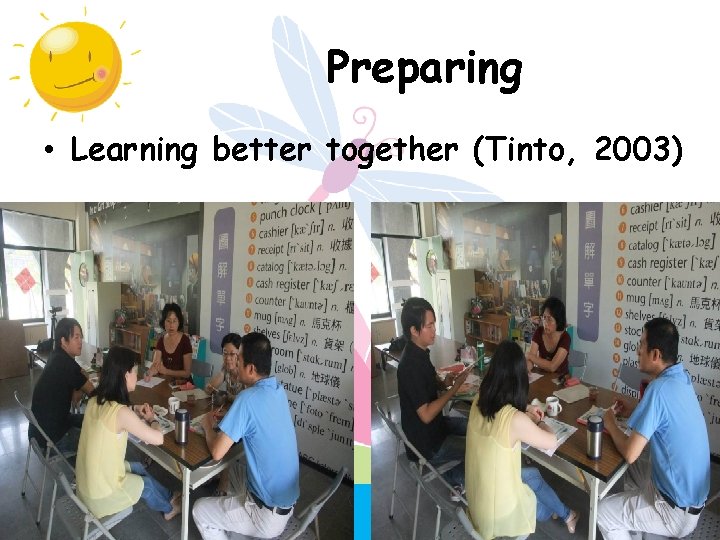
Preparing • Learning better together (Tinto, 2003)
Teaching • Move from whole-class, teachercentered instruction to learnercentered (Farrell, 2009)
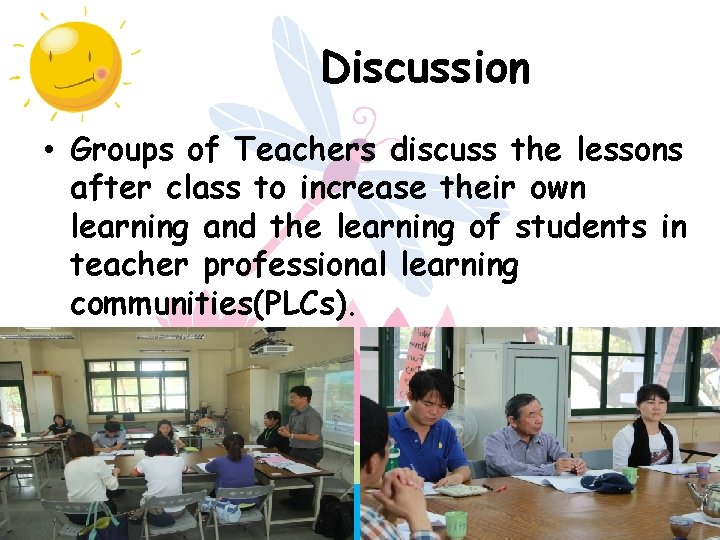
Discussion • Groups of Teachers discuss the lessons after class to increase their own learning and the learning of students in teacher professional learning communities(PLCs).
Collaborative Instruction • Collaborative versus Cooperative Learning
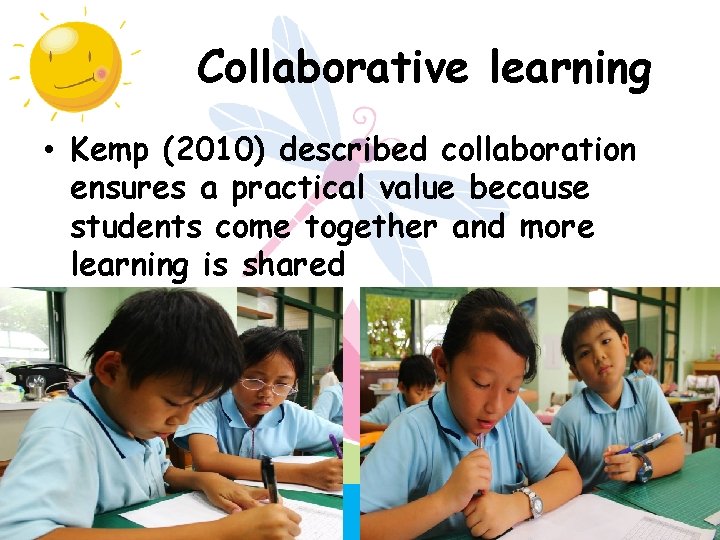
Collaborative learning • Kemp (2010) described collaboration ensures a practical value because students come together and more learning is shared
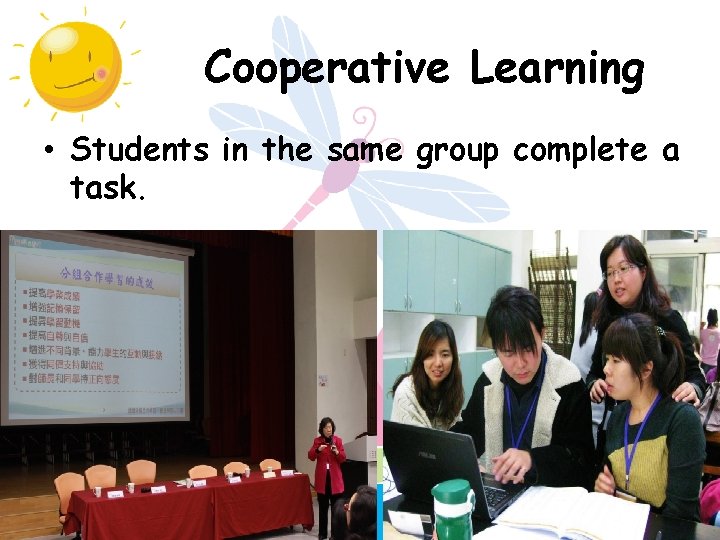
Cooperative Learning • Students in the same group complete a task.
EFL Learner • Learning English as foreign language (EFL), that is, English in one’s native culture with few immediate opportunities to use the language within the environment of that culture (for example, a Taiwanese learning English in Taiwan).
Conclusion • The purpose of this study is to explore the application for collaborative of learning community in Syuejia Elementary School of EFL classroom.
References • Aoki, T. T. (2005). Curriculum in a new key-The collected works of Ted T. Aoki. Pinar, W. F. , R. L. Irwin (Eds. ). Nwe Jersey: Lawrence Erlbaum Associates. • Bandura, A. (1977). Social learning theory. • Brown, H. D. (2007). Sociocultural Factors. In H. D. Brown (Ed. ), Principles of language learning and teaching (pp. 204 -206). New York, NY: Pearson Education Press.
• Burns, A. , & Richards, J. C. (2009) Collaborative Teacher Development. In B. Johnston (Ed. ), The Cambridge guide to second language teacher education (pp. 242 -243). Cambridge: Cambridge University Press. • Burns, A. , & Richards, J. C. (2012) Competence and Performance in Language Teaching. In J. C. Richards (Ed. ), The Cambridge guide to pedagogy and practice in second language teaching (pp. 52 -53). Cambridge: Cambridge University Press.
• Burbules, N. C. , B. C. Bruce (2001). Theory and research on teaching as dialogue. In V. Richardson (Ed. ). Handbook of research on teaching (pp. 11021121). Washington, D. C. : American Educational Research Association. • Dubin, J. (2010). American Teachers Embrace the Japanese Art of Lesson Study. Education Digest, 75(6), 23.
• Farrell, Thomas S. C. (2009) Small groups/Pair work. In Thomas S. C. Farrell (Ed. ), Talking, Listening, and Teaching: A Guide to Classroom Communication (pp. 75 -77). California, CA: Corwin Press. • HUANG, Y. –L. [黃郁倫]. (Trans. ). (2013) 學習共同 體: 構想與實踐 [Learning Community: Conception and practice] (2013 ed. ). Taipei, Taiwan: Common. Wealth Magazine
• HUANG, Y. –L. [黃郁倫], & ZHONG, Q. –Q. [鍾啟泉]. (Trans. ). (2012) 學習的革命: 從教室出發的改革 [The Revolution of Learning: A Guide to the. Classroom Reform] (2013 ed. ). Taipei, Taiwan: Common. Wealth Magazine. • Johnston, B. (2009). Collaborative teacher development. In A. Burns & J. C. Richards (Eds. ), The Cambridge guide to second language teacher education (pp. 241 -249). Cambridge: Cambridge University Press.
• Kemp, L. (2010). Teaching and learning for international students in a learning community: creating, sharing and building knowledge. Journal of Scholarly Teaching, 5, 64 -74. • Lewis, C. (2000). Lesson study: The core of Japanese professional development. ERIC Clearinghouse. • Lieberman, Ann. , & Miller, Lynne. (2011). Learning communities: the starting point for professional learning is in schools and classrooms. Journal of Staff Development, 32, 16 -20.
• Liao, Y. -J. [廖詠潔], Lin, T. -J. [林騰蛟], Ye, Y. J. [葉永菁], Yu, S. -Q. [余淑清], Xie, W. -T. [謝宛 婷], Zhang, W. -B. [張文斌], & Zhou, C. –B. [周采 蓓]. (Eds. ). (2013). 學習的革命: 本土實踐的反思 [The Revolution of Learning: Local Practice & Reflection]. In Y. –S. , Ou. [歐用生] (Ed. ) 新北市教育: 學習共同體 特刊 [New Taipei City Education: Learning Community Special issue]. 新北市: 新北市政府教育局 [New Taipei City, Taiwan: Education Bureau, New Taipei City].
• Nayar, P. B. (1997). ESL/EFL dichotomy today: Language politics or pragmatics? . TESOL Quarterly, 31(1), 9 -37. • Panitz, T. (1999). Collaborative versus cooperative learning: A comparison of the two concepts which will help us understand the underlying nature of interactive learning. ERIC Clearinghouse. • Rubin, C. M. (2013, September 20). The global search for education: Japan. Blogger and author, The Real Alice in Wonderland. Retrieved from http: //www. huffingtonpost. com/c-m-rubin/theglobal-search-for-edu_b_3943658. html
• So, K. , Shin, J. , & Son, W. (2010). A comparative study of classroom teaching in Korea and Japan: a case study on reforming schools into learning communities. Asia Pacific Education Review, 11(3), 273 -283. • Tinto, V. (2003). Learning better together: The impact of learning communities on student success. Higher Education monograph series, 1(8).
• Tudge, J. (1992). Vygotsky, the zone of proximal development, and peer collaboration: Implications for classroom practice. • Watanabe, T. (2002). Learning from Japanese Lesson Study. Educational leadership, 59(6), 36 -39. • Weissman, E. , Cullinan, D. , Cerna, O. , Safran, S. , & Richman, P. (2012). Learning communities for students in developmental English: Impact studies at Merced College and the Community College of Baltimore County. NCPR Paper.
Thank you for listening!