
CHAPTER TWO FINANCIAL STATEMENT AUDIT 2 1 Audit



- Slides: 61
CHAPTER TWO: FINANCIAL STATEMENT AUDIT 2. 1. Audit of Current Assets §Current assets include cash and other assets that can be used or converted into cash within relatively short period of time usually one year or one operating cycle. §Validate the transaction and balance related audit objectives. § The first procedure is a transaction test (TA) which enables the auditor to evaluate the design and implications of internal control over cash. §The second procedure is test of balance §WHAT IS CASH?
2. 1. 1 Auditing Cash and Cash Equivalent • Cash is a medium of exchange that a bank will accept for deposit • money in coins and currency (notes) • Petty cash • Negotiable documents include checks, certificate of deposit, credit card and money orders.
Evaluating Internal Control over Cash • It’s detail task of auditors due to the fact that almost all transactions affect cash account • by its very nature cash is the most liquid and tempted to miss appropriation and embezzlement.
Internal Control Over Cash Receipt Ø Cash from sales can be received either over the counter or via mails in the case of credit sales. Internal Control over Cash Receipts over the Counter Ø There should be pre numbered receipt used in the sales process. Ø The cash receipt should be deposited immediately in a bank. Ø A person independent of the cashier should count cash, and compare it to the amount recoded on the receipts.
Conti… Internal Control over Cash Receipt by Mail • The mail should be locked and the key should be placed on the hand of a responsible person. • At least two people have to be present when mail is opened and list of money received should be kept. • A prelisting of cash received should be made in three copies, one copy for cashier, the second copy for accounting department and the third copy kept by the preparer
Internal Control of Cash Payment Ø Use voucher system in approving and making payment Ø Expenditure should be made using pre- numbered checks Ø The Persons who prepare checks and signing them should be separated Ø The signed check should be mailed under the supervision of the person signing them Ø Unsigned checks should be placed in secured place Ø To guard against alteration of the amount, the amount of the check should be imprinted or embossed on the check by means of a check protecting machine Ø The person who prepares checks should not bear responsibility over purchases or sales transactions.
Control over Petty Cash The internal control over petty cash includes: § The level of petty cash should be laid down formally by management § A maximum amount should be placed on a petty cash payment § Periodically the petty cash should be reconciled by an in dependent person
Bank Reconciliation as Control Mechanism • Bank statement and accompanying paid checks should be delivered in sealed envelopes directly to the person responsible for preparing bank reconciliation. • Restricting access to bank statement and accompanying paid checks to this person is important as it prevents other employees from attempting to conceal shortages or unauthorized transactions by altering the bank statement or the accompanying paid checks.
Substantive Audit Test of Cash Auditing Cash Receipts • Existence/ occurrence: The specific audit objective is to determine whether all recorded cash receipts transactions has occurred • Completeness: This assertions can be used to establish credibility of the accounting records by tracing the handling of representative transactions from origin of final account balance, i. e. , to trace whether all cash received has been recorded or not. • Rights and obligations: This is not an issue with cash receipts. • Valuation: This is not an issue (except foreign currency transactions)
Conti… • Cutoff: cash receipts are recorded in the correct period. • Presentation and disclosure: receipts are credited to the proper account, e. g. sales, accounts receivable. • Accuracy: The audit concern here is that cash receipts journal amounts are correctly posted to the Accounts Receivable Subsidiary Ledger and the General Ledger Cash account
B. Auditing Cash Payment • • • Existence/occurrence Completeness Rights and obligations Valuation Cutoff: Presentation and Disclosure
C. Auditing Cash on Hand Cash in Bank • Existence/occurrence: The specific audit objective is to determine that all cash balances exist and that cash is not overstated • a) Count cash on hand: All balances should be counted at once. • This is to prevent the client from moving cash from one branch to another and having it include in the count two or more times. • If it is impossible to count all locations at one time, each cash box should be sealed after counting and the auditor should check that the seals are still intact after completing the count. • It is very important that the cash custodian be present at all times during the count. • After the count, the auditor should ask the custodian to sign the paper
Conti… Ø Petty cash funds should be counted on surprise basis, some times before year end. Ø The reason for this is to detect if the petty cash custodian is borrowing from the cash box. Ø If the cashier knows the date on which the auditor will count cash, she /he can borrow money from friends to make up the balance for the auditors count, and then take the money out of the box after the auditor leaves.
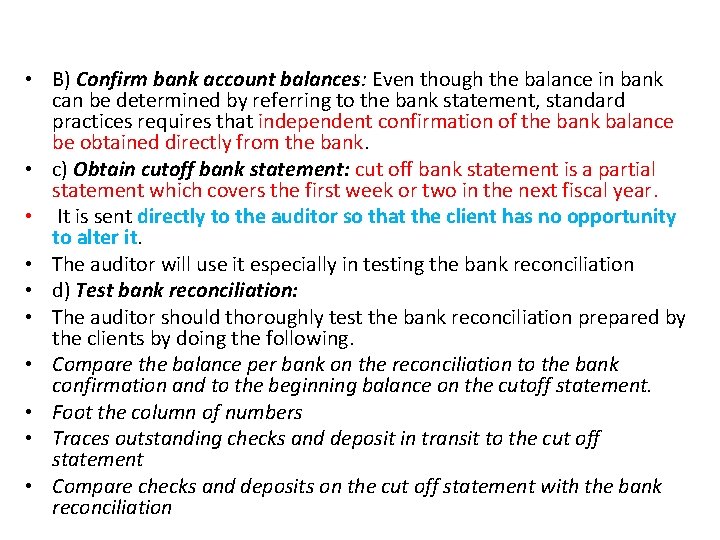
• B) Confirm bank account balances: Even though the balance in bank can be determined by referring to the bank statement, standard practices requires that independent confirmation of the bank balance be obtained directly from the bank. • c) Obtain cutoff bank statement: cut off bank statement is a partial statement which covers the first week or two in the next fiscal year. • It is sent directly to the auditor so that the client has no opportunity to alter it. • The auditor will use it especially in testing the bank reconciliation • d) Test bank reconciliation: • The auditor should thoroughly test the bank reconciliation prepared by the clients by doing the following. • Compare the balance per bank on the reconciliation to the bank confirmation and to the beginning balance on the cutoff statement. • Foot the column of numbers • Traces outstanding checks and deposit in transit to the cut off statement • Compare checks and deposits on the cut off statement with the bank reconciliation
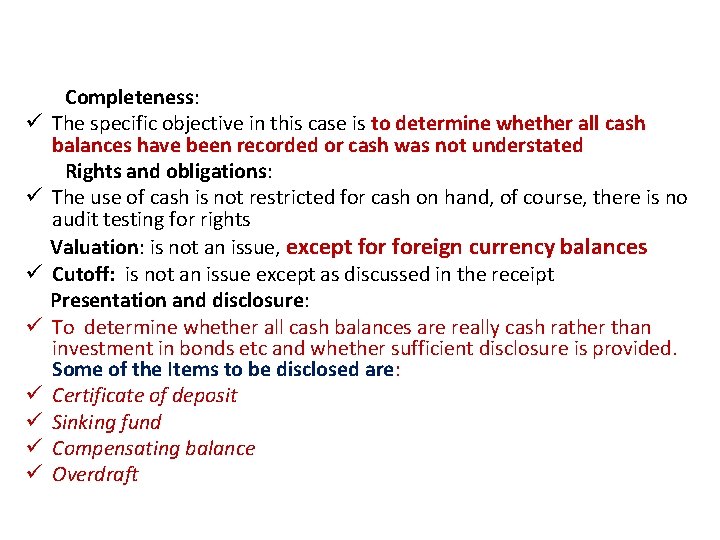
ü ü ü ü Completeness: The specific objective in this case is to determine whether all cash balances have been recorded or cash was not understated Rights and obligations: The use of cash is not restricted for cash on hand, of course, there is no audit testing for rights Valuation: is not an issue, except foreign currency balances Cutoff: is not an issue except as discussed in the receipt Presentation and disclosure: To determine whether all cash balances are really cash rather than investment in bonds etc and whether sufficient disclosure is provided. Some of the Items to be disclosed are: Certificate of deposit Sinking fund Compensating balance Overdraft
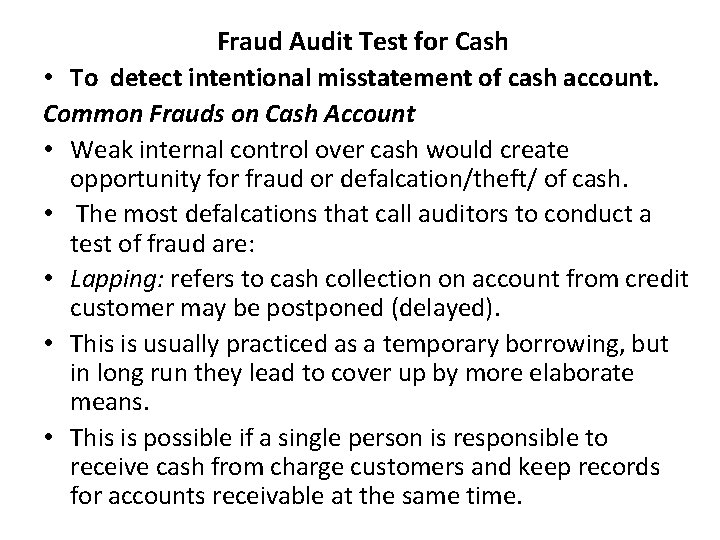
Fraud Audit Test for Cash • To detect intentional misstatement of cash account. Common Frauds on Cash Account • Weak internal control over cash would create opportunity for fraud or defalcation/theft/ of cash. • The most defalcations that call auditors to conduct a test of fraud are: • Lapping: refers to cash collection on account from credit customer may be postponed (delayed). • This is usually practiced as a temporary borrowing, but in long run they lead to cover up by more elaborate means. • This is possible if a single person is responsible to receive cash from charge customers and keep records for accounts receivable at the same time.
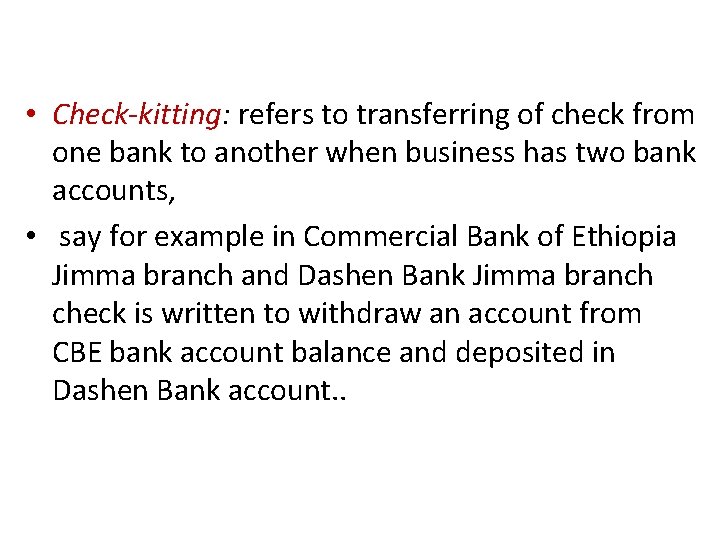
• Check-kitting: refers to transferring of check from one bank to another when business has two bank accounts, • say for example in Commercial Bank of Ethiopia Jimma branch and Dashen Bank Jimma branch check is written to withdraw an account from CBE bank account balance and deposited in Dashen Bank account. .
Conti… Ø Due to lag (delay) of time in clearance, the amount deposited in Dashen Bank may be reflected immediately in balance of cash account at Dashen Bank, but not reflected as deduction from the account at Commercial Bank of Ethiopia account soon. Ø As a result of such technique a casher may cover up cash shortage which an auditor might uncover under normal audit procedure
• Window dressing: cash shortage or cash position could be improved by holding the cash book open/unclosed/ beyond the closing date to include subsequent cash receipt. • There also other kind of frauds such as writing off bad debts, fictions Accounts receivable, casher payable to self, etc
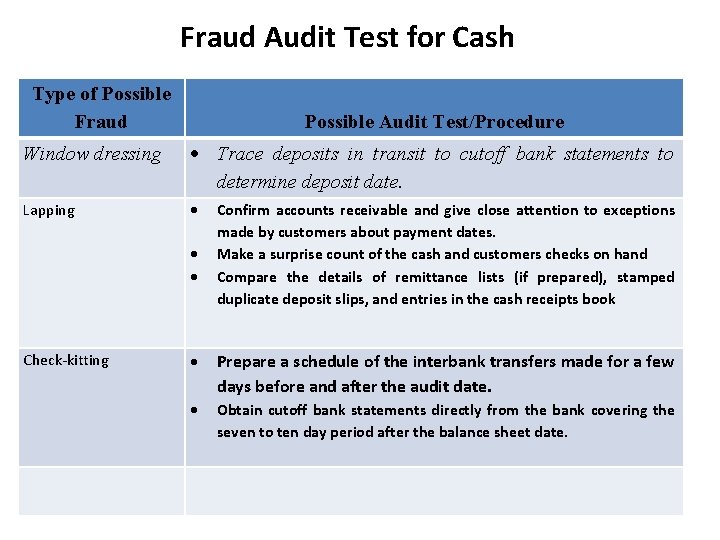
Fraud Audit Test for Cash Type of Possible Fraud Possible Audit Test/Procedure Window dressing Trace deposits in transit to cutoff bank statements to determine deposit date. Lapping Check-kitting Confirm accounts receivable and give close attention to exceptions made by customers about payment dates. Make a surprise count of the cash and customers checks on hand Compare the details of remittance lists (if prepared), stamped duplicate deposit slips, and entries in the cash receipts book Prepare a schedule of the interbank transfers made for a few days before and after the audit date. Obtain cutoff bank statements directly from the bank covering the seven to ten day period after the balance sheet date.
2. 1. 2 Audit of Accounts Receivables • For many business sales are made on credit • Thus auditors usually make a due attention in an audit of account receivable • Like those of other accounts, the auditor approaches an audit of receivable in two procedures; first it conducts assessment of internal control or transaction test and performs an audit of balance to substantiate the validity of audit objectives.
• The auditor checks the sales and receivable cycle, collection, the discount, allowance and returns offered to customer as well as the process of determining bad debt expense or written-off debt. • In attaining the overall audit objective, to substantiate the validity of expressed and implied assertion concerning balance of accounts receivable.
Evaluating Internal Control over Accounts Receivable Good internal control for receivables includes: • Any person who handles or has access to collect from customers should have no other responsibility relating to account receivable. • Responsibility for approval of credit to customers, account for returned goods, and allowance for uncollectible accounts should be given to the general manager or high ranking officers. • A person authorized to approve non cash credit should under no circumstance have access to cash collection. • The handling of cash should be separated from the preparation of the accounting records. •
Conti… Ø A person who opens a mail should make a record in 3 copies of all cash received, retain one copy for himself, send the cash and the second copy to the cashier and send the third copy to accounting department. Ø The cashier will deposit the cash in a bank and send the deposit slip to accounting department. Ø The accounting department will control the cash by comparing the third copy with the deposit slip sent to it. Ø Granting credit, collecting delinquent account, making records (accounting) and cashiering, all should not be granted to a single individual. Ø Using two types of account (subsidiary ledger and general ledger) and assigning recoding in the two accounts to different employees.
• Test of Control for Account Receivable Ø Test of control should be designed to check that the control procedures are being applied and the objectives are being acceded. In relation to accounts receivable, the following tests can be performed on a sample basis: Ø Cary out sequence test checks on invoices, credit notes, shipping/dispatch notes orders to ensure that all items are included and that there are no omissions or duplications. Ø Check authorization for the: Ø Acceptance of the order Ø Dispatch of goods Ø Raising of the invoice or credit notes Ø Pricing and discounts Ø Write-off of bad debts
Conti… • In this procedure, the auditor checks that the relevant signature exists and that the control has been applied in the process of credit sales and subsequent cash collection. • Seek evidence of checking of the arithmetic accuracy of invoices, credit notes and sales tax. • Check dispatch notes and goods returned notes to ensure that they are referenced to invoices and credit notes and vice versa. • Check that control account reconciliations have been performed and reviewed. • Ensure that batch total control have been applied by seeking signatures and tracing batches from inputs to output. • In all the above cases, the auditor attempts to get satisfaction on the proper application of the control procedure.
Test of Balance of Accounts Receivables • He /she further carries out substantive tests in an attempt to ensure that, the transactions, sales, cash receipt, discounts, return and allowance and bad debts in the accounts receivable subsidiary ledgers and controlling account, are in fact completely and accurately recorded or the balance is not materially misstated. • In audit of accounts receivable balance the audit program includes the following balance related objectives: • Accounts receivable in the aged trial balance agree with related master files
Conti… • Amounts, and the total is correctly added and agrees with the general ledger (detail tie-in) • Recorded account receivable exist(existence) • Existing accounts receivable are included(completeness) • Accounts receivable are accurate( accuracy) • Cutoff for accounts receivable is correct( cut off) • Accounts receivable are properly classified(classification) • Accounts receivable are stated at realizable value(realizable value) • The client has right to accounts receivable(rights) • Accounts receivable presentation and disclosure are proper(presentation)
Conti… • The followings are substantive audit test for account balance of accounts receivable: • Accuracy: is discussed first because the auditor must establish that the detailed record that support the account to be audited agree with the general ledger account. • The amounts continued in the financial statements are derived from the general ledger balances. • To test the fairness of a financial statement amount, the auditor tests the general ledger account by examining the amount or estimates that compose the balance. For many account, the general ledger balance is supported by a subsidiary ledger or listing of the details that make up the balance. • Normally, the auditor performs a number of accuracy tests of the subsidiary ledger or listing before conducting other tests of the account balance. • This process is followed when accounts receivable are audited. For example, the auditor agrees the accounts receivable subsidiary ledger of customers accounts to the general ledger account receivable (control) account. • This is typically accomplished by obtaining a copy of the aged trial balance of accounts receivable and comparing the total balance with the general ledger accounts receivable account balance.
• An aged trial balance of the subsidiary ledger is used because the auditor will need this type of data to examine the allowance for uncollectible accounts. • The auditor must also have assurance that the details making up the aged trial balance is accurate. • This can be accomplished in a number of ways. One approach involves mainly manual audit procedures. First, the aged trial balance is footed and cross footed. • Footing and cross footing mean that each column of the trial balance is added, and the column totals are then added to ensure that they agree with the total balance for the account. • Then a sample of customer accounts included in the aged trial balance is selected for testing. • For each selected customer account, the auditor traces the customer’s balance back to the subsidiary ledger detail and verifies the total amount and the amounts included in each column for proper aging. • A second approach involves the use of computer-assisted audit techniques. If the general controls over IT are adequate, the auditor can use a generalized audit software package to examine the accuracy of the aged trial balance generated by the client’s accounting system
• Validity: The validity of accounts receivable is one of the more important audit objectives because the auditor wants assurance that this account balance is not overstated through the inclusion of fictitious customer accounts or amounts. • The major audit procedure for testing the validity objective for accounts receivable is confirmation from customers. • If some customers’ dose not respond to the auditor’s confirmation request, additional audit procedures may be necessary. • There are two types of confirmation called positive confirmation and negative confirmation. • Basically positive confirmations are letters sent to debtors asking them to confirm directly to the auditor the amount of the balance in their respective accounts.
Conti… • The auditor wants a response regardless of whether the customer agrees or disagrees with the stated balance. The confirmation usually includes the amount from the client books, but it is possible to send a blank confirmation and ask the clients to fill in the correct amount. • The blank type of confirmation is very good evidence because the customer has to actually look up the information on his or her records and writes it down. But the response rate is usually lower because of the amount of work involved for the customers. • Negative confirmation on the other hand asks for a response only if the debtor disagree with the recorded amount. • Negative confirmation request are often simply stamped or glued on to the clients regular monthly statements to the customer before it is sent out. Positive confirmations are more reliable, partly because the auditor will follow up confirmations which are not returned. • If a negative confirmation is not returned, the auditor assumes it is because the debtor agrees with the balance. • Since negative confirmation are often simply ignored by the receipt that assumption may not be correct. Negative confirmation are less reliable, but are cheaper to send. • A formal letter is not required, and no time is spent following up.
2. 1. 3 Auditing for Inventory Management Process • Is affected by the internal control procedures for revenue, purchasing and payroll processes. • The acquisition of and payment for inventory are controlled via purchasing process. • The cost of both direct and indirect labor assigned to inventory is controlled through the payroll process. • Last, finished goods are sold and accounted for as part of the revenue process. • Thus, the “cradle-to-grave” cycle for inventory begins when goods are purchased and stored and ends when the finished goods are shipped to customers. The following are the more important documents and records that are normally involved in the inventory system.
Conti… In advanced IT system, some of these documents and records may exist for only a short time or only in machine readable form. • Production and schedule • Receiving report • Material requisition • Inventory master file • Production data information • Cost accumulation and variance report • Inventory status report • Shipping Order
Conti… The followings are internal control procedures that should exist in the client’s business to control inventory properly • Purchase or other commitment should be initiated only by authorized personnel, preferably on the basis of competitive bid. • Purchase orders for good and materials are placed as needed and for optimum quantity • Follow up should be made on purchase orders if delivery has not been made by the scheduled delivery date • Incoming shipment should be accepted only if the receiving department has authorization in the form of a copy of purchase order. • Quantity and quality of goods received should be as specified before payment is authorized • Terms, prices, and clerical accuracy of vendors invoice should be correct before payment is authorized • Refund or credit should be received for all purchase returned and allowance • The need to reorder signaled as soon as the amount of inventory on hand reaches a minimum safety balance
Conti… • Inventory quantity should be adequately protected against losses from theft, spoilage, unauthorized withdrawal by employee. • There should be full accountability for both units and birr for inventory quantity received, on hand issued or sold. • Difference between book and physical inventories are ascertained, differences adjusted and the amount of overage or shortage should be properly accounted for. • Proper authorization exists for inventory quantity removed from stock • All transactions pertaining to the issue or sales of inventories quantity should be accounted for and entered in the controlling record. • Inventory issues should be valued according to an acceptable method and the costs should be accounted for in a manner that provides adequate information for management including variance from standard
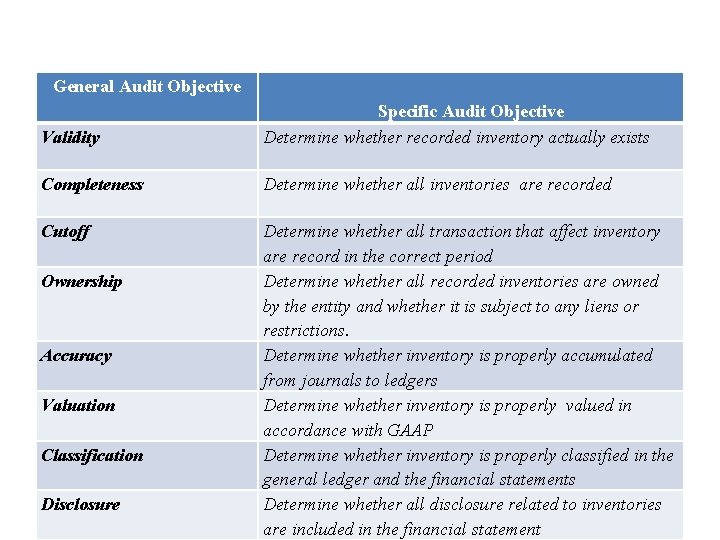
General Audit Objective Validity Specific Audit Objective Determine whether recorded inventory actually exists Completeness Determine whether all inventories are recorded Cutoff Determine whether all transaction that affect inventory are record in the correct period Determine whether all recorded inventories are owned by the entity and whether it is subject to any liens or restrictions. Determine whether inventory is properly accumulated from journals to ledgers Determine whether inventory is properly valued in accordance with GAAP Determine whether inventory is properly classified in the general ledger and the financial statements Determine whether all disclosure related to inventories are included in the financial statement Ownership Accuracy Valuation Classification Disclosure
2. 2 Auditing Noncurrent Assets • The following internal control procedures should be implemented to properly control fixed asset: • Capital budgeting approach should be used to the authorization • • • of plant expenditure. Comparison of budgeted and actual expenditure should be made periodically Expenditure for plant asset must also be properly classified according to whether they should be capitalized or expensed. After the fixed asset is acquired, detailed accounting record of them should be maintained in a plant ledger with a separate page for each items. An identifying serial number should be given to each fixed asset. Depreciation charges should be accurately determined particularly when disposal occurs.
Conti… • Historical cost, date of acquisition, accumulated depreciation, period of use, and major repair and improvement should be properly kept and shown on the plant ledger. • All maintenance or special work order done in the factory should be authorized by work orders and the accounting department should be informed for record keeping. • Discarding, sales or exchange of plant asset should be properly authorized by the concerned official and communicated to the accounting department on the date of disposal. • Purchase requisition should be initiated in relevant department and authorized at the appropriate level with in the entity. • However, highly technical equipments should be purchased only after passing though a specific skilled professional. • There should be a limit to the authorization at each managerial level to ensure that larger projects are brought to the attention of high level management for approval before commitment are made.
2. 3 Auditing Liabilities • A balance sheet will contain many liabilities grouped under various headings such as: • Trade creditors/Accounts payable • Notes payable • Bank loans and overdraft • Other creditors including accrued taxes, pension/provident fund payable and accrued and deferred income •
• In an audit of liabilities the auditors’ duty is fourfold, namely: • To verify the existence of liabilities shown in the balance sheet, • To verify the correctness of the money amount liability accounts, • To verify the appropriateness of the description given in the accounts and the adequacy of disclosure, • To verify that all existing liabilities are actually included in the accounts.
Conti… • During an audit of liabilities the auditors has to recognize the following points that differentiate the audit of asset and liability. • Management fraud designed to improve the apparent financial position of a company usually involves an overstatement of asset but an understatement of liability. • A transaction which has given rise to labiality need merely be ignored in the record to achieve the desired effect. • The auditor’s problem is then much more difficult, for there is no convenient starting point to an examination designed to disclose possible unrecorded liability.
Conti… • Defalcation by employee present less problem in the case of liability account since defalcation usually involves the abstraction and manipulation of asset. • Most liabilities are a statement of facts whereas most assets involve valuation problem based on individual judgment. Only some of the estimated liabilities such as a provision for cost to be incurred in connection with product guarantees involve problems similar to those of asset valuation
Conti… • Internal Control over Liability • Some of the internal control procedures that should exist over liabilities are listed as follows: • The authority to borrow money should be restricted to only two or three officials of the company. • Large borrowings should be made only under specific authorization of the board of directors. • All interest payment should be subject to close scrutiny before they are approved to be certain that interest is paid for known liabilities. • Voucher system should be used in processing account payables. • Two records (subsidiary ledger and controlling account) should be kept for account payables and should be reconciled periodically. • The client should maintain detailed record of long term debt transaction to ensure that all borrowing and repayment of principal and interest are recorded.
Conti… • 2. 3. 1 Auditing Current Liabilities (Accounts Payable and Accrued Liabilities) • The discussion below is related to audit of account balance of account payable and accrued expense. • The auditor first test accuracy in order to ensure that the detailed records support the general ledger accounts. • Accuracy: The accuracy of account payable is determined by obtaining a listing of accounts payable, footing the listing and agreeing it to the general ledger control account. • The items included on this listing are the unpaid individual vouchers or the balance in the individual ledger account in the subsidiary record • Validity: The auditor’s major concern with this audit objective is whether the recorded liabilities are valid obligations of the entity. • To verify the validity of liability, the auditor can vouch sample of the items included on the listing of account payable, or the accrued account analysis to voucher packets or other supporting documents. • If adequate source documents are present, the auditor has evidence that the amount represents valid liabilities. In some circumstances, the auditor may obtain copies of the monthly vendor statement or send confirmation request to
Conti… • • Completeness: Completeness is an important audit objective for accounts payable and accruals because auditors are concerned about unrecorded liability. Therefore, auditors frequently conduct extensive test to ensure that all liabilities are recorded. Such tests are commonly referred to as a search for unrecorded liabilities. The following audit procedures may be used as a part of the search for unrecorded liabilities. Ø Ask management about control procedures used to identify unrecorded liabilities and accruals at the end of an accounting period. Ø Obtain copies of vendor’s monthly statements and reconcile the amount to the clients account payable record. Ø Confirm vendor accounts, including accounts with small or zero balances. Ø Vouch large dollar items from the purchase journal and cash disbursement journals for a limited time after year and; examine the date on each receiving report or vendor invoice to determine if the liability relates to the current period. Ø Examine the files of unmatched purchase orders, receiving reports and vendors invoice for any unrecorded liabilities.
Conti… • Cutoff: The cutoff objectives attempts to determine whether all purchase transactions and related account payables are recorded in the proper period. • On most audits, purchase cutoff is coordinated with the clients physical inventory count. Proper cutoff should also be determined for purchase returns • Ownership: Generally, there is little risk related to this objective because clients seldom have an incentive to record liability that is not obligation of the entity. • Review of the voucher packet for adequate supporting document relating liabilities to the client provides sufficient evidence to support these audit objectives. • Valuation: Most accruals are relatively easy to value and proper valuation can be tested by examining the underlying source document. • Classification: The major issues related to the classification objectives are: • Identifying and reclassifying any material debits contained in account payables • Segregating short term and long term payables • Ensuring that different types of payables are properly classified.
Conti… • Proper classification can usually be verified by reviewing the accounts payables listing and the general ledger accounts payables. • If material debits area present, they should be reclassified as receivables or as deposit if the amount will be used for future purchase. • Any long term payables should be identified and reclassified to the long term liability section of the balance sheet. • Also, if payables to officers, employees or related parties are material they should be included with the trade account payables. • The auditor should also ensure that accrued expenses are properly classified. • Disclosure: Even though management is responsible for the financial statement, the auditors must ensure that all necessary financial statement disclosure is made for account payables and accrued expense. • Examples of disclosure items for purchasing process related liabilities include: • Payables by type (trade, officers, employees etc. ) • Short and long term payables
2. 3. 2 Auditing Long-Term Liabilities • Common types of long term debt financing include notes, bonds, and mortgage • The auditor must be assured that the amount shown on the balance sheet for the various types of long term debt is not materially misstated. • This assurance extends to the proper recognition of interest expense in the financial statements.
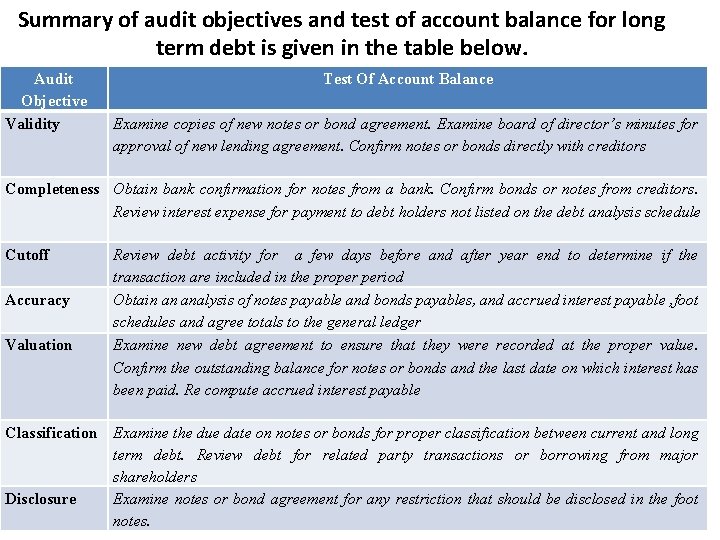
Summary of audit objectives and test of account balance for long term debt is given in the table below. Audit Objective Validity Test Of Account Balance Examine copies of new notes or bond agreement. Examine board of director’s minutes for approval of new lending agreement. Confirm notes or bonds directly with creditors Completeness Obtain bank confirmation for notes from a bank. Confirm bonds or notes from creditors. Review interest expense for payment to debt holders not listed on the debt analysis schedule Cutoff Accuracy Valuation Review debt activity for a few days before and after year end to determine if the transaction are included in the proper period Obtain an analysis of notes payable and bonds payables, and accrued interest payable , foot schedules and agree totals to the general ledger Examine new debt agreement to ensure that they were recorded at the proper value. Confirm the outstanding balance for notes or bonds and the last date on which interest has been paid. Re compute accrued interest payable Classification Examine the due date on notes or bonds for proper classification between current and long term debt. Review debt for related party transactions or borrowing from major shareholders Disclosure Examine notes or bond agreement for any restriction that should be disclosed in the foot notes.
2. 4 Auditing Stockholders’ Equity • 2. 4. 1 Evaluating Internal Control over Stockholders’ Equity • For most entities, stockholders’ equity includes common stock, preferred stock, paid-in capital, and retained earnings. • In recent years, numerous financial instruments have been developed that contain both debt and equity characteristics and affect the audit of stockholders’ equity. • Various stock options and compensation plans also impact the audit of stockholders’ equity. • Following are three major types of transactions that occur in stock holders’ equity: • Issuance of stock: This includes transactions such as sale of stock for cash, the exchange of stock for assets, services, or convertible debt and issuance of stock splits. • Repurchase of stock: This includes the reacquisition of stock (referred to as treasury stock) and the retirement of stock. • Payment of dividends: This includes the payment of cash dividend or issuance of stock dividends.
Conti… • Following are the major internal controls for stockholders’ equity. • Verify that stock and dividend transactions comply with the corporate charter. • Verify that stock and divided transactions have been properly approved. • Verify that stock and dividend transactions have been properly valued. • Verify that all stock and dividend transactions have been properly posted and summarized in the accounting record. • The individual responsible for issuing, transferring and canceling stock certificate should not have any accounting responsibility. • The individual responsible for maintaining the detailed stockholders record should be independent of the maintenance of the general ledger control account. • The individual responsible for maintaining the detailed stockholders records should not also process each receipts or disbursements. • Appropriate segregation of duties should be established among the preparation, recording, signing and mailing of dividend checks.
2. 4. 2 Auditing Capital Stock Accounts When auditing the capital stock accounts, the auditor is normally concerned with the validity, completeness, valuation and disclosure objectives. Validity and Completeness: All valid stock transaction is approved by the board of directors. § Therefore, the auditor can test the validity of capital stock transactions by tracing the transactions recorded in the current year to the board of director’s minutes. § When an independent registrar and transfer agent are used by the entity, the auditor confirms the total number of shares outstanding at the end of the period. § If the amount of shares outstanding on the confirmation reconciles to the general ledger capital-stock accounts, the auditor has evidence that the total number of shares outstanding at the end of the year is correct. • The auditor may perform the following tests: § Trace the transfers of shares between stockholders to the stock register and/or stock certificate book (valuation and completeness). § Foot the shares outstanding in the stock register and/or stock certificate book and agree them to total shares outstanding in the general ledger capital-stock certificates (completeness). § Examine any canceled stock certificates (validity).
Conti… • Valuation: When capital stock is issued for cash, the assessment of proper valuation is straightforward. • The par, or sated, value for the shares issued is assigned to the respective capital-stock account, while the difference between the price and par, or stated, values assigned to each transaction. • The proceeds from the sale of stock are normally traced to the cash receipts records. • The valuation issue is more complex when capital stock issued in exchange for assets or services, for a merger or acquisition, for convertible securities, or for a stock dividend. • For example, when a stock dividend is declared and the number of shares issued is less that 20 percent of the shares outstanding, the dividend is recorded at fair market value. • The fair market value of the stock dividend is charged to retained earnings and credited to common stock and paid-in capital. • To test valuation, the auditor can re compute the stock dividend and trace the entries into the general ledger.
• Disclosure: A number of important disclosures are frequently necessary for stockholders’ equity. Examples of stockholders’ equity disclosures include: • Number of shares authorized, issued and outstanding • Call provision, prices, and dates for preferred stock • Preferred stock sinking fund • Stock option or purchase plane • Restriction on retained earnings and dividend • The normal sources of this information include the corporate chatter, minutes of the board of directors’ meetings, and contractual agreements.
2. 5 Auditing for Income Statement Accounts 2. 5. 1 Auditing Revenue (Income) Accounts Major source of income from many companies is sales revenue; however some companies may drive revenue from other sources such as rent, interest, and dividend, • the auditor approaches the audit of revenue account, in such a ways that it is possible to get satisfactory evidence as to the reliability of the revenue system and the validity of all management assertions. • On the following part the nature of revenue account and the associated audit tests are discussed below. Ø Revenue Recognition • Revenue recognition is reviewed at the beginning of this duty because knowledge of this underlying concept is fundamental to auditing the revenue process. • Additionally, revenue must be recognized in conformity with GAAP in order for an auditor to issue an unqualified opinion. FASB statement requires that before revenue is recognized, it must be realized and earned. Revenue is realized when a product or a service is exchanged for cash, a promise to pay cash or other assets that can be converted in to cash. • SEC provides the following criteria for revenue recognition. • Persuasive evidence of an arrangement exists • Delivery has accrued or services have been rendered. • The seller’s price to the buyer is fixed or determinable. • Collectability is reasonably assured • • •
Conti… Three types of transactions are typically processed by the revenue process • The sales of goods or rendering of service for cash or credit • The receipt of cash from the customers in payment for the goods or services • The return of good by the customers for the credit or cash
2. 4. 3 Auditing Dividends • All dividends that are declared and paid will be audited as there are concerns with violations of corporate bylaws or debt covenants. • When the entity uses an independent dividend –disbursing agent, the auditor can confirm the amount disbursed to the agent by the entity. This amount is agreed with the amount authorized by the board of directors. • 2. 4. 4 Auditing Retained Earnings • Under normal circumstances, retained earnings are affected by the current year’s income or loss, as well as dividends paid. • However, certain accounting standards require that some transactions be included in retained earnings. • Prior-period adjustments, correction of errors, valuation accounts for marketable securities and foreign currency translation, and changes in appropriations of retained earnings are examples of such transactions. • The auditor begins the audit of retained earnings by obtaining a schedule of the account activity for the period. The beginning balance is agreed to the prior year’s working papers and financial statements. Net income or loss can be traced to the income statement. • The amounts for any cash or stock dividends can be verified as described earlier. If there any prior-period adjustments, the auditor must be certain that the transactions satisfy the requirements of relevant accounting standards.
Conti… The following list shows the most important document and records that are normally contained in the revenue process. Customer’s sales order Credit approval form Open order report Shipping documents Sales invoice Sales journal Customer’s statement Accounts receivable subsidiary ledgers Aged trail balance of accounts receivable Remittance advice Cash receipt journal Credit memorandum Write off authorization
2. 5. 2 Auditing Expense Accounts Ø Audit procedures for other types of expenses were discussed together with other balance sheet accounts. Ø For example you have seen the audit of depreciation with fixed asset and the bad debt with accounts receivable. Ø Thus, you can apply relatively similar procedure in an audit of other expense accounts.
Cont… • • 2. 5. 2. 1 Internal Control over Payroll Expense Establishment of strong internal control over payroll is important: To prevent payroll fraud such as listing of fictitious person on the payroll, overpaying employers, continuing employee on the payroll after their separation, etc. To process employee earning quickly and accurately. As existence of various payroll tax laws which require that certain payroll records be maintained and that payroll data is reported to the employee and to government agencies.