
Chapter two Enzyme kinetics Table of content Introduction
Chapter two Enzyme kinetics
Table of content Introduction • Nomenclature of Enzymes • Commercial Applications of Enzymes Simple Enzyme Kinetics • Michaelis-Menten Approach • Briggs-Haldane Approach • Evaluation of Kinetic Parameters Enzyme Reactor with Simple Kinetics • Batch or Steady-State Plug-Flow Reactor • Continuous Stirred-Tank Reactor Inhibition of Enzyme Reactions • Competitive Inhibition • Noncompetitive Inhibition Other Influences on Enzyme Activity • Effect of Temperature • Effect of p. H
Inhibition of enzyme kinetics • Inhibitors are chemicals that reduce the rate of enzymatic reactions • Inhibitors – substance that binds to an enzyme and interferes with its activity • The are usually specific and they work at low concentrations • They block the enzyme but they do not usually destroy it • Many drugs and poisons are inhibitors of enzymes in the nervous system
Enzyme inhibitors Reversible versus Irreversible • Reversible inhibitors interact with an enzyme via noncovalent associations • Irreversible inhibitors interact with an enzyme via covalent associations
Reversible enzyme inhibition • Competitive inhibition • Noncompetitive inhibition • Uncompetitive inhibition
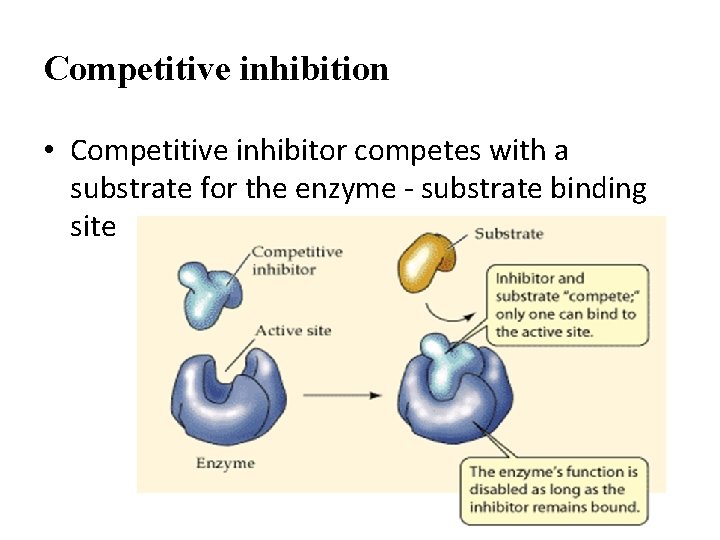
Competitive inhibition • Competitive inhibitor competes with a substrate for the enzyme - substrate binding site
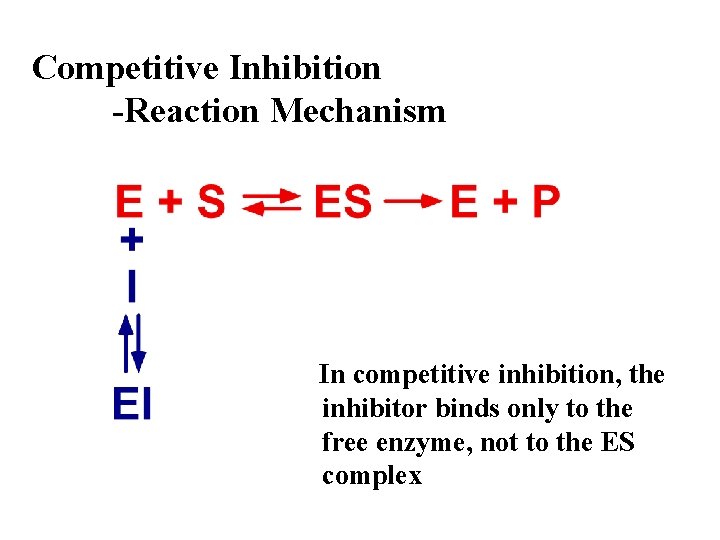
Competitive Inhibition -Reaction Mechanism In competitive inhibition, the inhibitor binds only to the free enzyme, not to the ES complex
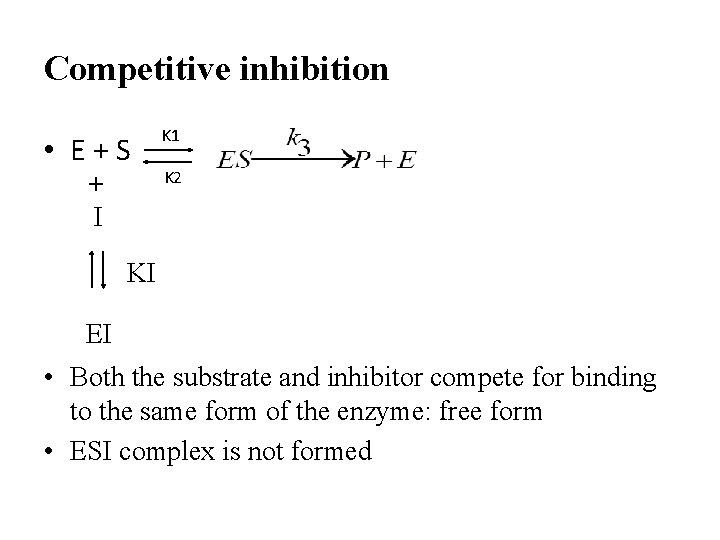
Competitive inhibition • E+S + I K 1 K 2 KI EI • Both the substrate and inhibitor compete for binding to the same form of the enzyme: free form • ESI complex is not formed
![Competitive inhibition • The inhibition is most noticeable at low [S] but can be](http://slidetodoc.com/presentation_image_h2/0b1a32a9d055f6b6b2a8c357815c4289/image-9.jpg "Competitive inhibition • The inhibition is most noticeable at low [S] but can be")
Competitive inhibition • The inhibition is most noticeable at low [S] but can be overcome at sufficiently high [S] - Vmax remains unaffected • Attaining Vmax requires higher [S] in the presence of competitive inhibitor - Apparent Km is increased
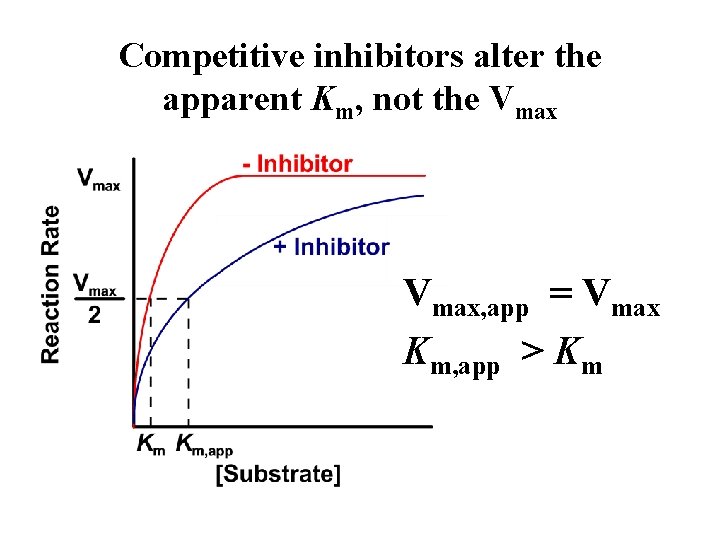
Competitive inhibitors alter the apparent Km, not the Vmax, app = Vmax Km, app > Km
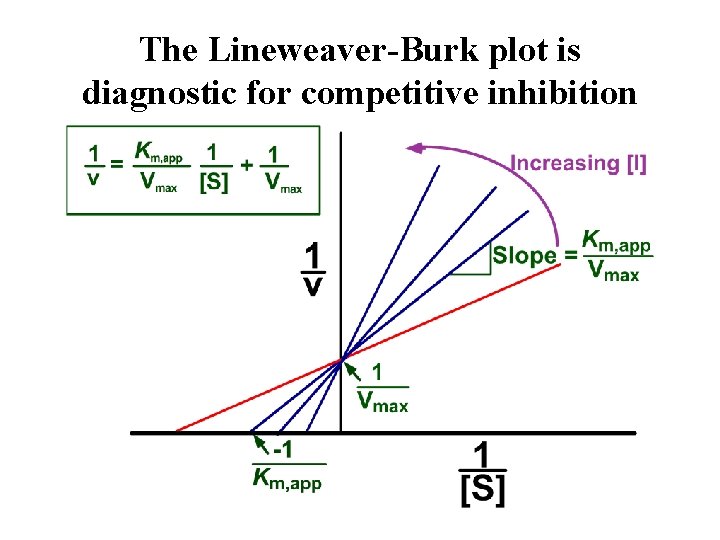
The Lineweaver-Burk plot is diagnostic for competitive inhibition
![Relating the Michaelis-Menten equation, the v vs. [S] plot, and the physical picture of](http://slidetodoc.com/presentation_image_h2/0b1a32a9d055f6b6b2a8c357815c4289/image-12.jpg "Relating the Michaelis-Menten equation, the v vs. [S] plot, and the physical picture of")
Relating the Michaelis-Menten equation, the v vs. [S] plot, and the physical picture of competitive inhibition Inhibitor competes with substrate, decreasing its apparent affinity: Km, app > Km Formationofof. EI EI complex shiftsreaction to > Kmm to the left: KKm, app > Km Vmax, app = Vmax
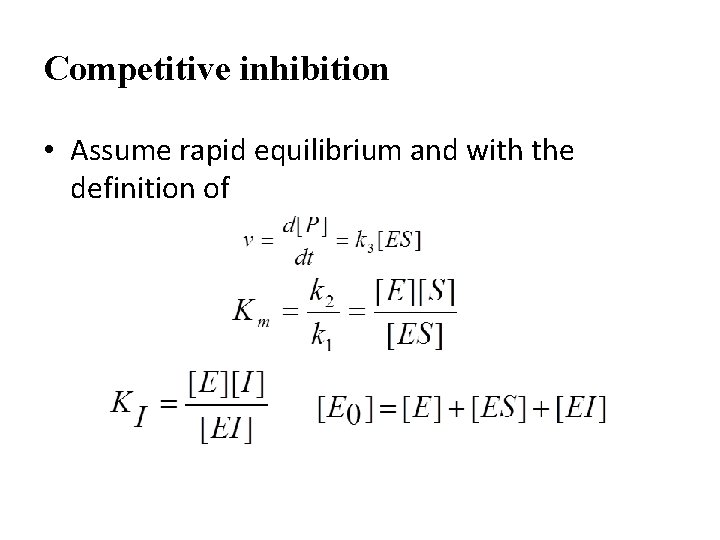
Competitive inhibition • Assume rapid equilibrium and with the definition of
![Competitive inhibition • Simplifying When [I]=0, Remains that of Michaelis-menten equation Is increased](http://slidetodoc.com/presentation_image_h2/0b1a32a9d055f6b6b2a8c357815c4289/image-14.jpg "Competitive inhibition • Simplifying When [I]=0, Remains that of Michaelis-menten equation Is increased")
Competitive inhibition • Simplifying When [I]=0, Remains that of Michaelis-menten equation Is increased
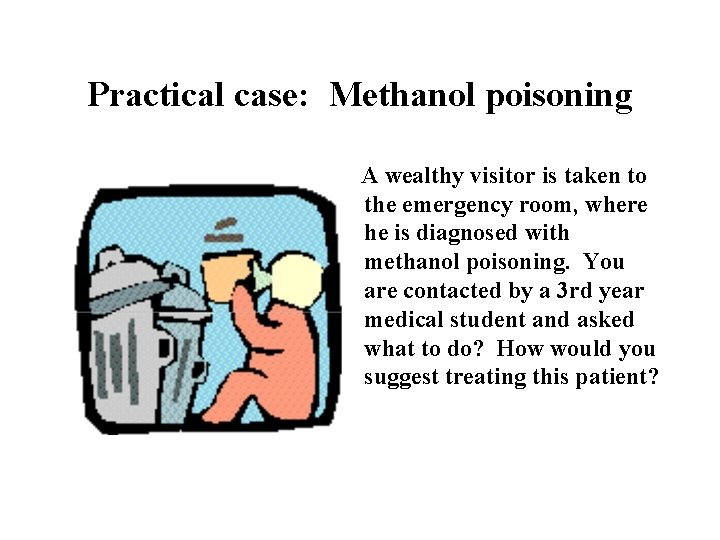
Practical case: Methanol poisoning A wealthy visitor is taken to the emergency room, where he is diagnosed with methanol poisoning. You are contacted by a 3 rd year medical student and asked what to do? How would you suggest treating this patient?
Methanol (CH 3 OH) is metabolized to formaldehyde and formic acid by alcohol dehydrogenase. You advisethe third year student to get the patient very drunk. Since ethanol (CH 3 CH 2 OH) competes with methanol for the same binding site on alcohol dehydrogenase, it slows the metabolism of methanol, allowing the toxic metabolites to be disposed of before they build up to dangerous levels. By the way, the patient was very grateful and decided to leave all their worldly possessions to the hospital. Unfortunately, after being released from the hospital, he went to the casinos and lost everything he had.
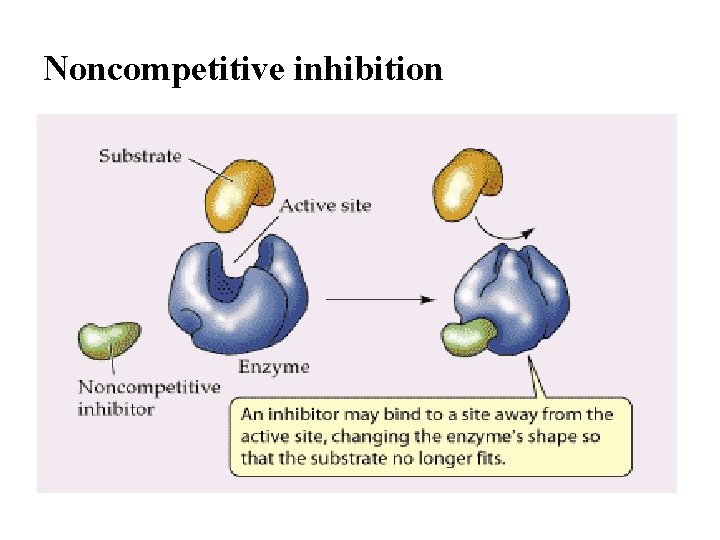
Noncompetitive inhibition
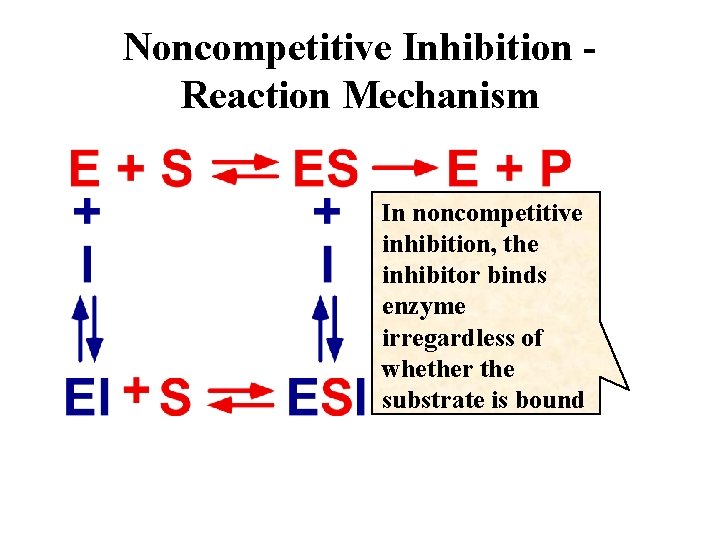
Noncompetitive Inhibition Reaction Mechanism In noncompetitive inhibition, the inhibitor binds enzyme irregardless of whether the substrate is bound
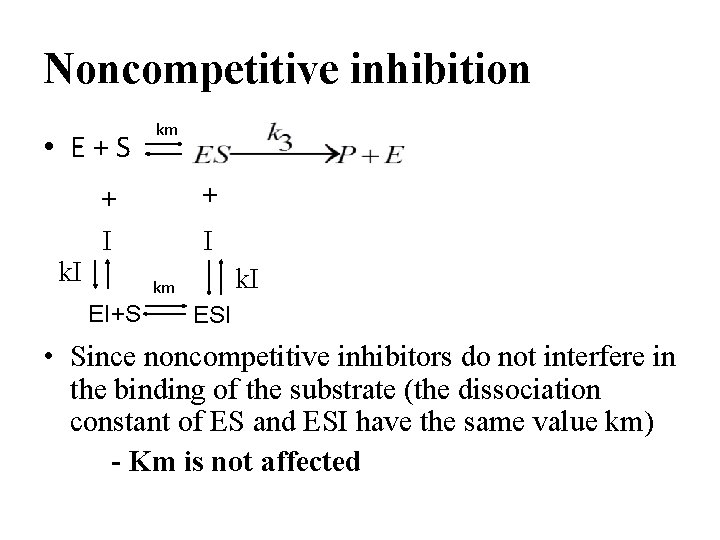
Noncompetitive inhibition • E+S km + + I km EI+S ESI • Since noncompetitive inhibitors do not interfere in the binding of the substrate (the dissociation constant of ES and ESI have the same value km) - Km is not affected
![Noncompetitive inhibition • However, increasing [S] can not abolish the inhibition - (ESI) complex](http://slidetodoc.com/presentation_image_h2/0b1a32a9d055f6b6b2a8c357815c4289/image-20.jpg "Noncompetitive inhibition • However, increasing [S] can not abolish the inhibition - (ESI) complex")
Noncompetitive inhibition • However, increasing [S] can not abolish the inhibition - (ESI) complex are formed and these are incapable of progressing to reaction products • The effect of a noncompetitive inhibitor is to reduce [ES] that can advance to product • Since Vmax = k 3[Eo], and the concentration of competent Eo is diminished by the amount of ESI formed - Vmax is decreased
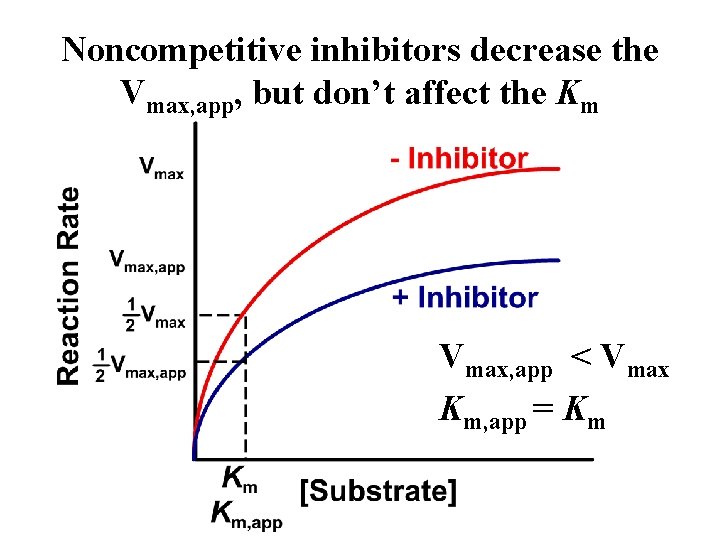
Noncompetitive inhibitors decrease the Vmax, app, but don’t affect the Km Vmax, app < Vmax Km, app = Km
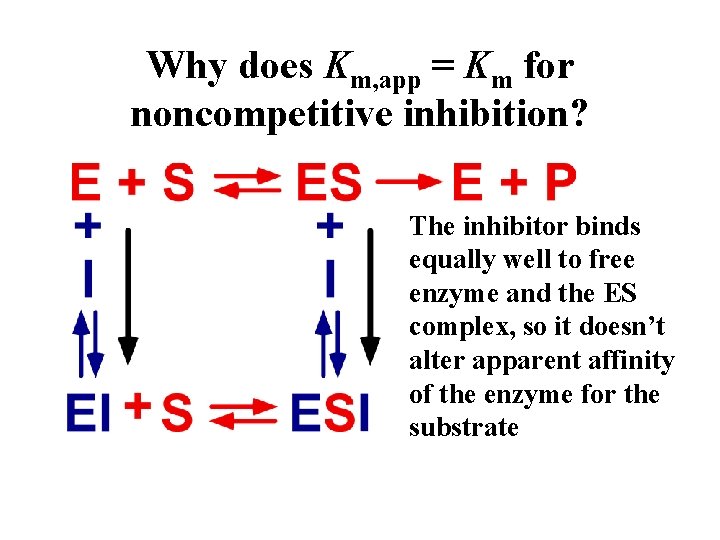
Why does Km, app = Km for noncompetitive inhibition? The inhibitor binds equally well to free enzyme and the ES complex, so it doesn’t alter apparent affinity of the enzyme for the substrate
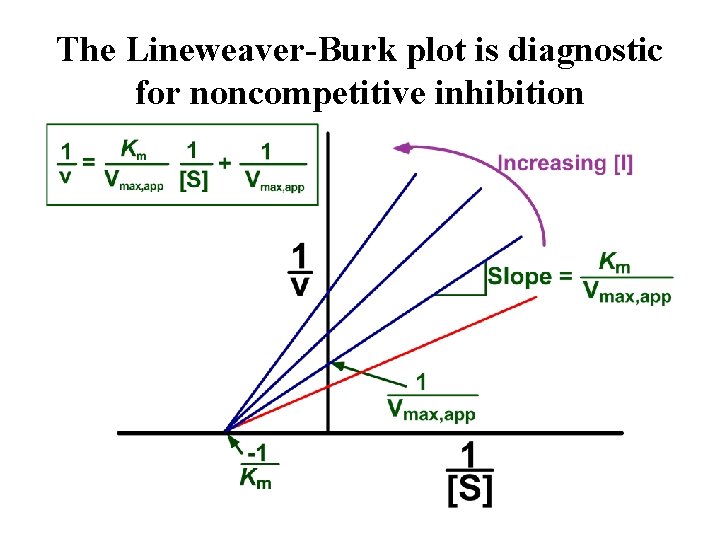
The Lineweaver-Burk plot is diagnostic for noncompetitive inhibition
![Relating the Michaelis-Menten equation, the v vs. [S] plot, and the physical picture of](http://slidetodoc.com/presentation_image_h2/0b1a32a9d055f6b6b2a8c357815c4289/image-24.jpg "Relating the Michaelis-Menten equation, the v vs. [S] plot, and the physical picture of")
Relating the Michaelis-Menten equation, the v vs. [S] plot, and the physical picture of noncompetitive inhibition Inhibitor doesn’t interfere with substrate binding, Km, app = Km Even at high substrate levels, Formation inhibitor of EI still binds, [E]t < reaction [ES] complex shifts Vmax, app < Vmax to the left: Km, app > Km Vmax, app Km, app > K< m. Vmax, app Km, app== V Kmmax
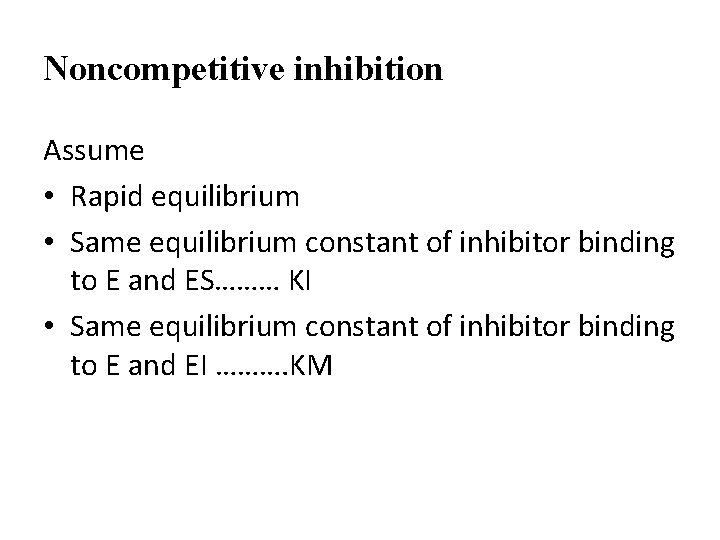
Noncompetitive inhibition Assume • Rapid equilibrium • Same equilibrium constant of inhibitor binding to E and ES……… KI • Same equilibrium constant of inhibitor binding to E and EI ………. KM
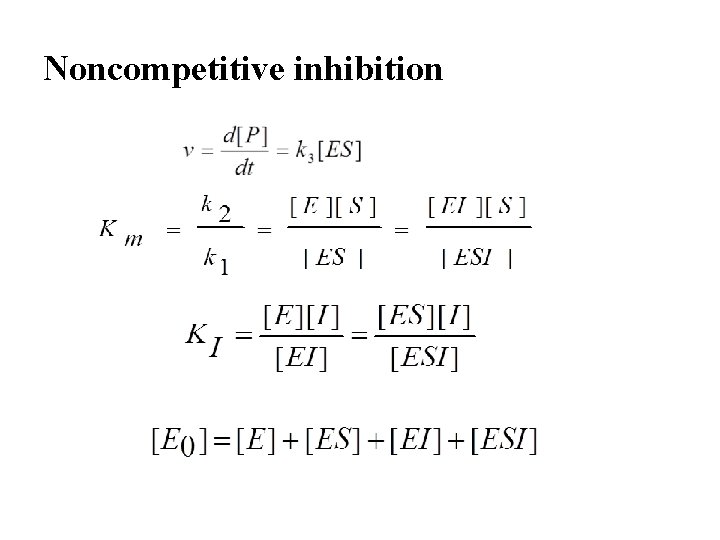
Noncompetitive inhibition
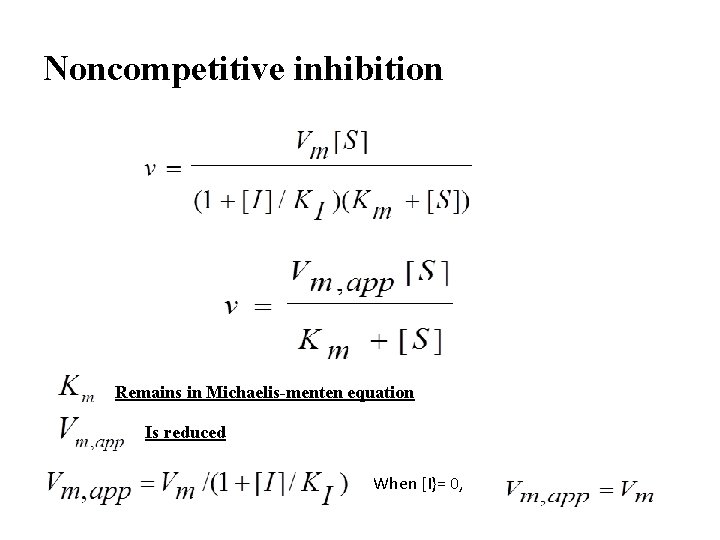
Noncompetitive inhibition Remains in Michaelis-menten equation Is reduced When [I}= 0,
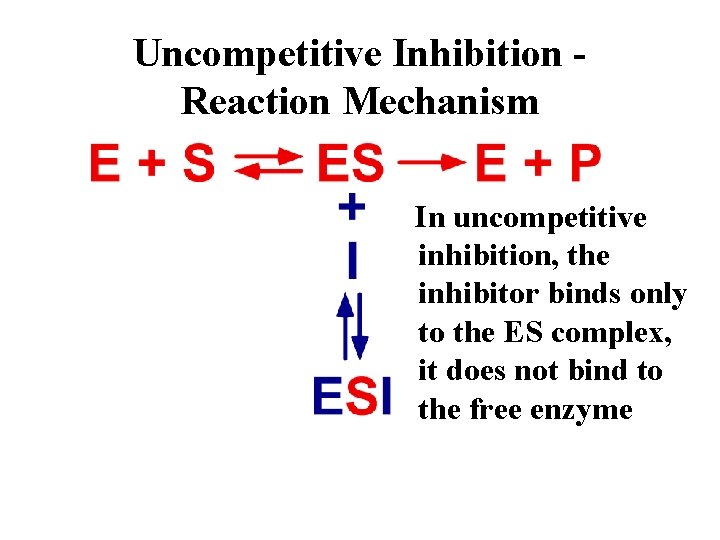
Uncompetitive Inhibition Reaction Mechanism In uncompetitive inhibition, the inhibitor binds only to the ES complex, it does not bind to the free enzyme
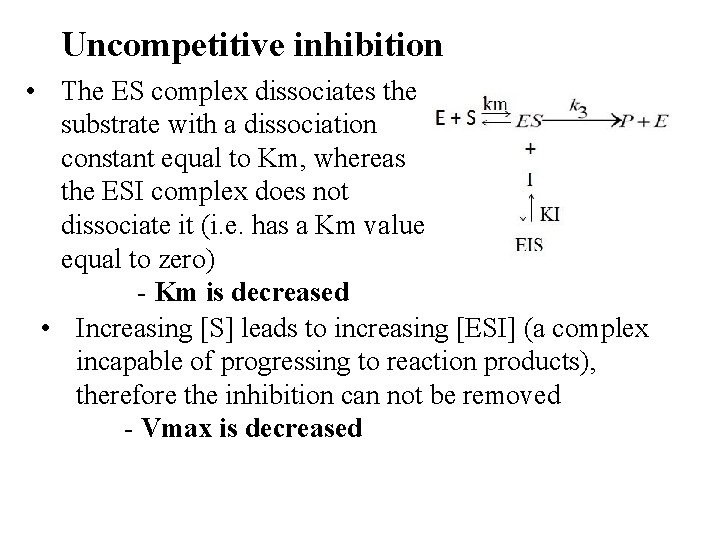
Uncompetitive inhibition • The ES complex dissociates the substrate with a dissociation constant equal to Km, whereas the ESI complex does not dissociate it (i. e. has a Km value equal to zero) - Km is decreased • Increasing [S] leads to increasing [ESI] (a complex incapable of progressing to reaction products), therefore the inhibition can not be removed - Vmax is decreased
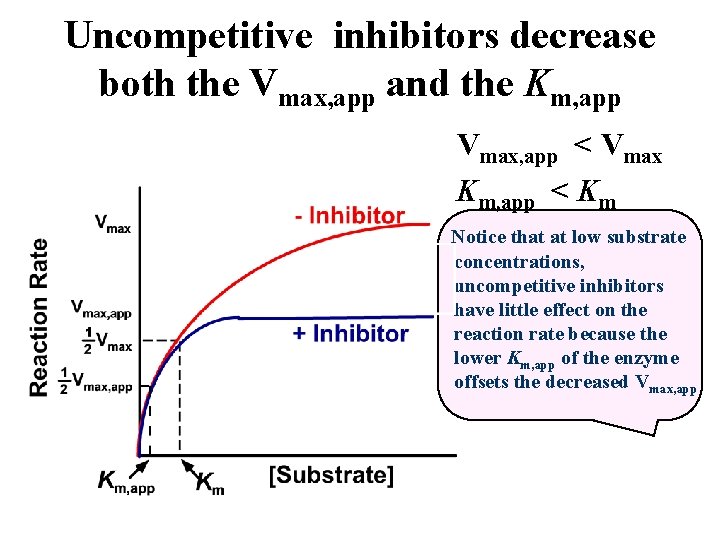
Uncompetitive inhibitors decrease both the Vmax, app and the Km, app Vmax, app < Vmax Km, app < Km Notice that at low substrate concentrations, uncompetitive inhibitors have little effect on the reaction rate because the lower Km, app of the enzyme offsets the decreased Vmax, app
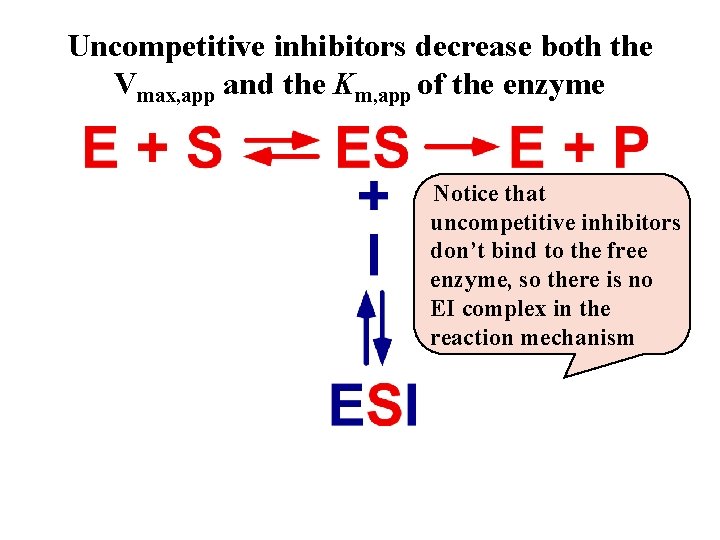
Uncompetitive inhibitors decrease both the Vmax, app and the Km, app of the enzyme Notice that uncompetitive inhibitors don’t bind to the free enzyme, so there is no EI complex in the reaction mechanism
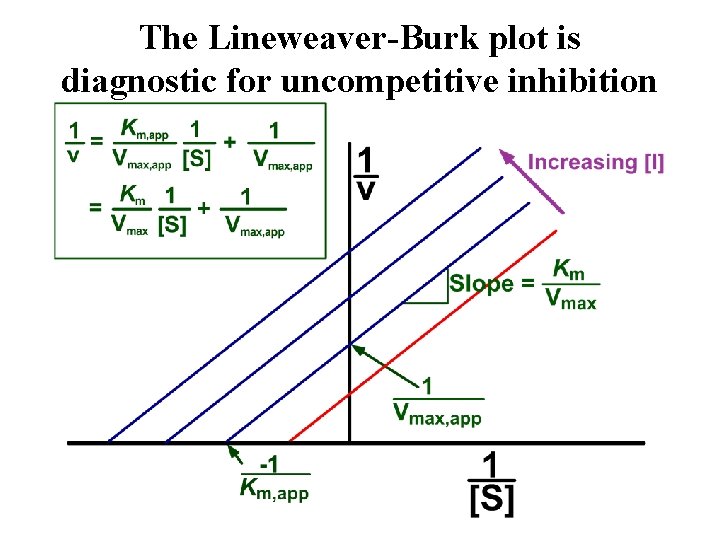
The Lineweaver-Burk plot is diagnostic for uncompetitive inhibition
![Relating the Michaelis-Menten equation, the v vs. [S] plot, and the physical picture of](http://slidetodoc.com/presentation_image_h2/0b1a32a9d055f6b6b2a8c357815c4289/image-33.jpg "Relating the Michaelis-Menten equation, the v vs. [S] plot, and the physical picture of")
Relating the Michaelis-Menten equation, the v vs. [S] plot, and the physical picture of uncompetitive inhibition Inhibitor increases the amount of enzyme bound to substrate Km, app < Km Even at high substrate Formation of EI levels, inhibitor binds, complex shifts reaction [E]t < [ES] to the left: KVm, app > Km max, app < Vmax, app < Vmax Km, app< Km
Effect of Temperature • Enzymes have an optimum temperature at which they are most active • The optimum temperature for most human enzymes is normal body temperature, 37 o. C • Above optimum temperature, enzymes lose activity due to disruption of intermolecular forces stabilizing the tertiary structure. 12/15/2021 35
0°C • Low temperatures - low Kinetic Energy of enzymes and substrates. • No/Very few enzyme-substrate complexes are formed. • Enzymes are inactivated. 12/15/2021 36
20°C (increasing temperature) • Increasing the temperature will lead to the increase in kinetic energy of enzyme and substrate molecules. • Enzyme and substrate molecules move with increasing speed and collide more frequently with each other. • This increases the rate of enzyme-substrate complex formation This increases the rate of enzymesubstrate complex formation and product formation. 12/15/2021 37
37°C • As the temperature continues to increase, the rate of enzyme activity also increases until the optimal temperature is reached. • Optimal temperature is the temperature at which the enzyme works best. Rate of product formation is highest! 12/15/2021 38
Beyond Optimal Temperatures • At high temperatures (>60°C), weak bonds within the enzyme molecule are broken • Enzyme loses its shape and its active site. • Loss of shape leads to a loss of function. Enzyme is said to have denatured • Denaturation is the change in 3 D structure of an enzyme or any other protein caused by heat or chemicals such as acids or alkali, causing it to lose its function. 12/15/2021 39
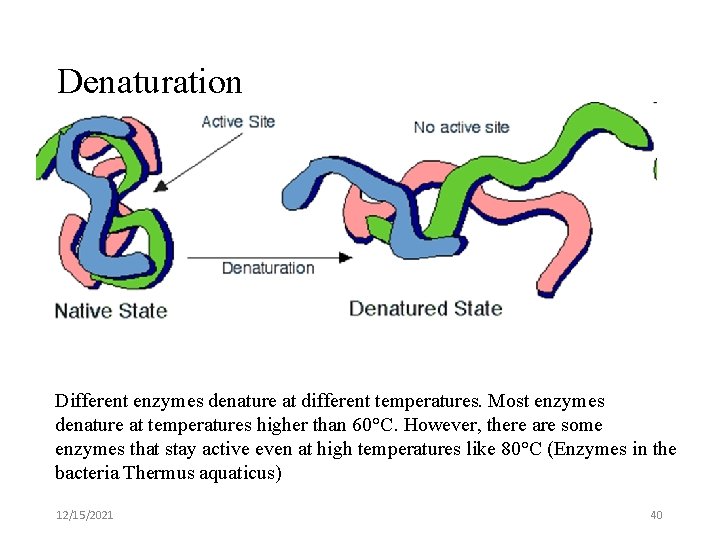
Denaturation Different enzymes denature at different temperatures. Most enzymes denature at temperatures higher than 60°C. However, there are some enzymes that stay active even at high temperatures like 80°C (Enzymes in the bacteria Thermus aquaticus) 12/15/2021 40
Effect of PH • When the enzyme environment is changed by p. H, its tertiary structure is disrupted, altering the active site and causing the enzyme’s activity to decrease. • Enzymes are most active at a p. H known as their optimum p. H. • At optimum p. H, the enzyme maintains its tertiary structure and its active site. 12/15/2021 41
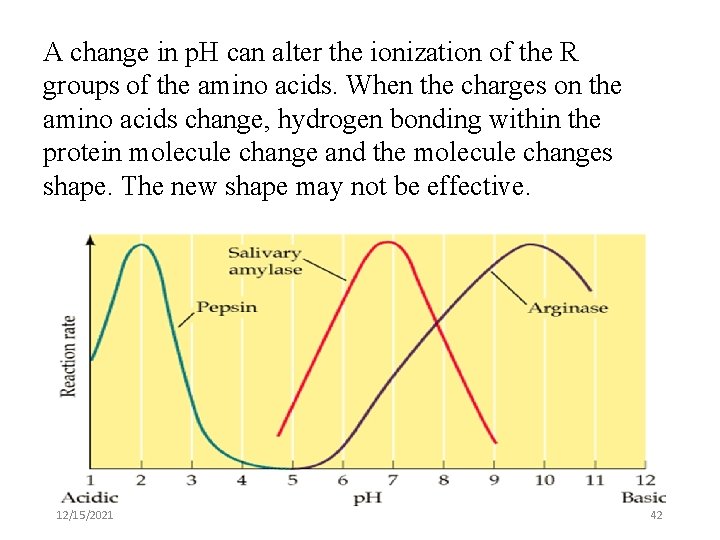
A change in p. H can alter the ionization of the R groups of the amino acids. When the charges on the amino acids change, hydrogen bonding within the protein molecule change and the molecule changes shape. The new shape may not be effective. 12/15/2021 42

12/15/2021 43
12/15/2021 44
- Slides: 43