
Chapter Two Effective Inclusion Practices Professional Collaboration This
Chapter Two Effective Inclusion Practices & Professional Collaboration This multimedia product and its contents are protected under copyright law. The following are prohibited by law: • any public performance or display, including transmission of any image over a network; • preparation of any derivative work, including the extraction, in whole or in part, of any images; • any rental, lease, or lending of the program. (c) Allyn & Bacon 2004
Introduction Ø Reasons inclusion is implemented: Ø To improve educational opportunities Ø To improve social development Ø To give all students equal opportunities (c) Allyn & Bacon 2004
Accepting Diversity Ø Ø The key issue underlying successful inclusion is the acceptance of diversity by both general and special educators and their students. One teacher can have a dramatic impact on the lives of students who are different and who have learning challenges. Positive steps toward successful inclusion can be taken on classroom-by-classroom and school-by-school bases. Placement trends since the 1980 s have indicated that inclusive placements are much more common. (c) Allyn & Bacon 2004

Implementing Inclusive Classrooms in the Early Years Ø Impact on Students’ Immediate Needs Ø Ø Ø Students learn in settings along with their peers. Students with disabilities learn as well as or better than they do in segregated settings. Impact on Students’ Long-Term Needs Ø Students will become adults who will need to live and work with each other in their home communities. (c) Allyn & Bacon 2004
Perceptions of Inclusion n n Most teachers agree that inclusion is a good thing. The major concern about inclusion among administrators and teachers is how to implement inclusion programs effectively. (c) Allyn & Bacon 2004

General Education Teachers’ Attitudes about Inclusion Ø Ø One study suggested that over 2/3’s of classroom teachers support the concept of inclusion (Scruggs & Mastropieri, 1996). Other results from this study were that: Ø Ø Teachers expressed a lack of willingness to teach students with certain types of disabilities in their own classrooms. Only 33% felt that they had sufficient time, expertise, training, and resources (material and support personnel) to enable them to work successfully with students with (c) Allyn & Bacon 2004

Parents’ Attitudes About Inclusion Ø Ø Some parents support inclusion; others do not. Many parents opposed to inclusion worry that general education teachers need additional training. (c) Allyn & Bacon 2004
Barriers to Inclusion Ø Ø Accurate information for parents, teachers, and the general public must be provided. The greatest challenge is to change the educational system. (c) Allyn & Bacon 2004
Critical Dimensions of Inclusive Classrooms è è è è è Sense of Community & Social Acceptance An Appreciation of Student Diversity Attention to Curricular Needs Effective Management & Instruction Personnel Support & Collaboration Active, Meaningful Participation in the Mainstream Sense of Belonging Shared Ownership among Faculty Administrative Support (c) Allyn & Bacon 2004
Promoting a Sense of Community & Social Acceptance Ø Ø Ø Ø Students are valued and nurtured. All children belong. The needs of all students are addressed. Classrooms are characterized by positive teacher attitudes about students with special needs. There are high teacher expectations for all students. Individualization of instruction is apparent. Students are educated about diversity and disabilities and positive interactions are facilitated by teachers. Development of friendships and a sense of classroom community are priorities. (c) Allyn & Bacon 2004
Appreciation of Student Diversity Ø Ø Ø Teachers must be sensitive to students’ diverse cultural, community, and family values. Diversity should be celebrated across all types of differences (e. g. , racial/ethnic, gender, religious, intellectual, physical, etc. ) Diversity is enriching and should be valued as such. (c) Allyn & Bacon 2004
Attention to Curricular Needs Ø Ø Ø Good teachers vary their instruction to meet the needs of students. Some students with disabilities may need substantial curricular modifications. Curricular concerns include: Ø Ø content that is meaningful to students in a current and future sense. approaches and materials that work best for students. (c) Allyn & Bacon 2004
Effective Management and Instruction Ø Ø Effective classroom practices must be conducive to learning. Effective classroom practices include four elements: Ø Ø Successful classroom management Effective instructional techniques Appropriate accommodative practices (c) Allyn & Bacon 2004 Instructional flexibility
Successful Classroom Management Ø Characteristics: Ø Ø Physical management Procedural management Instructional management Behavior management (c) Allyn & Bacon 2004

Effective Instructional Techniques Ø Elements of Effective Instruction Ø Ø Ø Daily Review Specific Techniques for Presenting New Information Guided Practice Independent Practice Formative Evaluation (c) Allyn & Bacon 2004
Appropriate Accommodative Practices Ø Ø Instructional supports are required for inclusion to be successful. Instructional supports include: Ø Ø Ø Accommodations -- changes in the manner in which students are taught Modifications - changes in policies Accommodative supports should be designed to benefit all students. Ø Example: Assistive Technology (c) Allyn & Bacon 2004
Personnel Support and Collaboration Ø Ø Ø Special education teachers Paraeducators Other related service professionals such as: Ø speech and language pathologists Ø occupational and physical therapists Ø audiologists (c) Allyn & Bacon 2004
Types of Collaborative Efforts Ø Ø Collaborative-Consultation Co-Teaching Teacher Assistance Teams Peer Support Systems (c) Allyn & Bacon 2004
Collaboration-Consultation Ø Ø A model that emphasizes a close working relationship between general and special educators. Benefits of collaboration: Ø Ø Ø Facilitates ongoing planning, evaluation, and modifications necessary to ensure the success of inclusive placements Enables general education classrooms to meet the needs of students with and without disabilities Provides personnel support of highly skilled colleagues Results in personal and professional growth for all involved Helps teachers identify ways to access the skills, knowledge, and expertise of other teachers (c) Allyn & Bacon 2004
Collaborative Skills Ø Ø A critical skill is effective communication. In order to communicate, school staff must have time for planning. Ø Ø Requires support of school administrators Ways to find time for planning: Ø Ø Ø Split schedules for teachers Utilizing roving aides to cover classes Providing financial incentives (c) Allyn & Bacon 2004
Co-Teaching Ø Ø Definition: Co-teaching is an arrangement of two or more teachers or other school staff who collectively assume the responsibility for the same group of students on a regular basis. Co-teaching: Ø Ø usually occurs at set times. involves the joint completion of tasks such as planning and teaching. includes monitoring and evaluating students. involves communicating about student progress. (c) Allyn & Bacon 2004
Co-Teaching Ø Important Co-Teaching Activities: Ø Ø Providing Feedback to Each Other Sharing Classroom Management Having Daily Planning time Using Cooperative Learning Techniques (c) Allyn & Bacon 2004
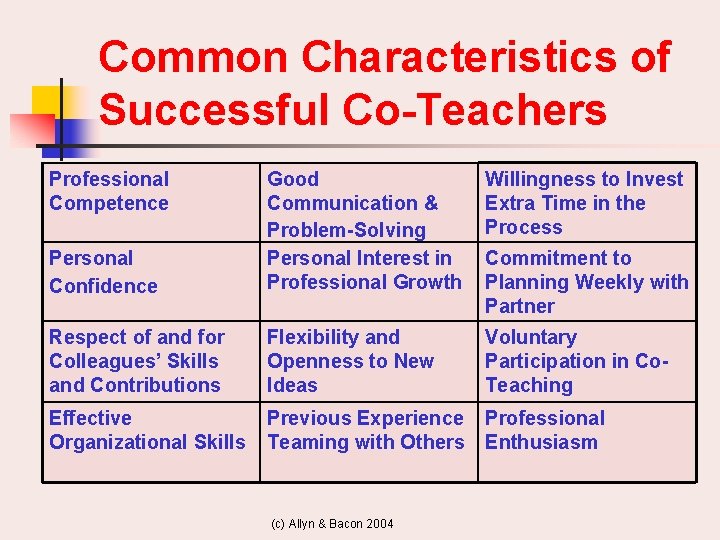
Common Characteristics of Successful Co-Teachers Professional Competence Willingness to Invest Extra Time in the Process Personal Confidence Good Communication & Problem-Solving Personal Interest in Professional Growth Respect of and for Colleagues’ Skills and Contributions Flexibility and Openness to New Ideas Voluntary Participation in Co. Teaching Effective Organizational Skills Previous Experience Teaming with Others Professional Enthusiasm (c) Allyn & Bacon 2004 Commitment to Planning Weekly with Partner
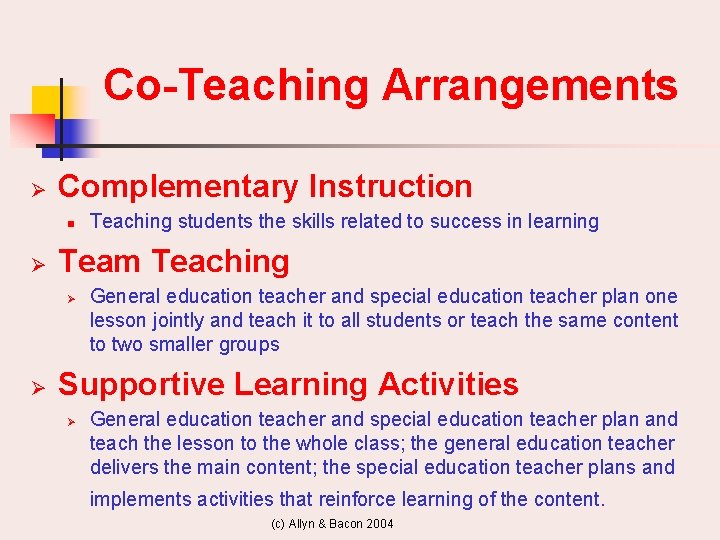
Co-Teaching Arrangements Ø Complementary Instruction n Ø Team Teaching Ø Ø Teaching students the skills related to success in learning General education teacher and special education teacher plan one lesson jointly and teach it to all students or teach the same content to two smaller groups Supportive Learning Activities Ø General education teacher and special education teacher plan and teach the lesson to the whole class; the general education teacher delivers the main content; the special education teacher plans and implements activities that reinforce learning of the content. (c) Allyn & Bacon 2004
Teacher Assistance Teams Ø Definition: School-based problemsolving teams designed to enable teachers to meet the needs of their students demonstrating difficulties. Ø Ø Ø Teams are comprised of teaches and other instructional support personnel. Teams meet to problem solve about students’ needs. Participation should be voluntary. (c) Allyn & Bacon 2004
Peer Support Systems Ø Ø Ø Rely on the natural support of peers in the general education classroom Can involve social or instructional peer supports Type of peer supports: Ø Ø Ø Partner learning Peer tutoring Cooperative learning (c) Allyn & Bacon 2004
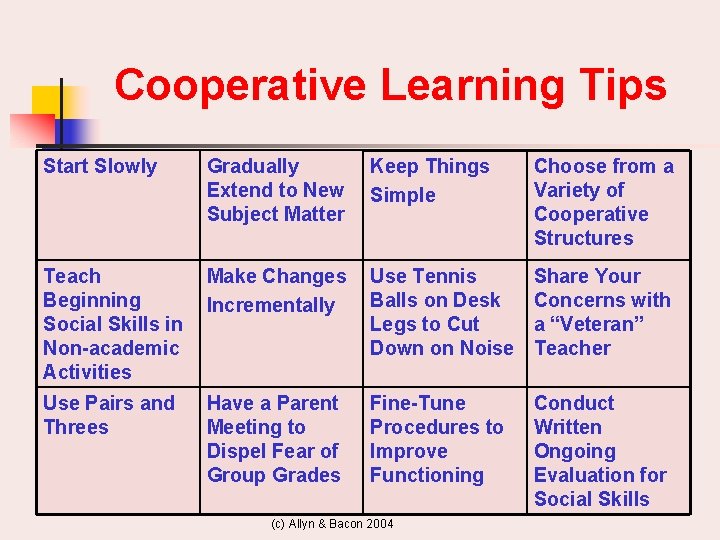
Cooperative Learning Tips Start Slowly Gradually Extend to New Subject Matter Keep Things Simple Choose from a Variety of Cooperative Structures Teach Beginning Social Skills in Non-academic Activities Make Changes Incrementally Use Tennis Balls on Desk Legs to Cut Down on Noise Share Your Concerns with a “Veteran” Teacher Use Pairs and Threes Have a Parent Meeting to Dispel Fear of Group Grades Fine-Tune Procedures to Improve Functioning Conduct Written Ongoing Evaluation for Social Skills (c) Allyn & Bacon 2004
Benefits of Peer Supports Enhance a Sense of Community Ø Increase Student Motivation Ø Increase Student Learning Ø (c) Allyn & Bacon 2004

Using Paraprofessionals Effectively Paraprofessionals must be adequately trained to work with students with special needs Ø Paraprofessionals must be familiar with a student’s IEP goals and objectives Ø (c) Allyn & Bacon 2004
Creating & Maintaining Inclusive Classrooms Ø Ø Ø Preparing Staff for Inclusion and Collaboration Preparing Students for Inclusion Maintaining Effective Inclusive Classrooms (c) Allyn & Bacon 2004
Preparing Staff for Inclusion Ø Involves all staff members Ø Includes exposure to good inclusive classrooms Ø Allows for acquisition of information and skills Ø Provides for planning time (c) Allyn & Bacon 2004

Preparing Students for Inclusion Ø Awareness Programs Ø Discussions Ø Simulations (c) Allyn & Bacon 2004

Maintaining Effective Inclusive Classrooms Ø Ø Ø Constant vigilance of the five critical dimensions of inclusive settings and ongoing reevaluation of operating procedures are needed. The use of problem-solving sessions is essential to handle inclusion-specific situations that have become problematic. Flexibility contributes to long-term success. (c) Allyn & Bacon 2004
Planning for Successful Inclusion: One Student at a Time Ø Ø Planning must be accomplished for students on an individual basis. School personnel must develop a planning model that provides opportunities for staff to develop supportive, individualized inclusive environments for each student. (c) Allyn & Bacon 2004
- Slides: 34