
CHAPTER TWO DETERMINISTIC OPTIMIZATION MODELS 1262020 ISE 420







- Slides: 19
CHAPTER TWO DETERMINISTIC OPTIMIZATION MODELS 12/6/2020 ISE 420 Algorithmic Operations Research 1
Deterministic Optimization Models are also called MATHEMATICAL PROGRAMS because they decide how to plan or program activities. The first step in formulating any optimization model is to identify the DECISION VARIABLES. 2. 1 Variables in optimization models represent the decisions to be taken. 12/6/2020 ISE 420 Algorithmic Operations Research 2
The next issue in formulating any optimization model is constraints. What limits decisions? 2. 2 VARIABLE TYPE CONSTRAINTS specify the domain of definition for decision variables: the set of values for which the variables have meaning. The most common variable – type constraint form: nonnegativity. 2. 3 MAIN CONSTRAINTS of optimization models specify the restrictions and interactions, other than variable type, that limit decision variable values. 12/6/2020 ISE 420 Algorithmic Operations Research 3
OBJECTIVE or CRITERION (evaluation) FUNCTIONS tell us how to rate decisions. 2. 4 Objective functions in optimization models quantify the decision consequences to be maximized or minimized. 2. 5 The standard statement of an optimization model has the form Min or max (objective function(s)) s. t. main constraints variable - type constraints 12/6/2020 ISE 420 Algorithmic Operations Research 4
2. 6 The FEASIBLE SET (or REGION) of an optimization model is the collection of choices for decision variables satisfying all model constraints. 2. 12 An OPTIMAL SOLUTION is a feasible choice for decision variables with objective function value at least equal to that of any other solution satisfying all constraints. 2. 14 The OPTIMAL VALUE in an optimization model is the objective function value of any optimal solutions. 2. 15 An optimization model can have only one optimal value. 12/6/2020 ISE 420 Algorithmic Operations Research 5
2. 16 An optimization model may have a UNIQUE OPTIMAL SOLUTION or several ALTERNATIVE OPTIMAL SOLUTIONS. Still, all must have the same optimal value, infeasible models have no optimal solutions. 2. 18 An optimization model is INFEASIBLE if no choice of decision variables satisfies all constraints. 12/6/2020 ISE 420 Algorithmic Operations Research 6
Another case where an optimization model has no feasible solution arises when it is unbounded. 2. 20 An optimization model is UNBOUNDED when feasible choices of the decision variables can produce arbitrarily good objective function values. Unbounded models have no optimal solutions because any possibility can be improved. 12/6/2020 ISE 420 Algorithmic Operations Research 7
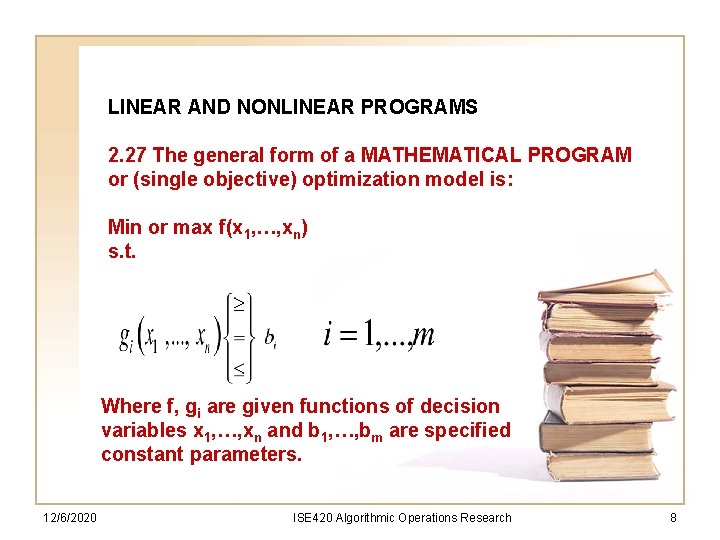
LINEAR AND NONLINEAR PROGRAMS 2. 27 The general form of a MATHEMATICAL PROGRAM or (single objective) optimization model is: Min or max f(x 1, …, xn) s. t. Where f, gi are given functions of decision variables x 1, …, xn and b 1, …, bm are specified constant parameters. 12/6/2020 ISE 420 Algorithmic Operations Research 8
2. 28 A function is LINEAR if it is a constant - weighted sum of decision variables. Otherwise it is NONLINEAR. 2. 29 An optimization model in functional form 2. 27 is a LINEAR PROGRAM (LP) if the (single) objective function f and all constraints functions g 1, …, gm are linear in the decision variables. Also, decision variables should be able to take on whole number or fractional values. 12/6/2020 ISE 420 Algorithmic Operations Research 9
2. 30 An optimization model in functional form 2. 27 is a NONLINEAR PROGRAM (NLP) if the (single) objective function f or any of the constraint functions g 1, …, gm is nonlinear in the decision variables Also, decision variables should be able to take on whole-number or fractional values. 2. 32 Linear functions implicitly assume that each unit increase in a decision variable has the same effect as the preceding increase: EQUAL RETURNS TO SCALE. Nonlinear functions have the effect of DECREASING/INCREASING RETURNS TO SCALE. 12/6/2020 ISE 420 Algorithmic Operations Research 10
DISCRETE OR INTEGER PROGRAMS 2. 33 A variable is DISCRETE if it is limited to a fixed or countable set of values. Often, the choices are only 0 and 1. 2. 34 A variable is CONTINUOUS if it can take on any value in a specified interval. 12/6/2020 ISE 420 Algorithmic Operations Research 11
2. 36 An optimization model is an INTEGER PROGRAM (IP) if any one of its decision variables is discrete. If all variables are discrete, the model is a pure integer program, otherwise it is a mixed – integer program. 2. 37 A discrete integer programming model is an INTEGER LINEAR PROGRAM (ILP) if its (single) objective function and all main constraints are linear. 2. 38 A discrete or integer programming model is an INTEGER NONLINEAR PROGRAM (INLP) if its (single) objective function or any of its main constraints is nonlinear. 12/6/2020 ISE 420 Algorithmic Operations Research 12
MULTIOBJECTIVE OPTIMIZATION MODELS A MULTIOBJECTIVE OPTIMIZATION MODEL is that maximizes or minimizes more than one objective function at the same time. 12/6/2020 ISE 420 Algorithmic Operations Research 13
Linear Programming • minimize or maximize a linear objective • subject to linear equalities and inequalities 12/6/2020 ISE 420 Algorithmic Operations Research 14
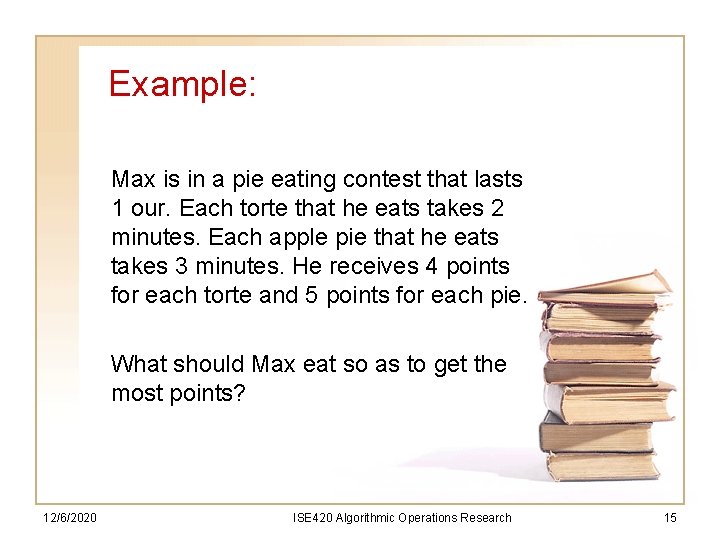
Example: Max is in a pie eating contest that lasts 1 our. Each torte that he eats takes 2 minutes. Each apple pie that he eats takes 3 minutes. He receives 4 points for each torte and 5 points for each pie. What should Max eat so as to get the most points? 12/6/2020 ISE 420 Algorithmic Operations Research 15
• Step 1. Determine the decision variables Let x be the number of tortes eaten by Max. Let y be the number of pies eaten by Max. • Step 2. Determine the objective function • Step 3. Determine the constraints Maximize z = 4 x + 5 y (objective function) S. t. 2 x + 3 y ≤ 60 (constraint) x ≥ 0 ; y ≥ 0 (non-negativity constraints) 12/6/2020 ISE 420 Algorithmic Operations Research 16
• A feasible solution satisfies all of the constraints. • x = 10, y = 10 is feasible; • x = 10, y = 15 is infeasible. • An optimal solution is the best feasible solution. • The optimal solution is • x = 30, y = 0. 12/6/2020 ISE 420 Algorithmic Operations Research 17
Terminology • Decision variables: e. g. , x and y. – In general, these are quantities you can control to improve your objective which should completely describe the set of decisions to be made. • Constraints: e. g. , 2 x + 3 y≤ 24, x≥ 0, y≥ 0 – Limitations on the values of the decision variables. • Objective Function: e. g. , 4 x + 5 y – Value measure used to rank alternatives – Seek to maximize or minimize this objective – examples: maximize NPV, minimize cost 12/6/2020 ISE 420 Algorithmic Operations Research 18
Addressing managerial problems: A management science (OR) framework 1. Determine the problem to be solved 2. Observe the system and gather data 3. Formulate a mathematical model of the problem and any important subproblems 4. Verify the model and use the model for prediction or analysis 5. Select a suitable alternative 6. Present the results to the organization 7. Implement and evaluate 12/6/2020 ISE 420 Algorithmic Operations Research 19