
Chapter TwentyTwo The Contemporary Contour Culture and Values

- Slides: 79
Chapter Twenty-Two The Contemporary Contour Culture and Values Cunningham and Reich and Fichner-Rathus, 8 th Ed.
1945 CE United States drops atomic bombs on Hiroshima and Nagasaki in 1945 World War II ends in Europe and Japan in 1945 United Nations General Assembly meets for first time in 1946 The transistor is invented in 1947 Israel becomes an independent state in 1948 Mao Zedong becomes leader of Communist China in 1949 1950 CE Korean War begins in 1950 United States explodes first hydrogen bomb in 1952 Korean War ends with a truce in 1953 School segregation is outlawed by the U. S. Supreme Court in 1954 U. S. civil-rights movement begins in the South Sputnik, the first artificial satellite, is launched by the Soviet Union in 1957 1960 CE East Germany erects the Berlin Wall in 1961 Soviet Union launches first human into space in 1961 An American orbits the earth in space in 1962 A TV signal crosses the Atlantic via a satellite in 1962 U. S. president John F. Kennedy is assassinated in 1963 United States builds up troops in Vietnam in 1964 National Organization for Women is founded in 1966 Martin Luther King Jr. and Robert Kennedy are assassinated in 1968 A U. S. astronaut takes the first walk on the moon in 1969
1970 CE Supreme Court decision in Miller v. California effectively ends censorship in 1973 United States withdraws from Vietnam in 1975 Microsoft is established in 1975 Apple Computer is established in 1976 1981 Space shuttle first flies Communist governments of Eastern Europe fall beginning in 1989 1990 CE East and West Germany reunite in 1990 Soviet Union is dissolved in 1991 Google is incorporated in 1998 Terrorists attack World Trade Center and Pentagon in 2001 United States invades Afghanistan in 2001 United States invades Iraq in 2003 Facebook is launched in 2004 United States withdraws from Iraq in 2011
Toward a Global Culture n Artistic satire of modern warfare n n Global economy, New World Order n n Economic, social inequities Search for individual, social meaning n n Heller, Pynchon, Kubrick Social, political oppression Artist as voice of protest, hope
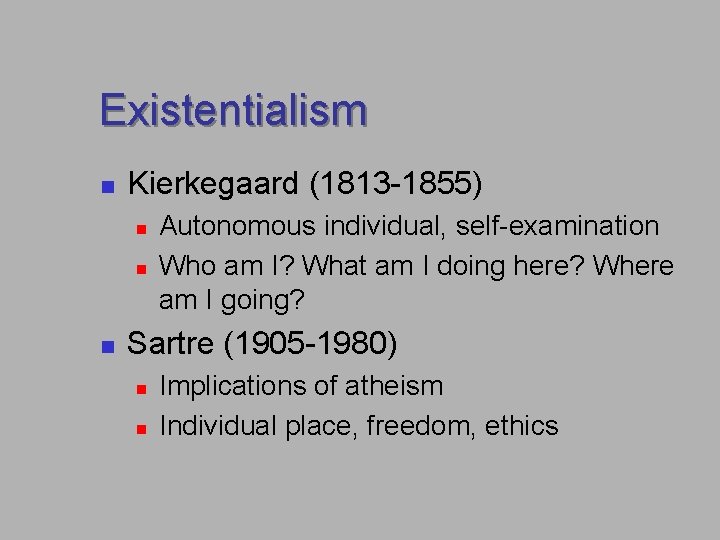
Existentialism n Kierkegaard (1813 -1855) n n n Autonomous individual, self-examination Who am I? What am I doing here? Where am I going? Sartre (1905 -1980) n n Implications of atheism Individual place, freedom, ethics
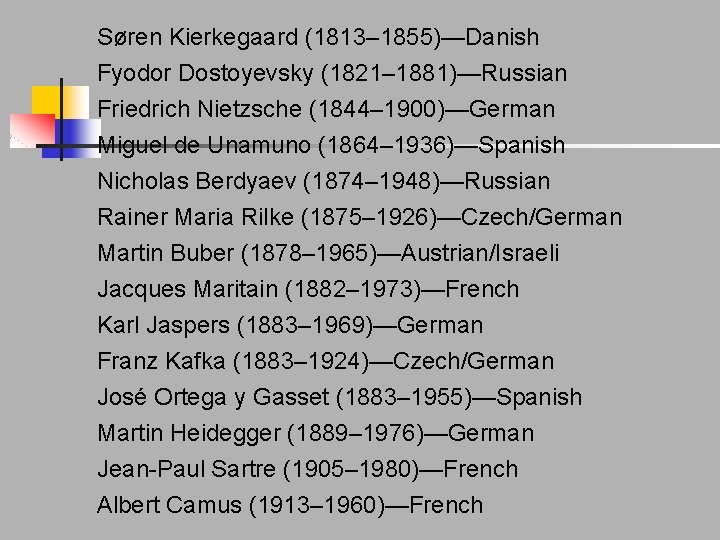
Søren Kierkegaard (1813– 1855)—Danish Fyodor Dostoyevsky (1821– 1881)—Russian Friedrich Nietzsche (1844– 1900)—German Miguel de Unamuno (1864– 1936)—Spanish Nicholas Berdyaev (1874– 1948)—Russian Rainer Maria Rilke (1875– 1926)—Czech/German Martin Buber (1878– 1965)—Austrian/Israeli Jacques Maritain (1882– 1973)—French Karl Jaspers (1883– 1969)—German Franz Kafka (1883– 1924)—Czech/German José Ortega y Gasset (1883– 1955)—Spanish Martin Heidegger (1889– 1976)—German Jean-Paul Sartre (1905– 1980)—French Albert Camus (1913– 1960)—French
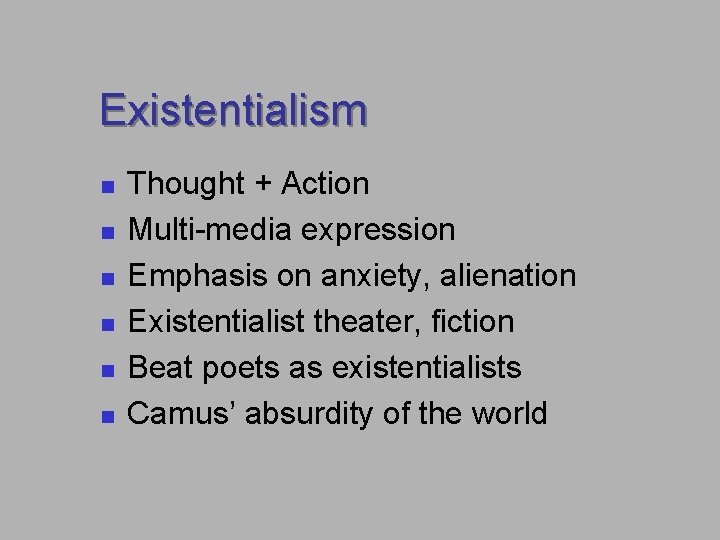
Existentialism n n n Thought + Action Multi-media expression Emphasis on anxiety, alienation Existentialist theater, fiction Beat poets as existentialists Camus’ absurdity of the world
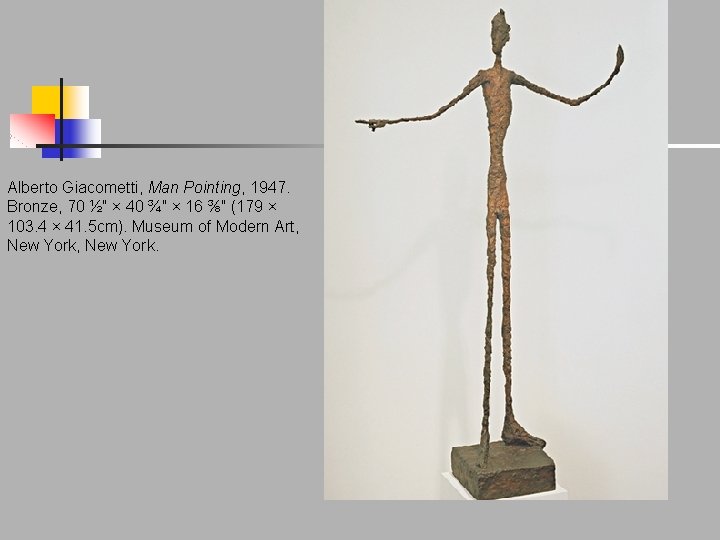
Alberto Giacometti, Man Pointing, 1947. Bronze, 70 ½″ × 40 ¾″ × 16 ⅜″ (179 × 103. 4 × 41. 5 cm). Museum of Modern Art, New York, New York.
Postmodern 1960 s+ n n n A reaction to and continuation of modernism a Rejection of any rational order Abandons traditional literary forms, often combining different genres & styles; an explosion of movements Nihilism: no reason for values or morality, or rejection of values: believes in nothing, cynical, randomness of existence Playfulness, parody, & irony
n n n n Women: Susan Glaspell, Charlotte Gilman Perkins African American: James Baldwin, Toni Cade Bambara, James Mc. Pherson, Ralph Ellison Native American: Zitkala-Sa, Mourning Dove John Cheever, Joyce Carol Oates, John Updike Jewish American: Saul Bellow, Philip Roth, Bernard Malamud Metafiction: representations of fiction, storytelling, or art in general. Magical Fiction—use of metaphysical devices: John Barth, Donald Barthelme, and Robert Coover
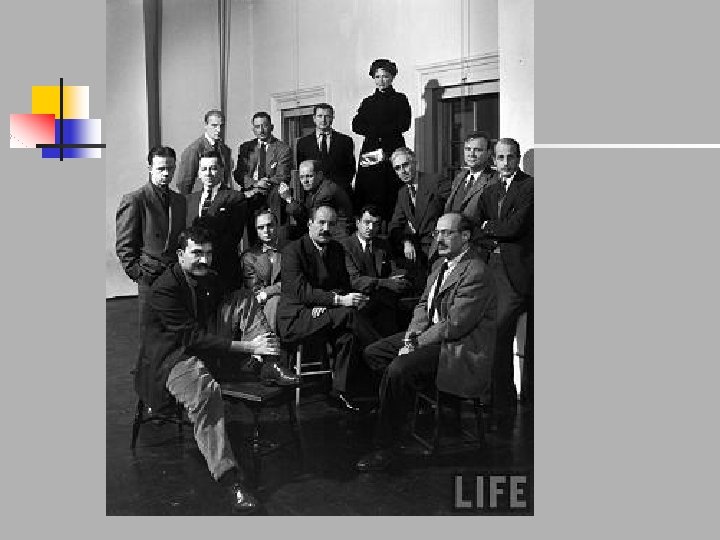
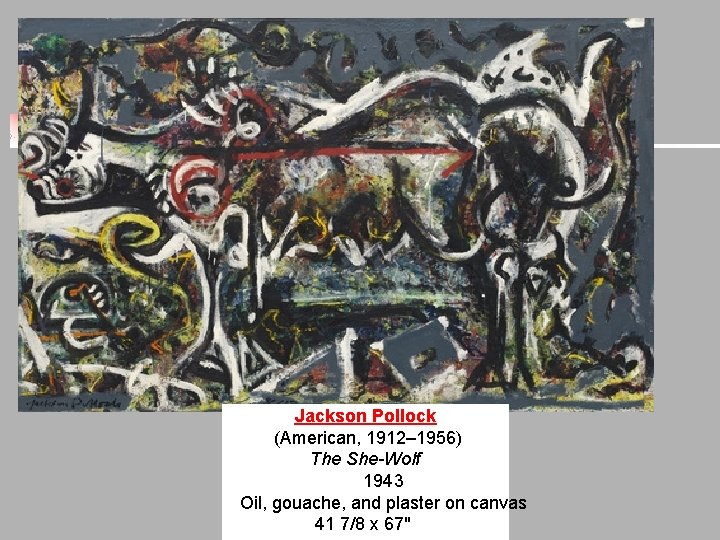
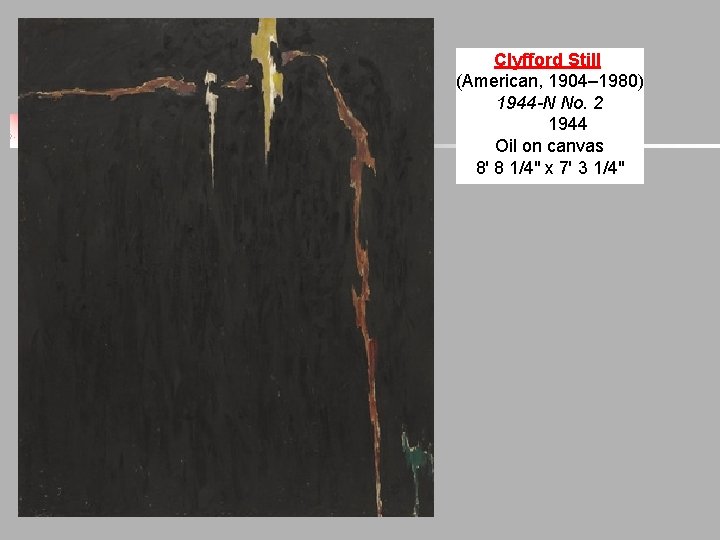
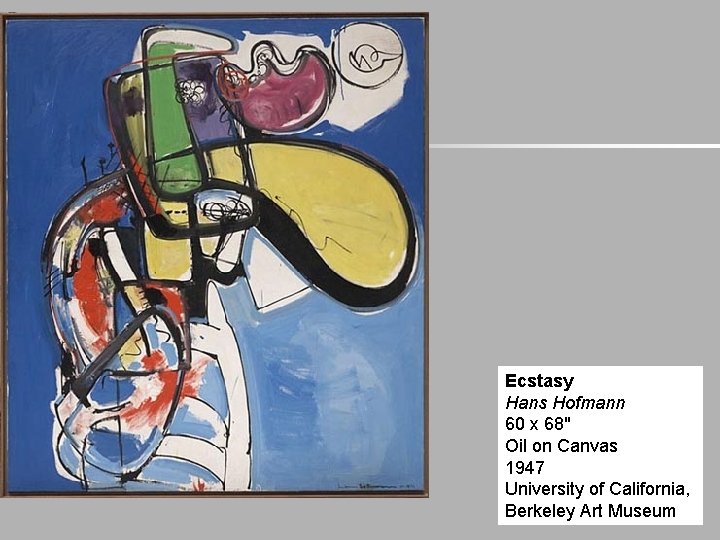
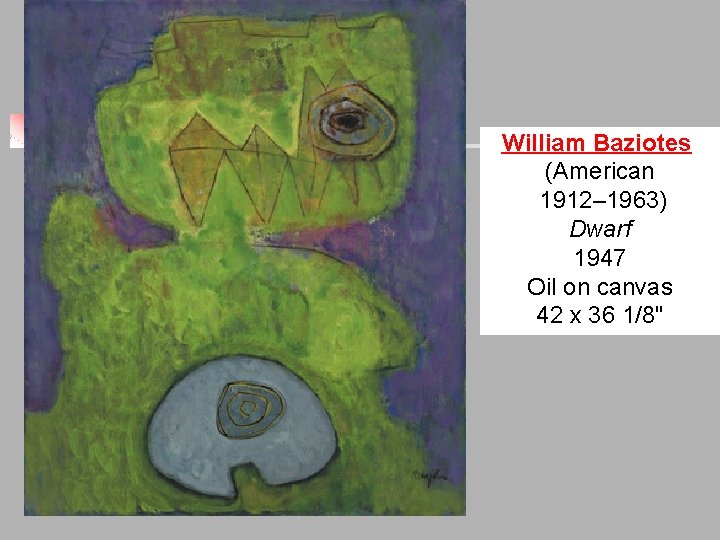
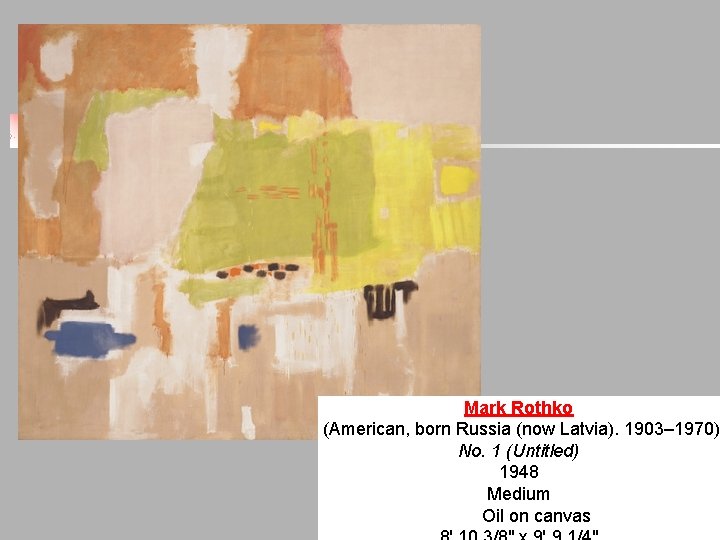
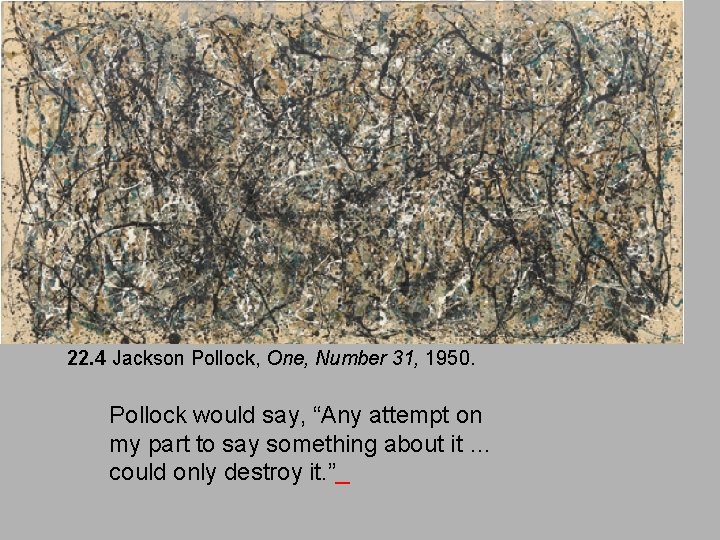
Visual Arts Abstract Expressionism n n Devoid of recognizable content Subjective aesthetic experience n n Line, color, shape New York School: The First Generation n Jackson Pollock (1912 -1956) n n n Radical break from tradition “all over” composition Action painting
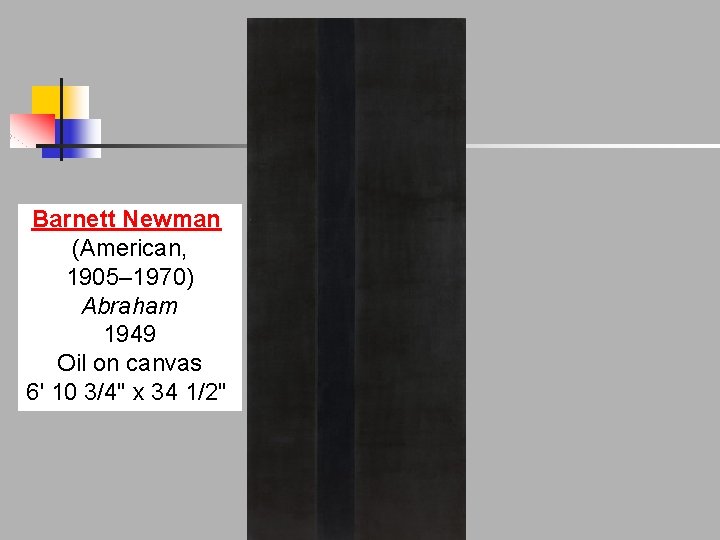
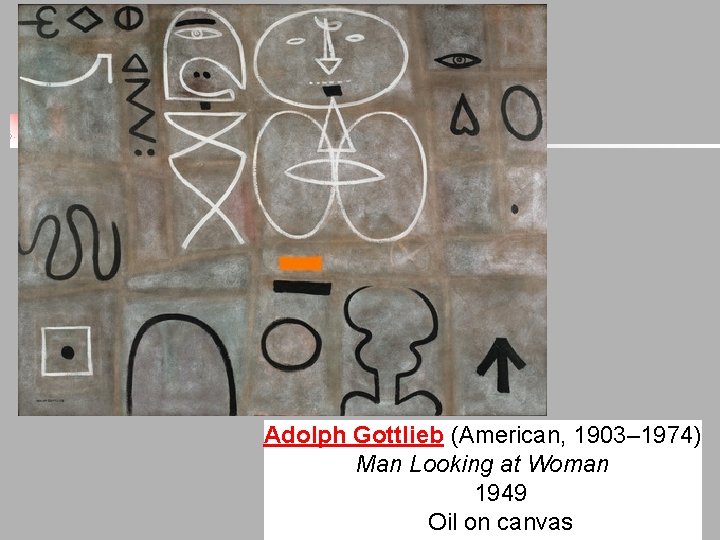
Barnett Newman wrote: "We felt the moral crisis of a world in shambles, a world destroyed by a great depression and a fierce World War, and it was impossible at that time to paint the kind of paintings that we were doing —flowers, reclining nudes, and people playing the cello. "* Adolph Gottlieb, writing with Rothko and Newman in 1943, explained, “We favor the simple expression of the complex thought. ”**
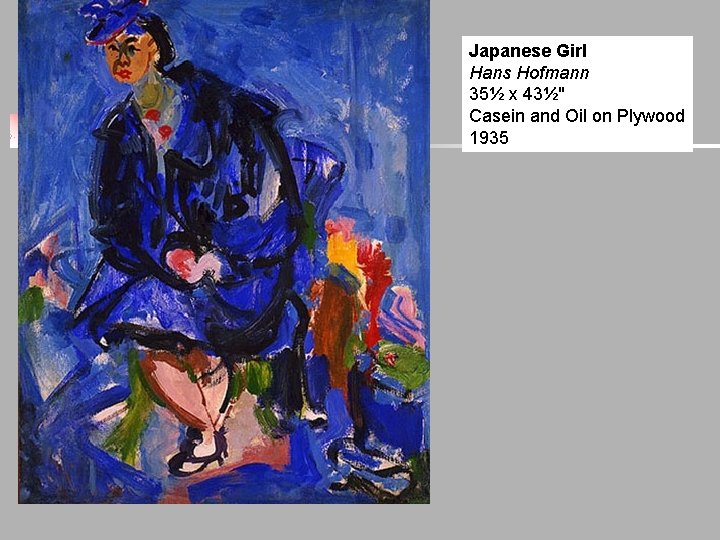
Japanese Girl Hans Hofmann 35½ x 43½" Casein and Oil on Plywood 1935
Jackson Pollock (American, 1912– 1956) The She-Wolf 1943 Oil, gouache, and plaster on canvas 41 7/8 x 67"
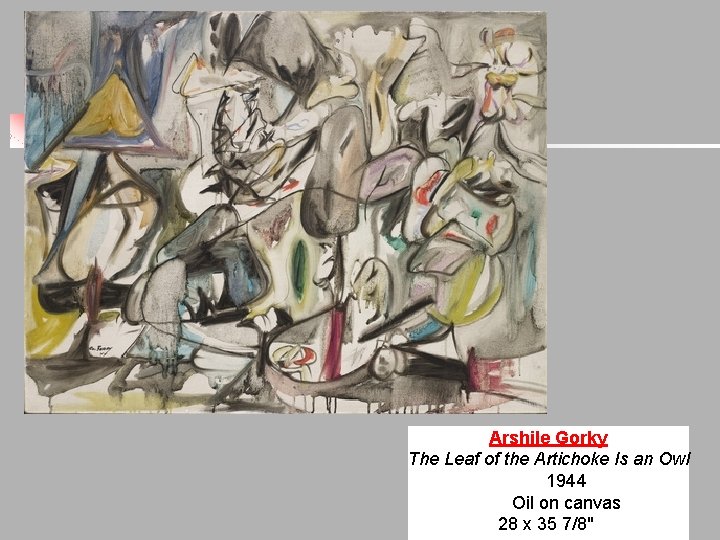
Arshile Gorky The Leaf of the Artichoke Is an Owl 1944 Oil on canvas 28 x 35 7/8"
Clyfford Still (American, 1904– 1980) 1944 -N No. 2 1944 Oil on canvas 8' 8 1/4" x 7' 3 1/4"
Ecstasy Hans Hofmann 60 x 68" Oil on Canvas 1947 University of California, Berkeley Art Museum
William Baziotes (American 1912– 1963) Dwarf 1947 Oil on canvas 42 x 36 1/8"
Mark Rothko (American, born Russia (now Latvia). 1903– 1970) No. 1 (Untitled) 1948 Medium Oil on canvas
Barnett Newman (American, 1905– 1970) Abraham 1949 Oil on canvas 6' 10 3/4" x 34 1/2"
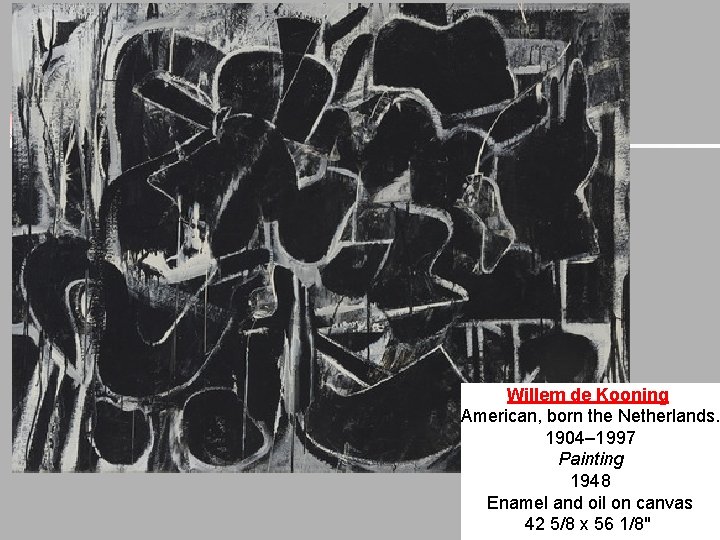
Willem de Kooning American, born the Netherlands. 1904– 1997 Painting 1948 Enamel and oil on canvas 42 5/8 x 56 1/8"
Adolph Gottlieb (American, 1903– 1974) Man Looking at Woman 1949 Oil on canvas
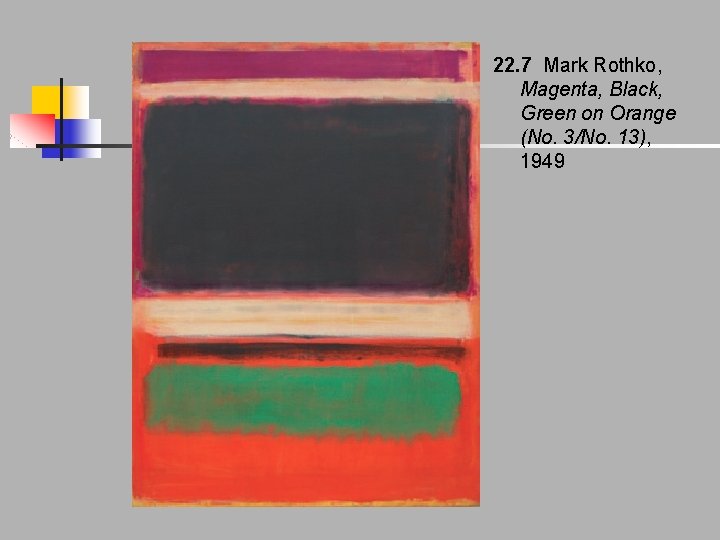
22. 7 Mark Rothko, Magenta, Black, Green on Orange (No. 3/No. 13), 1949
22. 4 Jackson Pollock, One, Number 31, 1950. Pollock would say, “Any attempt on my part to say something about it … could only destroy it. ”
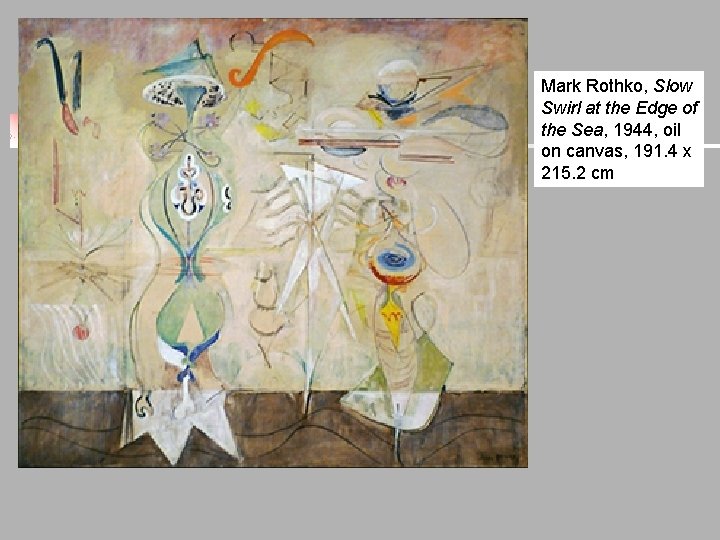
Mark Rothko, Slow Swirl at the Edge of the Sea, 1944, oil on canvas, 191. 4 x 215. 2 cm
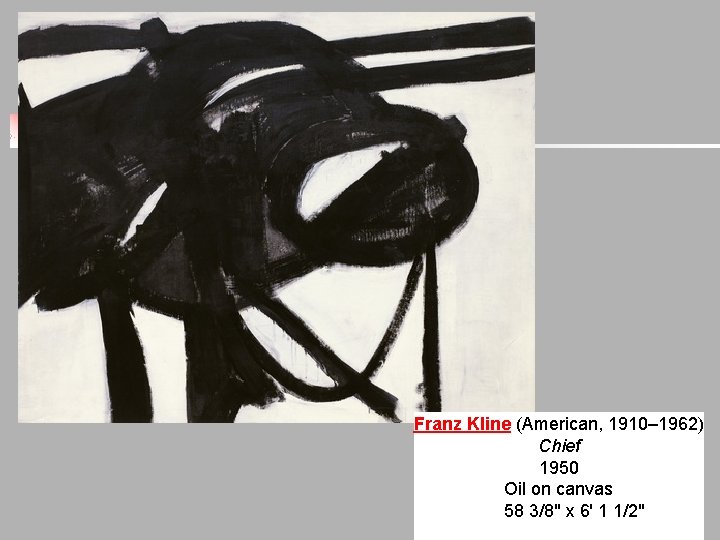
Franz Kline (American, 1910– 1962) Chief 1950 Oil on canvas 58 3/8" x 6' 1 1/2"
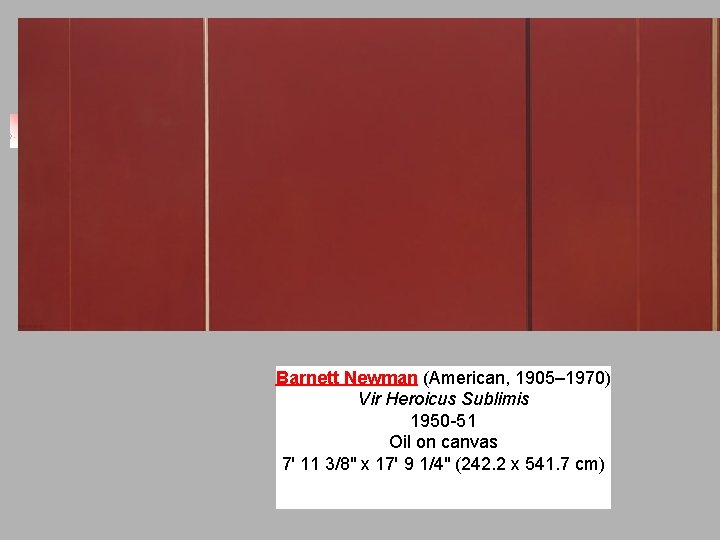
Barnett Newman (American, 1905– 1970) Vir Heroicus Sublimis 1950 -51 Oil on canvas 7' 11 3/8" x 17' 9 1/4" (242. 2 x 541. 7 cm)
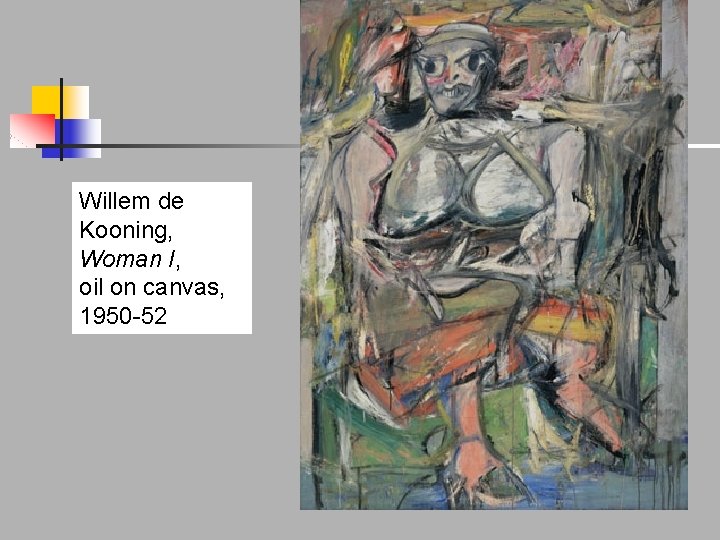
Willem de Kooning, Woman I, oil on canvas, 1950 -52
Visual Arts Abstract Expressionism n n The New York School: The First Generation Lee Krasner n n Willem de Kooning n n Easter Lilies (1956) Paintings of women Mark Rothco n Enormous canvases
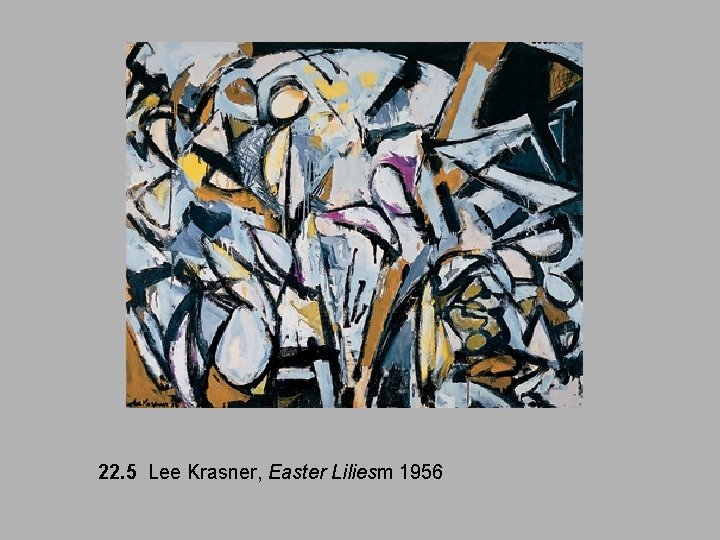
22. 5 Lee Krasner, Easter Liliesm 1956
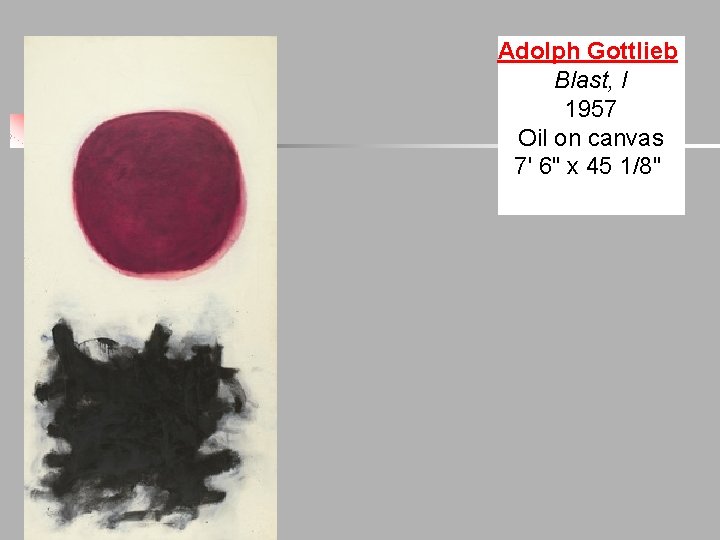
Adolph Gottlieb Blast, I 1957 Oil on canvas 7' 6" x 45 1/8"
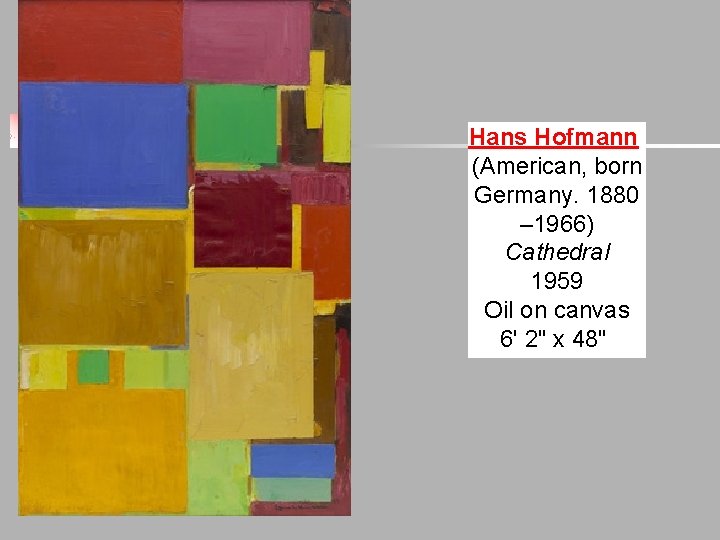
Hans Hofmann (American, born Germany. 1880 – 1966) Cathedral 1959 Oil on canvas 6' 2" x 48"
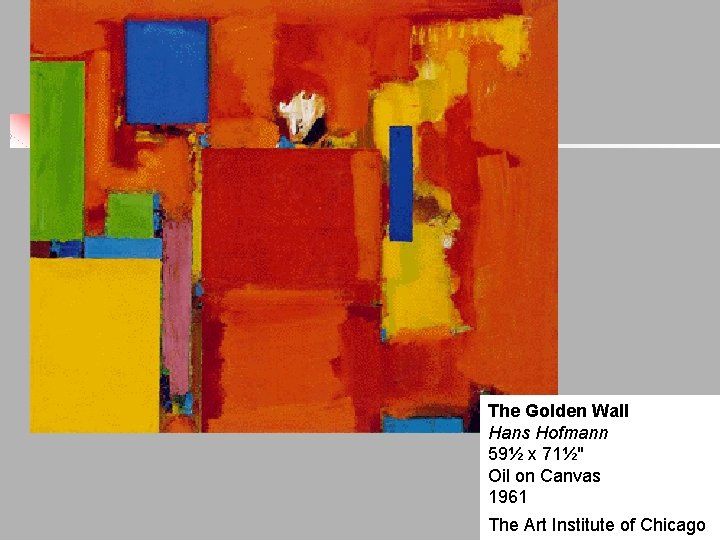
The Golden Wall Hans Hofmann 59½ x 71½" Oil on Canvas 1961 The Art Institute of Chicago
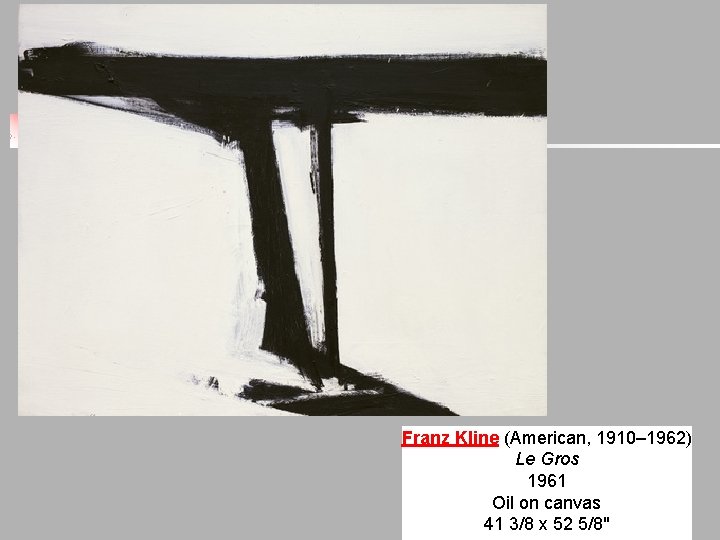
Franz Kline (American, 1910– 1962) Le Gros 1961 Oil on canvas 41 3/8 x 52 5/8"
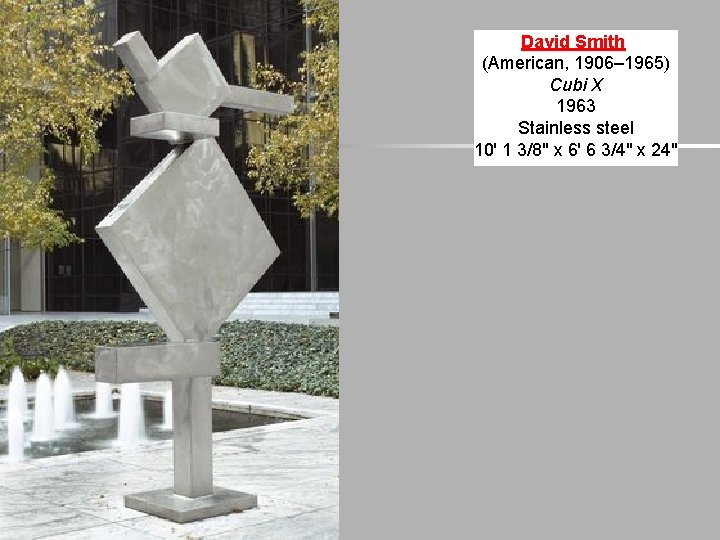
David Smith (American, 1906– 1965) Cubi X 1963 Stainless steel 10' 1 3/8" x 6' 6 3/4" x 24"
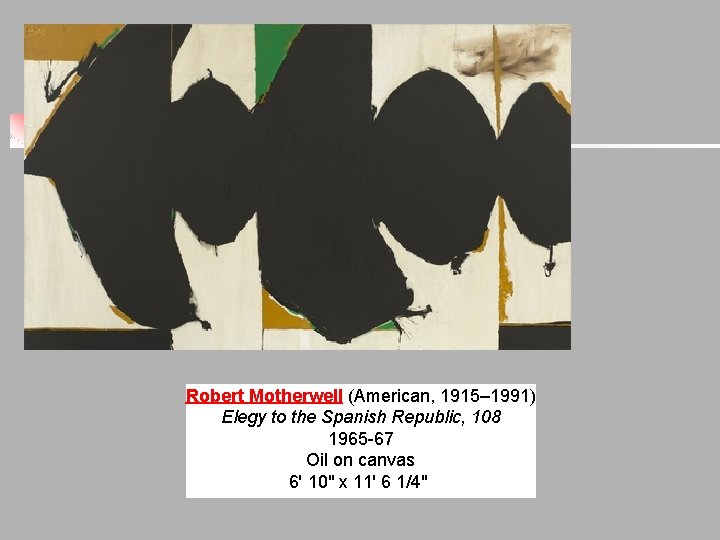
Robert Motherwell (American, 1915– 1991) Elegy to the Spanish Republic, 108 1965 -67 Oil on canvas 6' 10" x 11' 6 1/4"
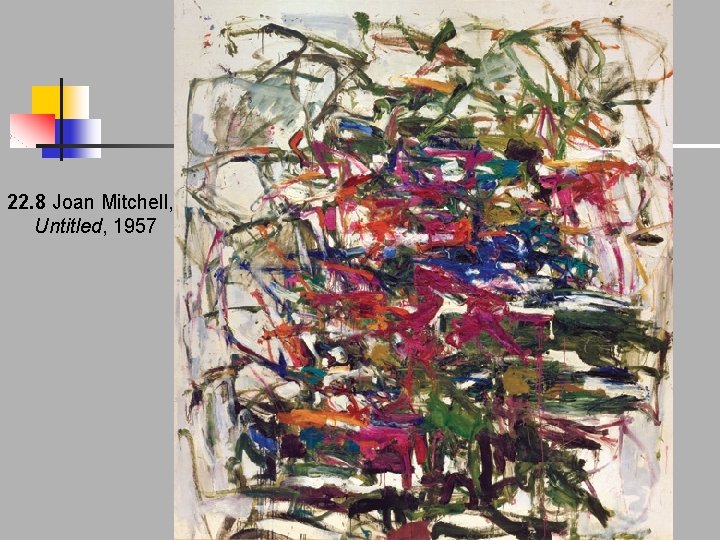
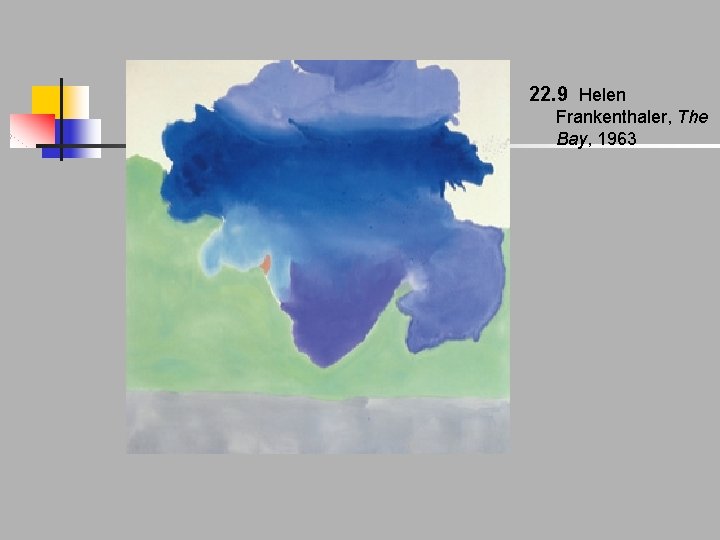
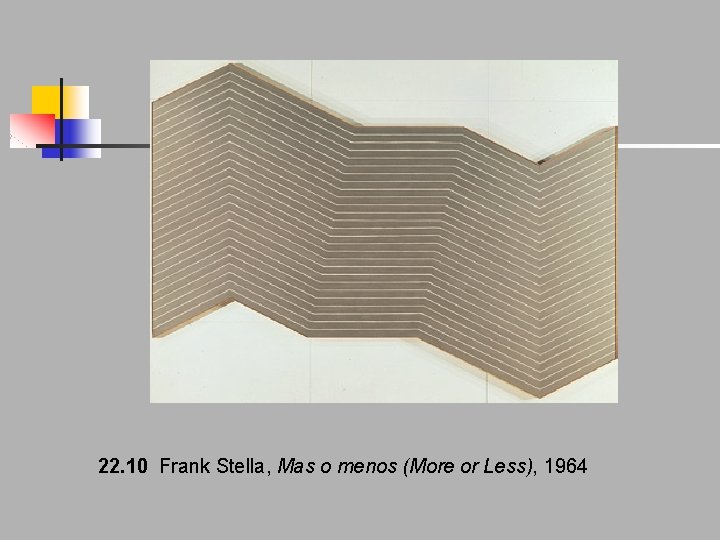
Visual Arts n The New York School: The Second Generation n Joan Mitchell n n Helen Frankenthaler n n Most important woman to work in the gestural idiom of abstract expressionism Color-field painter Minimal Art n n n Ascetic use of line, color Frank Stella Donald Judd
22. 8 Joan Mitchell, Untitled, 1957
22. 9 Helen Frankenthaler, The Bay, 1963
22. 10 Frank Stella, Mas o menos (More or Less), 1964
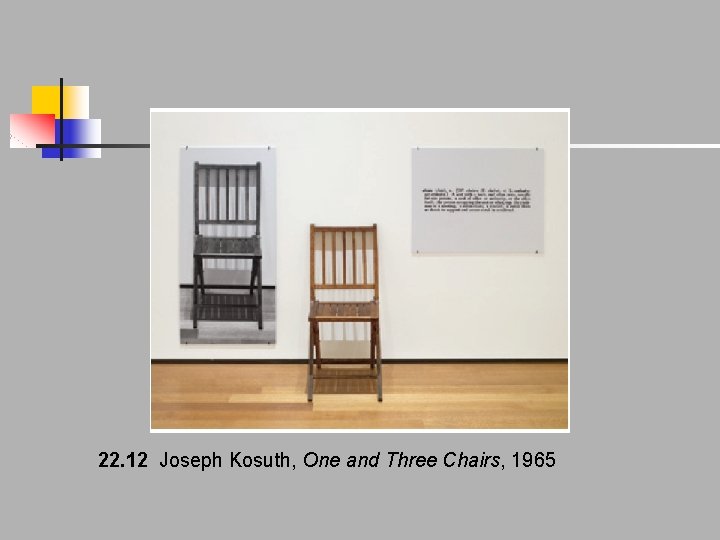
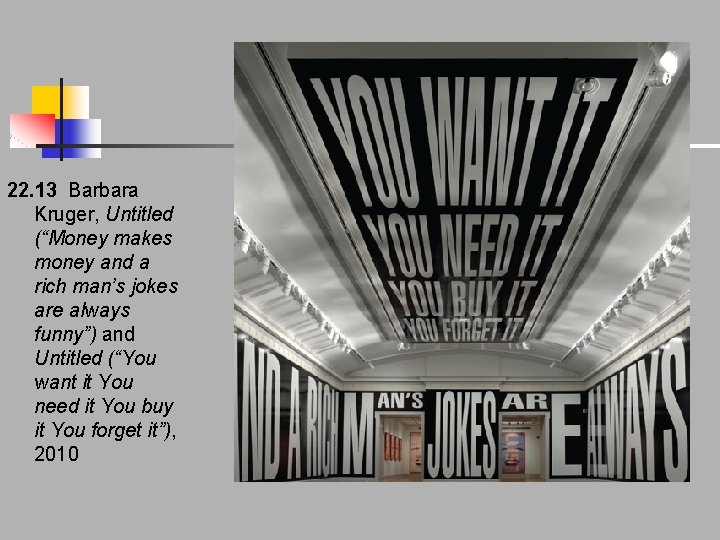
Visual Arts n n Conceptual Art Joseph Kosuth n n “What you see is what you see” Barbara Kruger n Prioritizes the idea of the work over the object
22. 12 Joseph Kosuth, One and Three Chairs, 1965
22. 13 Barbara Kruger, Untitled (“Money makes money and a rich man’s jokes are always funny”) and Untitled (“You want it You need it You buy it You forget it”), 2010
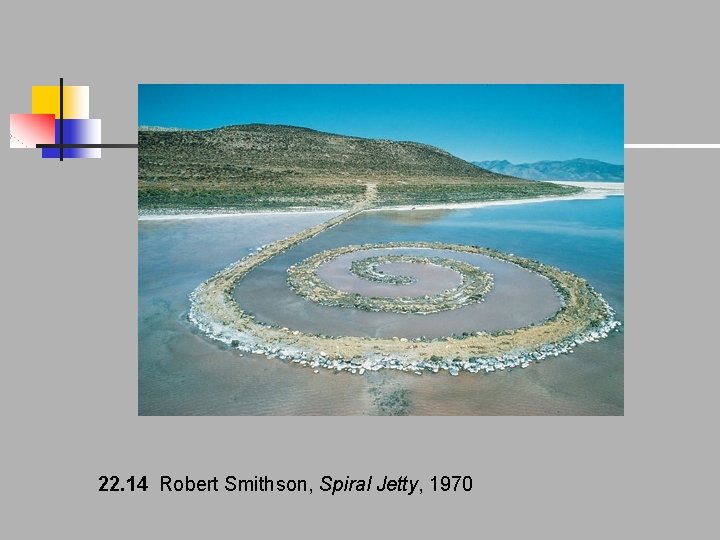
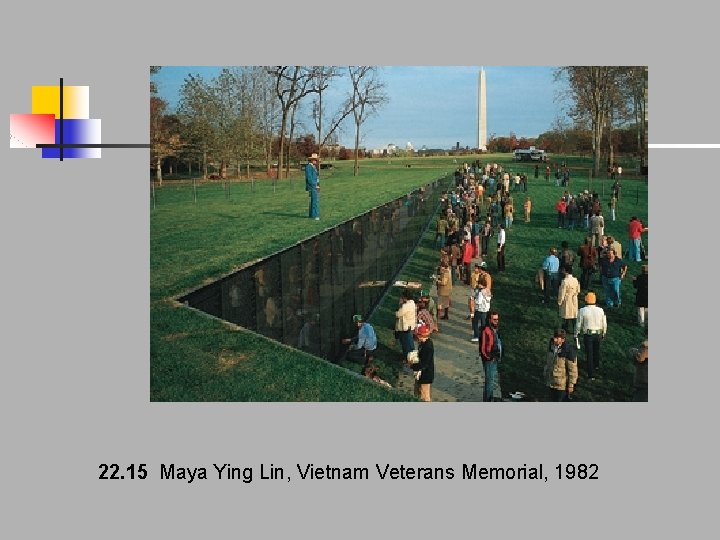
Visual Arts n Site-Specific Art n Robert Smithson n n Maya Ying Lin n n Land art—within natural surroundings The Vietnam Veterans Memorial Christo and Jeanne-Claude n Financed by the artists
22. 14 Robert Smithson, Spiral Jetty, 1970
22. 15 Maya Ying Lin, Vietnam Veterans Memorial, 1982
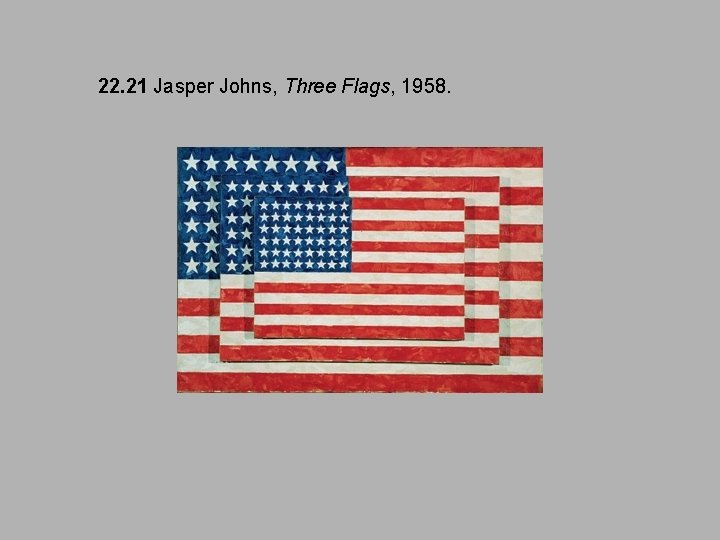
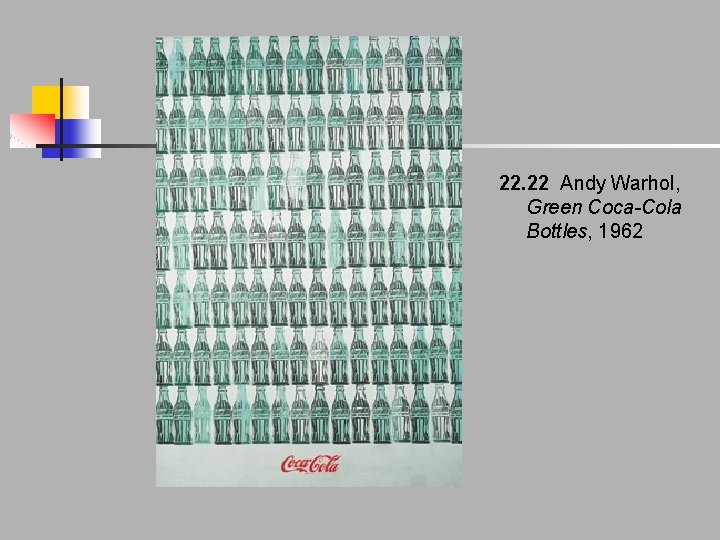
Visual Arts n Pop Art n n Robert Rauschenberg n n Universal images of popular culture Combine paintings Jasper Johns Andy Warhol Claes Oldenburg
22. 21 Jasper Johns, Three Flags, 1958.
22. 22 Andy Warhol, Green Coca-Cola Bottles, 1962
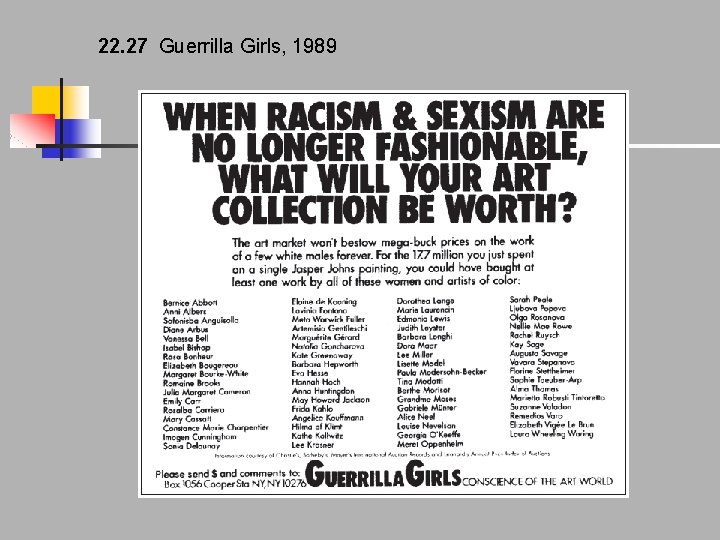
Visual Arts n Superrealism n n n New to the eye but doing something very old Audrey Flack Art, Identity, and Social Consciousness n n n Judy Chicago and Miriam Shapiro Cindy Sherman Guerrilla Girls
22. 27 Guerrilla Girls, 1989
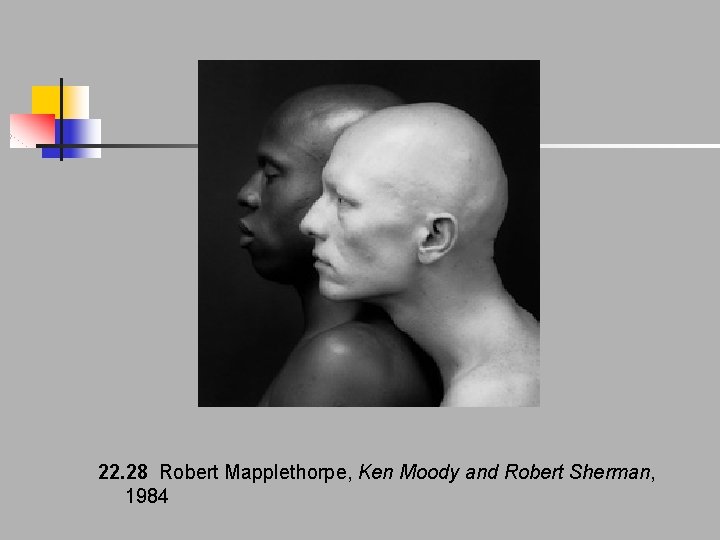
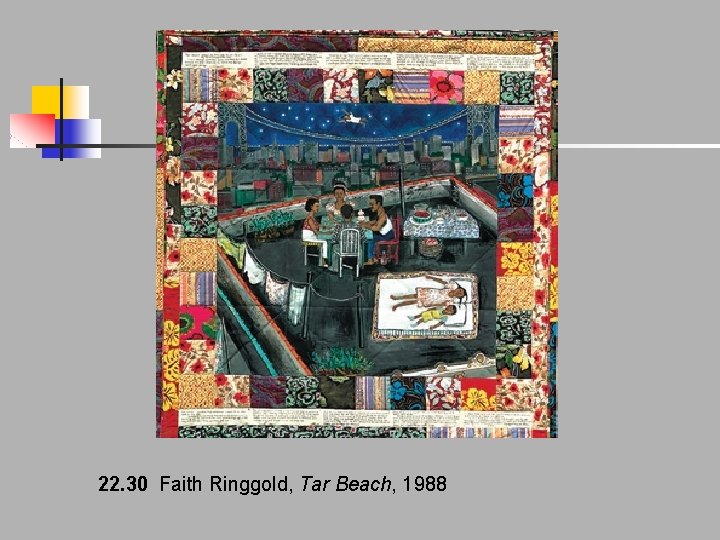
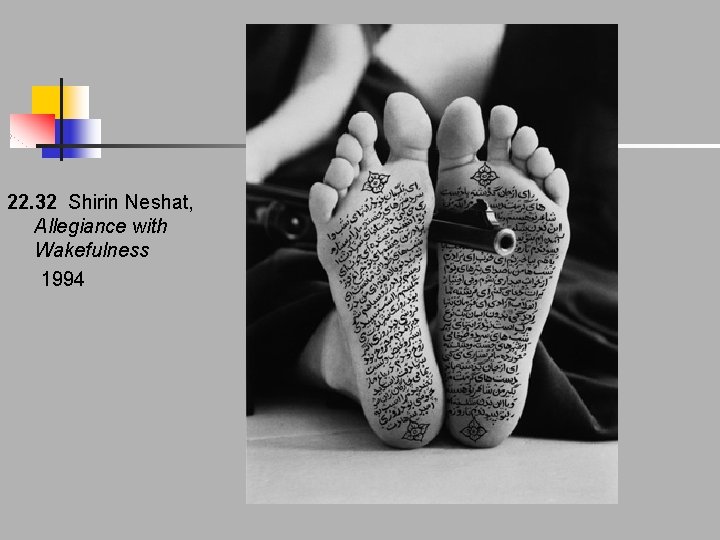
Visual Arts n Art, Identity, and Social Consciousness n n Robert Mapplethorpe Romare Bearden n n Synthesis of cubism and abstract expressionism African-American experience Faith Ringgold Anselm Kiefer Shirin Neshat
22. 28 Robert Mapplethorpe, Ken Moody and Robert Sherman, 1984
22. 30 Faith Ringgold, Tar Beach, 1988
22. 32 Shirin Neshat, Allegiance with Wakefulness 1994
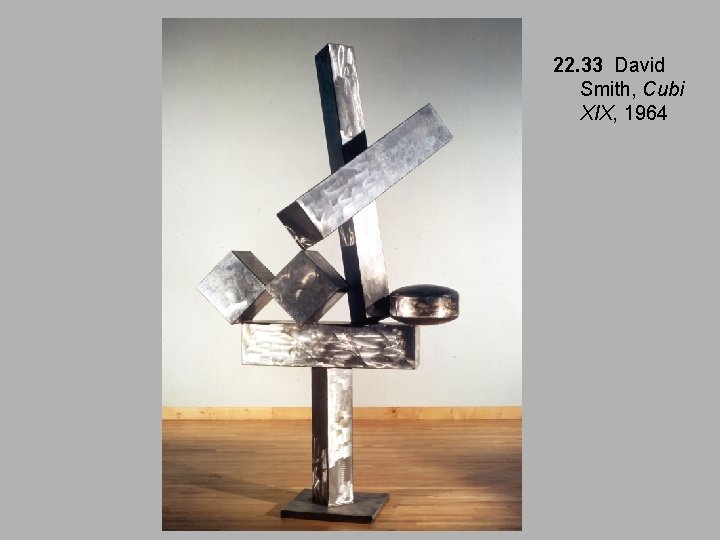
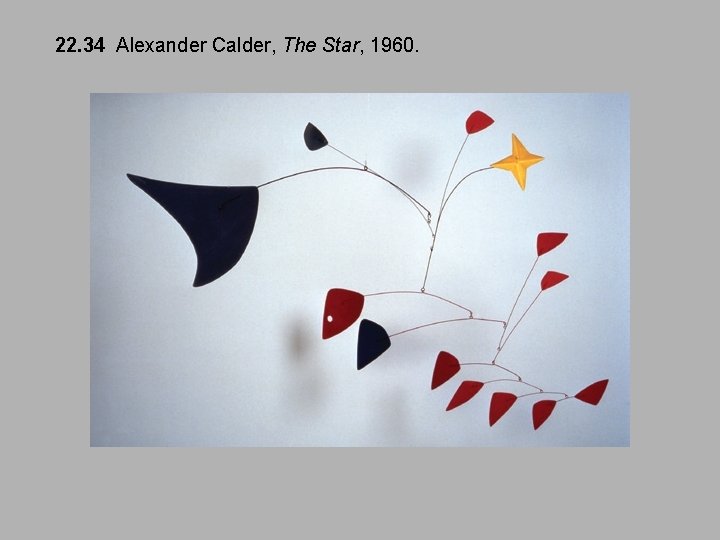
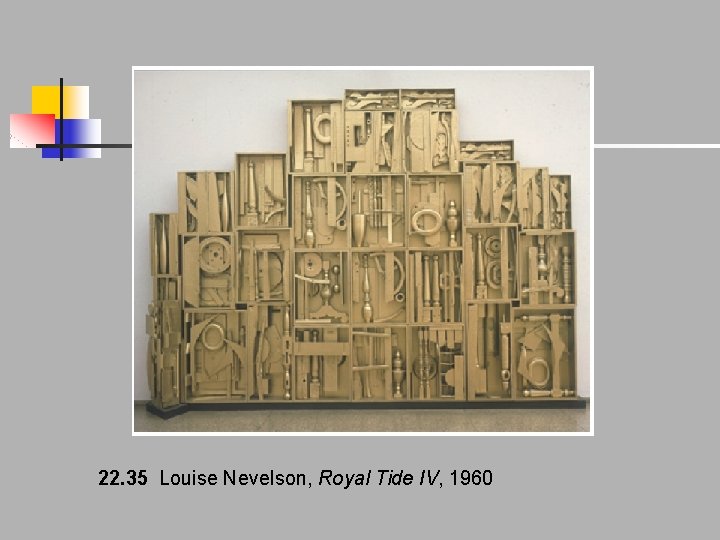
Contemporary Sculpture n n Continuity + Experimentation New materials, technical skills n n n David Smith (1906 -1965) Alexander Calder (1898 -1976) Assemblage n n Disparate materials Organic wholes Nevelson, Antoni, Whiteread
22. 33 David Smith, Cubi XIX, 1964
22. 34 Alexander Calder, The Star, 1960.
22. 35 Louise Nevelson, Royal Tide IV, 1960
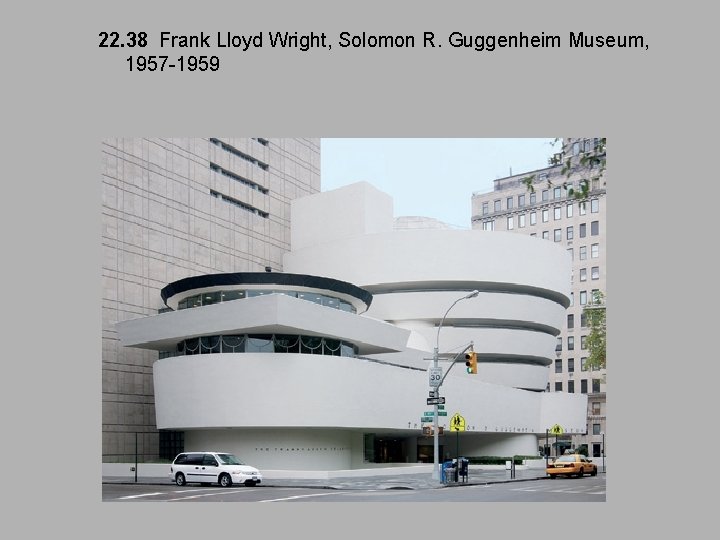
Architecture n Louis Sullivan (1856 -1924) n n “Form follows function” Frank Lloyd Wright (1869 -1959) n n Function is accomplished through form Organic architecture Flow of space vs. obstruction of space Guggenheim Museum (1957 -1959)
22. 38 Frank Lloyd Wright, Solomon R. Guggenheim Museum, 1957 -1959
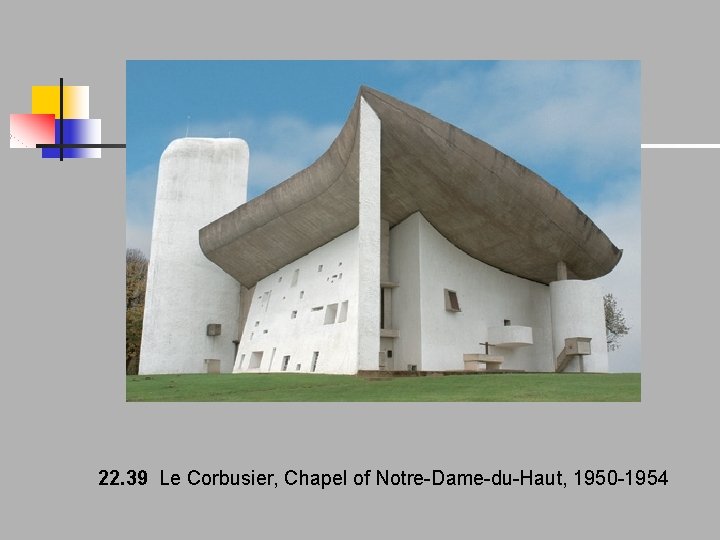
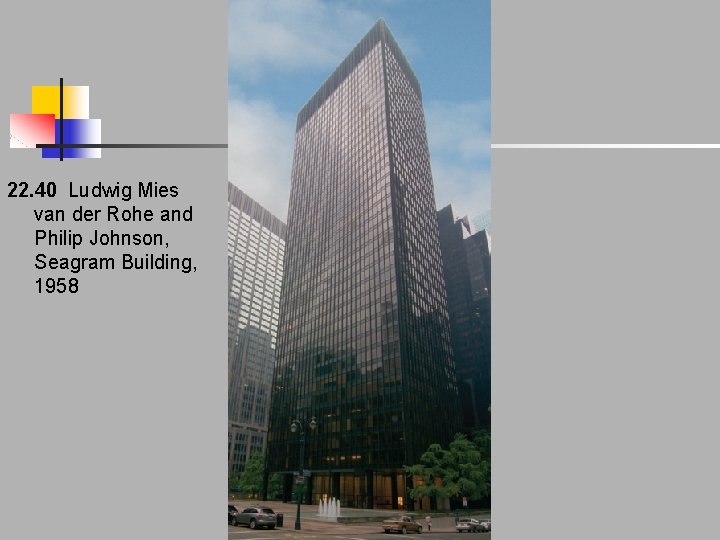
Architecture n Counterpoint to nature n Le Corbusier n n New brutalism Ludwig Mies van der Rohe and Philip Johnson n Seagram Building
22. 39 Le Corbusier, Chapel of Notre-Dame-du-Haut, 1950 -1954
22. 40 Ludwig Mies van der Rohe and Philip Johnson, Seagram Building, 1958
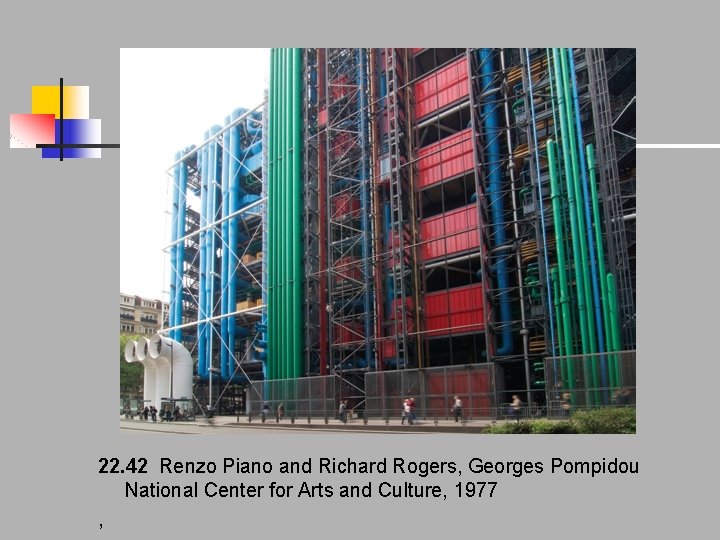
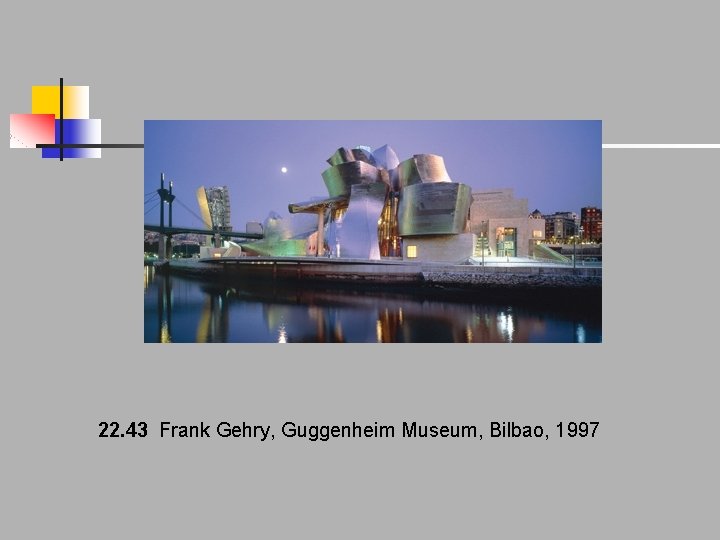
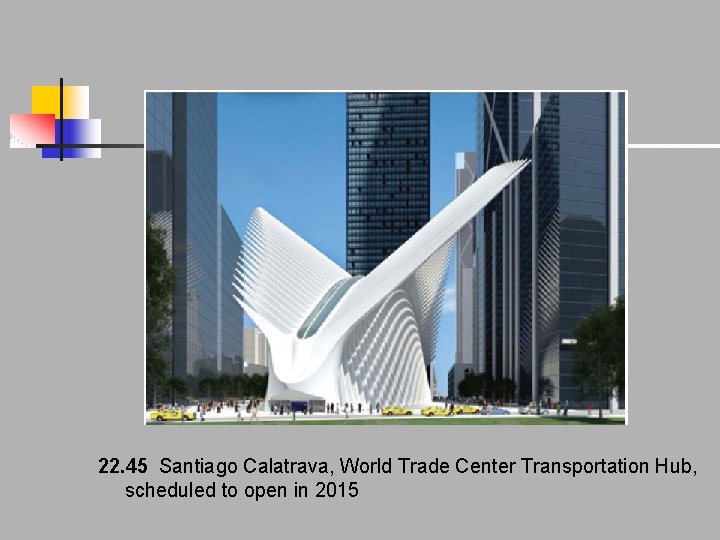
Architecture n Postmodernism n Classical motifs, Bauhaus severity n n n Humana Building Georges Pompidou National Center for Arts and Culture Deconstructivist Architecture n n Frank Gehry Santiago Calatrava
22. 42 Renzo Piano and Richard Rogers, Georges Pompidou National Center for Arts and Culture, 1977 ,
22. 43 Frank Gehry, Guggenheim Museum, Bilbao, 1997
22. 45 Santiago Calatrava, World Trade Center Transportation Hub, scheduled to open in 2015
Visual Arts n Video n Bill Viola n n Pipilotti Rist n n Video and sound installation Video-performance artist Matthew Barney n CREMASTER series
Some Trends in Contemporary Literature n Human search for meaning n n Experiences of the war n n n Samuel Beckett Elie Weisel American Literature of social, political protest n n John Updike Edward Albee
Some Trends in Contemporary Literature n African American Literature n n Maya Angelou Feminist Perspectives Sylvia Plath n Anne Sexton n
Music n Structuralism n n Precise organization, control Devoid of subjective emotional expression Electronic music, synthesizers Aleatoric Music, “sound events” n John Cage (1912 -1992)
Music The New Minimalists n Reich’s The Desert Music (1983) n n n Repetitions of simple chords, rhythms State of heightened concentration Philip Glass (b. 1937) n n n Influenced by non-Western music Repeating modules Operas as “happenings”
Music Traditional Approaches to Modern Music n n Innovative approach to symphony Dimitri Shostakovich (1906 -1975) n n n Political commentary, nature of death Traditional symphony orchestra Benjamin Britten (1913 -1976) n n n Violence of contemporary life Opera genre Inspired by earlier masterpieces
Modern Approaches to Traditional Music Genres n John Adams n n Rock Opera n n n Nixon in China Tommy Jesus Christ Superstar Musicals n Phantom of the Opera
Modern Approaches to Traditional Music Genres n Musicals and Social Consciousness n n South Pacific West Side Story Hair Popular Music n n Rock and Roll Rock Music Hip-hop and Rap Pop music and the music video
Chapter Twenty-Two: Discussion Questions n n n With contemporary art in its various forms, to what extent is the media the message? What does the composition of the art itself contribute to the artist’s theme, message, or primary emotion? Explain, citing specific examples. The evolution of Western artistic traditions reveals subtle changes in the ways in which the role of the artist is perceived. What is the role of the 21 st century artists? How is this role different than/similar to artists from other historical epochs? Explain. As an individual living in the 21 st century, what artistic form, genre most appeals to you? Why? Do you prefer to view art as a reflection of your personal values (subjectively), or is your attraction to art one of an objective nature? Explain, citing specific examples when appropriate.