
CHAPTER TWELVE TYPES OF PERSUASION Chapter Overview Explains
- Slides: 12
CHAPTER TWELVE– TYPES OF PERSUASION Chapter Overview Explains stasis theory, a central component of persuasive speech Details the differences between forms of deliberative persuasive speech and forensic persuasive speech Covers the elements of the persuasive process Chapter Twelve - Types of Persuasion
STASIS-THE ISSUE AT DISPUTE Definitive stasis is over word meaning Ex: The meaning of windfall profit Conjectural stasis concerns whether something happened Ex: Whether someone is guilty of stealing Chapter Twelve - Types of Persuasion
STASIS Qualitative stasis is about moral/ethical issues Ex: The amount of punishment for academic dishonesty Translative stasis is about a judge’s competence Ex: Is a mediator in a case fit to mediate the case? Chapter Twelve - Types of Persuasion
DIFFERENT TYPES OF QUESTIONS Fact, did or did not something happen? Ex: Did the politician take a bribe? Value, issues of right and wrong Ex: Was it morally wrong for the politician to accept a donation from a lobbyist Policy, should a course of action be taken? Ex: Should a law be passed forbidding politicians from taking lobbyist’s money Chapter Twelve - Types of Persuasion
TYPES OF PERSUASIVE SPEECHES Deliberative speeches About current or future things Legislatures employ this type Forensic speeches Used in justice systems Kategoria are about accusations Apologia are rebuttal Chapter Twelve - Types of Persuasion
SPEECHES OF REFUTATION Refutation speeches involves overcoming the opposition’s argument by introducing evidence that reduces the appeal of the opposing claim Rebuttal speeches use new evidence to make the opposing argument look weak A refutation speech attacks the other’s argument to make it look wrong or false Chapter Twelve - Types of Persuasion
PERSUASIVE PROCESS STAGES Issue awareness alerts the audience about the topic Comprehension through a clear context Acceptance is when the audience decides whether to agree or not Integration is when the audience sees the situation in a new light Chapter Twelve - Types of Persuasion
TYPES OF CREDIBILITY Initial credibility is at speech’s beginning Derived credibility is during the speech Terminal credibility is after the speech Chapter Twelve - Types of Persuasion
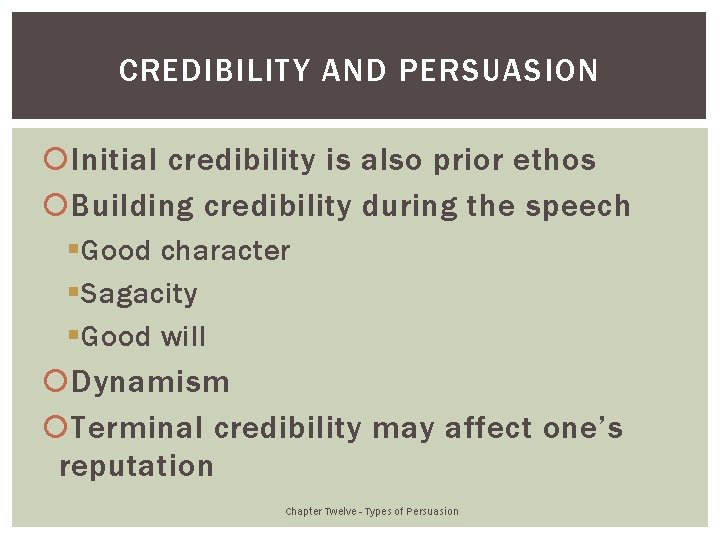
CREDIBILITY AND PERSUASION Initial credibility is also prior ethos Building credibility during the speech § Good character § Sagacity § Good will Dynamism Terminal credibility may affect one’s reputation Chapter Twelve - Types of Persuasion
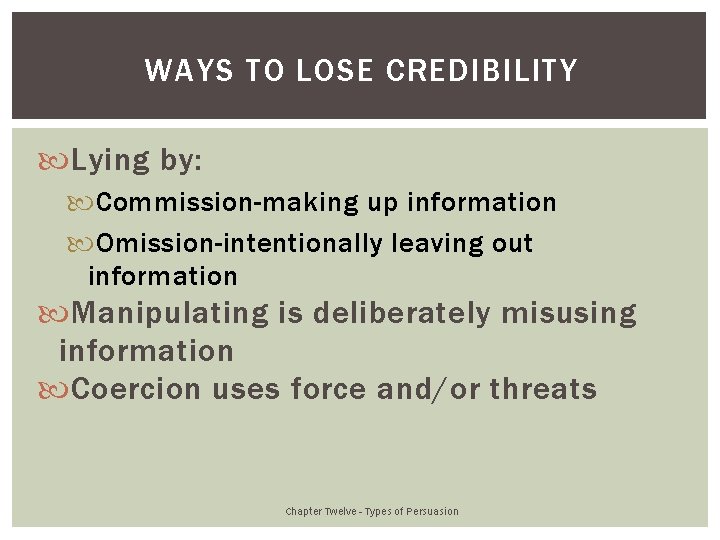
WAYS TO LOSE CREDIBILITY Lying by: Commission-making up information Omission-intentionally leaving out information Manipulating is deliberately misusing information Coercion uses force and/or threats Chapter Twelve - Types of Persuasion
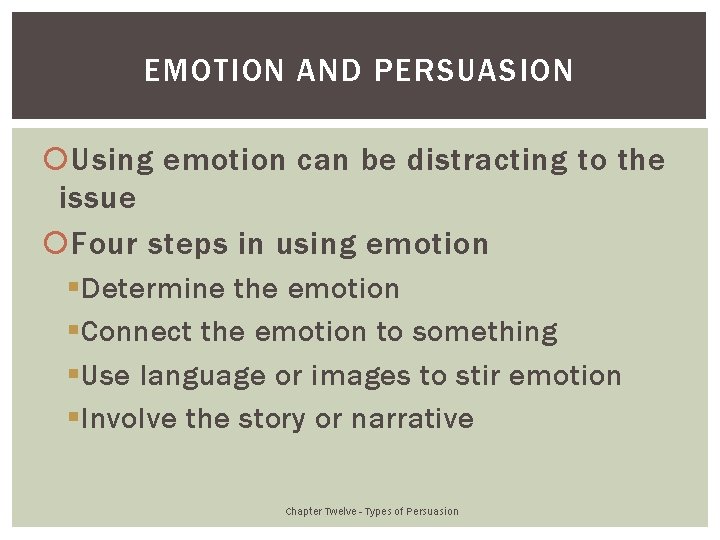
EMOTION AND PERSUASION Using emotion can be distracting to the issue Four steps in using emotion § Determine the emotion § Connect the emotion to something § Use language or images to stir emotion § Involve the story or narrative Chapter Twelve - Types of Persuasion
FINALLY… Remember, regardless of what or how you argue or persuade, speaker credibility is essential Chapter Twelve - Types of Persuasion