
Chapter Twelve Public Speaking Preparation and Delivery Steps
Chapter Twelve: Public Speaking Preparation and Delivery (Steps 7 -10) This multimedia product and its contents are protected under copyright law. The following are prohibited by law: - any public performance or display, including transmission of any image over a network; - preparation of any derivative work, including the extraction, in whole or in part, of any images; - any rental, lease, or lending of the program. Copyright © 2014, 2011, 2008 Pearson Education, Inc. All rights reserved.
Chapter Twelve Goals l l l Use language most effective for oral presentations Construct effective introductions and conclusions Rehearse your speech efficiently Deliver your speech with appropriate voice and body action Critically analyze a speech Copyright © 2014, 2011, 2008 Pearson Education, Inc. All rights reserved.
Step 7 – Wording Your Speech Oral Style: The style of spoken language consists of l Shorter, simpler sentences l More familiar words l Oral style will help audience members with comprehension and understanding Copyright © 2014, 2011, 2008 Pearson Education, Inc. All rights reserved.
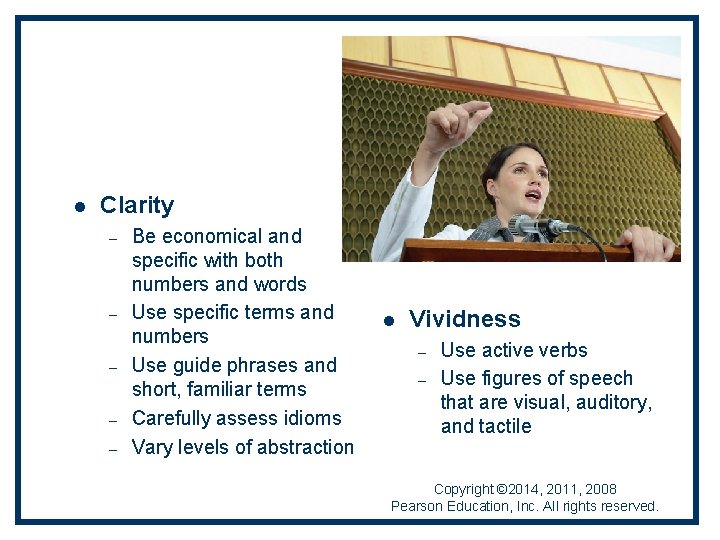
l Clarity – – – Be economical and specific with both numbers and words Use specific terms and numbers Use guide phrases and short, familiar terms Carefully assess idioms Vary levels of abstraction l Vividness – – Use active verbs Use figures of speech that are visual, auditory, and tactile Copyright © 2014, 2011, 2008 Pearson Education, Inc. All rights reserved.
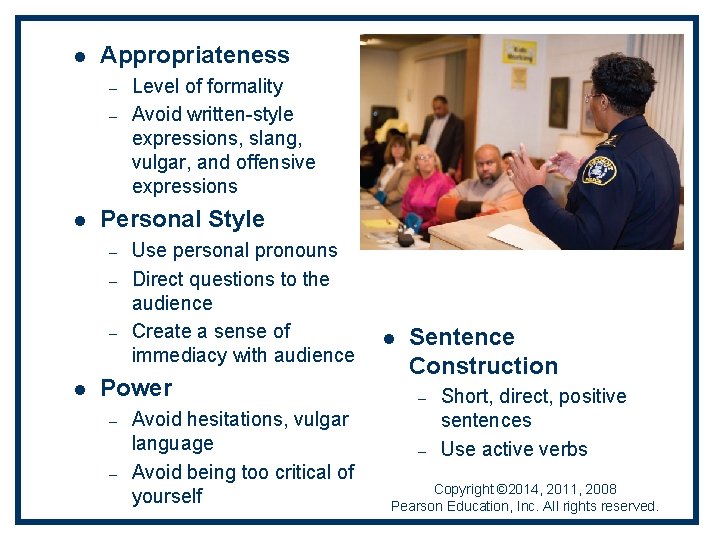
l Appropriateness – – l Personal Style – – – l Level of formality Avoid written-style expressions, slang, vulgar, and offensive expressions Use personal pronouns Direct questions to the audience Create a sense of immediacy with audience Power – – Avoid hesitations, vulgar language Avoid being too critical of yourself l Sentence Construction – – Short, direct, positive sentences Use active verbs Copyright © 2014, 2011, 2008 Pearson Education, Inc. All rights reserved.
Step 8 – Construct Your Conclusion, Introduction, Transitions, and Outlines Conclusions: Summarize l Restate your thesis, its importance, or the major points Close l Use quotation l Pose a challenge or question l Thank the audience Copyright © 2014, 2011, 2008 Pearson Education, Inc. All rights reserved.
Introductions Gain attention l Ask a question l Refer to specific audience members l Refer to recent happenings l Use illustration, or a dramatic or humorous story l Use visual aids Orient the audience l Preview main idea and propositions l Identify the goal you hope to achieve Copyright © 2014, 2011, 2008 Pearson Education, Inc. All rights reserved.
Guidelines for Avoiding Common Mistakes of Introduction and Conclusion l l l Don’t start speech immediately Don’t display discomfort or displeasure Don’t apologize for nerves or preface your introduction Don’t preface introduction Don’t introduce new material in your conclusion Don’t race away from the podium after the speech Copyright © 2014, 2011, 2008 Pearson Education, Inc. All rights reserved.
Transitions and Internal Summaries “Connecting the introduction to the body, points to points, the body to the conclusion” l l l To announce a proposition To signal you are closing To introduce an exception To reconnect audience to ideas To signal location point in speech Copyright © 2014, 2011, 2008 Pearson Education, Inc. All rights reserved.
The Preparation Outline l l l A full sentence outline Clearly states purpose and thesis Presents body of speech Builds both introduction and conclusion Notes possible presentation aids Lists references Copyright © 2014, 2011, 2008 Pearson Education, Inc. All rights reserved.
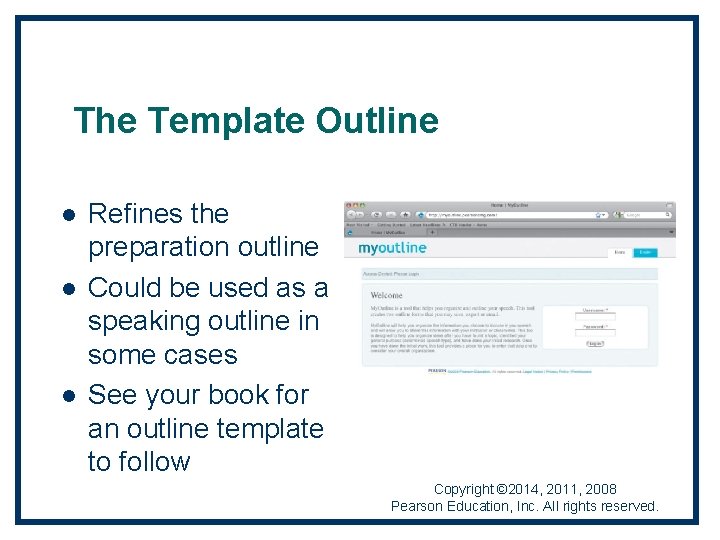
The Template Outline l l l Refines the preparation outline Could be used as a speaking outline in some cases See your book for an outline template to follow Copyright © 2014, 2011, 2008 Pearson Education, Inc. All rights reserved.

The Delivery Outline l l Assists in delivery of speech Guidelines – – – Be brief Be delivery-minded Rehearse with the delivery outline Copyright © 2014, 2011, 2008 Pearson Education, Inc. All rights reserved.

Step 9 – Methods of Delivery l l l Impromptu speaking Manuscript style Extemporaneous style – – Most useful Recommended for most people in most situations Copyright © 2014, 2011, 2008 Pearson Education, Inc. All rights reserved.
Rehearsing Your Speech l l l Rehearse the speech from beginning to end Time the speech Rehearse under conditions in which you will make speech Rehearse in front of full-length mirror Don’t interrupt rehearsal to make notes; do it after you finish Rehearse at least three or four times Copyright © 2014, 2011, 2008 Pearson Education, Inc. All rights reserved.
Step 10 – Deliver Your Speech Three dimensions of voice l Volume l Rate l Articulation and Pronunciation –Pauses –Avoid filler pauses (“um, you know, like, er”) –The use of silence Copyright © 2014, 2011, 2008 Pearson Education, Inc. All rights reserved.
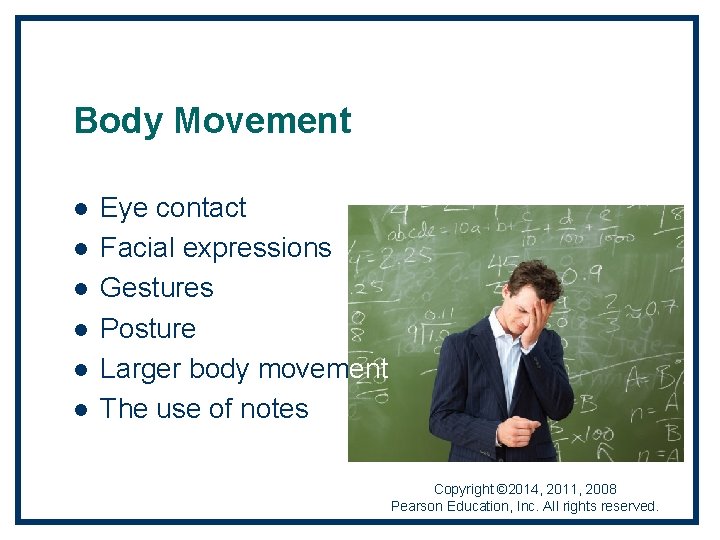
Body Movement l l l Eye contact Facial expressions Gestures Posture Larger body movement The use of notes Copyright © 2014, 2011, 2008 Pearson Education, Inc. All rights reserved.
Presentation Tips l l l Maintain good eye contact Use reasonable facial expressions Let gestures be spontaneous and natural Use movement to emphasize transitions and make important assertions Know and use notes in subtle ways Copyright © 2014, 2011, 2008 Pearson Education, Inc. All rights reserved.
Critically Evaluating Speeches l l l l l Is the subject appropriate? Is it appropriate for the audience? Has it been researched well? Are thesis and propositions appropriate? Is there good supporting material? Is the speech well-organized? Is the speech worded well? Are conclusion, introduction, and transitions effective? Is the delivery effective? Copyright © 2014, 2011, 2008 Pearson Education, Inc. All rights reserved.
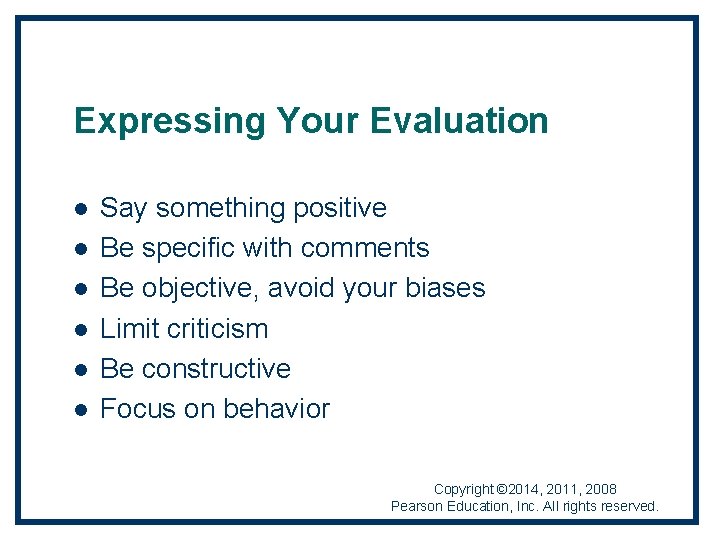
Expressing Your Evaluation l l l Say something positive Be specific with comments Be objective, avoid your biases Limit criticism Be constructive Focus on behavior Copyright © 2014, 2011, 2008 Pearson Education, Inc. All rights reserved.
End Show Copyright © 2014, 2011, 2008 Pearson Education, Inc. All rights reserved.
- Slides: 20