
Chapter Twelve Marketing Channels Delivering Customer Value Copyright
- Slides: 26
Chapter Twelve Marketing Channels: Delivering Customer Value Copyright © 2009 Pearson Education, Inc. Publishing as Prentice Hall Chapter 12 - slide 1
Marketing Channels: Delivering Customer Value Topic Outline • • • Supply Chains and the Value Delivery Network The Nature and Importance of Marketing Channels Channel Behavior and Organization Channel Design Decisions Channel Management Decisions Marketing Logistics and Supply Chain Management Copyright © 2010 Pearson Education, Inc. Publishing as Prentice Hall Chapter 12 - slide 2
Supply Chains and the Value Delivery Network Supply Chain Partners Upstream partners include raw material suppliers, components, parts, information, finances, and expertise to create a product or service Downstream partners include the marketing channels or distribution channels that look toward the customer Copyright © 2010 Pearson Education, Inc. Publishing as Prentice Hall Chapter 12 - slide 3
Supply Chains and the Value Delivery Network Supply Chain Views Supply chain “make and sell” view includes the firm’s raw materials, productive inputs, and factory capacity Demand chain “sense and respond” view suggests that planning starts with the needs of the target customer, and the firm responds to these needs by organizing a chain of resources and activities with the goal of creating customer value Copyright © 2010 Pearson Education, Inc. Publishing as Prentice Hall Chapter 12 - slide 4
The Nature and Importance of Marketing Channels How Channel Members Add Value Intermediaries offer producers greater efficiency in making goods available to target markets. Through their contacts, experience, specialization, and scale of operations, intermediaries usually offer the firm more than it can achieve on its own. Copyright © 2010 Pearson Education, Inc. Publishing as Prentice Hall Chapter 12 - slide 5
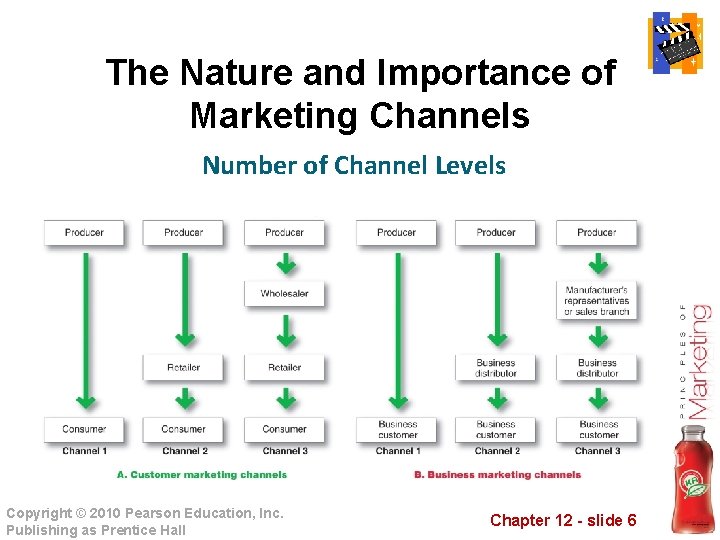
The Nature and Importance of Marketing Channels Number of Channel Levels Copyright © 2010 Pearson Education, Inc. Publishing as Prentice Hall Chapter 12 - slide 6
Channel Behavior and Organization Channel Behavior Marketing channel consists of firms that have partnered for their common good with each member playing a specialized role Channel conflict refers to disagreement over goals, roles, and rewards by channel members • Horizontal conflict • Vertical conflict Copyright © 2010 Pearson Education, Inc. Publishing as Prentice Hall Chapter 12 - slide 7
Channel Behavior and Organization Conventional Distributions Systems Conventional distribution systems consist of one or more independent producers, wholesalers, and retailers. Each seeks to maximize its own profits, and there is little control over the other members and no formal means for assigning roles and resolving conflict. Copyright © 2010 Pearson Education, Inc. Publishing as Prentice Hall Chapter 12 - slide 8
Channel Behavior and Organization Vertical Marketing Systems Vertical marketing systems (VMSs) provide channel leadership and consist of producers, wholesalers, and retailers acting as a unified system and consist of: • Corporate marketing systems • Contractual marketing systems • Administered marketing systems Copyright © 2010 Pearson Education, Inc. Publishing as Prentice Hall Chapter 12 - slide 9
Channel Behavior and Organization Vertical Marketing Systems Corporate vertical marketing system integrates successive stages of production and distribution under single ownership Copyright © 2010 Pearson Education, Inc. Publishing as Prentice Hall Chapter 12 - slide 10
Channel Behavior and Organization Vertical Marketing Systems Contractual vertical marketing system consists of independent firms at different levels of production and distribution who join together through contracts to obtain more economies or sales impact than each could achieve alone. The most common form is the franchise organization. Copyright © 2010 Pearson Education, Inc. Publishing as Prentice Hall Chapter 12 - slide 11
Channel Behavior and Organization Vertical Marketing Systems Franchise organization links several stages in the production distribution process – Manufacturer-sponsored retailer franchise system – Manufacturer-sponsored wholesaler franchise system – Service firm-sponsored retailer franchise system Copyright © 2010 Pearson Education, Inc. Publishing as Prentice Hall Chapter 12 - slide 12
Channel Behavior and Organization Vertical Marketing Systems Administered vertical marketing system has a few dominant channel members without common ownership. Leadership comes from size and power. Copyright © 2010 Pearson Education, Inc. Publishing as Prentice Hall Chapter 12 - slide 13
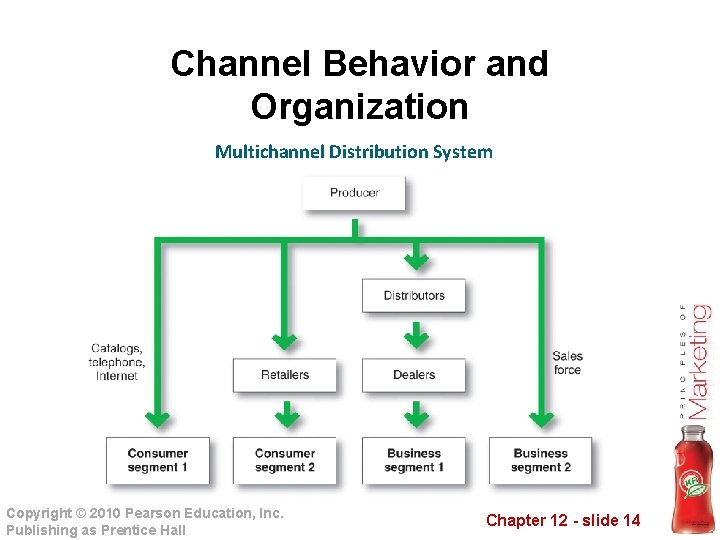
Channel Behavior and Organization Multichannel Distribution System Copyright © 2010 Pearson Education, Inc. Publishing as Prentice Hall Chapter 12 - slide 14
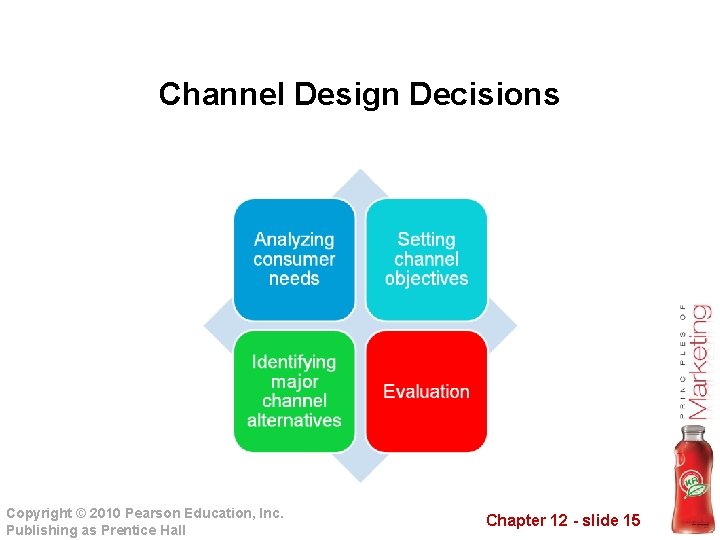
Channel Design Decisions Copyright © 2010 Pearson Education, Inc. Publishing as Prentice Hall Chapter 12 - slide 15
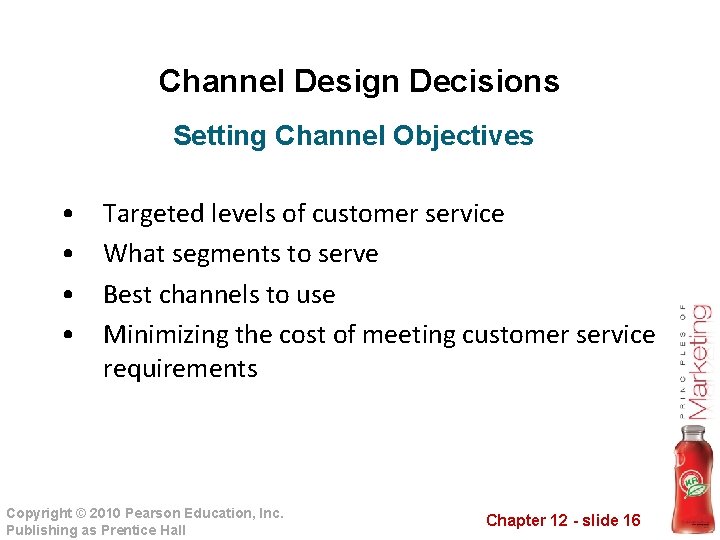
Channel Design Decisions Setting Channel Objectives • • Targeted levels of customer service What segments to serve Best channels to use Minimizing the cost of meeting customer service requirements Copyright © 2010 Pearson Education, Inc. Publishing as Prentice Hall Chapter 12 - slide 16
Channel Design Decisions Identifying Major Alternatives • Types of intermediaries • Number of marketing intermediaries • Responsibilities of channel members Copyright © 2010 Pearson Education, Inc. Publishing as Prentice Hall Chapter 12 - slide 17
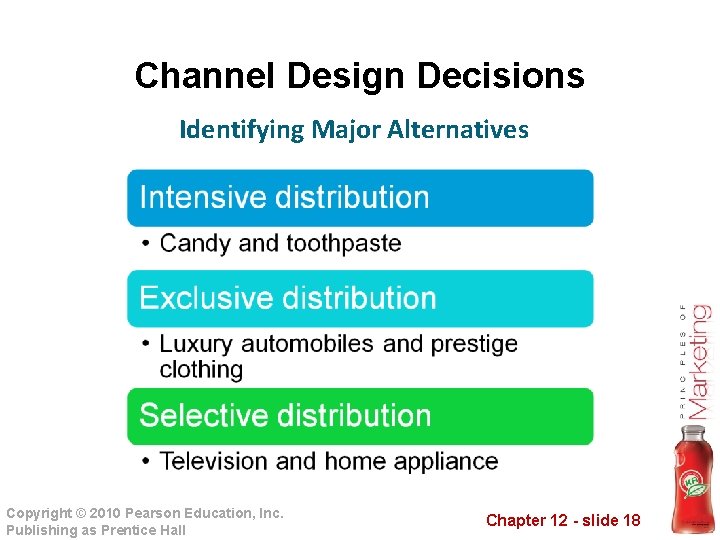
Channel Design Decisions Identifying Major Alternatives Copyright © 2010 Pearson Education, Inc. Publishing as Prentice Hall Chapter 12 - slide 18
Public Policy and Distribution Decisions Exclusive distribution is when the seller allows only certain outlets to carry its products Exclusive dealing is when the seller requires that the sellers not handle competitor’s products Exclusive territorial agreements are where producer or seller limit territory Tying agreements are agreements where the dealer must take most or all of the line Copyright © 2010 Pearson Education, Inc. Publishing as Prentice Hall Chapter 12 - slide 19
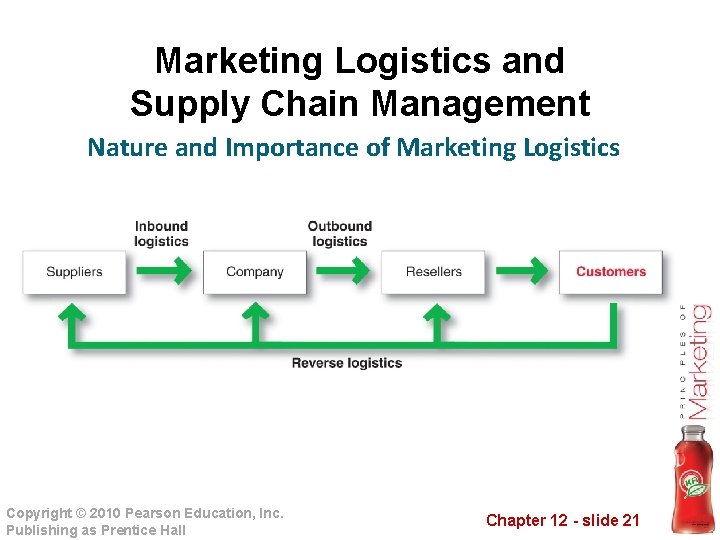
Marketing Logistics and Supply Chain Management Nature and Importance of Marketing Logistics Marketing logistics (physical distribution) involves planning, implementing, and controlling the physical flow of goods, services, and related information from points of origin to points of consumption to meet consumer requirements at a profit Copyright © 2010 Pearson Education, Inc. Publishing as Prentice Hall Chapter 12 - slide 20
Marketing Logistics and Supply Chain Management Nature and Importance of Marketing Logistics Copyright © 2010 Pearson Education, Inc. Publishing as Prentice Hall Chapter 12 - slide 21
Marketing Logistics and Supply Chain Management Nature and Importance of Marketing Logistics Supply chain management is the process of managing upstream and downstream valueadded flows of materials, final goods, and related information among suppliers, the company, resellers, and final consumers Copyright © 2010 Pearson Education, Inc. Publishing as Prentice Hall Chapter 12 - slide 22
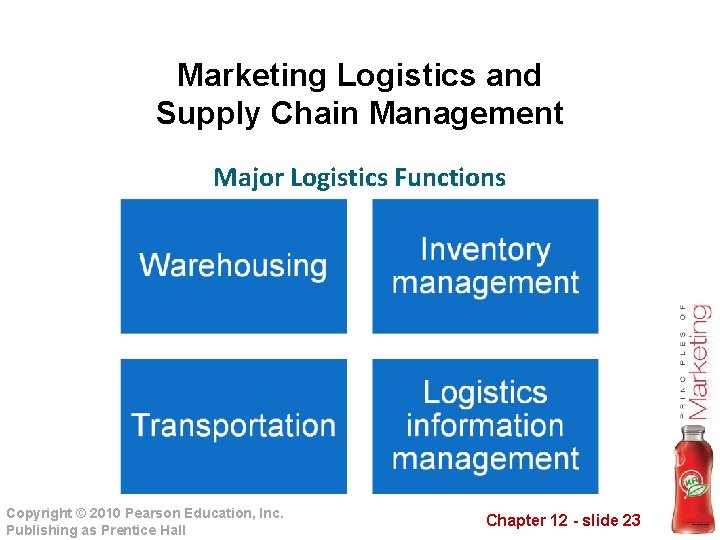
Marketing Logistics and Supply Chain Management Major Logistics Functions Copyright © 2010 Pearson Education, Inc. Publishing as Prentice Hall Chapter 12 - slide 23
Marketing Logistics and Supply Chain Management Warehousing Decisions • • How many What types Location Distribution centers Copyright © 2010 Pearson Education, Inc. Publishing as Prentice Hall Chapter 12 - slide 24
Marketing Logistics and Supply Chain Management Inventory Management • Just-in-time systems • RFID – Knowing exact product location • Smart shelves – Placing orders automatically Copyright © 2010 Pearson Education, Inc. Publishing as Prentice Hall Chapter 12 - slide 25
Marketing Logistics and Supply Chain Management Logistics Information Management Logistics information management is the management of the flow of information, including customer orders, billing, inventory levels, and customer data • EDI (electronic data interchange) • VMI (vendor-managed inventory) Copyright © 2010 Pearson Education, Inc. Publishing as Prentice Hall Chapter 12 - slide 26