
Chapter Twelve Macromolecular Transport Across the Nuclear Envelope
- Slides: 13
Chapter Twelve: Macromolecular Transport Across the Nuclear Envelope Amberlea Elliott October 21, 2003
Objective: l The cell regulates the entrance and exit of all molecules within its nucleus to prevent problems and allow for easy movement of approved molecules. l The movement is done through many highly specialized structures which all work together to regulate transport.
The Nuclear Envelope l Present in all Eukaryotic cells l Two- membrane system l Separates the Nucleus from the cytoplasm l Consists of a water impermeable phospholipid bilayer and various proteins l Perforated by many nuclear pores
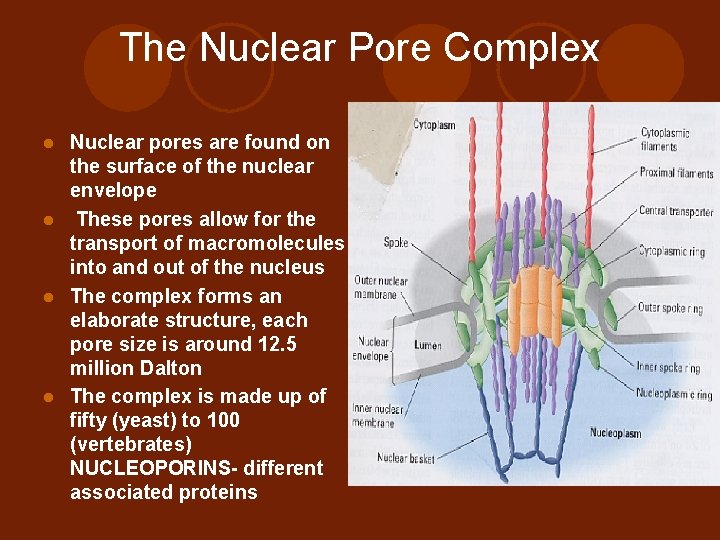
The Nuclear Pore Complex Nuclear pores are found on the surface of the nuclear envelope l These pores allow for the transport of macromolecules into and out of the nucleus l The complex forms an elaborate structure, each pore size is around 12. 5 million Dalton l The complex is made up of fifty (yeast) to 100 (vertebrates) NUCLEOPORINS- different associated proteins l
Structure of the Nuclear Pore Complex l Octagonal membrane l Eight 100 nm long filaments extending into the nucleoplasm l The filaments are joined by the terminal ring l These two parts combine to form the NUCLEAR BASKET
l NUCLEAR LAMINA- network of intermediate filaments extending over the inner surface of the nuclear envelope l CYTOPLASMIC FILAMENTS- extend from the cytoplasmic side of the nuclear pore complex into the cytosol
Transport l Ions, small metabolites, and globular proteins up to 60 k. Da, are able to diffuse through water filled channels l Large proteins and ribonucleicprotein complexes are too big to diffuse in and out of the nucleus… l They need a little help….
Selective Transport l System of transporting proteins and RNPC’s bigger than 60 k. Da l Works by assisting the molecule l A water soluble transporter will bind with the molecule and interact with the nucleoporins to allow for movement across the nuclear envelope
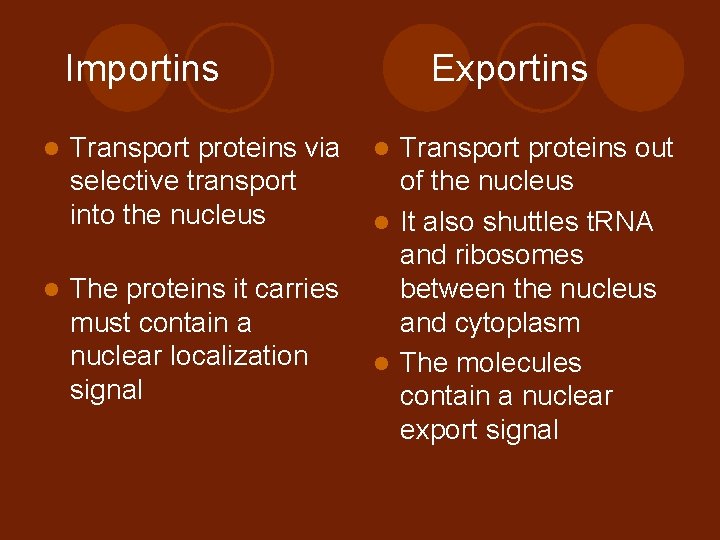
Importins l Transport proteins via selective transport into the nucleus l The proteins it carries must contain a nuclear localization signal Exportins Transport proteins out of the nucleus l It also shuttles t. RNA and ribosomes between the nucleus and cytoplasm l The molecules contain a nuclear export signal l
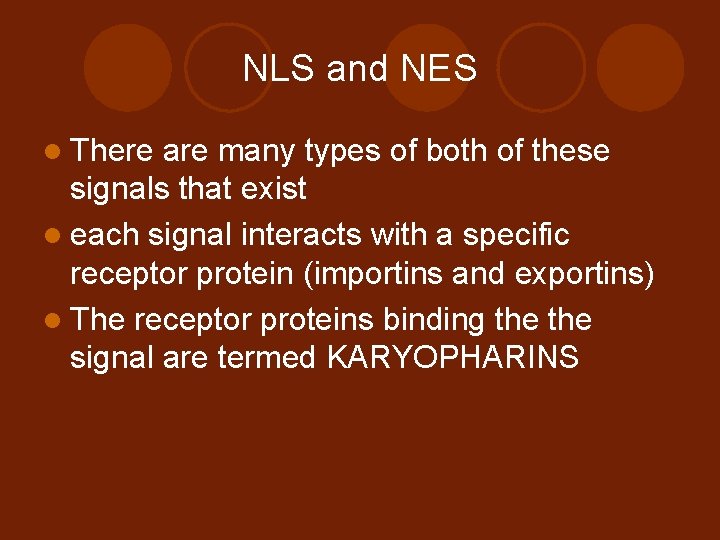
NLS and NES l There are many types of both of these signals that exist l each signal interacts with a specific receptor protein (importins and exportins) l The receptor proteins binding the signal are termed KARYOPHARINS
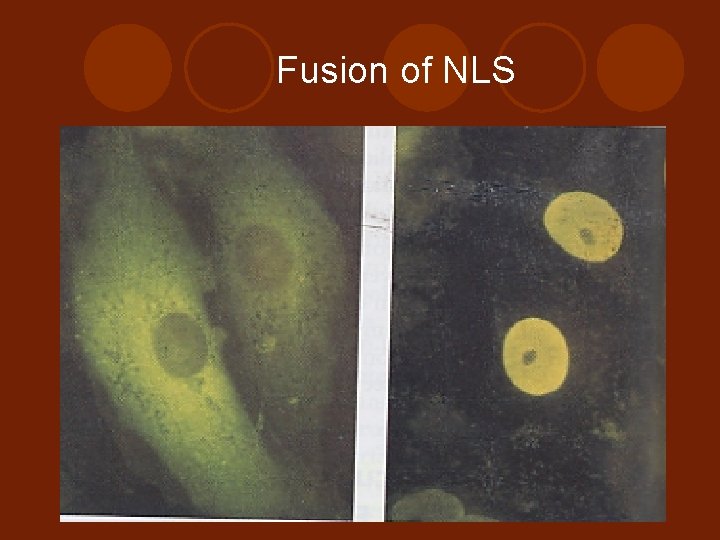
Fusion of NLS
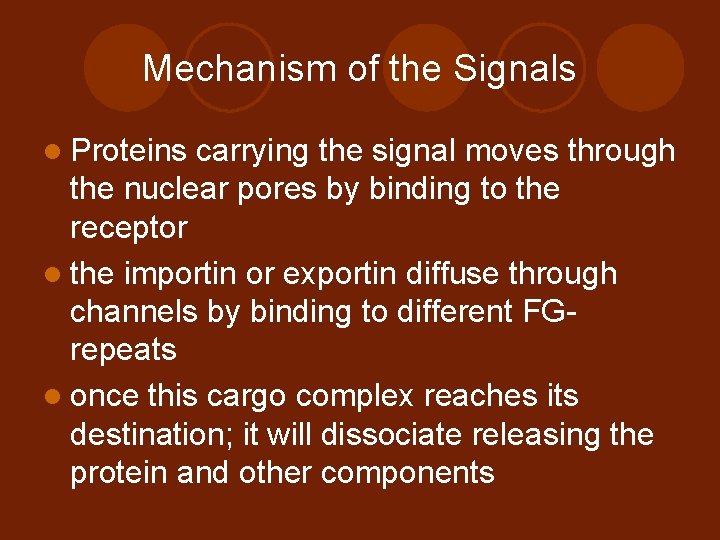
Mechanism of the Signals l Proteins carrying the signal moves through the nuclear pores by binding to the receptor l the importin or exportin diffuse through channels by binding to different FGrepeats l once this cargo complex reaches its destination; it will dissociate releasing the protein and other components
In summary: l The highly regulated import and export of macromolecules allows for protection from harmful mistakes or problems that free movement of any molecule could cause to the cell within the nucleus.