
CHAPTER TWELVE ARBITRAGE PRICING THEORY 1 FACTOR MODELS
CHAPTER TWELVE ARBITRAGE PRICING THEORY 1

FACTOR MODELS • ARBITRAGE PRICING THEORY (APT) – is an equilibrium factor mode of security returns – Principle of Arbitrage • the earning of riskless profit by taking advantage of differentiated pricing for the same physical asset or security – Arbitrage Portfolio • requires no additional investor funds • no factor sensitivity • has positive expected returns 2

FACTOR MODELS • ARBITRAGE PRICING THEORY (APT) – Three Major Assumptions: • capital markets are perfectly competitive • investors always prefer more to less wealth • price-generating process is a K factor model 3

FACTOR MODELS • MULTIPLE-FACTOR MODELS – FORMULA ri = ai + bi 1 F 1 + bi 2 F 2 +. . . + bi. KF K+ ei where r is the return on security i b is the coefficient of the factor F is the factor e is the error term 4
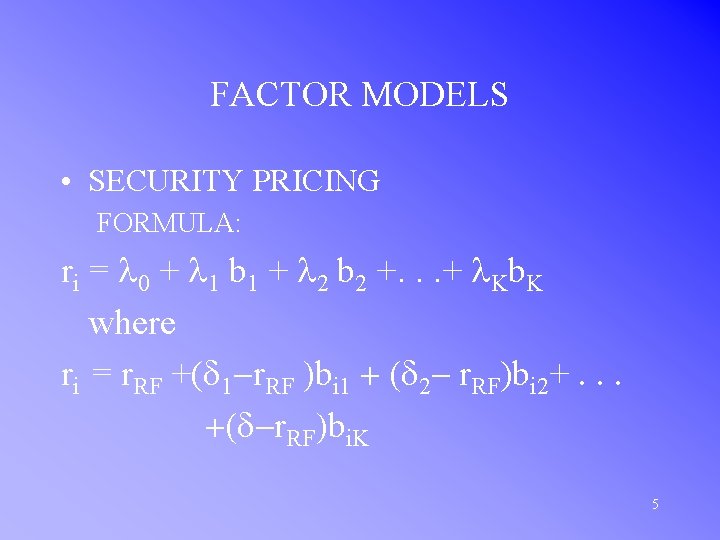
FACTOR MODELS • SECURITY PRICING FORMULA: ri = l 0 + l 1 b 1 + l 2 b 2 +. . . + l. Kb. K where ri = r. RF +(d 1 -r. RF )bi 1 + (d 2 - r. RF)bi 2+. . . +(d-r. RF)bi. K 5

FACTOR MODELS where r is the return on security i l 0 b e is the risk free rate is the factor is the error term 6
FACTOR MODELS • hence – a stock’s expected return is equal to the risk free rate plus k risk premiums based on the stock’s sensitivities to the k factors 7
- Slides: 7