
Chapter Training Employees 6 What Do I Need
- Slides: 17
Chapter Training Employees 6 What Do I Need to Know? Discuss how to link training programs to organizational needs. Explain how to assess the need for training. Explain how to assess employees’ readiness for training. Describe how to plan an effective training program. Compare widely used training methods. Summarize how to implement a successful training program. Evaluate the success of a training program. Describe training methods for employee orientation and diversity management. 12 C H A P T E R 1. 2. 3. 4. 5. 6. Creating and Maintaining High. Performance Organizations 7. 8. © 2005 Mc. Graw-Hill Ryerson Ltd.
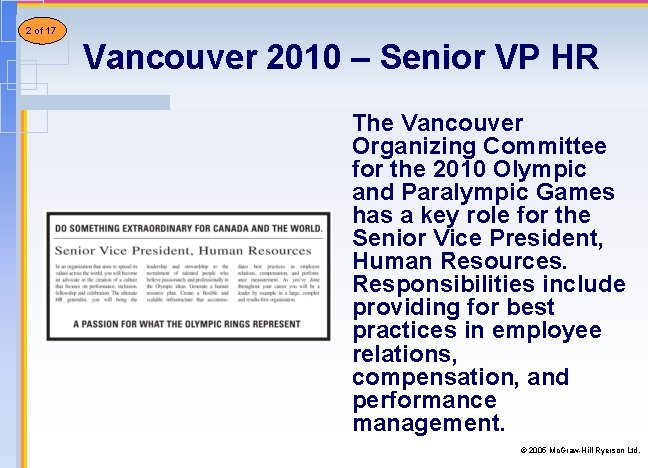
2 of 17 Vancouver 2010 – Senior VP HR The Vancouver Organizing Committee for the 2010 Olympic and Paralympic Games has a key role for the Senior Vice President, Human Resources. Responsibilities include providing for best practices in employee relations, compensation, and performance management. © 2005 Mc. Graw-Hill Ryerson Ltd.
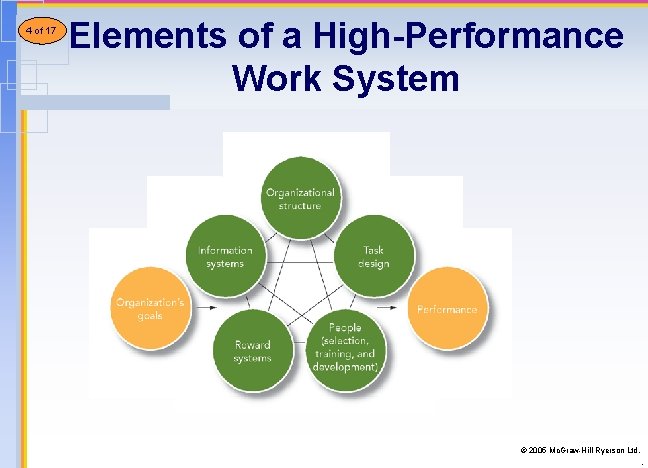
3 of 17 High-Performance Work Systems n Traditional management practices n n Isolated decisions about technology, organizational structure, and human resources High-performance work systems n Technology, organizational structure, people, and processes all work together to give an organization an advantage in the competitive environment © 2005 Mc. Graw-Hill Ryerson Ltd.
5 of 17 4 21 20 Elements of a High-Performance Work System © 2005 Mc. Graw-Hill Ryerson Ltd. .
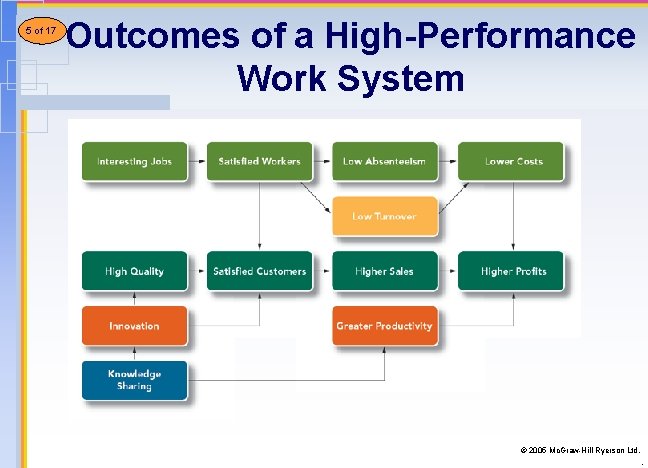
4 of 17 5 21 Outcomes of a High-Performance Work System © 2005 Mc. Graw-Hill Ryerson Ltd. .
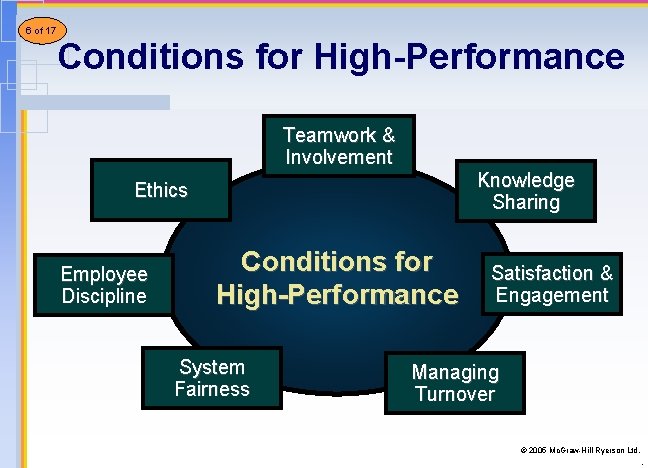
4 of 17 6 21 Conditions for High-Performance Teamwork & Involvement Knowledge Sharing Ethics Employee Discipline Conditions for High-Performance System Fairness Satisfaction & Engagement Managing Turnover © 2005 Mc. Graw-Hill Ryerson Ltd. .
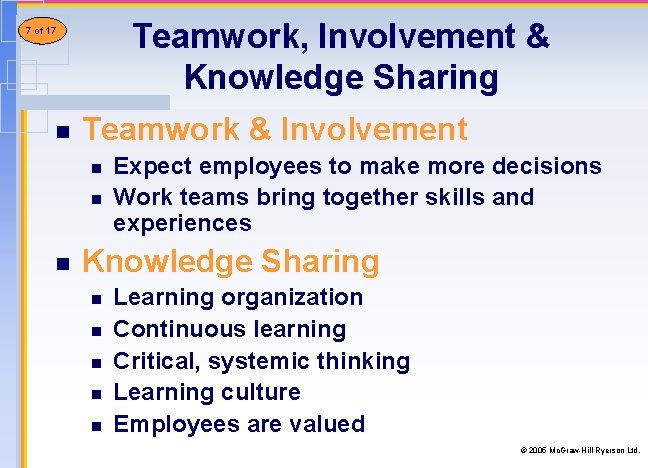
Teamwork, Involvement & Knowledge Sharing 8 of 17 7 21 n Teamwork & Involvement n n n Expect employees to make more decisions Work teams bring together skills and experiences Knowledge Sharing n n n Learning organization Continuous learning Critical, systemic thinking Learning culture Employees are valued © 2005 Mc. Graw-Hill Ryerson Ltd.
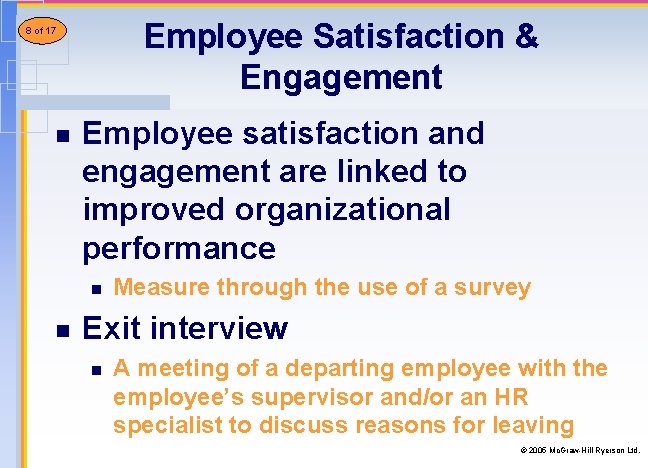
Employee Satisfaction & Engagement 8 of 17 21 n Employee satisfaction and engagement are linked to improved organizational performance n n Measure through the use of a survey Exit interview n A meeting of a departing employee with the employee’s supervisor and/or an HR specialist to discuss reasons for leaving © 2005 Mc. Graw-Hill Ryerson Ltd.
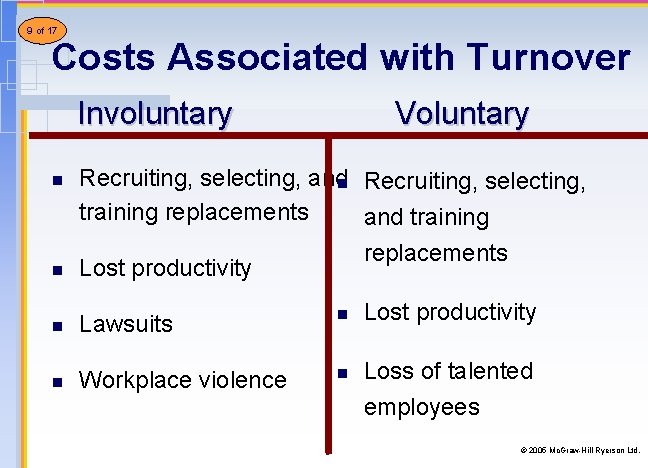
79 of of 16 21 17 Costs Associated with Turnover Involuntary Voluntary n Recruiting, selecting, andn Recruiting, selecting, training replacements and training replacements Lost productivity n Lawsuits n Lost productivity n Workplace violence n Loss of talented employees n © 2005 Mc. Graw-Hill Ryerson Ltd.
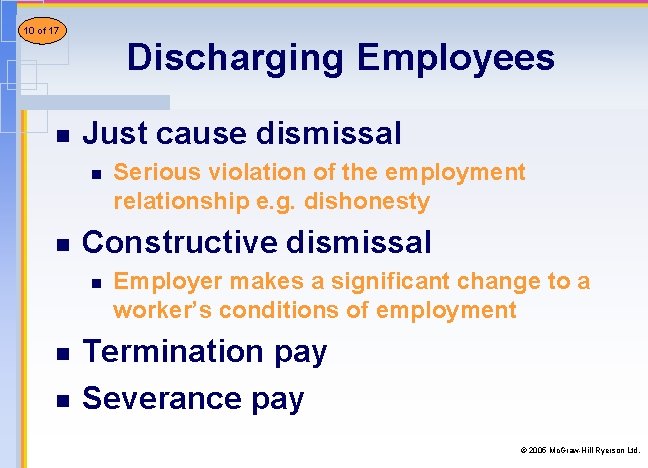
10 8 of of 21 17 n Discharging Employees Just cause dismissal n n Constructive dismissal n n n Serious violation of the employment relationship e. g. dishonesty Employer makes a significant change to a worker’s conditions of employment Termination pay Severance pay © 2005 Mc. Graw-Hill Ryerson Ltd.
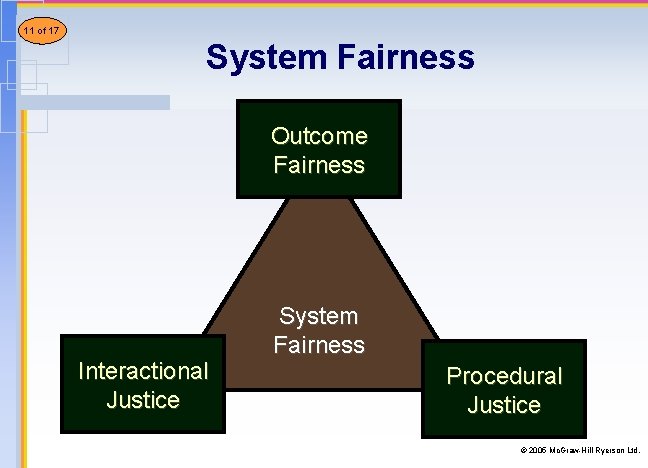
11 8 of of 21 17 System Fairness Outcome Fairness Interactional Justice System Fairness Procedural Justice © 2005 Mc. Graw-Hill Ryerson Ltd.
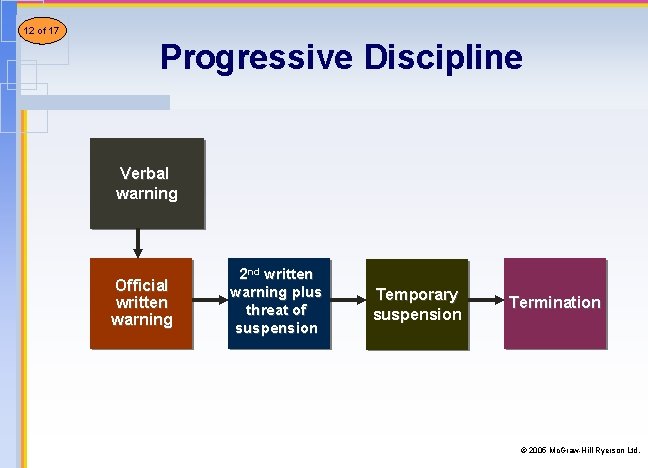
12 8 of of 21 17 Progressive Discipline Verbal warning Official written warning 2 nd written warning plus threat of suspension Temporary suspension Termination © 2005 Mc. Graw-Hill Ryerson Ltd.
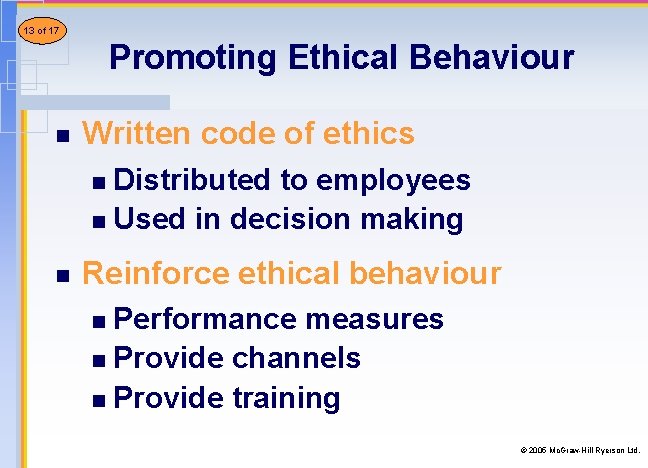
13 8 of of 21 17 Promoting Ethical Behaviour n Written code of ethics Distributed to employees n Used in decision making n n Reinforce ethical behaviour Performance measures n Provide channels n Provide training n © 2005 Mc. Graw-Hill Ryerson Ltd.
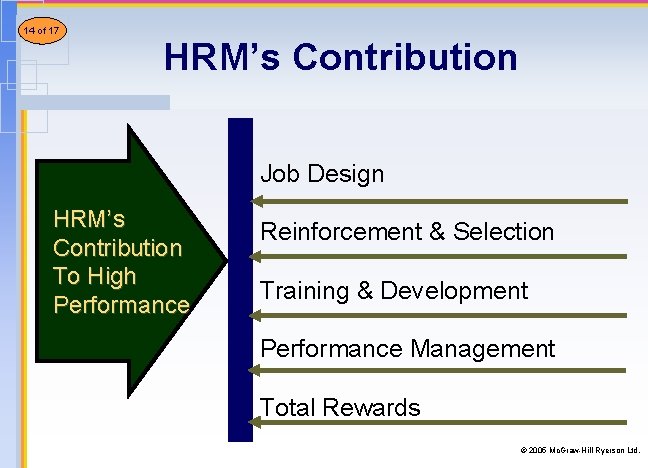
14 9 of of 21 17 HRM’s Contribution Job Design HRM’s Contribution To High Performance Reinforcement & Selection Training & Development Performance Management Total Rewards © 2005 Mc. Graw-Hill Ryerson Ltd.
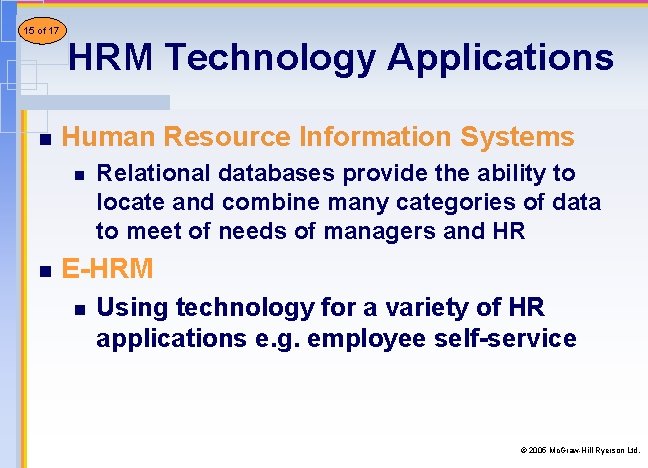
15 of 17 21 n HRM Technology Applications Human Resource Information Systems n n Relational databases provide the ability to locate and combine many categories of data to meet of needs of managers and HR E-HRM n Using technology for a variety of HR applications e. g. employee self-service © 2005 Mc. Graw-Hill Ryerson Ltd.
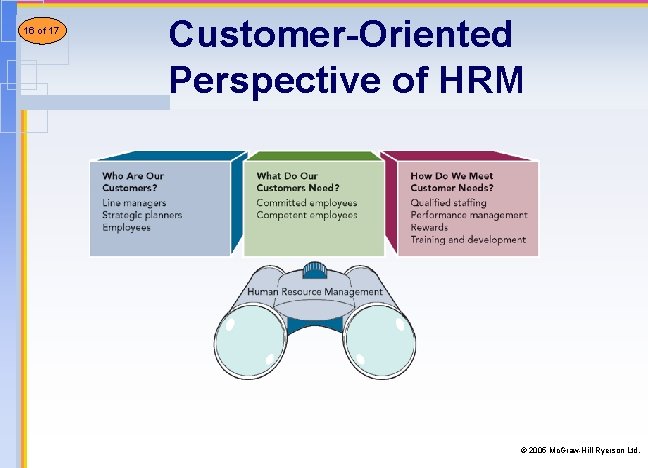
16 of 17 21 Customer-Oriented Perspective of HRM © 2005 Mc. Graw-Hill Ryerson Ltd.
Techniques for Measuring Effectiveness of HRM 18 of 17 17 21 n n HRM Audit n A formal review of the outcomes of HRM functions, based on identifying key HRM functions and measures of organizational performance ROI Math n Calculation of Return on Investment in Human Capital © 2005 Mc. Graw-Hill Ryerson Ltd.