
Chapter Three The Psychological Approach A Profusion of
- Slides: 19
Chapter Three The Psychological Approach: A Profusion of Theories
Psychology • • The scientific study of mind and behavior. Uses the scientific method as a means of gaining knowledge. Investigates internal mental events such as reasoning, language, and memory. Also investigates external behaviors such as talking, walking, and grasping.
The scientific method A theory is a general understanding of the world that organizes a set of facts and aids us in understanding how the world works. • A hypothesis is a more specific statement about the world that is frequently derived from a hypothesis and can be tested. •
Experiments Scientists use experiments to test hypotheses. • An experiment must have at least two variables. • The independent variable is manipulated by the researcher. • The dependent variable is measured by the researcher. •
Experiments An experiment must also have at least two conditions or groups. • The experimental group receives the independent variable. • The control group does not. •
Experiments Theory: Practice facilitates problem solving. • Hypothesis: Doing logic problems before being tested will increase scores on a subsequent logic test. •
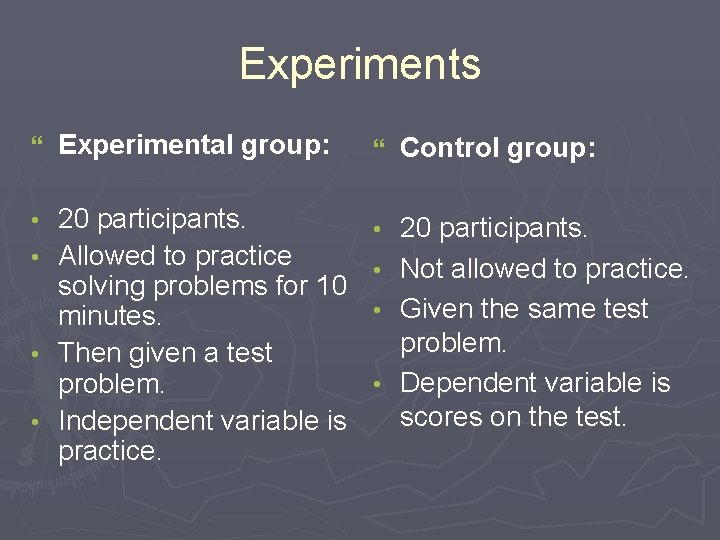
Experiments } Experimental group: 20 participants. • Allowed to practice solving problems for 10 minutes. • Then given a test problem. • Independent variable is practice. • } Control group: 20 participants. • Not allowed to practice. • Given the same test problem. • Dependent variable is scores on the test. •
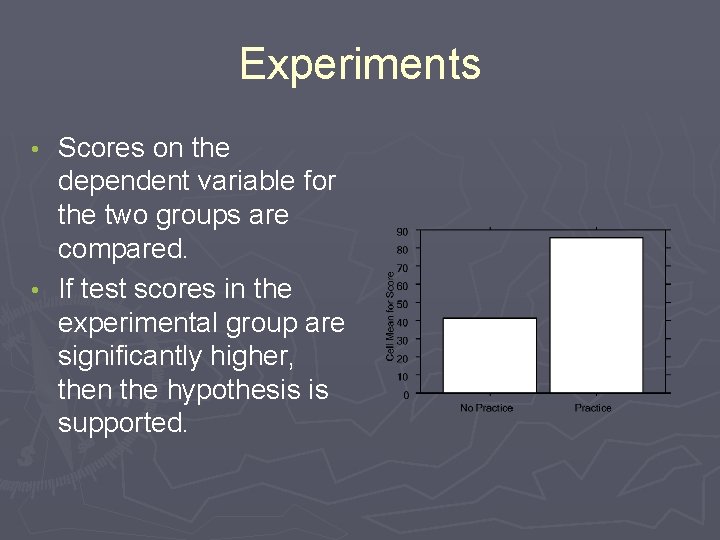
Experiments Scores on the dependent variable for the two groups are compared. • If test scores in the experimental group are significantly higher, then the hypothesis is supported. •
Voluntarism Wilhelm Wundt is founder. • View that the mind is made up of elements. • The elements are assembled into wholes through an act of will. • Influenced by atoms and molecules of chemistry. •
Introspection Method used by the voluntarists and other early psychologists. • Means “inner looking. ” Consists of subjective self-report of mental states. • Fraught with difficulties. •
Structuralism Edward Titchener considered founder. • Shares the beliefs that mind is made of elements and use of introspection with voluntarism. • But viewed element combination occurring through passive mechanical laws. •
Functionalism Closely associated with William James. • Focus is on mental processes and functions rather than elements. • Idea of a stream of consciousness. Thought is flowing and changing, not static. •
Gestalt psychology Contributors include Wertheimer, Kohler, and Koffka. • View that mind consists of wholes that are more than the sum of their parts, described as a gestalt. • Method was phenomenology, a subjective description of an external stimulus. •
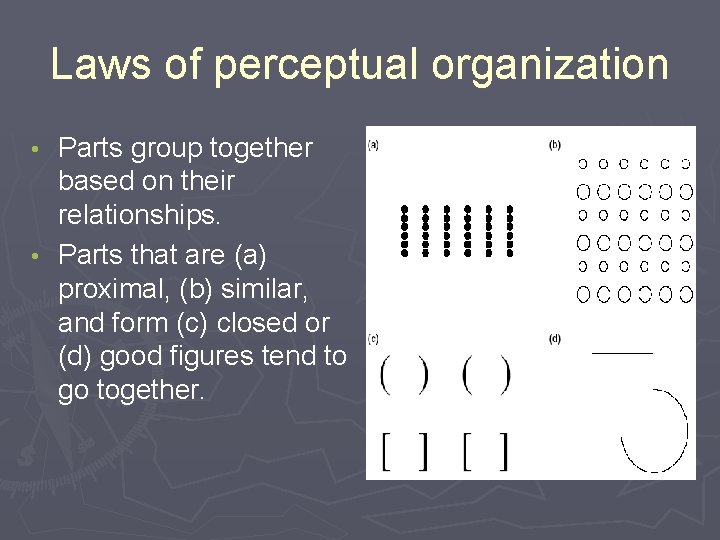
Laws of perceptual organization Parts group together based on their relationships. • Parts that are (a) proximal, (b) similar, and form (c) closed or (d) good figures tend to go together. •
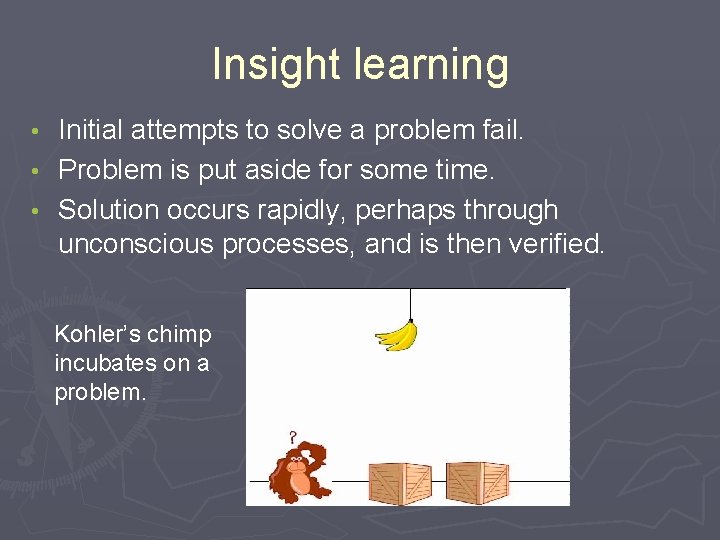
Insight learning • • • Initial attempts to solve a problem fail. Problem is put aside for some time. Solution occurs rapidly, perhaps through unconscious processes, and is then verified. Kohler’s chimp incubates on a problem.
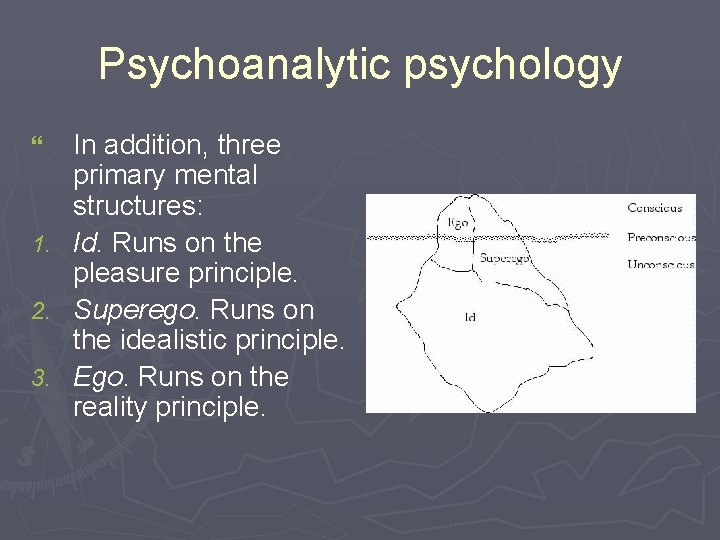
Psychoanalytic psychology • • • Established by Sigmund Freud. Mind is made up of “mini-minds” that compete for control. Three states of consciousness: 1. Conscious 2. Preconscious 3. Unconscious
Psychoanalytic psychology } 1. 2. 3. In addition, three primary mental structures: Id. Runs on the pleasure principle. Superego. Runs on the idealistic principle. Ego. Runs on the reality principle.
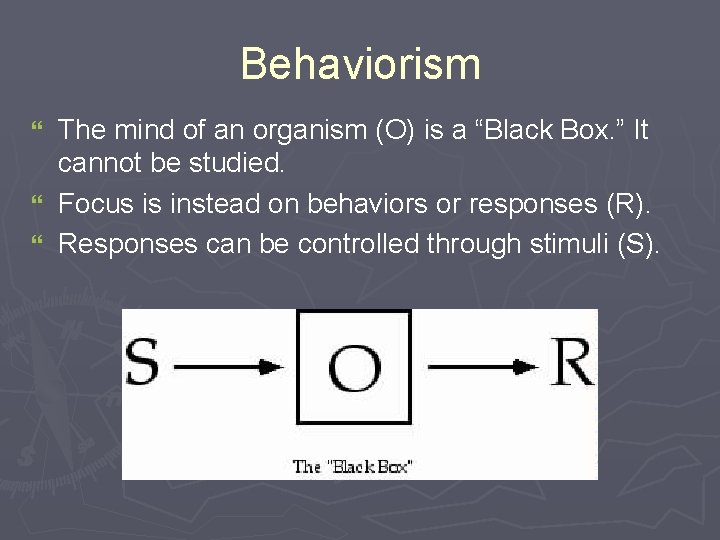
Behaviorism The mind of an organism (O) is a “Black Box. ” It cannot be studied. } Focus is instead on behaviors or responses (R). } Responses can be controlled through stimuli (S). }
Types of learning } Classical conditioning: • Unconditioned stimulus • Reinforcement. (US). • Punishment. Unconditioned response (UR). Conditioned stimulus (CS). Conditioned response (CR). • • • } Operant conditioning: