
Chapter Three The Managers Changing Work Environment Responsibilities
Chapter Three The Manager’s Changing Work Environment & Responsibilities Stakeholders: the people whose interests are affected by an organization’s activities. Internal Stakeholders: consist of employees, owners, and the board of directors, if any. External Stakeholders: people or groups in the organization’s external environment that are affected by it. The environment consists of: • The task environment • The general environment The Ethical Responsibilities Required of You as a Manager • Ethical Dilemma: a situation in which you have to decide whether to pursue a course of action that may benefit you or your organization but that is unethical or even illegal. • Ethics: are the standards of right and wrong that influence behavior. • Ethical Behavior: is behavior that is accepted as “right” as opposed to “wrong” according to those standards. Four Approaches to Deciding an Ethical Dilemma • The utilitarian approach: is guided by what will result in the greatest good for the greatest number of people. • The individual approach: is guided by what will result in the individual’s best long-term interests which ultimately are in everyone’s best interest. • The moral-rights approach: is guided by respect for the fundamental rights of human beings. • The justice approach: is guided by respect for impartial standards of fairness and equity.
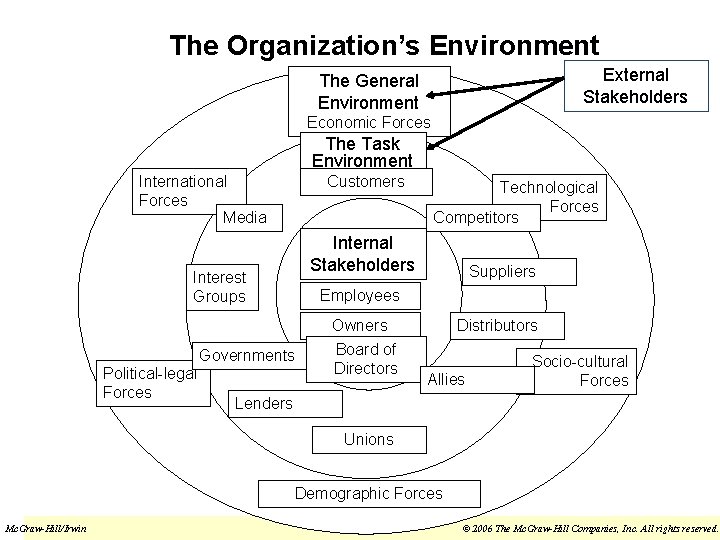
The Organization’s Environment External Stakeholders The General Environment Economic Forces The Task Environment International Forces Media Customers Internal Stakeholders Interest Groups Suppliers Employees Governments Political-legal Forces Technological Forces Competitors Owners Board of Directors Distributors Allies Socio-cultural Forces Lenders Unions Demographic Forces Mc. Graw-Hill/Irwin © 2006 The Mc. Graw-Hill Companies, Inc. All rights reserved.
How Organizations Can Promote Ethics 1) Support by top managers of a strong ethical climate. 2) Ethics codes & training programs. 3) Rewarding ethical behavior: protecting whistleblowers. Social Responsibility Social responsibility: is a manager’s duty to take actions that will benefit the interests of society as well as the organization. v Philanthropy: donating money to worthwhile recipients. Four Approaches to Social Responsibility 1) Obstructionist Approach 2) Defensive Approach 3) Accommodative Approach 4) Proactive Approach Thinking about Diversity v Mc. Graw-Hill/Irwin Diversity: represents all the ways people are unlike or alike—the differences and similarities in age, gender, race, religion, ethnicity, sexual orientation, capabilities, and socioeconomic background. © 2006 The Mc. Graw-Hill Companies, Inc. All rights reserved.
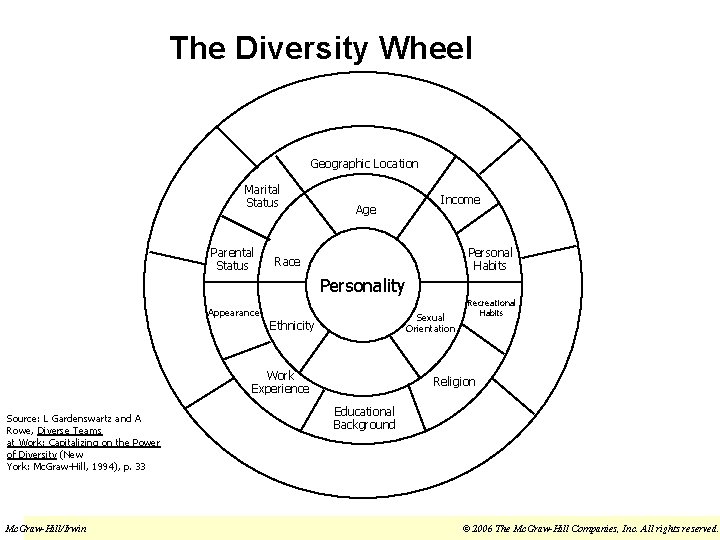
The Diversity Wheel Functional Level/ Classification Geographic Location Mgmt. Status Marital Status Parental Status Age Income Work Content/ Field Personal Habits Race Personality Appearance Union Affiliation Ethnicity Work Experience Source: L Gardenswartz and A Rowe, Diverse Teams at Work: Capitalizing on the Power of Diversity (New York: Mc. Graw-Hill, 1994), p. 33 Mc. Graw-Hill/Irwin Sexual Orientation Work Location Physical Ability Recreational Habits Division/ Dept. / Unit/ Group Religion Educational Background Seniority © 2006 The Mc. Graw-Hill Companies, Inc. All rights reserved.
Internal Dimensions of Diversity v Internal Dimensions: those human differences that exert a powerful, sustained effect throughout every stage of our lives. (Gender- ethnicity – race physical abilities – Age – sexual orientation) External Dimensions of Diversity v External Dimensions: includes an element of choice: they consist of personal characteristics that people acquire, discard, or modify throughout their lives. (personal habits – educational background- religion-income-marital status-geographic locationwork experience-recreational habits-appeareance) Organizational Dimensions of diversity v Organizational Dimensions include management status, union affiliation, work location, seniority, work content, and division of department. Trends in Workforce Diversity v Age: More Older People in the Workforce v Gender: More Women Working v Race & Ethnicity: More people of color in the workforce v Sexual Orientation: Gays & lesbians become more visible v People with Differing physical & Mental abilities v Educational Levels: Mismatches between education & workforce needs Mc. Graw-Hill/Irwin © 2006 The Mc. Graw-Hill Companies, Inc. All rights reserved.
Barriers to Workforce Diversity 1) Stereotypes & Prejudices 2) Fear of Reverse Discrimination 3) Resistance to Diversity Program Priorities 1) Unsupportive social atmosphere 2) Lack of support for family demands 3) Lack of support for career-building steps Entrepreneurship v Entrepreneur: is someone who sees a new opportunity for a product or service and launches a business to try to realize it. v Intrapreneur: is someone who works inside an existing organization who sees an opportunity for a product or service and mobilizes the organization’s sources to try to realize it. Mc. Graw-Hill/Irwin © 2006 The Mc. Graw-Hill Companies, Inc. All rights reserved.
- Slides: 6